Blog dedicated primarily to randomly selected news items; comments reflecting personal perceptions
Thursday, January 31, 2019
Pesticide Threats to Human Health
"Glyphosate-based products have been used safely and successfully for
over four decades worldwide and are a valuable tool to help farmers
deliver crops to markets and practice sustainable farming by reducing
soil tillage, soil erosion and carbon emissions." Bayer AG statement
"When it comes to Roundup they’re [governments] dead
wrong. And I know they’re dead wrong because when you look at
the science it’s pretty clear."
"[Government regulators are not] truly unbiased."
"If
tomorrow they decided ‘you know what, it actually does cause cancer,’
they’d have to tell the world that for 40 years they’ve been wrong, that
people have been dying under their watch."
"It’s a lot easier
to keep the status quo."
Brent Wisner, U.S. attorney, Los Angeles-based
Bottles of Monsanto's Roundup pesticide are pictured in a gardening store.
PHILIPPE HUGUEN/AFP/Getty Images
Canada is "dead wrong" two visitors to Canada stated unequivocally, in not recognizing that the manufacturer of the glyphosate-based weed killer Roundup, is a threat to people coming in contact with it. The two, Michael Bauman and Brent Wisner were on the team of lawyers that managed to succeed in persuading the U.S. justice system to find for their client, a former groundskeeper who believes his terminal cancer resulted from years of exposure to the herbicide glyphosate, Roundup.
Their client was the beneficiary of a court that ordered Bayer AG to pay $289 million, later dropped to $78 million, a significant agreement of the danger inherent in the use of the weedkiller. It is an order that the company is appealing, but over 11,000 additional plaintiffs in the United States are suing the Germany-based Bayer which since 2018 when it bought out Roundup maker Monsanto is left with the product they continue to persist in stating has no health risks to humans.
Lawyer Baum knows of no Canadians that have brought suit over Roundup, but he and his colleague Wisner arrived in Ottawa to meet with Members of Parliament on Parliament Hill to acquaint them with the issue, explaining evidence that proves glyphosate causes cancer. "There's going to be the same type of injuries suffered here", he assured skeptics.
The two lawyers will continue on to Toronto to work with Canadian activists and lawyers in a bid to determine how most effectively to proceed, with the intended purpose of potentially beginning court action, according to CEO of Friends of the Earth, Beatrice Olivastri. "We're actively looking for ways forward in litigation", she stated.

American lawyers who successfully sued the makers of the
glyphosate-based weedkiller Roundup on behalf of a man dying of cancer
say Canada is "dead wrong" to allow it to be widely used here. (File)
On the market for over forty years, glyphosate has its appearance in over 130 products available for use in Canada. The Pest Management Regulatory Agency branch of Health Canada has just recently re-approved glyphosate for use in the country following a process of review, including reviewing their assessments in the past following objections filed by eight organizations. Objections that included allegations that Monsanto improperly influenced evidence that Health Canada relied on to determine the safety of the product.
Agency scientists "left no stone unturned", discovering no evidence the science was tainted, according to Connie Moase, director in the health-effects division of Health Canada. Canada's review of glyphosate was thorough and proper, proving yet again that it is a safe product, stated Bayer, noting glyphosate is approved for use in 160 countries. "Twenty of our best scientists" reviewed the evidence before approving the project, stressed a spokesperson for Canada's Minister of Health.
According to lawyer Wisner, the unbiased International Agency for Research on Cancer -- a specialized
agency of the World Health Organization -- scientists were unanimous in concluding glyphosate is a human
carcinogen. The glyphosate decision has caused a "crisis in confidence in Canada’s pesticide police", according to Ms. Olivastri of Friends of the Earth, Canada.
Side Effects Associated with Monsanto Roundup
Adverse side effects that have been allegedly linked to use of glyphosate products including Monsanto's Roundup include:
"Many shoppers don’t realize that pesticide residues are common on
conventionally grown produce – even after it is carefully washed or
peeled. EWG's analysis of tests by the U.S. Department of Agriculture
found that nearly 70 percent of samples of conventionally grown produce
were contaminated with pesticide residues." "The USDA tests found a total of 230 different pesticides and
pesticide breakdown products on the thousands of produce samples
analyzed. EWG's analysis of the tests shows that there are stark
differences among various types of produce. The Shopper's Guide to
Pesticides in Produce™ lists the Dirty Dozen™ fruits and vegetables with
the most pesticide residues, and the Clean Fifteen™, for which few, if
any, residues were detected." Sonya Lunder, Senior Analyst, Environmental Working Group (EWG)
"Food safety is a top priority for the Industry, from field to fork." "The fresh produce industry seeks to ensure a safe, efficient and timely supply chain, allowing consumers to experience fresh fruits and vegetables at the peak of their performance." Tom Stenzel, CEO, United Fresh Produce Association
"A recent review article in the scientific journal Nature Plants makes the claim that organic produces 'foods that contain less (or no) pesticide residues, compared with conventional farming.' That's not what the latest USDA-PDP (Pesticide Data Program) information about pesticide residues says.
What that transparent source of tax payer-supported research indicates
is that 40 different synthetic pesticide residues were detected on
organic food samples at levels similar to what was seen for the
comparable conventional food samples. In both cases the amounts are too small to be a health/safety concern, but this certainly does not fit the standard organic narrative." "Finding synthetic pesticide residues on organic is not unprecedented. Earlier, larger surveys of organic conducted by the USDA and by Canadian Food Inspection Agency
found un-approved residues in at least 40% of samples. The normal
explanation of this is that it represents inadvertent spray drift or
cross-contamination in harvesting bins etc. Many of the detections are
at such low levels they fit those scenarios, but interestingly when I
looked at the conventional detections for the same 78 chemical/crop
combinations, the organic detections were only significantly lower in 26
cases, and the organic detections were equal to or higher than those in
conventional for 30 cases." Dr. Steve Savage, Plant Pathologist, writer, public speaker, Forbes
The Environmental Working Group issues a yearly report card on pesticide residues found in fruits and vegetables, giving a heads-up to list those agricultural whole foods found to have the "highest loads of pesticide residues", and those which are discovered to have the least. The EWG also recommends that consumers hedge their bets by seeking out organic produce rather than conventionally grown, with the assurance that organics, though containing trace amounts of pesticides, carry far less and thus are safer to consume.
This year's report in the 2018 Shopper's Guide to Pesticides in Produce, strawberries were top-of-the-list for high pesticide residues, the third year they've made that distinctive lead. Avocados, on the other hand, are top of the "Clean Fifteen" list of those whole foods ranking produce testing positive for "few, if any, residues." Based on the U.S. Department of Agriculture tests examining 47 common fruits and vegetables for pesticide residue, the guide feels it presents a very accurate assessment of pesticide residues to enable them to advise people with a high degree of confidence which fruits and vegetables are best to avoid.
Approximately 70 percent of conventionally grown, non-organic produce samples were found to be contaminated with pesticide residues, warns the EWG. In response, the U.S. Apple Association and other produce groups put out their own press releases, discounting the accuracy of the EWG's conclusions; the guide, they claim, is "inaccurate" and "harmful".
"So, the bottom line is that there is no meaningful distinction between
organic and conventional foods that the USDA tested in 2016. Both are
quite safe and consumers should not hesitate to buy and consume these
foods that are well documented to promote health. The real take-away is
that consumers should be very wary of organic-funded organizations like
the Environmental Working Group that are trying to manipulate them with
fear. EWG ends its dubious list with a link to 'Donate Now' because 'EWG
helps protect your family from pesticides!' Does convincing you to
spend more for organic which has the same, low, safe levels of pesticide
qualify as 'protection?' Such organizations deserve no respect or
support."
Dr. Steve Savage, Plant Pathologist, writer, public speaker, Forbes
"Each
of these foods [dozen foods that included strawberries, spinach, nectarines, apples peaches, pears, cherries, grapes, celery, tomatoes, sweet bell peppers, cucumbers] tested positive for a number of different pesticide
residues and contained higher concentrations of pesticides than other
produce." "Pears and potatoes were new additions to the Dirty Dozen,
displacing cherry tomatoes and cucumbers from last year’s list." "Apples tend to have the most pesticides because of the chemicals applied to the crop before and after harvest to preserve them longer." Environmental Working Group Dirty Dozen list
Photo: Pixabay
Apples are likelier than any other fruit, because of their portability, ease of eating, taste and reputation as a healthy fruit, to be included in most peoples' packed lunches, including those that mothers prepare for their school-age children. That old adage, "an apple a day keeps the doctor away" didn't appear out of nowhere; it recognized the health benefits of eating an apple daily. The benefits, from cleaning teeth, to providing roughage and minerals and vitamins galore, are numerous.
Sadly, the apple appears as number four on the Environmental Working Group's list of the twelve most pesticide-ridden foods. Their residue load is taken to be harmful to human health. We do, of course, know that we are supposed to wash fruits and vegetables before using them. And that certainly includes fruits with skins that are discarded, like oranges, grapefruits, and melons, for example, as well as bananas, just as much to remove harmful moulds that might be present, as pesticides.
Placing grapes in a bowl of clear, cool water to which lemon juice has been added, works well to clean pesticides and dirt off grapes, followed by a thorough rinsing. In Japan fastidious consumers go so far as to peel grapes before eating them. Potatoes can be left unpeeled, but well scrubbed with a stiff brush, then rinsed. Researchers at University of Massachusetts produced a study published in the Journal of Agricultural and Food Chemistry recently, suggesting that soaking apples in a baking soda solution is the best method of removing pesticide residues.
Apples have already gone through a commercial bleach solution wash before they appear on supermarket s helves. According to the study's lead author Lili He, that initial washing is meant to remove dirt and contaminants, not necessarily pesticide residues. And her study points out that the longer produce sits unwashed, the deeper the chemicals can be absorbed. So much for the common wisdom that produce lasts longer if washed only before eating.
Testing the efficacy of three variants on washing of organic Gala apples was undertaken by the UMass Amherst researchers after they had been sprayed with two often-used pesticides. The apples were left for 24 hours after spraying, then they were washed with plain water, or the bleach solution commercially used, alternately a baking soda-water solution. In two minutes' time the baking soda solution succeeded in removing the most pesticides, while plain water turned out to be more effective than the bleach solution.
However, for the baking soda solution to succeed in entirely removing pesticide residue, a 12 to 15-minute bath in baking soda solution was required. "One thing that surprised us was how long it took to wash the pesticides away", added Dr. He. Her successful formula was to dissolve one teaspoon of baking soda for every two cups of water, to soak the fruit for a minimum of two minutes, then rinse with tap water prior to consuming.
The short cut of peeling apples before eating, thus bypassing the pesticide residue issue completely, sacrifices the nutritional benefits of the skin's fibre and nutritious qualities.
"No one has ever measured pesticides in hummingbirds before. So we decided to try it. It turns out, to our surprise actually, that the birds are obviously picking up pesticides in their food, which can be nectar and also insects." "Now what does it mean? Right now we're just understanding what the level of exposure is, and then how is it affecting the [hummingbird] population." Christine Bishop, biologist, Environment and Climate Change Canada
Christine Bishop, a research scientist with Environment
and Climate Change Canada, holds a rufous juvenile male hummingbird as
she prepares to measure and band it and collect urine and feces for
testing, in Surrey, B.C. (Darryl Dyck/Canadian Press)
Research scientist in British Columbia, Christine Bishop, is attempting to determine why it is that some species of North American hummingbirds appear to be in severe decline. A preliminary finding is that the cause may possibly be related to the very same insecticide used in agriculture that is affecting the honey bee population. She and other researchers have begun studying a number of factors ranging from habitat loss to alterations in plant bloom time, that may be involved.
And the method these researchers decided to rely upon from which to extract their data is the collection of urine and feces from the hummingbirds. That collection and the resulting data appear to confirm that the concentration of pesticides in hummingbird urine is fairly high, at three parts per billion. The study focused on the Fraser Valley and southern British Columbia, those agricultural regions identified as a core locale for the rufous hummingbird.
The tiny bird with a red throat has a negligible weight, roughly that of a five-cent piece. It spends its summers in British Columbia, in Alaska and the Pacific Northwest states. When signs of winter arriving alert the hummingbird to its survival imperative by reverting to its species' habitual migration, it returns to the southern United States and Mexico which represent its winter habitation site, away from the bitter cold of the summer location.
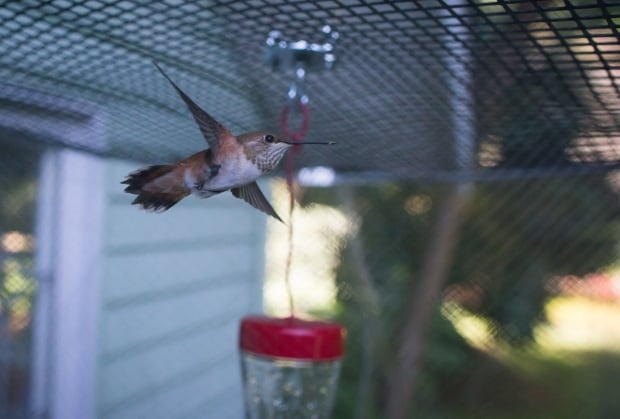
A rufous juvenile male hummingbird flies around after being captured with a net above a feeder. (Darryl Dyck/Canadian Press)
To obtain the feces and urine of those flighty, ever-moving tiny birds, the researchers place nets over feeders which are lowered when a hummingbird comes along to feed. As a byproduct of the hummingbird's constant processing of nectar, it concomitantly expels it so that the collection of urine and feces for test results is then accomplished with the help of the nets. This study is meant to last for five years, and is only in its initial stage, at two years.
Hummingbirds, like bees, habitually come back to routinely recognized places to find their food, recalling where certain flowers grow. Another concern is that pesticide absorption might have the effect of disrupting their memory. According to an annual breeding bird survey, between 1966 and 2013, the population on the Pacific Coast of the rufous hummingbird has declined an average of 2.67 percent annually.
Two other species of hummingbird were also found to be in decline, the Allen's and broad-tailed hummingbirds, leading Health Canada to reevaluate the use of imidacloprid, a neonicotinoid insecticides commonly used on agricultural crops and coincidentally used as well for flea and tick control on cats and dogs. Separately, an earlier Health Canada report noted that imidacloprid has the potential to exact short- and long-term effects on bees inclusive of behavioral changes and mortality rates.
Aside from suspicions about the effect of these insecticides there are additional issues which may be impacting on the well-being of both hummingbirds and bees. Habitat loss, seasonal plants blooming at a different time of season, even an increase in the deer population, consuming the same flowers required by the hummingbirds to exist, could all be found to play a role in the decline of these wonderful, tiny birds.
Hummingbirds filling up for their winter migration flight. (Grouse Mountain)
"We would never market or continue to market any chemical which we genuinely felt posed a health risk or an environmental risk." "I do believe paraquat is safe when it's used appropriately." Philip A. Botham, head of product safety, Syngenta, Switzerland
"[The breadth of research is] about as persuasive as these things can get [that exposure to the herbicide Paraquat presents a danger to human health]." "[It should be banned]." Freya Kamel, scientist, National Institutes of Health, U.S.A.
"[The body of research linking Paraquat and Parkinson's has] converged to make a fairly convincing argument that paraquat is truly an environmental exposure that can either increase the risk of Parkinson's disease or collaborate with other factors, including genetic factors." Dr. Vikram Khurana, neurologist, Harvard Stem Cell Institute, U.S.A.
"Our estimates of risk for ambient exposure in the workplaces were
actually greater than for exposure at residences. And, of course, people who both live and work near these
fields experience the greatest PD [Parkinson's disease] risk. These workplace results give us
independent confirmation of our earlier work that focused only on
residences, and of the damage these chemicals are doing." "Our results suggest that pesticides affecting different cellular
mechanisms that contribute to dopaminergic neuron death may act together
to increase the risk of PD considerably." Dr. Beate Ritz,
senior author, professor of epidemiology, UCLA School of
Public Health.
A survey of farmers and their families undertaken in 2011 in Iowa and North Carolina concluded that people handling pesticides were two and a half times likelier to develop Parkinson's with the use of Paraquat or Rotenone, (another pesticide). A year later, a subsequent study concluded that people whose genetic endowment included a variation were eleven times more likely to develop Parkinson's disease through exposure to Paraquat.
Paraquat has been around for over 130 years, but it wasn't until the mid-1900s that it was produced for common use as a pesticide. At the present time, over one hundred types of agricultural crops globally make use of the weed killer, including crops such as oranges, coffee and sugar cane. Even in Burkina Faso the use of the weed killer accounted for a fifth of the country's accidental pesticide poisoning cases, leading its government to seek out global regulation of its use.
As for Parkinson's and its onset connection with Paraquat, a more generalized view is that the loss of nerve cells in part of the brain owes to both environmental and genetic factors. Syngenta, the maker of Paraquat, insists that studies linking paraquat to Parkinson's fail to consider other incriminating factors. And the company that produces the weed killer has done so for a hundred years in Huddersfield, an industrial town in England.
But nowhere in the European Union may Paraquat be lawfully used; it is outlawed in recognition of its threat both to the environment and to human health. Britain produces it, but it cannot be used in Britain. Instead, it is exported to other countries of the world that continue to permit weed-spraying with Paraquat. Last year it was exported to Brazil, Colombia, Ecuador, Guatemala, India, Indonesia, Japan, Mexico, Panama, Singapore, South Africa, Taiwan, Uruguay and Venezuela, as well as to the United States.
This is a drug with a grim history of use in suicides. One sip of the weed killer can have lethal consequences. And now that research links its use to Parkinson's disease, the Environmental Protection Agency in the United States has stated: "There is a large body of epidemiology data on paraquat dichloride use and Parkinson's disease".
As a result, the agency is considering whether to allow the chemical to continue to be used on crops. A 2018 decision is anticipated. But until such time as that decision is made, the countries where Paraquat produce the chemical, but ban its internal use, are happy to continue exporting the product elsewhere. Switzerland, where the Syngenta company is based, has itself not allowed its use since 1989.
Monsanto's Roundup has the distinction of being the world's most used weed killer with 100 million kilograms of its active ingredient used in the United States in 2015. However, weeds are becoming resistant, and Paraquat has been marketed as an efficient and efficacious alternative. Though knowledge of the link between Paraquat and Parkinson's is decades old, the past five years of research appears to have sufficiently validated that link as to convince medical science hat the connection exists.
In the United States, Paraquat is classified as "restricted commercial use." People must obtain a license to use the product. Breathing
in Paraquat may cause lung damage and can lead to a disease called
Paraquat lung. Paraquat causes damage to the body when it touches the
lining of the mouth, stomach, or intestines. You can get sick if
Paraquat touches a cut on your skin. Paraquat may also damage the
kidneys, liver, and esophagus (the tube food goes down from your mouth
to your stomach). If Paraquat is swallowed, death can quickly
occur. Death may occur from a hole in the esophagus, or from severe
inflammation of the area that surrounds the major blood vessels and
airways in the middle of the chest. Long-term exposure to Paraquat may cause scarring of the lungs called pulmonary fibrosis. This makes it hard to breathe.
"At this time, there is no 'silver bullet' for impacting a specific gene to control bed bug potentials. [But] the presence of a nearly complete genome will make identifying potential targets much easier." Joshua Benoit, University of Cincinnati
"Work on bedbugs previous to this was like feeling your way in the dark. By providing this genome, it's like turning a light on. Now researchers know better how to explore." "We had this 60-million-year-old bedbug in amber that, when you look at it, it looks essentially identical to bedbugs today, even though that specimen obviously predates them feeding on people by a lot." "The naive idea was that maybe by looking at their genomes, we might find something unique to explain why they seemed unchanged." George Amato, director, American Museum of Natural History, Sackler Institute for Comparative Genomics
Source: CDC (PD)
Professor Benoit's study published in Nature Communications, along with a second by Dr. Amato, may revolutionize how scientists may eventually come up a solution to some of modern society's most vexing little problems. Little problems, as in the existence of a tiny bloodsucking creature that inspires horror in people, resulting in a very large problem as in how to destroy them and free up homes, apartments, hotels and other vulnerable places from the scourge of their presence?
The teams of researchers have reported the complete genome sequencing of the lowly, irritating, loathsome bedbug. Both of the published studies isolated evidence that through a process named horizontal gene transfer, bedbugs over time had taken advantage and incorporated genes from bacteria; as well, bedbugs sport an ecosystem of micro-organisms living in and upon them.
Not a particularly pretty vision, but a distinction that humans too can boast. Think gut microbia, and of all the microbes, mostly beneficial to us, that thrive on our skin, within our bodily depressions and our interiors. We need most of these bacteria to remain healthy, so it's just as well we cannot see them; enough that we know they exist and are useful to us.
The inspired thought among researchers, arising from that realization is that there is the potential that bacteria specific to bedbugs may also be responsible for their survival. Therefore, specifically identifying and targeting any bacteria that protect bedbugs could provide enterprising scientific investigation with a solution amounting to a purposeful defence against the pestilence they represent.
Genes were discovered in Professor Benoit's study that assist the female of that bloodsucking species to survive the act of copulation where the male bedbug stabs the female in the abdomen. If the protective gene was disrupted in its life-saving function the potential is there to terminate the bedbugs' lifespan, thus diminishing the infestations that they liberally engage in.
Bedbugs are an ancient enemy of humankind. The common bedbug (Cimex lectularius) has been disgusting humans throughout history. They suck human blood, cause pain and welts and anguish in the knowledge of their infestation. Scientists have found that bedbugs have become extremely resistant to whatever chemicals are being used in their extermination.
To the point that while killing them for collection-study purposes it required 30,000 times more insecticide than required to kill bugs bred in the laboratory for 30 years.
Dr. Amato and museum colleagues (including researchers fro Weill Cornell Medicine) discovered that despite their ancient lineage, not much appears to have changed over thousands of years. The organism that the bedbug represents may have reached its ultimate physical form matched to function at an extraordinarily early stage in its development.
The bedbug, as nature's perfect conception of a troubling companion to humanity. Yes, an understanding deserving of the coined expression of repugnance: Gross!
"[I have done] strip trials where I evaluated treated versus untreated seed. It always came out where it [pesticide] brought value to my farm." "The government felt this was a good time to reach out and ask producers what they thought about it. And a lot of producers didn't have time to bring comments forward." "Within my own farm I can have 16 different soil types -- minute variations but enough that it might affect the pest population. It's so hard to determine where [we need] and where we don't need these products." Mark Brock, Hensall, Ontario farmer
On a farm near Listowel, Ont. a ‘strip trial’ shows the difference between a corn crop treated with insecticide, top, and not.Roger Drudge /
Ottawa Citizen
"They [seed companies] are really trying to put pressure on beekeepers through the farmers. What they are trying to do is intimidation. I've had phone calls from seed companies. The pressure is coming downhill." "They have found out who owns bee yards [land where hives are placed] and are contacting the farmer who owns the bee yards, telling them they are going to get sued ... by beekeepers." "I'm getting calls from farmers now, telling me to move my bees." Guy Anderson, beekeeper, Kincardine, Ontario
Bees are under stress from many factors — neonics are just the latest. Wayne Cuddington /
Ottawa Citizen
"If you take away their habitat, if you feed them [bees] poison, if you stress them out by working them really hard, and giving them all these drugs and selecting [breeding] them for certain characteristics ... it's easy to imagine that, hey, we've pushed them a little too far." "If the bees have evolved to feed on a whole variety of things and now they are forced to feed on a monoculture [single crop], and also they have to ride on the back of an 18-wheeler ... you don't need too many degrees to appreciate how that would be stressing out the little insects." Graham Thompson, entomologist, Western University, London
There are about 800 species of native bees in Canada. Roughly 60 of those are bumblebees. Their well-being has been impacted in a number of ways. One of which is the pesticides that farmers spray on their fields. Fields where bees are exposed to those pesticides. Even if they're not directly fertilizing fields of grain, wind carries residue from the pesticides over a wide range of territory and exposure is almost guaranteed.
The latest problem to surface for the overall bee population which is in decline for a variety of reasons, pesticide contamination being one of the more serious ones, the exposure to neonics used as a pesticide has grown over the decade just passed. Neonicotinoids are chemicals whose molecular structure is matched to that of nicotine, and its purpose is to kill insects. The pesticide is applied to seed, designed to be a systemic and to kill bugs feeding on grain crops.
In minuscule amounts they are lethal to bees. Traces of the chemical, airborne, infect bees. Since the chemical makes its way throughout a plant's structure and enters the pollen that bees carry to the hive, the extent of bee loss to a hive is catastrophic. "The thing about bees is they're not just feeding on a single plant", points out Graham Thompson who specializes in bees at Western University in London.
There are other issues; Varroa mites suck fluids from bees, tracheal mites burrow into a bee's airways to choke it. A bacterial disease, American foulbrood, can infect a hive badly enough that the very frames supporting the bees must be burned. There are other parasites and there are fungal diseases drawn to the warm dry, sugary hive environment. "That's probably why they're so defensive in the first place" ventured Dr. Thompson.
Worker bees land on tens of thousands of flowers during their two- or three-week lifetime. The infected pollen is carried home to the hive, and fed to the offspring of the queen bee. Commercial bees are taken by truck from province to province to pollinate field crops. They are like migrant workers, going where the labour is needed; for the bees it is being hauled off to pollinate whatever any given farmer needs to be fertilized through pollination. There is stress in the travel for the bees, and stress in being exposed to a single cultivar.
Guy and Gail Anderson have been keeping bees for decades. They tend to almost 1,500 hives which they place at 54 farms, with permission from the farmers who take their rent in honey. The business produces 120,000 pounds of honey annually. And then along came the neonics and 62 percent of their bees perished in 2013 leaving 795 hives without bees. Honeybees are not native to Canada, they are imported from Europe. So they ordered more bees, and again lost the bulk of them.
Mark Brock farms 1,5000 acres of corn, soybeans and winter wheat. His concern is whether wireworms, aphids and other insect pests will destroy a large part of his crop because the Government of Ontario has ordered farmers to reduce their neonic use by 80 percent by the year 2017. Insect damage, points out Mr. Brock, can destroy 20 percent of a crop where the profit margin is already low.
And there it is, a new antagonism between bees, fruits and vegetables, and grain; fruits and vegetables require the pollinating action of bees and grains do not; they require protection from insect pests. And then the lawyers for Grain Farmers of Ontario began warning farmers that beekeepers could sue them for damage to hives. "Grain farmers may have to end these co-operative arrangements", went the warning.
Ontario farmers produced up to $2-billion in value of soybeans in 2014, another $1.4-billion in corn. Ontario bees pollinate about $897-million worth of crops each year in Ontario, and an additional $71-million of berries in Atlantic Canada, taken there by truck. They pollinate apples, peaches, strawberries, raspberries, tomatoes, cucumbers, cherries, blueberries, onions and more.
The principals struggle to find a mutually-useful solution.