Ruminations

Blog dedicated primarily to randomly selected news items; comments reflecting personal perceptions

Monday, August 24, 2026

The Openly-Acknowledged Black Market in MOTS-c Peptide

https://desertbodycontour.com/wp-content/uploads/elementor/thumbs/exercise--rroethtyyalpalvnga7hvkqadjpqt4sny03jitm9gk.png
"Turns out that tens of thousand of people are injecting themselves with MOTS-c. [That's] black market, illegal, from unknown sources, unknown purity,  unknown sterility, and I strongly object to that."
"We can't stop the black market. So I think it's a better choice to at least guarantee the quality, the sterility and require that real doctors are part of the process. I really think this is a better choice than just letting it go on the way it is." 
"Certain groups of people -- for example the fitness enthusiasts, which is the kind way to refer to gym rats -- those people take one figure from one paper done on mice and take it to become gospel." 
Dr. Pinchas Cohen, dean, USC Leonard Davis School of Gerontology
 
"My impression is that the 'lesser of two evils' argument is a minority perspective. While it's true that most [pharmaceutical] compounders can likely [produce] purer versions of these peptides than what's in the grey market, that doesn't address potential inherent risks of the peptides themselves." 
"There's no special reason they should be allowed to bypass the standard clinical trial system just because there's a peptide fad driven by wellness influencers and telehealth firms." 
Professor Paul Knoepfler,  cell biology and human anatomy, UC Davis School of Medicine
 https://substackcdn.com/image/fetch/$s_!nNpg!,w_1456,c_limit,f_webp,q_auto:good,fl_progressive:steep/https%3A%2F%2Fsubstack-post-media.s3.amazonaws.com%2Fpublic%2Fimages%2F3f15b7f2-af0e-4290-91b2-0e80be67f038_971x622.png
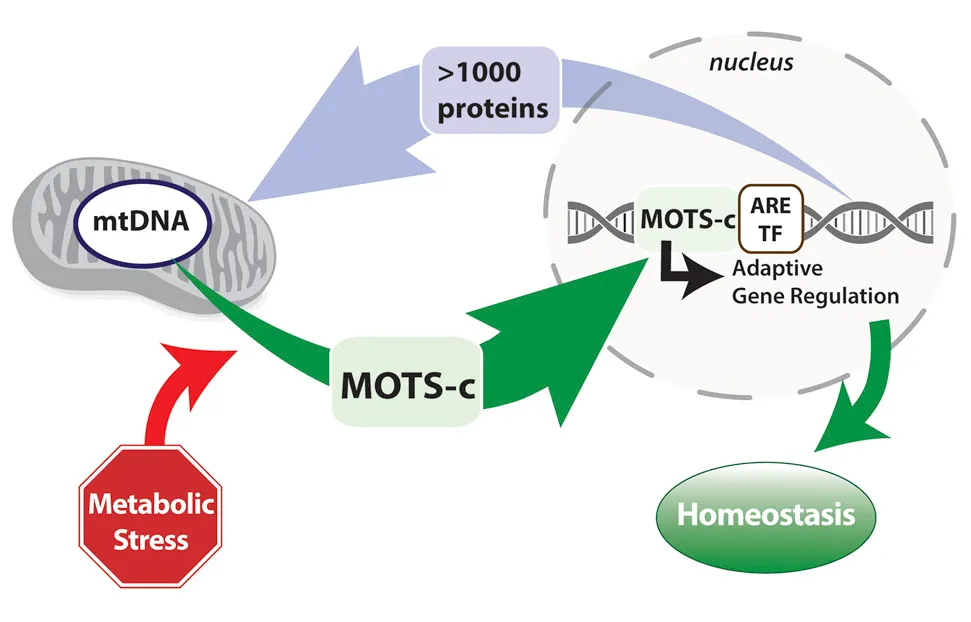
Dr. Pinchas Cohen's laboratory at the School of Gerontology, USC Leonard Davis identified the MOTS-c peptide  as one of the thousands of peptides acting as chemical messengers in the human body. It was discovered when Dr. Cohen combed through the 97 percent of human DNA that does not encode for genes. Once dismissed as "junk DNA", or the "Dark genome", this biological hoard has been recognized as being full of hormones and microproteins playing vital roles in directing systems and processes in the body.
 
When he became aware his discovery was being promoted by longevity seekers, fitness enthusiasts and wellness influencers as "exercise in a bottle", he felt dismayed. While not approved by the U.S. Food and Drug Administration, the peptide was available widely online, frequently found in vials marked "for research use only". Social media hype and a public consumer zest for experimental peptides has overwhelmed the public seeking magical fountains of youth and energy, and unregulated peptides now fuels a high-stakes federal government policy conflict.
 
Unsurprisingly, U.S. Health and Human Services Secretary Robert F. Kennedy Jr. is a self-confessed "big fan" of peptide use personally, pledging to put an end to government's "aggressive suppression" of the peptides. Some of which, like insulin, human growth hormone and glucon-like peptide-1 have seen transformational therapeutic effects to humans. However, every one of these peptides (think Ozempic) on a pharmacy shelf has undergone decades of clinical trials and testing for safety.
 
https://innerbody.imgix.net/mot-c-peptide-upper.jpg?auto=format,compress&fit=max&w=826&q=75&dpr=1
Photo by Innerbody Research
 
The same cannot be said for MOTS-c and a host of other peptides now widely available online. Those wedded to their use claim the substances' effectiveness in aiding weight loss, boosting energy and muscle mass, frequently citing research conducted only on animals, or with a very limited number of humans. Leading to the situation where it is unknown how or when the peptides should be used for humans; no data exists that can attest to their safety and effectiveness.
 
An FDA committee was recently struck to vote whether to recommend compounding pharmacies be permitted to manufacture six different peptides currently available online: BPC-157, TB-500, KPV, epitalon Semax and MOTS-c. Last month, Health Canada announced that a Canadian court had approved their request to permanently ban a Quebec-based online store from selling unauthorized injectable peptides in Canada. 
 
Many of the members comprising the FDA committee work for telehealth, longevity and wellness companies that will profit from the regulation of peptides. Dr. Cohen arrived in Washington to speak before the committee; stating that he believed "quality-controlled, prescriber-supervised" compounding was the safest way forward. FDA staff who also spoke at the meeting advised against peptide compounding on the reasonable basis that insufficient safety data exists to justify the move.
 
It is unknown how long-term use of these peptides would affect humans. Claims by influencers that peptides have a positive effect on human weight loss, muscle mass, longevity and energy have been taken from effects seen on laboratory animals. Nor is it known what formula or dosage might be effective for human use. Molecules are viewed by scientists as a promising area of research where significant health breakthroughs could result. Rigorous science on the other hand takes time; guesswork is just that; unproven assumptions.   
 
https://hips.hearstapps.com/hmg-prod/images/213e3186-5f88-41a9-a011-3db4b7397abd.jpg?crop=1xw:1xh;center,top
viviana loza//Getty Images
 
"Peptides are neither miracle cures nor snake oil. They are signalling molecules. Some have strong evidence. Some have intriguing or early data. Some are wildly overhyped, and some probably should never leave the laboratory."
"Patients are looking for alternatives, and they are looking not at physicians. They're looking at this grey market source." 
Dr. Ben Gonzales, former emergency medicine physician, Walter Reed Army Medical Center 
 
"The big picture is that we're transitioning as a nation from the 20th-century model [in which] all health care was dictated by physicians and insurance companies to a new 21st-century model where consumers are demanding and receiving health and wellness services and products that they pay for in cash."
"I'm not saying that's a better model. But it's the model we're transitioning into."
Dr. Pinchas Cohen 
https://desertbodycontour.com/wp-content/uploads/2026/07/Screen-Shot-2026-07-31-at-9.27.00-AM.png
MOTS-c peptide hype


Labels: , , , , , , , , ,

Friday, February 07, 2025

British Columbia's Experimental 'Safer Supply' Flop

"A significant portion of the opioids being freely prescribed by doctors and pharmacists are not being consumed by their intended recipients."
"[Those opioids are being trafficked]provincially, nationally and internationally."
"As long as [safer supply] gives valuable things away for free, or for far below market prices, one should expect there to also be 'profiteers' wishing to profit by obtaining supply for resale."
Leaked B.C. document
 
"You can stand in front of just about any of these pharmacies that are involved in this -- usually close to the safer supply prescribing office -- and you can sit outside for five minutes and watch all kinds of transactions going down."
Addiction outreach worker David McEvoy
 
"We have noted an alarming trend over the last year in the amount of prescription drugs located during drug trafficking investigations, noting they are being used as a form of currency to purchase more potent, illicit street drugs."
RCMP spokesperson Cpl. Jennifer Cooper 

"We have been concerned about this increasingly polarized rhetoric that is not informed by evidence, that is not paying attention to evidence, as a matter of fact, and is sharing opinion or anecdote that, in fact, is clearly not defensible if you look at the data."
"[Hydromorphone was not] present in a significant number [of the bloodstreams of the roughly 200 people per month dying of overdoses in B.C.]" 
Former B.C. Chief Coroner Lisa Lapointe
https://i.cbc.ca/ais/1.7156186,1717224314156/full/max/0/default.jpg?im=Crop%2Crect%3D%280%2C0%2C1919%2C1079%29%3BResize%3D620
Some pharmacies are paying cash kickbacks to vulnerable patients in Vancouver’s Downtown Eastside to attract more business — years after crackdowns related to the practice. Still from video
 
For years health officials in British Columbia dismissed concerns expressed relating to freely handed out opioids to drug addicts through 'safer supply' outlets, in a program designed to charitably provide a product considered safer than street opioids, in an effort to wean people off more dangerous drugs like fentanyl in response to an epidemic of deadly overdoses. Those overdoses have occurred across Canada, but British Columbia remains the poster child of drug-induced accidental overdoses. 

Which is what led the government of B.C. to develop a ground-breaking system of 'safer supply', representing, since 2020, one of the world's most comprehensive such programs. Once the program was operational, sharp eyes began to notice a proliferation in the illicit street market of diverted opioids and it wasn't difficult to conclude that the giveaway drugs were being sold on the black market in exchange for more powerful drugs like fentanyl. 
 
And while the less dangerous drugs were selling on the street at very competitive prices, they lured teenagers into venturing into the temptation of 'trying them out', creating a new generation of drug users.
 
The evidence of diversion was clear, and investigative reportage delved into the problem, publishing their damning results; the larger availability of drugs flooding the marketplace thanks to 'safer supply' initiatives, doing far more harm to society broadly; in effect enabling addicts who spurned the lesser highs of hydromorphone for the attraction of infinitely more potent (and dangerous) fentanyl-laced street drugs. These were dismissed by the province's health authorities as unsubstantiated rumours and 'false news'. 
 
This week, however, the provincial Opposition Conservatives in the province released a leaked presentation that had explored the issue without prejudice, finding that those accusations of 'safe supply' boosted opioid availability at the street level, and leading in fact to more accidental drug overdoses rather than preventing them as intended, were indeed reflecting reality. The Conservatives labelled the issue of diversion, as evidence of "taxpayer-funded drug trafficking".
 
https://smartcdn.gprod.postmedia.digital/vancouversun/wp-content/uploads/2024/09/png-0502n-overdose-037.jpg?quality=90&strip=all&w=564&h=423&type=webp&sig=SwU4R5fpM3qvebKB1TNPlg

The undeniable evidence that the government health authorities had been apprised, despite their denials, even led B.C. Health Minister Josie Osborne to confirm that the claims about diversion outlined in the report were a reflection of reality, that the report's destination was intended for the attention of law enforcement. "These allegations are here. There's absolutely no denial of it. There's no diminishing of it, and there should be no acceptance of it."
 
The very direction of distributing free recreational drugs to addicts was meant for the purpose of weaning them away from illicit drug supplies tainted by fentanyl or heroin. "Safer supply services can help prevent overdoses, save lives, and connect people who use drugs to other health and social services", an official Government of Canada policy backgrounder explained. 

In the years from 2022 to 2024, 19,751,000 mg of hydromorphone was handed out representing safer supply equivalent to 2.5 million 8-mg pills, while 1.4 million mg of oxycodone was also distributed, equating to 70,000 20-mg pills. When the program was initiated, critics gave warning that users would end up selling their rations of 'safer sup' to use the profits from their sale to acquire illicit drugs. Which led to government-supplied drugs flooding the market and addicts gaining money to buy illicit drugs.
 
"We ... know that about 50 percent of the hydromorphone pills that we come across can indeed be attributed to safe supply", the Standing Committee on Health was told by Vancouver's Deputy Chief Constable Fiona Wilson. Which did not deter drug policy advocates and government of B.C. officials from repeatedly insisting diversion was no problem; contending otherwise represented misinformation or political posturing.
 
https://i.cbc.ca/1.5896676.1684427088!/cumulusImage/httpImage/image.jpg_gen/derivatives/16x9_1180/hydromorphone.jpg?im=Resize%3D780
Hydromorphone, a type of opioid, is pictured at a managed opioid program in 2019. The drug is among those whose prescriptions have dramatically increased in recent years. The province is investigating the diversion of a 'significant portion' of opioids. (Ashley Burke/CBC)


Labels: , , , , , ,

Friday, April 12, 2024

Singing From a Different Hymnal

"Media Relations officers were asked to ensure that internal notifications were flagged and shared with provincial headquarters prior to things being issued so that additional notifications could be completed."
"No one has been restricted from addressing matters in their jurisdiction and pre-existing Media Relations protocols have not changed."
"[In fact, the guidance indicated that we] commit to be available to review and ensure timely feedback as it is not our intention on delaying communication efforts."
Staff Sgt.Kris Clark, senior media relations officer, Royal Canadian Mounted Police E Division statement

"Organized crime groups are actively involved in the redistribution of safe supply and prescription drugs."
"It might mean how we regulate our safe supply might need a sober second glance."
Cpl. Jennifer Cooper, RCMP Prince George detachment
The front of a pharmacy, with text reading 'Third Avenue IDA Pharmacy'.
RCMP have arrested a suspect who was accused of standing outside the IDA pharmacy in Prince George and trading illicit drugs for safe supply prescription pills. (Andrew Kurjata/CBC)

A leaked memo emerged where Mounties in British Columbia have been instructed to step carefully around "hot button issues", in the wake of RCMP in British Columbia continually reporting the phenomena of government-distributed "safer supply" opioids showing up in drug busts. "It is very clear we are in a pre-election time period and the topic of 'public safety' is very much an issue that governments and voters are discussing", the email of March 11 from HQ of E Division, B.C. branch of the RCMP reads.

Thus the 150 detachments in the province of the RCMP were instructed not to directly address such potentially controversial issues. Best practice henceforth would be rout enquiries from journalists and government communications staff through to central headquarters for response. Drug seizures and drug decriminalization to be considered on a list of "hot button issues". Controversies continue to erupt related to the province's commitment to "safer supply", at the same time that it has decriminalized simple possession of illicit drugs.

At the turn of the year, provincial RCMP detachments had reported seizures of black-market hydromorphone tablets initially distributed by the government of British Columbia ostensibly representing a safer supply. Consequentially, in northeastern B.C., RCMP with the Prince George division reported hydromorphone tablets seized, along with various street drugs like cocaine and methamphetamine and prescription drugs  such as painkiller and anti-convulsant gabapentin.
 
A police seizure showing money and drugs on a table.
Prince George RCMP seized prescription drugs, suspected methamphetamine and fentanyl and a small amount of cash from the suspect's residence after a 10-day surveillance operation. (Prince George RCMP)

Police in Campbell River on Vancouver Island, a month earlier reported seizure of 3,500 hydromorphone pills identifying them as having been diverted into the black market by "a well-organized drug trafficking operation". Reports that appeared to contradict the consistent claim of authorities in British Columbia that "diversion" did not present as a major problem; alternately that it wasn't occurring, to begin with.

British Columbia boasted becoming the world's first jurisdiction to launch the Safer Opioid Supply program in 2020, a plan to dispense prescribed recreational opioids, in the form of hydromorphone pills; an alternative to addicts relying on the "toxic illegal drug supply". Interviews with over a dozen addiction-medicine specialists in May 2023 by investigative journalist Adam Zivo, for the National Post, concluded that addicts routinely obtain safer supply, then turn around to provide it for cash to the black market.

The obvious result was that the "toxic illegal drug supply" was in fact being subsidized by the illegal funding resulting from reselling safer supply. The black market was flooded with inexpensive hydromorphone. A search of the  website reddit by Adam Zivo resulted in the appearance of dozens of posts boasting diverted "dillies" for sale. B.C. chief coroner Lisa Lapointe, herself an enthusiastic advocate for safer supply, publicly declared in June of 2023 that it was "not true" that diversion was taking place, but was the result of "increasingly polarized rhetoric that is not informed by evidence"
 
RCMP coincidentally in British Columbia promulgated an official statement authorized by its assistant commissioner that there "is currently no evidence to support a widespread diversion of safer supply drugs in the illicit market in B.C. or Canada", the very day the "hot button issues" memorandum had been sent out. "We've increased awareness to our police officers in order to better identify cases where safer supply drugs may be present within their investigations", the assistant commissioner clarified. 
 
https://i.cbc.ca/1.6831678.1683159536!/cumulusImage/httpImage/image.jpg_gen/derivatives/16x9_780/overdose-statue.jpg
A statue commemorating people who have died of drug overdoses is pictured at Seaforth Peace Park in Vancouver on in April 2022. B.C implemented a safer supply program in 2020 in an attempt to address the toxic drug crisis in the province. (Ben Nelms/CBC)
"Someone comes out of a pharmacy with their prescribed safe supply, and is met head on with a drug dealer offering them illicit drugs in exchange for those drugs to be then distributed into the community."
"It's pretty evident this is exactly how this problem has become a problem in British Columbia."
Elenore Sturko, ex-RCMP officer, currently B.C. United opposition critic for mental health and addiction

Labels: , , , , ,

 
()() Follow @rheytah Tweet