Ruminations

Blog dedicated primarily to randomly selected news items; comments reflecting personal perceptions

Saturday, September 07, 2019

When the Cure Represents Another Threat

"...We can't eliminate use of these [cardio-toxic] treatments completely because they are needed to cure cancer."
"While anthracycline chemotherapy may induce heart disease, many patients require these treatments to survive."
"[It's important to] make sure survivors and their doctors are aware of the risks and [know] what to look out for."
"The close connections between lifestyle, metabolic disorders and cardiac disease warrant careful follow-up and monitoring of the childhood cancer survivor population."
Dr.Paul Nathan, professor of pediatrics and health policy, management and evaluation, University of Toronto

"There are half a million childhood cancer survivors in the U.S. and that number continues to grow as treatments get better."
"[The good news is that this is] something we can actually affect."
Dr.Kirsten Rose-Felker, pediatric cardiologist, UPMC Children's Hospital of Pittsburgh
Heart Failure in children and adolescents, American Heart Association

Research is now pointing in the direction of suspected survivors of childhood cancer future risks for heart problems associated with the treatment protocols -- a problem already in the realm of medical knowledge -- is actually far more urgent than suspected. A new study of over 43,000 children led Canadian researchers to the insight that young cancer survivors in actual fact have up to a three-fold increased risk of developing other cardiovascular problems, according to the report published in Circulation.

Study co-author, staff oncologist at The Hospital for Sick Children Dr. Paul Nathan, stresses that these new conclusions should compel survivors of childhood cancers to focus on identifying and improving risk factors for modifiable heart disease. Particular attention must be paid to high blood pressure and diabetes until the evolution of cancer treatments lead to less toxic treatments to the heart. Dr. Nathan points out that the newly-identified increased risk should ensure that survivors of childhood cancer be regularly screened to identify at an early stage symptoms of heart disease.

Dr. Nathan and his research colleagues made use of a cancer registry named the Pediatric Oncology Group of Ontario Network Information System to enable them to closer scrutinize the impact of childhood cancer therapies on the heart. Health data from the general public collected by The Institute for Clinical Evaluative Sciences was also made use of.

The focus was on the 7,289 cancer survivors diagnosed before the age of 18 who were treated between 1987 and 2010 at a pediatric cancer centre, and who survived for at least five years, where the study was designed for each of those survivors to be matched in age, gender and postal code to five cancer-free people from the general public; a total of over 36,000 individuals representing the control group.

For over a decade, 50 percent of the patients were tracked and during followup 203 survivors representing 2.8 percent of the total experienced one or more cardiac events, in comparison to 331 such events that the control group experienced (0.9 percent). It was discovered that even at relatively young ages, cancer survivors ended with a three-fold increased risk for any type of heart event; as great as a ten-fold increased risk for heart failure compared to their peers, once the researchers analyzed their data.

According to Dr.Kirsten Rose-Felker of the Children's Hospital of Pittsburgh, many pediatric cancer centres follow survivors of childhood cancers for possible heart damage. A protocol based on previous knowledge of links between the drugs used to battle childhood cancers, and their deleterious effects on the heart. The difference being that this new study establishes that those heart risks are even greater than what had been perceived, making the urgency of follow-up and swift remedial action more acutely required.

Sebastian Kaulitzki, Adobe Stock
(Sebastian Kaulitzki, Adobe Stock)


Labels: , , , , ,

Monday, July 29, 2019

Say "Quack"


"He couldn't even say, 'Why am I  taking this medication'?"
"At the same time, we didn't have the words to give him answers or explain to him what was making him sick."
"He's able to say [now[, 'My bones hurt more than usual', for example, which we didn't know before. I'll say, 'How are you feeling outside'? and he'll pick the emoji that is silly. And then I'll say, 'How are you feeling inside'? and when he's feeling horrible he'll pick up the emoji that shows he's feeling really bad."
"It's hard to imagine what a two-year-old is deriving from this whole journey [of chemotherapy]. So it's good for him to be able to emote what he's feeling also."
Rachid Abdallah, Children's National Health System, Washington
"If there's a ten-year-old, I can focus on the technology and the cool things the duck can do. But if I'm giving it to a four-year-old, it's more like, 'This is your friend. This is your buddy who is here with you."
"It's always therapeutic. It can be therapeutic to educate a child or it can just be therapeutic for them to play with a duck and not even talk about the medical aspect of things."
"There are so many ways we can use it [child-centric therapeutic duck robot]."
Joe Bauer, certified child life specialist, Children's National Health System


Over fifteen thousand children and teenagers are diagnosed annually with cancer in the United States, according to figures from the American Childhood Cancer Organization. Aflac, the larges private insurer in the U.S., used a quacking duck as a mascot in its commercials several decades ago. Now, in a partnership between Aflac and robotics toy company Sproutel, a robot named My Special Aflac Duck has been produced for child-friendly therapeutic purposes.

This endearing little robotic creature has special features that help children deal with their physical pain and emotional puzzlement over how they feel, being treated for cancer. The insurance company has donated four thousand of the robotic duck models to about two hundred hospitals across the United States. Designed as a companion for children whose lives have been compromised by serious illness it guides children to be able to express their emotions when language itself fails them.
"It is an indescribable feeling to see the smile on children's faces when they receive My Special Aflac Duck.
"It is wonderful to know that they enjoy the functions of the duck that we designed specifically for them. We're honored to work with Aflac and see this grow from a concept to a program that is impacting the lives of children across the country."
Sproutel CEO and Co-Founder Aaron Horowitz
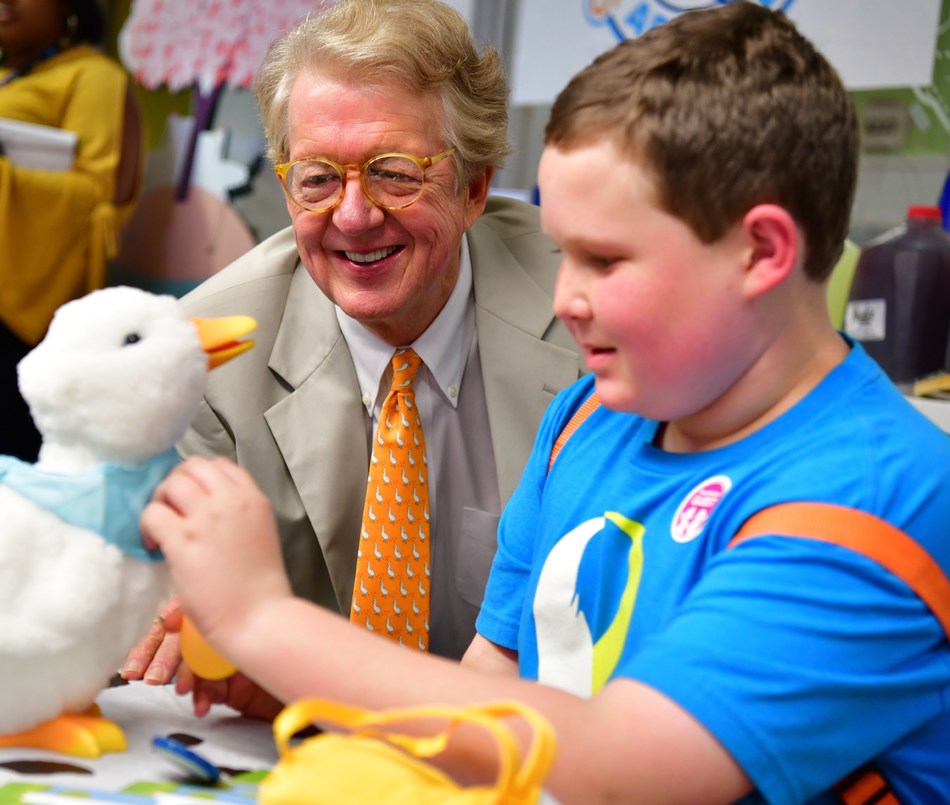
Aflac Chairman and CEO Dan Amos with a 13 year old patient at the Aflac Cancer and Blood Disorders Center in Atlanta, GA admiring the My Special Aflac Duck at a "duck delivery" event in September.
Aflac Chairman and CEO Dan Amos with a 13 year old patient at the Aflac Cancer and Blood Disorders Center in Atlanta, GA admiring the My Special Aflac Duck at a "duck delivery" event in September

There are plastic emoji discs that the robot comes with, each of them characterizing an emotion. Placing any of the discs against the duck's chest programs the robot to act out the specific emotion that the disc represents. The duck emits sounds representing happy chirps all the way to uneasy moans. The My Special Aflac Duck makes use of a series of touch sensors enabling the device to respond to whoever interacts with it.

The robot is able to turn its neck, nuzzle, open its beak -- and it emits sounds and vibrations. The duck can emit a series of pulses designed to mimic a heartbeat that can assist in calming a child and guide their breathing, useful when doctors want a patient to breathe in a rhythmic pattern. When medications are administered to patients, a toy syringe can be attached to the robot allowing a child to mimic what is happening to themselves by giving the duck medication as well.

Coping strategies are developed to help guide a child toward a feeling of control in uncertain environments, or to distract them through times of extreme stress, according to the experts. It helps them to deal with the painful pricks caused by syringes. And this sense of calm and control distracting the child from the immediate discomfort felt -- and insecurity, is provided with the use of the duck.

Rachid Abdallah, whose two-year-old son Savi Abdallah-Sinha underwent initial chemotherapy treatment to expunge leukemia from this body, considers the robot duck to be a "great translator". The child was unable to communicate at that age the acute pain he was experiencing each time a new drug was introduced or a treatment completed, during the first months chemotherapy began. And then, a year ago the family received a new tool meant to help in communicating; the quacking robotic duck that seemed like a soft stuffed animal.

Now, Savi is four years old and is able to express how he feels, giving his parents details once unavailable when he was younger. In his final phase, and the least intensive of his three-year chemotherapy plan, the child -- often stoic in the face of pain -- hesitates to communicate distress. Which makes the duck as a communication tool, particularly useful.

A robotic duck helps Savi Abdallah-Sinha, 4, and battling leukemia, share his ups and downs. The Washington Post

Labels: , , ,

 
()() Follow @rheytah Tweet