Prescriptions for Increasing Life Expectancy
"On the opioid crisis, heightened attention to overprescribing of pain medications, including new prescribing guidelines, has begun to reverse the two-decade-long increase in deaths from opioid prescription drugs. We need to drastically improve management of both pain and addiction. This will require improvements in how medical care, including physical therapy and addiction treatment, is provided and paid for. And law enforcement needs to stanch the inflow of illicit heroin and fentanyl, because lower prices and greater accessibility lead, inevitably, to increased use."
"For those addicted to opioids, easy access to medically-assisted treatment, particularly with buprenorphine and methadone, is important. For everyone else, we need to hit the reset button on opioid prescriptions, which, except for terminal palliative care and no more than three days for acute pain, should rarely be used. These are dangerous medications — a few doses and a patient can be addicted for life, and a few too many pills and a person can die; no other class of medication kills such a high proportion of people who take them. Doctors and their state medical boards should be informed each time a person dies from a prescription they wrote."
Thomas R. Frieden, director of the Centers for Disease Control and Prevention from 2009 to 2017
"Living in the US increasingly looks like a health risk. Average life expectancy here dropped for the second year in a row, according to recent data from the Centers for Disease Control and Prevention. The grim trend stems from a toxic mixture of more drug- and alcohol-related deaths and more heart disease and obesity in many parts of the country. And it puts Americans at a higher risk of early death compared to their counterparts in other wealthy countries."
Julia Belluz, Vox
Life expectancy in the United States has begun to decline -- rare in a wealthy country -- with most of the emerging decline seen to be the result of an increase of "deaths of despair" related to drug overdoses, suicide or alcohol abuse. In addition, the increase of those deaths are seen to be heavily weighted in areas with poorer and people living rurally. Mr. Rehm recently wrote a paper, published in the Canadian Medical Association Journal suggesting that the problems plaguing the United States are sliding over into Canada.:no_upscale()/cdn.vox-cdn.com/uploads/chorus_asset/file/9995881/Screen_Shot_2018_01_08_at_10.35.48_AM.png)
"In Canada, the average life expectancy was 80 years for males and 84 years for females in 2018. For the United States those numbers were 71 years for males and 81 years for females. Of those considered in this statistic, the life expectancy of female Canadian infants born in 2015 was the longest, at 84 years. Female infants born in America that year had a similarly high life expectancy of 81 years."
Statista.com
”[Society in the U.S. is] very unequal to an extent the whole national performance is affected – it is the only country without universal health insurance."
"The U.S. has the highest child and maternal mortality, homicide rate, and body-mass index of any high-income country."
"The USA is also the only country in the OECD (Organization for Economic Co-operation and Development) without universal health coverage, and has the largest share of unmet health-care needs due to financial costs. Not only does the USA have high and rising health inequalities, but also life expectancy has stagnated or even declined in some population subgroups."
Majid Ezzati, professor, global environmental health, Imperial College London
"There are some signs which are pointing in the same direction [that life expectancy in Canada may come under threat by factors similar to those causing falling life expectancy in the United States]."
"We find the same [trends], to a much lesser degree, in Canada. Ninety percent of what's happening with deaths of despair in the United States is happening in rural America. You cannot let large parts of a country have a net loss in salary over ten to fifteen years and expect those people to be as happy and as clear as before."
"Our life expectancy [in Canada] is increasing, but it's plateauing."
Juergen Rehm, Centre for Addiction and Mental Health, Toronto
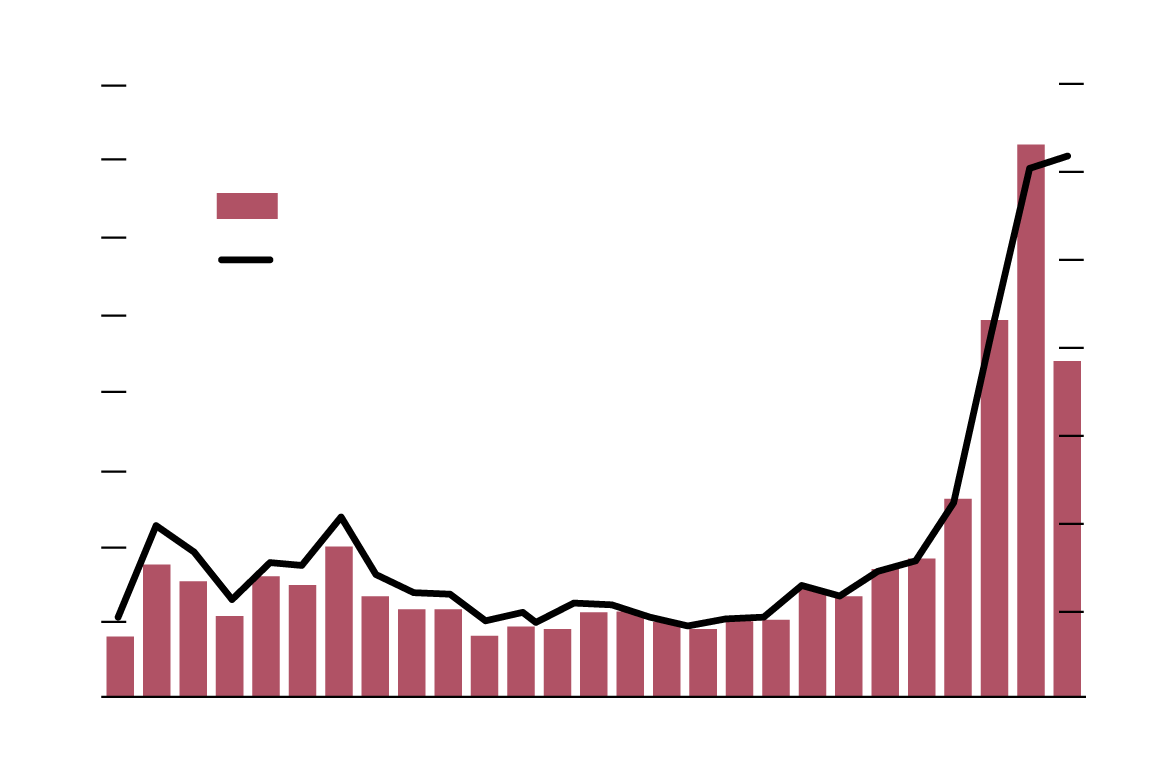
Overdose deaths, lethal enough to take the lives of well over 100 American citizens daily have been on a steady increase, amounting in 2017 to a total of 4,000 in Canada, according to the commentary by Mr. Rehm published in the Canadian Medical Association Journal. As deaths from drug overdoses rise, so too are those from alcohol-related diseases such as cirrhosis of the liver. Canadian income inequality may not quite reflect those of the United States, but World Bank figures indicate that income inequality is on the rise in Canada, as well.
A separate paper published in the same journal provides additional support for Mr. Rehm's contention. The average Canadian lifespan remains at 82 years -- representing the 10th-longest in the world, up slightly from 81 years in 2006. A decade ago, Canada's ranking among other nations was several notches higher than it now is. The death rate from mental and substance use disorders increased by 11 percent in Canada from 2006 to 2016, according to the same study.
Canadians' health overall is generally good, reports the Public Health Agency of Canada, while also noting health issues in an aging population are steadily shifting toward disease and disability as people age. With his experience at the teaching and research hospital at Toronto's Centre for Addiction and Mental Health, Mr. Rehm stresses that further decline in life expectancy driven by deaths of despair can be avoided by the simple expedient of making it more difficult to acquire inexpensive alcohol.
The obvious factor of doctors prescribing opioid painkillers too liberally and with too little oversight to patients is yet another partial solution to an intractable and growing problem within society. "While Canada has seen half the prescription opioids in the U.S., we’re still the second-highest-use country in the world", he emphasized. "We should allow those policies that are at least not worsening our gap between the rich and the poor. I’m a statistician, I’m not a member of a political party, I’m not a member of anything. I look at the data. Will I convince everybody? No, but I’ll do my best."
/https://www.thestar.com/content/dam/thestar/news/canada/2018/11/05/researcher-warns-canadian-life-expectancy-could-fall-like-in-us/camh.jpg) |
| The Public Health Agency of Canada says the average Canadian lifespan is 82 years — still the tenth-longest in the world. But it’s up only slightly from 81 years in 2006. And Canada’s current ranking is two notches lower than it was a decade ago. The same study finds the death rate from mental and substance use disorders increased by 11 per cent from 2006 to 2016. (Brian B. Bettencourt / Toronto Star) |
Labels: Aboriginal Youth, Alcohol, Canada, Disease, Drugs. Overdoses, Life Expectancy, Poverty, United States
posted by Pieface @ 6:34 PM
0 comments


/arc-anglerfish-tgam-prod-tgam.s3.amazonaws.com/public/Y77ATV537ZAAHFSS53FQS6C6EQ.jpg)

/https://www.thestar.com/content/dam/thestar/vancouver/2018/08/29/bc-government-sues-opioid-manufacturers/darcy_eby_opioid_lawsuit_announcement.jpg)
