Ruminations

Blog dedicated primarily to randomly selected news items; comments reflecting personal perceptions

Thursday, May 01, 2025

The Safety and Security of Crowds Attending Public Events

"[We offer our] deepest condolences to the victims of the Lapu Lapu Day Festival, their families and the entire Filipino community during this incredibly challenging time."
"Vancouver Coastal Health can confirm the alleged driver of the vehicle was under the care of a mental health team and on extended leave in accordance with the Mental Health Act."
"Extended leave is intended to help clients maintain their treatment plans while transitioning back to community for ongoing support."
"The care team followed established guidelines for a client on extended leave, and there was no indication this person was not following their treatment plan or presented a public safety risk."
Vancouver Coastal Health Authority, Vancouver, British Columbia 

"[If a] director considers that leave would benefit a patient detained in the designated facility, the director may release the patient on leave from the designated facility providing appropriate support exists in the community to meet the conditions of the leave."
Subject 37, British Columbia Mental Health Act
https://i.cbc.ca/1.7519787.1745806308!/fileImage/httpImage/image.jpg_gen/derivatives/original_1180/lapu-lapu-police.jpg?im=Resize%3D1180
Police and first responders are pictured at the intersection of Fraser Street and 43rd Avenue after a vehicle struck a street festival crowd on Saturday. (Ben Nelms/CBC)

The day prior to a deliberate car ramming at a Philippine festival put on by a Filipino-Canadian community in Vancouver, accused mass killer Kai-ji Adam Lo showed up at the Richmond B.C. RCMP detachment in an evident state of disturbance, claiming that someone had been tossing things into his SUV. When an officer followed him outside to search the contents in the back of the black Audi, there was absolutely nothing there. This was the vehicle used by its owner a day later when he killed 11 people at the Filipino street festival.
 
As Lo drove off, the Mountie entered a report into the police computer system, known as PRIME. Following the 26 April car ramming when the 30-year-old driver plowed his SUV through a crowd of festival-goers at the Lapu Lapu event on Saturday in a psychotic rage of killing and injuring men, women and children, officers ran the suspect's name through the PRIME database that revealed the brief interaction of the day before between the mass murderer and a member of the RCMP detachment.
 
https://i.cbc.ca/1.7519788.1745761271!/fileImage/httpImage/image.jpg_gen/derivatives/original_1180/lapu-lapu-police.jpg?im=Resize%3D1180
Emergency crews respond to the scene. Vancouver police say the driver is in custody. (Ben Nelms/CBC)
 
Now charged with eight counts of second degree murder, with more charges anticipated, Lo's mental health record may very well be used in a court of law to effectively pardon him from his unspeakable crime of mass murder on the basis of his mental condition blocking his innate and and social-values-driven prohibition against committing violent acts of gross criminality. Of the 32 injury victims of Lo's deliberate ramming of his vehicle into a crowded celebratory event of ethnic heritage and pride, 7 individuals are in critical condition while three others sustained serious injuries.
 
Kaiji Adam Lo, believed to have suffered from delusions and paranoia, had dozens of encounters with police over the years. He is now charged with driving his 2018 Audi SUV through a crowd of people on East 43rd Avenue around 8:00 p.m. Saturday at the Filipino festival. British Columbia Premier David Eby announced the creation of "an independent commission" on best practices to safely hold outdoor public events such as this one. There "will be quick turnaround, so that people can feel safe and comfortable attending and celebrating with their communities this summer", he promised.
"If you're worried that an inquiry would jeopardize this case, don't make the inquiry focused on this [tragic event], make it focused on the lack of effective intervention to prevent serious and deadly incidents in this province in the mental care system."
"Let's set this case aside then, and let's just look at the dozen -- at least -- other cases of injuries, dismemberment and even death that have occurred because of people who were mentally ill and obviously not receiving effective support."
B.C. Conservative public safety critic Elenore Sturko 
https://i.cbc.ca/1.7519793.1745806358!/cantoImage/httpImage/image.jpg_gen/derivatives/original_1180/lapu-lapu-police.jpg?im=Resize%3D1180
Police gather at the scene of the tragedy in Vancouver. (Ben Nelms/CBC)

Labels: , , , , , , ,

Friday, December 06, 2024

Random Stranger Attacks

"Residents in Vancouver are sick of this cap. It's bulls---t."
"[The incident was] devastating. There's a lot of anger actually."
"We can talk about how crime's down, violence, assaults are down, but when these things happen, they're jarring and they really impact the entire community."
"The federal government needs to step up, or at least have a conversation with us.Their responsibility is to help us out because we don’t have the jurisdiction." 
"It isn’t only those in Vancouver who are fed up, but] residents of this entire country."
"The federal government, we need them to come to the table, or just tell the country they’re not serious about this, and they’re going to do nothing about it, and then we’ll deal with it."
"But don’t waste our time and don’t tell people that you’re going to deal with the issue."
Vancouver Mayor Ken Sim
The very Vancouver that is widely recognized as a beautiful city in a geographically spectacular province of mountains, lakes, rivers and forests, is also considered one of best cities of the world to live in. This, despite, the infamous Downtown East Side with its homeless, drug-addicted individuals, the presence of opioid 'harm-reduction clinics' set up to prevent drug overdoses, and the greatest number of deaths from Fentanyl in any Canadian jurisdiction.

https://i.cbc.ca/1.7402587.1733433428!/cumulusImage/httpImage/image.jpg_gen/derivatives/16x9_780/7-eleven-shooting.jpg
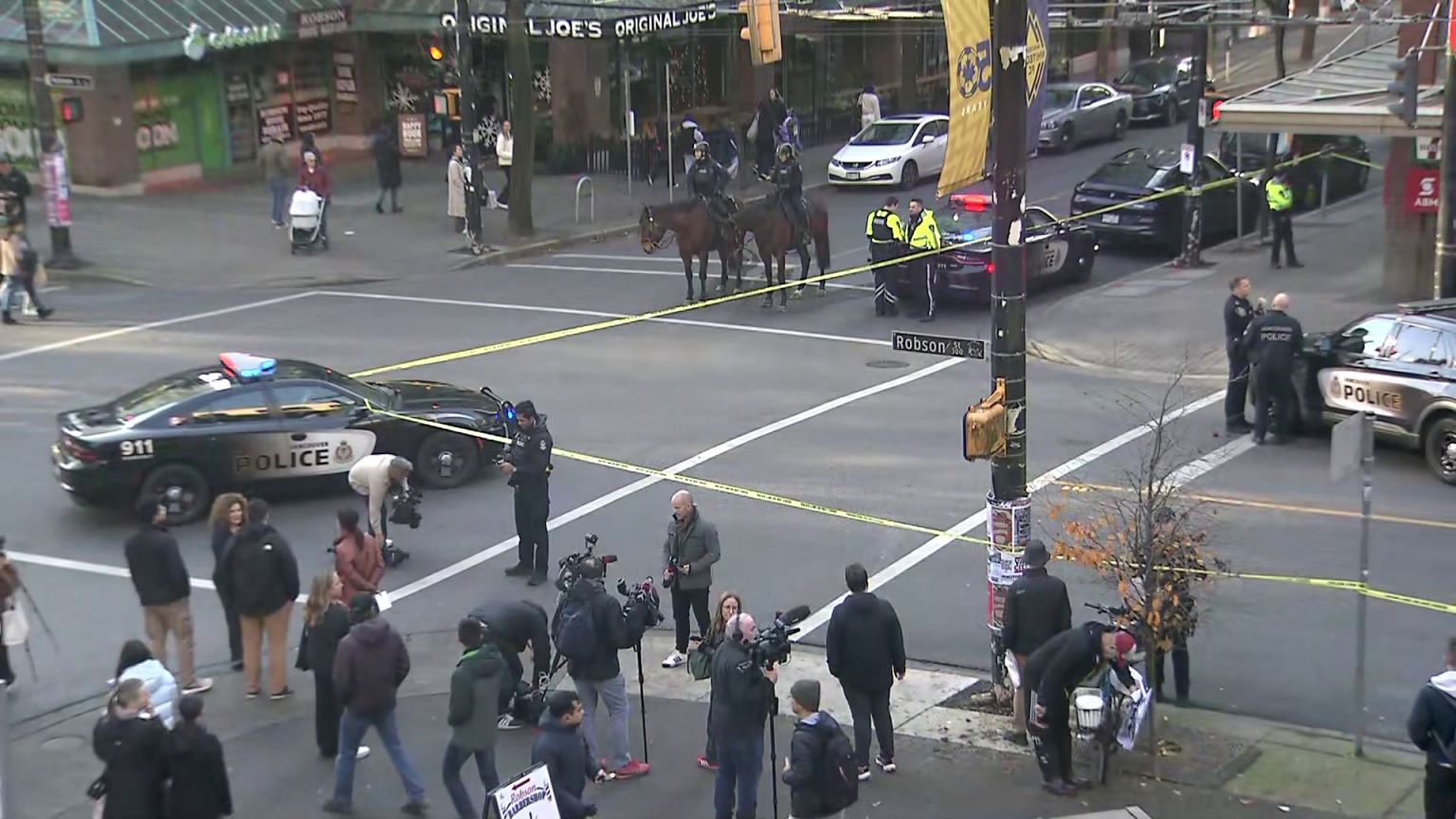
Vancouver police officers on the scene outside a 7-Eleven store after police shot and killed a man who injured two people in downtown Vancouver, British Columbia, on Wednesday, Dec. 4, 2024. (Ben Nelms/CBC)

Vancouver's problem -- and it's one that plagues most of Canada's large cities -- is random 'stranger' attacks. Random stabbing sprees have become distressingly all too common. It is a symbol of a justice system incapable of protecting the public from the erratic behaviour of violent criminals. On Wednesday one such individual went into an Original Joe's shop located close by the Vancouver Public Library, where he stole a knife and a bottle of liquor. He then went on to stab random strangers in the neighbourhood before being shot fatally by police inside a 7-11.

In January 2022, a man by the name of David Morin repeatedly plunged a knife into a stranger's back at a Vancouver Tim Horton's. Vancouver Police revealed last week that though classified as a "high risk to reoffend", the man had been set free. It all seemed to begin back in 2002 when a 22-year-old Korean student, Ji-Won Park, was attacked in Stanley Park, while he was out jogging. "Stranger attacks" are now a near-daily event. Not all are stabbings, sometimes a push, a shove, a jab, a punch.

Wednesday's attack was one of the more serious events. A predictable pattern of such attacks begin with a mentally unstable offender, one with a criminal record, and often someone with that background, out on bail or probation. Vancouver Police analyzed 44 separate stranger attacks that took place over a three-month period, with the finding that mental health was a factor in 73 percent of cases; 60 percent of suspects had been charged previously with a violent crime.

The problem seems to stem from two sources, one impacting the other; a mental health system unable to keep violent mental health patients from stalking and harming the public. Aligned with a justice system for which bail and early release are routinely granted, even when the most brazen repeat offenders are before them. A random stabbing spree in September saw 70-year-old Francis David Laporte killed, and a man in his 50s mutilated, his hand severed. Both had been strolling the downtown core, then were suddenly victimized by multiple stab wounds.

An erratic and "very troubled" 34-year-old Brendan McBride was arrested. He had been on probation and credited with a lengthy history of court-ordered psychiatric care. "I think that we have to realize that there's too many unwell people walking around in our streets", commented Vancouver Police Chief Adam Palmer. Coast Mental Health called the incident an indictment of the B.C. approach to mental health: "Nothing excuses what's happened here. People want answers. They're not easy solutions", said CEO Kier Macdonald.

https://i.cbc.ca/1.7402910.1733445851!/fileImage/httpImage/image.jpg_gen/derivatives/original_1180/robson-stabbing-suspect.jpg
An image of the man alleged to have stolen liquor from a bar and wounded two people in downtown Vancouver before being shot and killed by police. CBC News has not yet learned the man's identity. (Submitted to CBC News by a witness)

At the September 2023 Light Up Chinatown festival, the suspect who had stabbed several people randomly, turned out to be a man with a history of stabbing attacks. He was hospitalized, but was given a day pass from a local psychiatric hospital. Charged with three counts of aggravated assault, Blair Donnelly had stabbed his own daughter to death in 2006. Found not criminally responsible for the murder as a result of a mental disorder, Donnelly had been accused since then of stabbing someone while on leave from a mental hospital.

The legal system -- and this is not confined solely to British Columbia -- has proven willing to grant constant release to violent and unpredictable offenders. Leading police forces in British Columbia to refer to a new category of 'super-prolific offenders', defined as an offender with over 30 convictions. Mohammed Majidpour with 30 convictions to his name, in September 2022 randomly attacked a 19-year-old woman in Downtown Vancouver with a pole. Later that same day he set fire to a car. When he was arrested he spent a weekend in detention and then was out on bail.

After which he was arrested several more times. Majidpour was on bail less than three hours before being arrested again for attempting to steal $300-worth of merchandise. Two officers who had arrested Majidpour the previous day on a separate incident, followed him until he broke the law once more. "At the time of his arrest, the suspect had been out of custody for two hours, 18 minutes" a police statement read of the event. 
"If this is a prolific offender, and if the courts will not keep them off our streets, then we should be using the Mental Health Act."
"We need to strengthen the Mental Health Act so that these people who are at risk of harming themselves or others can be held and treated and not be released until they’re no longer a risk."
John Rustad, B.C. Opposition Conservative Leader
https://vancouver.citynews.ca/wp-content/blogs.dir/sites/9/2024/12/04/Vancouver-Police-Downtown-Stabbing-Robson-Hamilton-14-1536x864.png
Vancouver Police officers responded to a “violent” incident that left multiple people injured Wednesday. (CityNews Image)

Labels: , , , , ,

Tuesday, January 10, 2023

Canada's Hard Drugs Problem

"The Drugs Store will provide customers with reliable access to safe, tested drugs, harm reduction supplies such as unused sterile needles, pipes, etc., and educational information."
Basically, allowing medical storefront access has been the main goal all along."
"I would risk my freedom all over again and lose everything, give up everything to change the law so that people could get help medicinally."
Jerry Martin, "king of compassion", Vancouver, British Columbia
Tents remain on East Hastings in Vancouver's Downtown Eastside a week after city staff began the process of removing them, citing a fire department order that the structures constitute an extreme fire safety hazard. (CBC News)

Personal-use quantities of heroin, fentanyl, methamphetamine, cocaine and MDMA is set to be provincially decriminalized in British Columbia at the end of this month. Beginning on January 31, possession of fewer than 2.5 grams of any of these drugs will no longer be classed as illegal.
 
Although this verges on Federal territory since criminal status of drugs is a federal responsibility, British Columbia was successful in obtaining a two-year "time-limited exception" to the Controlled Drugs and Substances Act. The emergency measure is purposed to "reduce the barriers and stigma" attached to drug addiction in hopes of achieving a reduction in the province's huge rates of fatalities due to overdose.
 
Even so, while personal-use possession of drugs will for the next two years, become decriminalized, the federal law remains unchanged; selling or trafficking in any of these drugs will remain illegal. "Under this exemption, illegal drugs ... will not be legalized and will not be sold in stores", according o a provincial background policy document.
 
Despite which a Vancouver entrepreneur is preparing to open a storefront for the sale of illegal drugs. The store to be named The Drugs Store. It is unknown where the business plans to source its inventory. Vancouver is known for its clinics that prescribe medical-grade opioids to drug users, but it is unknown whether The Drugs Store plans a similar service to its clients.
 
The soon-to-be proprietor of The Drugs Store was on trial recently to face charges regarding operation of an illegal cannabis dispensary in Whitewood, Saskatcewan. Jerry Martin's dispensary, Martin Medical Services, had been raided in 2016 by the RCMP two years before the legalization in Canada of retail sales of recreational cannabis.
 
Prior to the legalization of marijuana in 2018, Vancouver hosted over three dozen cannabis "dispensaries", all of them with no legal status since their very existence was in direct contravention of the Controlled Drugs and Substances Act. Vancouver police wee open about their refusal to shut down these dispensaries.
 
"We do have a priority-based approach to policing here in Vancouver, and we do have other priorities", stated Vancouver police spokesman Constable Brian Montagne. That changes when a dispensary was viewed as a conspicuous threat to public safety or violated the rules by selling to minors, and that would warrant a visit from police.
 
It's a different story altogether with regard to selling drugs linked to the overdose crisis. Before Christmas the Vancouver Police Service made public a major bust of a drug ring funneling fentanyl into Vancouver's infamous Downtown Eastside. Mr. Martin's scheme however, is to get arrested, to draw attention to a charter challenge against the federal prohibition on hard drugs.
 
Essentially the plan is to present a case arguing that banning retail sales of hard drugs is itself a contravention of the charter-guarantee of the right to "life, liberty and security of person", since it causes people using drugs to search for illegal sources of drugs carrying a higher overdose risk.
 
The Drugs Store is the brainchild of Vancouver's Jerry Martin, a self-proclaimed “king of compassion.”

Labels: , , , ,

Friday, April 29, 2022

Keeling Over Dead-Drunk

"[Bradley Johnson left the Roxy in a state of] extreme intoxication [and shortly afterward injured himself]."
"There is both a legal and a common law prohibition against over-serving alcohol beverages -- a visibly intoxicated patron should never be served more alcohol."
Personal injury lawsuit, Vancouver
Close-up of two men clinking whiskey drink alcoholic beverage at bar counter in the pub background.
Getty Images

Bradley Roger Johnson, a Vancouver pub bartender, finished his shift at the Kingston Taphouse and Grille at 11:00 p.m. Before he left his workplace he had two drinks. At 11:30 p.m. he wandered over to another establishment, the Studio Lounge and Nightclub, in the Granville area of Vancouver. There he enjoyed two ciders and two shots of whisky. An hour later he entered another bar, Relish, and there he relished "approximately four 12-ounce Lonetree ciders, a double vodka and soda and a shot of Jameson Whiskey".
 
In a total period of four hours on 23 of August, 2016, he consumed two double vodka and sodas, two Strongbow ciders, two shots of whiskey, four 12-ounce Lone-tree  ciders, a double vodka and soda, a shot of Jameson whiskey, three double vodka and sodas, three shots of whiskey and one other shot not identified. Between 2:20 a.m. and 3:20 a.m. he downed three rounds at the Roxy Cabaret, each a double vodka and soda and a whiskey shot, all ordered at three different bars n the establishment, capped with a final "further unidentified shot".

When he finally called it a night, he began to walk home, and in an obviously compromised condition, soon fell backwards. As he fell his head hit the sidewalk. In the claim he filed with the B.C. Supreme Court, there is a statement that he was left with a "severe brain injury". On the basis of this rather straightforward narrative of gross over-consumption of alcohol, it just might be assumed that his brain injury preceded his fall and the night's overindulgence.

What he wants and feels he is entitled to, is to be awarded damages for health-care-related costs and loss of earning capability. He points out that his parents gave him the support he required to recuperate from his ordeal. The allegations in his lawsuit have not been proven -- with both The Roxy and Studio denying his version of events. Johnson was a regular patron at the Roxy, so they knew him well; his character, or lack of such.
 
Johnson had about 19 ounces of hard liquor, six servings of cider and one “unidentified” shot.
Johnson had about 19 ounces of hard liquor, six servings of cider and one “unidentified” shot. Photo by Getty Images 
 
According to their account, he was not over-served, and nor was he visibly intoxicated when he left. "If the plaintiff was intoxicated at the time he departed The Roxy, which is expressly denied, the plaintiff left The Roxy in the care and company of persons who were, or alternatively who reasonably appeared to be, sober", read the response to the lawsuit.
 
Not only is this bartender fortunate that he didn't die on the spot from alcohol poisoning, he has guaranteed that he will never again be hired by any respectable bar or lounge in the city. His legal claim for compensation will never succeed. As a bartender himself he knows the rules, and as a mature adult he should be aware that the responsibility not to overindulge to the point of non-function is ultimately his. Too bad, so sad. His suffering parents stuck with a wastrel son to support.

Bartenders are generally reluctant to serve already-intoxicated customers.
Bartenders are generally reluctant to serve already-intoxicated customers. Photo by Getty Images

Labels: , , , ,

Thursday, July 01, 2021

Killing Heat Waves, Electrical Wildfires : Western Canada

"[The number of deaths recorded since Friday -- 486 sudden deaths -- is] unprecedented [in the province; officials will be reviewing what happened in the hopes of preventing such a tragic outcome in future heat waves]."
"On the coast, we're not used to the extreme weather events. There are many things, I think, that many of us can learn in terms of response, in terms of informing the public about the risk."
"Please arrange regular check-ins with those who live alone, and encourage everyone you know to drink water, stay in the shade as much as possible and visit cooler environments whenever they can." 
"The Coroners Service would normally receive approximately 130 reports of death over a four-day period. From Friday, June 25 through 3 p.m. on Monday, June 28, at least 233 deaths were reported. This number will increase as data continues to be updated."
Chief coroner Lisa Lapointe, British Columbia
 
"The reality is we've never seen anything like this in B.C., and in fact the country, but especially in the Lower Mainland."
"After we are past this, we will have to take a hard look at what we need to change for the future."
B.C. Public Safety Minister Mike Farnworth
Sun
 
"[Police received a flurry of calls Tuesday morning] as people are showing up in their parents’ house or relatives’ house and finding them deceased."
"It’s changing [numbers of calls coming in to police] as people are discovering their loved-ones dead. [Police usually respond to three or four sudden deaths on a typical day]."
"We have more reports that have been made to us that we have not been able to send officers to because they are currently at other scenes waiting for the coroner to take over the investigation."
"I’ve been a police officer for 15 years and I’ve never experienced the volume of sudden deaths that have come in in such a short period of time. This has been an extreme sudden spike in sudden deaths throughout the city all over the city."
Sgt.Steve Addison, Vancouver Police Department
 
"This was an unprecedented heat wave, with records being broken day after day. The public was acutely aware that we had a heat problem. And we were doing our best to break through all the other noise to encourage people to take steps to protect themselves. But it was apparent to anybody who walked outdoors that we were in an unprecedented heat wave and again there’s a level of personal responsibility."
"This is a tragedy upon a whole host of others we’ve had to address over a number of months but I believe we did what we could to get the information out and we rely also on the public press and media outlets who’ve done a really good job in my mind, of making the case, telling people to be wary and we have our internet presence and social media doing that as well."
British Columbia Premier John Horgan
A view of the city after the scorching weather triggered an Air Quality Advisory in Vancouver, British Columbia, Canada June 28, 2021.
The sweltering heat wave settling over Western Canada is widely viewed as being responsible as a contributing factor to the majority of hundreds of sudden-death calls to the RCMP since Monday in the greater Vancouver area, where Burnaby residents were treated to extremely high temperatures. The spike in calls to police has been astonishing in sheer numbers, while the deaths remain under investigation.

Temperatures in the Vancouver area reached just under 32C Monday but according to Environment Canada, the high humidity accompanying the heat made it actually feel close to 40C in those areas furthest from the water in the coastal city. Residents were urgently requested by authorities to check on  members of their family, and their neighbours, particularly those in the older age bracket.

"We are seeing this weather can be deadly for vulnerable members of our community, especially the elderly and those with underlying health issues", said Cpl.Mike Kalanj of the RCMP, of the countless calls being received of sudden deaths. No fewer than 103 heat records across British Columbia, Alberta, Yukon and the Northwest Territories were broken in the historic weather system.

A new Canadian high temperature of 47.9C was set in Lytton, B.C. leaving the previous record of 46.6 from the same village a day earlier, in the dust. In the Alberta communities of Jasper, Grande Prairie and Hendrickson Creek, temperature records continue to be broken as the mercury spiralled upward to the mid- to high-30s.

The Nahanni Bute region of N.W.T. went up to 38.1 C, the highest temperature ever recorded in the territory, Environment Canada reported. Four heat warnings have also been issued for regions along Manitoba's western boundary with forecasters warning of extreme conditions persisting across the Prairies for the remainder of the week and perhaps into next week.
 
Wildfire in Lytton
A wildfire burns in the mountains north of Lytton, B.C., on Thursday, July 1, 2021. THE CANADIAN PRESS/Darryl Dyck
 
As the extreme heat recedes, another potential emergency rises. Even as  temperatures are expected to slide back to more seasonal values, the chance of lightning has been enhanced inside the parched southern Interior; the very same area where evacuation alerts were issued as a wildfire grew close to two square kilometres on Monday. Sixty-two wildfires and 29,000 lightning strikes have now been reported in just 24 hours.

Residents of Lytton in the B.C. Interior have been told to evacuate after wildfires swept in following a record-breaking heat wave.   CBC


Labels: , , , , , ,

Friday, April 17, 2020

Profiles in Courage

Registered nurse Zoe Manarangi Bake-Paterson is photographed at St. Paul's hospital in downtown Vancouver B.C. Thursday, April 2, 2020. THE CANADIAN PRESS/Jonathan Hayward
"I just wonder how this will change me or change my co-workers in our practice or in our personal lives, because I think it's a lot that's going to come our way."
"I just wonder, when we come through the other side, how different will we be?"
"People have been joking about how their skin is already feeling abrasions because of this constant friction with the masks."
"Even in the masks where you can't see people's smiles and glasses are fogged up and ... there is this physical disconnect, it feels like we're in this together."
Zoe Manarangi Bake-Paterson, registered nurse, emergency department, St.Paul's Hospital, Vancouver

Registered nurse Duncan McTavish is photographed at St. Paul's hospital in downtown Vancouver B.C. Thursday, April 2, 2020. THE CANADIAN PRESS/Jonathan Hayward ORG XMIT: JOHV212 [PNG Merlin Archive]
Duncan McTavish    Jonathan Hayward/PNG
"It kind of looks like pneumonia. They're short of breath,  usually pretty high fevers and they tend to deteriorate pretty quickly, the people who are really not doing well."
"Every single action I take I have to think about [everything he does related to who might be carrying the virus]."
"What kind of mask I need and if I enter the room, swab this person, leave again -- I have to make sure I've changed my gloves and washed my hands between every single step."
"We do that all the time, but certainly the awareness of that right now is really heightened."
Duncan McTavish, registered nurse, Vancouver
"I actually cried when I got my result [of the coronavirus test]. Every time I go to work my fear is 200 percent, because I always think of my son, my mom who lives with me."
"What would happen if I got sick?"
"So far we're doing OK, but that can change any second. Just continue to be cautiously optimistic."
"We are all in this together. We just need to keep going."
Maria Alonzo, registered nurse, single mother
Maria Alonzo had her experience with what she thought of as a close call, after waking one morning, her body aching. She had a fever and experienced the sensation of a dry throat. Now, what would an experienced nurse, working with COVID patients first think of? Particularly since one of the physicians with whom she works closely had contracted the coronavirus. That, added to the fact that as a dedicated professional she is daily confronted with the needs of people in the hospital she works at, all of whom are considered potential carriers of the virus.

Her test result gave her great relief when it was returned negative. This time. Yet, despite her deep-seated fears for her 73-year-old mother and her son, there is no question in her mind that she will continue going in to work. She and thousands of other health-care professionals dedicated to the healing profession, and prepared despite their fears, to offer their qualifications and experience in the universal struggle the world is now experiencing, in an effort to bring the SARS-CoV-2 virus under control.

All of these health professions working at St.Paul's Hospital experience self-doubts and fears, but know that their profession though under huge duress means the difference between life and death for populations the world over. The dreaded surge of cases haunts them, and they all share a feeling of uncertainty, palpably under stress from the moment they awake to the time they finally, exhausted, go back to sleep, hoping to be able to rest so they can face another day.

"It feels like we're in a lifeboat in the ocean waiting for the tsunami to arrive", explains Manarangi Bake-Paterson. The hospital where she works specializes in treating the flotsam of society's homeless and drug-addicted. It was one of the few centres to treat HIV-positive patients in the 1980s in British Columbia. Many of the patients treated back then who survived now live on the streets in the Downtown Eastside, with the more current episode of a crisis of overdosing; one that continues to this day.

If and when the province succeeds in slowing the spread of COVID-19, the situation the nurses dread of a potential Downtown Eastside outbreak among the homeless and the health-vulnerable will remain unabated, simply because physical-social-distancing is a challenge. In these special circumstances, at this special time, the hospital remains closed other than for the presence of patients and staff. Beds have been vacated, triage overhauled to accommodate patients presenting with respiratory symptoms.

The staff, awaiting the anticipated surge, rehearse urgent intubation protocols to increase their skill levels post-shift and work on adjusting to operating in zero pressure rooms, even as updated directives are received in reflection of new evidence emerging on the outbreak. Typically, it is unknown whether a patient has been infected with COVID after taking swabs when the patients may be sent home instructed to manage symptoms. Alternately be in intensive care by the time results of their tests are received.

Staff are conflicted in their concerns that flood their minds focused on the coronavirus. Concerned over the welfare of patients as well as their own personal welfare and those intimates in their personal lives. Their morale is lifted when they become aware of the admiration elicited by their courage and their plight on the part of the public who celebrate them as heroes. Cheers ring out nightly throughout the city for health workers.

Donations of food and other supplies are dropped off for them by members of the public, as an expression of gratitude. "At those times it feels so incredibly joyous to experience that", said registered nurse Rachel Mrdeza who had never given much thought about the protective gear she must wear; now, given the current situation aware that it is her shield against an implacable, unseen enemy.

St. Paul's Hospital site in downtown Vancouver officially put up ...
St.Paul's Hospital, Downtown Vancouver

Labels: , , , ,

Saturday, February 18, 2017

Disciplining Vulnerable Employees

"Mr. Mohammed did not consider the particular circumstances or make any assessment of the actual seriousness of Ms. Ram's conduct before deciding to terminate her employment."
"He claimed that he did not do so because it is necessary to ensure that employees know that taking food without authorization will not be tolerated."
"[Mr. Mohammed had testified that Usha Ram] was a good and valued employee, with no record of any formal discipline] with the Burger King chain before she was fired."
"[Janif Mohammed and co-owner of the franchise Michael Lacombe] behaved in an unreasonable, unfair and unduly insensitive manner."
B.C. Supreme Court Justice Lisa Warren
Usha Ram has been awarded $46,000 after being fired from a Vancouver Burger King.
Usha Ram has been awarded $46,000 after being fired from a Vancouver Burger King. (Jesse Johnston/CBC)

A 55-year-old woman who had come to Canada in 1987 from Fiji with a basic amount of English at her disposal having achieved a Grade 8 education in her country of birth, worked as a cook in a Burger King franchise for 24 years. As a full-time worker the woman, who was the sole family earner whose salary enabled her to care for a physically handicapped husband and an adult daughter who is mentally disabled, earned an annual wage of $21,000.

Her long employment and dependability marked her as a valuable employee, a fact her employers agreed upon. Yet she was fired because of a miscommunication and a company policy that ensnared this woman into a situation that was both demeaning and crudely and cruelly dismissive of her work record, her dignity as a human being, as well presenting as an acute instance of total disinterest in her welfare at age 55, with few other skills and poor English, in a search for replacement employment.

Her firing transpired as 2013 came to a close when her employer accused her of stealing from the company. Her crime was that she understood she had been given permission to take home with her a fish sandwich, french fries and a soft drink as she went off shift. She had asked the duty manager at the fast food outlet for permission to take home with her a "fish fry" free of charge as she had forgotten her wallet.

The manager agreed, under the impression that she would be taking the fish sandwich only, not accompanied by french fries and a soft drink. At the Burger King franchise employees were given entitlement to free drinks during shifts and outside of shifts, half-price food. Miscommunication aside, the cost of the the food items that Usha Ram had taken home with her would represent a value of $1.00. But management was offended that she was under the impression that she owed them nothing.

The manager bided his time, waiting for Ms. Ram to pay for the 'extra' food she had taken, but when she neglected to do so, he notified the owners. That resulted in Janif Mohammed accusing Usha Ram of theft. She wept, offering to pay for the food, hoping her job would not be in peril. But the decision had been made to fire her. This is a woman whose loyalty to her employers was evident in her willingness to be assigned to various sites.

The franchise locations in Vancouver, included a number of sites, and she was transferred to one site after another over the 24-year period when she was employed by the franchise owners. Justice has now finally been done. She has been awarded $46,000 for wrongful dismissal. Justice Warren ordered that the franchisee pay this ill-done-by woman general damages of $21,000, reflective of a year's salary, along with $25,000 in aggravated damages.


Labels: , , , , ,

Saturday, December 17, 2016

Desperate Times in Vancouver

"At least six persons died after using drugs in the Downtown Eastside in a span of only eight hours [while five more died in the rest of the province]."
British Columbia Coroner's Service warning

"It's going to take dramatic and immediate action from the B.C. government to invest in treatment options."
"It's desperate times in Vancouver and it's hard to see any silver lining. We don't seem to have hit rock bottom."
Vancouver Mayor Gregor Robertson

"Nine days [waiting list for treatment]. You lose the window to help within hours. Nine days is an eternity."
"When somebody is ready, they are ready to get off drugs. We need to help them right away because they're at risk of dying if we do not help them."
Vancouver Police Chief Adam Palmer
Fentanyl crisis
Vancouver officials held a news conference Friday to address the growing crisis of drug overdose deaths. (CBC)

It's all hands on board in Vancouver's battle with drug addicts acquiring illegal drugs cut with unknown amounts of deadly fentanyl and far deadlier carfentanil, manufactured in drug laboratories in China for the most part, and ordered through Chinese websites at prices hugely attractive to drug dealers in the West to use as filler with heroin or other opiates popular with people addicted to these deadly, recreational drugs.

Police, firefighters and  health officials in Vancouver, the seat of the illicit drug epidemic that has spread over the rest of Canada, where municipalities have had to deal with the crisis of people overdosing and gambling with their lives to the extent that an increasing number of such deaths are causing consternation throughout the country. Naxalone, used as an antidote has been largely successful in forestalling deaths, if it's administered in a timely manner.

front line 14
Paramedics attend to an overdose patient after three doses of Narcan fail to revive him. (CBC)

On Thursday, in the span of an eight-hour period, eleven people died from the vicious effect of fentanyl-laced opioids. These are drugs so powerful that a few grains present with other drugs is sufficient to cause overdose and death. These are drugs so powerful that they are used by veterinarians dealing with elephants, to subdue the great beasts for surgical procedures. These are drugs so threatening to the addicted population that they play Russian roulette for a fix.

In despair Mayor Gregor Robertson of Vancouver notes that naxalone applied to reverse the overdose effect of fentanyl just isn't cutting it. Since those treated and defeating death in that one sitting, simply take themselves off to the streets once again to access drugs for another go at it. What these hard-core addicts need, he says, is treatment effective enough to help them turn their lives back in the direction of normalcy.

These are people too far departed into the neverland of drug addiction to be responsible for themselves. And so, society has been pushed to pick up the pieces in an effort to restore them to a point of self-reliance, once they have reached a psychological equilibrium that will balance them toward avoidance of illicit drugs, if that can be achieved. In the interim, pop-up clinics helping addicts with their injections, with help standing by to react, have attempted to fill the gap.

The federal government recently announced new measures permitting cities across the nation to open supervised injection sites. Even so, Gregor Robertson notes, greater efforts are required to deal with the "horrific impact" of Vancouver's overdose deaths. About 1,300 people daily committing themselves to using illicit opioids, "playing roulette" with fentanyl, cut into heroin.


An unprotected, used needle sits on a metal grate at Carrall and Hastings streets, around the corner from the overdose treatment facility set up at 58 West Hastings St. recently.
An unprotected, used needle sits on a metal grate at Carrall and Hastings streets, around the corner from the overdose treatment facility set up at 58 West Hastings St. recently. (Rafferty Baker/CBC)

The City of Vancouver has approved a tax hike of .05 percent devoted to aiding firefighters who respond to this crisis. Drug users are in need of housing and mental heath services to deal with isolation caused by their cycle of addiction dependency. According to the Vancouver Coroners Service, from January of 2015 to the end of October, 622 people died of overdose deaths caused by illicit drugs in the province, many related to fentanyl.

A police officer approached by three drug addicts asking for help to access treatment for drug abuse, revealed some of the difficulties involved. The enquiring officer, acceding to the request for help and direction found it more complex to access treatment than he might ever had imagined. Informed that space is tight and there would not be an opportunity for the three to gain assistance until nine days later, they had nowhere to turn to on the spur of the moment.

Now, the city is calling on the provincial government to recognize the dire need to provide treatment on demand for drug users, reflecting the overdose death toll, which is reaching toward staggering proportions.

Overdose epidemic reaches disturbing milestone

Labels: , , , , ,

Friday, May 22, 2015

Living A Delusion

"We [his musical band in North Carolina] became popular with the college crowd."
"I kept it very hush-hush [that he is Eric Clapton's half-brother]. I did not want to be known as 'Eddie Fryer, the half-brother of Eric Clapton."
"This writer came in and did a character assassination on the place where I live [rooming house in Vancouver's Downtown Eastside]. Granted, it is not the Hilton. It is a shelter that has a medical team and they do a good job of looking after me."
"He [Eric Clapton] played it [a demo tape of his music], and right away he wrote me a personal letter where he said he played the CD and it blew him away.Yes, he liked it and I sent him a letter back just to say I was glad you were able to get an opportunity to see what your brother's music was like."
"I have never asked him for money. A person is not entitled to another person's achievements."
"I gain nothing by being defeated [by heroin and illness]. I am a fighter and want to play again, maybe even with Eric."
Fast Eddie Fryer, Vancouver musician
Jason Payne/Postmedia News
Jason Payne/Postmedia News   At one time, Eddie Fryer was convinced he would meet his half-brother Eric Clapton.

Ah well, it is human nature to dream and to fantasize, and to believe and to have hope that one's dearest wishes will be realized some day. But Eddie Fryer is fast running out of time. He learned seventeen years ago that the famous Eric Clapton is his half-brother, both biological sons of a shared father. Correction: Eddie Fryer shared his early life with his father, Edward Fryer Sr., who'd had a wartime fling in Britain with Patricia Clapton who was left to raise her son Eric as a single mother.

Eddie Fryer Sr. was also a musician; he played piano. When he was demobilized at war's end, he set out on a dinner club piano-playing career in appearances across North America. Both his boys inherited his love of music; each of them played guitar. And both boys when they reached maturity struggled with addiction to heroin. But whereas Eric Clapton left his heroin addiction to the past and carried on with his career, his half-brother had no such luck.

And now he suffers from "end-stage" cirrhosis of the liver. And he is dependent on social services for a place to live, for social welfare assistance, and for medical treatment for his poor health condition and just as poor health outlook. At an age when new opportunities no longer present themselves, when age and failing health guarantees not too many years on the horizon, Eddie Fryer still has a fond hope that he will some day play guitar with his half-brother.

Jason Payne/Postmedia News
Jason Payne/Postmedia News   After discovering his lineage 17 years ago, “Fast Eddie” Fryer, now dying of cirrhosis of the liver, remembers how he was hounded by the press and just wanted to be left alone to deal with his own musical career — and his own demons.

Presumably, that hope sustains him. As for his brother, it seems that he is not that much given to brotherly affection for another man whom he has never met. Perhaps he feels nothing but resentment to have been abandoned, ignored by the biological parent he never met. In any event, that world-famous celebrity with wealth to spare, had none to spare for his indigent brother. While Eddie Fryer takes pride in never having asked his brother for money, perhaps his brother takes pride in never having offered any.

But it would appear that Eddie Fryer is a reasonable man, grateful for whatever life had to offer him, back when he was young and ambitious, and even now that he is old and ailing. A story written for the British media recently made the observation that Mr. Fryer lived in squalid conditions. A misunderstanding, says Mr. Fryer, of the rooming house where he lives, and where he is well cared for.

"They have been very much responsible for getting my medical condition under control", he observes of his subsidized "medical" housing. He still dreams of revisiting his musical career. He still believes that he will meet his half-brother, that Eric Clapton will make a magnificent effort to take the trouble to visit with his half-brother in Vancouver.

He would have to have surgery on his hands because of the tightened tendons, to enable him to hold a guitar once again. And if that happened, and if he met his half-brother, and if they played a duet, he would die a happy man. He feasts on his dreams of fulfillment, as a musician, as a man whose playing ability might match that of his famous, multi-millionaire half-brother.

Labels: , , ,

Tuesday, May 12, 2015

Vancouver Port as Conduit

"It is a concern to us. We feel that a lot of the illegal drugs that come into this country come in through our ports."
"So as far as the ports are concerned, it's the whole success of the Hells Angels."
Det.-Staff.Sgt.Len Isnor, Ontario Provincial Police

"The presence of numerous members of organized crime groups (OCGs) as dockside employees of the Port of Vancouver, coupled with the ability to access the port by members of OCGs employed in the trucking industry creates a high-risk for smuggling at the port."
"Vancouver marine will continue to pose a high risk for the smuggling of precursor chemicals into Canada from China and India. However, Prince Rupert may increasingly become the port of entry for precursor chemical shipments due to expansion in marine container commerce and/or a deliberate effort by smugglers to direct shipments through Prince Rupert, in the hope of evading seizure of the shipments."
"[The CBSA links smuggling to Hells Angels and other gangster at the port working] in key positions -- longshoremen, equipment operators, foremen and truck drivers."
"Joint forces operations by Canadian law enforcement agencies, which have included the CBSA, have succeeded in dismantling smuggling operations and temporarily disrupting the movement of drugs, cigarettes and other contraband. However, since OCGs are adept at quickly re-establishing their presence at the ports, these successes are typically shortlived."
2010 Border Services Agency internal report
Port of VancouverThe Port of Vancouver: More than two dozen of the longshoremen unloading container ships on the docks of Metro Vancouver are Hells Angels, their associates, other gangsters or people with serious criminal records, a Vancouver Sun investigation has found. Photograph by: Arlen Redekop, PNG
"Yes, we are aware of who they are. They make no secret of it. It is not within my mandate. We are a service primarily to labour relations and training and secondarily in terms of government relations and social outreach. In any of those areas, we have yet to see a situation where someone's criminal associations or participation in the Hells Angels, or whatever, has been an issue."
If you are talking about access of workers to long rows of containers which are in lightly populated work areas day or night, the TSC [Transportation Security Clearance pass issued by Transport Canada] doesn't come into it."
Andy Smith, president, B.C. Maritime Employers Association

"If Transport Canada receives any information that an existing clearance holder poses a security threat, we act on it."
"I think that the marine transportation security regulations have set out very robust security requirements for the vessels, the ports, the marine facilities and the purpose of those regulations is to enhance the international framework for the deterrence and prevention and detection of acts that may threaten security in the marine port."
"We are continuously reviewing and enhancing our marine security regime and that includes our security regulations, our standards, our procedures in order to maintain that security environment.
Guy Morgan, director of security and screening programs, Transport Canada


The 2010 Canada Border Security Agency report states their understanding that even while the Mafia and Hells Angels "have exerted the most significant criminal influence at major Canadian marine ports, many other international OCGs, including Asian, East Indian, Persian, Middle Eastern, Eastern European and local groups have developed a presence in Canada." Nothing, however, particularly new in these revelations. They've been known for decades. And for decades authorities have shrugged, while law enforcement is alarmed.

Back in 1995 the Criminal Intelligence Section of the province reported: "Hells Angels have numerous members in the longshoremen's union employed in a variety of port jobs. This has provided them with the direct means of transporting narcotics and other drugs internationally". It was also reported that the B.C. Hells Angels enjoy close relations with the Mafia, referred to as "traditional organized crime".

So, what to do about it? No one seems all that determined to do much of anything about it, actually. Not least the president of the B.C. Maritime Employers Association, who feels that putting an end to bikers or other criminals working on the docks, having useful-to-crime access for the retrieval and movement of drugs and allied contraband, would solve nothing. Stop one access point, another will move in, he claims.

"If there are methodologies by which to get product through the port in containers or otherwise -- if somebody thinks, well, raising the bar for people to come and work here is going to slow that down -- I don't think so. There are always vulnerable people. There are always people who are ethically or morally challenged. And if it wasn't people with records or who are members of groups which are deemed to be not acceptable, they will always find people to do this work for them", he asserts with complete confidence.

Why have laws altogether as part of the social contract that governments will undertake the responsibility to ensure that law and order be observed? Why just not let anarchy rein as it would with no constraints placed upon humanity's penchant to indulge in illegal activities meant to enrich themselves? With no roadblocks to illicit activity chaos ensues. Granted, as long as the gangsters hired with union backing are given the opportunity their organizations require to ply their trade, all is serene. But in turning a blinkered eye to such underworld connections at Canada's premier port of call various levels of government and authority are enabling crime.

The employment practise permitting union members to nominate friends, relatives and associates as new positions come open on the docks, also allows for members of criminal organizations to open the ranks to more gangsters working on the docks of Metro Vancouver unloading container ships. It is an arrangement whose strategic functionality is of immense benefit to organized crime and the gangsters involved in it. More than one and a half million sea containers pass through the four container terminals every year at Port Metro Vancouver.

And the Canada Border Services Agency, whose job it is to check containers, manages to validate the contents with their shipping manifests of slightly over three percent of the total. Some Hells Angels members have worked on the docks for decades, and others come on stream constantly, representing a minority of workers it is true, but workers with a distinct agenda. Union locals send out their workers to Fraser Surrey docks and Deltaport as well as Vancouver; some of the union executive have personal criminal histories.

Of course there's nothing particularly new about these types of activities going on at docks anywhere in the world; they're a magnet for crime, giving suitable access to illegal shipments to be dispersed by those involved in transporting and disseminating illicit goods. Public records and union membership lists blatantly identify such links. Police are certainly troubled by the fact that criminals and gangsters are enabled to move drugs and other contraband through Port Metro Vancouver.

Once someone is certified as a union member and is hired to work at the port, they're given a basic port pass, for which a criminal record check is not required. That pass permits access on a wide scale to the tens of thousands of containers behind locked gates in Vancouver, Surrey and Delta. Among the thousands of dock workers in British Columbia some are in possession of higher-security Transportation Security Clearance passes allowing them to enter waterfront restricted areas.

Part of the problem in clamping down on the common existence of criminals working at ports is quite simply a lack of policing manpower. The RCMP can do just so much with the resources available to the federal policing force. Thousands of officers have been reassigned across the country to focus on terrorism cases. Working on organized crime cases suffers as a result.
Port of Vancouver

Andy Smith, president of the BC Maritime Employers Association, photographed at the Port of Vancouver. He says his agency is aware of the Hells Angels and others with gang connections on the docks. Photograph by: Arlen Redekop, PNG


Labels: , , ,

Saturday, October 25, 2014

But Is It Canadian?

"You put up an information sign in a neighbourhood that only passes information to the
Chinese-reading population, that tells me something is wrong with what we're doing and we need to re-evaluate it."

Evelina Halsey-Brandt, Richmond councillor

"I want my community back ... it's very difficult when you can't read the signs and communicate."
Kerry Starchuk, Richmond resident

"With a population of half our people or more being of Chinese origin you can't be surprised you'll see some Chinese language."
Richmond Mayor Malcolm Brodie
Retail signage along Westminster Highway in Richmond, BC, has a mixture of English and Chinese signs as well as Chinese-only signs on March, 18, 2013. In a unanimous decision last week, Richmond has directed its lawyers to figure out whether it could legally start cracking down on Chinese-only signs.
Richard Lam / Postmedia News   Retail signage along Westminster Highway in Richmond, BC, has a mixture of English and Chinese signs as well as Chinese-only signs.
 
"We, the new visible minorities, are experiencing exclusion", complained Richmond resident Ann Merdinyan, standing before a slideshow of some of the city's Chinese-only signs. A caption underlining a photograph of a Chinese-only bus add reads: "WHY? ... Is this INCLUSIVE TO ALL? another caption reads, delivering a clear and concise message.

The initial complaints from some of the residents of Richmond, a suburb of greater Vancouver, British Columbia, were given short shrift by the city's mayor when Richmond City Council was presented with a thousand-signature petition a year and a half ago seeking to have the city sign on to a bylaw that would enforce advertising by local businesses in one of Canada's official languages.
Not interested, no need, was that response.

Several weeks ago, however, the matter brought again to city council, the  initial decision was soundly reversed and in a unanimous decision was reached among all present to tread into muddy waters. City lawyers were authorized to determine whether Richmond would be within its legal right to crack down on Chinese-only signs. 

Richard Lam / Postmedia News
Richard Lam / Postmedia News   Signage along Park Road in Richmond, BC
 
"I don't think they're purposely trying to exclude anyone. I'm a second generation Taiwanese-Canadian and I don't use these services [commercial services aimed directly at Chinese clients] either", noted Judy Chern who has lived all her life in Richmond and possesses only a passing knowledge of Chinese written characters. "There aren't really that many signs that are Chinese-only in the city overall."

Ms. Chern pointed out that the Chinese signs posted within the city are mostly placed on businesses that offer goods and services of no interest whatever to non-Chinese. They are private businesses that have made a decision to communicate through Chinese-only signage with their client base only, and it seems like a sound business decision.

"I firmly believe that Chinese-only signs only serve to exclude the rest of the community and this is very un-Canadian" an independent candidate, one of many vying for a council seat in the November 15 election, stated of her opinion of what many consider to represent an "unwelcoming environment" of Chinese-only signage.

Ms. Halsey Brandt, a soon-to-retire councillor, had originally swept aside the complaints she received about such signage. She had no wish to come down heavy on shopkeepers about the language they chose to use on their private-business signs. What changed her mind, she explained, was when she came across an all-Chinese sign on the front of a development site in progress.

Richard Lam / Postmedia News
Richard Lam / Postmedia News   A for sale sign with information only in Chinese sits on a property along Cook Road in Richmond, BC
 
Another Chinese-Canadian independent candidate, Henry Yao is in support of a "well-redeveloped regulation" for signage. His reasoning is partly related to the umbrage he sees directed toward the Chinese community and he has hopes that the dispute could be resolved amicably and end the "racism, discrimination and anger", that he feels the sign dispute has spurred.

It does make sense, surely, that private shopkeepers feel inclined to address clients whose cultural background motivates them to be interested in Chinese pharmaceutical products, language, DVDs and products directly related to feng shui. When city councillor Bill McNulty last year conducted a casual search of his own he discovered a mere half-dozen signs exclusively Chinese.

The practise may not be polite, diplomatic or particularly neighbourly-inclusive, but it represents a business decision with a solid judgement base. The Richmond Chamber of Commerce feels justified in maintaining that the city's sign issue should be left to free enterprise to shake out. Those local businesses who feel what they have to offer would be of no interest to the two million Vancouverites who have no experience with the Chinese language should be free to continue as they have.

"We've always had the same position on this ... we don't feel a bylaw is the right answer", explained Gerard Edwards, chair of the Richmond Chamber of Commerce. This opinion is one shared by the Canadian Federation of Independent businesses. "The market can correct itself pretty fast on this type of thing", offered Dan Kelly, the group's CEO.

A case in point is Richmond's Aberdeen Centre, a Richmond mall that while it is a hub of Asian stores and restaurants, chose to expand its client base and in so doing mandates that all signage be at least two-thirds English. "I trust the entrepreneur to know what is in the best interests of the business", explained Mr. Kelly.

As for Richmond council candidate Carol Day: "This is about self-segregation: Many people who come to Richmond decide that they don't want to integrate. I believe that they're cheating themselves out of a much more enriched life. [But] you can't force this on people", said Ms. Day, who, ironically enough is herself a professional signmaker.

Labels: , , ,

 
()() Follow @rheytah Tweet