Ruminations

Blog dedicated primarily to randomly selected news items; comments reflecting personal perceptions

Sunday, November 03, 2019

The Hungry Among Us

"I was trying to find something [that would bring people together in an effort to help others] that was universal and everyone can agree on -- and everyone has to eat."
"[Since then the Lowcountry Blessing Box project has] exploded."
"My response [to people who complain] has been that poor people are always here -- you can't judge somebody based on what you're observing." 
"Everybody goes up to the project the exact same way — whether you’re putting food in or taking food out. So no one knows what position you’re in."
Katie Dahlheim, Little Free Pantry network, South Carolina

"The reason people were so ready for this [Community Food Box Project] is because they see people in their neighbourhoods every day who are hungry, and this is something they can do about it."
Sierra Nuckols-Cosby, Little Free Pantries, Indiana
The Little Free Pantry


Most people have seen Little Free Library initiatives where people leave books they have read for others to pick up and take advantage of and leave behind books of their own. Usually there is a boxed arrangement of some kind with shelving set up innocuously in a public space and people are invited to help themselves, free of charge. It's a great way to spread books and the love of reading around; people are able to dispose of books they've read and offer to others the chance to read a book they might otherwise not know exists. The book, or others like it, can be returned to the shelves after reading and the entire community is set to be enriched by this mode of sharing.

The concept appealed for its simplicity and its open-handedness and its benefit to communities, and it inspired a global movement called Little Free Pantry, giving to those in need, with 24-hour access and no questions asked. Every community has its local Food Bank and its purpose is similar albeit not spontaneous. To qualify, people are screened to ensure they have access to Food Banks, an organized affair unlike the free pantries which ask no questions, are always open and accessible and are meant to serve without intruding.

The founder of the Little Free Pantry used the free library project as her model. Jessica McClard meant community members and local businesses to become involved, just as they have with free book access in over 90 countries, with free-standing boxes appearing in cities making books available to the interested. The first free pantry box was built by Ms. McClard in 2016 in Fayetteville, Arkansas on the grounds of a church. Arkansas, she stated, has always been one of the most food-insecure states in the country. She stocked diapers and hygiene products, along with non-perishable food.

Thank you @dandridgelibrary for showing how easy a #littlefreepantry can be! Thank you, too, for all the ways you care for your #dandridgetn neighbors! #publiclibraries are among the best places and people. ❤️


The 2008 recession had a profound effect on communities in the United States, just as it did all over the world where recovery is only yet still in progress. A September 2018 report from the U.S. Department of Agriculture indicated that over 11 percent of the American population live in "food-insecure" households. A damning statistic that is reflected all over the developed world, in very fact. Harvard University research in 2017 showed "severely burdened" households spend half of what secure households do on food.

Using the motto "Feeding Neighbours, Nourishing Neighbourhoods", the Little Free Pantry movement in four years has expanded to 670 recorded projects. Not only has it seen pick-up across the United States but abroad there are now similar projects in Europe, Canada, South Africa, the Philippines, New Zealand and Australia, according to Ms.McClard. South Carolina has the distinction of boasting one of the larger Little Free Pantry networks, born out of its founder Katie Dahlheim motivated two years ago by a nationally polarized atmosphere and deciding to build four pantries from old cabinets,

nets.
Simple #minipantry #littlefreepantry #blessingbox or anywhere at all upgrade. Need #courage #healing ? Take them.

Two years later, close to one hundred such boxes have spread throughout a third of South Carolina. When children are out of school in the summer, their families must face the need to feed them three meals daily, and these boxes respond to that need for impoverished families. In Indianapolis, old newspaper distribution boxes are the vehicle of choice for Sierra Nuckols-Cosby. In 2016, she realized the city had "food deserts" where people lack access to grocery stores and fresh produce. And so she used the decommissioned newspaper boxes for Little Free Pantries.

Two preteen girls stocked their refurbished dresser with fruit, canned goods, toothpaste, children's books and other items in Alexandria, Virginia. Twelve-year-olds, Amanda Santana and Anna Rissi, attached a sign to their cabinet that read "Take what you need, leave what you can", and the residents of the area make it their business to regularly stock the "pantry" with non-perishable food, toiletries and toys, readily available free, to anyone needing them.

Rafael erected her little free pantry about two years ago as part of a growing movement to help neighbours struggling with food insecurity.

Labels: , , ,

Tuesday, October 01, 2019

Mired in Continued Controversy

"We suggest that individuals continue their current consumption. We cannot say with any certainty that eating red or processed meat causes cancer, diabetes or heart disease."
"This is not just another study of red and processed meat, but a series of high quality systematic reviews resulting in recommendations we think are far more transparent, robust and reliable."
"However, any health benefits from staying away from meat are uncertain, and, if they exist at all, are very small."
"[With cancer, for example], we see risk reductions of anywhere from one to 13 cases per 1,000 people followed over a lifetime. So, that's 0.1 percent to 1.3 percent. That's our best estimate."
"Our approach has been there is a possible reduction, that's true. But what's also true is that we're uncertain whether we can make a causal inference."
"And if that's the case people should know what their possible risk reduction is, if it exists at all, and be informed of that so they can make their own decisions."
Dr.Bradley Johnson, associate professor, community health and epidemiology, Dalhousie University, Halifax

"We have saturated the market with warnings about the dangers of red meat. It would be hard to find someone who doesn't 'know' that experts think we should all eat less."
"[However], continuing to broadcast that fact, with more and more shaky studies touting potential small relative risks, is not changing anyone's mind."
Dr. Aaron Carroll, author, The Bad Food Bible, Indiana University School of Medicine

"They should not be making recommendations on this highly connected and sensitive issue, namely, meat consumption, linked as it is to GHGE [greenhouse gas emissions], climate change, our whole attitude to other life forms -- in short, connected to existential issues for life on this planet."
Dr.David Jenkins, nutrition scientist, University of Toronto
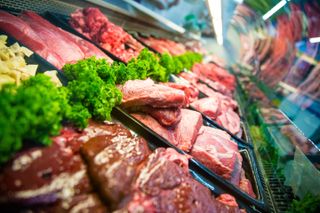
Red meat.
Image: © Shutterstock)

Heresy, nothing less, and perhaps much more. After all the prevailing advice has been dispensed, urged upon, validated, warned, and assured that red meat consumption, and processed meats in particular, will inevitably lead to a dismal health end in flirting with cardiovascular disease, stroke, heart attack, cancer, diabetes or death from any cause whatever, along comes a new team of health scientists to present us with alternate findings. A panel of international scientists led by researchers at Dalhousie and McMaster universities in Canada has published their study results in the reputable journal Annals of Internal Medicine.

And their conclusion, that lowering red or processed meat consumption turned out to have little, perhaps trivial effects in reducing the risk of serious health malfunctions goes against the popular grain with a tremendous 'thud!'. The researchers engaged in four systematic reviews to assess risk inherent in red and processed meat consumption and their conclusion is, more or less, don't bother with this concentrated avoidance, it's hardly worth the effort. They looked at the situation purely from a medical standpoint, not taking into account environmental or animal-humane impacts.

They focused on the health aspect of eating red and processed meat since most people choosing to eat otherwise such as vegetarians self-report their reasons as personal health, along with secondary influences. As far as they are concerned, blaming red and processed meat consumption with premature death is vastly overblown. In other words, the 2015 panel of experts assembled by the World Health Organization through the International Agency for Research on Cancer were precipitate in attributing bacon, sausages, biltong, beef jerky and an assortment of salted, cured, smoked meats as carcinogenic; red meat 'probably' in the same category.
Most people who understand the magnitude of the risks would say, 'Thanks very much, but I'm going to keep eating my meat,' said co-author Dr. Gordon Guyatt of McMaster University in Hamilton. (Erin Collins/CBC)
The oft-stated advice from government health agencies to select a diet high in plant proteins, not animal protein more frequently, along with the American dietary guidelines recommending red meat limits to about one weekly serving, in one fell swoop, overturned. By no means are other food scientists prepared to accept the magnitude of reversal inherent in the conclusion of this new study, citing the authors' recommendations accompanied by a "low certainty of evidence". "Because the studies themselves have low certainty of evidence", points out Dr.Joe Schwarcz of McGill.

And this rests in the face of the very unscientific aspect of observational testimonials on which nutritional studies are mostly based, since they are unable to prove cause-and-effect, relying on people's accurate reports on what they have eaten and the amounts. Researchers follow participants over time and observe what happens, but, as Dr. Schwarcz, director of McGill's Office for Science in Society observed, "People tend to claim that they eat more of what they think they should have eaten instead of what they ate".

Estimates are that North American and European populations consume red and processed meat roughly three to four times weekly on average. Researchers from Poland and Spain were also involved in the performance of five systematic reviews, one including over 100 studies involving more than six million people. Differences in red and processed meat consumption resulted in small differences in risk of dying from cardiovascular disease, stroke, heart attack or type 2 diabetes according to their analyses.

They found again a small link when another meta-analysis, specifically studying the risk of developing or dying from prostate esophageal, colorectal, breast or other cancers and the consumption of meat. On the other hand, it was found that people who ate three fewer servings of red or processed meat weekly did slightly reduce their risk of  heart disease, cancer and diabetes, with an uncertain association for validation.

Processed meats, such as salami, have been on the World Health Organization’s hit list as being carcinogenic.

Labels: , , , , , ,

Thursday, September 26, 2019

Modifying Our Diets

"Our data indicate that it is actually dairy product consumption that explains much of the differences in greenhouse gas footprints across diets. Yet, at the same time, nutritionists recognize the important role dairy products can have in stunting prevention."
"It would be satisfying to have a silver bullet to address carbon footprints and the impact of food production; however, with problems as complex and global as nutrition, climate change, freshwater depletion and economic development, that's not possible."
"There will always be tradeoffs."
Martin Bloem, director, Johns Hopkins Center for a Livable Future, professor of Environmental Health, Bloomberg School
Vegetables
Going vegetarian may not be as good for the environment as you might think

"Dietary shifts don’t have to be as draconian as many people think to have a meaningful impact on the environment."
"Our study found that in the UK, switching to a vegetarian diet that includes eggs and dairy is actually less helpful for reducing greenhouse gas emissions than a diet that includes meat, dairy and eggs for one of three meals, and is exclusively plant-based for the other two meals."
"Certain forms of beef production can significantly reduce our capacity for carbon sequestration. In particular, production that involves deforestation for feed production and grazing land has serious implications for our climate."
"Including beef in our diets at current rates would have grave consequences for the environment."
"There are many parts of the world where eating insects isn’t an outlandish idea. Based on our data, there may be great value in exploring ways to normalize this in other parts of the world."
Dr Keeve E. Nachman, Environmental Health and Engineering, John Hopkins University
Rich countries might opt for less meat — and cheese — so that poor countries can eat more, researchers find. Getty

A new study by Johns Hopkins University researchers published in the journal Global Environmental Change, analyzed the carbon footprint of nine plant-centric diets. A roster that included vegan, ovo-lacto vegetarians (vegetarians who eat eggs and dairy), pescatarian and no red meat -- in 140 countries. According to the study findings, the flexitarian diet -- cutting back on animal products -- may turn out a better commitment for the planet than would excluding meat from human diet altogether.

The study authors speak of a "two-thirds vegan" diet, which is to say, limiting animal product consumption to one meal daily, which would place a lesser strain on the environment than ovo-lacto vegetarianism in almost all of the countries studied (95 percent). Abstaining from dairy products in 64 percent of study nations resulted in lower greenhouse gas emissions than ovo-lacto vegetarian diets. Veganism, however, proved to have the lightest environmental impact in almost all of the nations (97 percent).
The study examined the environmental impacts of nine plant-centric diets in 140 countries.  Getty Images
Leaving researchers to conclude that "a theoretical shift" to plant-based eating across the board would effectively see a 70 percent per person drop in food-related greenhouse gases. Diets high in vegetables and other plants, incorporating animals low on the food chain -- mollusks such as clams, oysters and scallops and small fish such as anchovies, herring and sardines -- were found by the researchers to have footprints equal to veganism. Ruminant meats -- beef, lamb and mutton, and goat were "by far" the most greenhouse gas-intensive foods.

Of the 74 foods studied, the impact of each serving of ruminant meats was found to be 40 times more acute than were pulses (beans, chickpeas, lentils), nuts, soy or seeds). Plant-based foods generally represented the least intensive while insects (crickets, mealworms) and forage fish (herring, sardines) were recognized to be "the more climate-friendly animal products, significantly more so than dairy".

According to the study authors, it is vital to understand that their findings emphasize challenges searching out universal solutions for hunger, nutritional concerns or food-related climate impacts. It is therefore, essential that circumstances of individual countries be reflected in policies.


Labels: , , ,

 
()() Follow @rheytah Tweet