Ruminations

Blog dedicated primarily to randomly selected news items; comments reflecting personal perceptions

Wednesday, December 11, 2019

Waste Not, Want Not

"It’s been really successful for us this summer. This location in particular has been able to save our customers thousands of dollars and we’ve also been able to divert over 11,000 pounds of waste. It’s pretty exciting."
"Most of us… buy large quantity items and package them up and freeze them. So we have short-dated items in these coolers, like meat or chicken or hamburger. You can easily pack it and save it for another day so you can feed your family and it costs pennies."
"Sometimes you have a bag of perfectly good produce or fruit or vegetable, and there’s one bad apple or one rotten lemon. We can… open the package, take those really good quality items and put them into boxes and sell them for a significantly discounted price to our customers."
Tarla Confiant, manager, Edmonton Superstore

"A company that can make money while making a big social impact is an entrepreneurial dream come true. I think that the backbone of Canada's economic future depends on innovators like Josh….Josh [Josh Domingues, CEO, Flashfood] might have the right plan, experience, and competitive advantage to disrupt the industry in a meaningful way."
"When pitching a business in its early stages, elaborating on your business background and highlighting your strengths as an entrepreneur will greatly help offset any doubt investors may have in the concept. Time will tell what the future holds for this entrepreneur and his big vision, but with a deal like that, things are looking pretty bright."
Jasmin Ganie-Hobbs, major accounts manager, Business Development Bank of Canada (BDC)
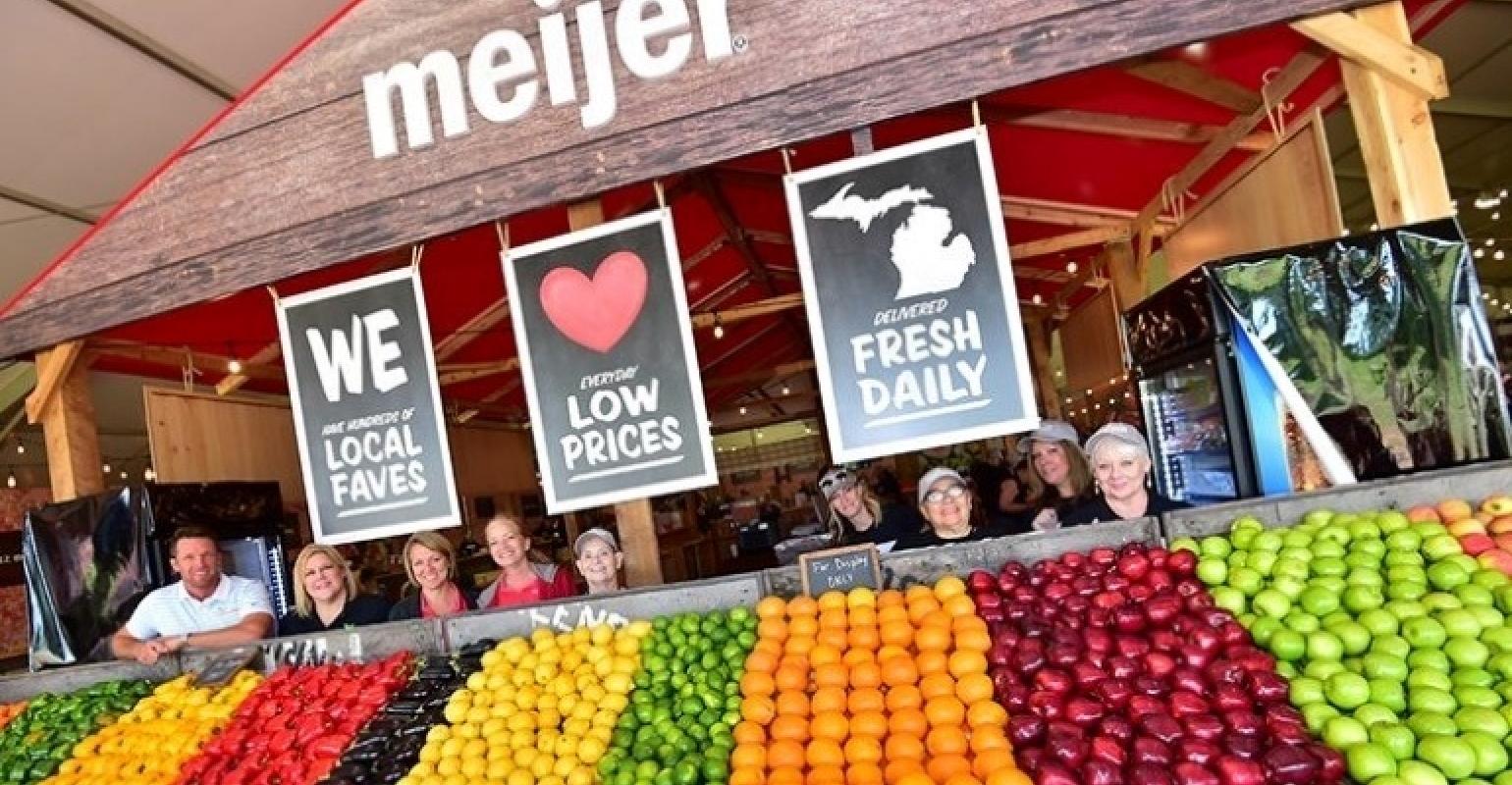
Meijer produce area - Copy.jpg
Meijer produce area

"Food is at the core of what we do, and we are constantly looking at ways to minimize in-store waste because it’s the right thing to do for our communities and our customers."
"We are excited to work with Flashfood and learn how much food can be spared from landfills."
Don Sanderson, group vice-president of fresh, Meijer 

"Bringing the Metro Detroit community the ability to buy such great food at huge discounts while reducing food waste is exciting."
"Meijer is a well-respected market leader focusing on innovation and it's evident through our partnership. Both teams are thrilled about the impact we're bringing to market in this pilot."
Josh Domingues, founder, CEO, Flashfood, Toronto
Meijer Pilots App to Reduce Waste, Sell Food Before Spoiling
Food purchased on the Flashfood app will be stored for customer pick-up

In this age of the Internet, convenience and compressed time, it's an idea whose time has come, quite obviously. Deeply discounted groceries linked with decreasing the amount of food waste that regularly goes into dumps when supermarkets are left with stale-dated grocery products and over-ripe fruits and vegetables. True, most supermarkets do make an effort to slash prices on foods nearing or just past their best-before dates as well as too-mature produce, but it is only shoppers who happen to be at the store physically that can take advantage of deep discounts whose effect reduces the store's waste.

The Toronto startup enables its clients to use the Flashfood app at partnered supermarkets to view the perishable foods available at a huge mark-down and order what they want to bring home with them when they drive by and pick up whatever looked appealing and price-irresistible. So much perfectly good food ends up in landfills, an unjustifiable waste which led Meijer to try the Flashfood app at four Michigan outlets where grocers upload "close-dated" items -- fresh foods closing in on their best-buy dates, at up to 50 percent off.
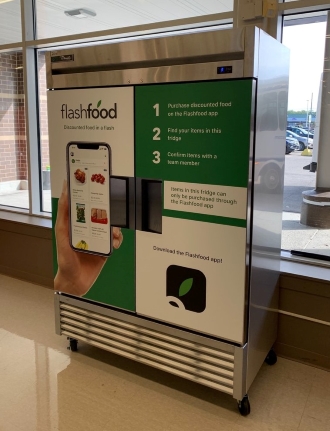
Meijer Flashfood refrigerator - Copy.jpg
 Customers pick up their selected discounted          groceries which can consist of baked goods, deli products, meat, produce and seafood -- from a refrigerated case or shelving unit at participating stores. That grocery stores face a food waste problem is well-established. They can and do donate many food items to local food cupboards, and some foods can be re-purposed for animal feed. Yet the problem remains simply because it is so endemic and so vast. Some 73 billion kilograms (160 billion pounds) of perishable food ends up in landfills in North America on an annual basis at a cost to grocers of around $24.2 billion yearly.

 Food retailers such as Kroger, Target and Whole Foods in the U.S. have experimented with 'order-to-shelf' technology in the hopes of reducing food waste, even while the creation of a market for 'ugly produce' failed to grab the food shoppers' imagination as had been anticipated, despite the well-executed public relations effort to convince shoppers that misshapen produce is every bit as fresh and nutritious as their 'perfectly shaped' counterparts. The discounted produce effort simply failed to resonate with shoppers, leading the retailers to set the initiative aside as a failure in alternate marketing.

Loblaw, Canada's largest food retailer, decided earlier in the year to partner with Flashfood where the service is now available at 405 locations across Canada. "It cuts down on grocery costs, it's easy to do online and you just pick it up", one satisfied customer in Ontario enthused. "Often it solves the 'what's for dinner' problem. I just see what's available."

Food waste costs grocers about $24.2 billion yearly representing 160 billion pounds of wasted food

Labels: , , , , ,

Sunday, October 13, 2019

Marketing Frugality to Cut Back on Food Waste

"I was on a business trip to Scotland and I read about Selina in a newspaper. Around that time, we learned that every Dane was throwing out 63 kilos of food per year and I was sitting in this airport thinking, she's right."
"It exploded in the media because it was the first time a retailer said, 'It's O.K. if we sell less'."
Anders Jensen, buying director, REMA 1000, Denmark supermarket chain

"When we emigrated [from the Soviet Union], I had never seen so much food. I was shocked."
"Then I was shocked again when I saw how much food people wasted."
"[Now], surplus food has become very popular."
Selina Juul, Russian immigrant, professional designer

"Food waste might be a uniquely American challenge because many people in this country equate quantity with a bargain."
"Look at the number of restaurants that advertise their supersized portions."
Meredith Niles, professor, food systems program, University of Vermont

"There's been a lot of focus on energy [relating to the environment and climate change]."
"But climate change is as much a land issue and a food issue as anything else."
Paul Berens, professor of energy and environmental change, University of Leiden, Netherlands
"Happy hour" at the S-market in Helsinki, Finland where food expiring in a few hours is steeply discounted. Photograph, Juho Kuva, for The New York Times

According to the Food and Agriculture Organization of the United Nations, an estimated one-third of food produced globally and packaged for human consumption is either lost or wasted, equalling 1.3 billion tons annually, with a value of close to $680 billion. This, in the face of another fact; that ten percent of people in the world are undernourished. In addition to which scientists point out that the excess food that goes to waste is a contributor to climate change.

Food lost during harvest and production or wasted by consumers contributes between 8 to ten percent of greenhouse gas emissions according to a recent report. Methane, a gas approximately 25 times more harmful to the environment than carbon dioxide, is emitted by landfills of rotting food. In most retail cultures, selling as much food and moving it along as expeditiously as possible is integral to profit and retailing success.

Which makes the reduction of waste a challenge in persuading merchants that they can promote and also profit from "food rescue" protocols. "Consumers are paying for the food, and who wants to reduce that?" is the rhetorical invitation to a response by Toine Timmermans, director of the  United Against Food Waste Foundation in the Netherlands. "Who profits from reducing food waste?"

No photo description available.
REMA 1000

That question linked to the hoped-for success of selling a new idea of reducing food waste is being answered by a growing number of supermarkets, restaurants and start-ups, mostly based in Europe. Apps appear to hold out much promise in efforts toward reducing food waste. One of the most popular apps is Too Good to Go, based in Copenhagen, with 13 million users and contracts with 25,000 restaurants and bakeries in 11 countries.

The idea behind their success is convincing consumers it is to their advantage to pay about one-third of the sticker price for food items; most of it going to the retailer, and a small percentage to the app. Food rescue in Denmark has become a kind of cultural movement. Selina Juul has been recognized as its founding principal when at age 28 in 2008 she launched a Facebook group called Stop Wasting Food.

Before a week was up she was interviewed on radio and following that Anders Jensen, buying director of REMA 1000 the largest Danish supermarket chain, contacted her. They met in Copenhagen and the result was that REMA 1000 eliminated in-store bulk discounts to entice people to buy food in impractical quantities leading to waste. From 2008 forward there were no such 'bargains' as three hams for the price of two.

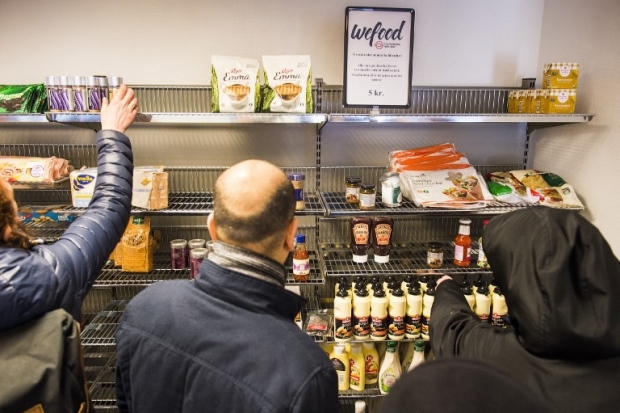
Wefood project
This file photo taken on February 22, 2016 shows people shopping in the Wefood supermarket that sells food past its sell-by date at Amager in Copenhagen, Denmark. (© Soren Bidstrup / SCANPIX DENMARK / AFP)


Labels: , ,

Wednesday, May 30, 2018

Solutions To Food Waste

"Your hands get kind of gross. There's dressing and cooked mushrooms and that's gross. Or if you see a rat, that's kind of gross."
"There's a box, then there's produce, then there's another box and there's produce, and box and produce."
"There are absolutely things that look good enough to buy in the store. Often I'm confused why they're in the garbage."
"You go out at night, you have your headlamps and your little grocery bags. You're looking into these dumpsters and they're absolutely full of food."
"You get over it quickly [initial distaste at riffling through discarded food in a dumpster] because it kind of feels beautiful. You're not just doing something good for yourself, but you are doing something good for the world because less food is going to waste."
"Some people just don't understand because it sounds gross. When I first told my father I was going dumpster diving, you know, he was ashamed of me ... He said, 'I can lend  you some money'. And I said: 'I enjoy this. This is something I want to do. I think it's good." 
Chelsea Power, University of Victoria, Really Garbage Cookbook co-author
Emily Kirbyson, left, and Rebecca Rogerson look through a garbage bin behind a grocery story for produce and other edibles near or just past their expiry date in an effort to create a cookbook on dumpster diving for their thesis work at the University of Victoria.   Chad Hipolito/Postmedia

During her undergraduate years, Chelsea Power met another student who had joined a dumpster diving club. As a university student with limited financial means she, like many others, found it difficult to pay for her tuition, her living costs and to be able to afford good wholesome food. People in straitened circumstances, those with low incomes -- and post-secondary students not living at home have discovered that there are alternatives to visiting food banks; visiting supermarket dumpsters.

According to Ms. Power, she has had the experience of coming across some grocers who obligingly help people looking for unwanted, discarded food, offering more than they find in dumpsters, bringing out from inside the store more for them to select from. On the other hand, there are different responses from different people, some of whom can be downright mean and nasty that someone is trying to advantage themselves at no cost by going out of their way to secure food no one else wants.

Ms. Power's attitude about wasted food is one that could be emulated by many more people, held back by a feeling of shame. She feels that the food is perfectly fine, it's healthy and nutritious and shouldn't end up in a landfill when it could be put to good use by needy or simply practical people. From that perspective it's downright criminal for supermarkets to discard food that may be disfigured or no longer at the peak of perfection. Instead of placing the food out as discarded waste, food that remains edible and in good shape should be placed on racks in back of the store to enable people easy access.

Emily Kirbyson holds a bag of produce and other edibles found behind a grocery store. Chad Hipolito/Postmedia

Ms. Power along with Emily Kirbyson and Rebecca Rogerson -- both graduate students at University of Victoria like herself -- plan to present their waste-food project and recipe book at the Congress of the Humanities and Social Sciences, an annual conference gathering in thousands of academics and taking place in Regina this year. They will speak of the frustrations and rewards of riffling through discarded produce, coming across vegetables, fruit and herbs, cheese, close-to-expiry milk layered between cardboard boxes that have been tossed in with the discarded food.

Their Really Garbage Cookbook describes the pact of an increasing group of garbage foragers living in cities, and the knowledge they share that inside most dumpsters behind a grocery or bakery rests a fount of good-to-fair food destined for a garbage heap which their intervention could free up for personal use. A 2009 Supreme Court decision made it clear that anything set out for garbage collection will not legally be considered private.

The book, still being put together, presents anecdotes, food collection guides, poetry and recipes. There are tips on how to select a dumpster (avoid big box supermarkets), when to venture out (week days preferably) and how to prepare the food that has been rescued (cleansing it with antibacterial soap), and to practise civil etiquette; to restrain yourself from taking everything presentable in favour of leaving some for others to 'rescue' and make good use of.

Rebecca Rogerson and Emily Kirbyson. Chad Hipolito/Postmedia

Labels: ,

Friday, May 18, 2018

Misinterpreting Cautionary Food Labelling on Freshness

"It is the responsibility of the regulated party to determine if the product has a durable life of 90 days or less and the specific durable life information for the products they sell. The durable life of products or categories is not prescribed in regulation."
"Any changes made to the durable life information that result in false or misleading information on the label are prohibited by Section 5.(1) of the Food and Drugs Act."
"Note: All foods sold in Canada must be safe for consumption [4.(1), Food and Drugs Act]. A durable life date is not an indicator of food safety, neither before nor after the date. It applies to unopened products only; once opened, the shelf life of a food may change. Products may be found for sale after the "best before" date has passed as the date is based on freshness and quality rather than safety. When this date has passed, the food may lose some of its freshness and flavour, or its texture may have changed. Some of its nutritional value, such as vitamin C content, may also be lost."
Canadian Food Inspection Agency web page


A study undertaken in the United Kingdom by The Waste and Resources Action Programme conjectures that when best before dates are extended by the consumer by a single day past the recommended 'best before' printed on a food product labelled to inform consumers, as regulated by national food agencies, household food waste would be reduced by up to 5 percent. In Canada an estimated $31 billion-worth of food is discarded in landfills or becomes composted annually.

That figure breaks down to an estimated 170 kilograms of food that the average consumer discards yearly. As consumers, we regard 'best before' dates as a food manufacturer's warning that past the recommended date the food in question is no longer safe to eat. Nothing could be further from the truth. The food involved, on the other hand, may not be at the absolute peak of its freshness, and that's another thing altogether. The average consumer's invariable reaction to the date, however, is to discard the food immediately that date has been reached, although the food is likely still edible, as sensory tests can inform (smell and taste).

A study published in the journal Waste Management revealed that research has discovered 80 percent of Ontario residents interpret 'best before' dates as signals whether food should be discarded. The other 20 percent pay little attention to the dates and simply consume the food, past-due or not. They may know that the 'best before' date is a notional one and even if the date is meant to caution that the food is past its prime, it does not necessarily follow that this is the actual case. It is food producers' way of ensuring that what they manufacture is eaten at the peak of its freshness and taste. Aside from which the quicker the food is eaten -- or some of it discarded -- the sooner it will be replaced.

The truth of the matter is, when food deemed to be past their 'best before' date is discarded, it is rarely in a spoiled state. Aside from which the 'best before' designation does not mean 'expired'. It is a stamp whose dates are not meant to indicate food safety, but the time by which the producer feels the food will have begun to lose its optimum taste, and perhaps full nutritional value as well. When the food manufacturer decides on a number of days before what they produce is no longer optimum, that date is dialled back by 20 percent in a spirit of caution.


As it is, only foods that remain in a fresh state for under 90 days are required by law to state 'best before' dates. Packaged cereals, beans, dried pastas, soft drinks all are deemed to have a stable shelf life, and as such are exempt from being required to present a 'best before' stamp. Despite which, manufacturers stamp them regardless. Very few foodstuffs are actually required to be presented with expiration dates as opposed to 'best before' dates. According to the Canadian Food Inspection Agency, "As it is not illegal to sell a product that is past its best-before date, a consumer can use this information to consider how the food may have changed in terms of freshness, flavour, texture and/or nutritional value before purchasing."

"Expiration date" means the date after which the manufacturer does not recommend that the product be consumed, and up to which it maintains its microbiological and physical stability and nutrient content declared on the label.
Expiration dates are not required on all foods, but only on foods for special dietary use. A food for special dietary use means food that has been specially processed or formulated to meet the particular requirements of a person [B.24.001 FDR].
The FDR requires that expiration dates must be used on the following products [B.24.001 and B.25.001 FDR]:
  • formulated liquid diets (a nutritionally complete diet for persons using oral or tube feeding methods)
  • foods represented for use in a very low-energy diet (foods sold only by a pharmacist and only with a written order from a physician)
  • meal replacements (a formulated food that, by itself, can replace one or more daily meals)
  • nutritional supplements (a food sold or represented as a supplement to a diet that may be inadequate in energy and essential nutrients)
  • human milk substitutes (infant formula)
These foods should not be eaten if the expiration date has passed as they have strict compositional and nutritional specifications which might not be met after the date.
Generally, the expiration date may be shown on any label panel, except the bottom. However, in the case of formulated liquid diets, infant formula, and foods represented as containing infant formula, this information can be shown on any panel including the bottom panel provided there is a clear indication of the location of the date elsewhere on the label [B.01.005(4), FDR]. There are no prescribed expressions for "expiration date", however, the term "Exp." is often used.
Canadian Food Inspection Agency

Only a handful of products in Canada require expiration dates, which are much different than best before dates. (CBC)

Labels: , , , ,

Thursday, May 03, 2018

Feeling Virtuous About Our Excellent Food Choices, Are We?

Abstract : Improving diet quality while simultaneously reducing environmental impact is a critical focus globally. Metrics linking diet quality and sustainability have typically focused on a limited suite of indicators, and have not included food waste. To address this important research gap, we examine the relationship between food waste, diet quality, nutrient waste, and multiple measures of sustainability: use of cropland, irrigation water, pesticides, and fertilizers. Data on food intake, food waste, and application rates of agricultural amendments were collected from diverse US government sources. Diet quality was assessed using the Healthy Eating Index-2015. A biophysical simulation model was used to estimate the amount of cropland associated with wasted food. This analysis finds that US consumers wasted 422g of food per person daily, with 30 million acres of cropland used to produce this food every year. This accounts for 30% of daily calories available for consumption, one-quarter of daily food (by weight) available for consumption, and 7% of annual cropland acreage. Higher quality diets were associated with greater amounts of food waste and greater amounts of wasted irrigation water and pesticides, but less cropland waste. This is largely due to fruits and vegetables, which are health-promoting and require small amounts of cropland, but require substantial amounts of agricultural inputs. These results suggest that simultaneous efforts to improve diet quality and reduce food waste are necessary. Increasing consumers’ knowledge about how to prepare and store fruits and vegetables will be one of the practical solutions to reducing food waste.
PLOS One  Zach Conrad, Meredith T. Niles, Deborah A. Neher, Eric D. Roy, Nicole E. Tichenor, Lisa Jahns 
food-waste-in-value-food-chain
"Eating healthy is important, and brings many benefits, but as we pursue these diets, we must think much more consciously about food waste."
Meredith Niles, study-co-author

"Food waste is an issue that plays out at many different levels. Looking at them holistically will become increasingly important to finding sustainable ways of meeting the needs of a growing world population."
Zach Conrad, study lead author
1.3 billion tonnes of food is lost or wasted every year around the globe
1.2 billion tonnes of food is lost or wasted every year around the globe. Food and Agriculture Organization of the United Nations
Consumer education is of primary importance in the preparation and storage of food, as well as acquiring the capacity to assess when foods still retain their nutrient value, remain fresh enough to consume, as opposed to appearing superficially damaged, but still nutritionally edible.

It is safe enough to venture the opinion, one might feel, that experience is the gateway to knowledge. That people who have handled food products for a long period of their lives have that familiarity, that the researchers speak to the lack of familiarity of new food consumers learning their way around the corridors of food edibility, preparation, hygiene and safety.

What they have focused on in their study recently published in PLOS One, was that those consumers who base their nutritional intake on "higher quality diets", surprisingly enough generate the most food waste. The link they make between diet quality and food waste reveals that vegetables and fruits are misused casually on a more frequent basis than other food categories, according to study co-author Meredith Niles.

It is true in a society in which all manner of foods are readily available, we tend to take their presence for granted, and in so doing fail to take the care we should to ensure we use those primary foods while they are still fresh and holistically nutritious. Failing to do so creates waste when the food spoils and must be discarded.

Our penchant for spurning food that fails to have that perfect appearance despite that its nutritional value is no different from visually pleasing counterparts does us no credit in respecting food choices, as well.
The Passionate Eye  Wasted! The Story of Food Waste – Chef

The study demonstrated that in the United States fruits, vegetables and mixtures incorporating both result in about 39 percent of total daily food waste, while the second most squandered category is dairy at 17 percent, meat at 14 percent, and finally grains, at 12 percent waste. Foods of lesser quality such as processed products, potatoes, soup, nuts and eggs together represent less than ten percent wastage.

Yet, though lower quality diets generate less food waste, the implications appear to be that "low nutritional value and higher rates of cropland wasted".

The average American's waste quotient adds up to close to a pound of food daily (454 grams). Canadians, on the other hand, also appear to represent themselves among the world's worst food-wastage offenders.

CBC Marketplace spent six months investigating the food that supermarkets throw out. Marketplace staff found dozens of bins full of food behind two Toronto-area Walmart locations. (CBC)


Labels: , , , ,

 
()() Follow @rheytah Tweet