Ruminations

Blog dedicated primarily to randomly selected news items; comments reflecting personal perceptions

Monday, January 23, 2023

Ravenous, Are We?

"We've discovered that  you really need that gut signalling to have long, sustained reduction in AgRP activity."
"In the absence of that gut signalling, you really don't shut off these hunger neurons."
"[Hanger researchers identify neuron activity in the hypothalamus, a brain region co-ordinating hunger and emotion. Hunger activates these brain cells known as AgRP neurons for the proteins they express. These neurons are colloquially spoken of as 'hangry neurons']."
Amber Alhadeff, researcher, Monell Chemical Senses Center, Philadelphia
Two people eating
Scientists asked participants to record their emotions and hunger levels five times a day for three weeks. Pexels
 
Researchers are now beginning to make biological sense of how our brains and emotions are affected by what we eat, or what we fail to eat when we should. A study out of Britain concludes that the feeling of hunger is associated with emotions on the negative scale. The word "hangry" was added to the Oxford English Dictionary in 2018 in recognition of its acceptance as a real phenomenon. Not everyone becomes angry when they are hungry, but many do.

And the very link between hunger and mood has long been known, but never before ascribed to biological connections with hormones. Messages are hormonally sent everywhere in the body, travelling through the bloodstream. Research being undertaken at present focuses for the most part on the body communication system through hormones and neurons. Hunger coincides with a drop in glucose linking to hormonal changes affecting brain functioning.

Eating something can raise low blood glucose; a combination of protein, fibre and complex carbohydrates works best to raise blood glucose. Low blood glucose instructs the body to release adrenalin and cortisol, hormones that naturally raise blood sugar, enabling function even with a drop in blood sugar. On the other hand, cortisol and adrenalin flooding the bloodstream creates a natural reaction of alertness to threats. High alert in combination with hunger can result in irritability associated with hanger.

Dr. Alhadeff's laboratory at the Monell Chemical Senses Center studies food intake behaviour and how gut-brain  communication influences what we eat. When lack of food activates AgRP neurons in mice, a signal of hunger is sent by the neurons. The cells also signal a "negative valence"; an emotion of discomfort generally associated with fear, anxiety and anger. Once the mice eat, AgRP neurons calm and both hunger and negativity signals abruptly halt.

Dr. Alhadeff hypothesizes hungry neurons to represent remnants of a era in distant human history when people foraged for food and more than just hunger was needed to motivate us to find food. This neuron group still has a lasting impact. 

A woman eats a cheeseburger
Researchers say that hunger turns up the dial on anger.   Dmitry Ageev / Getty Images/Blend Images

Labels: , , , ,

Friday, April 15, 2022

Xi Jinping's Triumph in Leadership

"Until Omicron, I actually thought a COVID-zero approach could be plausible. [But] it's just so insidious, it can just spread so quickly."
"I feel it's kind of like a losing battle. You could do it for a week or two ... then it's going to come back again."
"I just don't know how China will be able o avoid what happened in Hong Kong, write large."
"If everyone stays home, the outbreak will get snuffed out. But ... even if Shanghai can snuff out this particular outbreak, there's going to be more introduction of it, because it's circulating everywhere else in the world."
Dr.Jeff Kwong, public-health professor, University of Toronto

"What happens to your pet if you test positive remains an unsettling grey area with no clear solution."
"Horror stories circulate online about pets being left behind and one was recently killed with a shovel by a person in a haz-mat suit."
CNN journalist David Culver, Shanghai
Shanghai police remove protester
One clip shows a policeman in a hazmat suit removing a protester from the scene  BBC
 
CNN journalist Culver, as a resident of Shanghai, has his own very personal fears aside from his writing about regular morning marches of neighbourhood residents to designated areas where they are tested by health officials wearing haz-mat suits. Should they test positive they are immediately sequestered, not permitted to return home and must go into isolation. If they have pets at home the pets are confiscated and put to death. David Culver has nightmares of testing positive, worried about abandoning his dog, as he would be forced into quarantine.
 
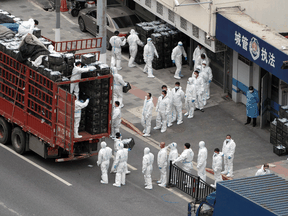
Shanghai's 25-million residents have been cooped into lockdown for weeks, unable to leave their homes except for COVID testing, and living with food shortages caused by the enforced total lockdown. A lockdown originally meant to last a few days, but that has been ongoing now for weeks with no indication how long it may last, as long as COVID-positive cases continue to present and authorities continue to react with draconian methods of isolation. The situation led to people shouting in desperation from open windows in their apartments and from balconies.
 
People wearing personal protective equipment transfer food supplies and necessities for local residents during a COVID-19 lockdown in Shanghai, April 5, 2022.
People wearing personal protective equipment transfer food supplies and necessities for local residents during a COVID-19 lockdown in Shanghai, April 5, 2022. Photo by AFP via Getty Images
 
The protests spurred officials to seek a solution to the angry social protests, including media posts in a country not known to tolerate dissent. The solution? Drones, circulating in neighbourhoods with very specific messages: "Please comply with COVID restrictions. Control your soul's thirst for freedom. Do not open your windows and sing", the female voice instructs.

Children separated from their parents when found to be COVID-positive. This is a reflection of China's   COVID-zero policy meant to completely eradicate, not merely control SARS-CoV-2. The virus is not responding positively to that goal, however, and the method finds no wide public acceptance. Chinese health authorities who subscribe to the COVID-zero manoeuvres insisting on complete lockdown to effectively beat virus transmission, appear not to have reckoned with the high transmissibility of the Omicron strain.
 
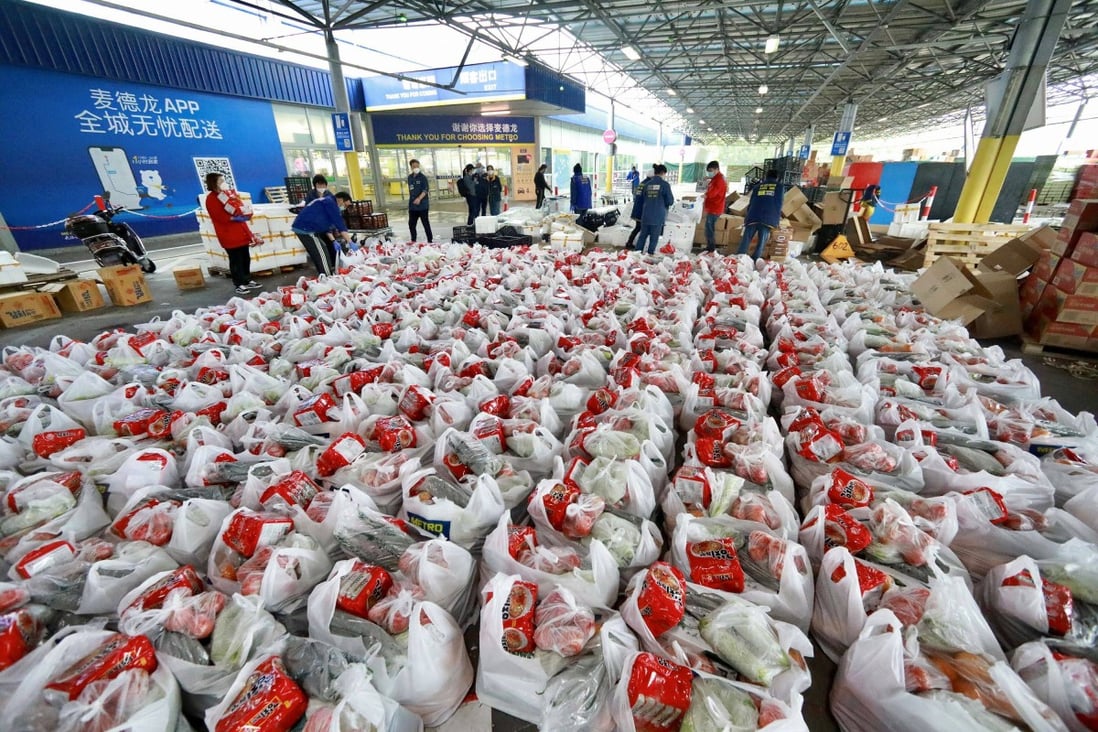
Staff members organise mass food orders from locked down Shanghai residents. Photo: Reuters
Staff members organize mass food orders from locked down Shanghai residents. Photo: Reuters

"Judging from how this pandemic is being handled by different leaderships and systems ... [we can] clearly see who has done better", China's President Xi Jinping has boasted in the past. And it did realize a good measure of success with pop-up cases here and there and swift responses in fragmented areas, quickly contained. Until Omicron arrived and infections began reaching into the stratosphere, as much as 15,000 daily of late. Beijing's firm orders for Shanghai's total lockdown reflected its wish to avoid the disaster in Hong Kong.

Hong Kong's own COVID-zero achievements were blown to smithereens when three million people were infected and mass deaths occurred. In both areas low vaccination rates among people aged 80 and over and lack of access to mRNA vaccines seem partly to blame. That the most vulnerable age group in the populations have not been vaccinated seems like an an avoidable Achilles heel that should not have gone unaddressed. China's home-grown vaccines have a relatively low efficacy rate; somewhere around 50% and less, compared to the mRNA vaccines.

Locked into their homes the population has been unable to work, attend school, shop, attend medical appointments. The government plan to supply people with food deliveries has overburdened commercial delivery services, the result of which has been that a great many people face starvation, deprived of food access. Clearly, China's approach to stifling the virus that originated in Wuhan, China and went on speedily to infect the global population, has been nothing to celebrate as a success.

Workers in protective suits disinfect an old residential area under lockdown amid the COVID-19 pandemic, in Shanghai on April 15.  ALY SONG/Reuters

Labels: , , , , , , , ,

Thursday, May 03, 2018

Feeling Virtuous About Our Excellent Food Choices, Are We?

Abstract : Improving diet quality while simultaneously reducing environmental impact is a critical focus globally. Metrics linking diet quality and sustainability have typically focused on a limited suite of indicators, and have not included food waste. To address this important research gap, we examine the relationship between food waste, diet quality, nutrient waste, and multiple measures of sustainability: use of cropland, irrigation water, pesticides, and fertilizers. Data on food intake, food waste, and application rates of agricultural amendments were collected from diverse US government sources. Diet quality was assessed using the Healthy Eating Index-2015. A biophysical simulation model was used to estimate the amount of cropland associated with wasted food. This analysis finds that US consumers wasted 422g of food per person daily, with 30 million acres of cropland used to produce this food every year. This accounts for 30% of daily calories available for consumption, one-quarter of daily food (by weight) available for consumption, and 7% of annual cropland acreage. Higher quality diets were associated with greater amounts of food waste and greater amounts of wasted irrigation water and pesticides, but less cropland waste. This is largely due to fruits and vegetables, which are health-promoting and require small amounts of cropland, but require substantial amounts of agricultural inputs. These results suggest that simultaneous efforts to improve diet quality and reduce food waste are necessary. Increasing consumers’ knowledge about how to prepare and store fruits and vegetables will be one of the practical solutions to reducing food waste.
PLOS One  Zach Conrad, Meredith T. Niles, Deborah A. Neher, Eric D. Roy, Nicole E. Tichenor, Lisa Jahns 
food-waste-in-value-food-chain
"Eating healthy is important, and brings many benefits, but as we pursue these diets, we must think much more consciously about food waste."
Meredith Niles, study-co-author

"Food waste is an issue that plays out at many different levels. Looking at them holistically will become increasingly important to finding sustainable ways of meeting the needs of a growing world population."
Zach Conrad, study lead author
1.3 billion tonnes of food is lost or wasted every year around the globe
1.2 billion tonnes of food is lost or wasted every year around the globe. Food and Agriculture Organization of the United Nations
Consumer education is of primary importance in the preparation and storage of food, as well as acquiring the capacity to assess when foods still retain their nutrient value, remain fresh enough to consume, as opposed to appearing superficially damaged, but still nutritionally edible.

It is safe enough to venture the opinion, one might feel, that experience is the gateway to knowledge. That people who have handled food products for a long period of their lives have that familiarity, that the researchers speak to the lack of familiarity of new food consumers learning their way around the corridors of food edibility, preparation, hygiene and safety.

What they have focused on in their study recently published in PLOS One, was that those consumers who base their nutritional intake on "higher quality diets", surprisingly enough generate the most food waste. The link they make between diet quality and food waste reveals that vegetables and fruits are misused casually on a more frequent basis than other food categories, according to study co-author Meredith Niles.

It is true in a society in which all manner of foods are readily available, we tend to take their presence for granted, and in so doing fail to take the care we should to ensure we use those primary foods while they are still fresh and holistically nutritious. Failing to do so creates waste when the food spoils and must be discarded.

Our penchant for spurning food that fails to have that perfect appearance despite that its nutritional value is no different from visually pleasing counterparts does us no credit in respecting food choices, as well.
The Passionate Eye  Wasted! The Story of Food Waste – Chef

The study demonstrated that in the United States fruits, vegetables and mixtures incorporating both result in about 39 percent of total daily food waste, while the second most squandered category is dairy at 17 percent, meat at 14 percent, and finally grains, at 12 percent waste. Foods of lesser quality such as processed products, potatoes, soup, nuts and eggs together represent less than ten percent wastage.

Yet, though lower quality diets generate less food waste, the implications appear to be that "low nutritional value and higher rates of cropland wasted".

The average American's waste quotient adds up to close to a pound of food daily (454 grams). Canadians, on the other hand, also appear to represent themselves among the world's worst food-wastage offenders.

CBC Marketplace spent six months investigating the food that supermarkets throw out. Marketplace staff found dozens of bins full of food behind two Toronto-area Walmart locations. (CBC)


Labels: , , , ,

Wednesday, January 28, 2015

Hunger Gnaws in Nunavut

"There's always been incidents of starvation."
"Economically Inuit were now [with collapse of fox fur trade] in really serious trouble."
"Inuit were moved around [government Northern relocation]. The attitude was, 'Well, you know, what the hell? They can survive anyplace there's snow and caribou and foxes to be had."
"By the mid-1950s, the government sort of saw what they thought was the handwriting on the wall. That Inuit were going to have to be modernized instead of kept in their traditional lifestyle."
Frank Tester, Arctic historian, University of British Columbia

"Bringing something as private as poverty and the fact that you're hungry and you're food insecure, that's very different."
"I think people are saying, 'This is not a hidden problem. We can't pretend it doesn't exist anymore'."
"There is a disparity -- not only ethnically, but also the social classes."
former Iqaluit mayor Madeleine Redfern

"When farms do not make enough produce, farmers are given a lot of subsidies across Canada. But in Canada's Arctic, prices are rising in terms of bullets, ammunition and Ski-Doos, the equipment. So it's more costly to hunt."
Cathy Towtongie, president, Nunavut Tunngavik

  • The shelves at the Northern Store in Arctic Bay, Nunavut, in February 2011 show very high prices for things like processed cheese spread, infant formula and instant noodles. Nunavut MLA Ron Elliott, who represents Arctic Bay, says the prices of these items have risen in Nunavut's High Arctic communities since the federal government started changing its northern food subsidy program last year. (Submitted by Ron Elliott)
  • The shelves at the Northern Store in Arctic Bay, Nunavut, in February 2011 show very high prices for things like processed cheese spread, infant formula and instant noodles. Nunavut MLA Ron Elliott, who represents Arctic Bay, says the prices of these items have risen in Nunavut's High Arctic communities since the federal government started changing its northern food subsidy program last year. (Submitted by Ron Elliott)
The Government of Canada initiated a $60-million food subsidy called Nutrition North to alleviate the burden of food cost for Northern residents of Canada. The high cost of shipping food to the North meant that prices for ordinary food fundamentals were sky-high, unaffordable but for the very necessities, and even those beyond the reach of many of Nunavut's residents. The Northern AirStage Program of the 1960s also known as FoodMail was initiated to try to amend the problem.

That program of subsidizing shipping costs changed in 2011 to Nutrition North, where food retailers were granted a subsidy based on the weight of eligible foods shipped to eligible communities. Canada's auditor general, after recent careful scrutiny, reached the conclusion that the Aboriginal Affairs Department erred in not selecting eligible communities based on need. That designation was instead granted communities based on year-round road access and whether they had made use of the old FoodMail program.
mi-iqaluit-protest-june-9-2012
Leesee Papatsie, the organizer of the Feeding my Family protests, speaks to the crowd Saturday in Iqaluit. (Ronald Elliott)

Those communities that had seldom used the program are under the new one eligible only for a partial subsidy; those that hadn't used it at all, have no eligibility under the new program. "Consequently, community eligibility is based on past usage instead of current need", the audit found; a poor measure of need. Auditor General Michael Ferguson was informed by Aboriginal Affairs that to expand the full subsidy to some 50 fly-in northern communities would increase the cost by $7-million annually.

That niggling problem was solved somewhat with the federal government increasing its spending on the program by another $11.3-million over the following year. Under the current program, merchants are not required to report profit margins, a yardstick of measurement that would reveal whether the full subsidy is being passed on to the consumer. As of April 1, another change has been made where retailers will have to give that information on their current and long-term profit margins.

Organizer of the June 14 food protest, Leesee Papatsie, holds a sign at a protest held across the street from Northmart in Iqaluit. About a dozen people came out to raise awareness of overpriced and expired food in the North. (PHOTO BY DAVID MURPHY)

The emergence of a Facebook group calling itself "Feeding My Family" revealed to a wider audience the shocking price tags that people in Nunavut face when they trek into their local grocery store; the sheer unaffordability of eating decently. That revelation gave way to street protests. And it became clear that those going hungry are Inuit. Their record of unemployment is a hint of the problem they face. Nunavut's labour force represents 14,000 individuals, 9,500 of them Inuit.

A deeper look at the statistics indicate that 8,500 working-age Inuit are not included in the labour force, in comparison to 600 non-Inuit who are unemployed. During the last three months of 2014, the unemployment rate for Inuit in Nunavut stood at 17.9 percent. The territory's statistics bureau indicates that the number of people in Nunavut on social assistance during 2013 was 14,578. To place that in perspective, the total Nunavut population in 2011 was 31,906.

Inuit traditional foods called "country food" is represented by caribou, seal and whale meat. The Nunavut Food Security Coalition, comprised of representatives from the territorial government, Inuit organizations, industry and social groups, recommended that Inuit return to their tradition of hunting for their food. An enterprising former Edmontonian began a hunter's and trapper's market in Iqaluit, inviting hunters to sell their meat through his town market.

"The goal was really to change the conversation about how we deal with country food here in Iqaluit", said Will Hyndman who operates the market. But then, most of the hunters face another struggle; to be able to afford the price of ammunition and fuel, to be enabled to sell their the product of their hunting forays. In Iqalui,t people cope as well with the help of the soup kitchen operated by the city, or they turn to the food bank open two days a month.

The Niqinik Nuatsivik Food Bank, begun in 2001, served about 30 families at its outset. Currently, according to its chairman of the board, Stephen Wallick, 120 families benefit from food and supplies handed out every two weeks. The city's soup kitchen makes enough for 200 servings daily, sometimes finding it's not enough to serve everyone who needs the help.

There are suggestions that the federal government consider operating a program providing funding to hunters to enable them to buy equipment to hunt, fish and trap. Nunavut Tunngavik Inc.'s president feels the government should offer to offset the cost of hunting equipment in the North as a fair and just reflection of the way it aids in the subsidy of farmers in the rest of Canada.

How expensive are groceries in Nunavut? Shop for yourself by checking the items in the grocery cart to find out. 
CART
Celery (1kg)
Onions (1kg)
Canned tomatoes (796ml)
Baked beans (398ml)
White sugar (2kg)
Carrots (1kg)
Dried macaroni (500g)
French fries (1kg)
Bananas (1kg)
Mushrooms (1kg)
Canned soup (284ml)
Ketchup (1L)
Soda crackers (450g)
Oranges (1kg)
Potatoes (4.54kg)
Sliced bacon (500g)
Processed cheese (250g)
Apples (1kg)
Instant coffee (200g)
Bread (675g)
Hot dogs (450g)
Baby food (128ml)
Peanut butter (500g)
Butter (454g)
Canned salmon (213g)
Pork chops (1kg)
2% milk (1L)
Stewing beef (1kg)
Ground beef (1kg)
Eggs
(1 doz.)
Interactive background image.
Arctic Bay
$230.74
Interactive background image.
Arviat
$207.13
Interactive background image.
Baker Lake
$208.36
Interactive background image.
Gjoa Haven
$234.03
Interactive background image.
Igloolik
$214.63
Interactive background image.
Iqaluit
$203.19
Interactive background image.
Kugluktuk
$216.47
Interactive background image.
Pangnirtung
$242.20
Interactive background image.
Pond Inlet
$231.60
Interactive background image.
Rankin Inlet
$205.80
Interactive background image.
Canada
$113.99
Interactive background image.
Nunavut
$219.80
Interactive by Murat Yukselir/The Globe and Mail; Reporting by Josh Kerr for The Globe and Mail; Research by Josh Kerr for The Globe and Mail and Rick Cash/The Globe and Mail Sources: Food Price Survey Report August 2013/Nunavut Bureau of Statistics, Firstair.ca, Interviews with First Air and Arctic Co-op

Labels: , ,

 
()() Follow @rheytah Tweet