Ruminations

Blog dedicated primarily to randomly selected news items; comments reflecting personal perceptions

Friday, October 23, 2020

Fair Play and May the Best WoMAN Win!

"[Players] should be able to participate as the gender with which they identify and not be subject to requirements for disclosure of personal information beyond those required of cisgender athletes. Nor should there be any requirement for hormonal therapy or surgery."
Rugby Canada Guidelines for player inclusion: "I identify as female"
 
"She's [trans rugby player Kelly Morgan, 6' tall] going to be a good, good player for the next few years, as long as we can stop her injuring players in training."
founder, U.K. rugby team
 
"I do feel guilty, but what can you do? I don't go out to hurt anybody. I just want to play rugby." 
"I'm always optimistic and I think being open breaks the ice with people. I'm like, 'this is me, this is what I'm going through'." 
"Times are changing. Hopefully I'll inspire more people to come and play rugby, or any sort of sport."
Kelly Morgan/Nicholas Gareth Morgan, transgender rugby player
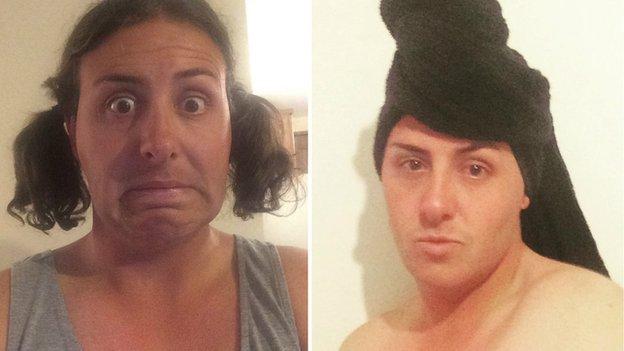
Kelly Morgan
'If you can't take the mick out of yourself, then what's the point?'

 The World Rugby association investigated the harms women are vulnerable to in contact sports under inclusion rules, bringing together professional experts in the study of biology, sociology and kinesiology for the purpose of updating eligibility standards for player inclusion. The consultation committee based its study and conclusions on data the Karolinska Institute of medical academic research, in Sweden had published.
 
And that data led them to conclude that even following IOC hormone reduction guidelines, genetically male athletes are on average 40 percent heavier, 15 percent faster, 30 percent more physically powerful and 25 to 50 percent stronger than are female athletes; enormous spreads that make a world of difference in the time, and distance measurements distinguishing gold from silver.  

Injury to female athletes tends to increase by 30 percent when paired against genetically male competitors. The World Rugby Council issued a resolution on October 9 with respect to transgender participation: "Transgender women may not play women's rugby", representing a first for a sport federation to go its separate way from the IOC on the issue.

Ice Hockey, rugby and ringette are recognized as the riskiest of sports among youth between the ages of five to 19, for brain injuries. Brain injuries account for 27 to 44 percent of all physical harms sustained during games. Yet it is the 'hurt feelings' that may result when "gender identity and gender expression" fail to be given the respect due them that appears to rate.

The safety issue, however, is paramount, or should be, in playing hard-contact sport. Female athletes who compete against genetically male athletes don't necessarily feel safe even in non-contact sports. Three female Connecticut high school runners launched a federal Title 1X lawsuit in reflection of the fact that over three competitive seasons from 2017 to 2019, two genetically male athletes won gold and silver in 15 women's state championship titles.

The U.S. Department of Education Office for Civil Rights agreed that Franklin Pierce University in New Hampshire's transgender sports and inclusion policy violated Title 1X prohibiting discrimination in educational programs and activities on the basis of sex. This was a resolution of a civil rights claim brought by Concerned Women for America. The upshot was that FPU agreed to "rescind its Transgender Participation and Inclusion Policy and will cease any and all practices related thereto".

The complaint originated when transathlete CeCe Telfer competed in the 400m hurdles on the men's team in 2015 and 2017, ranking 390th in NCAA Division 2, then in 2018 he self-identified as a woman and became eligible to compete against women according to NCAA rules. He won the women's national championship in June 2020. His win was ascribed by his coach to attitude: "I've never met anyone as strong as her mentally in my life".
 
CeCe Telfer
Screengrab via Twitter/ NCAA Division II
"But there are all these disadvantages of competing in the 100 hurdles, you know?"
"First of all, my height, how tall I am, is a disadvantage, because the wind is hitting us so hard and the taller you are, the harder you fall, basically. There’s wind resistance."  
"[Another disadvantage:] The fact that the hurdles are so close. [smaller in women’s competition; six inches shorter than in men’s races, but more than half a meter closer together]."
“And there are people who say I have the benefit of testosterone. But no: I have no benefit. I’m on hormone suppression, it doesn’t help. It’s another disadvantage. Cis women are producing more testosterone than the average trans female."
"So it’s crazy! I’m the crazy one, to be the weakest female, the weakest link in the chain, to be competing against the top ones. I should be fingered as the stupid one, for wanting to do that in the first place."
CeCe Telfer, transgender athlete
The IOC has allowed biological males since 2015, self-identifying as female for a year to compete in women's sport as long as they reduce their testosterone levels to 10 nmol/1, higher as it happens, than the female testosterone range of .54 to 2.4 nmol/1. So much for testosterone comparability. 

CeCe Telfer, center, as seen moments prior to the start of the 60M hurdles.
Screengrab/NCAA


Labels: , , , ,

Sunday, July 26, 2020

Female Governing Intuition

"Our findings show that COVID-19 outcomes are systematically and significantly better in countries led by women. Even accounting for institutional context and other controls, being female-led has provided countries with an advantage in the current crisis."
"Risk aversion may manifest differently in different domains -- human life versus economic outcomes -- with women leaders being significantly more risk-averse in the domain of human life, but more risk-taking in the domain of the economy."
Report: Centre for Economic Policy Research, Washington
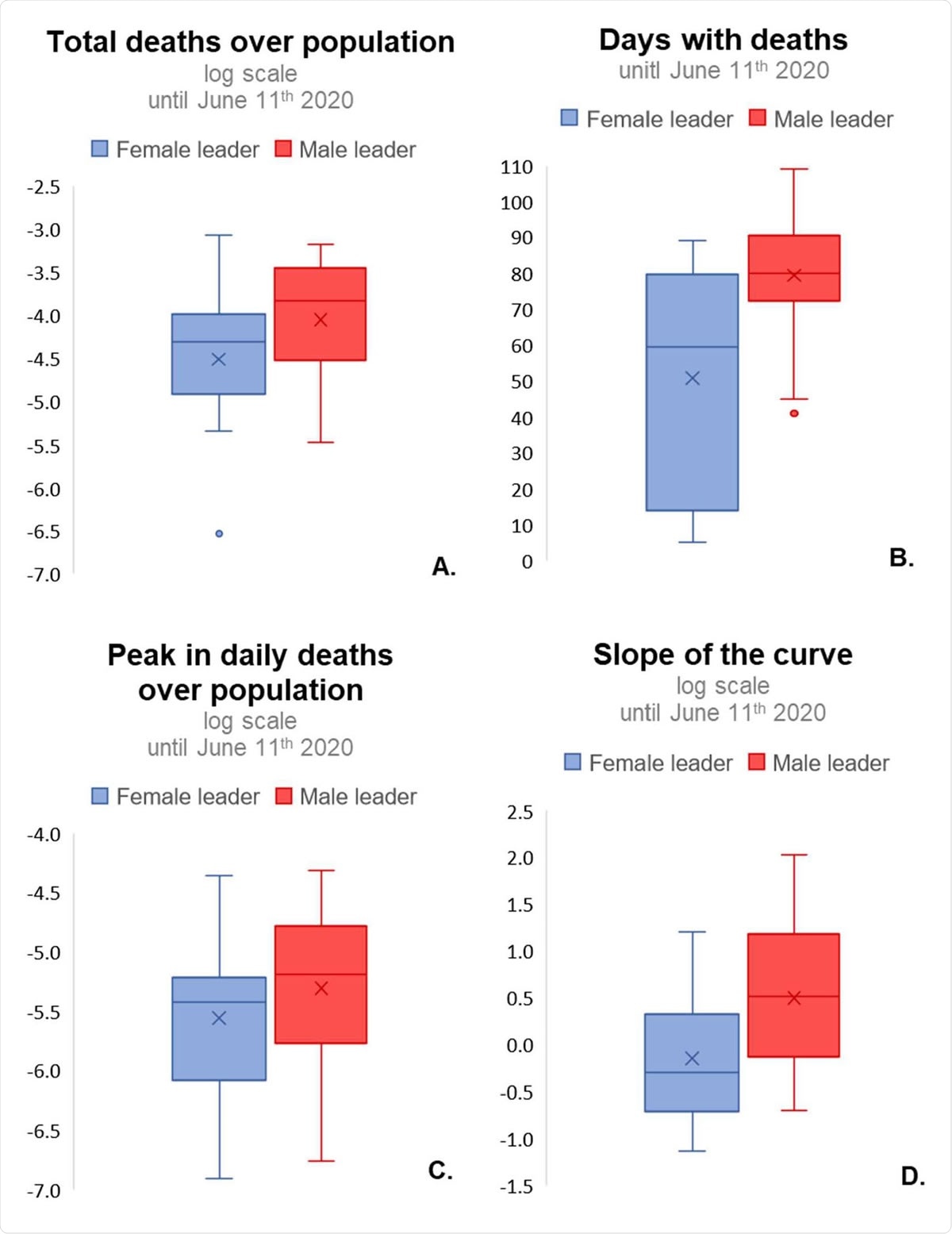
Box-plot of main impacts of COVID-19 in countries with male leaders and countries with female leaders.

A new study published by economists Supriya Garikpati and Uma Kambhampati under the imprint of the Centre for Economic Policy Research lays claim to having proven without a doubt that those countries led by women have been superior in controlling the global pandemic for their nations' ultimate benefit, right from the very start when the world was placed on high alert that a global pandemic was in the process of laying the world low.

It isn't all that hard to identify those countries where the executive administration in collaboration with the individual nations' top health advisers have conducted a poorly-envisioned and -outcomed national strategy to deal with the fallout of the SARS-CoV-2 virus causing COVID-19, simply by reviewing the numbers of infected cases and the deaths caused by COVID-19. The United States, where the research for the study citing women-led outcomes as superior, a case in point for high infection and death rates.

The top ten  countries in the world whose outcomes have been poor are all male-led, according to the Independent, with a cautionary note from the report's authors that every country possesses variables unique to the country itself, making a one-on-one comparison difficult. And then there is the simple fact that merely ten percent of nations worldwide are led by women to begin with.

Collage of images of Angela Merkel and Jacinda Ardern
Photo-Illustration: Sam Whitney; Getty Images
The report's authors began by comparing women-led countries with other countries and matching  demographics linked to the spread of the coronavirus; primarily population size and GDP, so New Zealand for example, was matched with Ireland, Germany with the United Kingdom, and Bangladesh with Pakistan.

What the investigators found across the board is that those countries with fewer COVID-19 cases were all led by women, and fewer deaths occurred in those women-led countries than occurred in those countries governed by their male counterparts.

Led by Jacinda Ardern, New Zealand's 1,455 cases and 22 deaths compared favourably with Ireland's counts of 25,826 cases of coronavirus and 1,763 deaths reported as caused by the complications linked to COVID-19. The disparity could conceivably be linked to the fact that women-led countries were more inclined to swiftly bring in social distancing regulations and impose lockdowns to curb the first wave of the virus, according to the report's authors.

Women, according to the research conclusion. are more averse to risks in comparison to their male counterparts. Representing a potential explanation clarifying why it is that countries led by women made the determination to lock down more immediately than their male-led counterpart nations. The added recognition that women are more risk-averse relating to saving lives meant that women were conversely prepared to risk their economies, in exchange.

Taiwanese President Tsai Ing-wen celebrates victory with her supporters in Taipei. Taiwan has managed to curb the coronavirus pandemic despite its proximity to China. (AP Photo/Chiang Ying-ying)

Labels: , , ,

Thursday, August 29, 2019

Female Heart Risk Data

"[Being female is a] statistically significant risk factor for dying after surgery."
"These established sex differences explain our overall observation of lower estimated long-term survival in women after cardiac surgery and of female sex being an independent risk factor for long-term mortality."
"[The risk of dying after bypass surgery remains low; in the one percent rage.] But out of that one percent, we are seeing more women than men."
Dr. Louise Sun, cardiac anesthesiologist, clinical scientist, University of Ottawa Heart Institute

"Given the substantial sex differences in patient presentation for coronary and valvular heart disease, further efforts need to be directed at the education of both physicians and patients in the early recognition of acute presentation of cardiac disease in women."
Research Study authors 
Cardiogram monitor in surgery Fotolia
A study recently published in the Journal of the American Heart Association where over 72,000 Ontario cardiac patients were involved, found women likelier to die than their male counterparts following coronary artery bypass surgery or valve surgery, including both combined, within thirty days -- including in the longer term. Researchers at the University of Ottawa Heart Institute and the University Health Network in Toronto, conducted the study which now becomes part of the evidence steadily mounting pointing out that heart disease and surgical outcomes are vastly different between men and women.

Of the 72,824 Ontario patients who had undergone cardiac bypass and valve surgeries in the years 2008 to 2016, the majority represented male patients, a reflection that heart disease afflicts a greater number of men than it does women. Of those studied, twenty-five percent were women. While women were seen to have significantly higher rates of death compared to men following coronary artery bypass surgery and combined bypass and mitral valve surgery, women had lower rates of long-term mortality after isolated mitral valve replacement.

Men, on the other hand, experienced lower death rates after isolated mitral valve repair, findings that led researchers to the conclusion that women are plagued with "long-term mortality" in the wake of cardiac surgery. Several plausible reasons were considered, explaining women's high death rates; one, that women tend to be more age-advanced than men when cardiac bypass surgery is required; they are more physically frail, and more medically complex, frequently associated with additional health issues like diabetes and hypertension.

Apart from those common gender-difference reasons, women frequently experience treatment delays where men do not tend to, leading to their conditions becoming more seriously impacted by the time surgery appears on the horizon. Among medical complexities in female patients, pointed out Dr Sun, is that some patients undergoing bypass and mitral valve surgery have had a previous undetected heart attack which might explain why they require surgery to replace a leaky mitral valve.

Additionally, sex-specific risk-prediction models for patients undergoing cardiac surgery is needed, for which a suitable protocol is currently being worked on.

Heart attack symptoms for women

The most common heart attack symptom in women is some type of pain, pressure or discomfort in the chest. But it is not always severe or even the most prominent symptom, particularly in women. And, sometimes, women may have a heart attack without chest pain. Women are more likely than men to have heart attack symptoms unrelated to chest pain, such as:
  • Neck, jaw, shoulder, upper back or abdominal discomfort
  • Shortness of breath
  • Pain in one or both arms
  • Nausea or vomiting
  • Sweating
  • Lightheadedness or dizziness
  • Unusual fatigue
Mayo Clinic

Labels: , , , , ,

 
()() Follow @rheytah Tweet