Ruminations

Blog dedicated primarily to randomly selected news items; comments reflecting personal perceptions

Sunday, July 26, 2020

Female Governing Intuition

"Our findings show that COVID-19 outcomes are systematically and significantly better in countries led by women. Even accounting for institutional context and other controls, being female-led has provided countries with an advantage in the current crisis."
"Risk aversion may manifest differently in different domains -- human life versus economic outcomes -- with women leaders being significantly more risk-averse in the domain of human life, but more risk-taking in the domain of the economy."
Report: Centre for Economic Policy Research, Washington
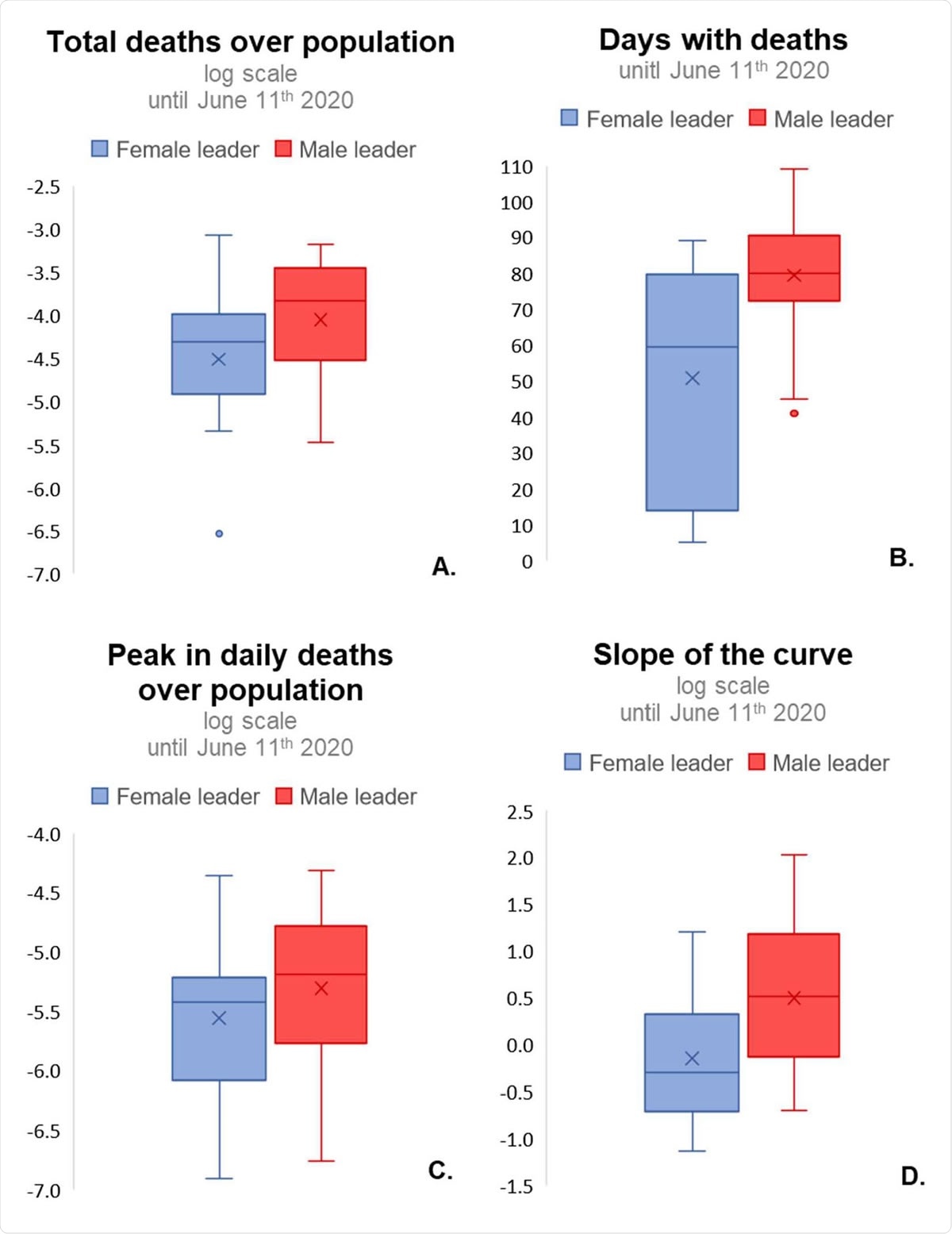
Box-plot of main impacts of COVID-19 in countries with male leaders and countries with female leaders.

A new study published by economists Supriya Garikpati and Uma Kambhampati under the imprint of the Centre for Economic Policy Research lays claim to having proven without a doubt that those countries led by women have been superior in controlling the global pandemic for their nations' ultimate benefit, right from the very start when the world was placed on high alert that a global pandemic was in the process of laying the world low.

It isn't all that hard to identify those countries where the executive administration in collaboration with the individual nations' top health advisers have conducted a poorly-envisioned and -outcomed national strategy to deal with the fallout of the SARS-CoV-2 virus causing COVID-19, simply by reviewing the numbers of infected cases and the deaths caused by COVID-19. The United States, where the research for the study citing women-led outcomes as superior, a case in point for high infection and death rates.

The top ten  countries in the world whose outcomes have been poor are all male-led, according to the Independent, with a cautionary note from the report's authors that every country possesses variables unique to the country itself, making a one-on-one comparison difficult. And then there is the simple fact that merely ten percent of nations worldwide are led by women to begin with.

Collage of images of Angela Merkel and Jacinda Ardern
Photo-Illustration: Sam Whitney; Getty Images
The report's authors began by comparing women-led countries with other countries and matching  demographics linked to the spread of the coronavirus; primarily population size and GDP, so New Zealand for example, was matched with Ireland, Germany with the United Kingdom, and Bangladesh with Pakistan.

What the investigators found across the board is that those countries with fewer COVID-19 cases were all led by women, and fewer deaths occurred in those women-led countries than occurred in those countries governed by their male counterparts.

Led by Jacinda Ardern, New Zealand's 1,455 cases and 22 deaths compared favourably with Ireland's counts of 25,826 cases of coronavirus and 1,763 deaths reported as caused by the complications linked to COVID-19. The disparity could conceivably be linked to the fact that women-led countries were more inclined to swiftly bring in social distancing regulations and impose lockdowns to curb the first wave of the virus, according to the report's authors.

Women, according to the research conclusion. are more averse to risks in comparison to their male counterparts. Representing a potential explanation clarifying why it is that countries led by women made the determination to lock down more immediately than their male-led counterpart nations. The added recognition that women are more risk-averse relating to saving lives meant that women were conversely prepared to risk their economies, in exchange.

Taiwanese President Tsai Ing-wen celebrates victory with her supporters in Taipei. Taiwan has managed to curb the coronavirus pandemic despite its proximity to China. (AP Photo/Chiang Ying-ying)

Labels: , , ,

Wednesday, September 04, 2019

Yet Another Pathological Eating Nightmare

"Popular media have highlighted the risks for poor cardiovascular health, obesity and cancer associated with junk food, but poor nutrition can also permanently damage the nervous system, particularly vision."
"That means [youth diagnosed with optic neuropathy] he can't drive and would find it really difficult to read, watch TV or discern faces."
"He can walk around on his own though, because he has got peripheral vision."
"Initially, they may struggle to function [body cells lacking a variety of nutrients to enable normal functioning] with depleted supplies but eventually they [the cells] will die."
"So, problems take a long time to develop [following four years on the chosen restrictive diet]."
Dr. Denize Atan opthalmologist, Bristol Eye Hospital

"However, the patient confessed that, since elementary school, he would not eat certain textures of food."
"He had a daily portion of fries from the local fish and chip shop and snacked on Pringles [Kellogg], white bread, processed ham slices, and sausage."
"[Unlike anorexia nervosa], avoidant-restrictive food intake disorder [is not driven by concerns about body image or weight gain. It tends to strike in middle childhood in a sudden lack of interest in food, a heightened sensitivity to certain textures and] fear of the consequences of eating."
"Nutritional optic neuropathy should be considered in any patient with unexplained vision symptoms and poor diet, regardless of BMI."
Bristol research team: "Blindness caused by junk food diet"
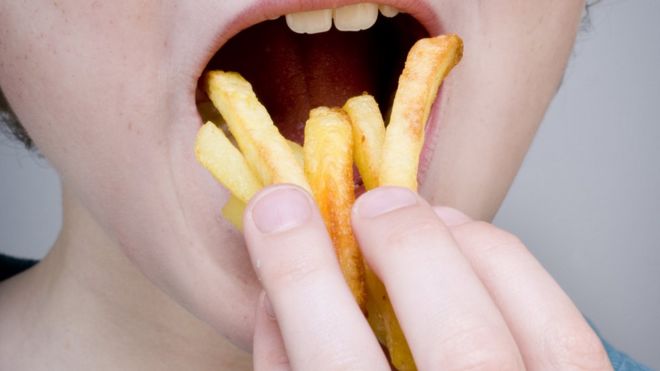
person eating chips
Getty Images

A study of a case linked to the fairly newly coined "avoidant-restrictive food intake disorder" (ARFID), recently added to the fifth edition of the Diagnostic and Statistical Manual of Mental Disorders, was published in Annals of Internal Medicine, titled "Blindness caused by junk food diet", chronicling the case of a 14-year-old from Bristol, brought to his family doctor when he complained of feeling constantly tired. The boy seemed well enough but he was described as a "fussy eater".

The examining physician diagnosed him with macrocytic anemia -- abnormally large red blood cells -- along with low levels of vitamin B12. After which B12 injections were prescribed, and the boy was advised to expand his diet sensibly, to begin eating a healthier diet. Instead, he began to develop loss of hearing after a year and then started complaining of problems with his vision which grew more compromised over the following two years. He was eventually sent on to Bristol Eye Hospital. And there Dr. Atan diagnosed damage to the optic nerve.

Alcohol, tobacco or drug use were all ruled out as a causative. The boy denied ever using any of them. He was of normal-to-average height and weight as was his body mass index. The vitamin B12 shots had gone by the wayside, leaving him with low levels of copper, selenium and vitamin D levels as well as abnormally high zinc levels -- and he was losing bone mass. Placed on nutritional supplements, he was referred to a mental health expert for validation of a suspected eating disorder.

His vision appeared to stabilize, leaving him, however, with permanent blind spaces in the centre of both his eyes. Malnourishment causing optic neuropathy is rare in developed countries, and caught early enough the condition can be reversible. However, left untreated, it leads to permanent blindness. Now 19 and studying information technology, the young man is registered with sight impairment and will never drive a vehicle.

Image result for photo, veggie burger
InspiredTaste Veggie Burger

Selective eating deliberately and severely restricted to inexpensive, nutritionally vacant junk foods cause multiple vitamin deficiencies creating a recognized eating disorder. And according to Dr. Atan writing as well in The Conversation, it is quite possible that nutritional optic neuropathy will become more commonly diagnosed given recent trends.
"For example, the wide-spread consumption of junk food at the expense of more nutritious food and the rising popularity of veganism can lead to vitamin D and B12 deficiencies, because fish, meat, eggs and dairy are the main dietary sources of these vitamins."

While it is possible to remain healthy eating a vegan diet that is plant-based, including a variety of fruit and vegetables, nuts, seeds and grains, "...this still needs to be supplemented with B12 in particular, as animal products are the main source of B12."

vitamin tablets
Getty Images


Labels: , , , , ,

Saturday, March 02, 2019

Artificial Intelligence 'Trained' to Diagnose Medical Conditions

"In some situations, physicians cannot consider all the possibilities. This system can spot-check and make sure the physician didn’t miss anything."
"The sheer size of the population [in China] — the sheer size of the data [advantages researchers in China in collecting and assessing data] — is a big difference."
Dr. Kang Zhang, chief of ophthalmic genetics, University of California

"You have go to multiple places. The equipment is never the same. You have to make sure the data is anonymized."
"Even if you get permission, it is a massive amount of work."
Dr. George Shih, associate professor of clinical radiology, Weill Cornell Medical Center

"Medicine is a slow-moving field."
"No one is just going to deploy one of these techniques without rigorous testing that shows exactly what is going on."
Ben Shickel, researcher, University of Florida
aimed-02131901
Doctors competed against A.I. computers to recognize illnesses on magnetic resonance images of a human brain during a competition in Beijing last year. The human doctors lost.  CreditMark Schiefelbein/Associated Press
  
A collaboration between researchers in the United States and China has resulted in the testing of a potential corrective for the frequent inability of humans to find solutions, to adequately assess data, and to produce correct diagnoses. This is where artificial intelligence comes in, in its ability to do all these things free of human frailties, depending only on an elite mechanistic influence that calibrates and assesses and reaches logical conclusions.

System have been built by scientists capable of automatically diagnosing common conditions afflicting children after the patient's symptoms, history, lab results and other clinical data has been processed; the system producing highly accurate conclusions. A system that holds out great promise as one day being viewed as sufficiently dependable to act as a huge assist to doctors in diagnosing complex or rate conditions whose symptoms elude many doctors.

The records of close to 600,000 Chinese patients who had visited a pediatric hospital over a period of a year and a half were drawn upon for the data useful in training the new system. The very reality of the most populous country on the planet producing logistics to enable this type of research speaks volumes of the advantages to Chinese researchers using their own population numbers as a base for their research.

Not only is the Chinese population enormous, but the state itself fails to involve itself in the kind of human rights concerns exerted in Western democracies; the protection of health and other types of personal information; with fewer restrictions on sharing digital data, it becomes simpler for Chinese researchers to engage in designing "deep learning" systems for health care which in turn advantages China in general in the global race to achieve the pinnacle of artificial intelligence.

Systems are being developed by many groups to analyze electronic health records to flag medical conditions like osteoporosis, diabetes and heart failure. Technologies with similar aims are being built for the purpose of detecting signs of illness in X-rays, M.R.I.s and eye scans, the systems reliant on neural networks, a type of artificial intelligence capable of 'learning' tasks independently through analyzing vast tracts of data.

Dr. Kang Zhang, chief of ophthalmic genetics at University of California, San Diego, has been involved in building systems to analyze eye scans for the presence of hemorrhages, lesions and related signatures of diabetic blindness with a view to serving as a first line of defence, screening patients and identifying who among them would require additional attention.

A newer system developed by Dr. Zhang's laboratory is one capable of diagnosing a wider range of conditions through the recognition of text patterns, not merely in medical images alone. A report by the scientists involved was published in the journal Nature Medicine.

Medical records of close to 600,000 patients at the Guangzhou Women and Children's Medical Center in southern China were utilized for the experimental system to analyze, in the process 'learning' to associate common medical conditions with specific patient information gathered by doctors, nurses and allied technicians. Initially, physicians annotated hospital records, identifying information by labels related to specific conditions which the system then analyzed.

New information was then provided including patients' symptoms, enabling the device to make connections between records and symptoms. The software, when tested on unlabeled data, rivaled the performance of experienced physicians, its diagnoses of asthma over 90 percent accurate, while physician accuracy ranged from 80 to 94 percent.

Neural networks can be extremely powerful in their capacity to recognize patterns in data which human intelligence might never identify on their own, but experts too, experience difficulty understanding why the systems make specific decisions and how they 'teach' themselves.

Labels: , , , , ,

Thursday, August 09, 2018

Zika: It's Not Over Until It's Really Over....

"We are still early in the Zika story, and we still have lot to learn about how these children will grow and develop. We expect there will be multiple outbreaks in the future [around the world]."
"I think the bottom line is that the Zika story is not over. People may feel like it's behind us. For these children, it's not over, and we need to know as much as possible so that we can be prepared [should something similar happens again]."
"There remain] opportunities for improvement [in the screening of children who may have been exposed to Zika in utero]."
"We really urge parents to get recommended care — brain images after birth, having measurements taken, getting a developmental screening and having an eye evaluation."
Margaret Honein, director, U.S. Center of Disease Control Division of Congenital and Developmental Disorders

Maria de Fatima, right, joins her 18-month-old son, Joaquim, who was born with Zika-related microcephaly, in a manual-dexterity therapy session in Recife, Brazil, in May. (Eraldo Peres/AP)

The U.S. Centers for Disease Control advised couples to abstain from sex or to use condoms for a minimum six-month period following the event of a male partner contracting Zika. That has now changed, changed however in recognition of the importance of new findings, leading health officials to alter that recommendation only this week, from six to three months since research newly concluded that one of every seven babies born to American mothers infected with Zika during pregnancy developed a health condition of some kind. Linked to that finding is that the risk of sexual transmission is narrower than was thought to be the case.

The findings in question represent the data outcome of the first long-term study of its kind. Focusing on Puerto Rico and other U.S. territories where most Zika cases were discovered as the disease swept across the Americas over two years ago, children born with the Zika syndrome pointed researchers toward the sheer numbers involved. Infection during pregnancy can lead to severe brain-related birth defects in babies, even though when most people become infected they may have symptoms ranging from mild to irritating but they don't tend to become ill.

Letting down their guard and failing to realize that although adults are able to shrug off the symptoms of Zika, pregnant women carrying the infection can transmit it in alarming numbers to their offspring. For babies there is no resemblance to the mild illness with fever, rash and joint pain that results in infected adults; infection during pregnancy can have infinitely more serious consequences. The new mega-study searched for the presence of medical conditions in these affected babies whose symptoms arose after birth.
The Associated Press
A mother stands in her home with her 2-month-old son, who was diagnosed with microcephaly – a condition linked to the mosquito-borne Zika virus – in Puerto Rico in 2016.  The Associated Press

This was a seriously ambitious study that looked at 1,450 infants of one year of age and older whose mothers had been infected while pregnant with the Zika virus. Most of these occurred in Puerto Rico, but American Samoa, the Marshall Islands, the U.S Virgin Islands and Micronesia births were also included in the survey. Six percent of the children had birth defects; abnormally small heads (microcephaly), damaged brains, or eye irregularities -- amounting to roughly 30 times the rate that afflicts the general population of children.

Later-developing problems likely Zika-caused, including seizures, developmental delays and difficulty swallowing or moving, encountered by the researchers, increased the percentage involved to 14% birth defects resulting from infected pregnancies. During the course of the study, researchers found that some children were not receiving medical attention to determine whether any problems existed. Only a third were recommended for eye exams by a specialist, half received a hearing evaluation and fewer than two-thirds were given brain scans.

The obvious  takeaway was that children requiring treatment or therapy or both will be missing out. Needless to say, poverty plays a part in factoring in who gets important medical advice and tests, and who does not. Lack of education surrounding the dangers involved and cautionary action to be taken is also reflected in poverty. Zika can be spread through sex or blood transfusions, not only through infected mosquitoes' bites.

Labels: , , , ,

Saturday, March 31, 2018

 Marijuana and Pain Management

The Globe and Mail
Fred Lum/Globe & Mail - an employee of a medical marijuana lab handling product

"I think we're in a desperate need for information at the moment."
"Obviously, we need information on both efficacy as well as safety. Does the drug [marijuana] work for a particular condition? Is it safe for patients to use?"
"Though it’s a preliminary study, this clinical trial is significant because we’re looking at two important things. 
"We’re studying how patients respond to the delivery system of vaporized cannabis and we’ll see if there’s a particular ratio of the two major compounds most likely to give an analgesic response. It’s groundbreaking in many ways. The study and people involved will help build our knowledge base. We’re acutely aware of how little information there is out there to help physicians make decisions with respect to medical cannabis."
Mark Ware, pain specialist, associate professor, Family Medicine and Anesthesia, McGill University
Canada s First Medical Cannabis Trial Seeks New Options For Arthritis Patients   The Production Process CanniMed Facilities  CanniMed

Medicinal cannabis lacks the "high" that distinguishes recreational marijuana, resulting from lower levels of THC present in the product. It is frequently prescribed for low-level pain management, targeting patients suffering with chronic pain. The drug is prescribed for various conditions, including glaucoma, post-traumatic stress disorder, Parkinson's-related tremors, and for pain originating from irritable bowel syndrome and Crohn's disease.

A new study on chronic pain has resulted in findings suggesting medicinal cannabis may present as an alternate prescription other than opioids, to offer relief to pain sufferers. Apollo Applied Research of Toronto funded this new research tracking the experiences of over 300 chronic pain patients over a three-year period, where over one-third of participants had been prescribed a regimen of opioids; oxycodone and fentanyl among them, known for the risk associated with addiction and the potential of fatal overdose.

Resulting surveys of participants in the study -- observations rather than experimental in nature -- found that 45 percent of opiate users reduced their dosage once they began cannabis treatment, with another 35 percent cutting out their opiates altogether. There are problems inherent in the use of any drug, and long-term overuse of marijuana has been linked with decreased memory capacity and impaired cognitive function, along with bronchitis.

Making it mandatory that rigorous scientific evidence be required with respect to potential health benefits. A group of ten medical professionals last month published a peer-reviewed guideline in the journal Canadian Family Physician, suggesting caution requires limited medical cannabinoid use because of "a lack of high-level research". Health Canada approved a first experimental trial in 2015; a randomized, double-blind study by researchers at McGill University, on the efficacy of cannabis treatment for osteoarthritic knee pain.

In the Apollo study every participant was given an individualized treatment plan formulated by their own physician. Researchers followed up by having each participant complete standardized surveys, to determine whether they felt any reduction in the intensity and frequency of pain, along with any other improvements perceived to their quality of life. Participants overall responded with a 20 percent reduction in the severity of symptoms as well as a dramatic reduction in opiate use.

"In total it was close to about 75 percent to 80 percent of [opioid users] that stopped or reduced their opioid use", stated Apollo Applied Research's director of clinical research, Genane Loheswaran. Who elaborated, explaining that the Apollo researchers have as well been searching out cannabis effects among patients suffering from post-traumatic stress disorder, with equally promising results. Apollo has spent over $1-million on this study, but it earns a profit from its relationship with licensed cannabis producers.

Neither of its studies has been published by a peer-reviewed journal as yet. Apollo Applied Research is a division of Apollo Cannabis Clinics, which operates a national referral service for medical marijuana, along with two dedicated clinics in Toronto. They cannot possibly be considered a disinterested source. In defence of his company's interests, Bryan Hendin, company president, stated: "If you look at it for Pfizer, to get a medication out, they're not asking someone else to pay for their clinical trial. At the end of the day, this data will speak for itself."

Dr. Ware, a renowned pain specialist who had been involved in the osteoarthritis study, is himself funded by industry producers Prairie Plant Systems and CanniMed, believing that studies are reviewed, crucially by an ethics board and that findings are submitted for peer review within a credible journal. "I think we still have got a long way to go before we can make recommendations, but it's an area that deserves very serious and very careful attention", he concluded.
"Many physicians are worried that patients who ask for medical cannabis want to use it for recreational purposes. Yet we hear repeatedly from patients that they’re trying to control severe symptoms and cannabis appears to be helping them. They want to achieve a quality of life they can’t have with other medication. By studying medical cannabis we’re trying to strike a balance between what patients tell us and address physicians’ concerns. The hope is to find a happy medium, a dose patients can safely use that minimizes side effects but helps them live with less pain."
Mark Ware, pain specialist, associate professor, Family Medicine and Anesthesia, McGill University

Labels: , , , , ,

 
()() Follow @rheytah Tweet