Ruminations

Blog dedicated primarily to randomly selected news items; comments reflecting personal perceptions

Friday, December 21, 2018

The Franklin Terror and Erebus Northwest Passage Expedition
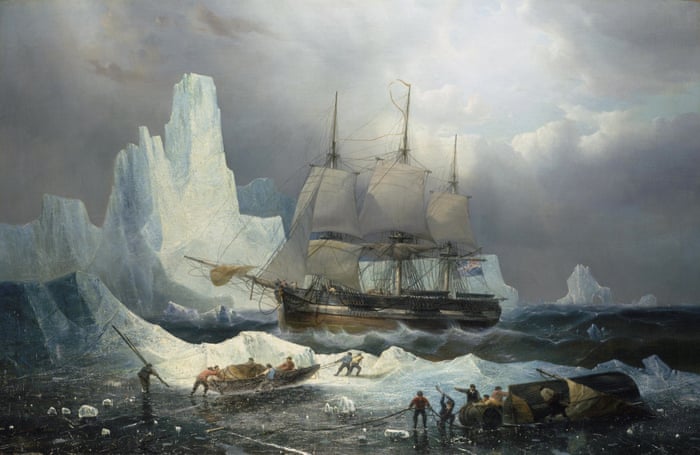
Francois Etienne Musin’s Erebus on Ice (1846) Photograph: National Maritime Museum
"People are superstitious. They feel there is a connection between the deaths and disturbing the wreck sites."
"My late mother told me, even before these wrecks [HMS Terror and Erebus of the 1845 Arctic Franklin expedition] were discovered ... the whole King William Island has non-human people that we cannot see."
"It's a funny feeling when we get on the other side of the island. You sense that somebody's around you, but there's nobody around you."
"It was always like that, even before these shipwrecks were found."
"My mother used to warn me] Don't let them get to you – just do what you have to do."  
Jacob Keanik, president, Nattilik Heritage Centre, Gjoa Haven, King William Island, Nunavut
Louie Kammokak (left) and Jacob Keanik (right) in 2015 at the blessing of the wreck of HMS Erebus. (Parks Canada)

"It is only artifacts that are being taken off wreck sites."
"There are plans in place that if any bodies are found [in and around the wrecked ships' sites on the ocean bottom], they will be left in place."
"We will not bring up or disturb human remains."
Fred Pedersen, Kitikmeot Inuit Association


"This summer, following the tragedies, elders blessed sand from Gjoa Haven and the Terror Guardians brought it to the wreck of HMS Terror, where they sprinkled it over the wreck and performed a blessing."
"Both of these blessings were led by Inuit from Gjoa Haven."
Parks Canada spokesperson Dominique Tessier  
The ship's wheel of HMS Terror. Some in the 1000-member Inuit community link recent deaths with its rediscovery. Parks Canada/Thierry Boyer/The Canadian Press

The search for the fabled Northwest Passage from the Arctic to shorten long sea voyages and connect from the Atlantic to the Pacific consumed the British Royal Navy which sent ship after ship to investigate the presence of the passage -- during times when the Navy wasn't otherwise occupied in fighting various wars -- and to chart the Arctic, to no avail. Finally, a last stab at its location to discover a route through the vast sea-iced Arctic was undertaken by an elderly and unfit Sir John Franklin, his last stab at acquiring notable explorer-status.

Maps showing the route of the Franklin expedition and New York-Hong Kong’s flight trajectory. (Cryopolitics)

His voyage too was destined to end in failure, but it is also known for the tragedy that ensued while he led the expedition when all hands were lost when sea-ice trapped his ships and ultimately the sea claimed them. He died himself of illness before the full tragedy struck, but there were no survivors from the expedition. Ship after ship was dispatched from Britain to search for the missing vessels and every one returned with no hints to solve the mystery of what had occurred to the expedition. It was considered a great disaster with the deaths of 129 crewmen.

Remains were eventually discovered. Along with some grisly evidence that in their desperation to survive cannibalism took place. Through their oral tradition, memory of local Inuit coming across some of the crew in a parlous state was handed down from generation to generation. That memory and its recounting immeasurably helped in the discovery of the wrecks by Canadian divers in 2014 finding Erebus and in 2016 when Terror's preserved underwater presence was discovered.
A 1945 photo of skulls, bleached white by the sun, discovered around King William Island in what is now Nunavut.

Since the wrecks' discovery divers have been carrying off artifacts from the wrecks for historical preservation. Great Britain ceded ownership of the ships and all their artifacts to Canada. The artifacts when fully assembled will be placed on public display. What has disturbed local Inuit is their belief that disturbing the dead will bring their spirits back to life and they will wreak vengeance. Six deaths of natural causes and accidents that occurred in the space of two weeks the past summer led the Inuit community to the conclusion that the wrecks should have been left as they were, undisturbed.

Traditional local Inuit "guardians" performed a formal blessing soon after the Erebus wreck was discovered. Then the realization struck that no blessing had been carried out when the Terror was discovered. Belatedly that blessing was performed and the purpose of it was not only to carry on the traditions respecting history. heritage, and the site of deaths on the island, but in the hope of pacifying the demons the Inuit feel certain occupy the island, and in so doing, putting an end to the "curse" they are convinced has been provoked.

Following the community's tragedies of the six deaths -- two men dead from an all-terrain vehicle accident, another two the result of a boating accident, then the death of a local school staff member who died of a heart attack, and the final death, that of an elder dying of old age -- a traditional ceremony took place where community elders blessed sand taken from Gjoa Haven, to sprinkle it over the wreck of HMS Terror.

The small community of Gjoa Haven is on King William Island in Nunavut. The wreck of HMS Terror was found in an island bay, while HMS Erebus was found further south. (CBC News)


Labels: , , , ,

Wednesday, November 21, 2018

Inuit Knowledge and Climate Change

The draft management plan leans heavily on Inuit knowledge, which contradicts polar bear population estimates from Environment Canada. (Niore Iqalukjuak)
"Inuit believe there are now so many bears that public safety has become a major concern."
"Public safety concerns, combined with the effects of polar bears on other species, suggest that in many Nunavut communities, the polar bear may have exceeded the co-existence threshold."
"Although there is growing scientific evidence linking the impacts of climate change to reduced body conditions of bears and projections of population declines, no declines have currently been attributed to climate change."
"[Inuit knowledge] acknowledges that polar bears are exposed to the effects of climate change, but suggests that they are adaptable."
Nunavut government draft management plan 

"That's just plain wrong. That's been documented  in many places now -- not just linked to body condition but reproductive rates and survival."
"They will move into communities seeking food [with a lack of sea ice due to climate change]. There's lots of attractants around Northern communities."
"They [Nunavut] don't ask for input from southern scientists. The less input from the South is where it seems to be moving." 
"If the stated goal is to have fewer polar bears, that may be the tripping point whereby polar bear management in Canada comes under renewed scrutiny." 
Andrew Derocher, polar bear expert, University of Alberta

"[Inuit knowledge] has not always been sufficiently incorporated by decision-makers."
Nunavut Tunngavik Inc., (Inuit land-claim organization)


"This is very frustrating for Inuit to watch ... We do not have resources to touch bases with movie actors, singers and songwriters who often narrate and provide these messages [that climate change is impacting deleteriously on wildlife and particularly Polar bears]."
"We know what we are doing and western science and modelling has become too dominant."
Kitikmeot Regional Wildlife Board
A submission from the Kitikmeot Regional Wildlife Board expresses frustration with how polar bears are used as an icon in the fight against climate change. (Jonathan Hayward/Canadian Press)

This past summer of 2018 saw two Inuit being killed by Polar bears. Among the issues that have led the northern Canadian territory of Nunavut to conclude that the existence of too many Polar bears needlessly endangers the lives of both humans living in the area and other vulnerable animal populations. The report issued by the Nunavut government points out that in their considered opinion, living close to the animals on their shared traditional heritage hunting grounds, if climate change is a reality it has not yet affected the Polar bear population.

That this conclusion flies in the face of the scientific certainty that climate change is altering Polar bear natural environment with dramatic consequences for the bears as a worrying symptom of steady wholesale changes in Earth's atmosphere, is something else altogether. Inuit believe that their lived experience with the land, with its seasons and with its animals in their natural habitat equips them in a far more realistic way to draw conclusions even if they disagree with those reached by biologists studying the bear population.

The territory has proposed a plan set to be examined in public hearings in the territorial headquarters of Iqaluit which states that public safety is being jeopardized and that being the case the situation calls for traditional Inuit knowledge allied with current experience and should drive policies on management of the bear population. Simply put, Inuit knowledge yields population estimates greater than those identified by Western science, encompassing all 13 regional bear populations.

Despite the confidence that Nunavut holds in the Inuit conclusion, scientists claim that there is one only population of bears managing to prosper in contrast to the Inuit number of nine. Four bear populations, according to Environment Canada, are seeing diminished numbers, while the Inuit beg to differ, stating that none are shrinking in numbers. Eleven Inuit groups and hunter's organizations aided Nunavut's conclusions, by their submissions.

The Nunavut management plan has provisions for increased education and programs on bear safety for hunters and communities. It also states that hunting bans would no longer be applied automatically when bear populations appear to be shrinking; that "management objectives could include managing Polar bears for a decrease."

The territory's wildlife management board will take what it hears at the public hearings and include it in a final document, which will go before the Nunavut cabinet for approval. (Niore Iqalukjuak)

Labels: , , , , , ,

Thursday, August 30, 2018

Conservation, Inuit Tradition, Climate Change

THE CANADIAN PRESS/Jonathan Hayward
"They had to sit tight. It was pretty scary. They didn't sleep and they were out there for a while."
"It looks like it was a mother [polar bear] and a cub. The mother and the cub were killed."
"[The hunters] killed at least one more. There were multiple other bears in the area that were attracted by blood and scent."
Rob Hedley, administrator, hamlet of Naujaat, Nunavut

"I can't even describe the pain we're feeling right now."
"Those [bears] could have been caught if we didn't have these laws from the government."
"[Bears] are in our land and they are very, very dangerous. I just want Inuit to kill all the bears they see."
"It was a heavy burden to share the sad news with our community."
Helena Malliki, Naujaat, Nunavut

"The past few years, sightings and encounters have been rising. We're at a different level now."
"The guys I've been talking to say the bear population is at a level where it's safe to not have a quota."
Gordy Kidlapik, Rankin Inlet
"The seal harvest dropped dramatically [once the European ban on seal fur destroyed the market]."
"Bears start to move ashore [once the sea ice cover is lost]. Once all those bears are on shore, the likelihood of them coming into conflict with people increases."
"The ecosystem is changing. People in polar bear habitat have to look at changing some of their behaviour."
Andrew Derocher, polar bear biologist, University of Alberta
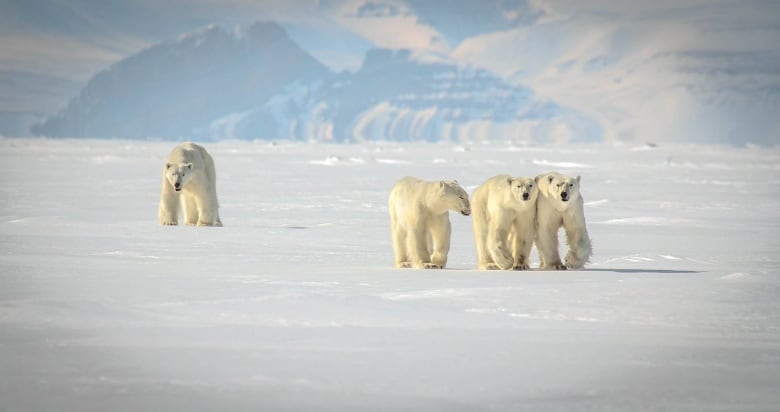
A polar bear walks over sea ice floating in the Victoria Strait in the Canadian Arctic Archipelago. RCMP say a hunter died after a polar bear attack near Naujaat, Nunavut. (David Goldman/Canadian Press)

Inuit communities in Canada's far north are resentful of interference by the federal and territorial governments that limits their hunting of polar bears. Quotas limiting the numbers of polar bears to be killed in each of the territorial regions act to constrain Inuit from thinning out the bear population, they contend. The result, they charge, is an overabundance of the powerful beasts who then threaten the existence of the people of the north. Inuit say they are exposed to greater numbers of 'interactions' with bears on the land than ever before.

In early July a man from Arviat was enjoying a family outing on an island close by the community with his children. A polar bear suddenly appeared. The 31-year-old Inuit man shouted to his children to run as he placed himself in harm's way to protect his children. He was killed, and the children survived, having run to safety. More recently, two Inuit hunters spent three days huddling alongside the body of a third hunter, killed by a polar bear. Four bears circled their camp, as the hunters hoped for rescue.

The bitter response from Inuit at the news that another of their community members has been killed by a rampaging bear, is that southern interference by people who have no idea of the dangers northern people can be exposed to, are the architects of legislation that complicate their lives in the interests of conserving bears, even while their habitat is being impacted by climate change. The stranded men had left from Naujaat on the northern shore of Hudson Bay on August 21, planning to hunt for narwhal and caribou.

Expectations were that they would be returning last Thursday; when the three hunters hadn't returned by Sunday, police were notified. The following day federal, territorial and local teams set out to investigate, knowing approximately where the hunters had been headed. Heavy sea ice conditions blocked the search boats, so the Coast Guard icebreaker Louis St.Laurent went into action, its helicopter discovering the hunters early the next day, 100 kilometres east of Naujaat.

The two hunters who had remained by their dead companion had been injured, but not seriously. Polar bear biologist, Dr. Derocher, commenting on the situation, pointed out that the quotas being criticized for hampering the Inuit from thinning out the presence of polar bears, ensuring the safety of the community, are set in Nunavut but only after consultation with hunters. Lacking careful management of the bears, the likelihood of a backlash from the international community, he pointed out, would have a deleterious effect on the communities' well-being.
A mother polar bear and her cub near Churchill, Man. A hunter from Naujaat, Nunavut, was killed after a polar bear and cub attacked him and his two friends on Thursday. (Elisha Dacey/CBC)

The European Union would possibly spearhead a ban on exports of polar bear products from Canada, essentially destroying an important income source for those Inuit communities. Inuit would end up killing even fewer bears, just as occurred when the ban on seal fur destroyed that market. Local hunters, he pointed out, had failed to take their allotted one hundred bears last year, despite the complaints of insecurity now being cited by community members in the wake of those two deadly polar bear attacks.

He also pointed out that the Foxe Basin bear population around Naujaat has seen the loss of some 30 days of sea ice seasonally over the last number of decades. Once the sea ice is unstable, the bears that usually hunt seals and other polar wildlife from the ice, abandon their uneasy perches for land. And this is when the intersection of bear and man becomes acute. A problem, however, attributed now to climate change propelling the bears into areas where that interaction becomes more common, with its potential for unfortunate occurrences.

The last death has been attributed to an interaction between the hunter, a mother bear and her cub. Bears are known to be acutely protective and angrily reactive to anything they perceive to be threatening to their cubs. This is elementary, and common knowledge. That a seasoned hunter would come to grief in this type of scenario is indeed inexplicable. The mother and cub were killed at the scene of the unfortunate encounter, along with another bear.

Labels: , , , ,

 
()() Follow @rheytah Tweet