Ruminations

Blog dedicated primarily to randomly selected news items; comments reflecting personal perceptions

Sunday, December 25, 2022

Canadian Hudson Bay Western Arctic's Diminishing Polar Bear Population

"The actual decline is a lot larger than I would have expected."
"It certainly raises issues about the ongoing viability [of the area to provide food for struggling female bears to enable them to nurse and rear offspring]."
"That is the reproductive engine of the population."
Andrew Derocher, biology professor, University of Alberta

"Those are the types of bears we've always predicted would be affected by changes in the environment."
"[The capacity for polar bears in the Western Hudson Bay to reproduce will diminish] because you simply have fewer young bears that survive and become adults."
Stephen Atkinson, polar bear specialist, lead author, government polar bear survey
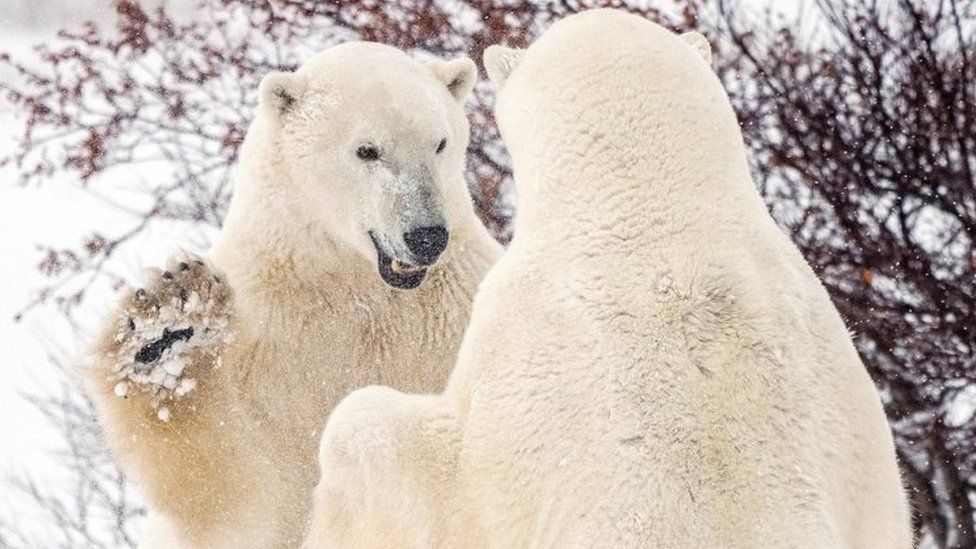
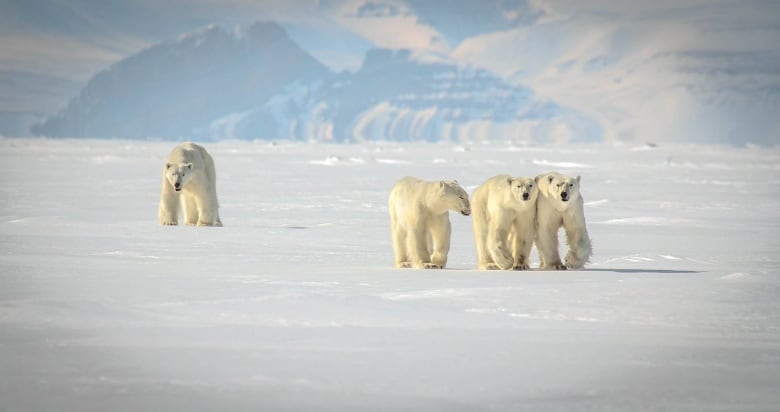
Polar bears spar near the town of Churchill, Canada. File photo
Polar bears are the most studied specimens in the world   Reuters

Western Hudson Bay in the Canadian Arctic on its southern edge are dying in large numbers according to a newly released government survey. In particular the survey points out, female bears and their cubs are experiencing a particularly difficult time. Churchill in Western Hudson Bay, called the Polar Bear Capital of the World, is the locale where a 2021 air survey was undertaken, leading to an estimation of 618 bears in comparison to the 842 found in the 2016 survey.

Biology Professor Andrew Derocher has studied the polar bears at Hudson Bay for close on to four decades and he is alarmed by these revelations. The number of bears in the region since the 1980s fell by close to 50 percent, according to the authors of the study, of which Dr. Derocheer was not a part. The issue comes down to the disappearance of the Polar ice essential to the survival of polar bears reliant on Arctic sea ice -- frozen ocean water -- which in the summer with warmer temperatures, shrinks, to form again in the next long winter.
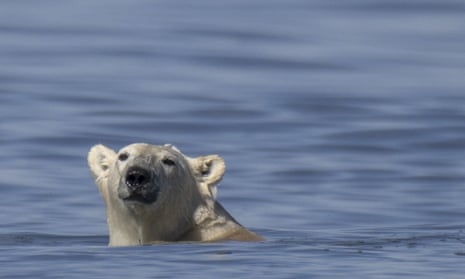
 
A polar bear near Churchill on the western coast of Hudson Bay
A polar bear near Churchill on the western coast of Hudson Bay, where sea ice has been disappearing at an alarming rate. Photograph: Olivier Morin/AFP/Getty Images
 
The ice enables polar bears to hunt, as they perch astride holes in the thick ice to spot seals coming up for air. The bears are carnivores, seals their favorite food. The Arctic, however, has warmed twice as quickly as the rest of the world, as a result of climate change. And sea ice is cracking earlier while taking longer to freeze back in the fall, leaving many polar bears living across the Arctic with less ice where they can live, hunt and reproduce.

It is the death in numbers of young bears and females in Western Hudson Bay that is most alarming to the future of the species according to the researchers.  The problem centres around the fact that young bears require energy to enable them to grow. They cannot survive long periods in the absence of enough food. In the same token, female bears face a difficult struggle in their expenditure of massive amounts of energy that it takes to nurse and rear their offspring. The future appears drear for the species.

A mother polar bear and cub near Churchill, Man. (Elisha Dacey/CBC)

Labels: , , ,

Wednesday, November 21, 2018

Inuit Knowledge and Climate Change

The draft management plan leans heavily on Inuit knowledge, which contradicts polar bear population estimates from Environment Canada. (Niore Iqalukjuak)
"Inuit believe there are now so many bears that public safety has become a major concern."
"Public safety concerns, combined with the effects of polar bears on other species, suggest that in many Nunavut communities, the polar bear may have exceeded the co-existence threshold."
"Although there is growing scientific evidence linking the impacts of climate change to reduced body conditions of bears and projections of population declines, no declines have currently been attributed to climate change."
"[Inuit knowledge] acknowledges that polar bears are exposed to the effects of climate change, but suggests that they are adaptable."
Nunavut government draft management plan 

"That's just plain wrong. That's been documented  in many places now -- not just linked to body condition but reproductive rates and survival."
"They will move into communities seeking food [with a lack of sea ice due to climate change]. There's lots of attractants around Northern communities."
"They [Nunavut] don't ask for input from southern scientists. The less input from the South is where it seems to be moving." 
"If the stated goal is to have fewer polar bears, that may be the tripping point whereby polar bear management in Canada comes under renewed scrutiny." 
Andrew Derocher, polar bear expert, University of Alberta

"[Inuit knowledge] has not always been sufficiently incorporated by decision-makers."
Nunavut Tunngavik Inc., (Inuit land-claim organization)


"This is very frustrating for Inuit to watch ... We do not have resources to touch bases with movie actors, singers and songwriters who often narrate and provide these messages [that climate change is impacting deleteriously on wildlife and particularly Polar bears]."
"We know what we are doing and western science and modelling has become too dominant."
Kitikmeot Regional Wildlife Board
A submission from the Kitikmeot Regional Wildlife Board expresses frustration with how polar bears are used as an icon in the fight against climate change. (Jonathan Hayward/Canadian Press)

This past summer of 2018 saw two Inuit being killed by Polar bears. Among the issues that have led the northern Canadian territory of Nunavut to conclude that the existence of too many Polar bears needlessly endangers the lives of both humans living in the area and other vulnerable animal populations. The report issued by the Nunavut government points out that in their considered opinion, living close to the animals on their shared traditional heritage hunting grounds, if climate change is a reality it has not yet affected the Polar bear population.

That this conclusion flies in the face of the scientific certainty that climate change is altering Polar bear natural environment with dramatic consequences for the bears as a worrying symptom of steady wholesale changes in Earth's atmosphere, is something else altogether. Inuit believe that their lived experience with the land, with its seasons and with its animals in their natural habitat equips them in a far more realistic way to draw conclusions even if they disagree with those reached by biologists studying the bear population.

The territory has proposed a plan set to be examined in public hearings in the territorial headquarters of Iqaluit which states that public safety is being jeopardized and that being the case the situation calls for traditional Inuit knowledge allied with current experience and should drive policies on management of the bear population. Simply put, Inuit knowledge yields population estimates greater than those identified by Western science, encompassing all 13 regional bear populations.

Despite the confidence that Nunavut holds in the Inuit conclusion, scientists claim that there is one only population of bears managing to prosper in contrast to the Inuit number of nine. Four bear populations, according to Environment Canada, are seeing diminished numbers, while the Inuit beg to differ, stating that none are shrinking in numbers. Eleven Inuit groups and hunter's organizations aided Nunavut's conclusions, by their submissions.

The Nunavut management plan has provisions for increased education and programs on bear safety for hunters and communities. It also states that hunting bans would no longer be applied automatically when bear populations appear to be shrinking; that "management objectives could include managing Polar bears for a decrease."

The territory's wildlife management board will take what it hears at the public hearings and include it in a final document, which will go before the Nunavut cabinet for approval. (Niore Iqalukjuak)

Labels: , , , , , ,

Friday, February 02, 2018

Climate Change in Polar Regions' Bear Habitat

"This study was designed trying to get a much more detailed understanding of what the [Arctic polar] bears were actually doing on the ice."
"It allowed us to actually monitor the behaviour of the animals. [The camera] gave a perspective right underneath the bear's chin."
"Overall, the metabolic rates of these animals are similar to other marine and terrestrial carnivores. They need to be catching more seals than would have been predicted previously."
"It was quite fascinating and really exciting to watch."
"These animals are in extremely remote environments, where it’s typically impossible to observe individuals for a prolonged period of time."
"We wanted to get a better understanding of just how many seals these bears needed to be catching to meet their energy demands, but also to get an understanding of their basic behaviors on the sea ice — how much time are they spending resting versus walking versus swimming, how much time they’re spending trying to hunt and catch seals, and how often they’re successful."
Anthony Pagano, researcher, University of California, Santa Cruz
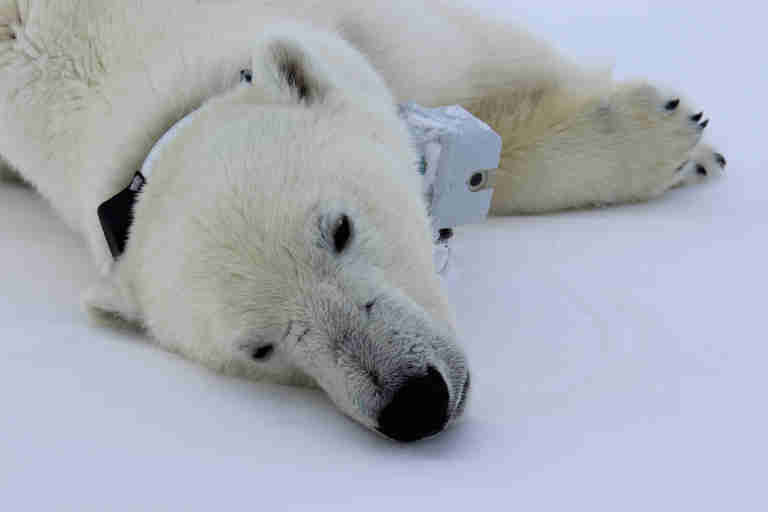
A polar bear wears a GPS collar equipped with video camera on the sea ice of the Beaufort Sea. | Maria Spriggs, Busch Gardens

"The beauty of this study I think really comes from the fact that it’s an all-in-one. The researchers have done it all in one, in one place, in a set of animals. That’s never been done before like this."
"[Follow-up research should follow more animals over a longer stretch. But], I think it confirms all the reasons to be concerned about polar bears from a conservation perspective are intact."
"You might get a very different picture on weight gain from many more individuals [in a wider-ranging, longer-term study]."
Andrew Derocher, polar bear biologist, University of Alberta
Polar bear on the sea ice. 
Photo by Brian Battaile, USGS

Attaching cameras to polar bears is a latter-day innovation on the study of the habits of these beasts of the far North. A new study, to capture data on how often bears manage to secure seals for dinner and how many ideally would be required to keep them healthy in their very demanding environment was undertaken by Dr. Pagano and his colleagues who studied nine of the animals, in the Beaufort Sea.

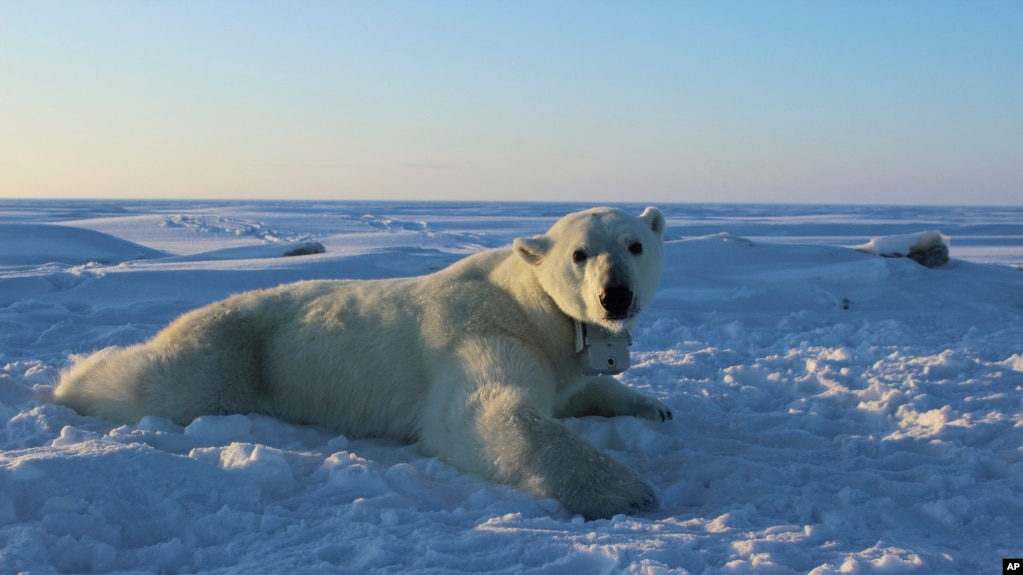
The bears were fitted with GPS-enabled video cameras along with instruments designed to measure speed and distance travelled, and how efficiently and swiftly energy was burned, along with how much time the bears spent in the frigid waters of their environment. The study conclusions recently saw publication in the journal Science.

Spring represents the bears' prime hunting season. They require vast amounts of food, usually seals, to remain in good  health. They consume over 12,000 kilocalories daily -- according to the new research findings -- considerably more than it was assumed by scientists up to now. As Arctic ice continues to melt, reflecting rising temperatures, polar bears, as suspected, may find their hunt compromised.
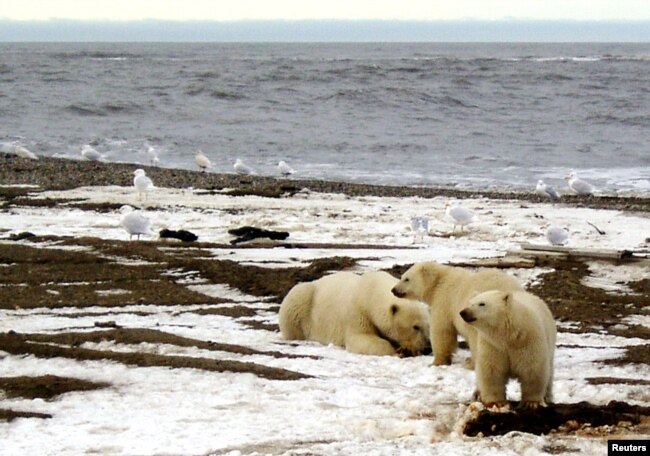
FILE - A polar bear sow and two cubs are seen on the Beaufort Sea coast within the 1002 Area of the Arctic National Wildlife Refuge in this undated handout photo provided by the U.S. Fish and Wildlife Service Alaska Image Library, Dec. 21, 2005.
A polar bear sow and two cubs are seen on the Beaufort Sea coast within the 1002 Area of the Arctic National Wildlife Refuge in this undated handout photo provided by the U.S. Fish and Wildlife Service Alaska Image Library

Over the course of a week on three successive Aprils from 2014 to 2016, the researchers gathered the data they would need to reach their conclusions. One of which is that the bears require considerably greater amounts of food than believed when scientists hypothesized that bears use little energy while waiting for a seal to come up through a blowhole. It was believed by many biologists that bears simply lowered their metabolism when there was little energy being expended.

What this study demonstrates is that those theories were incorrect. Bear metabolism, according to the study results, is 60 percent higher than believed through previous estimates. Bears require far more seals to maintain a healthy weight. Footage of bears catching seals and bringing them out of the ice, along with bears wrestling with large seals in frigid waters was captured by camera recordings of their activities.

In the final analysis, it was discovered by the researchers that five out of the nine bears in the study lost weight throughout the study period, representing up to ten percent of their body mass, despite the study's focus on the critical time when bears normally experience their most successful hunting of the year.

The population of polar beats in the Beaufort Sea has realized a decline in lock-step with declining sea ice. The study served a vital function in clarifying how polar bears manage to cope in the face of their habitat undergoing severe change, with the shrinking of sea ice.

In this April 15, 2015 photo provided by the United States Geological Survey, a polar bear wearing a GPS video-camera collar lies on a chunk of sea ice in the Beaufort Sea. A new study released Feb. 1, 2018 shows some polar bears in the Arctic are shedding pounds during the time they are supposed to be beefing up.

"Polar bears may start to suffer from declining sea ice more rapidly than they would have, had their metabolism been lower as was previously mentioned."
Steven Amstrup, chief scientist, Polar Bears International

Labels: , , , ,

 
()() Follow @rheytah Tweet