Ruminations

Blog dedicated primarily to randomly selected news items; comments reflecting personal perceptions

Tuesday, January 31, 2023

Fresh Water in a Parched Landscape

"All the extra water that [the plants] are producing we will be able to bring it with the national water carrier system up north and into the Sea of Galilee."
"With the environment of climate changes, you don't know what to expect next year and the year afterward."
"We are no longer depending on rain basically for water supply."
Yoav Barkay, manager, Mekorot, state-owned national water carrier, Tiberias, Israel
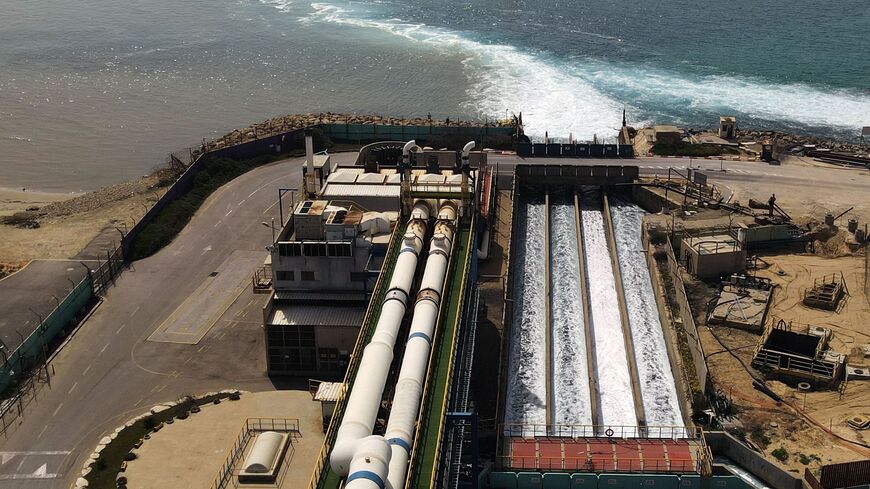
JACK GUEZ/AFP via Getty Images

When Jordan and Israel signed their peace treaty in 1994 as neighbours previously at war, one of the major issues that became part of the treaty was Israel's agreeing to provide Jordan with potable water in a region of the world perpetually suffering water shortages. Ever since, the two countries have participated in the pact that has Jordan dependent on Israel for the supply of 50 million cubic meters of potable water annually; an amount doubled by agreement in 2021.

Israel's main reservoir is the Sea of Galilee, the very place where biblical Jesus Christ was held to have walked upon water, making the site a religious tourist draw with hotels around the perimeter of the lake that feeds the Jordan River flowing south to the Dead Sea. The lake level responds to protracted droughts with receding shorelines as the water table diminishes, causing no little amount of anxiety. Heat waves and heavy rain events change the lake's water level dramatically.

Which led Israel to build a chain of desalination plants along its Mediterranean coastline, resulting in the country being able to boast a surplus of water in an infamously arid region of Earth. Water gushes into a dry river bed, racing to the shore of the Sea of Galilee when the floodgates are opened in northern Israel. An area lost to droughts and a growing population's needs has been totally altered.
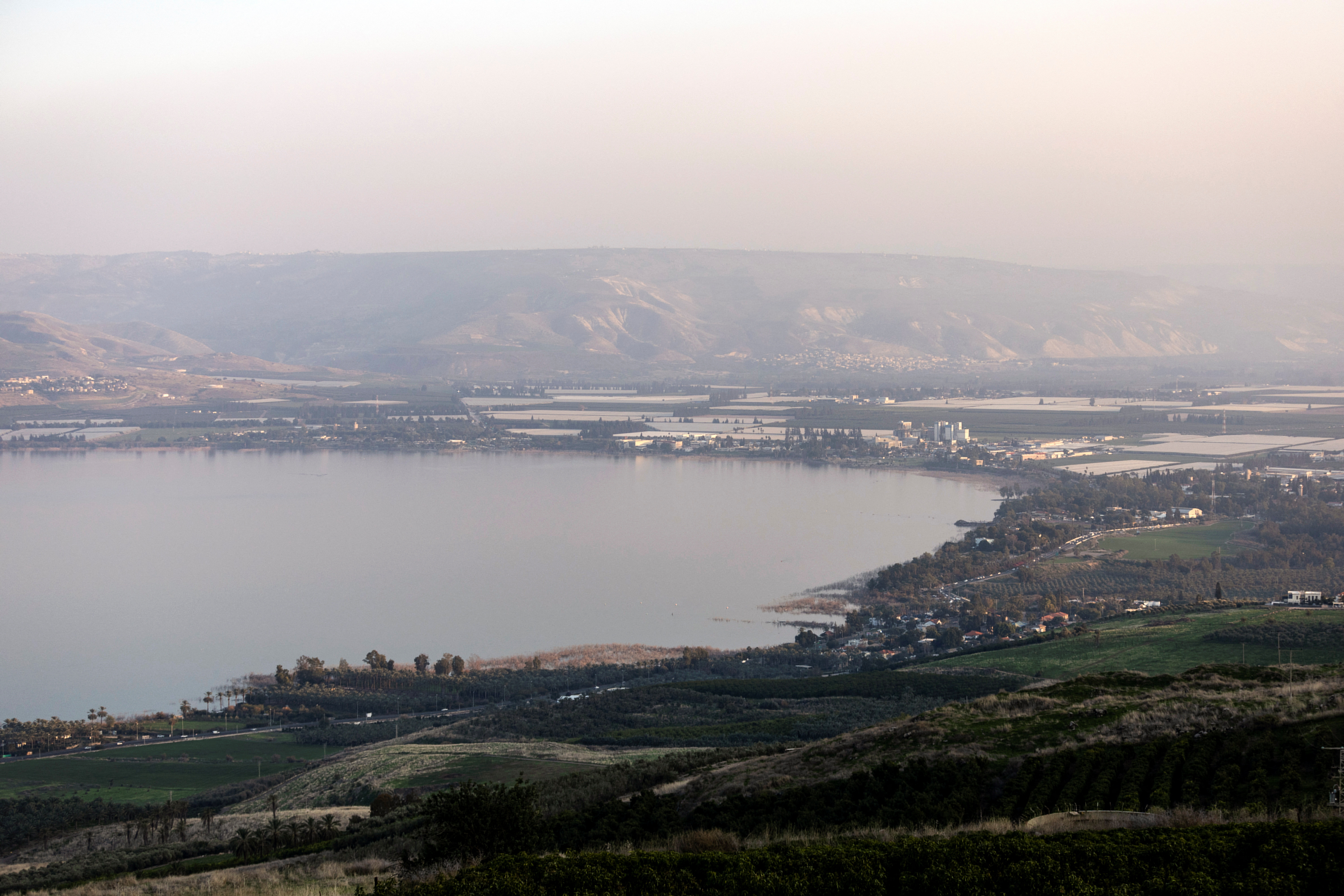
A general view of the Sea of Galilee with Jordan in the background
A general view shows the Sea of Galilee with Jordan in the background, in northern Israel, January 23, 2023. REUTERS/Ronen Zvulun
 
Desalinated water, fresh and high-quality, comes from the Mediterranean Sea to be transported across the country to await the order to replenish the lake when shrinkage occurs. A life-sustaining refill system enabling increased water exports to Jordan. The lake's level can be raised by half a meter annually with the use of this system. 

Another agreement between the two countries saw Jordan agree to partner in a project where Jordan would build 600 megawatts of solar generating capacity for export to Israel in exchange for the additional water supply. A pipeline to redouble the amount to reach Jordan is under construction. Some 200 million cubic meters of water-- an amount equal to what the five largest Israel cities combined consume, is set to be supplied to Jordan.

A bay at the Sea of Galilee can be seen in northern Israel
A bay at the Sea of Galilee can be seen in northern Israel, January 23, 2023. REUTERS/Ronen Zvulun

Labels: , , , , ,

Monday, November 07, 2022

Girls' and Women's Sporting Life in the Arab Middle East

"Sometimes we face some difficulties, of course. Like, 'This is a game only for boys or males, why do you wear shorts?' --and so on. This is a huge problem we face."
"But I think with time, it's getting better and better."
Masar Athamnehy, 20, Orthodox Club women's soccer team, Amman, Jordan
 
"Life has become hell for us, as a woman we can't do anything by our choice."
"Unfortunately,l my dream  to make it to Afghanistan's national team] remained just a dream."
Sabera Akberzada, 17, Afghanistan
 
"You're a girl, it's not right [they tell me]."
"I fell in love with the game because it's got action. I love it a lot, more than any other sport."
Sarah Asimrin 13, Amman, Jordan
 
"There is no support for women's sports in the Gaza Strip -- no support to be like girls in other parts of the world."
Maha Shabat, team manager Beit Hanoun Al-Ahli Youth Club, Gaza

"On the internet, I see many girls [elsewhere] playing normally."
"[The biggest obstacle in Gaza is society and tradition but I just] think positively about the criticism. I will take it as a motive to proceed and challenge everyone."
Rama Ashour, 14, Gaza
Joud Shunti, 23-year-old goalkeeper, trains with the Orthodox Club's women's team in Amman, Jordan. (Raad AL-Adayleh/The Associated Press)
 
The Middle East is a geographic region where the game of soccer has enthusiastic fans everywhere. Even among girls and women for whom participation in any kind of sport, much less soccer, is untraditional and goes against the cultural/religious strain of what is viewed as fitting for women in society. In Amman, Jordan, 13-year-old Sarah Asimrin and her younger sister might be viewed as coming by their fascination with soccer as an inherited trait, since their father is himself a soccer coach at a private academy in Amman.

Mad for the men's game of soccer as the region may be, the women's game has no real status and there is little interest in financing it as long as conservative interests continue to insist that girls and sports just do not fly, along with the issue of uniforms being entirely unsuited since they typically reveal bare skin on legs and arms. Jordan stands out as one of the leaders in the region, with a network of girls' youth and school leagues.

In Saudi Arabia where only in the last few years were women given permission to even attend soccer games as spectators, the first matches of a new women's Premier League were held. For the first time the Saudi national women's team played against international teams. Tournaments newly launched allow women's teams opportunities in international competitions.

The smaller West Asian and Asian football associations held their own first women's club championships several years back. A women's club championship was inaugurated in Cairo by the African Federation last year. This year's games began in Morocco with a sizeable financial incentive for the winners even though the win was considerably less than the $2.5 million that goes to the winning men's club.
Football Player for the Egyptian National Team. Sarah Essam
 
Financial incentives are provided by Jordan's Football Association in support of forming women's teams, so that even some conservative clubs have joined. A holdup in promoting women's teams is the fact that they fail to generate income. Since Qatar was named host of the World Cup this year, it has departed from its traditional lag in promoting women's soccer, to develop women's teams at universities, holding soccer academies for girls, as a new initiative.

The region's most prominent contrast is Egypt with its men's teams -- wealthy powerhouses -- winning regional tournaments on a regular basis even while women's soccer languishes in neglect. Egypt's Wadi Degla wins most women's competitions. The price has been public backlashes where a victory by the under-20 national women's team over Lebanon led to a barrage of sexual harassment on social media of obscene comments and sneers at girls playing soccer.

The African Champions League is to require clubs in its men's tournament to include and promote women's teams, a move that should have the effect of moving the Egyptian clubs to alter their resistance to aiding the formation of women's soccer clubs. In the Palestinian West Bank, women's soccer is somewhat active, while it has a non-existent presence in the Gaza Strip where its 2.3 million residents are conservative and its Islamist government in Hamas has little patience for women's freedoms.

The Beit Hanoun Al Ahli Youth Club with 20 girls playing basketball and soccer wear pants rather than shorts, and long-sleeve shirts. Their soccer-playing days are over once they reach age 17, when they no longer play, looking toward marriage instead. And in Afghanistan since the Taliban takeover of the country, the nascent women's sport scene collapsed under order of the authorities, leaving hundreds of female athletes without recourse to the sports they love.

"I feel so worried and so sorry for women, young women who wanted to be independent. I don't think women will play sports again in Afghanistan", sighed Khalid Popal, a former captain of the women's national team now living in exile in Denmark, and desperately trying to get members of the under-15 team still in Afghanistan to safety outside her benighted country.

Soccer player Insherah Heyasat, left, gives instructions during a training of the Orthodox Club's women's team in Amman, Jordan, on Oct. 22. Women's soccer has been long been neglected in the Middle East, a region that is mad for the men's game and hosts the World Cup for the first time this month in Qatar. (Raad AL-Adayleh/The Associated Press)
 

Labels: , , , , , ,

Thursday, October 31, 2013

The Desperation of Survival

"The Syrians we work with, they talk to us about their neighbours and they tell us how helpful and friendly they are. The attitude seems to be, 'What else can we do but be hospitable?' It's amazing, really."
East Amman, Jordan, Care International's Syria centre director Matt Sugrue

"The Jordanians have gone shoulder to shoulder with us in places like Afghanistan and Haiti, and our relationship contains all the bells and whistles that you wouldn't normally associate with such a small country."
Canadian Foreign Affairs official

"Our treatment here is already starting to be awful. It is because we are considered people who are taking away people's jobs, and taking away their needs. Rents are going up, and people blame us. People need work, and clothes, and they are getting into debt.
"There is a pain in our hearts. We were peacefully living. Now our country is being torn apart. And there is nothing we can do."
Jihad Saleh, Syrian English teacher, refugee in Jordan

The number of homeless refugees, both those remaining within Syrian borders, forced to leave their homes, their towns, their city suburbs as a result of deadly attacks threatening their lives, and with the pain of having lost relatives, continues to grow. Currently that number, according to the United Nations, is seven million traumatized Syrian civilians, desperate and torn with the reality of their desperate situation.

That number can be compared with the number of Palestinians who originally fled when Israel declared itself a State with the blessing of the United Nations in 1948, and was immediately attacked by a combined Arab army determined to dislodge them from the Middle East. While the United Nations has kept the original 700,000 Palestinian refugees and their generational descendants on permanent refugee status, in 'refugee camps' which are really cities with all the amenities of city living in a permanent welfare state, ten times that number have been made homeless by a government willing to slaughter its own.

In Jordan, Egypt, Turkey, Iraq and Lebanon, millions of Syrian men, women and children have fled their country of birth to take refuge from conflict and deprivation, oppression and menacing government attacks. Jordan, whose population already consists of Palestinians who had migrated there in 1948 and never left -- though Jordan's military fought a brutal war to dislodge the PLO -- has taken in an estimated million Syrian refugees and is doing its best to manage their needs.

With the help of the United Nations, and with the willing assistance of other countries with which Jordan has agreements, Jordan is managing its burden. Canada is one of those countries, having signed a Canada-Jordan Foreign Investment Promotion and Protection Agreement, a free-trade agreement and a Canada-Jordan Nuclear Cooperation Agreement. Direct support to Jordan for assistance with budget relief and refugee care has come from Canada in the sum of $130-million.

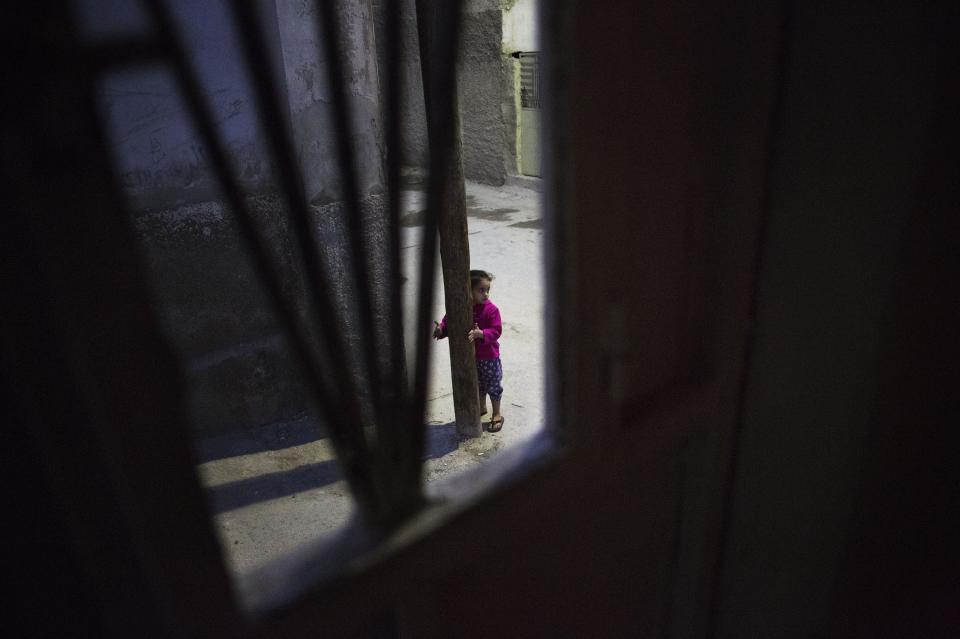
In this Monday, Oct. 21, 2013 photo, a Syrian refugee girl is seen through the window of her family home as she plays on the street the outskirts of Zarqa, Jordan's industrial center where thousands of Syrian refugees are living, northeast of the capital Amman. More than 420,000 Syrian refugees have settled in Jordan's cities, struggling for survival on U.N. foods stamps and straining the meager resources of a country that absorbed millions of exiles from the region's hotspots in the past.(AP Photo/Manu Brabo)
AP Photo, Manu Brabo

Along with the Palestinians, the Hashemite Kingdom ruled by King Abdullah II, has also given refuge to Iraqis who fled their country after the U.S.-allied invasion to remove Saddam Hussein. Its ancient heritage included the capital Amman having been conquered by biblical King David before it was ruled by the Greek Ptolemies, then Rome, and its emergence as a Byzantine Christian city. The eighth Century saw it invaded by Islam, and that is its status to the present day, with Jordan being one of only two Islamic countries in the Middle East sharing a peace treaty with Israel.

Jihad Saleh, the refugee from Syria living in Amman, was once a man of modest substance in his home country. "Of course, we are beggars now. I brought my wife and five children here from Damascus because I had to, for their safety.  Now, all our savings are gone, and I do not know what we are going to do." Unlike the Syrians living in tented refugee camps with basic amenities, Mr. Saleh is among those Syrian refugees who were able to pay for rent, for food and other necessities.

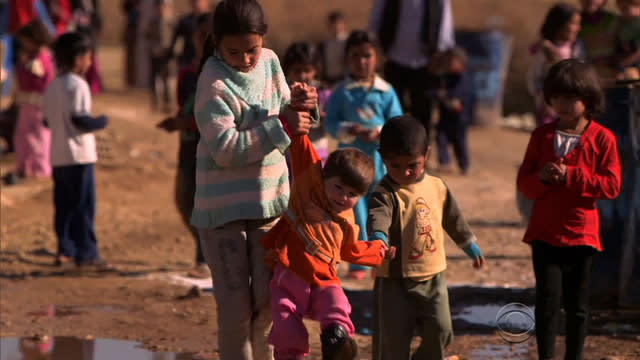
Syrian refugee children work in fields to support families
AP Photo - Manu Brabo

Now, however, his family's savings have been depleted, and he is concerned about how they will manage to survive. Because of the huge influx of refugees, an influx that continues, the small country of Jordan is hard put to accommodate them all. It is not a wealthy country, and depends on the goodwill and understanding of the international community to aid it in meeting expenses relating to the refugees' needs. When goods and services are in high demand difficult to meet, stress occurs as prices rise and scarcity looms.

And while Jordanians have been helpful and accommodating, sympathetic to the plight of the refugees, they too are under everyday living pressures of providing for their own families. It is inevitable, always has been and always will be, that when a country is overrun with an overabundance of refugees fleeing war in nearby countries the first reaction is to help, before resentment at rising prices and employment challenges kick in.

Labels: , , , ,

Saturday, March 23, 2013

Obama ends Middle East trip with visit to Petra ruins

BBC News online - 23 March 2013
Barack Obama stops in front of the Treasury as he takes a walking tour of the ancient historic and archaeological site of Petra March 23
US President Barack Obama has ended his visit to the Middle East with a trip to the famous ruins of the ancient city of Petra in Jordan.

The diplomatic part of his visit ended on Friday when he met King Abdullah and pledged an additional $200m (£131m) to help Syrian refugees in Jordan.

Correspondents say his four-day visit has yielded mixed results.
He brokered an Israeli rapprochement with Turkey but there was little progress on the Palestinian issue.

The BBC's North America editor, Mark Mardell, says the American leader's clear warmth towards Israel comes at a price, and many in the Arab world will feel let down.

Yet, our editor adds, he brought a subtle message to young Israelis that every people deserves freedom and a land of its own.

Mr Obama's Marine One helicopter touched down near Petra after an hour-long flight from the Jordanian capital, Amman.
The site of the ancient city, which is carved into rose-red stone, dates back 2,000 years and is Jordan's top tourist attraction, drawing more than half a million visitors each year.

Most of the president's time in the Middle East was spent in Israel where he held several meetings with Prime Minister Benjamin Netanyahu.

A highlight of the visit came when Mr Netanyahu apologised to Turkey for "any errors that could have led to loss of life" during the 2010 commando raid on an aid flotilla that tried to breach the Gaza blockade.

He also agreed to compensate the families of the nine Turkish activists who were killed.
Turkish Prime Minister Recep Tayyip Erdogan's office said he had accepted the apology, "in the name of the Turkish people".

Mr Obama also briefly visited Ramallah in the West Bank to meet Mahmoud Abbas, the president of the Palestinian Authority.

He urged Palestinians to drop their demands for a freeze in Israeli settlement-building as a precondition for peace talks.

However, a spokesman for Mr Abbas said the Palestinian leader had told Mr Obama the precondition remained in place.

Speaking to an audience of young Israelis in Jerusalem, Mr Obama praised Jewish nationhood before turning the argument around by stressing the need for Palestinians to share these same values of self-determination and justice.

"It is not fair that a Palestinian child cannot grow up in a state of her own living their entire lives with the presence of a foreign army that controls the movements of her parents every single day," Mr Obama said.

The US leader is due to return to Washington later on Saturday.

Labels: , , , , ,

 
()() Follow @rheytah Tweet