Ruminations

Blog dedicated primarily to randomly selected news items; comments reflecting personal perceptions

Sunday, March 17, 2024

Disgracing Canada

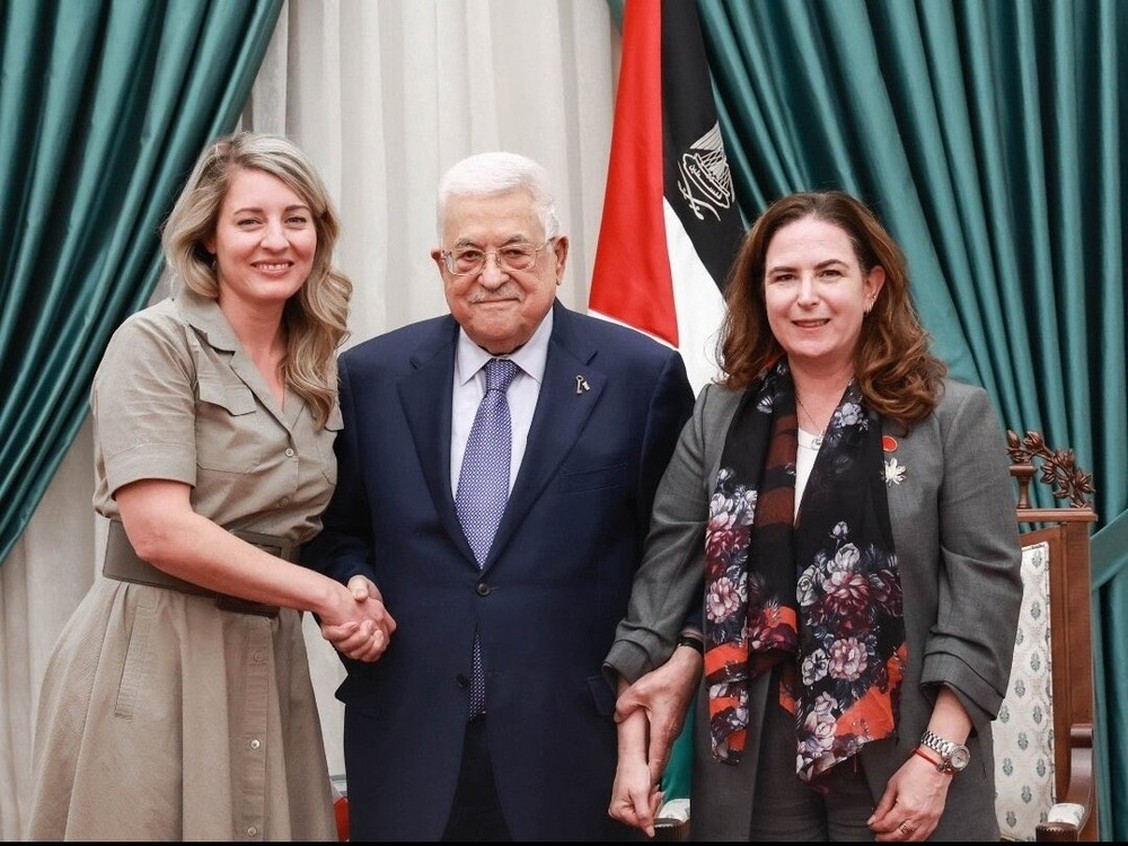
"In the West Bank, we met with President Abbas to discuss the humanitarian crisis in Gaza, the future governance of the Palestinian Authority and the work to advance towards a two-state solution."
Global Affairs Canada Minister Melanie Joly 
https://smartcdn.gprod.postmedia.digital/nationalpost/wp-content/uploads/2024/03/GIreQ-4XIAATOK0.jpeg?quality=90&strip=all&w=1128&h=846&type=webp&sig=-7DiifWP59p61AWRrTDxAw
"During the two meetings, Minister Joly raised the dire humanitarian crisis in Gaza, including the protection of civilians and the growing threat of hunger and disease for displaced Palestinians."
"The Minister emphasized that a humanitarian ceasefire is urgently needed to stop the violence, bring hostages home and ensure that civilians in Gaza can access humanitarian relief."
Global Affairs Canada statement
The man who graduated from Patrice Lumumba Friendship University in Moscow with a doctoral degree in Holocaust denial is being honoured by Canada's Foreign Affairs Minister, Melanie Joly, and of course, by extension, the government of Canada itself under the current helmsman of a once proud ship, prime minister Justin Trudeau. A man and his Liberal cabinet who find it extremely difficult to honour Canada's heritage, history, traditions, culture and values, finds it politically expedient to honour another man who has proven his credentials as a raving antisemite. 

Canada's prime minister Justin Trudeau has taken it upon himself to solve the problem of the two-state solution, a 'solution' that finds no favour with the Palestinian Authority whose actual solution is the destruction of Israel.  Mahmoud Abbas is committed to a one-state solution, leaving 'Palestine' the award of the entire region, since with Israel absent, the way is free and clear, as planned.

The PA president feels it is only just that Israel finally be cleared out of the way. His and the leadership corps of the Palestinians who claim the entire region, were plans to one way or another, always with the use of violent force, 'persuade' Jews to surrender the territory in question to the rightful owners, Arab Palestinians who claim it is their ancestral right, not that of Jews with their indigenous four-thousand year history of originating in the disputed geography. 

To ensure that the Palestinian population know of a certainty that Jews are their enemy, an enemy that must be destroyed, the PA leadership, led by Mahmoud Abbas, have taught generations of Arab Palestinian children to aspire to martyrdom, to achieve that status by a commitment to kill Jews by any means possible. Funding is always available as a reward for strikes against Israel and the murder of Jews.

"He denied the Holocaust. He denied October 7. He set up the Martyrs Fund that rewards families of terrorists who kill Jews", responded Melissa Lantsman on seeing the boast of Madam Joly, alongside a photograph of herself and another Liberal Cabinet member, a Jewish member of Parliament, clearly suffering discomfort from the company of M. Abbas commemorating the occasion. "You held this guy's hand", wrote Lantsman, the Conservative deputy leader.

According to the PA's Abbas, the October 7 terrorist attack in southern Israel that saw 1,400 Israelis and a handful of foreign farm workers slaughtered, and girls and women gang-raped, mutilated and murdered, along with entire families burnt to death in their torched homes, Israel itself, not the terrorist group Hamas, was responsible for the savagery of horrendous sadistic proportions. The Palestinian Authority approved of the October 7 Hamas carnage, while at the very same time proposes that Israel planned and executed it.

The man who cherishes the PA's 'Martyrs Fund' in a 'pay-for-slay' scheme to formalize and reward the killing of Israelis by Palestinians, speaks of peace, engagement and a two-state solution to his Western, democratic audience, and of destroying Israel to his home audience. Canada's Conservative Party, set to overturn the Liberal governance in a forthcoming election, and to return Canada to its long-held position of supporting Israel, views the current government's stand with absolute abhorrence.

"[It is] absolutely shameful [to see the Liberals] holding hands with rabid antisemite, [H]olocaust and October 7th denier Mahmoud Abbas", declared Conservative Member of Parliament Marty Morantz.  

"[Joly] reaffirmed Canada's position that the expansion of illegal settlements in the West Bank endangers the prospects for a two-state solution and  highlighted Canada's continued calls for perpetrators of extremist settler violence against Palestinians in the West Bank to be held accountable", announced Global Affairs Canada. Condemning 'settlements' established by Jews on heritage Israeli land, but no mention of condemning the deadly violent attacks by Palestinians on Israelis.

Honouring Mahmoud Abbas, the man who claimed Hitler had 'fought' Jews for their 'social role' as money lenders, and not as a result of their religion/ethnic roots. Declaring that European Ashkenazi Jews are not Semites, not descended from the ancient tribes of Judah and Israel, but descendants of a nomadic tribe that during the Middle Ages converted to Judaism.

"When we hear them talk about Semitism and antisemitism -- the Ashkenazi Jews, at least, are not Semites" Abbas said with the full authority of his doctorate from Moscow's Lumumba University. His brand of viral Jew-hate appears to meet with approval by Canada's current prime minister who during the sad years of his administration has made Canada a poorer place in very respect.

Labels: , , , ,

Thursday, October 26, 2023

Palestinians for Peace and Good Governance

"Israel will exist and will continue to exist until Islam will obliterate it. [Jihad is] the individual duty of every Muslim."
"The land of Palestine is an Islamic Waqf [holy possession] consecrated for future Muslim generations until Judgement Day."
"No one can renounce it or any part, or abandon it or any part of it."
Hamas Covenant
 
"There will never be peace ... We'll take what you give, but we will never give up our armed struggle."
"As long as I, Sheikh Yassin, am alive, I shall make sure that there will be no peace talks with Israel."
"I do not have a time problem: ten more years, 100 more years -- in the end you will be wiped off the face of the earth."
Ahmed Yassin, Hamas founder
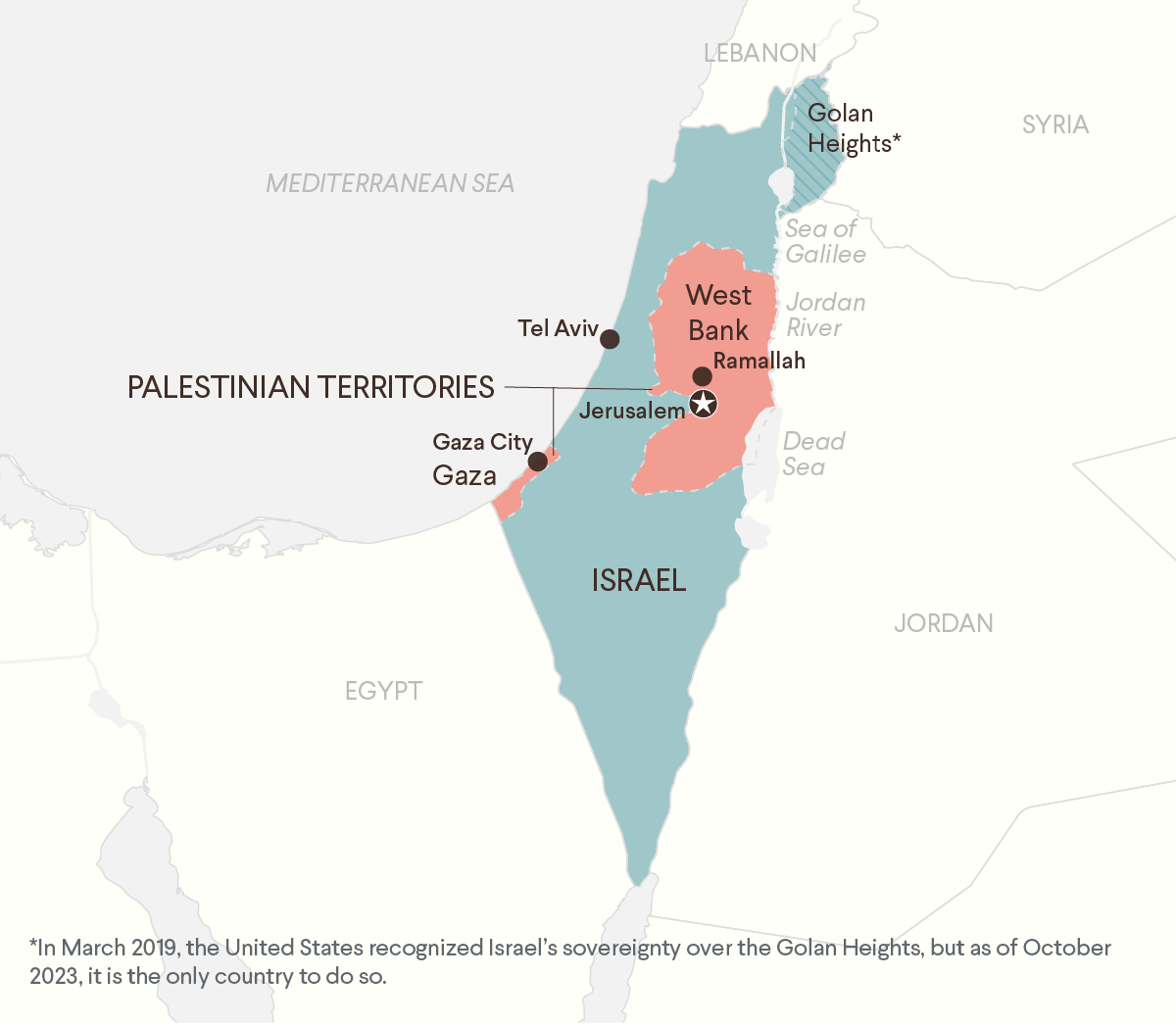
https://www.cfr.org/sites/default/files/image/2023/10/israel_palestine.png
 
Any onlooker into the Middle East conflict between the State of Israel and the Islamist terrorist groups -- first the Palestine Liberation Organization and its various arms, now its reiteration in Fatah and the Palestinian Authority, and the even grimmer Hamas and Palestinian Islamic Jihad, Hezbollah, and lesser but lethally determined groups to obliterate the Jewish state -- who believes that reason and practical intelligence can prevail over institutionalized violence bred and led by the Arab/Muslim states that greeted the fledgling state in 1948 with a military welcome, suffers from inattention.

It is not possible to negotiate with groups dedicated to the eradication of a legally constituted state on the ancestral lands of its predecessors which welcomes a vast diaspora of people who have suffered indignities, discrimination, oppression, pogroms, exiles, and finally genocide over the millennia since they rebelled against an occupation of a foreign dynasty with a global reach. Fatah, which governs the area the West and the UN refers to as the 'West Bank', shares the Hamas agenda of re-occupying the land Israel sits upon, but it is far more discreet than Hamas; the former is secular, the latter religious.
"The Day of Judgement will not come about until Muslims fight Jews and kill them. Then the Jews will hide behind rocks and tees, and the rocks and trees will cry out: 'O Muslim, there is a Jew hiding behind me, come and kill him'."
Islamic Hadith
When the founder of Hamas, Ahmed Yassin, was imprisoned in an Israeli jail, he managed to control and order Hamas, giving the group instructions on how to proceed with their deadly agenda. Around 1992 the Hamas campaign of suicide bombing attacks began against Israelis. In 1992 a group of soldiers close to a West Bank settlement was targeted.

Prime Minister Yitzhak Rabin and PLO leader Yasser Arafat signed the Oslo Accords, brokered by the U.S., meant to lead to peace and eventually, a Palestinian state. A situation that led Yassin to increase the frequency and deadliness of the suicide attacks. A similarity can be seen in the current situation, where Israel, with U.S. brokering assistance has signed peace agreements under the Abraham Accords with Morocco, the United Arab Emirates and Bahrain.

The long-awaited rapprochement between Saudi Arabia and Israel, which would in time lead to additional members of the Arab League joining the accord for peace with Israel, alarmed the Islamic Republic of Iran, which called upon its proxies to take action that would destroy any opportunities for peace agreements beyond that of Israel with Jordan, Egypt and the latter three states. What happened when Hamas and Palestinian Islamic Jihad fired hundreds of rockets into Israel and Hamas broke through the separating wall to slaughter 1,400 mostly civilian Israelis was to create dire tension.

Thirty years ago, Hamas expanded targeting of Israel into Israel's internationally recognized borders to target civilians on commuter buses, gathering places, restaurants, on the street, committing carnage on a larger scale, in reaction to the Oslo Accord. Negotiations for a peace agreement in 2000 saw Israel offering self-harming concessions to the Palestinians in their eagerness to avoid an increase in attacks and hope for a cessation to all attacks. Only to be met with refusals, followed by more suicide bombing.

Yassin was finally assassinated in 2004, effectively martyring him as a celebrated figure of 'resistance' for Palestinians enamoured of deadly violence. The general view outside of the Middle East is that Palestinians who are exploited by their Hamas rulers in Gaza, and who become civilian shields when Hamas places rocket launch sites inside schools, hospitals, apartment complexes, and in other densely populated enclaves, fear and detest Hamas for failing to provide them with opportunities to prosper.

Nothing could be further from the truth. The 2006 Palestinian legislative election saw Hamas win 44.5 percent of the vote, giving them 74 of 132 seats. An election judged by international observers to be free and fair. A year and a half later, Hamas violently seized control of Gaza from Fatah, after Israel had pulled out all its settlements and its military presence, leaving the enclave to the Palestinians entirely. The struggle between Fatah and Hamas was violent and conclusive; Fatah outed and Hamas in control.

No follow-up election has ever been held. Current politics, according to the Palestinian Center for Policy and Survey Research saw its most recent poll in June concluding that "two-thirds of the public do not believe that Israel will celebrate its centenary (in 2048), and a majority, albeit a small one, believes that the Palestinian people will, in the future, be able to recover Palestine and return its refugees to their homes".

The concept of a two-state solution, overwhelmingly supported by the Western world whose charity has supported the Palestinian territories for the past 70 years, is supported by a mere 28 percent of Palestinians, with 70 percent in opposition to it. The Palestinian Authority is not favoured by Palestinians, half looking for its collapse, while 71 percent are in support of the formation of independent armed militias.

And while 69 percent of the Palestinian population would like to have an election, if one were held, 56 percent would vote for Hamas leader Ismail Haniyeh and a mere 33 percent for Mahmoud Abbas, president of the Palestinian Authority. As for hopes of peace, 53 percent  percent of Palestinians are in support of a return to an armed intifada, with 47 percent in support of peaceful resistance. Overall, a population choosing to reject Israel's right of existence, believing that achieving a Palestinian state is only achievable through violence.
 
https://cdn.cfr.org/sites/default/files/styles/immersive_image_3_2_desktop_2x/public/image/2021/08/hamas_bg_1.jpg.webp
The Palestinian militant group has struggled to govern Gaza and remains committed to violently resisting Israel. Its surprise attack against Israel in 2023 threatens a wider conflagration in the Middle East. Council on Foreign Relations

Labels: , , , , , ,

Monday, December 29, 2014

The Arab Heritage of Jesus' Divinity

"Palestine is here, exactly where it always was. It has been lived in for 4000 years, by Arabs, Christians, Jews and anyone else who showed up. The Roman Emperor Augustus called it Iudaea. Later, in 135 CE, the Romans renamed it Syria Palaestina in an attempt to sever all connection to it by the Jews.  It was part of the Ottoman Empire until its dissolution in 1918, then called Palestine again under the British Mandate. After Israel's war of Independence in 1948, it was and still is called Israel."
"There never has been a Palestinian state. Ever. The West Bank was Jordanian, the Golan Heights were Syrian and the Gaza Strip was Egyptian."
Bassam Tawil, Palestinian Journalist, The Gatestone Institute, 28 December 2014

Mahmoud Abbas, Pope Francis
Atta Jaber/Flash 90

A re-writing of history, however, has Palestinians living since forever in "Palestine". It's true that they did live there, only they weren't then Palestinian Arabs, they were Jews living in "Palestine". There never has been a time when Jews didn't live there. The Palestinian Arabs who now claim to have their heritage firmly lodged in Palestine are relatively recent migrants, having moved from Egypt and Jordan into the area that once was Judea. The ancient place names are familiar to anyone reading the Old Testament, as a geography familiar for its Jewish presence.

But now, not only did those Palestinian Arabs originate from the area, they are also responsible for the presence of Jesus of Nazareth, the God's tender gift to humankind. How in error the world has been from antiquity to the present to attribute the birth of Jesus the Christ to a Jewish mother, Mary, and a Jewish father, Joseph. Mary and Joseph may have been Jewish, and even that must be questioned, according to the new Palestinian narrative, but their son was most certainly of Palestinian Arab origin.

The Palestinian Authority has authorized a "Christmas tradition"  to enrich the Palestinian claim to exceptionalism in the geography, to be honoured by the international community and Christianity in particular. Jesus was no Jew; he was an Arab Palestinian. Senior figures of the Palestinian Authority, along with PA Chairman Mahmoud Abbas declare it thus, and so it must be; Jesus was "Palestinian". A new art exhibit demonstrates these claims through artistic license and the examples below are testament to their sincerity.
 
Here’s the original by Raphael:
18-raphael-paintings.preview
Raphael The Deposition (1507)
In what has become a "Christmas tradition" for the Palestinian Authority (PA), PA Chairman Mahmoud Abbas and other senior figures of the group once again made the ahistorical claim that Jesus was "Palestinian." This is a historical truth dating back to the year before which was the first time that claim was made; at the time the Israeli Foreign Ministry responded by declaring: "We forgive him because he knows not what he does."

But, again, a week ago the official PA newspaper WAFA was informed by Mahmoud Abbas officially that: "We celebrate the birth of Jesus, a Palestinian messenger of love, justice and peace"; decoded by Palestinian Media Watch. Poor History; it has the parentage and ethnic roots of the most influential prophet in religious history all wrong; how utterly incongruously ignominious. Christianity itself must now look to somehow making amends by recognizing Christ as an Arab, not an accursed Jew.

Ignoring at the same time the inconvenient other bit of history that it was hundreds of years after the death of Jesus that the Roman Empire, still occupying the geography of the Middle East, thought to alter the name of that particular region from Judea to "Palestina". The name itself resurrected thousands of year afterward during the British mandate when after World War I the name change from Israel to "Palestine" took place.

Another update to history and looking forward into the future had the Palestinian Authority Supreme Sharia Judge Mahmound Al-Habbash authoritatively announce the soon-to-occur disappearance of Israel, for a religious war, incited by Mahmoud Abbas is on the near horizon. "Christmas is also a Palestinian holiday because Jesus, peace be upon him, was Palestinian. He was born in Palestine; lived and was sent (as prophet) to Palestine. Therefore Christmas has a special Palestinian flavour."

As though all of this doesn't appear firm enough in validating the historical correction, District Governor of Ramallah and El-Bireh, Laila Ghannam, announced on official PA TV that "We are standing here, Muslims and Christians, in Yasser Arafat Square (named after) the symbol of our cause, to celebrate Christmas. So too we will stand united to celebrate victory, far off as it may be. Merry Christmas, let's celebrate and be merry; Jesus the Messiah is Palestinian, and we are Palestinians and will continue to hold our heads high."

To clinch this new version of religious historical transfiguration, Adnan Al-Damiri, official spokesman for the PA Security Forces celebrated on his December 25 Facebook entry: "The anniversary of love and peace, the birth day of Jesus the Palestinian", while PA chief negotiator Saeb Erekat of Fatah's Central Committee, spoke of "the first Martyr, the first Palestinian, Jesus." Not to be outdone, Tawfiq Tiraw, another Fatah Central Committee member wished the "united Palestinian people a new Christmas that will herald liberty as did Jesus, the first Palestinian."

Jesus -- who knew? -- ordained that the Palestinian Arabs had first place in God's love, and it was they who were chosen to be a light unto the world. We have it on the highest authority of the Palestinian Authority. And so, it is right and proper for Palestinian Arabs to host the world thronging as they do annually to Bethlehem, when tourism is at its height in adoration of a Palestinian Arab chosen by God Almighty as his only son to bring peace and tranquility to the world.

We can judge for ourselves how successful the Palestinian Arabs, anointed by God who sacrificed his only living son as a Palestinian Arab to the cause of world peace -- while the iniquitous Jews continue to claim what is not rightfully theirs; the State of Israel, somewhat truncated from its original, but if the Palestinian Authority has anything to say about it, and they do, soon to be no more -- have demonstrated by their brotherly forbearance that peace is preferable to slaughter..

Pope Francis appeared to keep his counsel to himself when during his visit to the Holy Land in May the Palestinian Authority entertained the pontiff with an extraordinary art exhibit presenting Jesus in his true historical persona as a "suffering Palestinian martyr."

Here’s the Palestinian version of the Rafael painting, from the current Palestine Museum exhibit:
988511_607500702698614_957813745928407508_n

"Jesus’ legs replaced by a photo of the wounded legs of a Palestinian, carried by a man as an Israeli soldier looks on".  The inference relating to 'violence committed by Israel against modern day Palestinians' by Israeli Jews; an historical line from Christ-the-Arab's divine agony to that of his present-day 'descendants'. Now that's artistic innovation for you, hugely aiding historical revisionism to sound success.

Labels: , , , , ,

Wednesday, November 27, 2013

PA Caught Digging at Ancient Hasmonean Fortress

The fortress, an important site in the Maccabee revolts which Hanukkah commemorates, is located in 'Area A' not under Israeli control.

By Ari Yashar, Arutz Sheva Staff
First Publish: 11/27/2013, 12:31 PM

PA Digging at the Hasmonean Fortress
Kfar Etzion Field School
 
Tour guides from the Kfar Etzion Field School this week discovered that the Palestinian Authority (PA) has been digging at Beit Betzi, a Hasmonean fortress located between Bethlehem and the Herodion in "Area A." The Hasmonean revolt against the Greek empire is commemorated in the holiday of Hanukkah that begins Wednesday night.

Following the Oslo Accords the site, one of the only existing discoveries from the days of the Hasmoneans, was transfered to PA control.

News of PA digs at the site is particularly of concern given the organization's penchant for rewriting history. In 2011, amid renewed PA digs in Shechem, which the Bible records was bought by Jacob (Yaakov), Hamdan Taha, director of the PA's Department of Antiquities, said the dig would help in “writing or rewriting the history of Palestine.”

The Field School guides discovered the archaeological digging during a trip taken in advance of a walking tour planned for December 6 during Hanukkah. The Field School said Israeli groups have not traveled the area in roughly 20 years.

Given the lack of a mandate for rule and for IDF involvement in Area A, the School said "all that's left is to hope that the findings will be dealt with according to the great importance the site has to the Jewish people."

The Hasmoneans successfully forced the occupying Greek Empire out of Israel and established their own dynasty over 2,000 years ago. Their revolt, sparked by Greek decrees outlawing Judaism, lead to the purification and rededication of the Second Temple in Jerusalem.

Regarding the site, representatives from the School explained that Judah Maccabee, a key leader in the uprising, died three years after the Temple was purified. Following his death "the Hellenist Jews together with the Greek army returned to rule over Judea and the gains accomplished by the Hasmonean revolt nearly fell completely. The recovery from this hard setback happened in the Judean desert between Bethlehem and Tekoa at the hill named Beit Betzi."

At the ruins remains of a magnificent fortress from the Hasmonean and Early Roman period were found. According to Dr. David Amit's research in the 1980s the site played a critical role in the Hasmonean struggle against Greek forces.

Manager of the Field School Yaron Rozental noted that while "national agreements left the ancient site in Area A out of Israeli control, there is no reason to lose the cultural tradition of our people from the days of the Macabbean revolt."

Rozental continued, saying "I call on the national authorities to do everything so that the information contained in the layers of the ancient site will stay a part of the cultural heritage of humanity."

Previously the Field School found what appears to be a castle from King David's time (roughly 3,000 years ago), the discovery of which authorities apparently have been trying to keep secret given its location in a PA controlled area.
PA Digging at Beit Betzi in "Area A" Kfar Etzion Field School

Labels: , , , ,

Saturday, March 23, 2013

Obama ends Middle East trip with visit to Petra ruins

BBC News online - 23 March 2013
Barack Obama stops in front of the Treasury as he takes a walking tour of the ancient historic and archaeological site of Petra March 23
US President Barack Obama has ended his visit to the Middle East with a trip to the famous ruins of the ancient city of Petra in Jordan.

The diplomatic part of his visit ended on Friday when he met King Abdullah and pledged an additional $200m (£131m) to help Syrian refugees in Jordan.

Correspondents say his four-day visit has yielded mixed results.
He brokered an Israeli rapprochement with Turkey but there was little progress on the Palestinian issue.

The BBC's North America editor, Mark Mardell, says the American leader's clear warmth towards Israel comes at a price, and many in the Arab world will feel let down.

Yet, our editor adds, he brought a subtle message to young Israelis that every people deserves freedom and a land of its own.

Mr Obama's Marine One helicopter touched down near Petra after an hour-long flight from the Jordanian capital, Amman.
The site of the ancient city, which is carved into rose-red stone, dates back 2,000 years and is Jordan's top tourist attraction, drawing more than half a million visitors each year.

Most of the president's time in the Middle East was spent in Israel where he held several meetings with Prime Minister Benjamin Netanyahu.

A highlight of the visit came when Mr Netanyahu apologised to Turkey for "any errors that could have led to loss of life" during the 2010 commando raid on an aid flotilla that tried to breach the Gaza blockade.

He also agreed to compensate the families of the nine Turkish activists who were killed.
Turkish Prime Minister Recep Tayyip Erdogan's office said he had accepted the apology, "in the name of the Turkish people".

Mr Obama also briefly visited Ramallah in the West Bank to meet Mahmoud Abbas, the president of the Palestinian Authority.

He urged Palestinians to drop their demands for a freeze in Israeli settlement-building as a precondition for peace talks.

However, a spokesman for Mr Abbas said the Palestinian leader had told Mr Obama the precondition remained in place.

Speaking to an audience of young Israelis in Jerusalem, Mr Obama praised Jewish nationhood before turning the argument around by stressing the need for Palestinians to share these same values of self-determination and justice.

"It is not fair that a Palestinian child cannot grow up in a state of her own living their entire lives with the presence of a foreign army that controls the movements of her parents every single day," Mr Obama said.

The US leader is due to return to Washington later on Saturday.

Labels: , , , , ,

Thursday, March 21, 2013


Political Insight and Analysis From The Wall Street Journal's Capital Bureau
Text of Obama’s Speech in Israel
 March 21, 2013
Associated Press
U.S. President Barack Obama and Israeli Prime Minister Benjamin Netanyahu take a bite of matzah as they tour the Technology Expo in Jerusalem, Israel, Thursday, March 21, 2013. Mr. Obama later gave a major address to Israelis. (AP Photo/Pablo Martinez Monsivais)
Here is the text of President Barack Obama‘s address Thursday at the Jerusalem Convention Center, as prepared for delivery:
Remarks of President Barack Obama To the People of Israel
Jerusalem Convention Center
March 21, 2013
Shalom. It is an honor to be here with you in Jerusalem, and I am so grateful for the welcome that I have received from the people of Israel. I bring with me the support of the American people, and the friendship that binds us together.

Over the last two days, I have reaffirmed the bonds between our countries with Prime Minister Netanyahu and President Peres. I have borne witness to the ancient history of the Jewish people at the Shrine of the Book, and I have seen Israel’s shining future in your scientists and entrepreneurs. This is a nation of museums and patents, timeless holy sites and ground-breaking innovation. Only in Israel could you see the Dead Sea Scrolls and the place where the technology on board the Mars Rover originated. But what I’ve looked forward to the most is the ability to speak directly to you, the Israeli people – especially so many young people – about the history that brought us here today, and the future that you will make in the years to come.

Now I know that in Israel’s vibrant democracy, every word and gesture is carefully scrutinized. But just so you know, any drama between me and my friend Bibi over the years was just a plot to create material for Eretz Nehederet.

I also know that I come to Israel on the eve of a sacred holiday – the celebration of Passover. And that is where I would like to begin today. Just a few days from now, Jews here in Israel and around the world will sit with family and friends at the Seder table, and celebrate with songs, wine and symbolic foods. After enjoying Seders with family and friends in Chicago and on the campaign trail, I’m proud to have brought this tradition into the White House. I did so because I wanted my daughters to experience the Haggadah, and the story at the center of Passover that makes this time of year so powerful.

It is a story of centuries of slavery, and years of wandering in the desert; a story of perseverance amidst persecution, and faith in God and the Torah. It is a story about finding freedom in your own land. For the Jewish people, this story is central to who you have become. But it is also a story that holds within it the universal human experience, with all of its suffering and salvation. It is a part of the three great religions – Judaism, Christianity, and Islam – that trace their origins to Abraham, and see Jerusalem as sacred. And it is a story that has inspired communities around the globe, including me and my fellow Americans.

In the United States – a nation made up of people who crossed oceans to start anew – we are naturally drawn to the idea of finding freedom in our land. To African-Americans, the story of the Exodus told a powerful tale about emerging from the grip of bondage to reach for liberty and human dignity – a tale that was carried from slavery through the civil rights movement. For generations, this promise helped people weather poverty and persecution, while holding on to the hope that a better day was on the horizon. For me personally, growing up in far-flung parts of the world and without firm roots, it spoke to a yearning within every human being for a home.

Of course, even as we draw strength from the story of God’s will and His gift of freedom expressed on Passover, we know that here on Earth we must bear our responsibilities in an imperfect world. That means accepting our measure of sacrifice and struggle, and working – through generation after generation – on behalf of that ideal of freedom. As Dr. Martin Luther King said on the day before he was killed – “I may not get there with you. But I want you to know that… we, as a people, will get to the promised land.” So just as Joshua carried on after Moses, the work goes on – for justice and dignity; for opportunity and freedom.

For the Jewish people, the journey to the promise of the State of Israel wound through countless generations. It involved centuries of suffering and exile, prejudice, pogroms and even genocide. Through it all, the Jewish people sustained their unique identity and traditions, as well as a longing to return home. And while Jews achieved extraordinary success in many parts of the world, the dream of true freedom finally found its full expression in the Zionist idea – to be a free people in your homeland.

That is why I believe that Israel is rooted not just in history and tradition, but also in a simple and  profound idea: the idea that people deserve to be free in a land of their own. And over the last 65 years, when Israel has been at its best, Israelis have demonstrated that responsibility does not end when you reach the promised land, it only begins.

And so Israel has been a refuge for the diaspora – welcoming Jews from Europe to the former Soviet Union; from Ethiopia to North Africa.

Israel has built a prosperous nation – through kibbutzeem that made the desert bloom, business that broadened the middle class, and innovators who reached new frontiers – from the smallest microchip to the orbits of space.

Israel has established a thriving democracy – with a spirited civil society, proud political parties, a tireless free press, and a lively public debate – lively may even be an understatement.

And Israel has achieved this even as it has overcome relentless threats to its security – through the courage of the Israel Defense Forces, and a citizenry that is resilient in the face of terror.

This is the story of Israel. This is the work that has brought the dreams of so many generations to life. And every step of the way, Israel has built unbreakable bonds of friendship with the United States of America.

Those ties began only eleven minutes after Israeli independence, when the United States was the first nation to recognize the State of Israel. As President Truman said in explaining his decision to recognize Israel, “I believe it has a glorious future before it not just as another sovereign nation, but as an embodiment of the great ideals of our civilization”.

Since then, we have built a friendship that advances our shared interests. Together, we share a commitment to security for our citizens and the stability of the Middle East and North Africa. Together, we share a focus on advancing economic growth around the globe, and strengthening the middle class within our countries. Together, we share a stake in the success of democracy.

But the source of our friendship extends beyond interests, just as it has transcended political parties and individual leaders. America is a nation of immigrants. We are strengthened by diversity. We are enriched by faith. We are governed not simply by men and women, but by laws. We are fueled by entrepreneurship and innovation. And we are defined by a democratic discourse that allows each generation to reimagine and renew our union once more. So in Israel, we see values that we share, even as we recognize what makes us different.

Yet I stand here today mindful that for both our nations, these are complicated times. We have difficult issues to work through within our own countries, and we face danger and upheaval in the world. When I look at young people within the United States, I think about the choices that they must make in their lives to define who we will be as a nation in this 21st century, particularly as we emerge from two wars and a painful recession. No matter how great the challenges are, their idealism, their energy, and their ambition always gives me hope.

I see the same spirit in the young people here today. And given the ties between our countries, I believe your future is bound to ours. So I’d like to focus on how we can work together to make progress in three areas that will define our times: security, peace, and prosperity.

I will begin with security. I am proud that the security relationship between the United States and Israel has never been stronger: more exercises between our militaries, and more exchanges among our political, military and intelligence officials than ever before; the largest program to date to help you retain your qualitative military edge. Those are the facts. But to me, this is not simply measured on the balance sheet. I know that here, in Israel, security is something personal. So let me tell you what I think about when I consider these issues.

When I consider Israel’s security, I think about children like Osher Twito, who I met in Sderot – children, the same age as my own daughters, who went to bed at night fearful that a rocket would land in their bedroom simply because of who they are and where they live. That’s why we’ve invested in the Iron Dome system to save countless lives – because those children deserve to sleep better at night. That’s why we have made it clear, time and again, that Israel cannot accept rocket attacks from Gaza, and have stood up for Israel’s right to defend itself. And that’s why Israel has a right to expect Hamas to renounce violence and recognize Israel’s right to exist.

I think about five Israelis who boarded a bus in Bulgaria, who were blown up because of where they came from; who were robbed of the ability to live, and love, and raise families. That’s why every country that values justice should call Hizbollah what it truly is – a terrorist organization. Because the world cannot tolerate an organization that murders innocent civilians, stockpiles rockets to shoot at cities, and supports the massacre of men, women and children in Syria.

The fact that Hizbollah’s ally – the Assad regime – has stockpiles of chemical weapons only heightens the urgency. We will continue to cooperate closely to guard against that danger. And I have made it clear to Bashar al-Assad and all who follow his orders: we will not tolerate the use of chemical weapons against the Syrian people or the transfer of these weapons to terrorists. The world is watching, and we will hold you accountable.

America will also insist that the Syrian people have the right to be freed from the grip of a dictator who would rather kill his own people than relinquish power. Assad must go so that Syria’s future can begin. Because true stability in Syria depends upon establishing a government that is responsive to its people – one that protects all communities within its borders, while making peace with countries beyond them.

When I consider Israel’s security, I also think about a people who have a living memory of the Holocaust, faced with the prospect of a nuclear-armed Iranian government that has called for Israel’s destruction. It’s no wonder Israelis view this as an existential threat. But this is not simply a challenge for Israel – it is a danger for the entire world, including the United States. It would raise the risk of nuclear terrorism, undermine the non-proliferation regime, spark an arms race in a volatile region, and embolden a government that has shown no respect for the rights of its own people or the responsibilities of nations.

That is why America has built a coalition to increase the cost to Iran of failing to meet their obligations. The Iranian government is now under more pressure than ever before, and that pressure is increasing. It is isolated. Its economy is in a dire condition. Its leadership is divided. And its position – in the region, and the world – has only grown weaker.

All of us have an interest in resolving this issue peacefully. Strong and principled diplomacy is the best way to ensure that the Iranian government forsakes nuclear weapons. Moreover, peace is far more preferable to war, and the inevitable costs – and unintended consequences – that would come with it. Because of the cooperation between our governments, we know that there remains time to pursue a diplomatic resolution. That is what America will do – with clear eyes – working with a world that is united, and with the sense of urgency that is required.

But Iran must know this time is not unlimited. And I have made the position of the United States of America clear: Iran must not get a nuclear weapon. This is not a danger that can be contained. As President, I have said to the world that all options are on the table for achieving our objectives. America will do what we must to prevent a nuclear-armed Iran.

For young Israelis, I know that these issues of security are rooted in an experience that is even more fundamental than the pressing threat of the day. You live in a neighborhood where many of your neighbors have rejected your right to exist. Your grandparents had to risk their lives and all they had to make a place for themselves in this world. Your parents lived through war after war to ensure the survival of the Jewish state. Your children grow up knowing that people they have never met hate them because of who they are, in a region that is changing underneath your feet.

So that is what I think about when Israel is faced with these challenges – that sense of an Israel that is surrounded by many in this region who reject it, and many in the world who refuse to accept it. That is why the security of the Jewish people in Israel is so important – because it can never be taken for granted. But make no mistake: those who adhere to the ideology of rejecting Israel’s right to exist might as well reject the earth beneath them and the sky above, because Israel is not going anywhere. Today, I want to tell you – particularly the young people – that so long as there is a United States of America, Ah-tem lo lah-vahd.

The question, then, is what kind of future Israel will look forward to. And that brings me to the subject of peace.

I know Israel has taken risks for peace. Brave leaders – Menachem Begin and Yitzhak Rabin –reached treaties with two of your neighbors. You made credible proposals to the Palestinians at Annapolis. You withdrew from Gaza and Lebanon, and then faced terror and rockets. Across the region, you have extended a hand of friendship, and too often have been confronted with the ugly reality of anti-Semitism. So I believe that the Israeli people do want peace, and you have every right to be skeptical that it can be achieved.

But today, Israel is at a crossroads. It can be tempting to put aside the frustrations and sacrifices that come with the pursuit of peace – particularly when an Iron Dome repels rockets, barriers keep out suicide bombers, and so many other pressing issues demand your attention. And I know that only Israelis can make the fundamental decisions about your country’s future.

I also know that not everyone in this hall will agree with what I have to say about peace. I recognize that there are those who are not simply skeptical about peace, but question its underlying premise, and that’s a part of democracy and the discourse between our two countries. But it is important to be open and honest with one another. Politically, given the strong bipartisan support for Israel in America, the easiest thing for me to do would be to put this issue aside, and express unconditional support for whatever Israel decides to do. But I want you to know that I speak to you as a friend who is deeply concerned and committed to your future, and I ask you to consider three points.

First, peace is necessary. Indeed, it is the only path to true security. You can be the generation that permanently secures the Zionist dream, or you can face a growing challenge to its future. Given the demographics west of the Jordan River, the only way for Israel to endure and thrive as a Jewish and democratic state is through the realization of an independent and viable Palestine. Given the frustration in the international community, Israel must reverse an undertow of isolation. And given the march of technology, the only way to truly protect the Israeli people is through the absence of war – because no wall is high enough, and no Iron Dome is strong enough, to stop every enemy from inflicting harm.

This truth is more pronounced given the changes sweeping the Arab World. I recognize that with the uncertainty in the region – people in the streets, changes in leadership, the rise of non-secular parties in politics –it is tempting to turn inward. But this is precisely the time to respond to the wave of revolution with a resolve for peace. As more governments respond to popular will, the days when Israel could seek peace with a handful of autocratic leaders are over. Peace must be made among peoples, not just governments. No one step can change overnight what lies in the hearts and minds of millions. But progress with the Palestinians is a powerful way to begin, while sidelining extremists who thrive on conflict and division.

Second, peace is just. There is no question that Israel has faced Palestinian factions who turned to terror, and leaders who missed historic opportunities. That is why security must be at the center of any agreement. And there is no question that the only path to peace is through negotiation. That is why, despite the criticism we’ve received, the United States will oppose unilateral efforts to bypass negotiations through the United Nations.

But the Palestinian people’s right to self-determination and justice must also be recognized. Put yourself in their shoes – look at the world through their eyes. It is not fair that a Palestinian child cannot grow up in a state of her own, and lives with the presence of a foreign army that controls the movements of her parents every single day. It is not just when settler violence against Palestinians goes unpunished.  It is not right to prevent Palestinians from farming their lands; to restrict a student’s ability to move around the West Bank; or to displace Palestinian families from their home. Neither occupation nor expulsion is the answer. Just as Israelis built a state in their homeland, Palestinians have a right to be a free people in their own land.

Only you can determine what kind of democracy you will have. But remember that as you make these decisions, you will define not simply the future of your relationship with the Palestinians – you will define the future of Israel as well. As Ariel Sharon said, “It is impossible to have a Jewish, democratic state and at the same time to control all of Eretz Israel. If we insist on fulfilling the dream in its entirety, we are liable to lose it all.” Or, from a different perspective, think of what David Grossman said shortly after losing his son, as he described the necessity of peace – “a peace of no choice” he said, “must be approached with the same determination and creativity as one approaches a war of no choice.”

Of course, Israel cannot be expected to negotiate with anyone who is dedicated to its destruction. But while I know you have had differences with the Palestinian Authority, I believe that you do have a true partner in President Abbas and Prime Minister Fayyad. Over the last few years, they have built institutions and maintained security on the West Bank in ways that few would have imagined a decade ago. So many Palestinians – including young people – have rejected violence as a means of achieving their aspirations.

Which leads to my third point: peace is possible. I know it doesn’t seem that way. There will always be a reason to avoid risk, and there’s a cost for failure. There will always be extremists who provide an excuse to not act. And there is something exhausting about endless talks about talks; the daily controversies, and grinding status quo.

Negotiations will be necessary, but there is little secret about where they must lead – two states for two peoples. There will be differences about how to get there, and hard choices along the way. Arab States must adapt to a world that has changed. The days when they could condemn Israel to distract their people from a lack of opportunity are over. Now is the time for the Arab World to take steps toward normalized relations with Israel. Meanwhile, Palestinians must recognize that Israel will be a Jewish state, and that Israelis have the right to insist upon their security. Israelis must recognize that continued settlement activity is counterproductive to the cause of peace, and that an independent Palestine must be viable– that real borders will have to be drawn. I’ve suggested principles on territory and security that I believe can be the basis for talks. But for the moment, put aside the plans and process. I ask you, instead, to think about what can be done to build trust between people.

Four years ago, I stood in Cairo in front of an audience of young people. Politically, religiously, they must seem a world away. But the things they want – they’re not so different from you. The ability to make their own decisions; to get an education and a good job; to worship God in their own way; to get married and have a family. The same is true of the young Palestinians that I met in Ramallah this morning, and of young Palestinians who yearn for a better life in Gaza.

That is where peace begins – not just in the plans of leaders, but in the hearts of people; not just in a carefully designed process, but in the daily connections that take place among those who live together in this land, and in this sacred city of Jerusalem. Speaking as a politician, I can promise you this: political leaders will not take risks if the people do not demand that they do. You must create the change that you want to see.

I know this is possible. Look to the bridges being built in business and civil society by some of you here today. Look at young people who have not yet learned a reason to mistrust, and those who have learned to overcome a legacy of mistrust that they inherited from their parents because of the simple recognition that we hold more hopes in common than the fear that drives us apart. Your voices must be louder than the extremists who would drown them out. Your hopes must light the way forward.

Look to a future in which Jews, Muslims and Christians can all live in peace and greater prosperity in this Holy Land. Look to the future that you want for your own children – a future in which a Jewish, democratic state is protected and accepted, for this time and for all time.

There will be many voices that say this change is not possible. But remember this: Israel is the most powerful country in this region. Israel has the unshakeable support of the most powerful country in the world. Israel has the wisdom to see the world as it is, but also the courage to see the world as it should be. Ben Gurion once said, “In Israel, in order to be a realist you must believe in miracles.” Sometimes, the greatest miracle is recognizing that the world can change. After all, that is a lesson that the world learned from the Jewish people.

That brings me to the final area I will focus on: prosperity, and Israel’s broader role in the world. I know that all the talk about security and peace can seem distant from other concerns that you have in your daily lives. And every day, even amidst the threats you face, Israelis are defining themselves by the opportunities you create.

Through talent and hard work, Israelis have put this small country at the forefront of the global economy. Israelis understand the value of education, and have produced 10 Nobel laureates. Israelis understand the power of invention, and your universities educate engineers and inventors. That spirit has led to economic growth and human progress: solar power and electric cars; bandages and prosthetic limbs that save lives; stem cell research and new drugs that treat disease; cell phones and computer technology that change the way we live. If people want to see the future of the world economy, they should look at Tel Aviv: home to hundreds of start-ups and research centers. And Israelis are so active on social media that every day seemed to bring a different Facebook campaign about where I should give this speech.

That innovation is just as important to the relationship between the United States and Israel as our security cooperation. Our first free trade agreement in the world was reached with Israel nearly three decades ago, and today the trade between our two countries is at 40 billion dollars each year. More importantly, that partnership is creating new products and medical treatments, and pushing new frontiers of science and exploration.

That is the kind of relationship that Israel should have – and could have – with every country in the world. Already, we see how that innovation could reshape this region. One program here in Jerusalem brings together young Israelis and Palestinians to learn vital skills in technology and business. An Israeli and Palestinian have started a venture capital fund to finance Palestinian start-ups. Over 100 high-tech companies have found a home on the West Bank, which speaks to the talent and entrepreneurial spirit of the Palestinian people.

One of the great ironies of what is happening in the broader region is that so much of what people are yearning for – education and entrepreneurship; the ability to start a business without paying a bribe, to connect to the global economy – those things can be found in Israel. This should be a hub for thriving regional trade, and an engine of opportunity. And this is already a center for innovation that helps power the global economy. I believe that all of that potential for prosperity can be enhanced with greater security, and a lasting peace.

Here, in this small strip of land that has been the center of so much tragedy and triumph, Israelis have built something that few could imagine sixty-five years ago. Tomorrow, I will pay tribute to that history – at the grave of Herzl, a man who had the foresight to see that the future of the Jewish people had to be reconnected to their past; at the grave of Rabin, who understood that Israel’s victories in war had to be followed by battles for peace; and at Yad Vashem, where the world is reminded of the cloud of evil that can descend on the Jewish people and all of humanity if we fail to remain ever vigilant.

We bear that history on our shoulders, and we carry it in our hearts. Today, as we face the twilight of Israel’s founding generation, you – the young people of Israel – must now claim the future. It falls to you to write the next chapter in the story of this great nation.

As the President of a country that you can count on as your greatest friend, I am confident that you can help us find the promise in the days that lie ahead. And as a man who has been inspired in my own life by that timeless calling within the Jewish experience – tikkun olam – I am hopeful that we can draw upon what’s best in ourselves to meet the challenges that will come; to win the battles for peace in the wake of so much war; and to do the work of repairing this world. May God bless you, and may God bless Israel and the United States of America. Toda raba.
###
 ,

Labels: , , , , , , ,

Saturday, February 16, 2013

Modern politics overshadows Israel’s historic Herod exhibit

Visitors examine sarcophagi and what is believed to be the burial place of Herod brought from Herodium The Israel Museum has rebuilt what is believed to be Herod's burial place
He's best known as a great tyrant. King Herod is said to have killed his wife and sons as well as all the baby boys of Bethlehem.

But the first major exhibition on the Biblical ruler at the Israel Museum sets out to prove that he also had positive qualities that make him more deserving of the title "Herod the Great".

"We tried to show that he was not only the cruel person described by [the Jewish historian] Josephus and the New Testament but he was also a ruler who managed to keep this country in peace for 33 years," says curator Silvia Rosenburg.

"It was probably very difficult being a local ruler caught between the Roman Empire and the different exigencies of Judaism, but he did it very well. In his time there was prosperity and work for everyone."

A main reason why there was mass employment was because of the ambitious building projects ordered by Herod when he ruled between 37 and 4 BC.

Some of the artefacts on display at the museum come from the Second Temple complex in Jerusalem, which he expanded. It was later destroyed but Jews still pray at its Western Wall.

He also erected splendid palaces in the desert including several in what is now the occupied West Bank: at Jericho, ancient Cypros and Herodium. Fragments of frescoes and mosaics from the sites have been pieced together at the museum.

The highlight of the exhibit is a partial reconstruction of what is believed to be the King's burial place at Herodium. It was discovered in 2007, by the Israeli archaeologist Ehud Netzer.

Some 30 tonnes of material were brought from Herodium including masonry and the sarcophagus thought to have contained Herod's body.
The man-made mountain at Herodium, 12km from Jerusalem, with ruins in the foreground Herodium is at the centre of a row between Israel and the Palestinians over cultural heritage
 
"The material that's never been seen before is the material that's been excavated at Herodium just within recent years," says museum director James Snyder.

"For the museum it's been a kind of privilege because we've been able to bring this material here, give it quality restoration and put it on view for the exhibition."

However, Palestinian officials say they will make a formal complaint to the museum for removing relics from the West Bank, which Palestinians want as part of a future state.

"This is against international law," says Rula Maayah, the Palestinian tourism and antiquities minister.

"Herodium is on land that was occupied in 1967. This is Palestinian land and the Israelis have no right for excavations there. They don't have any right or authority there in Herodium and they don't have the right to take any antiquities."

Ms Maayah says Israeli authorities did not consult her department about the exhibition even though it involves joint cultural heritage. "Actually we only heard about it from the media," she says.

The Israel Museum says the material from Herodium - and other West Bank locations - is on loan and will be returned to the sites, in better condition than before, after the exhibition closes in nine months.
Museum staff restore a wall painting from King Herod's palace Israel Museum staff have carried out extensive conservation work on the artefacts
 
But the controversy serves as a powerful reminder of how modern politics is tied up with the history of the Holy Land.

"There is no respect for Palestinian history. Herod is not just important for Jews. He is important to Christians and Muslims as well," says Xavier Abu Eid, a spokesman for the PLO Negotiations Unit.
"Archaeology and tourism are being used as tools to justify the occupation."

The Israeli government lists Herodium, a hilltop fortress-palace close to Bethlehem, as a national heritage site and has opened a visitor attraction there.

It is in Area C, part of the 62% of the West Bank that has been kept under full Israeli control since the 1993 Oslo Accords.

Meanwhile, the Palestinians, who were granted full membership of the United Nations' cultural body UNESCO in 2010, say they plan to nominate Herodium and monasteries nearby for recognition as a world heritage site.

Labels: , , , , , ,

 
()() Follow @rheytah Tweet