Ruminations

Blog dedicated primarily to randomly selected news items; comments reflecting personal perceptions

Wednesday, July 01, 2020

 COVID Fallout: Orca Whales in the Salish Sea

"The anticipation is that the quieter environment will help the killer whales in communicating, in socializing, in navigating and most importantly, in finding food."
"What we are seeing in the Salish Sea is levels of shipping noise that haven't been present for three or four decades. So we would have to go back to the 1980s before we would have heard such a quiet environment."
"They [killer whales] echo-locate to find their salmon. It's a very sophisticated sort of acoustic capability and the quieter the environment, they would have more success in finding prey." 
"If we see them returning and staying in their critical habitat for longer periods ... if we have evidence of successful feeding on the salmon, then those are all good signs and in some sense the quieter environments can only have helped their survival."
Richard Dewey, associate director of science, Ocean Networks Canada
An endangered female orca leaps from the water while breaching in Puget Sound west of Seattle, Wash. Ocean Networks Canada says the drop in sea traffic brought on by COVID-19 will be a boon for killer whales. (The Associated Press)
A calming effect has been noted thanks to the COVID-19 pandemic in the diminution of sea traffic off the coast of British Columbia, affecting southern resident killer whales. Which has led to a study, given this rare occasion of relative quiet in normally busy traffic in sea lanes, threatening the existence of these mammals. Ocean Networks Canada has stated its belief that the change will result in a positive outlook for the survival of endangered marine mammals like orcas.

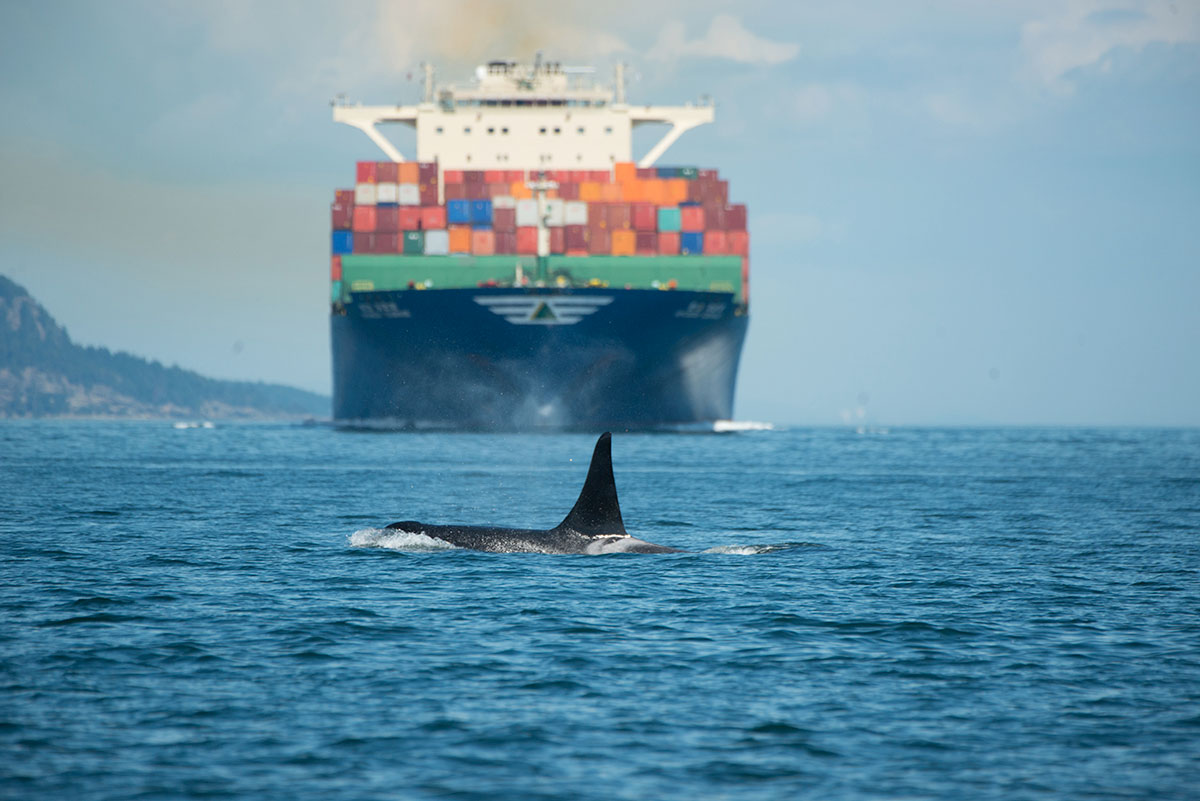
Orca L87 as a ship approaches. Capt. Alan Niles/Maya's Legacy Whale Watching

Noise from ships and sounds made by marine mammals have been studied for years, as the commotion brought about the presence of heavy traffic in the ocean has complicated and endangered life for marine animals. Last month a paper was published in the Journal of the Acoustical Society of America which concluded that a rough 30 percent decrease in commercial shipping traffic into the Port of Vancouver from China alone in the first four months of 2020 has been occasioned as a by-product of COVID-19 which has impacted on world shipping.

Along with a diminished commercial sea traffic, a pause in whale-watching boats, cruise ships, recreational vessels and tankers has also been occasioned. All of which has led to a 75 percent noise reduction. Shipping noises have been steadily increasing, close to doubling every decade, creating a major concern for the endangered southern resident killer whales. Their hearing is similar to that of humans, communicating in a frequency band also similar to that of humans.

Orcas use sound to hunt and communicate. (Elaine Thompson/Associated Press)

Whales use sound "continuously and all the time", in the ocean, said Dr.Dewey. Sound enables the whales to scope out kilometres' distance, while their eyesight allows them to see up to a distance of approximately five to ten metres in a very "turbulent" and murky environment in the Salish Sea. Loud sounds emanating as a result of human activity has a deleterious impact on the whales, increasing stress hormones when the whales are forced to 'shout' to make themselves heard in communicating over large distances.

By the time killer whales accomplish their seasonal return to the Salish Sea, scientists will have put in place 30 hydrophones to record the volumes of the sounds they make. The aim of the study is to yield vital data so that policy and regulatory changes can be enacted to aid survival of the animals.

In the past, killer whales would be seen in the Salish Sea in May and June, but their arrival has been delayed for the past four years, according to the director of the University of British Columbia marine mammal research unit.

Hypothetically, one reason for their late arrival -- sometimes as late as September -- may be insufficient numbers of salmon to feed on, although researchers believe that enough fish are present for the 72 remaining southern resident killer whales. Which has led scientists to wonder whether the whales are unable to hunt as a result of sound disruption from vessel traffic.

An orca swims in the Burrard Inlet near Port Moody. (Red Boat Charters)


Labels: , , , , ,

Friday, March 23, 2018

Killer Whale "Infanticide Teamwork"

"Intense vocal activity could be heard."
"It was not the kind of thing you can un-see, the image of the whales killing and passing around the dead baby are engraved in my mind."
"It's horrifying and fascinating at the same time."
Jared Towers, cetacean ecologist, Pacific Biological Station, Nanaimo, British Columbia

"Although killer whales [Orcinus orca] are one of the most studied and widespread species of cetacean, only a few observations of aggression between individuals of the same population have been reported."
"A secondary benefit of some infanticide events best explained by the sexual selection hypothesis [is the meal resulting from the kill]."
B.C. cetacean scientists' report
Transient killer whale infanticide
The male killer whale holds the calf in its mouth. (Gary Sutton)
Nature's evolutionary formula is not always pretty. Her creatures have been programmed to use some fairly ghastly, viciously violent means of ensuring their survival. Genetic survival is the cause of primal imprinted behaviours that express themselves in many species, and humankind is not exempt.
Our propensity as individuals and as groups, to view one another with suspicion is readily translated into hatred, an emotion often leading to threats and violence. The territorial imperative is, of course, inextricably linked to survival.

So it was at the beginning of time, so it is at the present time for humankind. And for other beasts that nature has contrived to live on this Earth that we share. Recently orca researchers at the northwest end of Vancouver Island came across an event never before catalogued as having been witnessed. An adult killer male committing infanticide in the company of its mother. The mother, at 50 years of age herself beyond conception, the son at 38, carrying her genetic history in search of a mate. Together they indulged in what the observing scientists coined as "infanticidal teamwork".

It has been known to biologists specializing in cetacean ecology that older female killer whales take a hand in assisting their male offspring to acquire mates. What has hitherto not been known that in so doing they may also help to kill the newborns of female orcas they mean to themselves impregnate. On December 2, 2016, close to Ledge Point located between Malcolm Island and Vancouver Island, scientists of the Nanaimo Pacific Biological Station witnessed just such an event.
Transient killer whale infanticide map
A map shows the location of the attack. (Jared Towers)

They saw an nauseating event unfold before their eyes as a 38-year-old adult male and his 50-year-old mother chased a 13-year-old orca mother, her three-year-old sister and the 13-year-old's newborn. Bite wounds could be seen on the bleeding sister orca. The male and his mother caught up to the desperately fleeing younger orcas and the scientists realized they were witness to a "predation event", and before long the newborn was no longer swimming.

They watched, incredulous, as the adult male swam about, the newborn in its mouth, its mother chasing the mature male as it was in the process of drowning it. A few minutes on the infant orca was dead, the killer and his mother swam off with the newborn, exchanging it from time to time so each swam about with it throughout the afternoon hours, followed by the mother and her sister. Light faded into dusk and the sun went down and the mother and son still celebrated their kill.

Conspecific infanticide, where newborns of the same species are killed is considered to be rare, but among primates, carnivores and rodents it does happen. Orcas are generally known to be peaceful creatures. On the other hand, there is ample documentation that many males and females of all age groups bear the teeth marks of other killer whales on their bodies. One possible explanation for an event that puzzles scientists is the male that kills an infant speeds up the new mother's fertility.

The male that has killed a newborn is indulging his own evolutionary role in passing his genes forward down the generations. In killing the infant his own procreation odds have been increased; as lactation stops in the recently bereaved orca mother and estrus resumes, the killer orca can then impregnate the female, bypassing the wait time for the calf he has killed to be weaned. Future competition his own offspring may face has been disposed of, additionally.

Clockwise from top left: wounds on a young female, mother and newborn flee an adult male and his mother, they are caught, blood sprays as the newborn is killed.  Scientific Reports


Labels: ,

Thursday, February 01, 2018

Orca Wikie Vocalizing Humanspeak

"Vocal imitation is a hallmark of human spoken language, which, along with other advanced cognitive skills, has fuelled the evolution of human culture."
"We found that the subject [orca] made recognizable copies of all familiar, novel and human sounds tested and did so relatively quickly, most during the first ten trials and three in the first attempt."
Jose Abramson, Complutense University of Madrid

"Wikie made recognizable copies of the demonstrated sound judged in real time by two observers, Wikie's trainer and one experimenter, later confirmed by both after listening to the recordings."
Researchers, reporting in Proceedings of the Royal Society
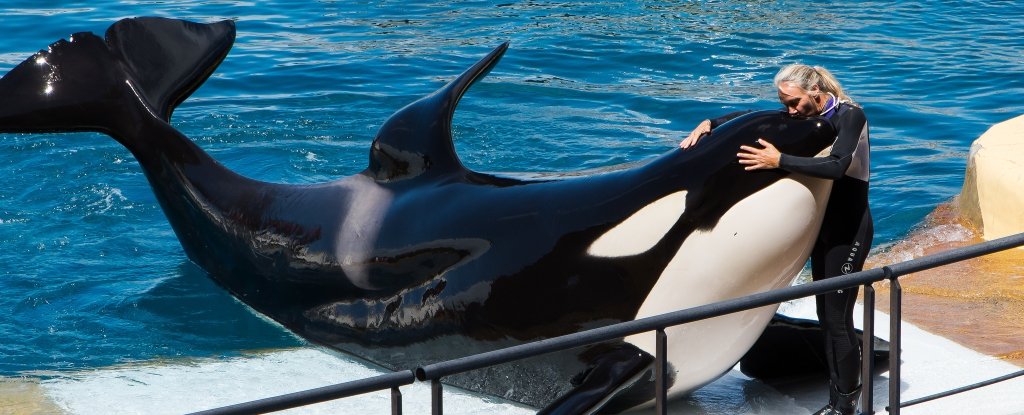
One of the orcas living at Marineland (Olivier Bain/Flickr)

Killer whales like the 14-year-old orca living at Antibes, France in Marineland, live in pods, each having its own "speech" dialect including calls unique to the pod. There are sound clicks expressed that are held to be the equivalent of humans calling one another by individual names, as they speak to one another. Killer whales have been observed being able to mimic the barks of sea lions and the whistles of sea dolphins, and beluga whales have been heard seeming to imitate humans.

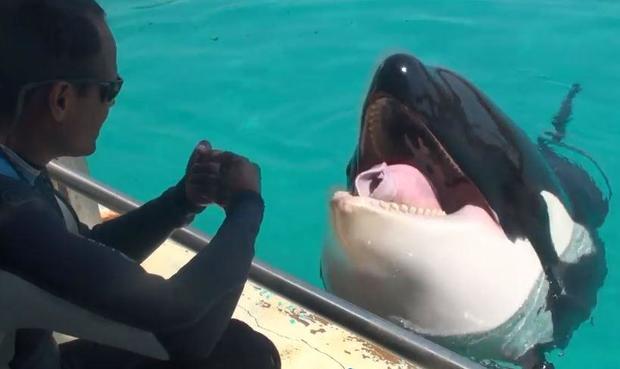
Now, however, biologists in Spain have been the first through experimenting in training an orca named Wikie to repeat the words "hello" and "bye-bye" -- to count up to three, and even to speak the name of her trainer, "Amy" -- to record an orca vocalizing human sounds. While the remarkability of orcas to mimic human voice sounds and words opens up new areas of enquiry, it has not been established that the killer whale, while sounding the words out flawlessly has any idea what they mean. Although it does give pause to ponder just that when the killer whale mouths her trainer's name.

Previously the ability to mimic human speech was believed to be possible only with primates, birds, elephants and seals. Wikie has proven an exception, or perhaps only the first of many others of her species capable of being trained to emulate the human voice and "speak" recognizable words. The experience with her, on the other hand, seems to reflect that she is a quick learner. That experience may yet open up new opportunities to determine whether her skills reflect a greater potential within her species.

Her voice, recording the words, is available to listen to on a variety of online sites, and her voice truly is remarkably akin to that of a human speaking. Humans have certain vocal chords, the larynx enabling speech in the species, and these are not shared by whales who are thought to make their underwater sounds through nasal passages with the use of air bursts. Scientists believe that whales have differentiating "accents" reflecting individual "cultures" that the young of their species adopt through imitation in patterning after adults, reflective of the very method by which humans acquire speech.

In the trial just recently reported on, Wikie was trained to understand a "copy" signal. She was then introduced to eleven completely new sounds offered to her by her trainer, and invited to repeat them. The sounds included words, along with sounds such as an elephant call, a wolf howl and a creaking door. As a reward for successful compliance, Wikie was presented with a fish or an approving pat on achieving the sound, thus reinforcing the learning curve. Six judges were asked to rate their opinion on whether the resulting vocalization was well matched to the original word or sound.
wikie-killer-whale-talks-jpg.jpg
Wikie the killer whale mimics human words with a trainer at the Marineland Aquarium in southern France, in an image made from video provided by researchers from the Complutense University of Madrid.  
Jose Abramson

"Human sounds are easily recognizable by us and if they could produce a human sound that is not in their normal repertoire, that would mean that the only way they could learn it is by listening to it and reproducing it. And that's what we did."
"Our study shows that our vocal learnings, even of sounds that are not in the killer whale repertoire, is plausible."
"After one has done it, one of the next questions is, can all killer whales do it? How widespread is this ability? Maybe Wikie is special, an exception, but maybe not."
"It was not about establishing a two-way communication between killer whales and humans... I doubt it sincerely. We have no evidence that [Wikie] thinks she is greeting someone in the morning and saying 'hello.'"
"Whether they could use this vocalization, these sounds they produce, whether they could use them to interact with humans or with other killer whales is a an open question, it's a fascinating question."
Josep Call, professor in evolutionary origins of mind, University of St Andrews, study co-author

Labels: , ,

Saturday, January 06, 2018

Ameliorating Disturbances for Endangered Orcas

"We know from the science that when boats are in close proximity to the whales, they don't forage as much and possibly don't forage as effectively, both because they're disturbed by the presence of the vessels and possibly by the sound of the engines."
"There is great concern right now about this population [of Killer Whales]. There has been a loss of too many whales in the last six months to a year."
Michael Milstein, spokesman, U.S. National Oceanic and Atmospheric Administration (NOAA)
In this July 31, 2015, file photo, an orca whale breaches in view of Mount Baker, some 60 miles distant, in the Salish Sea in the San Juan Islands, Wash.    Elaine Thompson / THE ASSOCIATED PRESS

A newly published study validates the regulations instituted in 2011 by the U.S. National Oceanic and Atmospheric Administration as having had a positive result in protecting the southern resident orcas while at the same time not having the foreseen disturbing effect on local whale watching and tourism industries. These killer whales found in the waters off British Columbia and Washington have species-at-risk status in Canada, and endangered species status in the United States.

In July a census indicated that in the three pods making up the population known for their presence in the Salish Sea, including the Straits of Georgia, Juan de Fuca and Puget Sound, a total of 77 whales were accounted for. But according to the Center for Whale Research in Washington state, there was a count of 76 whales in December, considerably reduced from their 2016 number of 83.

The 2011 regulatory changes that were implemented in hopes of saving more of the orcas from the devastating effects of an increasingly crowded, noisy and dangerous ocean were meant to prevent vessels from approaching within 200 yards (182 metres) from whales. And nor are vessels permitted to stray into the path of the whales, or to attempt to intercept them.
In this Sept. 2017, photo made with a drone, a young resident killer whale chases a chinook salmon in the Salish Sea near San Juan Island, Wash. John Durban/NOAA Fisheries/Southwest Fisheries Science Center via AP

The purpose of the study was meant to compare research and data on vessel compliance, on biological impacts and additional related factors in the five years previous and then once the regulations were implemented, to gauge the possible outcomes. The finding was that the number of incidents of vessels interfering in any manner with whales had dramatically decreased, as a result of the regulations.

The regulations were primarily aimed at tourism and recreation vessels associated with the tourism industry in Washington State and British Columbia. Large, commercial vessels are restricted to major shipping lanes, located at a considerable distance from those parts of the ocean where the whales are known to be more frequently found. But they can also be harmfully distracting to the whales.

Before the regulations were enacted, concerns were expressed they would have a deleterious effect on the lucrative and popular tourism industry off the B.C. and Washington State coasts, but the study discovered that tax revenues from the tourism industry had actually been seen to increase significantly, belying those initial concerns.

The study did find, however, that recreational boaters seemed unaware of the regulations, leaving the obvious impression that more needs to be done to ensure public education to protect the orcas should be more broadly focused. Most commercial vessels, on the other hand, appeared to be satisfactorily recognizing and respecting the new rules.

In recognition of the success of the NOAA initiative, Canada's Fisheries Ministry is prepared to bring in similar regulations before spring to ensure that in Canadian waters too, vessels remain at minimum 200 metres distance from southern resident killer whales.


A noise reduction trial was launched earlier this year by the Vancouver Fraser Port Authority, cautioning vessels to maintain a slower speed in the Haro Strait between southern Vancouver Island and San  Juan Island, but preliminary study results linked slower speeds with longer periods of time spent in the area, while at the same time reducing noise levels.


vessell effects

Labels: , , ,

 
()() Follow @rheytah Tweet