Ruminations

Blog dedicated primarily to randomly selected news items; comments reflecting personal perceptions

Saturday, September 20, 2025

Front Lines Pregnant With New Life

"If a man hesitates whether to make a shot or not, a woman will never. Maybe that's why women are the ones giving birth, not men."
"[Being a sniper is particularly difficult, mentally and physically]...Because you can see what is going on. You can see hitting a target. This is a personal hell for everyone who sees that in a [sniper's] scope." 
"For 30 seconds I was shaking - my whole body - and I couldn't stop it. That realization that now you'll do something that will be a point of no return."
"But we didn't come to them with a war. They came to us."
"When I had just joined the special forces, one of the fighters came to me and said: 'Girl, what are you doing here? Go and cook borshch'. I felt so offended at that moment I thought, 'are you kidding me? I can be in the kitchen, but I can also knock you out'!"
"I came to my commander and I asked him, 'what can I do the best?' He said: 'You will be a sniper.'" 
Evgeniya Emerald, sniper in a Ukraine battalion
https://ichef.bbci.co.uk/news/1024/cpsprodpb/9AE2/production/_130605693_2-img_4501.jpg.webp
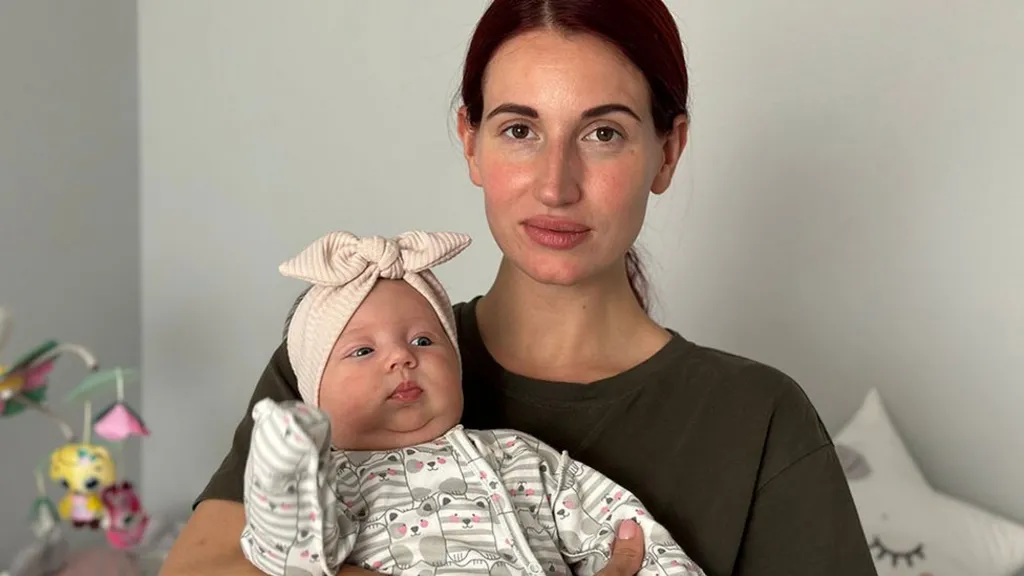
Evgeniya Emerald, pictured with her three-month-old baby, ran a jewellery business before the war
 
"It's terrifying -- every single day. You wake up wondering if everything is OK, if everyone is still alive [following nightly explosions]."
"You're constantly thinking about your child's well-being [as a pregnant soldier on the battlefield]. It was nonstop stress every day, combined with constant physical activity."
Nadia, 25, front-line radio operator 
 
"We have to protect our children. And we have to liberate the country for their future."
"I'm ready to assume responsibility that I am near the combat zone [pregnant] with my child. I do everything to protect her." 
"This is a long game, so we are needed."
Olya, 39, combat medic in Ukraine  
https://www.ukrainer.net/wp-content/uploads/2024/07/5_spivzasnovnytsia-Kateryna-Pryy-mak-z-posestramy-VETERANKA_foto-nadane-rukhom-VETERANKA.jpg
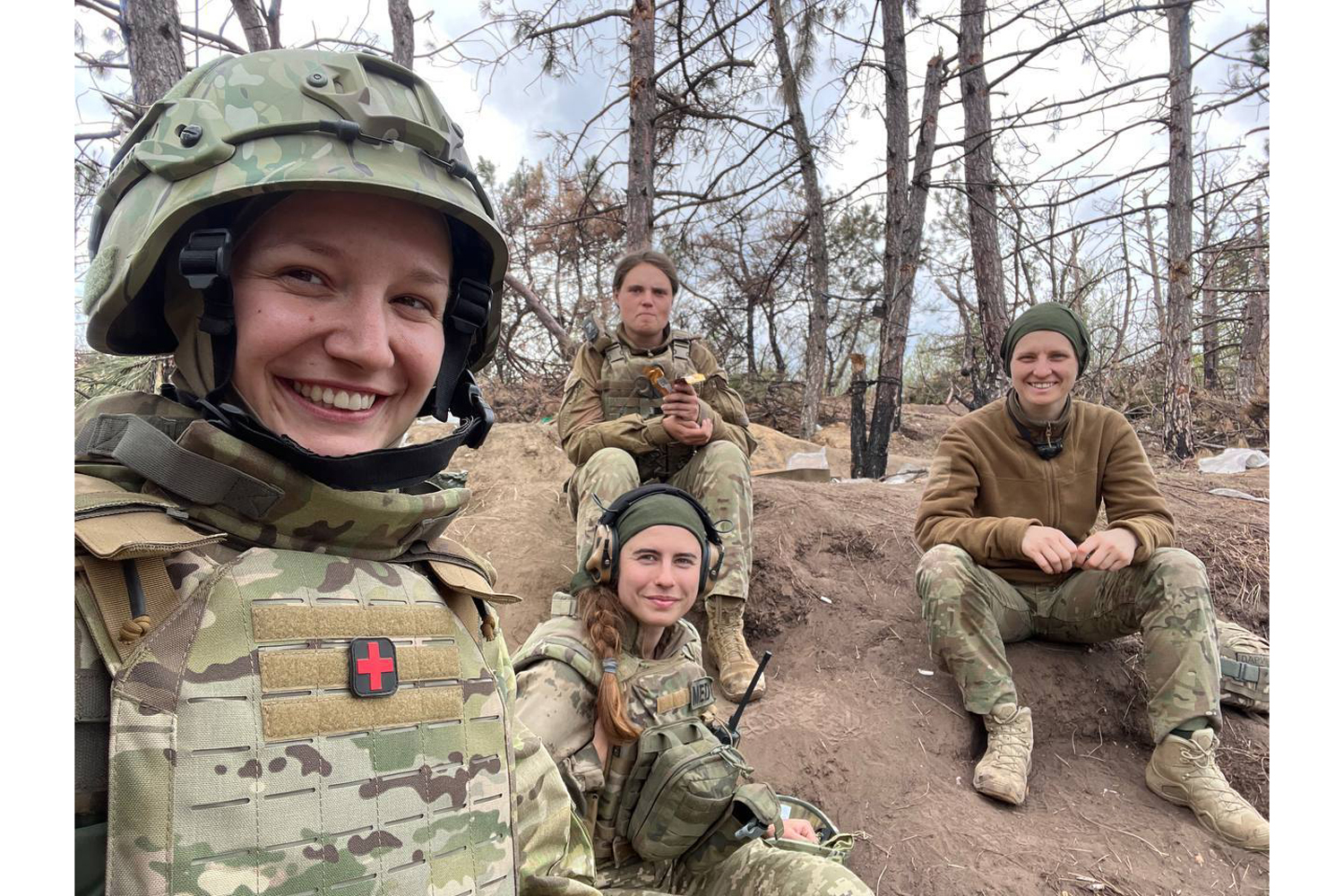
Kateryna Pryimak with fellow sisters from the Veteranka movement. Photo source: Women Veterans Movement. Ukrainer 
 
Women serving in some countries while at war see themselves removed from combat zones, but Ukrainian women in the military generally serve until they reach their seventh month of pregnancy in a military apparatus that the medical community and soldiers alike admit the Ukrainian military is ill-equipped to support their pregnant female soldiers. It starts with the uniforms they're given, not meant to clothe a pregnant woman and goes on to a deficit in neo-natal care during a costly war.
 
Pregnant Ukrainian soldiers -- hardships aside -- feel motivated to serve for a very good reason -- concern over Ukraine's future. "Our children are the future of this country", emphasized Olya, 39, Ukrainian combat medic, whose daughter was born in late May. And once a child is born their military mothers face another dilemma... how long they should remain at home with their babies before resuming their military position during a time of intense conflict. 
 
https://i.insider.com/64c8502bcf077800196816cd?width=700&format=jpeg&auto=webp
Zemliachky has bought and sent about 30 military uniforms to pregnant soldiers since the war began, the organization's founders said. Courtesy of Zemliachky
 
Following her baby's birth, Nadia explained that she was given 126 days of paid leave should she wish to return to the front. The alternative was to take three years unpaid leave, to raise her child in infancy. She chose the three years. She had worked as a front-line radio operator until she reached eight-and-a-half months in her pregnancy. She experienced how difficult a pregnancy can be under those circumstances. 
The clinic she relied upon for ultrasounds had closed. 
 
This is a brutal war, with many servicemen on both sides wounded or losing their lives. Lost lives in the tens of thousands for both Ukraine and Russia. The Ukrainian military, like Russia's, has experienced great difficulties in their recruitment efforts among young men. The women who join the military are all volunteers; their willingness to serve is a counterpoint to that of the men who are expected to serve. Since the Russian invasion of their country in 2022, the number of women serving has grown to 70,000.
 
The experience is not a salutary one by any means. Conditions are fairly tough under relentless shelling, having to live without heat n the winter, and the absence of running water and toilets. Major Viktoria Kravchenko is a psychologist whose 16 years of service in the military has given her ample opportunity to research sexism in her nation's armed forces. Women who become pregnant, she affirms, can face barriers; commanders who question their decision to return to the fray following birth, much less their fitness to serve.
 
https://media.cnn.com/api/v1/images/stellar/prod/221111133140-ukraine-women-on-the-front-lines-amanpour-pkg-ovn-intl-hnk-vpx-00033327.png?c=16x9&q=h_540,w_960,c_fill
It soon became clear that servicewomen needed a lot more than uniforms. Everything from smaller boots to lighter plates for bulletproof vests to hygiene products is in demand.
 
"It's no secret that gender bias exists", she states. Giving support to female enlistees there are private entities. Zemliachky is a group that produces maternity uniforms for female soldiers. Another, Kvitna, offers women's health care from a mobile clinic. "There was an urgent need", explained Taras Yeftemii, a gynecologist with Kvitna. The mobile clinic screened 573 female soldiers on a recent rotation, five of whom were pregnant.  
 
Initially, Olya, the senior combat medic, fearful that she might get reassigned, told no one of her pregnant state. A bleeding incident put her in hospital, finally forcing Olya to inform her commander of her pregnancy. She was advised by medical staff to "take it easy"; an order difficult to comply with since she was the sole medic in her company. The issue was partially solved when her commander arranged for Olya to refrain from entering combat positions.  
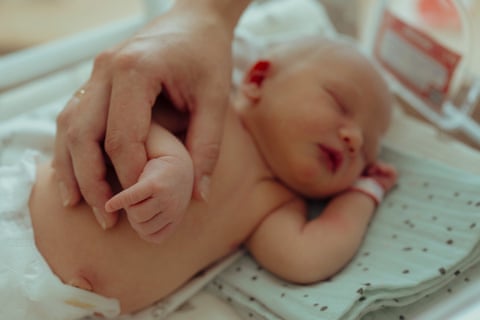
 
A two-day-old baby with eyes closed holding an adult’s finger.
At hospitals in Ukraine, women and hospital staff face terrible danger: circling drones, artillery, ballistic missiles and the targeted degradation of healthcare infrastructure.
 

Labels: , , ,

Sunday, January 09, 2022

Rejecting Birth Abnormalities

Cloey Canida with her husband, Colton Canida, near their home in Tuolumne, Calif.
Marissa Leshnov for The New York Times
 
"The Times reviewed 17 patient and doctor brochures from eight of the testing companies, including Natera, Labcorp, Quest and smaller competitors. Ten of the brochures never mention that a false positive can happen. Only one mentioned how often each test gets positive results wrong."
"Genetic counselors who have dealt with false positives say some doctors may not understand how poorly the tests work. And even when caregivers do correctly interpret the information, patients may still be inclined to believe the confident-sounding results sheets."
The New York Times -- "When They Warn of Rare Disorders, These Prenatal Tests Are Usually Wrong"
 
"It's a little like running mammograms on kids."
"The chance of breast  cancer is so low, so why are you doing it?"
"I think it's purely a marketing thing."
Mary Norton, obstetrician,l geneticist, University of California, San Francisco
 
"Despite the trend in delayed child-bearing and advanced maternal age at delivery in the last several decades rates of Down Syndrome in Canada have not increased proportionately."
"This is due to increased use of prenatal diagnostic procedures followed by termination of Down Syndrome pregnancies."
Public Health Canada
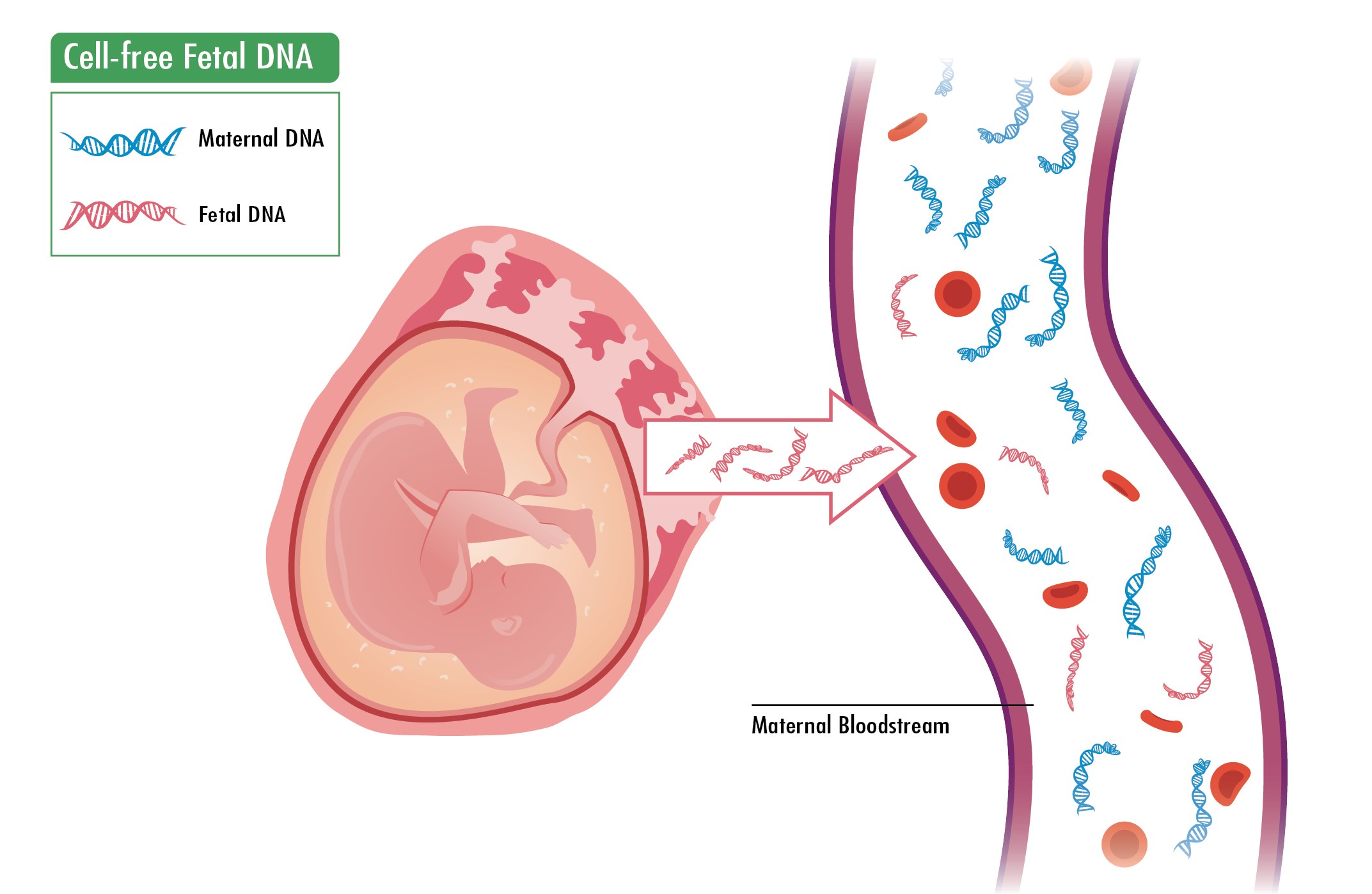
Cell free fetal DNA
Illustration adapted from Genetic Counseling Aids, 7th Edition

Relaxed access to abortion in most societies along with prenatal testing for genetic abnormalities have resulted in expectant parents making choices over whether to continue a pregnancy to completion or to abort a foetus and try again. Down syndrome babies became a primary target, readily picked up by tests for its easy detection as a chromosomal anomaly. The thought of giving birth to a child who would be impaired in development and have special nurturing needs was singularly unattractive to prospective parents in a world where it is no longer a woman's place to give her undivided attention to her children.
 
Down syndrome screening has resulted in far fewer children growing into adulthood with the syndrome, sheltered by their families and living longer so that they outlive their parents' ability to continue their role shielding their offspring from the harsh realities of life for those unable to function as wholly independent adults, depending on the severity of the condition.  Iceland in 2017 had few such children with close to 100 percent aborted following confirmation at prenatal testing.

Although not to the same degree as Iceland, many other countries see a majority of Down syndrome pregnancies aborted. The abortion rate for Down syndrome in the United States stands at 67 percent and in France, 77 percent, while Denmark has a 98 percent abortion rate for Down syndrome pregnancies.
 
AFP

The New York Times published a feature on non-invasive prenatal testing (NIPT) on the first day of the year 2022 pointing out that non-invasive tests tend to be hugely inaccurate, up to 85 percent of faulty results. And many of those 'positive' results in findings of abnormality -- many of them for extremely rare syndromes -- indicating a troubled birth in the delivery of a baby that nature failed to endow adequately to allow it to mature normally would take place. Such tests may urge follow-up consultations leading to validation of results -- but many prospective parents simply accept the results rather than investigate them since these are costly procedures, opting to abort instead.

The story in the NYT approached non-invasive prenatal testing in the case of five abnormalities beyond Down syndrome, discovering huge numbers of false positive rates; 81 to 93 percent of tests rendering incorrect results. And while many doctors prescribe these tests for their patients there are some experts in the medical community who view them with the skepticism they feel they deserve; as having a financial incentive; yet another marketing tool.

As an example, the story reported one large test producer, Natera, had performed over 400,000 screenings for one abnormality in 2020 which would be the equivalent of testing approximately ten percent of pregnant women in the United States. The simplest of all tests is that to recognize and identify gender. It may not register as reasonable to abort in favour of one gender over another but in some cultures a preference for male babies is the pervasive norm.

Decades ago an article was published on the "100 million missing women", by Amartya Sen, shocking attention to focus on the common South-Asian practice of sex-selected abortion and infanticide. Since then, the world has risen above its initial shock, going on to increasingly rely on testing technology now in widespread use -- and its consequences. It is when testing is done and results in hugely incorrect, misleading results, influencing parents to abort when they may, in most instances, be carrying perfectly normal foetuses that a societal problem raises concerns.

Labels: , , , , ,

Thursday, January 06, 2022

COVID-19 -- Age-Indifferent

"We have always expected that, if community rates went up, it would translate into the pediatric world. We talk a lot about COVID being mild in children. But, with increasing rates, we're seeing increasing hospitalizations in infants."
"There is a good transfer of antibodies to the newborn [when their mothers are vaccinated while pregnant]. We are extrapolating it will protect the baby for at least the first few months of life."
"I can understand the hesitancy, but I would like to assure [pregnant women] that it has been shown to be very safe."
"There is no doubt in our minds that this is beneficial. It's a vaccine-preventable illness. This is one thing that moms can do to protect their newborns."
Dr. Anne Pham-Huy, paediatric infections expert, Children's Hospital of Eastern Ontario (CHEO)

"All available COVID-19 vaccines approved in Canada can be used during pregnancy and breastfeeding, but the Society of Obstetricians and Gynaecologists of Canada [SOGC] recommends following provincial and territorial guidelines on type of vaccine to prioritize for pregnant and breast-feeding individuals."
Society of Obstetricians and Gynaecologists of Canada statement
American doctors are now treating over 500 kids a day for COVID-19. In Canada, admissions are also rising and pediatric hospitals are starting to see more infants with the virus.   CBC
 
The admission of four babies under a year of age to Ottawa's Children's Hospital of Eastern Ontario with COVID-19 infections in the past three weeks has raised alarms in the paedriatric medical community. That another two infants were admitted to the McMaster Children's Hospital in Hamilton aroused a desperate effort to persuade pregnant women to be vaccinated. Eight infants by comparison had been admitted to hospital with COVID during the entire two-year period of the pandemic.

Infant hospitalizations for COVID-19 infection prior to mid-December represented a rare event. A program at CHEO tracks vaccination status of mothers of infants admitted to the hospital. CHEO, along with the Hospital for Sick Children in Toronto, McMaster Children's Hospital and Kingston Health Sciences Centre formed a purposeful effort to urge pregnant women to be vaccinated -- not only for their babies' well-being but for their own protection against the pathogen stalking the world community.
 
A joint statement from the hospital group explained that "With the rise of Omicron, hospitals are starting to see a disturbing, potential new trend -- admissions of infants with COVID-19." Because infants have immature immune systems that make it difficult for them to combat infections, they are particularly at risk. Pregnant women who have been vaccinated mount excellent immune responses and that capacity is passed on to their newborns.

Absent a mother's vaccinated state, an infant has no protection of maternal antibodies that would be transferred during the third trimester of pregnancy, a reality that has been studied with other infectious diseases, like flu and whooping cough. CHEO's Better Outcomes Registry and Network (BORN) Ontario collects, interprets and shares data, and has been monitoring the impact of COVID in the provincial pregnant population. Research indicates no evidence that COVID-19 vaccines taken during pregnancy can be associated with adverse pregnancy outcomes.

Pregnant women infected with COVID-19 stand an increased risk of admission to hospital ending up needing critical care and invasive ventilation, in  comparison to their age-matched, non-pregnant peers. Almost 40,000 women received at least one dose of  COVID-19 vaccine during pregnancy between December 14, 2020 and June 30, 2021. 

Roughly seven to 11 percent of pregnant women are estimated to require hospitalization for COVID-related illness, while between one and four percent of pregnant women will require admission to intensive care units according to international and Canadian data. Being over 35 years of age, asthma, obesity, pre-existing diabetes, pre-existing hypertension and heart disease are factors associated with risk of severe illness.

An increased risk of preterm birth associated with COVID-19 has been identified in both Canadian and U.S. studies. Vaccine coverage in pregnant women has remained lower than within the general population, despite pregnant women having been prioritized for vaccinations, reports BORN Ontario.  
"The biggest difference is that Omicron is much more respiratory, so kids are presenting with cold-like symptoms, where before it was fever and maybe some gastrointestinal in the earlier waves."
"Now we're seeing kids, for example, with asthma. Their asthma is getting worse and bringing them into hospital."   
"We're way higher than we were previously. Part of that is because there are so many cases in the community that kids are coming in — some with COVID, some for other reasons — and we're screening COVID on admission."
"In previous waves, babies were essentially unaffected by COVID. But now we're seeing newborns. So in that first 30 days of life, significant disease."
Dr. Fatima Kakkar, paedriatic infectious diseases, specialist, Sainte-Justine Hospital, Montreal 
Multiple hospitals recently began seeing an uptick in young patients infected with the coronavirus, CBC News has learned, including some of the country's largest pediatric facilities in British Columbia, Ontario, and Quebec.  (Evan Mitsui/CBC)
 
According to figures from the U.S. Centers for Disease Control and Prevention, by the week ending January first, an average of over 570 children presenting with COVID were admitted to U.S. hospitals across the nation, daily. 
At the largest pediatric health care facility in the United States -- Texas Children's Hospital in Houston, over 700 children were treated in a single 24-hour period with COVID. The hospital reports an over four-fold increase in child hospitalization from COVID-19 just in the past two weeks, in lock-step with the emergence of the Omicron variant sweeping the world community.   
"As you're seeing a more transmissible variant plow through our communities, you are seeing more children get infected; primarily those who are unvaccinated."    
"Unfortunately, a subset of them are ending up in the hospital requiring, sometimes, ICU level care. So that certainly is alarming."    
Dr. Syra Madad, senior director, special pathogens, New York City Health System

Labels: , , , , , , ,

 
()() Follow @rheytah Tweet