Rejecting Birth Abnormalities
 |
| Marissa Leshnov for The New York Times |
"The Times reviewed 17 patient and doctor brochures from eight of the testing companies, including Natera, Labcorp, Quest and smaller competitors. Ten of the brochures never mention that a false positive can happen. Only one mentioned how often each test gets positive results wrong.""Genetic counselors who have dealt with false positives say some doctors may not understand how poorly the tests work. And even when caregivers do correctly interpret the information, patients may still be inclined to believe the confident-sounding results sheets."The New York Times -- "When They Warn of Rare Disorders, These Prenatal Tests Are Usually Wrong""It's a little like running mammograms on kids.""The chance of breast cancer is so low, so why are you doing it?""I think it's purely a marketing thing."Mary Norton, obstetrician,l geneticist, University of California, San Francisco"Despite the trend in delayed child-bearing and advanced maternal age at delivery in the last several decades rates of Down Syndrome in Canada have not increased proportionately.""This is due to increased use of prenatal diagnostic procedures followed by termination of Down Syndrome pregnancies."Public Health Canada
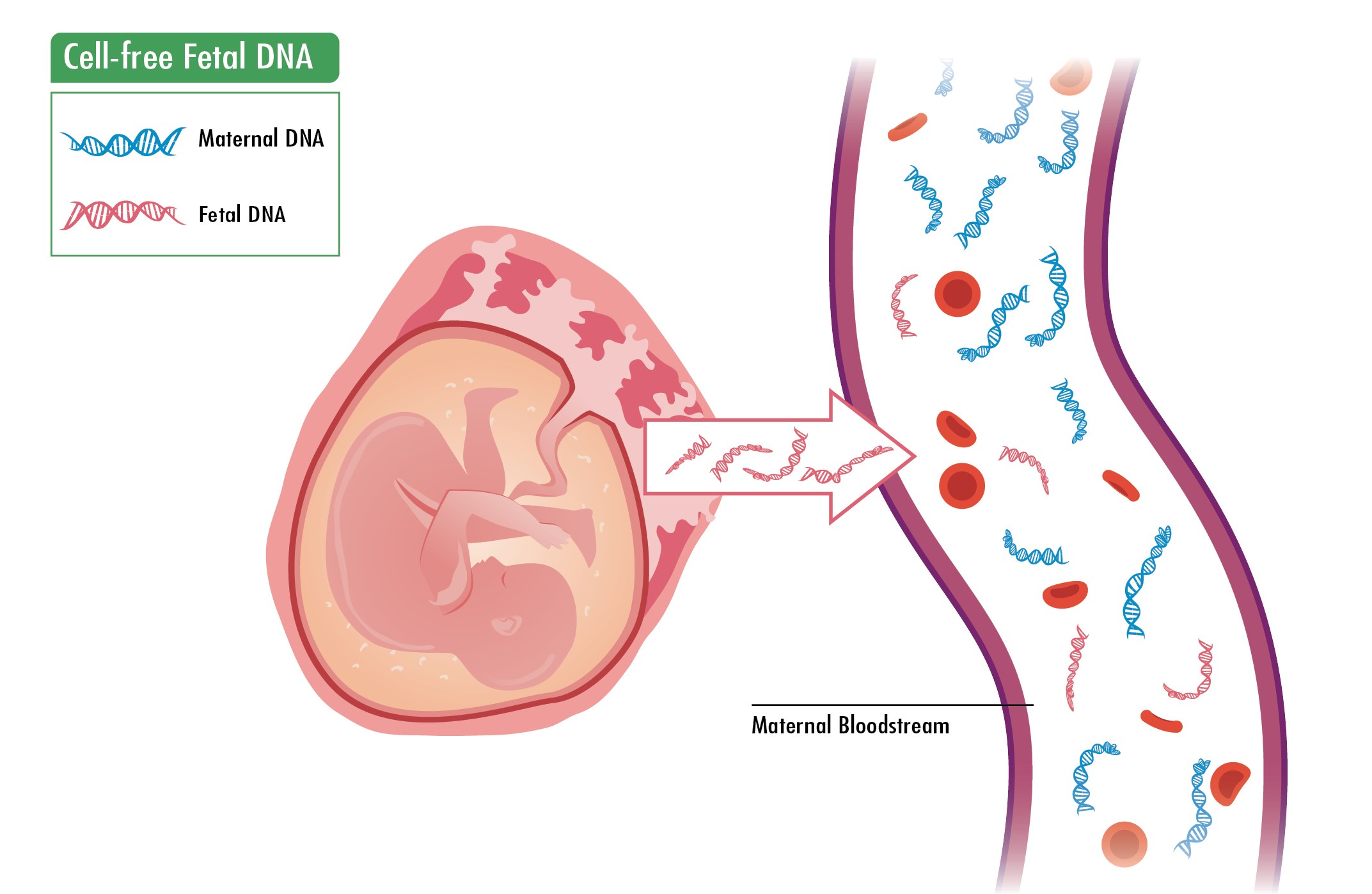 |
| Illustration adapted from Genetic Counseling Aids, 7th Edition |
Relaxed access to abortion in most societies along with prenatal testing for genetic abnormalities have resulted in expectant parents making choices over whether to continue a pregnancy to completion or to abort a foetus and try again. Down syndrome babies became a primary target, readily picked up by tests for its easy detection as a chromosomal anomaly. The thought of giving birth to a child who would be impaired in development and have special nurturing needs was singularly unattractive to prospective parents in a world where it is no longer a woman's place to give her undivided attention to her children.
Down syndrome screening has resulted in far fewer children growing into adulthood with the syndrome, sheltered by their families and living longer so that they outlive their parents' ability to continue their role shielding their offspring from the harsh realities of life for those unable to function as wholly independent adults, depending on the severity of the condition. Iceland in 2017 had few such children with close to 100 percent aborted following confirmation at prenatal testing.
Although not to the same degree as Iceland, many other countries see a majority of Down syndrome pregnancies aborted. The abortion rate for Down syndrome in the United States stands at 67 percent and in France, 77 percent, while Denmark has a 98 percent abortion rate for Down syndrome pregnancies.
 |
| AFP |
The New York Times published a feature on non-invasive prenatal testing (NIPT) on the first day of the year 2022 pointing out that non-invasive tests tend to be hugely inaccurate, up to 85 percent of faulty results. And many of those 'positive' results in findings of abnormality -- many of them for extremely rare syndromes -- indicating a troubled birth in the delivery of a baby that nature failed to endow adequately to allow it to mature normally would take place. Such tests may urge follow-up consultations leading to validation of results -- but many prospective parents simply accept the results rather than investigate them since these are costly procedures, opting to abort instead.
The story in the NYT approached non-invasive prenatal testing in the case of five abnormalities beyond Down syndrome, discovering huge numbers of false positive rates; 81 to 93 percent of tests rendering incorrect results. And while many doctors prescribe these tests for their patients there are some experts in the medical community who view them with the skepticism they feel they deserve; as having a financial incentive; yet another marketing tool.
As an example, the story reported one large test producer, Natera, had performed over 400,000 screenings for one abnormality in 2020 which would be the equivalent of testing approximately ten percent of pregnant women in the United States. The simplest of all tests is that to recognize and identify gender. It may not register as reasonable to abort in favour of one gender over another but in some cultures a preference for male babies is the pervasive norm.
Decades ago an article was published on the "100 million missing women", by Amartya Sen, shocking attention to focus on the common South-Asian practice of sex-selected abortion and infanticide. Since then, the world has risen above its initial shock, going on to increasingly rely on testing technology now in widespread use -- and its consequences. It is when testing is done and results in hugely incorrect, misleading results, influencing parents to abort when they may, in most instances, be carrying perfectly normal foetuses that a societal problem raises concerns.
Labels: Abortion, Inaccuracies, Medical Community, Pre-natal Non-Invasive Testing, Pregnancies, Prospective Parents
posted by Pieface @ 8:18 PM
0 comments