Ruminations

Blog dedicated primarily to randomly selected news items; comments reflecting personal perceptions

Saturday, April 23, 2016

21st Century Uplift in Rwanda

"The concept of drone ports is something that a very small decision-making unit in the country decided they were going to do."
"It took a very short time. It's something that America could learn from."
Michael Fairbanks, Rwanda presidential advisory council

Zipline drone
In 2014 Keller Rinaudo and William Hetzler had a visit with a young public health worker in Dar es Salaam, Tanzania. They were impressed with that worker's vision and initiative for having created a text-messaging system capable of helping hospital workers to use it as an emergency communication to request medical supplies in life-or-death situations.

"The public health worker showed me the database that had entries every time someone texted, and it was thousands of names long. It was mostly infants, and there was no response", explained Mr. Rinaudo. And it was at that moment that he understood the reality of what he was observing. That database with its entries that had never received a response was in fact a long list of death sentences.

That realization acted as a powerful spur, sending Keller Rinaudo and his business partner William Hetzler to find a solution. They looked for an airborne alternative to enable the automation of a supply chain. Their meeting with Keenan Wyrobek, a roboticist trained at Standford University set them on track to assemble an engineering team with background in the aerospace industry.

The close collaboration with roboticists and aerospace engineers led to a rapid engineering feat where a highly automated system was developed to be operated by a staff of five to eight people. That ground-breaking automated system was in fact a drone service. And now one is to be based in a city close by the Rwandan capital of Kigali.

In a story of modern technology uplifting and aiding one of the world's poorest nations, putting it way ahead of wealthier more technologically advanced countries of the world, Rwanda is on schedule to be the first to establish a commercial network of drone deliveries. "Rwanda has a vision to become a technology hub for East Africa and ultimately the whole continent of Africa", explained Mr. Hetzler.

He, as it happens, along with Keller Rinaudo founded a new technology company named Zipline, in Half Moon Bay, California. They helped to design small fixed-wing drones designed to carry medical supplies to remote locations up to 65 kilometres distance from operational headquarters. And the government of Rwanda has signed onto their initiative.

The new system will be capable of 50 to 150 daily deliveries. Rwanda's 21 hospitals and clinics in the western half of the nation is set, from July of 2016 when the system will begin operation, to take advantage of this life-saving option that modern technology has pioneered. A fleet of 15 drones, each with twin electric motors, a 1.6 kilogram payload and a 1.5-meter wingspan describes the system's base.

Speed maintains a "cold chain" -- temperature-controlled supply chain required to convey blood and vaccines. The Zipline drones will make use of GPS to navigate, and communication will take place using the Rwandan cellular network. Rough weather flight with winds up to 50 kilometres per hour will be handled by the drones which will not land but instead drop small packages from low altitudes with the use of paper parachutes.

Labels: , , ,

Monday, August 11, 2014

The Devil's Price Tag

"We didn't know he was free. I hadn't heard anything of him in two years. "
"We are happy to hear that now he is not on the street and hope the United States government will hand him over to Canada Border Services and the process of deportation starts over again as soon as possible."
"We hope things will move faster than it did before."
"This kind of crime, genocide, is never too old. The community will feel more comfortable -- and proud of our second country, Canada -- if Canada does everything possible to bring him to justice."
Alain Ntwali, president, Association Humura (Rwandan genocide survivors)
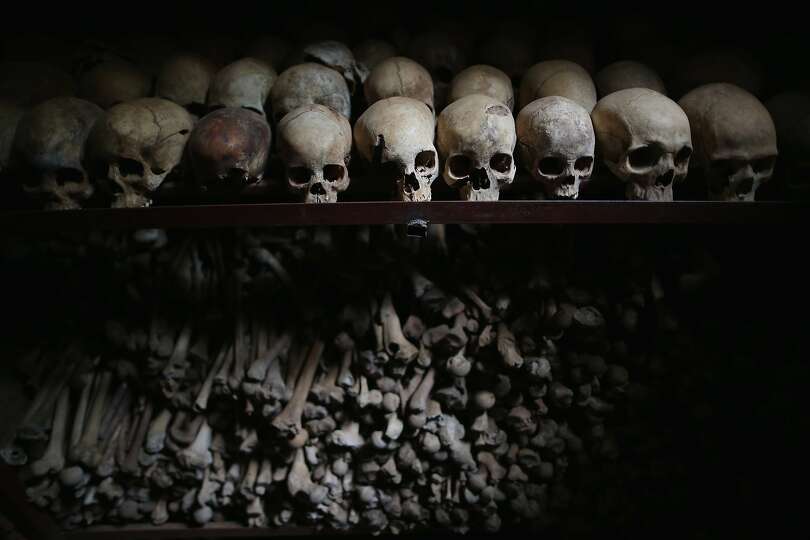
NYAMATA, RWANDA - APRIL 04:  Metal racks hold the bones of thousands of  genocide victims inside one
Chip Somodevilla/Getty Images   Metal racks hold bones of thousands of genocide victims inside one of the crypts at a memorial in Rwanda

Good luck on that one. Canada is making an effort to see justice done for the victims of the Rwandan massacre of Tutsis by the ruling Hutu in 1994, a gruesome wildly lunatic massacre in an episode of ethnic violence in Africa that will remain a subject of discussion throughout history in the countless other such episodes when one group of people turn their deadly hatred against another.

The Rwandan genocide sits alongside the Turkish mass slaughter of Armenians, the Soviets deliberately mass-starving Ukrainians, the unspeakable Pol Pot regime in Cambodia's mass murders, the Sudan government waging ethnic slaughter against the black Sudanese people of Darfur, the current government of Syria waging all-out war against its Sunni Syrian population. And, above all, the unspeakable atrocities of the Nazi-inspired Holocaust seeking to obliterate world Jewry.

Today's is a different Canada. Although Canadian soldiers fought valiantly against Nazi Germany and the Axis powers, once World War II came to an end, and former Nazis migrated to Canada, taking care not to declare their fascist-criminal war crimes when seeking immigration status, authorities were none too concerned. Jews, however, became aware of the presence of former death camp guards walking the streets of Toronto.

In this different era Canada is striving to meet its humanitarian and justice obligations and attempts to disallow entry into the country of any foreign national who has been engaged in conflict situations such as the above. Jean Leonard Teganya, a Rwandan Hutu is the eldest son of a convicted war criminal in Rwanda, who ten years earlier had sought refuge in Canada and was returned to his native country to face justice.

Now it is his son's turn. Jean Leonard Teganya was a medical student interning at the Butare University Hospital in Rwanda at a time that Hutu extremist government militias ran rampant killing patients, staff and moderate Hutus in the 1994 horrors of Tutsi extermination. As a medical student, he might have reacted by objecting to seeing helpless patients slaughtered, but he did not.

In that one hundred days of unspeakably bloodthirsty mayhem and carnage, 800,000 people were slaughtered. During legal challenges by Mr. Teganya -- whose asylum claims the Immigration and Refugee Board had twice rejected -- hoping to remain in Canada, the Federal Court of Canada studied evidence of lists drafted naming patients and staff at the hospital meant to be the targets of the genocide; of Tutsi patients turned toward death by marauding militamen.

His claims for asylum were rejected on the basis of the belief by the Immigration and Refugee Board that he had direct knowledge of atrocities being committed, and as such was complicit in those human rights abuses. For his part, Mr. Teganya held he was not involved in the violence, and was himself spared only because of his Hutu ethnicity; an obvious liability in that statement that does not appear to have occurred to the man.

The Federal Court's interpretation was that because Mr. Teganya had been "left unscathed", this alone represents evidence that he was "considered to be an extremist" by the militants; at the very least disinterestedly uninvolved in the dread fate of his countrymen, doing nothing whatever to attempt to avert their calamitous ending. So unconcerned, in fact, that he remained at the hospital afterward, to complete his internship.

When his legal challenges all failed, his deportation to Rwanda was scheduled to take place on October 23, 2012. Mr. Teganya chose on this occasion also to remain uninvolved, and simply ignored the order to appear at the time and place scheduled for his removal. After which he was placed on Canada's Border Services Agency's "wanted list" of those being sought, for forcible removal from Canada.

Last Sunday there was an alert by a citizen in backcountry Maine who had noticed a man walking through the woods at the border between Maine and New Brunswick. Soon enough, a border agent dispatched to respond found a man who identified himself as Jean Leonard Teganya, walking across the border without due process. When he was arrested and taken to the border patrol station, a fingerprint search revealed his identity; a man wanted in Canada for complicity in war crimes.

With his wife and children living in Canada, Mr. Teganya himself will not find a place for himself in the country. He is being held without bail at an American correctional facility. As someone with no legal status in Canada, the United States could choose to send him directly to Rwanda, once found to be inadmissible to the United States.

For having sought and failed refugee status in Canada, international law denies him the right to apply for refugee asylum in another signatory country.

Labels: , , , ,

Monday, March 31, 2014

Devil's Spawn / Innocent Offspring

"I wanted to abort. At first I refused to breastfeed him and was looking away when the doctors gave him to me. I didn't want to look him in the face, knowing where he came from."
"The third time I heard them raping her, it was during the night, and I told myself, 'This is death, I don't want to see my daughter dying, I have to go die somewhere else."
Egidie, Rwandan Tutsi
Rape divides mothers and children years after Rwandan genocide
Egidie, far right, stands with daughter Diana and son Bertrand. Diana was five during Rwanda’s genocide and was raped in a building next to where her mother was being raped. Egidie and Diana were separated for months and when they finally were reunited, Egidie was pregnant with Bertrand — whose father was one of the many men who raped his mother. The family is healing from their trauma through therapy. Photo and story by Sue Montgomery
 
"I've always felt rejected by her and he rest of the family. And now she feels responsible for the problems I'm having, and I feel guilty about that."
Angelique Uwasa, 19
Angelique Uwasa, 18, (centre) was born to Chantal Mukeshimana, who was raped during Rwanda's genocide in 1994. Both traumatized, they are trying to heal their troubled relationship which is rife with resentment.
Angelique Uwasa, 19, (centre) was born to Chantal Mukeshimana, who was raped during Rwanda's genocide in 1994. Both traumatized, they are trying to heal their troubled relationship which is rife with resentment.  Photograph by: Sue Montgomery, The Gazette
 
"I was vomiting and when I realized I was pregnant, I wanted to kill myself."
Chantal Mukeshimana, Angelique's mother
Vestine Mukangamije (left) was raped by the man who killed her husband and five children during Rwanda's genocide. Poor, homeless and still traumatized by the horrors of 1994, she leans on other rape survivors, such as Chantal Mukeshimana. (right)
 
During the 100 days of the 1994 genocide that took place in Rwanda, despite the presence of United Nations Peacekeeping troops, unarmed and unable in their paucity of numbers to physically restrain the Hutus of Rwanda from attacking their fellow Tutsi Rwandans, almost a million men, women and children were slaughtered by their neighbours using crude implements to effect their murders.

The genocidaires -- as they are now called; Hutu men and boys of age -- slaughtered, pillaged and raped. Tutsi women, between 250,000 and 500,000 of them, according to Amnesty International, were serially raped throughout the months of viciously frenzied killing. The aim of the majority ruling Hutu was to destroy the presence of the minority Tutsi.

An estimated 20,000 children were born of the mass rapes. These were children who understood themselves to be different by the way in which they were viewed by their mothers, by their families; branded with shame, dreaded by both ethnic communities as representing neither one nor the other. The children were living reminders of the horrors that were compelled upon them. Many thought of their children as representing "fruit of the devil".

In the southern town of Butare, a woman named Egidie was raped during the horrors of the genocide. Her daughter, all of five years of age at the time, was kept imprisoned in another building. And the child was raped repeatedly, the mother able to hear the voice of her little girl screaming in agony and pain and fear that would not stop. Months afterward, Egidie was able to see her child again, when both survived their dreadful ordeals.

The little girl could barely manage to walk, as a result of the internal injuries done her. And that's when Egidie realized she was pregnant. Her son Bertrand, has just turned 19. Donor funding allowed for widows of the genocide to live in neat rows of houses along Rwanda's terraced slopes. Hundreds of thousands of women survived, their husbands having been butchered. They helped to raise the children of others and shared what they could.

"In the past I felt rejected and unwanted", explains Bertrand, 6-feet tall. "But my mother hadn't explained to me what happened. Now I'm trying to move on, help my mom and leave the past." If that is at all possible. Diane, the five-year-old, now is in her third year of development studies at university. She hates men. But not her father. "My father loved us, especially me", she says, smiling.

As for Angelique Uwasa, whose mother was savagely gang-raped repeatedly, the memory of which has almost destroyed her, the mother and daughter are attending meetings arranged through a local NGO, Best Hope Rwanda. At the meeting, Angelique and her mother were among dozens of other women raped during the genocide, along with their offspring of those atrocities. They are all doing their best to find hope in life, to tamp down the bitter gall of memory.

These are women and their children who live in a country where those who considered them to be enemies, less human than themselves and deserving to die horrible deaths, now live among them as they did before the madness erupted. That, in and of itself, forcing accommodation with the fact that neighbours took part in such monstrous atrocities as mass murder, rape of children and women, is bitter fruit to taint the future.

Labels: , , , ,

Saturday, March 29, 2014

The Aftermath of Horrific Realities

"You cannot measure the consequences of war and conflict by counting the number killed. You have to count the survivors and what happened to them."
"The health outcomes aren't good."
Duncan Pederson, World Health Organization Collaborating Centre for Research and Training in Mental Health, Montreal

"We're not just starting to see PTSD, we are in the thick of it. It's an extremely big problem and we're not keeping up with the suffering."
"Will we come out of it quickly. I don't think anyone knows, but we need to work or study or do something that allows us to think of something other than death."
Naasso Munyandamutsa, Rwandan psychiatrist

"The whole thing is just so pervasive, you probably need 10,000 counsellors to even begin to make a difference. For most of us in other countries, the problem is anxiety, and this is ten times deeper than that. It's a huge challenge."
Delanyo Dovlo, World Health Organization Rwandan representative
Young people gather in Amahoro Stadium in Kigali for the 18th commemoration of Rwanda’s genocide, in 2012. Photo by Sue Montgomery/The Gazette

Young people gather in Amahoro Stadium in Kigali for the 18th commemoration of Rwanda’s genocide, in 2012. Photo by Sue Montgomery/The Gazette


The question is: How do vulnerable young children survive the horror of witnessing atrocities so brutal that their minds would be forever in a state of confused derangement over the loss of parents, siblings, extended family, leaving them as children to cope on their own and attempt to surmount that horror? Over a quarter of the Rwandan population now suffer post-traumatic stress disorder.

Each of the country's 43 district hospitals sees between 15 and 25 patients a day for psychiatric problems. Its first addiction facility, recently opened, treats 300 to 400 people a month, from age 16 and up. There are six psychiatrists serving 11.4 million Rwandans. A UNICEF national trauma survey that took place a year after the genocide took place warned of problems to come.

Of the estimated 99.9 percent of Rwandan children who witnessed violence during the genocide, 79.6 percent had at least one death in their family; 69.5 percent witnessed someone being killed or injured, and 31.4 percent witnessed rape of sexual assault. Those children in the UNICEF study are now young adults, and the trauma of their experiences has left them still struggling to understand what they experienced.
In 1994, at the Munigi refugee camp near Goma, a Rwandan child cries at his dying mother's side. Associated Press file photo
 
On April 7, Rwanda mourns the 20th anniversary of the genocide that befell it. And every April 7 there is a national recognition of the genocide, with a national week of mourning. The very churches and schools where hundreds of thousands of desperate Tutsis sought refuge, but found death instead, stand as memorials, testament, if any were required, of their torment. An estimated 300 people butchered each hour of one hundred days of slaughter.

Those young adults still struggling to understand what their young eyes were assaulted by in one hundred days of butchery where neighbours, former friends and even relatives by marriage viciously used machetes, nail-studded clubs and spears engaged on mass slaughter. Their minds cannot help but wander helplessly in the direction of the same question repeated without answer; what would make Hutus turn on that segment of the citizenry known as Tutsis?

This is an entirely different country now than it was twenty years ago. It present as clean, safe, and swiftly developing to embrace and meet all of the advanced indices the United Nations' eight Millennium Development Goals by next year. The very picture of success in living standards for Africa, achieving a list of targets agreed to by all countries in 2000; inclusive of pledges of poverty reduction and universal primary education provision by 2015.

And while the country becomes an information-technology hub, installing over 1,600 kilometres of fibre-optic cables and a 4G network covering 95 percent of the country, many among its population are barely managing to function. An estimated 600,000 people who lost both parents and have little to no access to psychological support, plagued by stress, epilepsy, unable to sleep, resorting to alcohol and drugs for relief.

Jonathan Nettal, a psychotherapist working for a Canadian NGO called Hopethiopia/Rwanda, counsels 19- to 23-year-olds how to help one another, even while traumatized. A native of Montreal whose grandparents are Holocaust survivors, Mr. Nettal teaches small groups of ten to 15 people coping skills. "So you have more calm, people are more supportive, more socially connected, and that's a huge resource in terms of post-traumatic resilience."

Think about it: how do you cope as a teen when you've just been informed you were conceived through mass rape. That venomous, self-destructive mind-flood of shame, confusion and anger must be confronted and dealt with. Mental illness in Rwanda is a dire issue, where thousands of "genocidaires" (perpetrators) live among their victims.
Egidie walks arm in arm with her son, Bertrand, who was born after Egidie was raped several times by many men during Rwanda’s 1994 genocide. Through counselling, they have learned to accept the horrific past and love each other. (Neither wanted their last names published) Photo by Sue Montgomery/The Gazette

Egidie walks arm in arm with her son, Bertrand, who was born after Egidie was raped several times by many men during Rwanda’s 1994 genocide. Through counselling, they have learned to accept the horrific past and love each other. (Neither wanted their last names published) Photo by Sue Montgomery/The Gazette


Labels: , , , ,

 
()() Follow @rheytah Tweet