Ruminations

Blog dedicated primarily to randomly selected news items; comments reflecting personal perceptions

Thursday, August 03, 2023

Vitamin D Intake ... Regular Sunlight Exposure
 
"Vitamin D is made in the skin when it’s exposed to sunlight. Sun exposure is by far the best way to boost vitamin D levels, particularly because very few foods contain significant amounts."
"Midday, especially during summer, is the best time to get sunlight."
"At noon, the sun is at its highest point, and its UVB rays are most intense. That means you need less time in the sun to make sufficient vitamin D."
"Many studies also show that the body is most efficient at making vitamin D at noon."
"For example, in the UK, 13 minutes of midday sunlight exposure during summer three times per week is enough to maintain healthy levels among Caucasian adults."
"Another study found that 30 minutes of midday summer sun exposure in Oslo, Norway was equivalent to consuming 10,000–20,000 IU of vitamin D,"
"The commonly recommended daily dose of vitamin D is 600 IU (15 mcg)."
"Not only is getting vitamin D around midday more efficient, but it might also be safer than getting sun later in the day. One study found that afternoon sun exposure may increase the risk of dangerous skin cancers."
healthline 
n0207a16207234035681
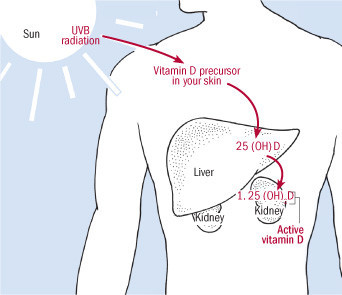
The sun's energy turns a chemical in your skin into vitamin D3, which is carried to your liver and then your kidneys to transform it to active vitamin D. Harvard Health Publishing
 
There is a link between sunlight and serotonin levels,the hormone that makes us feel good. The lack of sunlight can make some people susceptible to developing seasonal affective disorder when shorter fall days appear and winter brings us fewer daylight hours. An Australian study found that people had higher levels of serotonin in bright sunny days than on cloudy days. The increased levels of the hormone lead to greater feelings of calm and satisfaction, with lower levels of depression and anxiety.

Researchers speculate that the way UV light forces melanocytes, cells producing dark pigment in skin to release endorphins may explain the link between sun exposure and increased serotonin. Melatonin, the hormone that helps regulate the body's sleep-wake cycle, is encouraged in production through regular sunlight exposure. Melatonin helps as well to regulate our circadian rhythm, the body's internal clock that signals when to be alert and when to rest.
 
Our amygdala, the emotional part of the brain, is significantly more reactive following a bad night's sleep, leaving us likely to feel cranky. Exposure to sunlight can encourage feelings of drowsiness, so we can drift to sleep more readily, leading to a more comfortable daytime experience emotionally. Simply put; time spent in the sun has the potential to allow us to sleep soundly. 
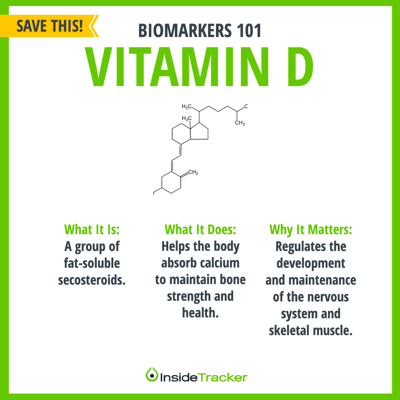
What is vitamin D and why does it matter for health 
Just one hour in the sun, according to research undertaken at Medical University of Graz in Austria, can boost a man's testosterone levels by 69 percent, helping to balance mood, sex drive and cognitive function, all achieved through vitamin D, produced following sunlight exposure. A link was identified between low levels of vitamin D and low levels of the female sex hormone estrogen, by researchers in China who studied the effect on post-menopausal women.

Vitamin D has a critical role in helping the body to absorb calcium, responsible for bone strengthening. Lack of vitamin D has been associated with osteoporosis, rickets and autoimmune diseases such as rheumatoid arthritis. Rates of falls in elderly people were found in a review by the Cochrane Library, due to the effects of brittle bones, that could be reduced by over a quarter if the elderly were prescribed supplements of vitamin D.

https://www.usnews.com/object/image/00000184-0f82-d474-a785-bf9ff7e10000/gettyimages-1047661360.jpg?update-time=1666707586795&size=responsiveFlow300
Casual exposure to sunlight is responsible for 90 percent of a person's vitamin D requirements; the best source of the nutrient. Experts believe on average that people should aim for 10 to 30 minutes of midday sunlight, several times weekly. A dose of vitamin D could also improve intellect. Scientists from the University of Manchester found higher levels of vitamin D linked with improved mental ability in middle-aged and older men. 

In their study, men were tested for memory and speed recollection, along with mood and physical activity levels before blood samples were taken. Men with higher levels of vitamin D consistently outperformed those with lower levels. Even on a cloudy overcast day we are exposed to 10,000 lux (light is measured in a unit called lux) in comparison with 500 lux, spending time indoors.


Labels: , , , , ,

Saturday, October 30, 2021

Losing Daylight, Gaining SAD

Academic research shows that losing an hour of daylight can be linked to negative effects on both the mind and body, including disturbed sleep patterns, seasonal depression and obesity. (iStock)
"When we admitted the first cohort, it was in the summer-time, and they were really quite well."
"Some skeptical people said, 'Well, what will happen if they don't get depressed? You'll look pretty stupid. And I thought, well, that's OK, I'll take that chance. It's not such a bad thing to look stupid."
"[And then, on schedule the majority of the test subjects became depressed; people went] down [at different times reflecting their sensitivity to lack of light']. We  exposed them to light and it was really quite one of the most exciting things. ... It was, in some cases, very transformational."
"If you've got SAD [seasonal affective disorder] and COVID anxiety, it's just a double whammy."
"If people aren't operating at their best, they should be treated or they should be helped."
"It's an unfortunate term, because it's got a kind of Freudian feel about it -- 'Oh these people are neurotic, they're just complaining about nothing'."
Dr.Norman Rosenthal, professor of psychiatry, Georgetown University School of Medicine

"We don't know what the trigger is, and it may be different for different people."
"What makes this unique is that there are very few sub-types of depression that we know when they're going to come on [most frequently between November and December] and when they're going to get better."
"Certain hormone levels, certain basic building blocks of proteins -- these all shift with the seasons."
Dr.Anthony Levitt, psychiatrist, chief, Hurvitz Brain Sciences Program, Sunnybrook Health Sciences Centre, Toronto
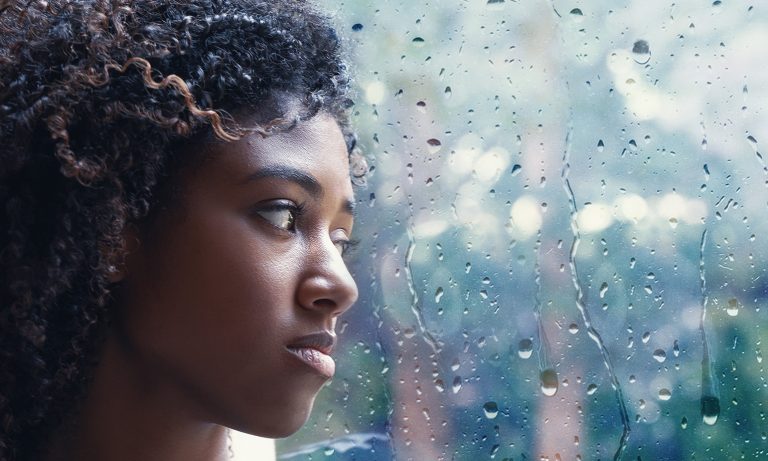
Young woman looking out through rain covered window, depressed
Seasonal Affective Disorder   HelpGuide
 
Dr.Rosenthal, back in the winter of 1981 began a study ti determine the extent of a depression that would affect peoples' moods in the late fall months, when those affected tended to go to sleep earlier, sleep for longer periods and awaken later. By late afternoon their energy levels failed, they felt unmotivated, lethargic and depressed. People who travelled south reported mood improvement days after their arrival "and a deterioration in mood a few days after returning North again".

He was a pioneer in the study of a syndrome newly named as seasonal affective disorder (SAD). He worked out of the National Institute of Mental Health in Bethesda then and had his work cut out persuading colleagues of the legitimacy of the phenomenon. "Some made a joke out of it", he recalled. Forty years later, there are still skeptics, but the reality is that when clocks are turned back by an hour at 2 a.m. on November 7 with the end of daylight saving time, society in general reacts unhappily.

An event shown to correlate with seasonal depression onset.  Now, with COVID still bedeviling the globe, the situation has become more acute for many people. In the official psychiatry catalogue of mental illness SAD is recognized as a major depressive disorder, with its "seasonal pattern", as a sub-type of major depression. It has long been associated with a lack of environmental light; once people were submitted to supplemental light, their symptoms eased; "the more light, the better".

Unknown is what it is that causes the shift of critical biological molecules; length of day? amount of light exposure? Temperature; wind velocity; barometric pressure? Some people get by without getting SAD completely; they feel the effects but not severely, in "subsyndromal SAD", while others go into full-blown depression interfering with their ability to function adequately day to day. 
 
Ten percent of any population report SAD or subsyndromal SAD, but fewer than one percent meet the criteria for a "seasonal pattern of major depressive episodes", according to Dr.Raymond Lam, associate head, department of psychiatry, University of British Columbia. The symptoms of SAD are well enough recognized in the general public to encourage people to invest in SAD lamps (which filter out UV rays), and green and blue glow glasses.

Some scientists argue the theory behind SAD that major depression can be influenced by the seasons is rooted in "folk psychology", more than objective data. A Canadian study making use of data from Statistics Canada surveys from 1996 to 2013 amounting to over half a million Canadians, found the proportion of those reporting major depressive episodes in January to be 70 percent higher than in August.

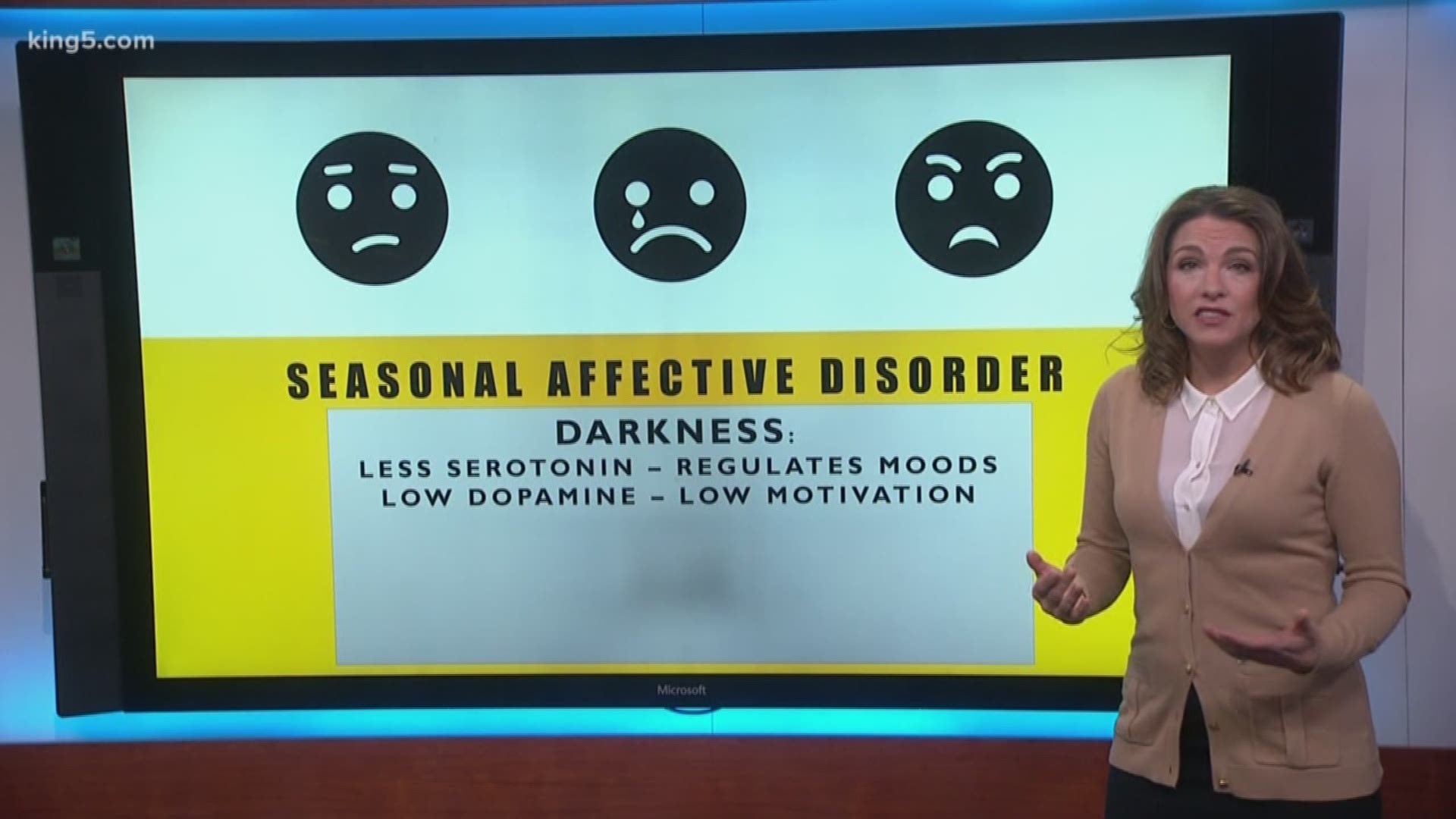
Several hypotheses are current; one that shorter winter days impact on the body's internal clock to cause "chrono-biological" disturbances. Decreased exposure to daylight hours impairs the regulation of serotonin, dopamine and noradrenaline, the three major neurotransmitters that scientists believe to be disturbed in depression. Nighttime secretion of melatonin, the body's natural sleep hormone is disrupted by reduced light exposure, leaving people to waken feeling exhausted and drained rather than refreshed and rested.

So how does exposure to increased light from specialized light-emitting lamps work to relieve the symptoms of SAD? "The retina is being impacted by the extra light and signals are going back through neural connections to the hypothalamus and various nuclei that are connected to emotional centres in the brain", explains Dr.Rosenthal. What can be  helpful is regular morning walks, looking at the sky,  cognitive behavioural therapy, stress reduction and maintaining social activities.

Labels: , , , ,

Wednesday, April 04, 2018

Stimulating The Brain, Banishing Sleep

"When sleep is not synchronized with our internal clock, or circadian rhythms, we know people get a lot of mood problems -- irritability or fatigue, sometimes anxiety."
"The conventional thinking has always been that timed light therapy at the appropriate time can help resynchronize our circadian rhythms." 
"Conventionally, for treatment, we use white light because white light has all the wavelengths. So, we're getting everything there, and that's generally been shown to be effective for treatment."
"Patient populations that should be particularly cautious about light therapy are those who are sensitive to light due to medical conditions such as eye conditions, certain diseases ... patients with a history of rapid cycling bipolar disorder, or patients with a history of migraine headaches."
"Teenagers might be more vulnerable to the circadian effects than adults. It's like a double hit. You're giving the most potent exposure to the most vulnerable people."
"This is one of several messages we try to get out: Take these things seriously because the effect is tangible and noticeable."
Dr. Elliott Lee, assistant professor, sleep specialist, Royal Ottawa Mental Health Centre
depression

Now there's some important advice to the general public almost universally addicted to iphones and computer-driven devices that consume our interest and drive our attention in a monoculture of Internet-derived entertainment: Cut back on evening screen time; no backlit screens within at least an hour, 60 minutes -- oh the agony of deprivation -- of bedtime. If you must, simply must cling to your personal favourite, cannot-live-without device, use the Night Shift option for however much benefit it can claim, which research doesn't appear to validate.

Light, natural light, sunlight, governs our days; our natural body rhythm is attuned daylight; it awakens us as dawn arrives and puts us to sleep when night has fallen. The structure of our physical, mental and behavioural tempo is hugely reliant on our circadian rhythm; we are with and of nature.
Which is to say, it is not only humans so affected but all living organisms. Those living in northern latitudes are particularly susceptible to the lack of natural light, when during winter months we are bereft of it with shorter days, longer nights.

And this where a phenomenon linked entirely to the seasons, brings us a condition named 'seasonal affective disorder', SAD, and sad it is indeed; discomfiting, troubling, disruptive to our normal state of being. The mood disorder that descends when hours of light are diminished and the sun's warmth decreased, places us into the thrall of a mood disorder that is capable of making us quite depressed, and certainly interferes with our sleep patterns.

Could I have SAD?

  • I feel like sleeping all the time, or I’m having trouble getting a good night’s sleep
  • I’m tired all the time, it makes it hard for me to carry out daily tasks
  • My appetite has changed, particularly more cravings for sugary and starchy foods
  • I’m gaining weight
  • I feel sad, guilty and down on myself
  • I feel hopeless
  • I’m irritable
  • I’m avoiding people or activities I used to enjoy
  • I feel tense and stressed
  • I’ve lost interest in sex and other physical contact  CMHA British Columbia
According to Dr. Lee, up to ten percent of the population suffers some form of SAD, and he should know, since his profession is geared to understanding and helping sufferers cope with the condition. One that has the potential to lead toward seriously dysfunctional impairment during winter months, including the desperation of suicide. A milder variant of SAD, known popularly as 'the winter blues' affects another ten to twenty percent of the population. And Dr. Lee and his associates recognize and continue to investigate the benefits (and limitations) of light as therapy, or light-therapy.

Artificial light, that is. It is a therapy gaining traction as an option to treat people presenting with mood disorders; depression in particular, irrespective of the seasonal variances of natural light. Recent research at the University of British Columbia points to light therapy promising benefits beyond its function in correcting circadian rhythm issues, to a more multi-purpose benefit. Some experts believe the blue wavelength of light significantly influences circadian rhythms, while others argue for the green wavelength's potency.

However, as Dr. Lee points out, white light contains all the required wavelengths for efficacy, with treatment consisting of white lights' availability in commercial panels next to a work desk. Absorbed through the pupils, white light hits light-sensitive receptors at the back of the eye functioning to alter circadian rhythms responding to light. No prescription is required to embark on personal light therapy, since light boxes are attainable commercially and relatively inexpensively.

As with all such protocols, including pharmaceutical regimens, there are side effects. Light therapy may include headaches and eye strain, which Dr. Lee recommends are reason to discontinue the use of the therapy. The need to determine optimal combinations of colour, timing, duration and intensity keeps researchers busy experimenting. Under examination as well, is the determination of who might be most responsive to light therapy.

The course regimen of a typical treatment is 30 minutes in the morning, generally between 6:00 and 9:00 a.m., at a time when people are most sensitive to light effects at a luminosity of 10,000 lux (for perspective, a bright sunny day represents around 100,000 lux). During the course of an ordinary day the very use of artificial light we are so accustomed to as routine is also capable of interrupting our circadian rhythms; from watching television, working on our laptops and simply switching on lights at dusk.

Backlit screens at night sabotage sleep in two ways, according to Dr. Lee. Light emanating from a screen resets our internal clock persuading our brain that it's daytime and not nighttime, suppressing the production of melatonin, a hormone we require to enable the onset of sleep and normal body maintenance that results from sound sleep. As well, what we derive from those iphones or computers tends to be stimulating; texting people at night rouses thoughts to race ahead, when we should be in a relaxed sleep mode.
While technology allows us to complete tasks faster, and do many tasks at once, it seems we actually have less hours in a day, and we’re almost never disconnected from our devices. Until we go to sleep  The Royal, Mental Health

Labels: , , ,

 
()() Follow @rheytah Tweet