Ruminations

Blog dedicated primarily to randomly selected news items; comments reflecting personal perceptions

Saturday, April 01, 2023

Benefits of a Refreshing, Good Night's Sleep

"I think these findings emphasize that just getting enough hours of sleep isn't sufficient; you really have to have restful sleep and not have much trouble falling and staying asleep."
"It's never too late o exercise or [to] stop smoking, it's also never too early.:"
"And we should be talking about and assessing sleep more often."
"If people have all these ideal sleep behaviours, they are more likely to live longer."
"So, if we can improve sleep overall -- and identifying sleep disorders is especially important -- we may be able to prevent some of this premature mortality." 
Frank Qian, clinical fellow in medicine, Harvard Medical School
Older couple jogging in park
Many experts suggest that quality sleep is as important to your health and well-being as good nutrition and exercise.
 
Researchers at Harvard University have concluded from a survey of data from over 170,000 people that those who enjoyed good-quality sleep lived the longest lives. Simply put, a good night's sleep has the potential to add years to a person's longevity. Sufficient sleep may extend a life by close to five years for males and over two years for females.

As well, eight percent of deaths from any cause may be linked to poor sleep quality, according to the study. Those who realized the largest benefit slept for between seven and eight hours nightly, had no difficulty falling asleep, nor trouble remaining asleep. Nor did they use any sleep medications. These are people who reported feeling well-rested on waking, at least five days of the week.
 
Close up of doctor taking someone’s blood pressure

Insufficient sleep may increase your risk of developing high blood pressure and cardiovascular disease 2008 JupiterImages Corporation


There are other deleterious effects of insufficient sleep, such as the recognition that just one night of poor sleep is capable of triggering a spike in a brain chemical linked to Alzheimer’s disease. People with sleep apnea, a condition which leads people to repeatedly stop breathing at night, are at risk for developing mild cognitive impairment on average ten years earlier than people without the sleep disorder.

Life expectancy came to 4.7 years' extension for men and 2.4 years for women, in those study subjects who reported enjoying quality sleep patterns. It has been known to medical science for years that having insufficient sleep increases risk of health complications such as high blood pressure, heart disease, obesity and diabetes. This, however, represents the first research that quantifies the benefit of good sleep to life expectancy.
 
The Harvard research team studied data from 172,321 subjects who participated in the National Health Interview survey which took place between 2013 and 2018. The Harvard study group presented their findings at the American College of Cardiology Annual Scientific Session.
https://d3k81ch9hvuctc.cloudfront.net/company/TKJEB5/images/3765db57-d95f-480e-8fad-9d341eeaf33a.jpeg


"Even from a young age, if people can develop these good sleep habits of getting enough sleep, making sure they are sleeping without too many distractions and have good sleep hygiene overall, it can greatly benefit their overall long-term health."
"It’s important for younger people to understand that a lot of health behaviours are cumulative over time."
"Just like we like to say, it’s never too late to exercise or stop smoking, it’s also never too early. And we should be talking about and assessing sleep more often."
Dr. Frank Qian
 

Labels: , , , ,

Wednesday, March 08, 2023

Sleep 101: do NOT Stint on ZZZZZZZZs

"I think these findings emphasize that just getting enough hours of sleep isn't sufficient, you really have to have restful sleep and not have much trouble falling and staying asleep."
"It's never too late to exercise or stop smoking, it's also never too early."
"Even from a young age, if people can develop these good sleep habits of getting enough sleep, making sure they are sleeping without too many distractions and have good sleep hygiene overall, it can greatly benefit their overall long-term health."
“So, if we can improve sleep overall, and identifying sleep disorders is especially important, we may be able to prevent some of this premature mortality."
"And we should be talking about and assessing sleep more often."
Dr. Frank Qian, clinical fellow in medicine, Harvard Medical School
 
“Compared to individuals who had zero to one favorable sleep factors, those who had all five were 30% less likely to die for any reason, 21% less likely to die from cardiovascular disease, 19% less likely to die from cancer, and 40% less likely to die of causes other than heart disease or cancer.” 
Study Statement 

"That [gender differential in study outcomes] was an interesting part of the study for me, and I hope we can find that answer with more research. [One potential reason for that gender difference could be the difficulty of evaluating women for obstructive sleep apnea, a potentially deadly condition in which breathing stops every few minutes. The more severe the apnea, the greater the risk of coronary artery disease, heart attacks, heart failure and strokes]."
"Women with obstructive sleep apnea often get under-diagnosed or misdiagnosed because they may not present with the classic symptoms that we see when we’re evaluating men.Maybe we need to ask different questions or look at different parameters, or is there something we’re missing here?"
Dr. Raj Dasgupta, sleep specialist, associate professor of clinical medicine, University of Southern California’s Keck School of Medicine
Getting good sleep could add years to your life, a study suggests (Alamy/PA)

A new study on the qualitative benefits of sleep was presented recently at the American College of Cardiology's Annual Scientific Session, Researchers involved in the study looked at data collected from 172,321 individuals participating in the National Health Interview Survey that took place between 2013 an 2018. 

It has been fairly well established by science that insufficient sleep will increase risk of health conditions such as high blood pressure, heart disease, obesity and diabetes. This study, however, shows for the first time that good sleep has benefits leading to increased life expectancy. To the present a premise that had never been put through a study microscope.

Now, scientists at Harvard University have definitively found that a good night's sleep has the potential to add years to one's life. Studying data from over 170,000 people, researchers found that those people who enjoyed good-quality sleep lived longer than those whose sleep patterns are found wanting in quality and duration.

According to the study, life may be extended by close to five years for men and over two years, for women. Eight percent of deaths from any cause may be linked to poor sleep, according to the study results. Those who realized the largest benefit slept for between seven and eight hours nightly and experienced no difficulty falling asleep, nor problems staying asleep.

And nor did any of these subjects make use of sleep medication. They routinely reported feeling well-rested on waking at least five days each week. Life expectancy in those who reported quality sleep was 4.7 years greater for men and 2.4 years for women.
"Certainly all of us... have those nights where we might be staying up late doing something or stressed out about the next day."
 "If that's a fairly limited number of days a week where that's happening, it seems like that's OK, but if it's occurring more frequently then that's where we run into problems."
Frank Qian, study co-author, Harvard Medical School 

Based on an assessment of five different factors in quality sleep, researchers determined the key habits for high-quality sleep are…

  1. Seven to eight hours of sleep per night
  2. Difficulty falling asleep no more than twice a week
  3. Trouble staying asleep no more than twice a week
  4. Not using any sleep medication
  5. Feeling well rested after waking up at least five days a week

Labels: , , , , ,

Monday, June 20, 2022

A Good Night's Sleep

"Getting a good night's sleep is important at all stages of life, but particularly as we age."
"Finding ways to improve sleep for older people could be crucial to helping them maintain good mental health and well-being and avoiding cognitive decline, particularlyfor patients with psychiatric disorders and dementia."
Professor Barbara Sahakian, University of Cambridge 

"It is important to note that there will always be individual variation [n sleep needs], with some people needing a little less and some people needing more -- a range of between six and nine hours."
"As long as people are waking up feeling refreshed and able to cope with their day, they are probably getting the right amount."
Dr.Guy Meadows, co-founder, Sleep School
Age groupRecommended amount of sleep
Infants 4 months to 12 months 12 to 16 hours per 24 hours, including naps
1 to 2 years 11 to 14 hours per 24 hours, including naps
3 to 5 years 10 to 13 hours per 24 hours, including naps
6 to 12 years 9 to 12 hours per 24 hours
13 to 18 years 8 to 10 hours per 24 hours
Adults7 or more hours a night          Mayo Clinic
"Compared to adults with 'normal' sleep duration, those who report short sleep appear more likely to develop obesity, diabetes, and cardiovascular disease."
"[Similarly, long sleepers] tend to have a greater risk of many of the same diseases -- both short and long sleep are somewhat associated with disorders of cognition."
"[When it comes to the benefits of seven hours] genetics influence sleep need. There is a very small number of people who are genetically short sleepers and need less than six hours' sleep per night."
"People with inflammatory disorders or mild infections might need more sleep to help regulate activity in the immune system."
"Your body clock is affected by when the sun comes up, so it's no surprise that people who live further from the equator have a shorter biological nighttime."
"Guidelines also recognize that sometimes a bit less or a bit more than these amounts is best."
Dr. Greg Potter, specialist in sleep and circadian rhythms
New research has come out of the University of Cambridge and Shanghai's Fudan University where the sleep habits of close to 500,000 adults between the ages of 38 and 73 were studied with participants asked about their sleep patterns, their mental health and well-being -- while taking part in a series of cognitive tests. About 40,000 of the study participants also took part in brain-imaging and the gathering of genetic data.
 
The study resulted in researchers concluding that both too much and alternatively insufficient sleep could cause mental health problems, along with "worse cognitive performance". Consistency was found to be important, to be as regular as possible in sustaining the same amount of sleep each night. One reason, the researchers feel, for the "brain fog" lack of sleep causes is the fact that slow-wave deep sleep is disrupted. A situation which may be responsible for blocking the brain from clearing out toxins.
 
The brain's "memory centre", the hippocampus, was also found to be affected by both an excess or a deficit of sleep. Scientists are still uncertain just why sleeping for too long causes an effect similar to not having sufficient sleep. According to Britain's National Health Service, as many as one in three people in the U.K. suffer from insomnia; middle-aged and elderly people the most affected. The recommendation out of the study was a solid seven hours of sleep each night is optimal for good health. 
 
A link between sleeping for too long and dementia in older people has been affirmed by recent studies. A drop in the hormones estrogen and melatonin may cause insomnia in some menopausal women, according to a number of studies."As people age, the body secretes less melatonin, which is normally produced in response to darkness that helps promote sleep by coordinating circadian rhythms", according to the Sleep Foundation.

https://d3k81ch9hvuctc.cloudfront.net/company/TKJEB5/images/3765db57-d95f-480e-8fad-9d341eeaf33a.jpeg

"There are four stages of sleep that repeat throughout our sleep cycle each night and are vital for our physical and cognitive health."
"Three of those stages fall into a non-REM [non-rapid eye movement] phase, and one in a REM [rapid eye movement] phase."
"[Stage 1 is non-REM sleep] You're in a light sleep state and can be awoken very easily. Heartbeat, eye movements, and breathing slow and your muscles will begin to relax. This stage lasts roughly ten minutes."
"[Stage 2, non-REM sleep, means] You're still in a light sleep state. Your muscles become more relaxed. Bursts of brain wave activity might occur -- this stage lasts between 30 and 60 minutes."
"[Stage 3 means you're in a deep sleep.] Your heart rate and breathing will be at their slowest. This stage is extremely important for your immune health and energy and your muscles will begin to restore. It's usually difficult to be woken during this stage, which lasts between 20 and 40 minutes."
"[Stage 4 is REM sleep]. This usually occurs 90 minutes into your sleep cycle and is vital for memory consolidation. That's when dreaming occurs."
"In your 40s, new concerns about sleep can arise, including sleep apnea, decreased quality of sleep, feeling tired throughout the day, changes in hormones, and less production of melatonin."
"Elderly people tend to have a short sleep duration during the night, but strong inclinations for daytime naps. They primarily experience Stage 1 or Stage 2 light sleep and often lack Stage 3 deep sleep."
Dr.Verena Senn, Head of Sleep Research & Neurobiologist, Emma -- The Sleep Company

Labels: , ,

Monday, November 04, 2019

The Conquest of Dark Night

"The excess light we dump into our environments is endangering ecosystems by harming animals whose life cycles depend on dark."
"We're endangering ourselves by altering the bio-chemical rhythms that normally ebb and flow with natural light levels."
National Geographic

"It is [a problem]. Light and dark are key to our circadian rhythm [body clock]  and therefore our sleep. As the sun sets, we release melatonin and, somewhere between one to three hours after that, is the time we go to sleep, or we would do."
"We are exquisitely sensitive to the dark night cycle. The problem is we now have the ability to have artificial light that can allow us to conquer the night."
"People who are using screens before bedtime will take longer to get to sleep not sleep as well and feel more sleepy the next day."
"The advice for a bedroom is it needs to be dark, and by dark we mean pitch black."
"People say we have a sleepiness epidemic, but we do it to ourselves. We are paying the price."
Dr.Neil Stanley, sleep researcher, sleep consultant, Great Britain
Our collective insomnia is ruining our health
Our collective insomnia is ruining our health  The Telegraph

Earth's artificial outdoor lighted area, including nighttime brightness, expanded by two percent a year between 2012 and 2016, according to a study by the GFZ German Research Centre for Geoscience. This phenomenon and its consequences has not gone unnoticed by scientists and environmentalists, causing even greater concern for the future. At the present time an estimated 80 percent of the world population experiences light-polluted skies.

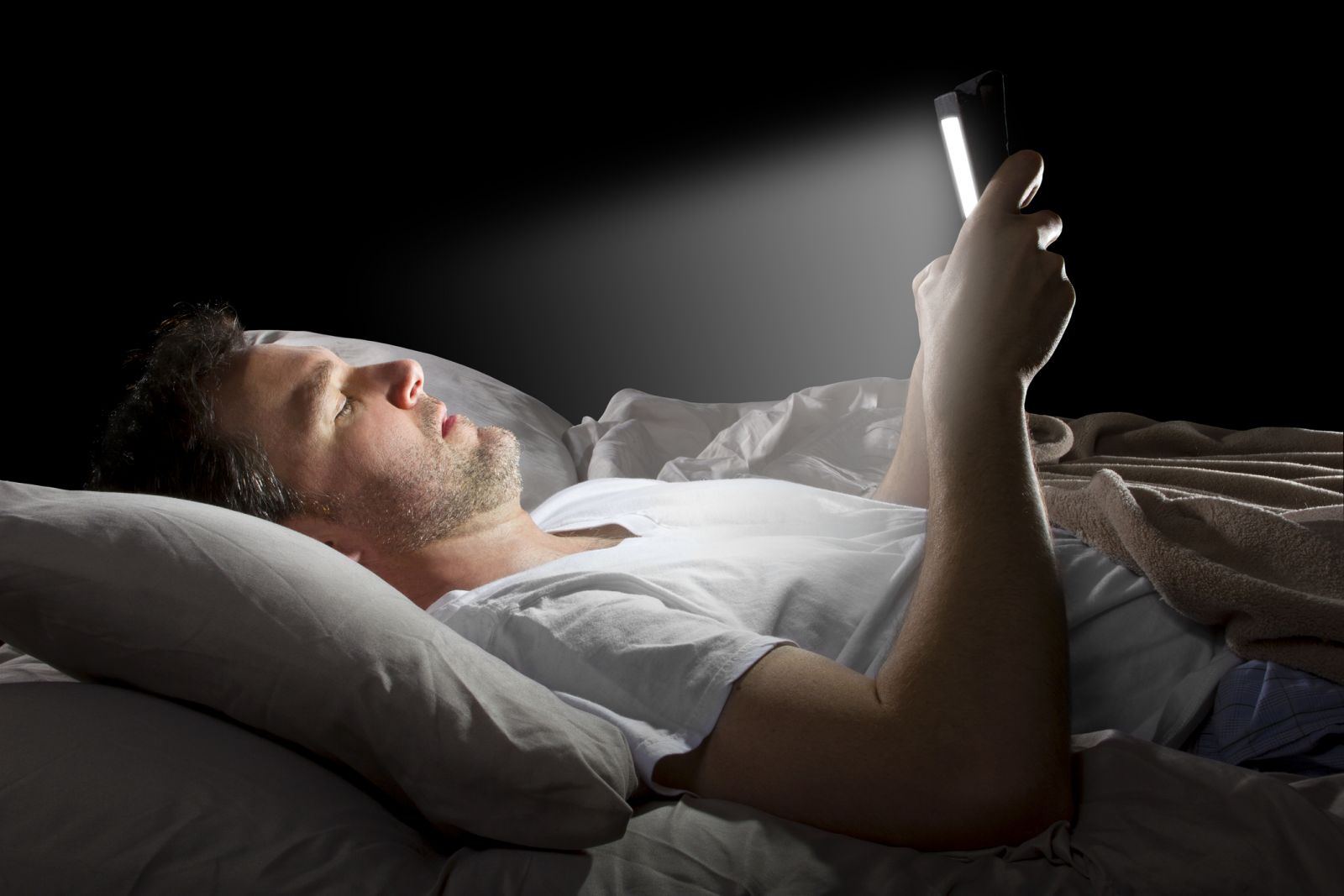
This is a problem given that melatonin -- the hormone regulating human sleep patterns -- is affected by day-night cycle disruptions caused by light pollution; a worrying change that impacts on sleep, and human health, according to sleep experts. People are impacted out in the open and as well, within homes as street lamps, electric light bulbs, LED displays, television light and melatonin-suppressing blue light emitted by computers and smart phones follow us into our bedrooms at night.

blue light at night
Harvard Health

How serious is this? Given that poor sleep patterns have been linked to lower productivity, days lost to ill health, to obesity, impaired memory and worsening mental health, one would have to conclude, very serious. Dr. Stanley has some useful suggestions such as sticking tape over the light on your television, changing curtains for blackout blinds, wearing eye masks when in bed, and moving away from screens for at least forty minutes before going up to bed.

"At home you could take the evening and the night seriously. You could use the curtains to not be disturbed by the outdoor light. Turn out/down your main light, switch off your screens at least an hour before going to bed. Turn off your phone at night."
"One researcher I have been talking to said, 'Imagine what it would be like if everyone thought a bit more about, and was a bit more conscious of, their exposure to darkness and light. If that were the case, I think we could save a lot of resources and mitigate a lot of suffering."
Sigri Sandberg, author, An Ode to Darkness
Why Light at Night Can Interfere with Your Sleep
Cleveland Clinic: Health Essentials

Labels: , , ,

 
()() Follow @rheytah Tweet