Locating the Next COVID Variant Outbreak
"[Delta is] the next scariest variant that is worrying people [all the more so that most people in Ontario received only a single dose of inoculation against the SARS-CoV-2 virus].""There is a lot of pressure [to complete the test], but, at the end of the day, we want to make sure it works. We have to balance the time pressure with the quality and reliability of the test.""Scientists, we have very few eureka moments and I guess that's one of them [testing community wastewater for the presence of COVID].""A million-dollar question right now in the field is trying to correlate the case numbers in the city or any surveyed area with the wastewater signal, and we still don't really have a good idea of how to do that.""I think at this point in time, [it] is not a question of if it's going to happen. It's a question of when and so the earlier we can get this information into the hands of public health officials, the better."Tyson Graber, research cell biologist, Children's Hospital of Eastern Ontario
 |
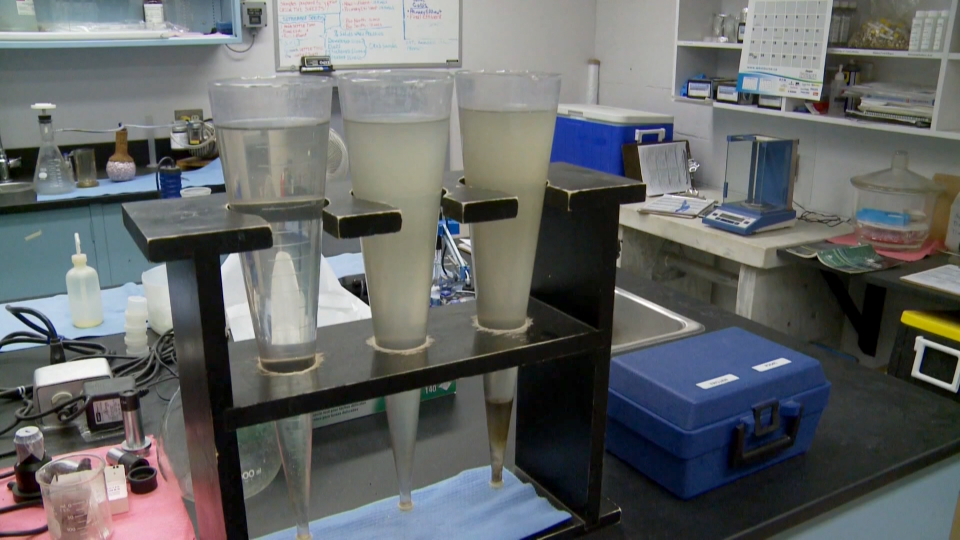
| Scientists at the CHEO Research Institute in Ottawa say this is the first test in Canada that can detect the variant first reported in the U.K., using wastewater. (Francis Ferland/CBC) |
The World Health Organization, in a bid to move identification of viruses away from the geographic location in which they originally surfaced has now resorted to renaming the U.K., India, Brazil, South Africa variants with the letters of the Greek alphabet to make them neutral in character. Dr.Graber and other researchers are working frantically in the creation of tests to track the latest variants of concern, to be found in municipal wastewater in an expanding move to more fully understand how the viruses causing COVID-19 mutates.
Funding has just been made available to the project out of CHEO and the University of Guelph, to financially support the research on testing potentials. The funding has come out of Genome Canada, Ontario Genomics and Illumina for researchers working out of the University of Ottawa, Children's Hospital of Eastern Ontario, and the University of Guelph, collaborating on the project. It is vital to develop new and expanded testing for the purpose of measuring variants, and all the more critical that it be done as expeditiously as possible at a time when the variant that surfaced first in India, now known as Delta spreads in Ontario and elsewhere in the world.
It has proven to be more contagious than the U.K. variant (now identified as Alpha) which was responsible for the virulence of the third wave that pushed through Ontario, taking hospitals to the brink of operational collapse. The urgency to identify the presence of these viruses in wastewater increases in the face of the reality that the Delta variant is known to be more resistant to vaccines. One dose of vaccine offers merely 33 percent protection against this version of COVID-19 in comparison to the 50 percent protection against the Alpha variant.
 |
| Scientists are still working to develop a test that will detect variants first found in Brazil and South Africa using wastewater. (Francis Ferland/CBC) |
An incomplete schematic of rates of variants is currently the reality reflecting the fact that only a small percentage of clinical samples in Ontario are sequenced in the bid to identify variants of concern. Wastewater surveillance increases knowledge of which variants are circulating and spreading. Delta has been found to be the dominant strain in the United Kingdom, at the present time. While in Ontario a small number of cases have surfaced.
Peel, the hardest hit region in southern Ontario, can expect the Delta variant to dominate within a month, according to its chief medical officer, Dr.Lawrence Loh. Who made his projection reliant on wastewater data leading him to the conclusion that in his region variant spread is a looming threat. Labs in Ontario will now be processing metagenetic wastewater testing, long done at the National Microbiology Lab in Winnipeg.
The end function of wastewater monitoring is to identify potential outbreaks before they are diagnosed in people through clinical testing. This is the kind of testing that can give medical authorities a heads-up a week in advance of clinical tests verifying the presence of the COVID-19 virus or its variants. That heads-up can prepare the medical community to react before people develop symptoms, measuring as well infections in people without symptoms.
The additional research funding is meant to expand metagenetic testing to research centres across the province from the genetic sequencing currently done that can produce a picture of what to expect in regions of the province. Dr.Graber, who had previously developed a test to identify wastewater Alpha variant, is now focusing his team on like tests for Delta and the Brazil-surfaced variant now identified as Gamma.
Labels: COVID Variants, COVID-19, Research, Testing, Wastewater
posted by Pieface @ 7:28 PM
0 comments