Ruminations

Blog dedicated primarily to randomly selected news items; comments reflecting personal perceptions

Thursday, November 12, 2020

Novel Coronavirus Endangering Marine Life

"Many of these species are threatened or critically endangered."
"In the past, these animals have been infected by related coronaviruses that have caused both mild disease as well as life-threatening liver and lung damage."
Graham Dellaire, director of research, pathology department, Dalhousie University, Halifax

“Our major concern is in developing nations, where there is already a disparity in public health and the wastewater treatment infrastructure required to handle the COVID-19 crisis."
"Monitoring susceptible species in these high-risk areas around the world will be pertinent for protecting wildlife during and post-pandemic."
Saby Mathavarajah, Killam pre-doctoral fellow, Dr. Dellaire’s lab
 
"Over the past several months our lab has been focused on detection of SARS-CoV-2 in wastewater to help understand public health outcomes."
"However, this study helped to shine a light on a potentially significant environmental concern of untreated wastewater."
Graham Gagnon, professor, Department of Civil and Resource Engineering, Dalhousie University
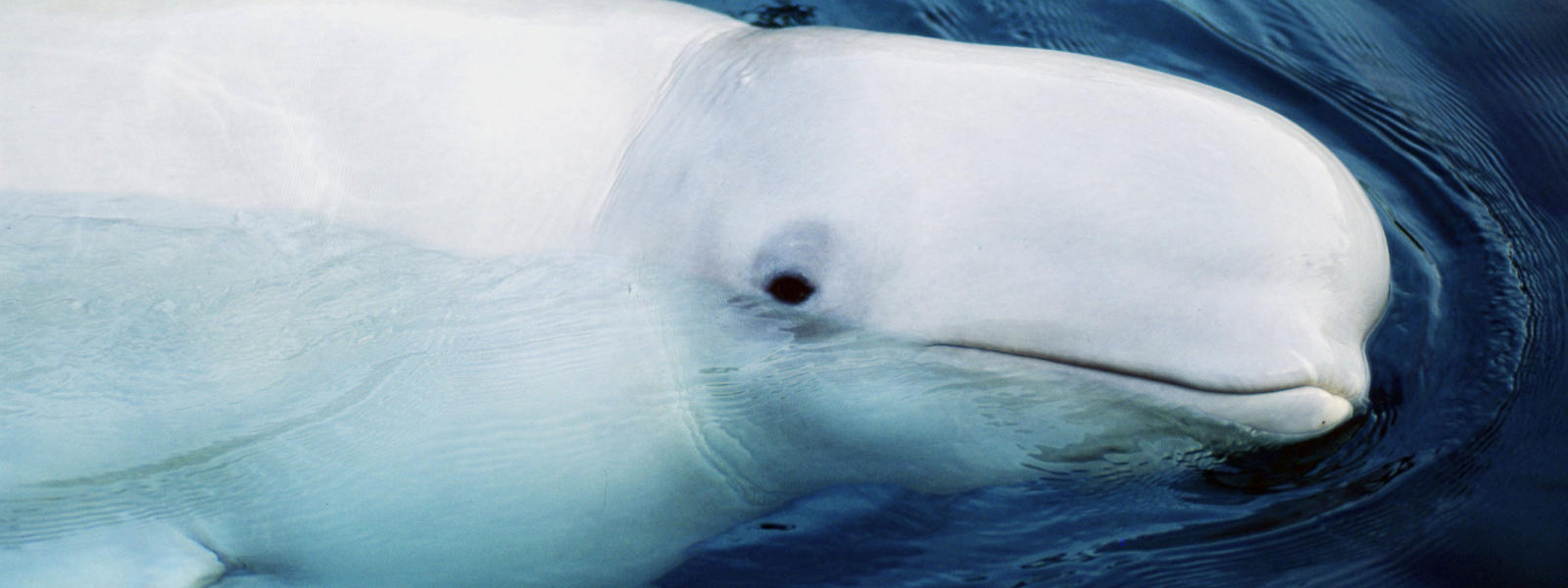
Kevin Schafer/WWF-Canon
Belugas are extremely sociable mammals that live, hunt and migrate together in pods, ranging from a few individuals to hundreds of whales. Their bulbous forehead, called a "melon”, is flexible and capable of changing shape. This allows them to make different facial expressions. Belugas can produce a series of chirps, clicks, whistles and squeals, which give the beluga its other name, "the canary of the sea." They may sound like music or even nonsense to us, but to fellow belugas they convey important information. World Wildlife Fund
 
Researchers out of Dalhousie University, with data on dolphins and beluga whales infected with coronaviruses in the past, have raised the alarm over COVID-19 spreading to whales and other marine mammals through improperly treated sewage and wastewater. Their study was published in the journal Science of the Total Environment, where the Dalhousie University scientists describe making use of genomic mapping in order to determine which marine mammals would be vulnerable to the novel coronavirus.  
 
The research team studied amino acids which the virus binds to, discovering striking similarities between those in humans and in several marine mammals, a group including dolphins, beluga whales, seals and sea otters. At least 15 marine mammal species were found to be susceptible to infections, reflecting the fact that they each carry a protein required for the virus to be enabled to infect cells, according to Graham Dellaire, director of research in the pathology department of Dalhousie University in Halifax, Nova Scotia. 
 

A researcher was surveying seabirds off the coast of Vancouver Island when he spotted something unexpected: a huge group of common bottlenose dolphins — about 200 of them — breaching and swimming.   Mike Hill/Getty Images

The prediction coming out of the study is that the majority of whale, dolphin and porpoise species -- some 18 of 21 -- have identical or higher susceptibility to the virus as do humans. Eight out of nine seal species are also predicted to be highly susceptible to infection by the coronavirus. The virus is excreted in feces and can survive in water for up to 25 days, according to studies.

This raises the possibility that wastewater has the potential to spread the disease. It has already occurred in Spain, Italy and France, where the virus has been detected in untreated sewage.
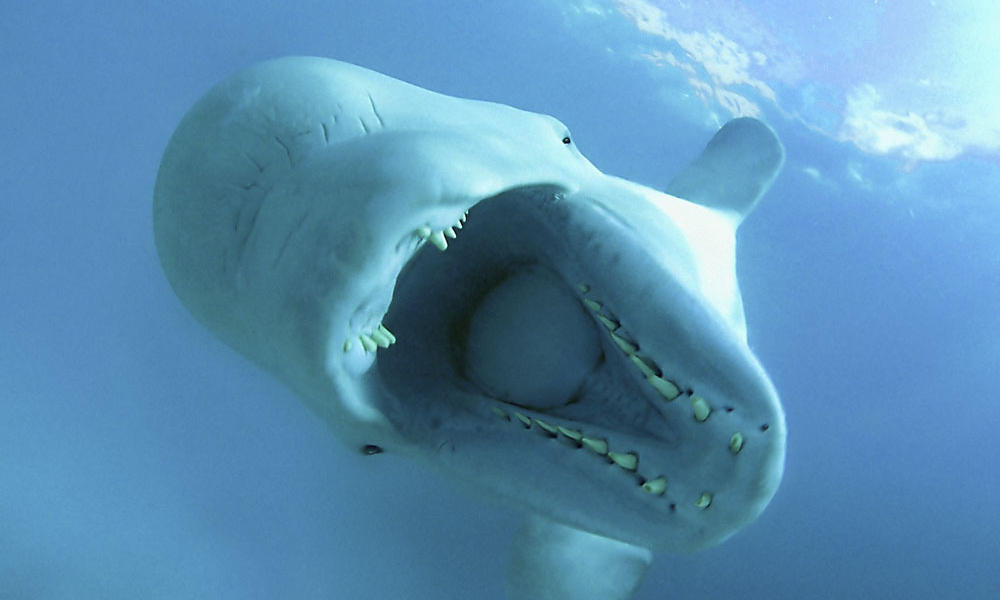
beluga whale
Whales, like the beluga, are at the top of the food chain and have an important role in the overall health of the marine environment. Beluga whales are also culturally important to indigenous communities in the Arctic. Like polar bears, the beluga depends on sea ice for its existence and can be directly impacted by climate change.  WWF

Labels: , , , , , , , ,

Saturday, December 16, 2017

Marine Animals At Risk of Extinction

"You do have to use the extinction word, because that's where the trend lines say they are. That's something we can't let happen."
John Bullard, National Oceanic and Atmospheric Administration

"The current status of the right whales is a critical situation, and using our available resources to cover right whales is of high importance and high urgency."
Mark Murray-Brown, Endangered Species Act consultant, NOAA
There are only about 500 North Atlantic right whales in existence.
There are only about 500 North Atlantic right whales in existence. (Center for Coastal Studies/NOAA)

Natural Resources Defense Council (NRDC), International Fund for Animal Welfare (IFAW), the League for Coastal Protection, Cetacean Society International, and Ocean Futures Society formed a coalition attempting to hold the U.S. Navy responsible for the damage its technology imposes on marine creatures. In a court brief, the coalition cited the Navy's own documents estimating that sonar testing was expected to kill 170,000 marine mammals, causing permanent injury to over 500 whales and deafness in 8,000 others. 
North Atlantic right whale breaks the ocean surface off Provincetown, Mass., in Cape Cod Bay.
Source: Associated Press

Though two lower courts agreed with the coalition that the U.S. Navy is responsible for mayhem in the Pacific in particular, the U.S. Supreme Court ruled for the Navy, that it should be permitted to continue its mid-frequency sonar testing as a requirement upholding national security. "The U.S. Navy could use a number of proven methods to avoid harming whales when testing mid-frequency sonar", objected IFAW’s Fred O'Regan. "Protecting whales and preserving national security are not mutually exclusive."

This has been a dreadful year for one of the most endangered whales on Earth, the North Atlantic right whale. In 2017 alone, seventeen of the gigantic oceanic mammals have died, and scientists are puzzled by the cause, although speculation is rife. According to the National Oceanic and Atmospheric Administration only about 450 right whales are left alive; when 17 of their number expire the situation verges toward the existentially catastrophic.

John Bullard of NOAA, views the threatened existence of right whales of such momentous crisis he feels that regulators in the United States and Canada are required to step in, because if nothing is soon done to help their recovery, they simply will not manage on their own to recover, and the planet will lose another important species whose presence at the moment in such scarce numbers is already rare.
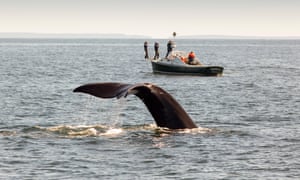
A North Atlantic right whale dives, near a New England Aquarium research boat.
A North Atlantic right whale dives, near a New England Aquarium research boat. Photograph: Alamy

Marine mammal researchers are doubly concerned that the year 2017  has been  a poor reproduction year, and added to that the high rate of mortality, the prognosis presents as beyond grim. Scientists estimate that roughly 100 breeding female North Atlantic right whales are now left to contribute what they can to the swiftly diminishing pool. Females have been dying at greater rates than males in a species decline that has accelerated since 2010.

The proliferating presence of ever-larger sea-going vessels is certainly one of the  reasons these giant marine species are facing extinction. It's a hugely uneven contest when an immense steel-hulled vessel challenges the right-of-way of a living creature. The sounds emitted by ocean-going vessels confuse and disorient whales. Military vessels' use of sonar equipment generate sound waves that assail the whales with high-decibel sound for hundreds of miles causing whales to attempt to escape the sounds with often deleterious results when whales become beached.
right whale deaths infographic
At least 14 right whales have been found dead in Canadian and U.S. waters this year. At least 11 of those were found in Canadian waters and it's not clear whether some of the carcasses that washed up in Newfoundland had drifted from where they were first spotted in the Gulf of St. Lawrence. (CBC)

Fishing vessels setting out their fishing gear are frequently cited causes of the death of whales as a result of gear entanglement. Giving birth in temperate southern waters, the animals then travel to New England and Canada in spring and summer, their traditional feeding grounds. Every one of the 17 deaths occurred off the coasts of New England and the Canadian Maritimes.

Recent scientific studies offer other hypotheses. One, published in the journal Nature Scientific Reports points to whales moving about far more than has been previously assumed, with some scientists suggesting that whales could be venturing far from traditional protected areas searching for food, and in this manner placing themselves in harm's way.

Yet another study published in the journal Endangered Species Research recounted that scientists found whales that suffer long entanglements in fishing gear produce hormone levels indicating high stress, revealed by studying their  feces. That stress impacts negatively on reproductive capacity, should they survive the entanglement event.

The development of a long-term plan to monitor the right whale population trends and habitat, and to study the impact of commercial fishing on right whales has been recommended in protection of the species, an initiative of a five-year NOAA review.

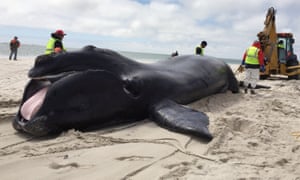
A rare North Atlantic right whale calf lies dead on a beach in Chatham, Massachusetts in 2016.
A rare North Atlantic right whale calf lies dead on a beach in Chatham, Massachusetts in 2016. Photograph: AP

Labels: , , , ,

Friday, June 23, 2017

The Globe's Foremost Apex Marine Predator

"We've been chased out of the Bering Sea. [Electronic noisemakers to frighten them off?] It became a dinner bell."
"It's possible at some point they [Orcas] might start hitting the pot [conversion to giant fishing traps called pots]."
"When I started fishing in the early '80s, when we saw a whale it was an event. Now, they circle the boat."
Paul Clampitt, co-owner F/V Augustine, Washington State

"[Orca pods close to the Aleutian Islands are like a] motorcycle gang."
"You'd see two of them show up, and that's the end of the [fishing] trip. Pretty soon all forty of them would be around you."
"[Pulling up lines to see some fish merely gnawed] That was them teaching the little ones. It's unfortunate the orcas are putting us out of business, because they're really a phenomenal mammal."
John McHenry, owner, F/V Seymour, Alaska, Aleutian Islands

The animals have learned to target individual boats, and are leading fishers on high-speed chases to get away : AP Photo/Elaine Thompson)

Are animals intelligent? Can they assess situations and react to them to further their own interests? Ask the fishermen who have been experiencing some unusual episodes of new behaviour expressed by aggressive orcas, forming pods skilled in harassing boats and harvesting their fish. "Since 1997, reports of depredation have increased dramatically", a report by the Southeast Alaska Sperm Whale Avoidance Project has noted.

It has by now been well enough witnessed and documents that orcas can patiently wait for fishermen to acquire a halibut cache, even if it takes all day, to then move in to strip the fishing lines. Cod and halibut fishers off the coast of Alaska have traditionally experienced peaceful coexistence with the orcas in the region. That was then; now the orcas have turned on the fishers to strip them of their catches.

Sperm whales, large and square-headed, have been pillaging fishing lines as well. A video taken in 2006 by the Avoidance Project succeeded in filming one of the 50,000-kg whales as it delicately shook loose fish from a fishing line. "I've had the same sperm whale follow me 70 miles", complained Michael Offerman of the F/V Kristiana.

The Bering Strait separating western Alaska from Russia appears to be the locus where the worst incidents of whale hijacking of fishers has been taking place, though fishing boats across Alaska have been reporting orca harassment. The cost of fish loss from orcas appropriating the fish from lines was estimated at $500 daily, according to a 2014 study.

While a 2015 study of fishing boats in Uruguay where similar fishing techniques are used discovered "the presence of killer whales in the fishing ground seems not to affect the catch per unit effort."  A rebound of North Pacific whale populations resulting from the 1980s moratorium on commercial whaling appears to be linked to the increasing predation of whales on fishing boat catches.

Up to the rebound, cod and halibut fishers' experience had been that of moving among populations of whales surviving the hunt by whaling fleets, where survivors had learned that the approach of a boat engine spelled danger to them. Earlier, in the 1990s, researchers had discovered that a sudden collapse in Pacific sea otter populations was caused by orca predation.

The orca social structure is a complex one; just like humans they have regionally distinct languages and strategies for hunting. Orcas have often been observed to be strategizing new hunting tactics, and teaching those advantageous new techniques to other whales. Alaska fishers claim to be seeing an increasing number of juveniles taught by their elders to snatch fish from fishing vessels.

Inuit have also observed that orcas swimming deeper into the Arctic as a result of polar ice cover melting, have been preying on slower-moving local fauna. Orcas, stated an Inuit interviewed for a 2012 study, would sometimes kill "hundreds" of belugas at one time. "When the killer whales had left the kill site, Inuit would collect the maqtaq (blubber) from the numerous dead belugas."

Making their home in all seven of the world's oceans, orca pods have been witnessed killing other top marine predators, including great white sharks, walruses and leopard seals.

File -- National Post

Labels: , ,

 
()() Follow @rheytah Tweet