Ruminations

Blog dedicated primarily to randomly selected news items; comments reflecting personal perceptions

Monday, December 14, 2015

Cocktails at Antarctica

"[Researchers have] only got so much money. There are only so many ships, there's only so much time in the academic year. We're up there four times a summer, and these researchers might get to go once. We saw an opportunity to fill that gap in, to do research where it's not being done already."
"This project is important because it is a test of amateurs being able to collect good data."
"We had a huge amount to learn, but ... we were able to settle into producing accurate and consistent data, which we then felt confident uploading for use."
Alex Cowan, geologist, contracted expedition staff
Citizen Science at the North Pole -- August 1, 2015 -- Photos by Lauren Farmer
 
"Glaciers we used to take people to are now gone. They're not only no longer in the water, they're so far back on the land that we can't reasonably hike to the foot of them."
"We do have an impact when we go there [Arctic]. It's well managed and our impact is small, but ... I think there's a real responsibility to do more than go there and take."
"For a first-time visitor, it's an incredibly powerful experience, but it doesn't really penetrate sometimes. I firmly believe that getting involved in the science means staying out longer, getting a little colder, getting out of your comfort zone, but ultimately you get a more vivid experience."
"You don't go to Antarctica for the cocktails, you know?"
Ted Cheeseman, ecological tour operator
Polar travel adventures as tourists now have a new twist to them. Typically, such expeditions have on board scientists, biologists, geologists, who contract with a travel companies to such ecologically exotic places to explain to tourists the landscapes they are observing and the ecology and the wildlife they happen to come across. When, for example, university is out for the summer months, professors of biology, or botany sometimes find it personally useful to sign on to expeditions as contracted specialists, available to give lectures and to act as guides for tourists travelling to the Arctic.

Whale-watching expeditions, for example, then offer the expertise of contracted marine biologists who will explain to those interested in delving deeper into the biology and habits of whales, just what is involved, bring the experience alive and educating tourists at the same time; entertainment and information in one fell swoop of the intersection of travel and academia. The duo of geologist Alex Cowan and photographer Lauren Farmer, working as contracted expedition staff last year discussed that intersection.

Travellers on an Northern expedition are conscripted to gather data to be used research for climate scientists.
Lauren Farmer   Travellers on an Northern expedition are conscripted to gather data to be used research for climate scientists

And from that discussion arose the concept of citizen-science. Ordinary people already sign on to giving additional assistance to government bodies, for example, in reporting certain weather events enabling forecasters to get a more wide-ranging idea of what's happening with the atmosphere. Enthusiastic birders tallying their ongoing sightings, help ornithologists and other agencies to get a clearer picture of migration and other issues of interest to science. The idea that Cowan and Farmer hatched was the involvement of ordinary people, as tourists on cruise ships to ecologically sensitive locations.

After recruitment of those interested in volunteering their time, a small circle of citizen scientists emerge, who are exposed to some training to enable them to understand what is required. Four round trips between Murmansk, Russia and the North Pole with Poseidon Expeditions enabled Cowan and Farmer to test their initiative with what they ultimately named the Sea Ice Research Team. All the volunteers were trained to measure the temperature and salinity of melt ponds in the Arctic Ocean, to aid scientists in producing accurate models of the speed of sea ice melt.

The work has been recognized as potentially valuable to ecologists. It is being used by the Arctic Research Consortium of the United States Sea Ice Prediction Network. The growing popularity of Arctic tourism in the cruise industry, with increasing numbers of tourists on passenger vessels travelling across Nunavut is a recognized trend that researchers are now exploring for its potential to bring them much-needed data. As with the Arctic, so too with the Antarctic. There, tourists are to track whale movement through documentation assembled in photographs. Researchers then record whale sounds applying multi-sensor tags, tracking the animals' underwater movements.

The travel industry years ago initiated a new type of travel; tourism abroad where people could volunteer to work on projects in underdeveloped countries. It gave people a sense of purpose to their tourism travels. This new line of tourist-involvement in gathering data useful to scientists is yet another way to allow tourists the opportunity to feel that they are being productive even while they are indulging their penchant for travel and sight-seeing. It is a more in-depth commitment, but one that promises to result in personal satisfaction of having been of use to science.

Labels: , , , ,

Thursday, March 06, 2014

How a Canadian River Fueled a Climate Change Denial Meme

The entire universe in blog form
March 6 2014 7:30 AM

How a Canadian River Fueled a Climate Change Denial Meme

Arctic sea ice is like the fabled canary in a coal mine when it comes to global warming. The far north is very sensitive to changes in climate, with temperatures that fluctuate more than the southerly latitudes.

The extent of (that is, area covered by) Arctic sea ice has been declining of late, as has its volume (which includes the thickness). This is true no matter what time of year you look; compare the maximum extent it reaches in winter today with what it was, say, 20 years ago and you can see it’s smaller. The same is true for the minimum extent in summer. This steady melting away of ice is a clear indicator of a warming planet.

However, 2012 was an exception ... in that the amount of Arctic ice fairly well plummeted, dropping far below average. Why? Scientists think they’ve figured that out, at least partially. And not unexpectedly, when the ice shrank away, a denier claim grew.


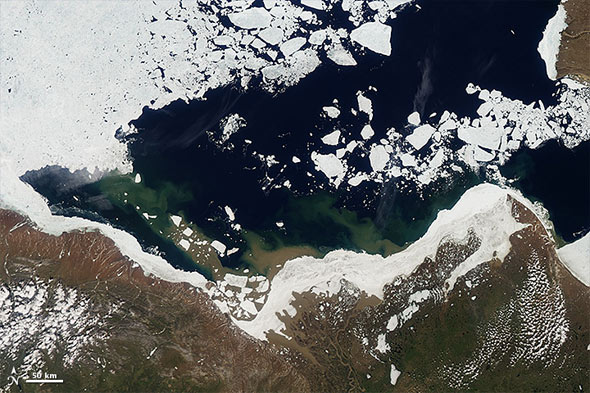
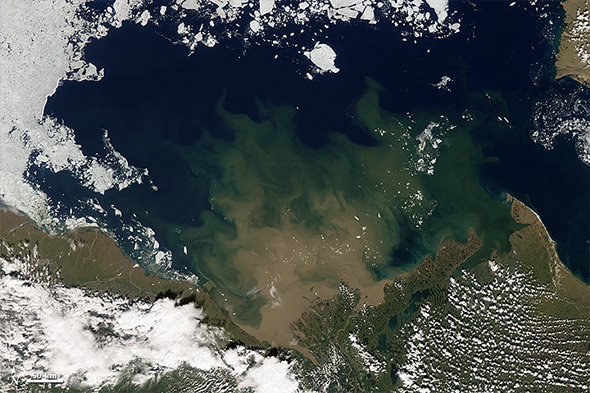
The images above are from NASA’s Aqua satellite, and they show natural-color shots of the Mackenzie River in the Canadian Arctic. Flowing north, its delta leads to the Beaufort Sea, which has copious ice floating in it in the winter. The two pictures are shown with a slider bar in between; move it back and forth to see the “before” shot (taken on June 14, 2012) and the “after” shot (taken on July 5, 2012) (Note: If you are using a mobile device you may see the images stacked vertically with no slider. If no images appear at all, click here to see them.)

In the “before” picture (moving the slider all the way to the right), you can see lots of ice in the water. Note, though, the ice piled up along the coastline. You can see the muddy water pooling in fingers stretching toward the water. That ice acted as a dam, holding the water back.

In the “after” picture (slider to the left) the dam is gone, and you can see the river water infiltrating the sea—the brown swirls are sediment washing out into the sea. Sometime in the intervening weeks the warm river water melted the ice dam and broke through, flooding the sea. This sudden infiltration of warm water raised the temperature of the sea considerably, melted the ice floating beyond.

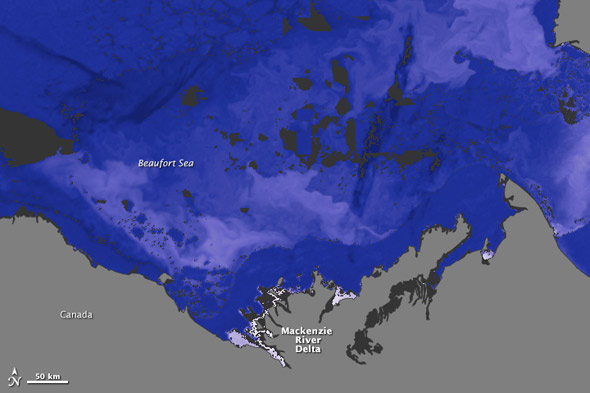
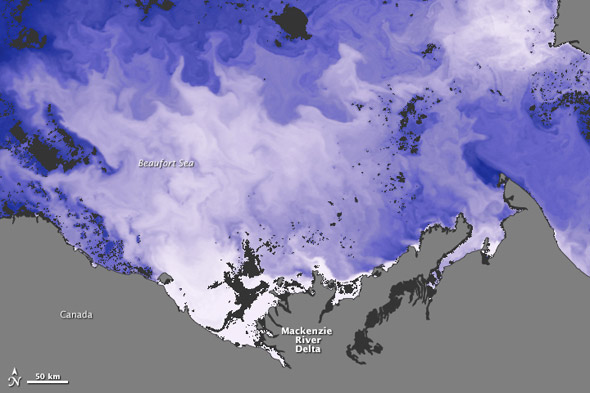
Aqua has detectors that can see microwave energy, which allows the surface temperature of the water to be taken. Here is the same region, this time showing the temperatures before and after the flood.


(Click here if you don't see the images.) The darkest blue is cold water/ice at about -2° C, and white/lavender is +15° C. As you can see, in just a few weeks the temperature went up substantially; in some places it went up about 15° Celsius, a huge increase in thermal energy; by my rough calculations it would far, far exceed the energy released by a nuclear weapon.
No wonder that ice melted.

Scientists think this is what contributed to the huge drop in Arctic ice that year. If the water were to move into the sea more slowly (as it usually does), then there would be time for its excess heat to radiate away into the atmosphere or be dropped into deeper waters. Instead, the sudden inundation due to the ice dam breaking dumped all that warmth into the sea surface, where it could melt the ice.
That’s why 2012 saw record low ice in the Arctic. The next year, things were more normal, and the ice extent and volume were more like they had been in previous years.

And this is what brought on the climate change denial fairy tale: That in 2013 the ice had “grown” by 60 percent over 2012. This is incredibly misleading; starting with a record low and then measuring from that is hardly what I’d call an honest claim. That makes it seem like global warming has stopped or even reversed, which is baloney, pure and simple. The ice extent and volume in 2013 were far below average, and while it’s early yet, 2014 is gearing up to be the same.

Incidentally, the waters in the Mackenzie (and other Canadian rivers) are warming up due to global warming as well. Coupled with thinning ice also due to warming, this water is breaking up the ice more efficiently than in previous years, which may be the overall reason ice is disappearing from the far north (incidentally, there are no rivers flowing into the Antarctic region, so the ice there is not affected in this way).

Rivers are efficient conveyors of heat, it turns out; just another piece of the huge and complicated puzzle that is global warming. Scientists studying these effects are finding more and more ways these pieces all fit together, which is a good thing. The more we understand how the planet is heating up, the better we’ll be at predicting what will happen, and how we’ll have to deal with it.

All photos by Jesse Allen and Robert Simmon, using data from the Level 1 and Atmospheres Active Distribution System (LAADS).

Labels: , , , ,

Wednesday, January 22, 2014

They Could, and They Did

"It was cool having Harry there because he was very much part of the team. He seemed to specialize in building the latrines and he built these incredibly elaborate ones. He did one with castellated sides, a flagpole and a loo roll holder, and you're sitting there thinking, 'This is a real royal flush'. He must have spent about 40 minutes making it."
Dominic West, celebrity patron, expedition raising funds for charity Walking With the Wounded

Reading of other Arctic and Antarctic expeditions of which this was one of the latter, often there would be one person who would stand out for their willingness and ability to build latrine pits to be used by the members of the expedition. In the instance of this particular trek/expedition it fell to Prince Harry of the British royal line who was part of the British team -- challenging a Commonwealth and an U.S. team to be the first to reach the South Pole -- to build his team's latrines.

This would not have been an appointed task, but rather a voluntary one, and it is to his credit that the young scion took with great alacrity to the task. Finding it no doubt, most amusing. Particularly given his aristocratic rank, the profile of the 'homes' that he was raised within, and emulating them in comic miniature as functioning and quite necessary latrines.
www.milngavieonline.com

"When we got to the Pole a couple of the guys striped naked and ran round the Pole", said West. "It was a sunny day with no wind, so it was safe to do that." And for Sgt. Duncan Slater, of the RAF Regiment, who'd had both legs amputated in 2009 after serving in Afghanistan: "I used my legs (prosthetics) as a primitive ice bucket and wedged the champagne bottle in there and passed them around."

It was undoubtedly a difficult trek for all concerned; horribly difficult but at the same time team spirit was obviously well in order and it turned into an exhilarating experience, particularly in fond retrospect. Temperatures down to minus-50 Centigrade, "horrendous" storms prevailed, and the teams forged on. Because of the deteriorating weather the three teams agreed to join forces to aid one another in their progress.
enablemagazine.co.uk

"The conditions were a lot tougher than we could have expected. The wind and the storms proved horrendous. However, video doesn't lie and Team UK did win. We did. Those are the facts. To the Australian contingent, if you're watching -- sorry.
"On a serious note, inspiring others is one of the cornerstones of this charity, to demonstrate to those who have experienced life-changing injuries that everything is still possible."
Prince Harry, House of Windsor

Prince Harry was toasted for having demonstrated the lighthearted cheek to entertain the expedition by telling "filthy" jokes, familiar perhaps in the atmosphere of the military, but which caused Dominic West to note of he Prince's performance telling "eye-wateringly rude jokes, which for a non-soldier like me was quite shocking."

That, among other issues, certainly the trials and tribulations they faced physically, will be among the fondest memories of all those who took part in the expedition which ended when they reached the Pole on December 13 after hauling along their equipment sleds 200 kilometres on skis.

Labels: , , , , ,

 
()() Follow @rheytah Tweet