Ruminations

Blog dedicated primarily to randomly selected news items; comments reflecting personal perceptions

Wednesday, August 15, 2018

Add A New Concern to Climate Change: Global Greening

"A 30 percent increase in photosynthesis does not translate into a 30 percent increase in strawberries off the land."
"While photosynthesis does pull carbon dioxide out of the atmosphere, much of that gas goes right back into the air. The reason: At night, the chemical reactions in plants essentially run backward. In a process known as respiration, plants pump out carbon dioxide instead of pulling it in.... Part of the story is that photosynthesis is going up, and part of the story is that so is respiration."
"Every year we build more power plants, and every year the plants take out more C02."
"Plants are quietly scrubbing the air of one China's worth of carbon. What frightens me is knowing this can't go on forever."
"If respiration catches up with photosynthesis, this huge carbon reservoir could spill back into our air."
Elliott Campbell, environmental scientist, University of California, Santa Cruz
Global_Greening_NASA

The bad news of course is what has been repeated time and again by those warning of the dread consequences of climate change, no longer referred to as global warming. Who in today's world is ignorant of the fact that weather situations have erupted that have been more of everything; more extreme in every conceivable way; hotter, wetter, drier, visiting catastrophic hurricanes, flooding, wildfires, drought, volcanic eruptions, more frequent earthquakes. The polar ice caps are melting, gigantic glaciers are breaking up, sea levels are rising, agricultural crops are failing.

In June, Johan Uddling of the University of Gothenburg, Sweden and colleagues suggested that the acknowledged rise in carbon dioxide has resulted in an increase in the rate that soil microbes take up and use nutrients, leaving plants bereft of the vital nutrients they need to thrive. By general consensus, scientists agree that plants remove a quarter of the circulating carbon dioxide that rises into the atmosphere resulting from industrialization's energy use -- and the cost of producing and using it is the diminution of environmental health.

Plants have been busy as vegetation is wont to do, scrubbing carbon dioxide out of the atmosphere in lock-step with rising emissions. The result is a greener planet. Described fittingly enough, as "global greening". But scientists are also urging caution over celebration; that carbon dioxide levels in reality continue to soar over the past two centuries' records. We are only just now in the past several decades beginning to fully understand how that rise is impacting the planet. For one thing, since 2010, the six warmest years on record have been noted.

Dr. Campbell's study, published a year ago, places these concerns into perspective, pointing out that the planet's energy use is responsible for emitting close to 40 billion tons of carbon dioxide annually. Smaller studies suggest that human activity contributes hugely to the situation leading to an increase around the world in photosynthesis. And photosynthesis is the transformation of energy from the sun to energy for plant growth and production. All to the good...?

The question appears to be: how good? After all, plants are now converting 31 percent more carbon dioxide into organic material than before the Industrial Revolution. Many take the figures that Dr. Campbell's research team published as verification that increased carbon dioxide is a plus for the world: "The best messages are positive: C02 increases crop yields, the earth is greening", exulted Joseph Bast, chief executive officer of the Heartland Institute.

While Dr. Bast's takeaway from Dr. Campbell's conclusions seems reasonably deduced, Dr. Campbell is less than pleased with what he views as an incorrect perception leading from his research. While farmland is producing more food than a century ago, he feels the additional carbon dioxide spewed into the atmosphere is only part of the reason. Photosynthesis is responsible for pulling carbon dioxide out of the air, but a substantial portion of the gas returns to the atmosphere in nightly-occurring respiration.
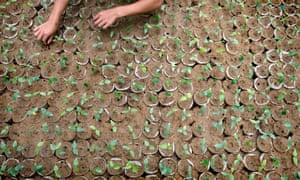
Natural vegetation absorbs about a quarter of the carbon emissions created by burning fossil fuels.
Natural vegetation absorbs about a quarter of the carbon emissions created by burning fossil fuels. Photograph: Kuni Takahashi/Getty Images
As any grade-school child knows from age-appropriate basic introduction to science, during the day plants absorb circulating carbon dioxide, while at night they exude it through respiration. As a result, these researchers emphasize that the benefit to crops is minimal; plants growing more robust thanks to additional carbon dioxide tend to have lower nutrient concentrations, they point out.

Additionally, Dr. Campbell and his think-alike colleagues, not knowing how long global greening will continue, point out that as temperatures rise and rainfall patterns change, the possibility that vegetation may no longer pull in extra carbon dioxide is a future potential. In which case even the amount of carbon dioxide, estimated at one-quarter of the circulating atmospheric carbon -- that plants now consume, will no longer be the case at some future date.

biological_sequestration_80

Labels: , , , ,

Thursday, October 12, 2017

The Health Benefits of Exposure to Greenery

"We found that those who have more trees and vegetation around where they lived had an eight to 12 per cent reduced risk of dying compared to those who didn’t."
 "Holding all that constant [ambient pollution, population density, socio-economic conditions], if you live in a greener area, compared to a less greener area, there’s about a 10-per-cent reduced risk of dying."
"One thing that was kind of striking is that we found that those who were in the highest income bracket and those who had the highest levels of education were benefiting more from the exposure to greenness."
"If you take two people and everything else is more or less the same … their age, sex and city they live in and they both have the same amount of greenness around where they live, someone who is more affluent is getting a big boost to their risk of dying whereas people in the lowest income group were getting almost no benefit at all."
"Parks are important but I think this shows that it’s just as important to have trees on medians and along streets and sidewalks where people are going to have contact on a regular basis."
"If it's a really nice green area, it's sort of a pleasant spot, people are more inclined to go walking, even just walking their dog, not necessarily getting … intense physical exercise."
"Water is completely different from green space, but living on the water can be very relaxing and stress reducing."
Dr. Dan Crouse, Epidemiologist, Research Associate in Sociology, University of New Brunswick 
Saint John's Rockwood Park is one of Canada's largest urban parks at 890 hectares.
Saint John's Rockwood Park is one of Canada's largest urban parks at 890 hectares. (YouTube)
A new study just published in the latest issue of The Lancet Planetary Health, is intriguing for its findings, but it shouldn't surprise people who gravitate to the out-of-doors in their leisure time for the distinct purpose of immersing themselves in natural surroundings such as city parks or urban forests. Ten researchers from Canada and one based in the United States formed a team led by Dr. Crouse do determine the health effects of being surrounded by trees and other types of natural greenery.

They undertook an extended study of data encompassing 1.3 million people over an eleven-year time span in cities around Canada, in an effort to understand and determine how people benefit from being in green environments. What they discovered was what they might have expected, except that the rate of benefit far outdistanced their expectation.

Constant, direct exposure to a green environment, they concluded, had the effect of reducing mortality caused by cardiovascular and respiratory diseases by between 8 and 12 percent.


It's no mystery that when you're immersed in an atmosphere of green, growing flora it has a calming effect. That kind of exposure is pleasurable and mellow, tending to a feeling of peacefulness. At risk of appearing maudlin: "at one with the world". But the mechanical properties of plant life represent an invaluable attribute; they cleanse the air we breathe by taking in carbon dioxide and exuding oxygen.

Moreover, when we venture into natural settings, in a park, on a forest trail, we walk or bicycle, exercising ourselves.

Most people acknowledge that having a canine companion results in the feeling of responsibility to get that dog, large or small, out for its daily exercise, a requirement to ensure the dog remains healthy. What works for dogs works for people, and in the very same way; exercise benefits a dog's cardiovascular and respiratory system just as it does for humans. We feel better about ourselves walking among trees and shrubs, and our vital organs, our muscles and our brains benefit.


Statistics Canada's many yearly collections and outputs of data carefully gathered and computed into useful form provide statistics used by many lines of research enquiries as well as for businesses. In this instance, their statistics from 2001 also aided this study which used the long-form census to compare it to mortality data within Canada for the following 11 years; extracting that information helped the researchers gain their end result.

Taking into account, moreover, the aggregate number of trees, plants, shrubs and allied vegetation in a 250-metre proximity to peoples' homes enabled the research team to conclude estimates of daily exposure to living greenery and that exposure's impact on longevity. Interviews resulted in anecdotal accounts of the stress-relieving capacity in green exposure on peoples' minds.

Economics enters the picture when it was judged that those in lower-income brackets may have less leisure time, and less opportunity to immerse themselves in green surroundings.The element of continuous exposure to local parks or trees growing on a boulevard close to one's home which can be passed daily has its benefits, as opposed to once-weekly visiting a treed park.

Labels: , , , ,

Tuesday, May 02, 2017

How Does Your Garden Grow?

"It's the whole Earth -- it's every plant."
"I've been referring to this as a carbon bubble."
"You see ecosystems storing more carbon for the next fifty years, but at some point, you hit a breaking point."
J. Elliott Campbell, University of California, Merced

A new study has concluded that in the last century plants on this planet have been thriving, growing at a vastly accelerated rate; far more so than at any comparable time in the last -- wait for it -- 54,000 years. How would botanical, environmental and other scientists, looking to the past know this? Elementary, my dear Watson, and the result of this study has been published in the journal Nature; that plants have been and are, converting 31 percent more carbon dioxide into organic matter than was the case before, say, the Industrial Revolution.

Now that should strike a chord. After all, it has been since the Industrial Revolution that the release of man-made carbon dioxide from all the energy being consumed to operate mechanical devices that form the framework output of the modern world, has emanated. The burning of fossil fuels; coal, oil, gas, to create energy to operate all the machines, commercial, domestic, that reflect the world of today and its busy management of all of our resources.

Dr. Campbell and colleagues understand full well that the increase in the presence of carbon dioxide in the atmosphere has resulted from what our use of resources is pumping into the atmosphere. But he also realizes that the increased levels of carbon dioxide in the atmosphere have benefited the flora of the Globe we call home. It is fertilizing plants with the circulatingcarbon in the super growth amounting to over 23 metric tons annually; three times the amount of carbon in all crops every year harvested on Earth.

There has been a 40 percent increase of concentrated carbon dioxide in the atmosphere since 1850. A fact that scientists theorized must be benefiting plants that depend on carbon dioxide to enable them to flourish and grow. Experimental measurements of carbon dioxide and its impact on plant growth instructed scientists that greater amounts of carbon dioxide indeed have been responsible for runaway plant growth. Another discovery was that plants in different parts of the world respond differently.

Scientists discovered a promising way to measure plant growth in the mid-2000s, by studying a molecule named carbonyl sulfide present in a few hundred parts per trillion in the atmosphere; roughly a million times lower than the concentration in the atmosphere of carbon dioxide, but which plants draw in along with carbon dioxide. Once carbonyl sulfide enters plant tissue, it is destroyed, and concomitantly the level of carbonyl sulfide in the atmosphere drops, while plants thrive.

It was in Antarctica that scientists next went to test their theory where the air at the South Pole is well placed to tell the story of carbonyl sulfide levels reflecting worldwide plant growth, for as ice forms in Antarctica, it captures bubbles of air, creating a historical record of the atmosphere. So Dr. Campbell and his group of researchers analyzed carbonyl sulfide records dating from the last 54,000 years to discover that over the course of several thousand years following the ice age, the gas decreased notably.

The decline reflecting the glaciers' retreat, and as land was uncovered, plants emerged and began the process of intake and destruction of carbonyl sulfide. Human activity since the Industrial Revolution has added additional carbonyl sulfide, but that was not found to be reflected other than marginally in the ice because plants have been busy withdrawing the gas from the atmosphere. Because the additional carbon dioxide has been used by plants, less has been retained in the air o contribute to global warming.

While the planet has been seen to have warmed 0.8 degrees Celsius since 1880, but for the greening of the Earth, it would be warmer still. The unknown in all of this is what occurs should carbon dioxide emissions continue their rise. More plant growth could be the result. On the other hand climate models warn that plants are set to suffer as temperatures rise, even as there is an anticipated shift in rainfall.

Labels: , , , , ,

 
()() Follow @rheytah Tweet