Ruminations

Blog dedicated primarily to randomly selected news items; comments reflecting personal perceptions

Tuesday, May 02, 2017

How Does Your Garden Grow?

"It's the whole Earth -- it's every plant."
"I've been referring to this as a carbon bubble."
"You see ecosystems storing more carbon for the next fifty years, but at some point, you hit a breaking point."
J. Elliott Campbell, University of California, Merced

A new study has concluded that in the last century plants on this planet have been thriving, growing at a vastly accelerated rate; far more so than at any comparable time in the last -- wait for it -- 54,000 years. How would botanical, environmental and other scientists, looking to the past know this? Elementary, my dear Watson, and the result of this study has been published in the journal Nature; that plants have been and are, converting 31 percent more carbon dioxide into organic matter than was the case before, say, the Industrial Revolution.

Now that should strike a chord. After all, it has been since the Industrial Revolution that the release of man-made carbon dioxide from all the energy being consumed to operate mechanical devices that form the framework output of the modern world, has emanated. The burning of fossil fuels; coal, oil, gas, to create energy to operate all the machines, commercial, domestic, that reflect the world of today and its busy management of all of our resources.

Dr. Campbell and colleagues understand full well that the increase in the presence of carbon dioxide in the atmosphere has resulted from what our use of resources is pumping into the atmosphere. But he also realizes that the increased levels of carbon dioxide in the atmosphere have benefited the flora of the Globe we call home. It is fertilizing plants with the circulatingcarbon in the super growth amounting to over 23 metric tons annually; three times the amount of carbon in all crops every year harvested on Earth.

There has been a 40 percent increase of concentrated carbon dioxide in the atmosphere since 1850. A fact that scientists theorized must be benefiting plants that depend on carbon dioxide to enable them to flourish and grow. Experimental measurements of carbon dioxide and its impact on plant growth instructed scientists that greater amounts of carbon dioxide indeed have been responsible for runaway plant growth. Another discovery was that plants in different parts of the world respond differently.

Scientists discovered a promising way to measure plant growth in the mid-2000s, by studying a molecule named carbonyl sulfide present in a few hundred parts per trillion in the atmosphere; roughly a million times lower than the concentration in the atmosphere of carbon dioxide, but which plants draw in along with carbon dioxide. Once carbonyl sulfide enters plant tissue, it is destroyed, and concomitantly the level of carbonyl sulfide in the atmosphere drops, while plants thrive.

It was in Antarctica that scientists next went to test their theory where the air at the South Pole is well placed to tell the story of carbonyl sulfide levels reflecting worldwide plant growth, for as ice forms in Antarctica, it captures bubbles of air, creating a historical record of the atmosphere. So Dr. Campbell and his group of researchers analyzed carbonyl sulfide records dating from the last 54,000 years to discover that over the course of several thousand years following the ice age, the gas decreased notably.

The decline reflecting the glaciers' retreat, and as land was uncovered, plants emerged and began the process of intake and destruction of carbonyl sulfide. Human activity since the Industrial Revolution has added additional carbonyl sulfide, but that was not found to be reflected other than marginally in the ice because plants have been busy withdrawing the gas from the atmosphere. Because the additional carbon dioxide has been used by plants, less has been retained in the air o contribute to global warming.

While the planet has been seen to have warmed 0.8 degrees Celsius since 1880, but for the greening of the Earth, it would be warmer still. The unknown in all of this is what occurs should carbon dioxide emissions continue their rise. More plant growth could be the result. On the other hand climate models warn that plants are set to suffer as temperatures rise, even as there is an anticipated shift in rainfall.

Labels: , , , , ,

Monday, February 15, 2016

 Culture and Cultivation

"She had few friends. She never married. She came to a strange country and did us the honour in that all her progeny were named after our early explorers. Her descendants are her Canadian Explorer roses."
"She was born in Vienna and that imprints a person, doesn't it? The Viennese manners, the Germanic culture -- she fit it to a T. She suffered no fools. To her friends she was extremely loyal. She was invariably polite, but the average person meeting her wouldn't find her warm."
"Canada has lost a national treasure. She is valued highly all around the circumpolar countries, a ring right around the Earth. When she started, she admitted that she knew nothing about roses. That's a good place to start. She had to learn without any preconceptions of what roses were all about. She started observing: which ones could withstand cold; which ones could withstand black spot. The Department of Agriculture suggested that she do something impossible. They wanted her to develop roses that would defy cold in Zone 2 -- this is cold -- but also to flower regularly through the summer."
"To defy cold you have to get your flower into being, pollinate it, make seed and curl up for winter. This means turning your leaves orange, then yellow, then drop them off and then take on Old Man Winter."
Harry McGee, (retired) National Research Council physicist

"Martin Frobisher takes a special place because it was the first rose. It was 1961 and it was already fall. I knew nothing about roses, but I loved them."
"Of the first batch of seedlings -- 2,000 in all -- two fitted the bill with a long flowering period and produced enough flowers to be showy."
Felicitas Svejda (former) researcher, rosarian, Department of Agriculture
Felicitas_Svejda

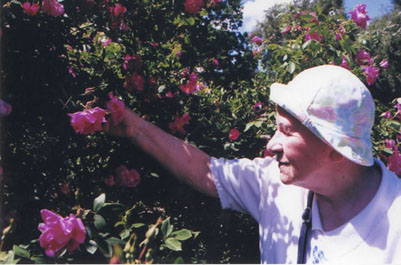
Born in Vienna in 1920, Felicitas Svejda is the creator of the Explorer roses
and of many hardy ornamental shrubs cultivated
in private and public Canadian gardens -- Montreal Botanical Garden Library

Tributes to this pioneer in hybridizing rose stock to withstand extreme cold have been pouring in since her death on January 19 in Ottawa, aged 95. Acknowledgement of her exalted place in the world of ornamental plant genetics have arrived from Russia, Iceland, the United Kingdom, Germany, Austria, Finland and Poland; every geographic place on the planet where rose lovers are now able to indulge in planting cold-hardy roses that will give them pleasure in beautiful blossoms throughout the garden growing season.

When Felicitas Svejda arrived in Ottawa in the early 1950s she came to an unsophisticated backwater compared to Vienna, the culture capital of Europe. Of course at that time in the historical fairly recent past, the Second World War had just concluded five years earlier and European cities were heavily damaged, their economies in dire straits, and guilt hung heavy over many Europeans for having hosted however unchosen, the charnel factories whose chimneys blasted the dry-waste effluvient of human remains during the Holocaust.

To choose to emigrate from Austria, a country aligned with fascist Germany and other Axis powers, to make her future in Canada, one of the Allied countries whose troops fought against those of the perpetrators of that mass conflict and genocidal extermination of Jews, must have represented a deliberate spurning of the dread social atmosphere in which fascism had thrived, in favour of finding her destiny in breeding living things of surpassing grace and beauty.

She was originally tasked with researching cereal grains, as an employee of the Department of Agriculture. Within a decade she had transferred her professionalism and interest to ornamental plants, focusing on rose bushes she had seen in the gardens of the Experimental Farm, the huge tract of treasured farmland set aside within the City of Ottawa as an untouchable preserve for experimentation in a country where the fundamentals of agriculture and animal breeding are taken seriously.

She learned the exacting science of hybridization, taking meticulous records of her observations, displaying the patience required to succeed. Patience is an obvious and fundamental requirement, since it can take a decade to determine whether a new variation will be successful. She sent her hybrid-bred roses around the world to be tested in the most inclement of climates, for example halfway up New Zealand's Mount Cook.

"She taught herself a lot. She talked to other people. As a scientist, she read the literature. Then she started to work crossing. If she wanted these results she'd cross a rose that showed [desired characteristics] with a rose that showed another kind of performance. She worked her way through it. And she was not too proud to admit that there were a lot of people on the Prairies who had gone before her with quite good results", explained Harry McGee, himself a renowned rosarian and author, as well as life-long friend of Felicitas Svejda.

Ms. Svejda's initial success came with a soft pink rose whose seed parent was a German-bred Schneezwerb shrub, developed from the hardy rosa rugosa native to northern Japan, and which she named after Martin Frobisher, the Arctic explorer. It wasn't only roses that this genetic engineer focused on, though they were her primary concern. She also bred mock oranges, forsythias and 'dancing' weigelas.

Once she retired, the program was given over to the Agriculture Canada laboratory in L'Assomption Quebec, eventually finding its way to the private sector. But the Svejda Explorer Roses are a hardy and lovely staple of nurseries. They appear in public gardens throughout Canada. And in private gardens where gardeners take pride in their hardy beauty. Like my own which over the years have hosted a number of the Explorer Series of Ms. Svejda's wonderful shrub and climbing roses.


Labels: , ,

 
()() Follow @rheytah Tweet