Ruminations

Blog dedicated primarily to randomly selected news items; comments reflecting personal perceptions

Saturday, June 03, 2017

"Liberating" Palestine, Boycotting a Film Tainted by Israel

"I am sending my love and prayers to my fellow Israeli citizens."
"Especially to all the boys and girls who are risking their lives protecting my country against the horrific acts conducted by Hamas, who are hiding like cowards behind women and children."
Israeli actress Gal Gadot
Israeli actress Gal Gadot arrives at the premiere of Warner Bros. Pictures' 'Wonder Woman' at the Pantages Theatre on May 25, 2017 in Hollywood, California.  (Frazer Harrison/Getty Images/AFP)
Israeli actress Gal Gadot arrives at the premiere of Warner Bros. Pictures' 'Wonder Woman' at the Pantages Theatre on May 25, 2017 in Hollywood, California. (Frazer Harrison/Getty Images/AFP)
"In typical Lebanese fashion and because we definitely have our priorities in order, Lebanon’s government decided to rise up from its slumber and resist, even though the movie has been announced for over three years now."
"The fact of the matter is that if you have a problem with the content of a movie, the actor or actress leading it or anything pertaining to it… Simply don’t go watch it."
"Call for a boycott, but you sure as hell have no right in making sure no one else gets to watch it too."
Blogger Elie Fares --  “A Separate State of Mind” blog
It is a cardinal sin to be an Israeli. All the more so, an Israeli who served in the Israel Defence Force. And since everyone in Israel, male or female, is expected to serve through general conscription for a two-year period in defence of their nation, those who wish to see Israel destroyed feel justified in considering all Israeli Jews as criminal persecutors of Palestinians. The simple fact that Israel must maintain a standing army in preparedness for any contingency owes to the other fact; that its neighbours wish to destroy it.

Palestinians cannot have it both ways; waging both physical war with Israel and expecting Arab Palestinians to recognize their obligation to attack Jews in an effort to 'recapture' the land it sits upon as its ancient heritage, but which Palestinian Arabs contest as their very own, and engaging in slanderous propaganda popular wherever anti-Semitism thrives, eager to join the Boycott-Divestment movement. But eager and prepared to present itself as a partner for peace with Israel.

The film Wonder Woman, which sets out to portray women as physically powerful, courageous and as determined as any man, in a campaign to save the world, has garnered lots of praise and worldwide attention. Advance premieres have resulted in critics giving it excellent reviews, and people are eager to see the film, considered a first of its kind because it features a woman in a super-hero role, usually reserved for super-men.
"She's incredibly strong, but she also stands for something which is the opposite of being violent -- which is love, truth, compassion."
"As a woman, it was interesting sometimes that I would say, 'I think [females] might fight a little differently than [males] might fight."
"The challenge is to see both the good and bad of mankind..."
"We all want to bring, not only a hero to the world, but a message of helping anybody find their voice."
Patty Jenkins, director, Wonder Woman
Perhaps the director's words hit the issue square, though of a certainty they weren't intended to be political. But what she says and how she describes the film and what it explores in human relations appears to lead directly to Israel-as-metaphor.

Wonder Woman is opening during the Muslim holy month of Ramadan and theatres in the United Arab Emirates, Qatar and Kuwait are scheduled to run the film. Oman and Bahrain are also going to feature this blockbuster that has aroused interest in theatre-goers worldwide. But film enthusiasts in Lebanon are just plain out of luck, because its ministry of economy has banned the film. Not because the theory  of a woman daring to do what men have always done is offensive to a religion where women are neither seen nor heard in public.

But because its star, a woman, is an Israeli Jew; a combination that makes for detestation and anger. Beirut had prepared to schedule the film at one of its cinemas but though posters and billboards went into play no one in the capital of Lebanon or elsewhere in the country will now see it because it has become symbolic of the state of war between Lebanon and Israel. Lebanon's Iran-led Hezbollah paramilitary group and the Islamic Republic of Iran, both committed to Israel's destruction, have, needless to say, great influence in this matter.

An Islamist Republic whose focus is on supporting terrorism world-wide and its creature, a terrorist group, both of which are helping Syria's mass-murdering president in his sectarian war against his own people would like the world to believe that it is Israel and its presence in the Middle East that is responsible for the violence, bloodshed and barbarism that floods the nations of Arab and Aryan Islam. The freedoms that Lebanese once enjoyed in a country once admired for its openness and social advancement has disappeared, with Druze, Christians, Sunni and Shiite Islam at one another's throats.

And it all began when the Palestinian Liberation Organization under the late Yasser Arafat made Lebanon its conflict outpost after Jordan's then-King Hussein refused to allow his country to continue to be overrun by Palestinian militias, attacking Israel over the border and destabilizing both Israel and Jordan. What the PLO failed to accomplish in Jordan (though a slow-simmering effort continues) it accomplished handily in Lebanon before it was forced from there, too.

But the chain of events leading from Lebanon's dystopian malfunctions which bred Hezbollah when the Iranian Republican Guard Corps infused Shiites with the sacred vision of jihad and martyrdom has entirely disrupted the country and its administration, the larger waves of which stimulated Sunni states like Saudi Arabia to encourage their own brand of death-dealing-and-loving jihad beginning with al-Qaeda and ending with Islamic State of Iraq and the Levant.

Should anything untoward happen to ISIL, the Muslim Brotherhood hovers in the background, infesting the Islamic nations of the Middle East and North Africa, and installing themselves throughout the Western world, infiltrating Europe, North America and Oceania.

Labels: , , , , ,

Saturday, March 29, 2014

If the Israeli presence in the West Bank, and the "settlements" from 1967 on, are the root cause of the conflict between the Israelis and the Palestinians, then why does Article 14 of the 1964 PLO Charter call for the destruction of all of Israel?
Because Judea and Samaria had no recognized sovereign, apart from the Ottoman Empire, prior to the illegal Jordanian occupation, the current Israeli presence in Judea and Samaria cannot possibly be designated as illegal.
It seems therefore that nothing Israel offers that is less than 100% of its entire land -- in other words if Israel agrees not to exist -- will affect the Palestinian Authority's willingness to make peace.
In a world ablaze, European governments and companies still see fit to boycott Israeli companies and products from the so called West Bank. The boycotting parties claim to base their actions on the fact that the West Bank is occupied territory and that the Israeli presence in the West Bank is the one true obstacle to durable peace.

It is apparently unbeknownst to them that both premises are entirely false.

In the West, the so-called "Green Line" is usually referred to when the "peace process" is being evaluated. Someone usually states that Israel should retreat behind this Green Line in order to maintain legitimacy and legality. The Green Line is allegedly synonymous with "the Borders of 1967." This is a highly misleading semantic trick. By asserting the Green Line as the borders of 1967, the case is made to sound as if this is the border from whence the Israelis started an aggressive expansion. The truth is the opposite. The Green Line is in reality the armistice line of 1949: the border where the Arab war of extermination was halted and where the Israelis finally prevented the attempted genocide of their people.

The term "occupied territories," even if not correct, is enough to nonplus the average Israel supporter and send left-wing and Muslim front groups into a twist. It is probably worthwhile to examine the legal accuracy of the term "occupied" as it is applied to the West Bank.

First, it is important to realize that the West Bank had no legally recognized sovereign prior to 1948. After the proclamation of the state of Israel in 1948, which then counted a scarce 660,920 Jewish inhabitants, Israel, literally on the day of its birth, was immediately faced with a war of extermination launched by Egypt, Syria, Lebanon, Jordan and Iraq, complemented by Saudi Arabian forces fighting under Egyptian command and a Yemeni contingent.

During this effort to obliterate the nascent state, Jordanian forces took control of the area that had, from biblical times, been known as Judea and Samaria. The Jordanians, in 1950, changed this name to the "West Bank" [of the Jordan River], apparently in an attempt to semantically strengthen their case of "occupation" by making the territory sound as if it were a legitimate part of their East Bank. The move also appears to be an attempt to delegitimize Israel's claim to the area by de-Judaizing its name[1] -- a strategy first adopted by Roman emperor Hadrian, when he changed the country's name from Judea to Palestine, after a nomadic maritime people, the Philistines, who had been in constant armed conflict with the Jews.

Moreover, only Britain, Iraq and Pakistan recognized the Jordanian occupation of Judea and Samaria. The rest of the world, including Jordan's Arab allies, never recognized the Jordanian occupation of Judea and Samaria as legitimate, let alone legal. The same goes for the Gaza Strip, only there, it was the Egyptians who ended up illegally occupying the area after the 1948 war of extermination.

During the Six Day War of 1967, Israel was faced with another war of extermination launched by its Arab neighbors. To survive yet another attempted genocide, Israeli forces conducted, in response, a war of defense in which the Israel Air Force destroyed Egyptian aircraft before enemy troops could reach Israel's fragile borders. In the process of this defensive war, the Israelis ended up expelling the Jordanians from the part of Jerusalem they occupied and the West Bank of the Jordan River: Judea and Samaria.

Because Judea and Samaria had no recognized sovereign, apart from the Ottoman Empire, prior to the illegal Jordanian occupation, the current Israeli presence in Judea and Samaria cannot possibly be designated as illegal. After all, from whom are they occupying the area, save from the former Ottoman Empire? The area can only be correctly designated as "disputed" territories, just like Kashmir, the Western Sahara, Zubarah, Thumbs Island, and a lengthy parchment of other disputed territories.

It has been alleged -- originally by diplomats of the Arab and Muslim world, and later parroted by a gullible European political elite -- that to leave this dispute unresolved blocks not only the peace process but also the general stability of the region. Any impartial examination of facts, however, shows that the Israeli presence in Judea and Samaria has no significant relationship to either the "peace process" or regional stability. It is probably just irresistibly convenient for autocrats to keep telling diplomats to focus on Israel and the Palestinian problem to throw them -- as well as their own people -- off the scent of their own questionable governance.

If the Israeli presence in the West Bank, and the "settlements" from 1967 on, are the root cause of the conflict between Israel and the Palestinians, then why does Article 14 of the 1964 PLO charter call for the destruction of all of Israel? "The liberation of Palestine, from an Arab viewpoint, is a national duty. Its responsibilities fall upon the entire Arab nation, governments and peoples, the Palestinian peoples being in the forefront. For this purpose, the Arab nation must mobilize its military, spiritual and material potentialities; specifically, it must give to the Palestinian Arab people all possible support and backing and place at its disposal all opportunities and means to enable them to perform their role in liberating their homeland."

In 1964, there was not a single Israeli in Judea and Samaria, nevertheless the PLO called for the obliteration of Israel. It is this '64 PLO mentality that has pervaded the upper echelons of Palestinian administration ever since. With the signing of the 1993 Oslo accords, although PLO leader Yasser Arafat said 'yes' to peace, in the period following his actions led to the first massive wave of terror attacks, known as the "Second Intifada." In 2000, then-Prime Minister Ehud Barak made Arafat an offer that shocked the world. Barak offered the PLO nearly everything it demanded, including a state with its capital in Jerusalem; control of the Temple Mount; the return of approximately 97% of the West Bank and all of the Gaza Strip, and a $30 billion compensation package for the 1948 refugees.[2] Arafat turned this deal down. In 2008, then-Prime Minister Ehud Olmert offered Palestinian President Mahmoud Abbas almost 98% of the West Bank, and again accepted nearly all Palestinian demands. Olmert too, was turned down.

It seems therefore that nothing Israel offers that is less than 100% of its entire land -- in other words, if Israel agrees not to exist -- will affect the Palestinian Authority's [PA] willingness to make peace. The Arabs rejected a plan to partition the land, they did not want peace when there were no Israelis in Gaza, the West Bank or the Jordanian-occupied eastern part Jerusalem, and have repeatedly turned down generous peace offers.

Judea and Samaria are not occupied territories, and the Israeli presence there has no relationship to the PA's willingness to make peace.

Why then would European governments and companies boycott the region? They do not boycott other comparable regions. Even more revealingly, in 2006, the EU even actively aided an occupying power, Turkey, by approving a $259 million aid package for Turkish occupied Northern Cyprus.

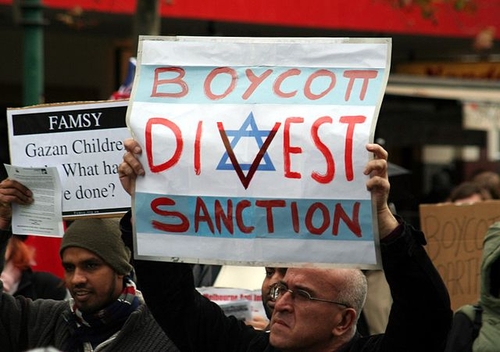
Anti-Israel protestors in Melbourne, Australia in June 2010. (Image source: Wikimedia/Takver)

Why these double standards and what do they tell us about the morality -- or lack thereof -- of the people who hold them?

As Thomas Friedman once wrote "Criticizing Israel is not anti-Semitic, and saying so is vile. But singling out Israel for opprobrium and international sanction out of all proportion to any other party in the Middle East is anti-Semitic, and not saying so is dishonest."

[1] Wim Kortenoeven, De Kern van de zaak

Labels: , , , , , , , , ,

Thursday, March 06, 2014

Defying BDS Calls, Promoter Shuki Weiss Brings Big-Name Performers to Israel

March 6, 2014 8:01 am
Madonna performs in Tel Aviv on May 31, 2012. Photo: MDNA.

JNS.org – While Pink Floyd’s Roger Waters has in recent years acted as a de facto frontman for the Boycott, Divestment and Sanctions (BDS) movement, urging fellow artists against performing in Israel, Shuki Weiss Promotion and Production Ltd. for nearly 35 years has brought the biggest names in entertainment to the Jewish state for historic live shows.

Musical guests attracted to Israel by the company have included Metallica, the Red Hot Chili Peppers, Radiohead, Madonna, David Bowie, and Eric Clapton. The trend continues this summer, with Neil Young, Soundgarden, and the Pixies all signed by Weiss to perform in Tel Aviv, and The Rolling Stones tentatively booked by Weiss but still unconfirmed.

“I’m not getting the message from the artists that they are feeling the pressure [from the BDS movement]. While that might have been true in the past, that’s not the case today,” Oren Arnon, the head promoter for Weiss’s company, tells JNS.org.

Weiss has also signed the international circus troupe Cirque du Soleil, which is bringing its “Quidam” performance to Tel Aviv this summer.

Promoting and producing live performances in Israel, in the dangerous and unstable neighborhood that is the Middle East, comes with significant financial risk, says Arnon. When the security situation becomes heated and artists decide to cancel their shows, “we lose millions [of dollars],” he says.

That was the case during the Second Lebanon War in 2006, when the popular British electronic music band Depeche Mode canceled their Israel show over concerns for their safety. (The band did make up for it by performing in Israel several years later.)

Over the past several years, some artists have canceled their planned Israel shows not due to security fears, but as a result of the pressure levied by members of the BDS movement. Yet Arnon says of what he calls the “many” artists who haven’t backed out, “We’ve had many positive experiences with conscientious and intelligent artists who choose to come and see for themselves rather than cave to the propaganda.”

If Weiss can confirm the band’s appearance, The Rolling Stones would be the biggest name to perform in Israel this summer. BDS groups have already taken to social media, calling on the Stones to boycott the Jewish state.

Whether or not she directly felt the BDS pressure, last year popular R&B singer Alicia Keys ignored the campaigns targeting her Israel performance and gave a concert in Tel Aviv that Arnon says was simply “incredible.”

Arnon admits that BDS “in many ways can be seen as nonviolent and legitimate,” but says art “is supposed to address issues that bother and disturb [people].”

“What BDS is saying is ‘just shut up—don’t use your art for good or for bad,’ which is something we [at Shuki Weiss Promotion and Production] have a hard time agreeing with,” Arnon says.

Arnon says Weiss’s company was behind the 2006 Israel concert by Roger Waters, a massive show was moved from its original venue to the Neve Shalom “Oasis of Peace” village, where Arabs and Jews live together. The vision was to play at a location symbolizing hope and peace between the two peoples. It was only after the show was announced that Waters was introduced to the BDS movement, according to Arnon. But Waters chose to play in Israel anyway, and after performing there decided to become one of the BDS movement’s biggest supporters based on his firsthand experience of the country.

“Whether you or I agree [with Waters’s decision to support BDS] doesn’t matter,” Arnon says. “I don’t think I am trying to put words in anyone’s mouth. I don’t think it’s legitimate to prevent people from educating themselves, and it’s also not legitimate to shove one specific set of beliefs down an audience’s throat. Everyone is entitled to obtain his or her own opinion, how they see fit.”

While Waters came away with one particular conclusion, many other artists who come to Israel see the country in a positive light, says Arnon. He cites various co-existence projects musicians are exposed to when they visit Israel, including work done by an organization called “Heartbeat,” which brings Jerusalem-area Jewish and Arab youths together to play music in order to “let go of the fear they might have of each other.”

“We’ve taken artists to see [Heartbeat’s work] together and given artists the opportunity to come and express their thoughts,” Arnon says. “Israel is a democracy and artists can go on stage and say what they want to say. That’s what the arts have been about the last few centuries.”

Arnon feels it would be best for both the Jewish and Arab public in Israel if artists would choose discussion over boycotts. While he says singers are entitled to boycott, he has a problem with those who say, “Don’t go there and play for your fans, and don’t engage with them.”

“Bottom line, come here and tour and see the facts,” Arnon says, conveying his message to potential artists considering performances in Israel. “Our success is having an artist tour, understand the difficulties, and understand that bad things happen here similar to anywhere else in the world. We encourage them to come instead of not showing up.”

Labels: , ,

Wednesday, July 10, 2013

Paul McCartney: They Threatened to Kill Me if I Played in Israel

Artists who perform in Israel aren't just worried about selling tickets, but about their safety, as they are targeted by BDS groups.

By David Lev -- ArutzSheva 7
First Publish: 7/10/2013, 5:38 PM

concert
concert
Flash 90
 
When rock legend Paul McCartney came to Israel in 2008, he was, at least to some extent, taking his life in his hands. Not because of Israel's sometimes precarious security situation, but because he was threatened by BDS (boycott, divest, and sanction) anti-Israel groups. “I got death threats, but I'm coming anyway,” the singer was quoted as saying by Jerusalem Center for Public Affairs researcher Adam Shay. 

“I got explicit death threats, but I have no intention of surrendering. I refuse to cancel my performances in Israel,” Shay quoted McCartney as saying.
The former Beatle is not alone.

Dozens of other artists who schedule dates in Israel are lobbied, bullied, threatened, and even attacked at concerts by anti-Israel groups who are bent on isolating Israel culturally, as well as economically. Many artists, said Shay, claimed that their web sites have been attacked by hackers right before their Israeli concerts.

Alicia Keys, who recently played a concert here last week, supplies the latest example of intimidation faced by artists who play Israel. Several of her fellow singers – notably Elvis Costello and Roger Waters – urged her to cancel, calling Israel an “apartheid state,” and Keys' Facebook page was littered with condemnations of her on the day of the concert. Costello himself cancelled a concert in Israel in 2010, as did Carlos Santana, after being hectored by anti-Israel groups. Other notables who have cancelled planned concerts in Israel are Jon Bon Jovi, the Yardbirds, Joe Lynn Turner, and the Pixies. Spanish singer Paco Ibanez went one better, telling a French newspaper that he is boycotting the Hebrew language, which he can speak, for political reasons.

But despite the pressure and threats, there are many artists who continue to play Israel. In the past month, rock bands Deep Purple and the Pet Shop Boys have held concerts in Israel, and American artist Rihanna is scheduled to take her second tour here in October. And of course, there was Madonna. 

Many of these artists, Shay said, decided to perform in Israel despite the threats. “When singer Moby was interviewed on Army Radio shortly before he performed in Israel, he said that the intensity of the attacks against him before he came to Israel made him suspect that this wasn't an objective movement that was concerned with people's welfare, but with something dark and dubious.” Unfortunately, though, “most artists just don't want to deal with it. It's much easier for them to release a statement that they won't be appearing in Israel 'for reasons of conscience' rather than to say their lives are being threatened and they're frightened.”

Labels: , , , ,

 
()() Follow @rheytah Tweet