Blog dedicated primarily to randomly selected news items; comments reflecting personal perceptions
Sunday, July 04, 2021
Good Faith Collaboration with Chinese Biological Research
"Why did Canada stand idly by when CanSino breached the agreement?"
"We could have sued them, basically, which would have put Beijing in a tough spot to explain its obstruction."
"That would have been worth doing for reasons of accountability, even if we concluded the vaccine was not a very good one."
Amir Attaran, law professor, health-policy expert, University of Ottawa
"After some time it became clear CanSiono could not secure the authority to ship the materials to Canada."
"The shipment delays did not constitute a termination of the agreement with cause by CanSino."
National Research Council spokesperson
"The experience of this partnership demonstrates once again that any collaboration with China can be jeopardized by Chinese authorities with malign intent towards Canada."
"It therefore renders all partnerships with China as inherently unreliable. Certainly in this case, Beijing is fully to blame."
"Canadians are learning this hard lesson, and are realizing that we should diversify our collaborations away from China and focus on partnering with countries that follow the rule of law."
"When I talk to Canadian AI scientists, they often say ‘I have partnered
with my Chinese friends, they would never steal from us'. I say ‘yes they would. Unfortunately, that is
how China’s system works'."
"This was a surprise to see our commitment to China, in sharing very
significant proprietary intellectual property, run into this major
blockage. China’s success in vaccines is
standing on the back of Canadian researchers and scientists. Over the
years we helped China develop its capacity. But China is no longer a
reliable partner."
Margaret McCuaig-Johnston, senior fellow, Institute for Science, Society and Policy, University of Ottawa
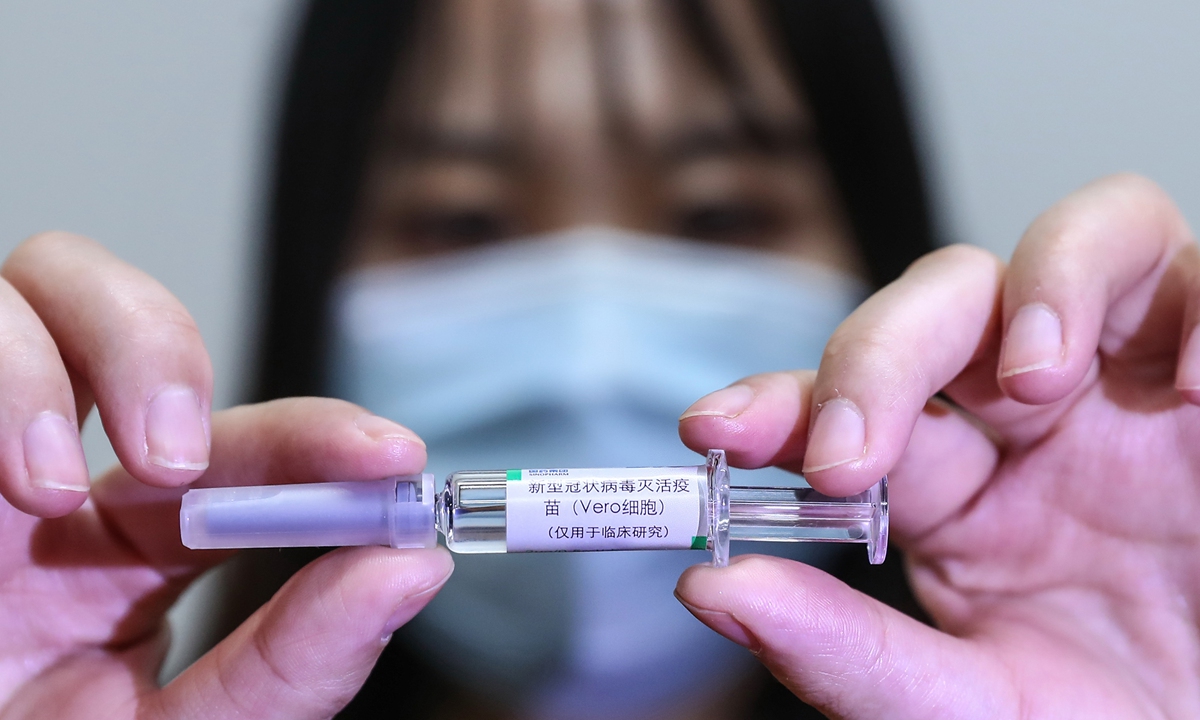
A medical worker shows the inactivated COVID-19 vaccine candidate
developed by SinoPharm at the company's vaccine candidate production
plant. Photo: Xinhua
In the world of scientific research, scientists the world over have always striven to rise above politics in the interests of sharing and learning from one another and working together for a higher purpose. Since so much of science and research benefits humankind, it makes good sense to separate the political world from that of scientific research and to maintain open communications and research exchange opportunities between various nations' scientists and research projects.
China's approach is somewhat different; under the Chinese Communist Party, control is everything and there is no avenue of endeavour, including scientific research where the CCP does not intervene. Moreover, China is well known for its penchant for hijacking whatever it can of other nations' discoveries, formulae and production secrets to get a jump-start on its own endeavours in technology and science. Above all, Beijing expects all its citizens, current and former, to be faithful to the aspirations of China and to work on its behalf, whether culturally, socially, politically or through espionage.
Canada's National Research Council signed a "collaborative research agreement" between itself and CanSino Biologics whose CEO had a Canadian connection in attending university in Canada and working for Canadian research facilities before setting out on his own with CanSino. The NRC provided CanSino with a cell line on which to establish its agreed-upon COVID vaccine. The agreement was for CanSino to ship samples of its vaccine to Canada to be tested and if proven successful, to be manufactured in Canada as well.
The Academy of Military Medical Sciences, an arm of China's People's Liberation Army, through an army major general as the lead researcher, co-jointly developed the ensuing vaccine with CanSino. The contract signed between the NRC and CanSino stipulated that neither party would be liable for problems caused by factors beyond their reasonable control.
And though the agreed-upon arrangement was meant to see Canada conducting phase one trials then possibly moving on to two and phase three trials on the vaccine, then to begin producing the vaccine at a National Research Council facility if it was approved by Health Canada, the agreement announced in May of 2020 to have the potential to place Canada up front with a COVID vaccine to inoculate against the SARS-CoV-2 virus, that is not quite how things turned out.
When the vaccine was ready for shipment and a Canadian plane sent to China to pick up the vaccine samples, they were denied by Chinese customs, refusing to permit vaccine samples to be sent to Canada. The event was generally assumed to be another of China's punishing tactics over the arrest in Canada of Huawei executive Meng Wanzhou, on an extradition request by the U.S. Department of Justice. The message was clear; the collaboration agreement was dead in the water, leaving Canada to scramble to find other vaccine sources.
Beijing did permit CanSino to provide its vaccine to Russia and Pakistan to fight the coronavirus pandemic there. Trial results from Pakistan rendered the information that the one-dose shot was roughly 66 percent effective in prevention of symptomatic COVID-19; while results from other sources using the China-produced vaccines gave even lower effectiveness rates of 51 percent, barely scraping through the minimum efficacy required for approval.
As for Canadian scientists heeding the warning of standing clear of possible scientific collaborations with their Chinese counterparts; in some areas it has fallen on deaf ears. Two scientists at the Canadian Centre for Vaccinology at Dalhousie University continue to be listed as principal investigators on the CanSino vaccine's phase three trials in other countries.
Vaccine
Ad5-nCoV is backed by Tianjin-based CanSino Biologics Inc., seen here
on Nov. 20, 2018, and the Institute of Biotechnology of the Academy of
Military Medical Sciences. CHINA STRINGER NETWORK/Reuters
Immunogenicity and safety of a
recombinant adenovirus type-5-vectored COVID-19 vaccine in healthy
adults aged 18 years or older: a randomised, double-blind,
placebo-controlled, phase 2 trial
This randomised, double-blind, placebo-controlled, phase 2 trial of the
Ad5-vectored COVID-19 vaccine was done in a single centre in Wuhan,
China. Healthy adults aged 18 years or older, who were HIV-negative and previous severe acute respiratory
syndrome coronavirus 2 (SARS-CoV-2) infection-free, were eligible to
participate and were randomly assigned to receive the vaccine at a dose
of 1 × 10¹¹ viral particles per mL or 5 × 10¹⁰
viral particles per mL, or placebo. Investigators allocated participants
at a ratio of 2:1:1 to receive a single injection intramuscularly in
the arm. The randomisation list (block size 4) was generated by an
independent statistician. Participants, investigators, and staff
undertaking laboratory analyses were masked to group allocation. The
primary endpoints for immunogenicity were the geometric mean titres
(GMTs) of specific ELISA antibody responses to the receptor binding
domain (RBD) and neutralising antibody responses at day 28. The primary
endpoint for safety evaluation was the incidence of adverse reactions
within 14 days. All recruited participants who received at least one
dose were included in the primary and safety analyses. This study is
registered with ClinicalTrials.gov, NCT04341389.
CanSino Biologics, China The Lancet
Courtesy of CanSino Biologics
China-based CanSino Biologics is the brainchild of Yu Xuefeng, who studied in Canada and earned his doctorate at McGill University. He later was in the employ of Sanofi Pharmaceutical based in Toronto and eventually returned to China where he launched his vaccine business. His links to Canada gained him an insider status. The National Research Council agreed to allow the use of a Canadian-created cell line to aid in the development of a vaccine first for Ebola and following that, SARS-CoV-2.
For reasons known only to Canada's prime minister an agreement was signed with CanSino for collaboration in the development of a COVID vaccine, at a time when relations with Beijing were beyond strained and bad faith was redolent and in full view when the Chinese Communist Party launched its hostage diplomacy initiative by arresting and charging two Canadians in China with security breaches endangering China, and then initiating a trade war.
Canada been burned in the past when dealing with China when Chinese technologists were hired to work for Canada's then-telecommunications giant Nortel Networks attaining positions of trust enabling them to lift trade secrets for their own, and Chinese hackers infiltrated and gained access to Nortel's top executive accounts spiriting away additional Nortel data which eventually helped lead to the company's demise but gaining China's telecommunications industry through Huawei where former Nortel employees worked, the edge they looked for, linked with China's military.
Once again the trusting Canadian government of Prime Minister Justin Trudeau who was personally transfixed with the notion that Canada would benefit hugely by association with China, in lucrative trade deals and investment, laid itself open to expropriation of Canadian technical and scientific expertise, signing a contract with CanSino to test their vaccine at Dalhousie University in conjunction with the National Research Council, which could produce samples of the vaccine. A vaccine which never arrived in Canada, as per the agreement.
A general view of Shifa International Hospital in Islamabad, Pakistan where a Phase 3 trial of CanSino's COVID-19 vaccine is undergoing trials. (Reuters)
A vaccine that Beijing refused to allow entry to Canada, while shipping it off elsewhere for testing. "In June, the vaccine (based on the Canadian cell line) was approved for use by Chinese military forces. As for the rights to the cell-line, a comment to Global News from Innovation, Science and Industry Minister Navdeep Bains was 'The NRC (National Research Council) retains the intellectual property related to the cell line, while CanSino in turn owns all intellectual property rights for the vaccines it develops.' Canada cannot claim any revenue if the vaccine proves successful", wrote Radio Canada International journalist Mark Montgomery.
"What exactly motivated Canada to enter into such an unstable partnership in the first place given the dire state of Canada-China relations and the scandalous history of China's vaccine industry?" questioned science writer Iris Kulbatski in the health-care journal Healthy Debate. She quoted Margaret McCuaig-Johnston, former assistant deputy minister in charge of Canada's vaccine collaboration with Beijing, that China's history of creating customs 'obstacles' in any trade disagreements, as leverage was well known.
"McCuaig-Johnston further said that 'China's success in vaccines is standing on the back of Canadian researchers and scientists. Over the years we helped China develop its capacity. But China is no longer a reliable partner." There is, in fact, nothing new about China's penchant for infiltration, sabotage and subterfuge along with the stealth mining of technological and scientific data originating elsewhere, than the ill-gotten gains used by China to further its own interests.
This is merely one more instance in a long history of unprincipled looting of other nations' research and development. With China taking the short-cut route to using others' intellectual property, parading it as their own, and reaping the financial benefits thereof. The question remains: why would this Canadian government see fit, all this being well known, to engage in a contractual agreement with a country that cannot be trusted, with a pharmaceutical company that has direct links to the People's Republic of China's Military?
Vials of a COVID-19 vaccine candidate, a recombinant
adenovirus vaccine named Ad5-nCoV, co-developed by Chinese
biopharmaceutical firm CanSino Biologics Inc and a team led by Chinese
military infectious disease expert, are pictured in Wuhan, Hubei
province, China. China Daily via REUTERS
"We need to tell people at the vaccine centres that they carry gold."
"Criminals don't see a vaccine load, they see money."
Thorsten Neumann, head, Tapa, European arm supply chain security association
"Pharmaceutical manufacturers are already spending a lot of time to make sure their products and their supply chain is secure."
"I don't think there is any other industry on the globe that is as prepared for something like this."
Chuck Forsaith, head, Pharmaceutical Cargo Security Coalition, industry association
"We have seen very targeted (cyber) attacks related to the vaccine. The health sector is not very mature in terms of cyber-security", according to Evangelos Ouzounis, head of the secure infrastructure unit at Enisa, the EU Agency for Cyber-security. One opinion based on experience and the reality of the situation, the other quick to run to defence of the industry's capability of protecting their products from the grasp of a criminal element. So, which is it? where is the biased assurance and where the reality-based acknowledgement?
The most secure government and their agencies sites for whom a firewall of restricted entry has been relied upon for its assurances of being impervious to cyberattacks has most recently been stunned by the revelation that they have been infiltrated by ingenious, determined and malicious state actors and have been oblivious to the fact that high security data of all kinds have been siphoned away for the scrutiny of unauthorized actors putting the lie to their presumed attention to securing high-value data away from hostile eyes.
Yet where there is a market there will be painstaking efforts to satisfy the demands of that market, if not legally, then by illegal means in the great interests of profiteers. An expert points out the lapse in security within the health sector, yet even elite government agencies for whom secrecy is of the highest order have failed, spectacularly, to prevent infiltration through cyberleak safety. While those within society deemed at highest risk of succumbing to COV-19 are fast-tracked for vaccine relief, other sectors of society feeling equally at risk, will seek any means by which they too can be prioritized for inoculation, even if through their own resourcefulness.
And for many, in what they regard obviously as a life-or-death situation, compelled by a need to protect themselves and their loved ones, it is worthwhile to seek out any method even illegitimate and potentially harmful means, for the legitimate desire to arm themselves against a dread disease playing havoc in the global community of humanity.
The dark web may seem like a sinister place to many, where traffic in the worst passions of a segment of sociopathic tendencies can be satisfied. But it is also a place of last resort for the desperate who will recklessly seek a source to supply them with forbidden elements of human gratification, from child porn to illicit recreational drugs and now to a new drug formula that will act as a vaccine against COVID-19.
Seller's Advertisement on Deep Paste
Cybersecurity groups have tracked offers on the dark web for such vaccines in response to the anxiety of the public fearful of contracting the disease. Shipping costs and methods are suggested, with "stealth" delivery and special packaging. Vendors claiming their product is derived from known sources, safe and effective. Many of the vaccines purportedly for sale on the dark web, according to experts are fake to begin with, and the product, once paid for, may never be delivered.
The issue is also that people suffering from a high degree of anxiety over personal safety, hoping to avoid infection will go to any ends to acquire what they believe will help to save their lives. Without due consideration with respect to what exactly it is they're hoping to receive and achieve. There are no guarantees that the 'vaccine' they plan to use is either effective or safe for human use. It is also an unknown whether vendors have somehow gained access to authentic products.
What experts in the field do agree upon, however, is that these underground offers for the sale of purported COVID vaccines will proliferate the longer the world community has to wait for mass inoculation. Vaccine shortages, accidents in delivery and distribution, handling and storage will all add to the massive work involved in administering the vaccine to the general public once the initial vaccines have been utilized in inoculating the identified high-risk candidates.
In December, Interpol and Europol gave warning of a likely "onslaught" of criminal activity with links to COVID-19 vaccines, citing online fraud and cyber crime, to theft and the sale of fake or substandard doses. Illegally refilled empty vaccine vials could be offered by vendors whose object is to gain profit, not ensure that safe substances will be injected intra-muscularly in desperate people hoping to avoid COVID-19. This is a public health threat of significant proportions "ineffective at best, toxic at worst".
The arrival of coronavirus vaccines means people have started hawking so-called "vaccines" on the Dark Web. CHRIS JACKSON/POOL/AFP via Getty Images
"[Such a policy -- on one hand to urge people to be vaccinated, on the other creating a compensation program should anyone be afflicted with vaccine-related harm -- creates] challenging communications issues, even if the policy makes sense because we're asking Canadians to get vaccinated as a public health act, an act for their community and therefore, if there's injury it makes sense to compensate them for it."
"On the other hand, it does create this impression injuries happen and require compensation."
Dr.Tim Caulfield, Canada Research Chair in health law and policy, University of Alberta
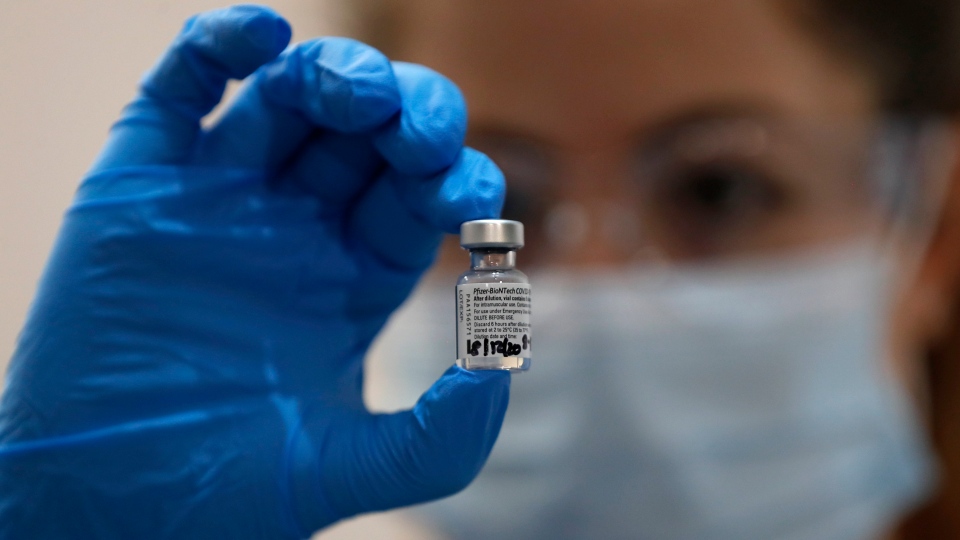
In this file photo, a nurse holds a phial of the Pfizer-BioNTech
COVID-19 vaccine at Guy's Hospital in London, Tuesday, Dec. 8, 2020. (AP
Photo/Frank Augstein, Pool)
According to Canada's chief public health officer Dr.Theresa Tam, this coming holiday season could see the country marking a few grim milestones. An analysis of the government's new modelling suggests the national caseload is set to ascend by at least 90,000 new infections by Christmas Day, a number that could conceivably reach up to 135,000 cases.
Over the past week an average of 2,900 patients with COVID-19 were admitted to hospitals for treatment on any given day, leading to 454 people being treated in intensive care. Dr.Tam's deputy public health officer, Dr.Howard Njoo, added the outbreak has loaded health-care facilities in some areas of the country to the point of being "completely overloaded", causing some hospitals to postpone critical medical procedures. Both reiterating that the provinces are required to strengthen their COVID-19 responses immediately in view of the virus spread along a "rapid growth trajectory."
Cds to keep wearing masksPhoto P.J. Thompson/National Post
"Knowing access to safe and effective vaccines for all Canadians is within sight might lead some to think COVID-19 is no longer a problem. But the reality is very different", Dr.Tam emphasized. And in the spirit of trying to cover all possible contingencies, the federal government announced a compensation program available to anyone who happens to suffer harm by the vaccine for COVID-19; actually any vaccine that is approved by Health Canada.
Around the globe only 19 other countries have enacted some version of a vaccine compensation policy. A cautionary note was issued by University of Alberta professor Dr.Lynora Saxinger whose specialty is infectious disease, that the announcement itself and the forthcoming policy has a risk inherent in its premise that undermines the messaging of a safe vaccine. "And so, it depends, I guess, on whether you think people's main fear is an adverse reaction or their main fear is not getting support in the event of an adverse reaction."
Such reactions are rare; anaphylaxis or a severe allergic reaction can occur in one out of 760,000 vaccine recipients, according to a Canadian Medical Association Journal study. Mild reactions on the other hand, like swelling around the injection site are common, speaking to the body's natural reaction to a foreign substance, including those meant to strengthen immunity. Between 1984 and 2018, Quebec, the only province that has a vaccine compensation program, paid out $5.4 million in 43 cases. Out of 228 claims, 187 were considered candidates for evaluation.
As Canada is preparing to roll out the Pfizer vaccine's initial delivery, American officials are preparing similarly to work toward expediting the most ambitious vaccination campaign in decades with regulators advancing toward approval of the first COVID vaccine to slow the pandemic that has succeeded in killing 3,000 Americans daily.
The rapid rollout of the Pfizer Imc./BioNTech vaccine could start in two to three days' time. "The FDA informed Pfizer that they do intend to proceed towards an authorization for their vaccine. We will work with Pfizer to get that shipped out so we could be seeing people getting vaccinated Monday or Tuesday", advised Health and Human Services Secretary Alex Azar.
A health specialist works at a COVID-19 testing site in Los Angeles on 9 December, 2020. Source: AP