Ruminations

Blog dedicated primarily to randomly selected news items; comments reflecting personal perceptions

Wednesday, October 12, 2022

Canine-Human Diagnosis and Comfort

"[The findings provide] deeper knowledge of the human-dog relationship and adds to our understanding of how dogs perceive and interact with human psychological states."
"[Earlier research with the use of sniffer dogs and human biological samples involved mostly detecting illness]; they can smell other parts of the human experience [however]."
"[The study results] provide firm evidence that odour is also a component that dogs can pick up on."
Clara Wilson, study author, doctoral student, school of psychology, Queen's University Belfast 

"I think this work helps confirm that dogs can be savvy in reading our emotional states, and this study in particular shows that this could be done through scent cues."
"The results seem to reinforce what a lot of owners feel; that their dog can be quite sensitive to their emotional state."
Nathaniel Hall, director, Canine Olfaction Research and Education Laboratory, Texas Tech University
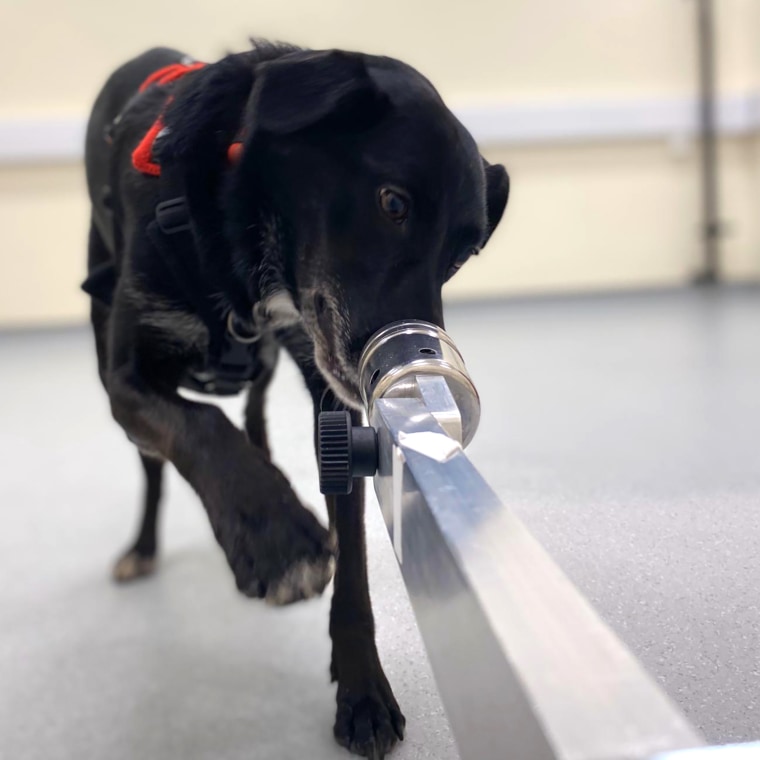
The dogs, including Minnie, were presented with samples from 36 people who gave sweat and breath samples before and after doing a fast-paced arithmetic task.
The dogs, including Minnie, were presented with samples from 36 people who gave sweat and breath samples before and after doing a fast-paced arithmetic task. Courtesy Queen’s University Belfast
"Spes ignored everyone else and immediately went to the crying young woman to see her."
"She loves people, so it was not surprising but in this case it was clear that this woman was the only person she wanted to see."
Victoria Allen, Goochland, Virginia, dog owner
The experience was recounted by Victoria Allan of her dog Spes when they were at a beach, and she and Spes came upon a scene of a group of  young people. One of the group was a young woman who was obviously upset and weeping. Her dog responded to the presence of an upset woman by directly approaching her. It seemed that the dog was sensitive to the woman's distress, meaning to comfort her. The study cited a number of such conclusion-affirmative occurrences interpreted by the dog owners as proof of a dog's sensitivity to people's state of mind.

Such anecdotal stories are common to many, if not most, people with companion dogs. That in their close personal experience with their dogs it became obvious to them that their dogs were aware of and sensitive to the state of mind of their owners. Particularly when something might happen to upset their emotional equilibrium. Of course, tone of voice in addressing a dog, body language that the dog assesses, informs a dog when he's being reproached.

The study in question, however, appears to affirm that dogs' intensely deep and discriminating sense of smell may be their primary tool for assessing emotional state of mind in humans. It is well enough known that dogs' exceptional sense of small has turned them into working dogs, trained to sniff out any number of things, from the presence of contraband drugs or ammunition, and of course, the scent of infections from chronic diseases before medical science itself can detect them. 
 
Changes in the odour of breath or perspiration can guide dogs to detect with a high degree of accuracy chemical odours exuded by people when they feel under psychological, emotional stress. A growing body of research expresses evidence related to dog behaviour; how dogs view things, react, and use their extraordinary olfactory sense in interacting with people. Their ability to produce relief for people suffering anxiety attacks and symptoms of depression are well known. Leading to their use as buffers against emotional upsets. 

Dogs giving attention to individuals and situations are known to assess such details as signals people send reflecting their moods; body language, type of voice changes, or quality of breathing, all symptoms weighed by dogs striving to make sense of what they see, hear and smell, with their hyper-acute senses. While the study focused on the acuity of a dog's sense of smell, it made no attempt to determine whether dogs could identify human emotions; recognize whether people were feeling happy, sad, angry or fearful. Only that stress was being experienced as could be measured by increasing heart rate and blood pressure.
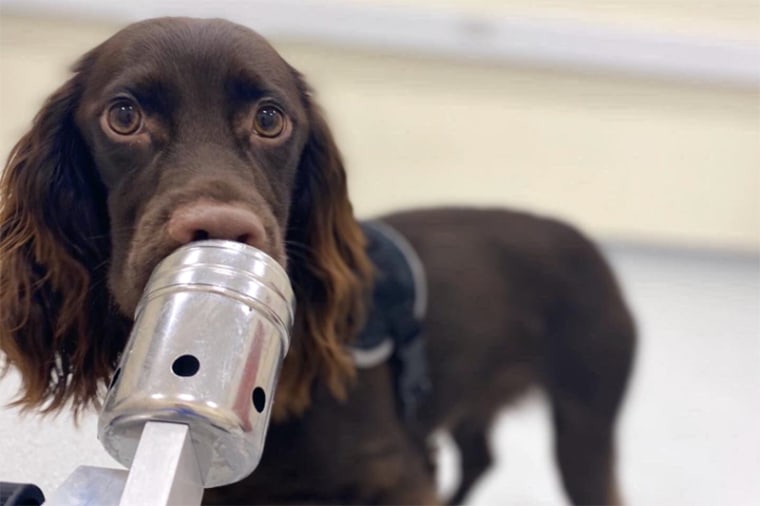
New research adds stress to the list of things dogs like Ruby, seen here, can detect in their owners, including nondiabetic seizures and cancer.
New research adds stress to the list of things dogs like Ruby, seen here, can detect in their owners, including nondiabetic seizures and cancer.    Courtesy Queen’s University Belfast
"The dogs can differentiate something about human odours in stressed vs non-stressed states, but not necessarily that they know anything about how a person is feeling, or what it means when the humans are stressed."
"They might -- but we just don't know that from this study."
Evan MacLean, director, Arizona Canine Cognition Center, University of Arizona

Labels: , , , ,

Thursday, September 23, 2021

Wash n'Wear

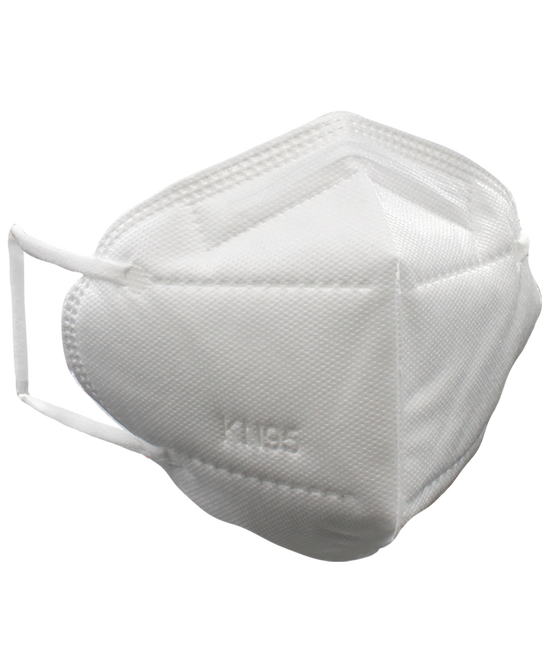
KN95 Mask (20 ct.)
"It's good news for sustainability. That cotton mask that you have been washing, drying and reusing? It's probably still fine -- don't throw it away."
"We were really bothered during the beginning of the pandemic, when going out on a hike or going downtown, and seeing all these disposable masks littering the environment." 
"We're assuming there are no gaps between the mask material and the person's face."
"I think the best mask might be the one that you're actually going to wear. And that is going to fit snugly against your face without being too uncomfortable."
Marina Vance, assistant professor, Paul M.Rady Department of Mechanical Engineering, University of Colorado Boulder
Published in the journal Aerosol and Air Quality Research, a new study concludes that cotton masks -- admittedly not as effective as surgical masks in filtering out viral particles -- still are useful for the task at hand, and certainly are more environmentally friendly. After an experimental 'laboratory-year' of washing and drying cloth squares in lieu of cloth masks, it was established that this care doesn't diminish their effectiveness.

Since the beginning of the global pandemic an estimated 7,200 tons of medical waste is generated daily, the majority comprised of disposable marks. Presumably in America alone. As a faculty member of the university's environmental engineering program, Dr.Vance leaped at the opportunity to collaborate with scientists from the National Renewable Energy Laboratory, testing the longevity of cloth masks.

A series of double-layered cotton squares created for the purpose of testing durability of cloth masks were washed and dried up to 52 times each, representing the equivalent of doing so weekly for the space of a year -- and then analyzed for effectiveness every seven cycles. The masks were subjected to real-world situations in the absence of being tested with human subjects, through being mounted on the end of a steel funnel exposed to a controlled flow of particles circulating in the air, including altered humidity and temperature changes simulating the breathing effect.

After that number of washings, the cotton fibres were seen to have degraded, reflecting repeated washing cycles, but the wear and tear was not found to significantly diminish filtration capacity of the fabric. One change that was detected was a resistance increase in inhalation properties as the masks became more difficult to breathe through, over the course of the study.

The capacity of the masks to filtrate properly rested on their fit, leading to their guarding against airborne particles remaining effective over time. A poor-fitting mask was found in previous studies to admit up to 50 percent of airborne particles, including the virus. Reusable cotton was found to filter out up to 23 percent of the smallest particles (0.3 microns) on which the COVID-19 virus can travel, on being inhaled. 

In contrast, surgical masks filtered out between 42 and 88 percent of particles. KN95 and N95 masks were seen to effectively stop 83 to 99 percent of particles The use of cotton on top of a surgical mask reflects a 40 percent filtration effectiveness. Dr.Vance pointed out other issues such as comfort, affordability and reusability as factors to be considered in making decisions on mask wear. And that ultimately masks should be worn, irrespective of the type, to achieve protection from the SARS-CoV-2 virus.
 
Now some brilliant scientific minds should undertake a study -- or a series of them, if necessary -- to determine why it is that the public carelessly, heedlessly, tosses away used disposable face masks rather than disposing of them properly. Presumably they are discarded because they've served their purpose; to protect the wearer against contracting COVID, and protecting others from being infected by a wearer who is carrying an undetected virus load, so they would be contaminated and yet remain in the public sphere....

Labels: , , , , , ,

Thursday, May 21, 2020

Security, Comfort, Safety - Forts for Children

"I feel like  you're in a safe place  your own bubble of cosiness."
"There are no other things affecting you -- you're blocked out from the world. Everything is wrong right now, but it's a safe space where no one worries about you."
"If you lock yourself in your room, people would worry, but if you hide in your fort all day, no worries."
Grayson Drewry, 22, Port Townsend, Washington

"Kids make sense of the world through play. In quarantine, all our needs are amplified."
"Everything is different. They're facing uncertainty -- not knowing how long we're going to be doing this."
"They're feeling what we're all feeling -- great loss."
"Whatever kids create in their imaginative world feels safe and predictable to them. It's like 'Every time I go into this fort, it will be just like I left it'."
"Don't mess with their fort. Let them go to town on making it feel safe and comfortable. It's theirs."
Emily King, child psychologist, Raleigh, North Carolina

"It's primal. [Our brains react with] self therapy."
"It's all aout safety and control. We seek out comfort. We need to restore order. And in COVID, we're doing more of these things."
Carol Stock Kranowitz, educator, author
In Forest Hill, Maryland, six-year-old Nacelle Bumford has several forts, including a tent near her mother's work spot she has named her "office". "We use them as her safe place", her mother explains. Inside the forts Nacelle gets two minutes of "cuddle time", an aid to normalcy and comfort for both mother and child. "She calls me into her 'office' for meetings that we both schedule on her calendar. It makes her feel in control of her day", said Linette Bumford.

David Sobel, professor emeritus at Antioch University's department of education, author of Children's Special Places: Exploring the Role of Forts, Dens and Bush Houses in Middle Childhood, explains that forts have always been important in childhood. He has done research across cultures on the developmental function that forts assume in children's lives, and he concluded they are universal, driven by "biological genetic disposition" as children develop a "sense of self", separate from parents.

According to Dr.Sobel, children initiate fort-building indoors about at age four, and then begin venturing to the outside two to three years on, to construct dens, treehouses and fort-like structures independently. Building forts reflect children's emotional growth as individuals as they create a "home away from home", away from parental control. "A lot of magic happens inside [a fort, fostering creativity", he explains.


For Grayson Drewry, a school assignment to take part in a fort-building competition, gave meaning to her life during a time of confusion. Her mother describes Grayson's seeking comfort in "nests" and forts when stressed. She transformed her bedroom in pastel-pink, building a tent made with sheets and pillows centrally propped by a mop, then decorated it with photographs, and spent most of her day inside. "I needed that!", she said to her mother.

Dr. Sobel pointed out that children now have more time to be creative as their developing brains need a break from computer time, so forts encourage play, beneficial for children, more acutely at the present time. Familiar routines suddenly disrupted, children have a need to feel in control of something, said Emily King. Therapeutic in nature for children, being in an enclosed dark space, sound buffered, the space creating separation from everything surrounding it, children on the autistic spectrum or with attention-deficit disorder can find it soothing.

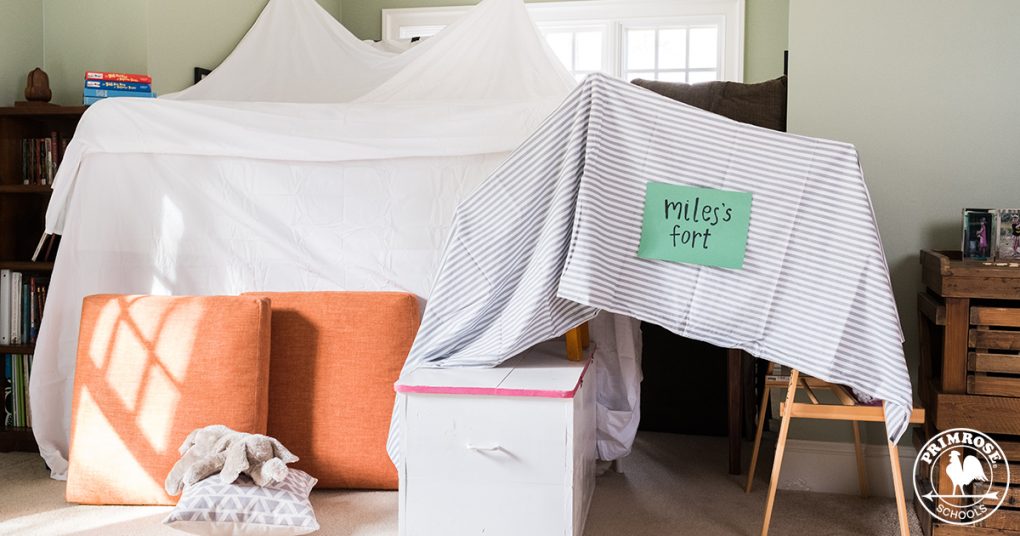
A fort made out of living room furniture, cushions and blankets, labelled 'Miles's fort'

Labels: , , , , ,

 
()() Follow @rheytah Tweet