Ruminations

Blog dedicated primarily to randomly selected news items; comments reflecting personal perceptions

Saturday, August 22, 2020

Risking Student Infection in Return to School
mask 2
Stock Image

"As you double the class size, from eight to 15 to 30, the number of cases and also the lost student days of instruction not only double each time, they triple or quadruple or quintuple. Those losses accelerate as you go to larger and larger classes."        "[Policy makers planning for elementary school class sizes of 30 kids or more] need to immediately reconfigure their school opening plans [to switch to hybrid models of part in-person, part online]."                                                                                  "Student days are like passenger miles -- it's the number of students affected, times number of days lost. When you put mores students in a classroom there is a higher chance one of them will test positive at some point for COVID, and so you've got to close that classroom. By the time you've identified that COVID case there might be other cases in the classroom already.You get aerosol transmission and you generate more cases by the time the classroom gets closed."                    "Many people may infect only one person, or even no one, but in some cases you have a so-called super-spreader who infects a huge number of people."                   Chris Bauch, mathematician, professor of mathematics, Waterloo University

"School is going to accelerate spread of the virus if it's already in the community. This is the same thing that happened when we reopened stores and restaurants. [School reopening] is not going to create more virus, but it's going to make it easier for the virus to spread."                                                                                          "It's very possible you could see cases."                                                        Dr.Chris Labos, cardiologist, epidemiologist, Montreal
jfj50173952-4

A new study undertaken by mathematics professor Dr.Chris Bauch and collaborators to determine the ideal class size in preventing COVID outbreaks affirmed through modelling that the very size classes many provinces are contemplating for their September school reopenings will predict the numbers of infections of COVID-19 certain to break out in each community. The infection numbers will be analogous to the size of classes in primary school classrooms as well as before-and-after school daycare programs.

Universally, teachers in British Columbia, Alberta, Quebec and Ontario are all making demands to their governments to mandate smaller class sizes in fear of just such scenarios unfolding with the reopening of the new school year. Students attending kindergarten to Grade 8 are set in Ontario to return to school with no reduction planned in class sizes. They are scheduled to spend the school day in a single group, limiting contact with other children in their school 'bubble'. Masks are required in grades 4 to12 only.

As a test instance, experts view what has happened in Israel as high schools reopened in May, when weeks afterward, major COVID-19 cases began spiking. In Berlin, hundreds of students and teachers from dozens of schools were infected with the coronavirus; now are in quarantine, two weeks following their school reopenings. 

Researchers who designed the new modelling study looked at the effect of different student-to-teacher ratios in a primary school class, along with school-based daycare to obtain an understanding of transmission of the SARS-CoV-2 virus causing COVID-19.  Despite masking, social distancing and hand washing, the model predicted an average of 53 infections in a school community of 150 students, parents and teachers in classes of 30 students.

Classes of 15, on the other hand, saw viral outbreaks of 12 infections, where students attend alternative weeks in groups of 15 students each class. For the 30-students-to-one-teacher ratio, outbreaks occurred over 40 to 60 days on average resulting in the number of student-days lost as a result of classroom closures ranging from 75 for the smallest ratio to 1,000 for the largest. 

The larger the class the greater number of students affected; the more students to a classroom the more difficult social distancing becomes to achieve.

According to the modelling, the teacher occasionally would be the first to become infected, though more generally it would be a student "because there are more of them. They bring it in somehow and we model what happens -- where they spread it in their household and where they spread it in school." It remains unclear as yet how efficient children are in spreading the virus causing COVID-19. 

As for childcare, the 15 children to two teachers ratio appeared the worst across all possible scenarios. Childcare optimally would be operating on a seven or eight children per room model, according to Dr.Bauch's mathematical reasoning, which would see siblings grouped together in daycare. 

Labels: , , , , , ,

Monday, August 17, 2020

"Recent evidence suggests that children likely have the same or higher viral loads in their nasopharynx compared with adults and that children can spread the virus effectively in households and camp settings."                                                      "This [closing schools early in the pandemic] may explain the low incidence in children compared with adults. Comparing trends in pediatric infections before and after the return to in-person school and other activities may provide additional understanding about infections in children."                                                               Centers for Disease Control and Prevention updated COVID guidance

COVID kids
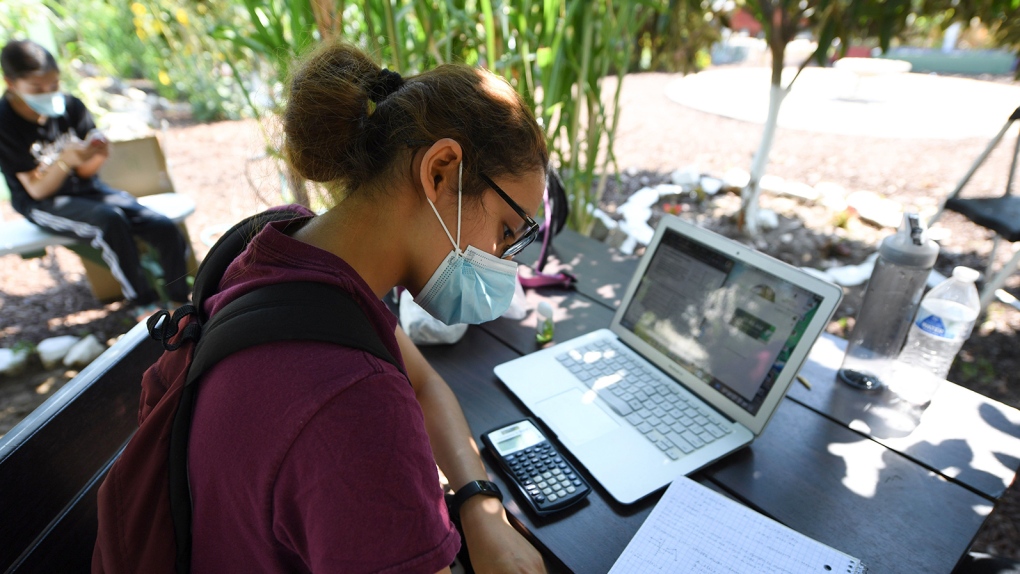
East College Prep High School senior Jocelyn Hernandez follows a remote Advanced Placement (AP) Calculus class while sitting in a community garden near her home, August 14, 2020 in the Boyle Heights neighborhood of Los Angeles, Calif. (Robyn Beck/AFP/Getty Images)

Since the global pandemic struck the United States in early spring, numbers and rates of  coronavirus cases have risen markedly in children. It had been generally accepted viewing the results of infections that children were spared the worst symptoms that COVID-19 could raise, and they were being infected at substantially lower numbers than older people of all age ranges in the general population. That initial impression has since undergone a profound adjustment.

As a new school year approaches, after the precipitate shutdown of schools with the first wave of COVID, a growing awareness of the risk that young people and their families face is striking alarm. Emergency use authorization was granted for a saliva-based coronavirus test by the Food and Drug Administration. The test, developed by Yale University researchers, is recognized as a route to reducing turnaround commercial laboratory times.

Over one thousand coronavirus-related deaths are being reported daily in the United States, with health officials reporting 1,220 new deaths and 57,120 new infections on Saturday alone. The rosy confidence relating to children's low infection rate and non-threatening symptoms related to COVID that originally reassured the medical community and parents, is now recognized as a factor linked to the first-wave action of school closings.

CDC warns US coronavirus death toll may reach 200K in weeks

That, and other public health measures such as social distancing certainly may have contributed to the low rates seen early on of coronavirus infection during the early days of the pandemic. Now, it is known that children between ages five and 17 test positive for the coronavirus at higher rates than any other age group, in accordance with CDC data; positive rates seen to be exceeding ten percent in public and private lab tests.

Children are recognized to experience a similar virus incubation period as do adults but are less likely by far to develop severe symptoms. On the other hand, roughly a third of children who are hospitalized for virus complications are placed in intensive care units at the same rate as are adults. With the anticipated start of the new academic year, concern turns toward new challenges that will most certainly arise.

Over 100 students and staff tested positive for the coronavirus in recent days and hundreds more were sent into quarantine in Mississippi, where return to school for in-person learning has been initiated. Cases have been reported in close to fifty percent of the schools in the state. The highest daily reported deaths in the country emanate from Mississippi, tracking by The Washington Post reveals.

How to recognize Covid-19 symptoms in children, based on pediatricians' advice

Elsewhere, virus concerns have forced officials to cancel classes or reverse plans to introduce students to reopened schools where the academic year is set to begin. On Saturday, a school district in Nebraska held back opening for a week because three staff members had tested positive. Classes have been cancelled as well in schools in Georgia and Tennessee.

In Canada, provinces are attempting variants on both in-class and remote teaching, with parents asked to inform their school boards in advance which option they prefer for their children. This, at a time when parents are bedevilled by the choices; personal attendance three days a week, remote the other two days. And of course it isn't only parents uncertain whether or not to return their children to classrooms which even under new rules will keep students in one classroom for all subjects and will mandate no more than 15 students to a class, but teachers also, concerned over an elevated risk of infection.

Labels: , , ,

Wednesday, May 06, 2020

COVID Vulnerabilities

"[Grocery store anxiety] is common across a lot of different people. Realizing that the anxiety is normal, to some degree, can help lower the intensity of it. You can remind yourself 'This is an unprecedented situation. It is normal to feel anxious in these situations. I'm not losing my mind. I'm going to be able to cope.' Normalizing that anxiety is an important thing."
"It's really hard to do other things while you're at the grocery store, but breathing [deep breathing to counteract intense feelings of fear] is one that can calm you down fairly quickly."
"If you feel more comfortable having a mask on, having gloves on, then do that. Equip yourself with what you need. And if you're in there and you feel dizzy, or you feel that you can't continue on, then just pay for  what you have and get out. And figure out another plan for next time."
"If you go to the grocery store and you're sweating, you can't sleep, you can't eat, and you're freezing upon walking in, then you know that it's impacting you. So look at how else you can do that. Can you do it online? Can you get someone else to do it? It's so important for people to know what their own realities are."
"It's all about knowing yourself, and really knowing what your limits are. And that's hard for people. We're in a different time, so it takes a little bit of different thinking and different creativity. Reach out. People always worry about the impact it's going to have on other people. But just by reaching out you can save yourself a lot of hurt and increased anxiety."
Suze Berkhout, assistant professor, psychiatry, University of Toronto
Grocery shopping
“If you feel more comfortable having a mask on, having gloves on, then do that. Equip yourself with what you need,” says Mercer. Getty Images

News of supply chain interruptions in the vital, integrated plan of moving food products and produce to market, and news of meat processing facilities having to shut down because of the number of their employees contracting COVID-19, of the agricultural industry facing problems being able to employ enough field workers to ensure they can seed crops and then harvest them, news of shortages of certain products, of export countries shutting their products from export to ensure adequate supplies are available to their own populations, all prey on people's minds during this strange and frightening time of SARS-CoV-2.

It can be difficult for most people to remain relaxed over the prospect of rationing food, of austerity measures undertaken in the face of food shortages. What could conceivably be more primary to human existence than the availability of food? Most people have experienced what it feels like to walk into a supermarket and see rows of empty shelves and it was not a pleasant sight, nor was that sinking feeling felt when viewing those empty shelves in knowing that you wouldn't be bringing home essential food that shopping expedition.

Concerns grow and become focal points for the mind to fasten itself, magnifying a problem that may or may not exist. Even while food producers and governments speaking on their behalf try to assure a worried public that there will be no food shortage, once the supply management and transportation sectors catch up with public hoarding responsible for those empty shelves. For some people the concerns are manageable. For others, even well-balanced people, the concerns only accelerate the more they read in the news media of one issue or another cropping up to complicate the new reality of a world settling in and trying to find balance in the face of a global pandemic.

Then there are those in the general population already suffering various stages of mental illness being exacerbated by worry over their ability to secure enough food to sustain life. A new survey conducted by Dalhousie University and Angus Reid, saw 64 percent of respondents saying they are buying more groceries than usual to avoid shopping as frequently as they have been accustomed to. Changing shopping habits from weekly to bi-weekly. Gauging how much food will be needed to take one over a two week period without running perilously short, in the interests of less exposure to the coronavirus.

For people already suffering the angst of insecurity, loneliness and depression, having to self-isolate leads to deeper feelings of loneliness that morph into depression. Depression raises existential fears. And the food shopping experience looms large as the battle to secure enough food while avoiding the potential of COVID infection, creating a burden of desperate fear. Fear of entering a store only to see empty shelves, crowded aisles where it's difficult to avoid contact, amid the caution required to avoid as much as possible, touching surfaces that may host the virus.

Hearts begin to race, and jaws clench. "If you're a senior or someone with an immune-compromised system, going to the grocery store is kind of like going into a war zone", observed Sue Mercer, a researcher and expert for the Mental Health Commission of Canada. People old enough or originally from other countries who immigrated to Canada with the background experience of food insecurity, or those living with conditions of disordered eating, react instinctively on the sight of empty grocery shelves. Those with limited incomes see stress from yet another perspective.

According to Suze Berkhout, a clinician-investigator at the University Health Network in Toronto, managing anxiety is paramount to managing life itself. To recognize anxiety when it occurs is critical; thoughts of fear, frustration, irritability, anger, overgeneralizing, imagining worst-case scenarios, emotional reasoning along with physical warnings such as increased heart rate, shallow and fast breathing, chest tension and weak muscles while feeling disconnected to your surroundings, are all common symptoms.

Grocery shopping
“You might be a bit nervous before you go to the grocery store,” Getty Images

That kind of reactivity needs to be dealt with to alleviate anxiety. When feelings of panic, stress or anxiety occur there are grounding techniques that can be used to halt the spiral of concerning thoughts and sensations. "They help you connect back into, 'OK. What is actually going on around me here, and how do I need to respond to it?" Inhaling over a four count, holding for a four count, exhaling and holding at the same pace, and repeating, a simple but effective grounding technique.

Imagine your brow furrowed and relax it, unclench your jaw or shoulders. "Then you can try to work with things like those worried thoughts to say, 'Is this realistic? Does this make sense?' Working with the thoughts comes once you've got more of that physical and emotional side of things a little bit more calm."
Grocery shopping
Grounding techniques “help you connect back into, ‘OK. What is actually going on around me here, and how do I need to respond to it?’” says Berkhout. Getty Images

Labels: , , ,

 
()() Follow @rheytah Tweet