Ruminations

Blog dedicated primarily to randomly selected news items; comments reflecting personal perceptions

Saturday, August 22, 2020

Risking Student Infection in Return to School
mask 2
Stock Image

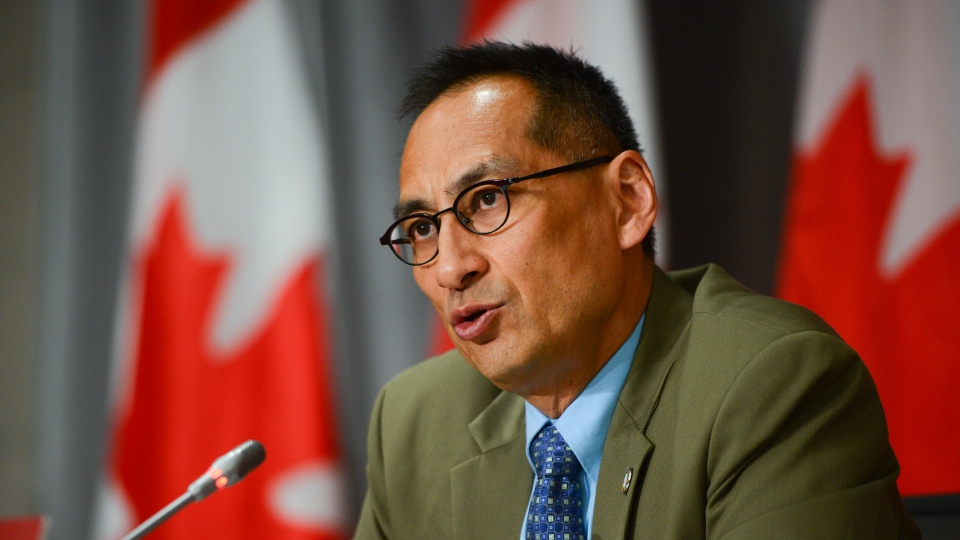
"As you double the class size, from eight to 15 to 30, the number of cases and also the lost student days of instruction not only double each time, they triple or quadruple or quintuple. Those losses accelerate as you go to larger and larger classes."        "[Policy makers planning for elementary school class sizes of 30 kids or more] need to immediately reconfigure their school opening plans [to switch to hybrid models of part in-person, part online]."                                                                                  "Student days are like passenger miles -- it's the number of students affected, times number of days lost. When you put mores students in a classroom there is a higher chance one of them will test positive at some point for COVID, and so you've got to close that classroom. By the time you've identified that COVID case there might be other cases in the classroom already.You get aerosol transmission and you generate more cases by the time the classroom gets closed."                    "Many people may infect only one person, or even no one, but in some cases you have a so-called super-spreader who infects a huge number of people."                   Chris Bauch, mathematician, professor of mathematics, Waterloo University

"School is going to accelerate spread of the virus if it's already in the community. This is the same thing that happened when we reopened stores and restaurants. [School reopening] is not going to create more virus, but it's going to make it easier for the virus to spread."                                                                                          "It's very possible you could see cases."                                                        Dr.Chris Labos, cardiologist, epidemiologist, Montreal
jfj50173952-4

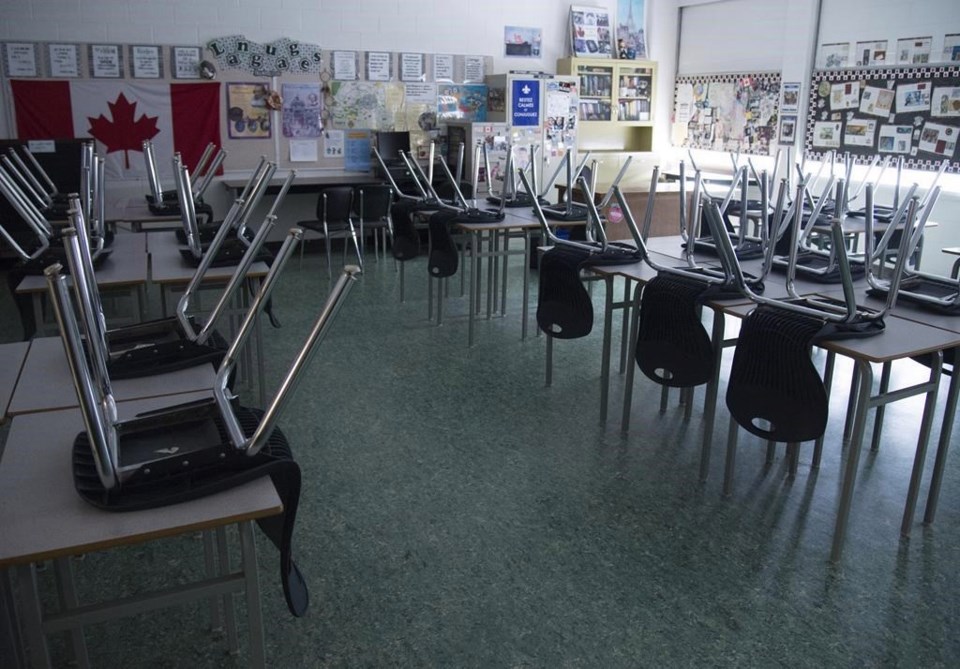
A new study undertaken by mathematics professor Dr.Chris Bauch and collaborators to determine the ideal class size in preventing COVID outbreaks affirmed through modelling that the very size classes many provinces are contemplating for their September school reopenings will predict the numbers of infections of COVID-19 certain to break out in each community. The infection numbers will be analogous to the size of classes in primary school classrooms as well as before-and-after school daycare programs.

Universally, teachers in British Columbia, Alberta, Quebec and Ontario are all making demands to their governments to mandate smaller class sizes in fear of just such scenarios unfolding with the reopening of the new school year. Students attending kindergarten to Grade 8 are set in Ontario to return to school with no reduction planned in class sizes. They are scheduled to spend the school day in a single group, limiting contact with other children in their school 'bubble'. Masks are required in grades 4 to12 only.

As a test instance, experts view what has happened in Israel as high schools reopened in May, when weeks afterward, major COVID-19 cases began spiking. In Berlin, hundreds of students and teachers from dozens of schools were infected with the coronavirus; now are in quarantine, two weeks following their school reopenings. 

Researchers who designed the new modelling study looked at the effect of different student-to-teacher ratios in a primary school class, along with school-based daycare to obtain an understanding of transmission of the SARS-CoV-2 virus causing COVID-19.  Despite masking, social distancing and hand washing, the model predicted an average of 53 infections in a school community of 150 students, parents and teachers in classes of 30 students.

Classes of 15, on the other hand, saw viral outbreaks of 12 infections, where students attend alternative weeks in groups of 15 students each class. For the 30-students-to-one-teacher ratio, outbreaks occurred over 40 to 60 days on average resulting in the number of student-days lost as a result of classroom closures ranging from 75 for the smallest ratio to 1,000 for the largest. 

The larger the class the greater number of students affected; the more students to a classroom the more difficult social distancing becomes to achieve.

According to the modelling, the teacher occasionally would be the first to become infected, though more generally it would be a student "because there are more of them. They bring it in somehow and we model what happens -- where they spread it in their household and where they spread it in school." It remains unclear as yet how efficient children are in spreading the virus causing COVID-19. 

As for childcare, the 15 children to two teachers ratio appeared the worst across all possible scenarios. Childcare optimally would be operating on a seven or eight children per room model, according to Dr.Bauch's mathematical reasoning, which would see siblings grouped together in daycare. 

Labels: , , , , , ,

Sunday, July 19, 2020

Pushing The Envelope on COVID-19

"This [daily rise in COVID-19 cases nationally] coincides with increasing reports of individuals contracting COVID-19 at parties, nightclubs and bars as well as increasing rates of transmission among young Canadians in some jurisdictions across the country."
"We are all in this together, and have a shared responsibility to help keep COVID-19 transmission low."
"I encourage everyone, especially young adults, to find creative ways to stay socially active in the time of COVID-19. Singing, mingling and dancing in close contact with others in closed spaces, in crowded places, is not the way to party this summer."
"It is concerning that we're seeing the data show us that a greater proportion of our cases are now among what we call young adults, those less than 40."
"I can remember that when I was  younger I thought I was invincible -- you can do anything, don't worry about it, it'll be OK."
"Having said that, we have seen some anecdotes of young people having severe outcomes so you can't consider that everyone is immune from having serious consequences."
Canada's Deputy Chief Public Health Officer Dr.Howard Njoo
Hundreds line up at a COVID-19 testing clinic July 14 in Montreal, after the city recommended that anyone who had been at a bar since July 1 get tested. Bars and restaurants are at varying stages of reopening across the country, bringing the risk of new outbreaks. (Ryan Remiorz/The Canadian Press)

Images of bars in Montreal crammed to the rafters with people relaxing and looking to socialize after a long and wearying lockdown, has been coinciding with a spike in new cases. Bars and nightclubs have fallen under suspicion as a result, as mingling in close quarters is known to facilitate the spread of the SARS-CoV-2 virus. Leading Dr.Njoo to urge people in youth-age categories to think hard about jamming bars and dance floors and nightclubs, stating there is "cause for some concern", since, following a steady decline in cases, new ones are rising.

Alcohol
Photo by Isabella Mendes from Pexels

Over the last week, he cited as the catalyst for his concern, 350 cases daily on the national level have occurred in comparison to the average daily case count in early July of around 300. Over 430 new cases were reported on Thursday alone, he said. Indoor activities raise the risk of spreading COVID and ultimately serious health consequences can arise among the greater population, even including the youth demographic.

In response to Dr.Njoo's concerned message of caution, Quebec's premier, Francois Legault announced his opinion that the recent resurgence of COVID-19 cases relates to private gatherings, not bar visits. He had stated only the day before contemplating whether to close bars and nightclubss in the province in the wake of a number of Montreal area outbreaks seemingly linked to such venues. He had sought advice whether recommending the closure of bars, or accepting the reality of their opening, a reflection of what people appear to approve of.

A patron enjoys a glass of wine at the bar of Lemeac restaurant on the first day after restrictions were lifted on restaurants in Montreal, on June 22. (Christinne Muschi/Reuters)

Dr.Njoo spoke of his concerns over COVID-19 being spread to older people; in particular parents and grandparents of the younger demographic that circulate through bars and nightclubs. Emphasizing in his message to them that theirs is a responsibility to act rationally in everyone's best interests, beyond the entertainment value of the bars and nightclubs that exert such an attraction, reflecting short-term desires, ignoring long-term outcomes.

Ontario, the province with the second-largest COVID cases in Canada after Quebec, announced that from the past Friday restaurants outside the Greater Toronto Area will be permitted to resume indoor service. Businesses like bars, gyms and theatres will begin to welcome their traditional patrons as well. Dr.Njoo stressed that even while young people see the most severe health consequences bypass them, there have been incidents wherein people under age 40 have been badly impacted.

Dr. Njoo
Dr. Howard Njoo, Deputy Chief Public Health Officer. The Canadian Press/Sean Kilpatrick

Apparently fit celebrities, he stated, have not been immune to serious consequences. His oblique but meaningful comment did not identify the fate of Canadian actor Nick Cordero, who died earlier in the month at age 43, having experienced an agonizing three-month battle in hospital when a range of health issues originating from COVID-19 exposure made him vulnerable enough to necessitate having his right leg amputated. The trajectory of the disease did not stop there; for Mr. Cordero, it took his life.

Montreal's downtown continues to get back to normal. Le Pois Penche employee Mamoun Ghanmeh prepares the restaurant on Thursday July 16, 2020 for another business day in the COVID environment. Dave Sidaway / Montreal Gazette ORG XMIT: 64738

Labels: , , , , , ,

 
()() Follow @rheytah Tweet