Ruminations

Blog dedicated primarily to randomly selected news items; comments reflecting personal perceptions

Sunday, January 18, 2026

Controlling The Arctic

"In fact, I think it would be fair to say that Denmark's claim to sovereignty over Greenland is far stronger than Canada's claim to sovereignty up to the North Pole for the entire archipelago."
"Whether it's enough [$1B in funding over 4 yrs to improve military transportation infrastructure in the Arctic and a partnership with Australia to develop Arctic Over-the-Horizon Radar] to offset American desire to own territory in the north? I don't know." 
Former chief of the Defence Staff Gen. Tom Lawson
 
"If they were to acquire Greenland, it would be the first step in eventually acquiring control over all of northern North America."
"It's such a bizarre distortion of the Monroe Doctrine, which was about not allowing non-North American powers to assert and control North America."
"It's telling that the Trump White House has not come back with any specific asks. And that, to me, points to the fact that this is smoke and mirrors and this is about America wanting to grow."
Whitney Lackenbauer, research chair, study of Canadian North, Trent University
 
"The first part that we've always been concerned with is that the Americans would say we're not pulling our weight, and they would go to systems that don't need Canadian territory."
"In other words, cut us out, so that NORAD either becomes hollow or doesn't even become functioning."
Robert Huebert, director, Centre for Military, Security and Strategic studies, University of Calgary 
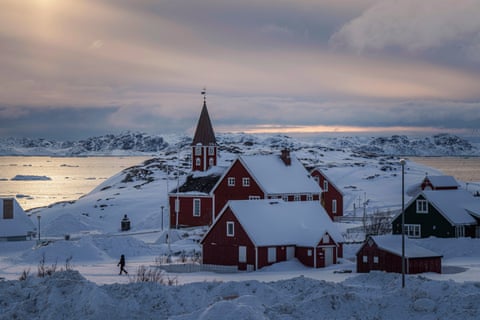
https://ichef.bbci.co.uk/news/1024/cpsprodpb/14b8/live/13b0e3b0-ea48-11f0-a422-4ba8a094a8fa.jpg.webp
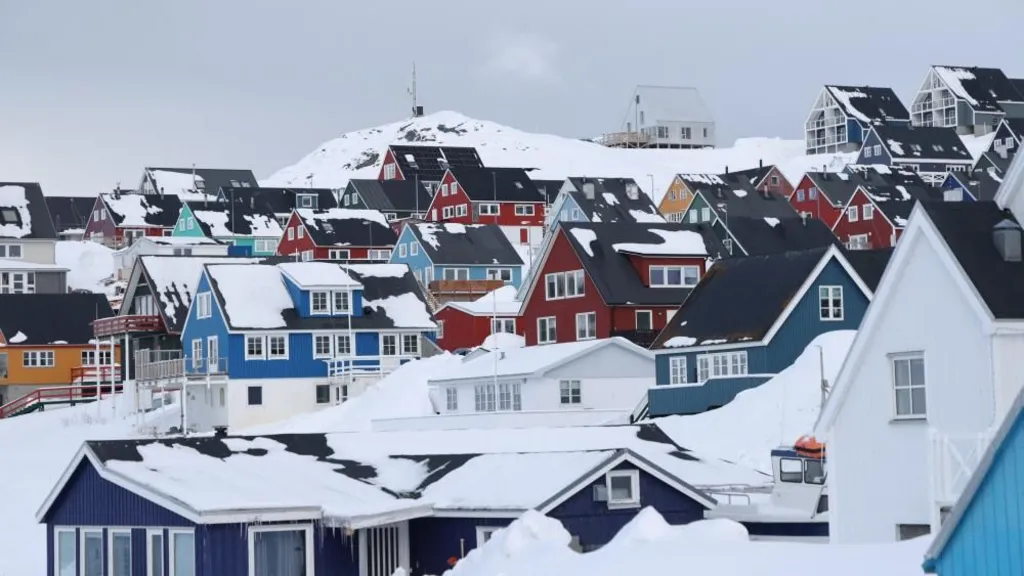
A new settlement was established near the present-day capital, Nuuk, after Danish colonization in the 18th Century. Reuters
 
A precedent is on the verge of being set, with U.S. President Donald Trump rumbling about taking Greenland from Denmark, and in the consternation over his belligerent assertions that the U.S. will, one way or another achieve that goal, in the process alienating his European allies and risking the dissolution of NATO, while other nations will likely begin to feel the pressure of the president's territorial acquisition aggression.
 
Mette Frederiksen in Paris last week during a bilateral meeting, met the not-unexpected support of Canada's prime minister with Mark Carney stating the position that the future of Greenland should be a matter between Denmark and Greenland with the exclusion of any others. Recent investments by the Carney government under pressure by Trump to meet NATO's minimum GDP investment in military preparedness doesn't equate to Canada being let off the hook of Trump's gimlet eye.
 
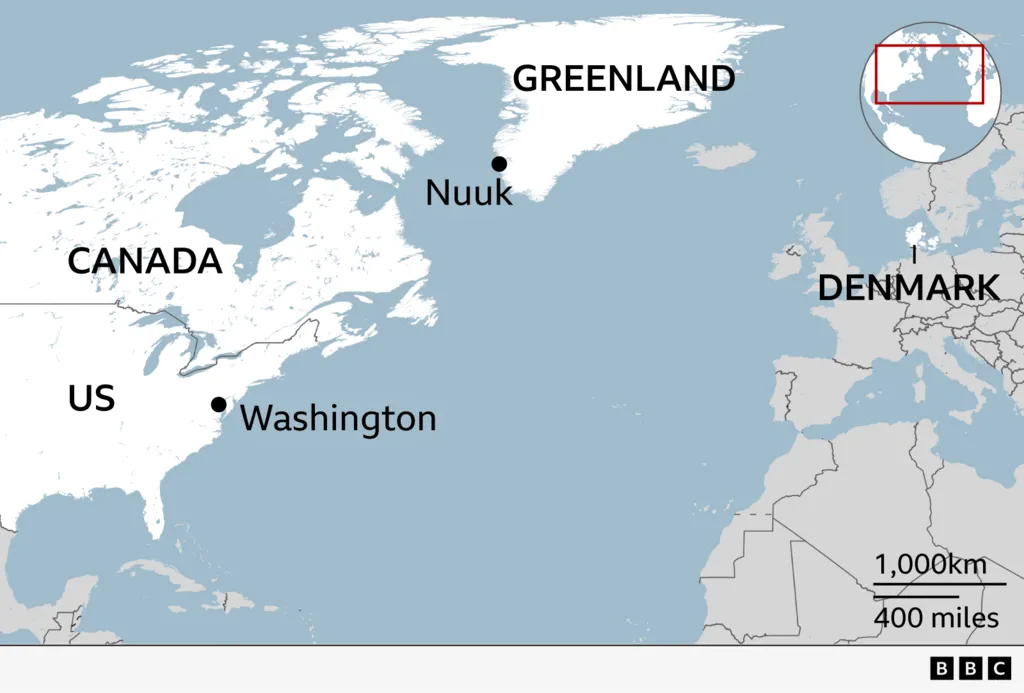
The initial investment in developing next-generation military satellite communications for Arctic operations may not insulate Canada to the extent it hopes for, from President Trump's continued gibes about Canada's irrelevance. Canada -- like Greenland, an autonomous territory under the Kingdom of Denmark's protection is also a member of the North Atlantic Treaty Organization, as an island of strategic importance in the Atlantic Ocean -- faces similar challenges from Mr. Trump..
 
https://ichef.bbci.co.uk/news/1024/cpsprodpb/f7dd/live/2f1bccb0-ebbe-11f0-b385-5f48925de19a.png.webp 
"One way or another, we will have Greenland", President Trump stated yet again, accelerating his threats in recent weeks to take over the largest island in the world. Ostensibly to prevent Russia and China from attempting to do the same, he cautions. Under the rationale of the imperative to ensure American security interests in the Western Hemisphere a repurposing of the Monroe Doctrine has been cited as the security instrument motivating and legitimizing a Greenland takeover.
 
That Denmark's Frederiksen vehemently opposes the proposed encroachment by the U.S., spurning its sovereignty in Greenland, and that Greenlanders themselves have no wish to become a U.S. protectorate is of no moment to Mr. Trump. The U.S. has an established military presence in Greenland through a 1951 agreement with Denmark, in the presence of a  remote airbase. Speculation over the manner in which the U.S. might assert its claims on the North abound.
 
The U.S. military raid in Venezuela that resulted in the scooping up of the country's President Nicolas Maduro and his wife and taking them to the U.S. to stand trial for narcotics trafficking appears to have put the U.S. President in the mood to flex his military muscles and exert pressure on both enemies and allies alike.  While Cuba and Colombia are in his crosshairs, so too are Denmark/Greenland and Canada, Trump's fanciful '51st State'. 
 
Trump is reportedly taking aim at Canada and expressing concern about its 'vulnerability' to adversaries after his previous threats to make the country the ‘51st state’
Trump is reportedly taking aim at Canada and expressing concern about its 'vulnerability' to adversaries after his previous threats to make the country the ‘51st state’   Getty Images 
 
"I think the EU and Canada, all of us are tiptoeing around Trump because we know he is very volatile." 
"We are all economically very dependent on the U.S. and militarily dependent on the U.S."
"[A potential rupture in NATO and Trump's] Donroe Doctrine [runs the risk of creating] strong men [spheres of influence across the world]."
"This then gives the nod to Russia to continue to control its sphere of influence and perhaps continue to try and annex Ukraine. And China is going to take this as a licence to be able to dominate its area of the world."
"We've seen in history when you have this multipolarity and these multiple spheres of influence, there's the greatest likelihood of conflict because of this increased great power competition."
"And then accidents and incidents are more likely to be interpreted as nefarious, and everybody comes out swinging."
Andrea Charron, director, Centre for Defence and Security Studies, University of Manitoba

Labels: , , , , , ,

Friday, January 09, 2026

Acquiring Greenland: Coercion or Military Action

"RUSSIA AND CHINA HAVE ZERO FEAR OF NATO WITHOUT THE UNITED STATES, AND I DOUBT NATO WOULD BE THERE FOR US IF WE REALLY NEEDED THEM."
"We will always be there for NATO, even if they won't be there for us."
"We are going to do something on Greenland whether they like it or not. Because if we don’t do it, Russia or China will take over Greenland, and we’re not going to have Russia or China as a neighbor."
"I would like to make a deal the easy way, but if we don’t do it the easy way we’re going to do it the hard way."
"You defend ownership. You don’t defend leases. And we’ll have to defend Greenland. If we don’t do it, China or Russia will. Not going to happen."
"I think that ownership gives you a thing that you can’t do with, you’re talking about a lease or a treaty. Ownership gives you things and elements that you can’t get from just signing a document [expanding its leased military base in Greenland]." 
"We need Greenland from the standpoint of national security, and Denmark isn't going to be able to do it. It's so strategic."
U.S. President Donald Trump
 
"If the United States chooses to attack another NATO country militarily, then everything stops."
"That is, including our NATO and thus the security that has been provided since the end of the Second World War."
Danish Prime Minister Mette Frederiksen
 
"The president and his team are discussing a range of options to pursue this important foreign policy goal, and of course,  utilizing the U.S. military is always an option at the commander-in-chief's disposal."
"[The president and his national security aides are] looking at what a potential purchase would look like."  
White House Press Secretary Karoline Leavitt 
Nuuk, capital of Greenland
The Aurora Borealis (Northern Lights) is seen behind a building with social housings with a mural in Nuuk, Greenland. REUTERS/Hannibal Hanschke/
 
Clearly, Danish Prime Minister Frederiksen's statement that the U.S. in agitating to take over Denmark's Greenland territory would result in the dissolution of the military alliance of NATO did not sit well with President Trump. There are dim echoes of his persistent declarations of security demanding U.S. total possession of the island -- not that its abundance of rich resources in rare earth minerals doesn't come far behind in a race with China over the wherewithal to produce electronics -- with the Third Reich's 1938 insistence that security and protection of German Sudetenlanders made it imperative to force its surrender from Czechoslovakia. When Europe, represented by Britain and France, boasted that by persuading Czechoslovakia to voluntarily hand it to Germany 'war was avoided'.
 
Fast forward to the present, and Europe is once again faced with a similar conundrum; avoiding military conflict to preserve the military alliance of NATO. And although a Europe, nervous in the wake of the U.S. night-time bombing of Venezuela and the scooping up of Maduro and wife, signalling that the U.S. is on a roll, France, Germany, Italy, Poland, Spain, Britain and Denmark responded to the tense situation in support of Greenland and Denmark alone deciding the trajectory of their joint relations.
 
Now, discreet White House sources whisper of internal discussions with respect to the potential of 'buying' Greenland through lump sum payments, where guidelines revolving around $100,000-per-person payments which would cumulatively result in a total payout close to $6 billion may be a solution but one still in essence 'forced' on an obviously reluctant Denmark and Greenland. Greenlanders in particular are far more invested in their total independence, yet would still prefer a linkage with Denmark over the United States.
 
houses on the water
A woman walks near a church in Nuuk, the capital of Greenland. Photograph: Evgeniy Maloletka/AP
 
Although the White House has not totally discounted the possibility of 'military intervention', there are those who have declared a definite preference for paying for the island outright, if not acquiring it through diplomatic negotiations. Only one of which choices would force NATO to make good on its mutual-defence mechanism, Article 5. Its lone invocation and action took place after the shock waves of 11 September 2001. On such an occasion where a member of NATO -- its most powerful and influential member -- itself would take hostile military action against another member, the very thought of a unified reaction is out of the question, altogether neutering the group.
 
The always-mercurial Donald Trump remains aggrieved with another NATO founding member whose Nobel Committee deigned to overlook the American president's qualifications to be chosen as 2025's outstanding nominee for the Peace Prize; a "foolish" decision, he said scornfully. When Nicolas Maduro was captured by military force, Europe nervously eyed the potential for Mr. Trump's next acquisitive eye in his increasingly unrestrained willingness to deploy the U.S. military to achieve  his ends.
 
The joint warning issued by European leaders reminding the American president that the territorial integrity of Greenland and Denmark must be respected would no doubt have fallen on Mr. Trump's notice as a particularly grievous irritant. More so, the nudge to his consciousness that as part of the Kingdom of Denmark, Greenland falls under NATO's defence umbrella, with NATO allies collectively prepared to achieve Arctic security. 
 
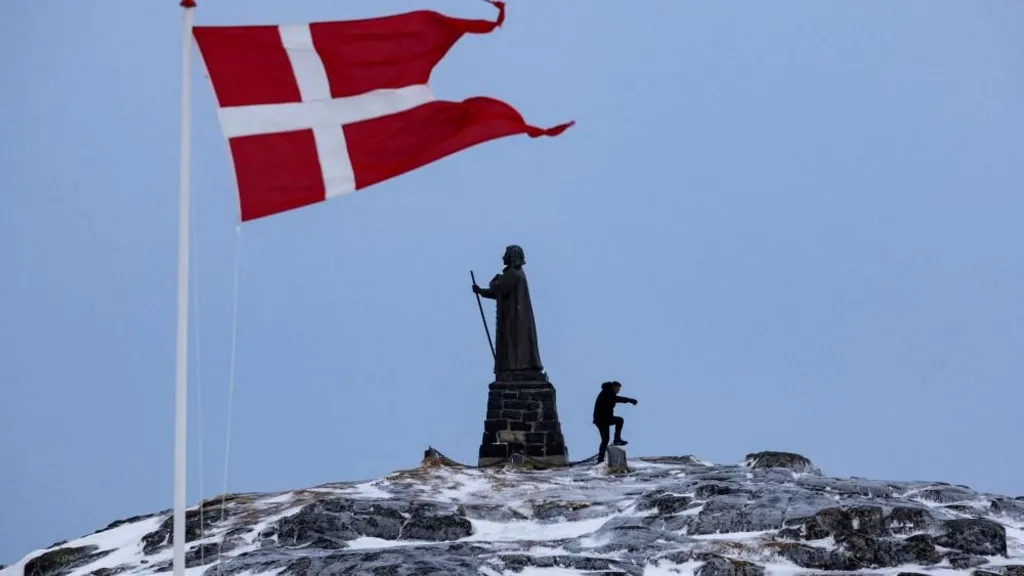
https://ichef.bbci.co.uk/news/1024/cpsprodpb/be27/live/96225880-eda7-11f0-a422-4ba8a094a8fa.jpg.webp
Greenland and Denmark have rejected Trump's offer to buy the semi-autonomous territory   Reuters


Labels: , , , , ,

Thursday, December 08, 2022

Creation ... Extinction

Abstract ... Late Pliocene and Early Pleistocene epochs 3.6 to 0.8 million years ago1 had climates resembling those forecasted under future warming2. Palaeoclimatic records show strong polar amplification with mean annual temperatures of 11–19 °C above contemporary values3,4. The biological communities 
inhabiting the Arctic during this time remain poorly known because fossils are rare5. Here we report an ancient environmental DNA6 (eDNA) record describing the rich plant and animal assemblages of the Kap København Formation in North Greenland, dated to around two million years ago. The record shows an open boreal forest ecosystem with mixed vegetation of poplar, birch and thuja trees, as well as a variety of Arctic and boreal shrubs and herbs, many of which had not previously been detected at the site from macrofossil and pollen records. The DNA record confirms the presence of hare and mitochondrial DNA from animals including mastodons, reindeer, rodents and geese, all ancestral to their present-day and late Pleistocene relatives. The presence of marine species including horseshoe crab and green algae support a warmer climate than today. The reconstructed ecosystem has no modern analogue. The survival of such ancient eDNA probably relates to its binding to mineral surfaces. Our findings open new areas of genetic research, demonstrating that it is possible to track the ecology and evolution of biological communities from two million years ago using ancient eDNA.
A 2-million-year-old ecosystem in Greenland uncovered by environmental DNA  Kurt H. Kjaer, Nature
"The study opens the door into a past that has basically been lost."
"[The samples came from a sediment deposit called the Kap København formation in Peary Land. Today, the area is a polar desert.]"
Kurt Kjaer, geologist, glacier expert, University of Copenhagen

"I wouldn't have, in a million years, expected to find mastodons in northern Greenland."
"I wouldn't be surprised if you can go at least one or perhaps a few million years further back, assuming you can find the right samples."
Love Dalen, researcher in evolutionary genomics, Stockholm University

"You really get a broader picture of the ecosystem at a particular time."
"You don't have to go and find this piece of wood to study this plant, and this bone to study this mammoth."
Benjamin Vernot, ancient DNA researcher, Max Planck Institute for Evolutionary Anthropology, Germany
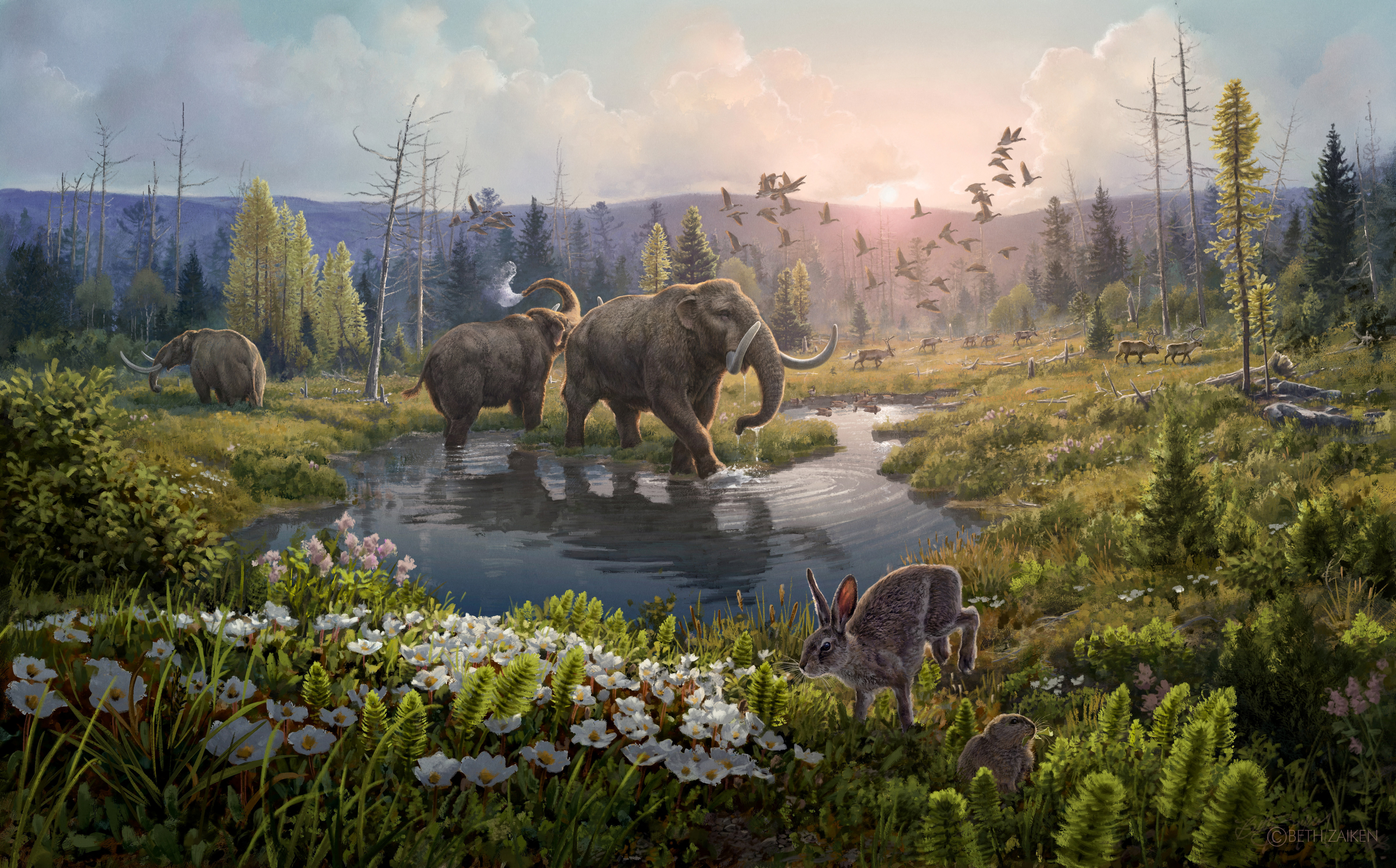
An undated artist’s reconstruction of the Kap Kobenhavn formation in northernmost Greenland
An artist's reconstruction shows the Kap Kobenhavn formation in northernmost Greenland two million years ago, at a time when temperatures were significantly higher than northernmost Greenland today, in this undated handout image obtained by Reuters on December 6, 2022. Beth Zaiken/Handout via REUTERS

A team of scientists have discovered the oldest known DNA, using it to interpret what life had been present two million years earlier on the northern tip of Greenland, a barren Arctic desert, which at the time they have revealed, at an ancient period of Earth's evolution, was a green landscape of trees and vegetation. A wide array of animals were present at that time, the now-extinct mastodon among them.

The researchers took to extracting environmental DNA -- eDNA -- in a barren landscape where remnants of animals and vegetation that once flourished in a far different atmosphere millions of years ago left next-to-nothing for posterity in the form of bone shards or a rare piece of woody material. It was from samples of soil that the eDNA emerged for study; genetic material shed by living organisms into their surroundings, from hair, waste, spit or carcasses in decomposition.
 
Genetic material breaks down gradually over lengthy periods of time and what is left for scientists to examine and extract information from represents fragments of a whole. Advanced technology has allowed researchers to obtain genetic information from small bits of DNA, explained senior paper author Eske Willerslev, a geneticist at the University of Cambridge. 
 
Published in the journal Nature, the study compared the DNA to that of various species. In the search for matches, the samples emerging from a sediment deposit identified as the Kap Kebenhavn formation in Peary Land.
 
Millions of years previously the region now a polar desert, was in a period of intense climate change. It was likely that sediment accumulated for tens of thousands of years at the site until the climate cooled and froze into the permafrost the DNA-infused soil the investigators studied. Delicate bits of DNA would have been preserved by the incoming environment awaiting discovery by present-day scientists who began drilling samples in 2006.
 
At the time of the warm period when average temperatures were 11 to 19 degrees Celsius higher than what pertains at the present, the area was home to an unusual array of plant and animal life. The studied DNA fragments speak of an array of Arctic vegetation such as birch trees and willow shrubs including genotypes usually preferring warmer climates such as firs and cedars. 
 
Traces of animals, including geese, hares, reindeer and lemmings were also detected in the studied DNA samples. The unexpected discovery of DNA from a mastodon, an extinct species that resembles an elephant or a mammoth stood out as hugely unusual. Researchers were in addition given clues surrounding marine life from the sediment in the mouth of a fjord -- with DNA pointing to horseshow crabs and green algae in the area, indicating much warmer seas in that long-ago era.
 
Dr. Willerslev is of the opinion that since these newly-detected plants and animals managed to survive during a time of climatic change, their DNA could present a "genetic road map" to assist environmental science in learning how best to adapt to the warming climate scenario that scientists have alerted the world to, at the present time.

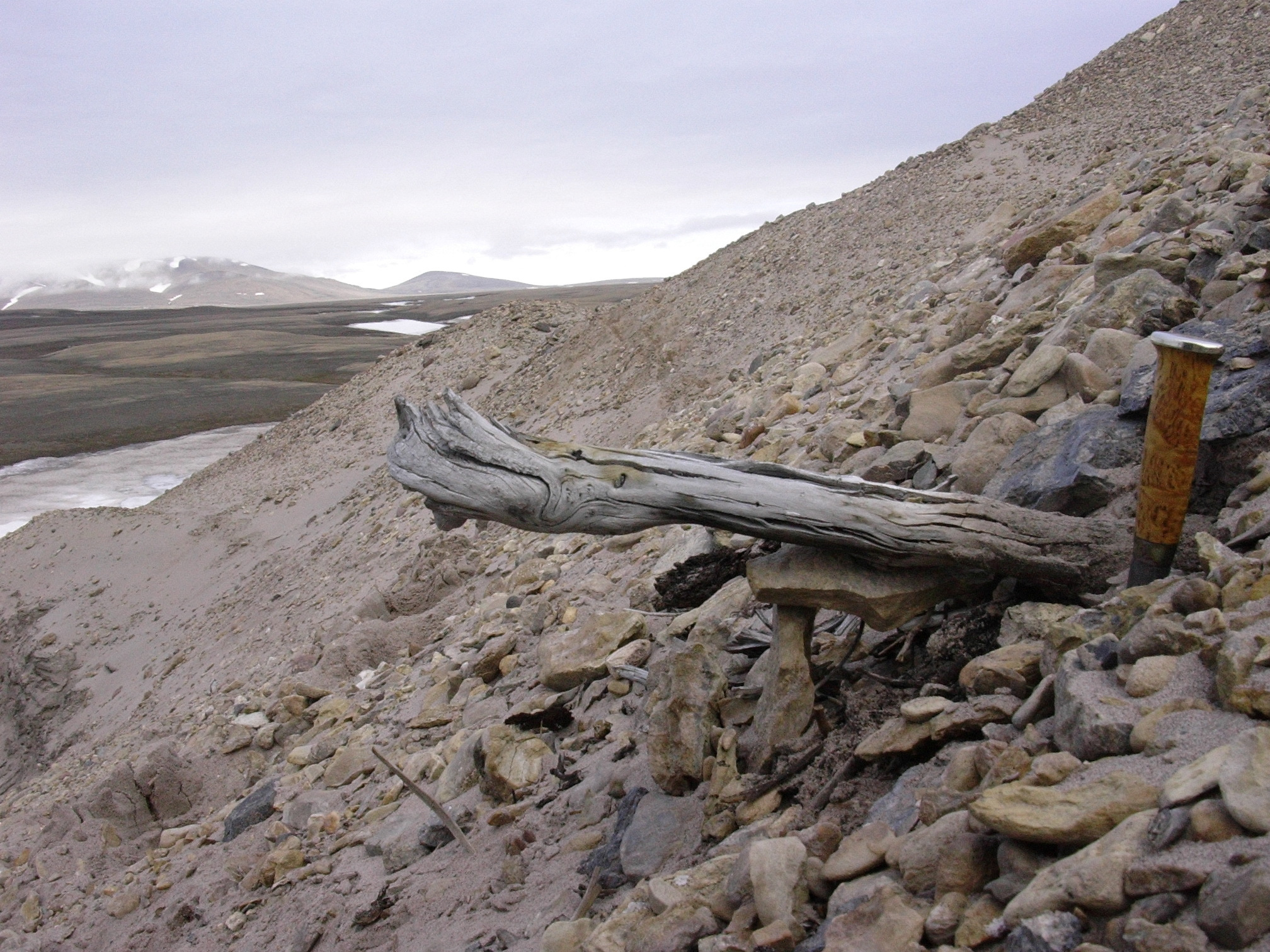
A two million-year-old trunk from a larch tree in northernmost Greenland
A two million-year-old trunk from a larch tree, still stuck in the permafrost within coastal deposits at the northern tip of Greenland, is seen in this undated handout photograph obtained by Reuters on December 6, 2022. The tree was carried to the sea by the rivers that eroded the former forested landscape. Svend Funder/Handout via REUTERS


Labels: , , , ,

Saturday, October 04, 2014

Hard Choices : Consequences

"You're never going to eliminate people getting their hands on liquor."
"The ingenuity that is practised to get liquor into dry communities is amazing; everything from taking a snowmobile for 100 miles, to making your own."
"People were drinking 26 ounces in 20 minutes, and then they were becoming violently drunk."
"All hell would break loose ... the nursing station, the social workers, the children, the schools and the police all go through hell for the time that the liquor is raging through the community."
RCMP Superintendent Howard Eaton

"You don't think as much about it as you did when there was restrictions. When it's prohibited, it's exciting -- you have to do it."
Bodil Paulson, alcohol-prevention worker, Greenland health department

"There's going to be more people bootlegging because they don't have to order liquor from Winnipeg, say, or Ottawa."
Nunavut MLA Tagak Curley

Canada's newest Territory Nunavut, is plagued by crimes related to alcohol consumption, even while liquor is completely banned in seven of Nunavut's twenty-five communities. While it is "restricted" in another fourteen communities a local committee scrutinizes alcohol orders for approval, but elsewhere drinks can be procured at the territory's scant few licensed restaurants or by ordering alcohol in by air delivery.
A dog howls from the hillside overlooking Iqaluit. (Peter Power/Peter Power/THE GLOBE AND MAIL)
A dog howls from the hillside overlooking Iqaluit.
(Peter Power/Peter Power/THE GLOBE AND MAIL)

In Iqaluit, drinkers can call in an order from a warehouse located in Rankin Inlet, about 1,200 kilometres distant after paying for a permit, a deposit and handling fees. If the buyer is very particular about his booze, ordering for example, a four-pack of Guinness, the order has to be flown in from 2,000 km away, in Ottawa, through securing a government-issued import permit. How Byzantine is that?

The result of the territory's alcohol-by-air protocol is that residents feel it to be more cost-effective to order hard liquor. When a plane loaded with liquor orders arrives, communities are subjected to nadness through an resulting orgy of violence and binge-drinking. "You haven't had beer for three weeks, so you sit down and one tastes good, and the 11th tastes good as well", it was explained.

It is estimated that in some Nunavut communities, some 95% of police call-outs are related to alcohol. At the Baffin Correction Centre in the capital Iqaluit, 90% to 95% of inmates are serving sentences that resulted from crimes committed while inebriated. Only two years following Nunavut's founding, it was reported by justice officials that six of seven of the territory's murders involved alcohol consumption.

A well-established network of bootleggers supply the people of Nunavut with the highest-priced alcohol in the Western hemisphere, coming in at $200 - $400 for each bottle of hard liquor, and roughly $180 for a two-four of beer. Nunuvut Mounties run regular raids on Nunavut liquor smugglers, but whatever ends up in RCMP hands represents no more than a blip in the Arctic black market estimated to bring in over $10-million on an annual basis.

When, four years ago Nunavut established a task force to stem the bootlegging trade in hopes of furthering the region's economic well-being, they concluded that the government should ensure that "beer, wine and cider be made more accessible." Superintendent Eaton, a member of the task force concluded: "I'm not a doctor, but in my experience people don't get as violent when they drink beer, and generally speaking after you drink a case of beer you have to go to the bathroom and you want to have a sleep."
Members of the RCMP detachment in Iqaluit arrest a man at gunpoint. He was intoxicated and allegedly carrying a knife at the time police were called. (Peter Power/Peter Power/THE GLOBE AND MAIL)
Members of the RCMP detachment in Iqaluit arrest a man at gunpoint. He was intoxicated and allegedly carrying a knife at the time police were called.
(Peter Power/Peter Power/THE GLOBE AND MAIL)

On the other hand, half of the territory's 31,000 residents are resistant to moving toward the liberalization of alcohol availability. Lingering in the minds of the elders is the dreadful social dysfunction in their communities brought on by the Frobisher Bay liquor store. "The fastest way to stop alcohol problems is to ban alcohol from Nunavut", stated one resident, uncompromisingly.

A study titled Alcohol and Violence in Nunavut that resulted in the early 1990s from a professor of Criminal Justice at Washington State University gauging whether communities could curb drunken disorders by going dry, concluded that dry communities suffered rates of assault, sex assault and murder as much as half of their wet counterparts. "We've seen the same thing in Alaska: Dry villages tend to be safer than the ones that don't prohibit alcohol", said Professor Darryl Wood.
RCMP Constable Shayne Pottie, 22, removes a young, intoxicated woman from a home in Iqaluit. This is the constable’s first posting as an RCMP officer (Peter Power/Peter Power/THE GLOBE AND MAIL)
RCMP Constable Shayne Pottie, 22, removes a young, intoxicated woman from a home in Iqaluit. This is the constable’s first posting as an RCMP officer
(Peter Power/Peter Power/THE GLOBE AND MAIL)

Even so, Dr. Wood's findings also revealed that even though dry communities were somewhat safer, they still represented the most dangerous places in Canada. Prohibition represented merely a "partly effective response to the violence that often accompanies alcohol abuse." In Greenland which had also long experienced equally high incidents of alcohol-fuelled violence, suicide and homicide, strict alcohol rationing had been imposed.

And then, a few years back Greenland decided to adopt a beer-for-whiskey program that gave immediate results. In the village of Ittoqqortoormiit, the murder and suicide rate dropped from 7 annually to zero. Iqaluit police are bracing for a temporary upswing in chaos once retail alcohol returns, just as occurred in Greenland. But it is anticipated that when the "novelty" of the situation wanes, a more responsible drinking culture will prevail.

Labels: , , , , ,

 
()() Follow @rheytah Tweet