Ruminations

Blog dedicated primarily to randomly selected news items; comments reflecting personal perceptions

Sunday, August 02, 2020

6'+? Increased Chance of Contracting COVID-19

"The results of this survey in terms of associations between height and diagnosis suggest downward droplet transmission is not the only transmission mechanism and aerosol transmission is possible." 
"This has been suggested by other studies, but our method of confirmation is novel. Though social distancing is still important because transmission by droplets is still likely to occur, it does suggest that mask-wearing may be just as if not more effective in prevention."
"But also, air purification in interior spaces should be further explored."
University of Manchester Professor Evan Kontopantelis
Associated Press NBA reporter Brian Mahoney records video while covering a protest, Wednesday, June 3, 2020, in New York. When the NBA season was suspended and he was reassigned to the news department,heI assumed it was just to report from here. But, according to Mahoney, there were so many coronavirus stories to tell: Health care workers trying to keep patients alive. Residents of a community who all knew somebody who had died. (AP Photo/Seth Wenig)
Associated Press NBA reporter Brian Mahoney records video while covering a protest in New York. 
Associated Press

The results of a new survey on COVID-19 cannot be taken entirely for granted without further verification, but the results are interesting. What they posit is that some circumstances make it likelier for certain categories of people to contract the virus causing COVID-19 than the average individual not included in the highlighted category. For example, in judging the chances of becoming infected, an international team of researchers reached the conclusion that:
  • Being 6 ft. or taller increases the chance of contracting COVID by 2.2 times;
  • Being an extrovert: 50 percent increase;
  • Working with reduced earnings: 2.9 time increase;
  • Sharing kitchen facilities: 2.2 time increase;
  • Being laid off or unemployed: 5.6 time increase.
The research team surveyed 2,000 people in Britain and the United States to arrive at their conclusions, by studying whether personal attributes and work and living practices could influence transmission of the virus. Taller people were found at higher risk, leading the scientists to venture the opinion that the virus was transmitting through the air; height alone would not account for people contracting COVID through droplet transmission.

Droplets are larger than aerosols, thought to move fairly short distances before abruptly dropping. Whereas aerosols can accumulate within poorly ventilated areas, and air currents carry them about. The baseline risk for anyone testing positive for coronavirus in the study was seen to be between five and ten percent, however, anyone taller than six feet acquired double the risk of contracting the novel coronavirus.

In addition to which, co-sharing a kitchen or accommodations was yet another condition viewed as a significant factor both in the United States and the United Kingdom, for COVID infection rate increase. In the U.S. particularly so, where the odds were 3.5 times as high, compared to Britain where they were 1.7 times greater.

Labels: , ,

Tuesday, May 08, 2018

To Have and to Hold

"We so much embrace sexuality and we so much embrace sex in marriage and relationships with others that we lose that connection with just feeling safe in touching and holding."
"I think a lot of guys don't know how to do that very well with their partners. They don't know how to hold a physical non-sexual space with a partner."
Mark Stone, holistic kinesiologist, Chicago

"They can't touch men because that's gay. They can't touch women because that's creepy. They can't touch children because, well, everybody knows you'd be a pedophile if you touched a kid."
"So men can either touch a sexual partner or they can touch in violence."
Kassandra Brown, cuddlist.com provider, Boulder, Colorado

"Most clients are under some level of duress: anxiety, stress, loss or need."
"If there's sexual chemistry [arousal] does that mean you have to act on it? You notice it, you let it pass."
Adam Lippin, co-founder, cuddlist.com

Cuddler Madison Powell says people often think her occupation is weird, but she believes providing human touch is an essential service for people who lack it in their lives. (Madison Powell)
 

There's a market for everything. Build it and they will come. Sometimes the service being marketed deals with deep-seated emotional needs. A market deserving to be served, perhaps. Perhaps the need for such a market reflects the deep alienation pervasive in modern society. On the other hand, it's possible that remoteness from one to another always existed, anywhere, at any time. In the modern era, however, it is all too likely exacerbated by our ability to communicate anywhere, anytime. Which is to say, remotely.

Our need to physically confront another human being for any reason; to pass the time of day, to indulge in deep conversations, to share experiences, to express our desires, to explore the possibility of finding a life companion, is being circumvented to a certain degree by the distance we place between ourselves and those we communicate with online. There are all too many who have a presence online with a nefarious agenda; how to separate them from the genuinely concerned?

In an era when companionship seems more elusive than ever, when more people live single lives, when it seems difficult to meet potential friends and partners in life, and when emotional bonds that form all too frequently break down as people exert their individuality and forgo the simple expedient of compromising in the greater interests of living congenially with others in mutual respect and fondness, separations constantly occur, and people are left emotionally deprived, shiftless.

"I was kind of an empty shell of touch deprivation. I thought, 'Why isn't there a Starbucks for hugs, where do I go for that? So I realized that this is a thing that should exist", explained 20-something Portland, Oregon resident, Samantha Hess. On the dissolution of her marriage she thought long and deep and in 2014 opened a shop she named Cuddle Up to Me, and there trained cuddlers to hold, stroke and hug customers platonically, fulfilling a need for a physical touch of another human being.

How innovative.... Casual physical touch appears an anomaly in current social culture where onscreen interactions is where socializing largely takes place for far too many people, leaving them with an aching vacuum. The website cuddlist.com is now two years old. It has been responsible for training roughly 400 professional cuddlers and works to connect clients to providers across the United States. (The concept has now spread to Canada, an indication that physical-touch deprivation is universal.)

Some of those clients have a physical disability, suffer from post-traumatic stress, or have been diagnosed on the autism spectrum. Increased attentiveness, decreased depression and immune-system boosts have been linked in studies with massage therapy. An hour session with a cuddlist.com provider comes in at $80 U.S, which the site has managed for over ten thousand requests for service. Although providers are both male and female, 91 percent of cuddlist.com clients are male, three-quarters of providers, female.

Marylen Reid, founder of The Cuddlery, said she dreamed of starting the business when she had trouble finding platonic 'cuddle buddies' online. (Marylen Reid)
 

There are strict rules imposed by cuddlist.com on how a session engages and performs. The initial contact between client and cuddler is by telephone after which a meeting takes place where both agree that there will be no sexual quotient involved and either provider or client may end a session at any point should either feel constrained to do so. Conversations usually run through a typical session, while clients and providers hold hands or hug.

"Massage therapy ethics are all about one-way touch. There was not a way for (clients) to be OK with saying, 'Could you hold me'?", explains Annie Hopson, a Cuddlist provider from Ellicott City, Maryland, who also works as a massage therapist. Steve Curry of Northampton, Massachusetts, who struggles with spina bifida, explains: "As far as being in a touch relationship, most touch centred around my medical-care needs, not emotional needs."

To fulfill those needs he books two-hour cuddle sessions twice monthly, and for him, "It's never enough". Once a pro cuddling session has concluded, some clients claim they feel more comfortable initiating touch casually among their friends, or they no longer, when someone happens to touch them casually, flinch.


Paid cuddling services have started up in several cities across Canada in the last year, charging between $60 and $100 for an hour of snuggling. (The Cuddlery)

Labels: , , ,

Tuesday, April 26, 2016

Cancer Life-Sentence Reprieve

"It means that this protein is a key piece of the puzzle and could be a possible target for future treatments."
"If we block the function of this Achilles heel [Oncostatin M Receptor], the tumor can't grow and disappears.  This is all done in a mouse of course."
"Within our lifetime if it's all successful, but it's a long difficult path to bring these treatments to clinic."
Dr. Mijchael Rudnicki, Director, Regenerative Medicine Program, The Ottawa Hospital

"[Glioblastoma] is really heartbreaking. These patients don't have a lot of hope right now. That is what drives me to study this."
Dr. Arezu Jahani-Asil, assistant professor, department of oncology, McGill University, Jewish General Hospital, Montreal

"It is very exciting to have not only these new findings, but the possibility of new treatments. This is a very devastating disease. I am one of the lucky few who have made it to the three-year [survival] mark. Only a small percentage of patients do."
"When people are in my situation, it is very much day-to-day living. For me, being a three-year survivor is phenomenal. I am finally in a place that I can look at next year."
Denis Raymond, 29, Ottawa teacher
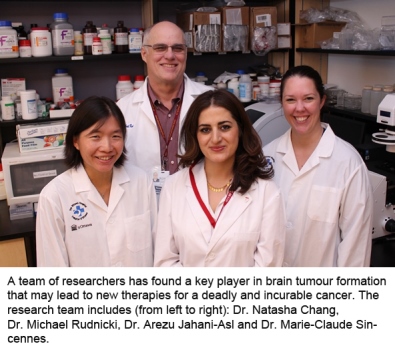
Diagnosed with brain cancer in 2013, Denis Raymond is a living anomaly among people with similar diagnoses; glioblastoma, the deadliest form of brain cancer. He took part in the medical trial of an experimental therapy in the field of electromagnetic therapy. And the research, to block Oncostatin M Receptor (OSMR), in his excited and hopeful opinion holds out great promise as an effective treatment for glioblastoma.

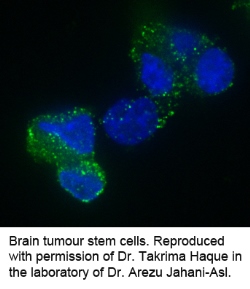
Now, a team of Ottawa researchers has published the findings resulting from their research into a treatment for glioblastoma, published in the journal Nature Neuroscience. Led by Dr. Jahani-Asl while she was a post-doctoral fellow under Dr. Rudnicki in Ottawa, the discovery was that a protein called OSMR is the handmaiden of bioblastoma; without that protein's presence the cancer tumours cannot form.

It was obvious to the research team that blocking the OSMR activity in brain stem cells should be their target. Blocking OSMR served to prevent them from forming tumours in laboratory mice. The research findings offer a new perspective on treatment of this difficult and deadly cancer, offering the hope that OSMR-targeted therapies might improve the prognosis for glioblastoma patients.

And glioblastoma patients need all the help they can get from medical science, to prolong their lives.

The diagnosis of glioblastoma is a grim one. Patients receiving that information soon learn that treatments currently available are limited in their efficacy. The condition is resistant both to radiation and therapy. And it is extremely difficult to surgically remove. Most people given that diagnosis survive a mere sixteen months.

"To finally be free of the constant worrying and constant thought of being faced with my own mortality, it's very exciting, very exciting", understated Denis Raymond.

29-year-old Denis Raymond at Ottawa Cancer Centre.

Labels: , , , ,

 
()() Follow @rheytah Tweet