Ruminations

Blog dedicated primarily to randomly selected news items; comments reflecting personal perceptions

Friday, January 24, 2020

China's Insatiable Appetite

"Between 1996 and 2011, the number of countries supplying the Chinese sea cucumber market expanded from 35 to 83. Over 90% of the world’s tropical coastline now lies within countries that export sea cucumbers to Hong Kong, a large proportion of which are traded on to mainland China."
"In many cases, finance extends from importers in China all the way through the supply chain to individual catchers."
Michael Fabinyi, Kate Barclay, chinadialogueocean

"The sea cucumber has been used in traditional Chinese medicine to treat everything from high blood pressure and fatigue to constipation and impotence."
"The sea cucumber is low in fat and cholesterol while being high in protein and B vitamins. It is also rich in antioxidants."
thespruceEats
Sea cucumber
In China, sea cucumbers are considered a luxury food and are used to treat kidney problems and impotence. Some species can sell for more than US$600 per kilogramme or 3,765 yuan (Photo: treetstreet/Thinkstock)
At one time in traditional Chinese cuisine culture, sea cucumbers were reserved for the wealthy, who could afford what has been viewed by the Chinese community as a luxury edible. China's economic boom has seen millions of people leaving poverty to become part of the growing Chinese middle class. With that rise in financial status, the voracious appetite for table delicacies has seen the popularity of sea cucumber soar among people who can now afford the expensive treat.

The creatures have a reputation in Asia for their nutritional value, along with their unusual texture; believed to have medicinal properties to treat medical conditions ranging from arthritis to impotency. There are, needless to say, many other wild creatures that Chinese cuisine values for their purported pharmaceutical properties, in a long tradition of Chinese medicine. Chinese are known to pay astronomical sums for creature delicacies to which they ascribe miraculous health properties.

It is why donkey populations worldwide have declined, through export to China in such unsustainable numbers as to threaten the species, from Brazil to Pakistan. It is why wild animals such as rhinoceros, tigers, antelopes, snakes buffaloes, deer, bear, sharks, elephants, monkeys ... the list goes on ... and on -- are similarly under threat. Threatening the very existence of many animals whose numbers are increasingly precarious.
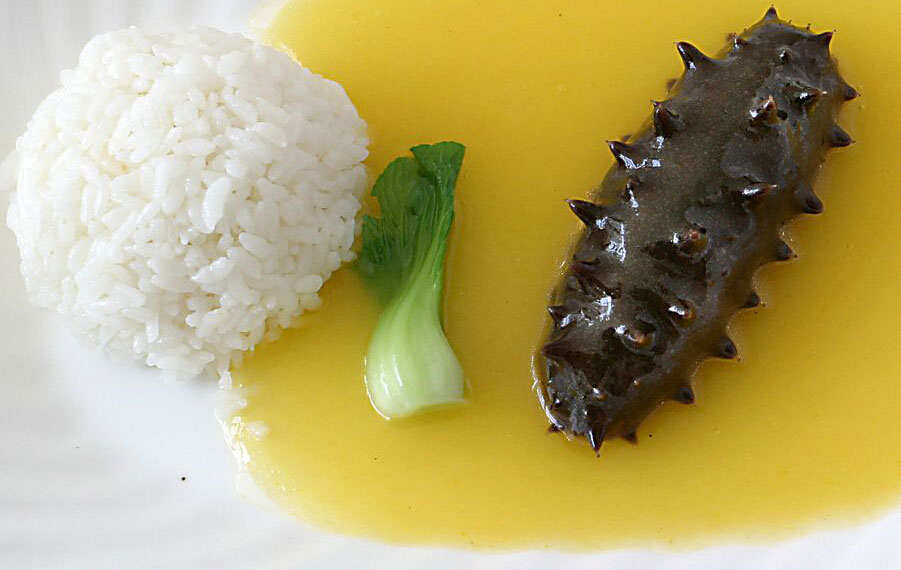

Because of the huge popularity of sea cucumbers, the oceans have been literally vacuumed of their presence around China, leaving the animals to become a rarity in their wild state because of the demand increase of the last several decades. Natural stocks of local species have been depleted. Leading to aquaculture, raising sea cucumbers in pens or ponds. Others are raised in the sea in conditions approximating their natural habitat, and these are considered to be free-range.

The local economy on the Liaodong Peninsula has undergone a transition where tidal flatlands have been transformed to a patchwork of ponds, the entire area so huge, they appear in satellite maps. Fed by ocean water, the ponds are seeded with the young and in a year's time they'll have grown sufficiently large to harvest. Huge structures that breed sea cucumbers destined for the ponds are located further inland.

"People here all rely on this", explained Liu Aiqing, while weighing sea cucumbers pulled by divers from a nearby pond. With a value of over $8 billion annually, sea cucumbers are now the most valuable of farmed sea products in China, according to Bao Pengyun, marine biologist who helped contribute to the development of the industry in China through his research at Dalian Ocean University.

The animals feed off the rocks and sand where they thrive while purifying surrounding water. Total eradication of the creatures would have a devastating result through the food chain, from either end. Some estimates place 70 percent of the world's edible species of sea cucumbers as over-exploited, from the South Pacific, to the Mediterranean, to the Gulf of Mexico.

As far as Mr. Bao, the marine biologist is concerned, little difference exists between sea cucumbers raised in pens or those raised in free range, and those from the wild. "Very much the same", he insists. "The difference is tangible", contends Mou Jie, a woman who set out with friends to drive up the coast to take a ferry to deposit her on Guanglu, where she plans to buy the delicacies.
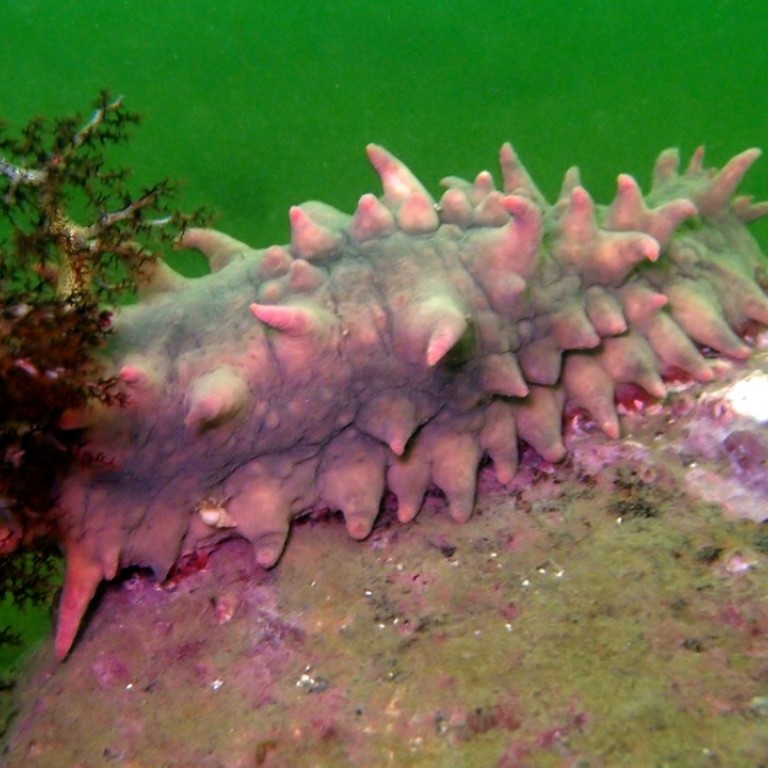
Image result for china, sea cucumbers
South China Morning Post

Sea cucumbers from cold waters grow more slowly than others, taking three years to reach maturity, rather than one, giving them the reputation of being more nutritious. Whether fresh, partially processed or dried, wild sea cucumbers are priced at two to three times the penned versions. Dried, the most expensive can cost close to $1,000 a kilogram.

And then there are those who claim sea cucumbers to be flavourless, with the texture of cartilage or rubber. Actually, they have little taste of their own; like another Eastern food product that some swear by and others swear at -- tofu -- sea cucumbers pick up flavour from whatever it is they are cooked in, or with. Plucked alive from the sea, lightly blanched, then bathed in a sauce of garlic, cilantro and chili oil, their taste then assumes that of a rubbery piece of cartilage flavoured by a sauce of garlic, cilantro and chili oil.

Takers, anyone?

Image result for china, sea cucumbers
Sea Cucumbers are being eaten to death : National Geographic


Labels: , , , , , , ,

Wednesday, April 03, 2019

Bottoms Up!

"With modern technology, some of the art of distilling has been lost. So to go back and see where it all came from was eye-opening."
"I thought, '[Plague water, how could that possibly taste good?' But in fact it tastes like the base for chartreuse."
"Some combinations of botanicals create surprising results -- they just make each other pop, in a way we didn't expect."
Jon Kreidler, founder, Tattersall Distilling, Minneapolis

"Herbs were the only medicine you had [in the Medieval era]. But plants are ephemeral and seasonal, so you'd put them in alcohol to have something shelf-stable."
"[As distilling became an industrial enterprise], a lot of amazing spirits went by the wayside."
Amy Stewart, author The Drunken Botanist: The Plants That Create the World's Great Drinks

"As I was touring the space, people would ask me what type of alcohol they would have consumed at these parties."
"We thought it would be fun to not just talk about alcohol in the period rooms, but to offer a taste as well."
"We realized we needed to contact real professionals [to achieve that practical end]."
Nicole LaBouff, curator, Minneapolis Institute of Art
Rare books and manuscripts from the Wangensteen Historical Library of Biology and Medicine at the U of M feature historic food and drink recipes.
Gallery: Rare books and manuscripts from the Wangensteen Historical Library of Biology and Medicine at the U of M feature historic food and drink recipes.   Carlos Gonzalez – Star Tribune
So that's how it began; public curiosity twigging a curator's interest in collaborating with a local brewery to produce beverages that would reflect those available during a much, much earlier era as medicinals that later morphed into sociable party spirits. The collaboration between the University of Minnesota and the Minneapolis Institute of Art and Tattersall Distilling has brought an entirely new focus on potable alcoholic beverages.

It's a serendipitous twinning that has produced award-winning gins, bitters and liqueurs. Next up: plague water.

What's plague water? A tonic to ward off diseases, produced by apothecaries of the Medieval era; a combination of angelica root, gentian and other herbs. That alcoholic concoction has now been revived by Tattersall, in the spirit of re-discovery, enterprise and art. The craft distilling industry is expanding enormously, and as it does, it intersects with an alert and fascinated group of historians focused on the role of alcohol in everyday life of the times.

Plague Party is a cocktail made with the historic spirits Plague Water and Aqua Mirabilis, pineapple juice, lime juice and honey sage syrup at Tatters
Carlos Gonzalez – Star Tribune   Plague Party is a cocktail made with the historic spirits Plague Water and Aqua Mirabilis, pineapple juice, lime juice and honey sage syrup at Tattersall Distilling.

Scholars are alert to the distiller's efforts enabling them to acquire a better understanding of how and what people ate and drank in the distant past. For their part, distillers are re-discovering their own history. Tattersall has made good use of the large inventory of the Wagensteen Historical Library of Biology and Medicine, at the University of Minnesota where, among its 72,000 volumes -- some of which date back to 1430 -- are hundreds lingering on the curative properties of roots, weeds, seeds, metals and ... animal parts.

Rare books and manuscripts from the Wangensteen Historical Library of Biology and Medicine at the U of M feature handwritten food and drink recipes. T
Rare books and manuscripts from the Wangensteen Historical Library of Biology and Medicine at the U of M feature handwritten food and drink recipes. Top Ð The Modern Art of Cookery Improved or Elegant, Cheap and Easy Methods of preparing moft of the Dishes in Vogue, Ann Shackleford, 1767. Middle Ð Book of Receipts, Ann Ward, c. 1724. Manuscript. Bottom Ð Art of Distillation.     Carlos Gonzalez – Star Tribune
The curative properties of these varied products of nature reflected the function of Medieval medicine in mixing and matching the ingredients into a concoction for optimum efficacy. When the ingredients were mixed with alcohol as a preservative, the resulting spirits led to combining sugar into the mix to create cocktails, leading to the industrial production of alcoholic beverages by distillers. In perusing the ancient recipes, a few dozen were chosen for re-creation.

Milk punch for example, currently a popular drink among bartenders, is made through adding citric acid to milk to have it curdle, them skimming off the solids so all that is left appears a yellowish, slightly sweet liquid mixed with alcohol. Plague water's renaissance saw some creative substitutions since some ingredients were simply unavailable or not to be used because they were discovered to be toxic. Plague water has a pleasant, earthy, herb-infused flavour.
Three cocktails made with historic spirits at Tattersall Distilling are Plague Party, Saffron Bitters Tonic and Clear Skies Ahead.
Three cocktails made with historic spirits at Tattersall Distilling are Plague Party, Saffron Bitters Tonic and Clear Skies Ahead.   Carlos Gonzalez – Star Tribune


Labels: , , , ,

Tuesday, February 07, 2017

Snail What? On My Face!

"Snail slime contains 91-98% water. The slime is filtered multiple times to increase its concentration and ensure its purity. Some snail slime products claim to contain as much as 97% snail secretion filtrate. However, the consistency and quality of the snail mucus should also be taken into account when looking for a good product." 
The YS Beauty Lab

Image: wikinoticia.com
"In the last ten months alone, we've seen a 46 percent increase in snail slime, due to demand from the cosmetics industry."
"It is really taking off."
"It [the Muller One machine] is essentially a spa for snails."
"We raise them naturally, feed them only vegetable matter and then extract the slime with water that contains ozone, which kills all the bacteria. The snails are not harmed."
Simone Sampo, president, National Heliciculture Association, Italy

Image: Yoshikazu Tsuno/ AFP/ Getty Images

Heliciculture, for the uninitiated, refers to snail farming. Which is to say, the industrialization of raising land snails to be used for human disposal. As in, for example, using snail flesh as an edible escargot, snail eggs to produce 'gourmet' caviar, and the slime one can see as a shiny path wherever snails slink in the garden along pathways or on the foliage of plants, as an ingredient to be incorporated into the manufacture of cosmetics and pharmaceutical products.

So snails are not plucked out of the garden and set upon your face to frolic and leave those slimy trails as they go about the business of replenishing natural oils in the prideful assurance that their secretions are capable of stimulating the production of collagen, helping women to retain that youthful, dewy appearance of beautiful, young, firm skin. The secretions -- a more polite word admittedly, than 'slime' are harvested and used to create creams, gels and serums.

Products which those who produce and market them claim can wonderfully heal acne and scars and slow down the age- and environment-induced wrinkles that blemish youthful beauty. At least that's what the manufacturers claim. And the consuming public is more than pleased to accept those claims and as a result, enthusiastically line up to make their acquisitions and use the products with high expectations of success. While dermatologists seem to delight in slighting their effectiveness.

Italy appears to be the source for the snail extract, where farming of snails has increased over 325 percent in the past several decades while a range of products using snail extract has blossomed on the market for cosmetics. The industry is now valued at $292 million. "We are seeing record numbers of new avant-garde snail production businesses", Roberto Moncalvo, president of Agricultural Association Coldiretti says.

According to Coldiretti, 44,000 tons of live and preserved snails are produced in Italy on an annual basis. And over four thousand producers are engaged in the lucrative business in Italy alone. For the most part, focusing on raising the European native breed, Helix aspersa. And both men and women, as a result, have taken to slathering snail mucus on their skin. For the sake of health and enduring beauty.

Interestingly enough, ancient Greeks left historical documentation describing the use of snail slime to heal skin; alternatively for its internal use as a protective agent against ulcers or coughs. So snails used in cosmetics and medicines is not unique to the present age, obviously. Human ingenuity in the use of natural products whose properties may benefit us in one way or another is not reserved to the current crop of inventive biologists.

Traditionally snails were placed in water with salt, vinegar or other chemicals to force them to secrete the treasured slime. Now, some Italian snail-breeder co-operatives do things differently. The invention of "cruelty-free" snail production methods and slime extraction has replaced the previous methodology, so producers can claim with pride that their industry harms no exploited and manipulated creatures.

The Muller One, recently patented by Italy's International Heliciculture Association, extracts snail slime through the immersion of snails in a special steam bath. Which the producers claim is a delightful experience for the snails, a natural process, and the snails are well treated with especial attention to their diet. Which doesn't quite explain how they feel about being eaten.


Image: Snailcream.co.uk


Labels: , , ,

 
()() Follow @rheytah Tweet