Blog dedicated primarily to randomly selected news items; comments reflecting personal perceptions
Monday, June 08, 2026
"Gone To Neverland", "Forever Young"
"[The review board's decision is] wrong. This man needs to be locked away."
"He should not be getting any kind of discharge, conditional or otherwise."
"After what he did, the public has every right to expect that he remains under the strictest supervision for the rest of his life."
"The Review Board has once again shown that under this NDP government,
dangerous people can gradually work their way toward more freedom, even
after committing the most unthinkable crimes against children."
Former B.C. Conservative leader John Rustad
"I am outraged by the British Columbia Review Board's slippery slope normalization of someone who killed their children."
"A conditional discharge is not a minor administrative step. It is part of a process that moves him closer to greater freedom."
Port Coquitlam Mayor Brad West
A mourner holds a program showing the pictures of Max, Kaitlynne and
Cordon Schoenborn during a public memorial in Merritt, B.C., on April
27, 2008. (Jonathan Hayward/The Canadian Press)
It took ten days for police to discover where Allan Schoenborn was hiding, in 2008 after his children were found dead by their mother, Darcie Clark, when she arrived home in Merritt, British Columbia. Her estranged husband, Allan, had moved to the Lower Mainland after they had separated, although he often returned to Merritt to visit with their three children, Cordon 5, Max 8, and Kaitlynne 10. When she found the children, they were all posed as though they were peacefully sleeping. The boys were lying together on a couch, and their sister was in her bed.
Their father explained afterward that he had separated them, not wanting the children to witness him smothering one another to death and trying to escape, making things awkward for him. After he killed his children he wrote a message on the living room wall with soy sauce: "Forever young". He repeated the phrase on one of Kaitlynne's pillow cases in blood.On the other pillowcase the bloody message read: "Gone to Neverland".
Allan Schoenborn had convinced himself that he was saving the children from a future where they would become addicted to drugs. He believed they were being sexually abused. By killing them he reasoned he was saving them from a sordid, unhappy life of sex and drugs. At his trial in 2010 he claimed not to have been responsible for their murder, that he was afflicted with a mental illness and was thus not guilty for the carnage he had wrought.
The B.C. Supreme Court judge reasoned that the man before him had plotted precisely what he set out to do, and was therefore guilty of capital murder as proven by the Crown, but he still accepted that due to mental illness Schoenborn was not 'responsible'.
Allan Schoenborn is shown in this sketch attending a British Columbia
Review Board in Coquitlam, B.C., on Thursday March 12, 2020. (Felicity Don/The Canadian Press)
Now, sixteen years after his conviction and incarceration, Allan Schoenborn has been granted a conditional discharge by the British Columbia Review Board. Found not criminally responsible given his mental disorder, for the first-degree murders of his children, he is now on track for a pathway to release. He had requested a 12-month conditional discharge when he appeared before the board for his annual hearing. Schoenborn is to attend a psychiatric clinic for treatment, live in a supervised place and stay at the Forensic Psychiatric Hospital in Coquitlam under the board's ruling, taking effect June 2nd.
Allan Schoenborn
Other conditions ordered were to report any intimate relationships, remain on good behaviour, and not have in his possession, nor use, any weapons or drugs. Schoenborn had legally changed his name to Ken John Johnson in May of 2021. That led the British Columbia government to pass legislation in prevention of those convicted of serious crimes from hanging their names. The Name Amendment Act requires all applicants for a legal name change in the province, aged12 years and older be background-checked for any possible criminal record.
The obvious intention is to prevent convicted criminals from evading accountability and the due consequences of their criminal actions, through a name change.
"In my opinion, [Schoenborn] is more evil than he is ill. He's interested in getting out, he's not interested in getting better."
"The conditional discharge is a] waiting room for the absolute discharge. It's very rare that people on a conditional discharge do not advance forward."
"Should he ever get an absolute discharge, I promise you we will be hearing about him on the news after he's created more tragedy."
Spokesperson for the victims' family, Dave Teixeira
"In the video you also see her choking me for a second before getting pulled off and that was what I was referring to when saying 'I was just assaulted'."
"I thought that was the end of it, but she came at me again and that's when the video cuts out. She choked me for a second time, kicked me and shoved me to the ground using the force from grabbing my hair."
"I was on the floor for the entirety of the next stop getting beaten all the while her hand never left my hair and her grasp was so strong that the clump of hair was ripped out."
"I noticed that while I was attacked, before and after I hit the ground, only one couple tried to help me."
"I now understand that every Jew is a target."
Unnamed Jewish Montrealer, 23-yr-old nurse
"Jews are eating kids!"
"You're a Jew. I smell the kids."
"It's OK for her to eat a kid but I can't choke her down?"
Diana Smith, assailant
A young Montrealer who happened to be an orthodox Jew now living in New York was choked, kicked, thrown to the floor and had the hair from her scalp pulled away by another passenger on a subway train in New York. The 23-year-old, a registered nurse by profession, took a video of the assault as it initiated, with her smartphone. The afternoon C train on May 31st was packed with commuters. A female who happened to be a large Black woman, after assessing the young woman as a Jew, turned about to face the aisle then shouted "Jews are eating kids!"
Leaning toward the young woman her assailant spoke directly to her: "You're a Jew. I smell the kids." The woman whose sheer size overwhelmed the petite nurse physically shoved her, leading the onboard crowd to collectively gasp and prompting some of the passengers to intervene to draw the attacker away from the smaller woman. The video records the shock of the assailant at others disapproving of her violence: "It's OK for her to eat a kid but I can't choke her down?", she protests.
Posted on X by Combat Antisemitism Movement, the video became the subject of a New York Post story, leading to a discussion over the rise of antisemitism in New York City, under a mayor who overtly champions the 'cause' of Palestinian nationhood and constantly vilifies Israel.
Agreeing to speak about her experience to the news media, the woman asked to remain anonymous. She was agreeable however, to sharing videos and photographs during the discussion. She also pointed out her despair that as she was being endlessly mauled, out of the subway car hosting a multitude of onlookers, only one couple made an effort to come to her aid.
Her attacker was identified as Bronx resident Diana Smith whom the New York Police Department confirmed as the assailant, listing the charges she is likely to face: assault, criminal obstruction of breathing and aggravated harassment, all in the context of hate crimes. It was left to The New York Post to reveal that the woman has a history of mental illness and police run-ins. She is yet to be indicted by the Manhattan District Attorney.
Clearly, the charges will be contested on a plea of the attacker not being guilty of the listed charges on the basis of mental illness. Like so many other similar instances of Jews being accosted, threatened and assaulted wherever they live in the diaspora, charges are laid and criminal prosecution is confounded by claims of mental illness, leading to withdrawn charges or the ensuing penalty hugely minimized in deference to someone's mental health leading to a psychotic incident.
The victims on the other hand? Stiff upper lip, Jews.
"I honestly feel terrified and I've been just running on fear and adrenaline. I have not been able to sleep properly or have much of an appetite."
"I feel sick that people can watch another human be attacked and do nothing. That they can hear dehumanizing words and say nothing."
"Physically, I know I will be OK. Emotionally though, these scars will never fade."
"It's stuff I saw on the news but not things that actually happened to people just on the subway home. I now understand that every Jew is a target. It isn't about Zionism, it's about Judaism."
"People have hated and persecuted us for years. As Jewish people, we have seen where this leads."
"We said 'never again' after the Holocaust -- and yet."
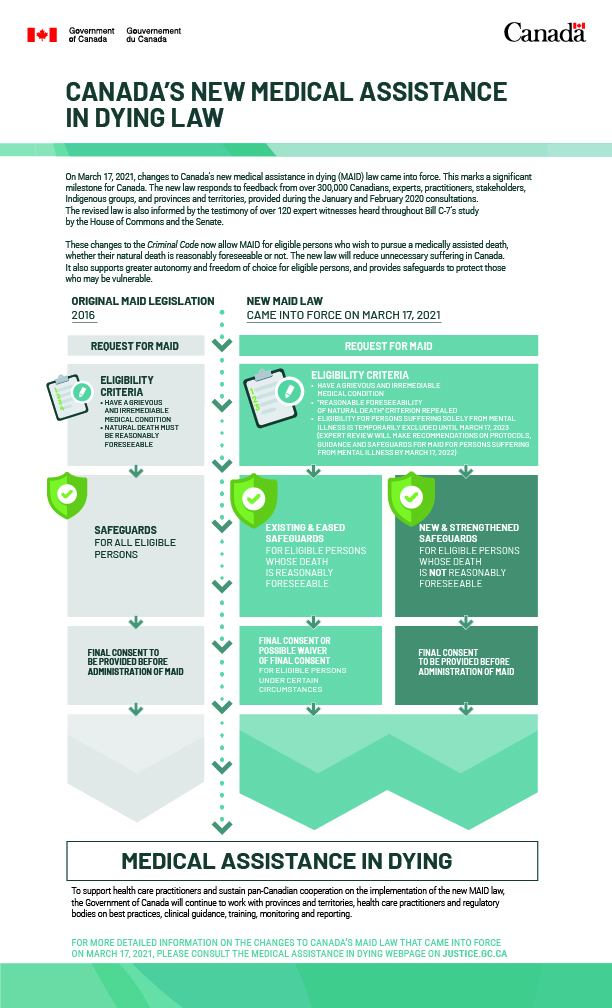
"I and other colleagues are experiencing this: People are clearly getting MAID [Medical Assistance in Dying] for reasons that are frankly illegal."
"Suicide contagion is a well-proven reality. Don't pretend that it won't happen in Canada.:
"For the last 23 years, I've treated patients that other psychiatrists told me could not get better, and they get better."
"Suffering can always be reduced ... There is absolutely no such thing as 'everything has been tried'."
Dr. John Maher, psychiatrist specializing in treating severe mental illness
Angus Reid Institute
"Under the guise of flimsy medical excuses", people suffering mental illnesses are already receiving assisted deaths in Canada, and others seeking MAID will "doctor-shop until dead" should euthanasia be extended under law to encompass psychiatric suffering alone, cautioned Dr. John Maher testifying before a Parliamentary committee of enquiry comprised of MPs and Senators. Should medical assistance in dying be seen as a legitimate option for mental suffering, he warned, the risk of a "suicide contagion" effect is high.
It's called the Werther Effect, referring to a notable increase in suicides following publicized reports of suicides among celebrities. In jurisdictions that have legalized doctor-assisted death, Dr. Maher pointed out, rates of suicide "have risen much faster after it was legalized, than before."
Conflicting reports pro and con have been presented to the committee over the safety of MAID eligibility expansion to individuals having mental illness in isolation from any other medical conditions; a controversial topic that includes whether or how a mental disorder might be considered to be incurable and thus qualifying for MAID.
"People are getting MAID for psychiatric reasons under the guise of flimsy medical excuses."
"Prolific MAID providers are happy to assist with suicide while people are on wait-lists for effective treatment, [and] MAID is being offered to veterans, disabled people and people with very treatable illnesses."
"People need lifeguards, not someone to push you under."
Dr. John Maher
In 2023, urgent requests for same-day assessments and provision [less than 24 hours] were reported in Ontario, speaking to the possibility of impulsive decision-making on the part of people with mental disorders willing and determined to end their lives, under the influence of their mental delirium. This, in a background of long wait times for appointments with mental-health professionals in Canada's overworked health care system.
"You're describing criminal misconduct, are you not, when you describe mental health as already qualifying people in the eyes of some assessors and providers for MAID?", asked one of the Members of Parliament on the committee. "I absolutely am", responded Dr. Maher. He informed the committee of his attempts to report his concerns with a doctor, to a provincial professional accreditation college and the response was "until the patient is dead, there is no malpractice".
And then, there were the counterarguments, as when University of Ottawa law professor Daphne Gilbert spoke of a small "very limited" number of people ultimately qualifying for MAID solely for mental illness. "This matters, because one justification for continued exclusion is the speculative claim that large numbers of people will become eligible if the ban is lifted. There is no evidence to support that claim."
"[Denying MAID to those with mental illness is predicated on the belief that they lack decision-making capacity and] must be protected from themselves and that their suffering is somehow less real, or less serious."
"In 2026, we are reinforcing historic stigma and paternalistic assumptions. The law continues to infantilize those with mental illness."
Professor Daphne Gilbert, vice-chair, Dying with Dignity Canada
"Residents in Vancouver are sick of this cap. It's bulls---t."
"[The incident was] devastating. There's a lot of anger actually."
"We
can talk about how crime's down, violence, assaults are down, but when
these things happen, they're jarring and they really impact the entire
community."
"The federal government needs to step up, or at least have a
conversation with us.Their
responsibility is to help us out because we don’t have the
jurisdiction."
"It isn’t only those in Vancouver who are fed up, but] residents of this entire country."
"The
federal government, we need them to come to the table, or just tell the
country they’re not serious about this, and they’re going to do nothing
about it, and then we’ll deal with it."
"But don’t waste our time and don’t tell people that you’re going to deal with the issue."
Vancouver Mayor Ken Sim
The very Vancouver that is widely recognized as a beautiful city in a geographically spectacular province of mountains, lakes, rivers and forests, is also considered one of best cities of the world to live in. This, despite, the infamous Downtown East Side with its homeless, drug-addicted individuals, the presence of opioid 'harm-reduction clinics' set up to prevent drug overdoses, and the greatest number of deaths from Fentanyl in any Canadian jurisdiction.
Vancouver police officers on the scene outside a 7-Eleven store after
police shot and killed a man who injured two people in downtown
Vancouver, British Columbia, on Wednesday, Dec. 4, 2024. (Ben Nelms/CBC)
Vancouver's problem -- and it's one that plagues most of Canada's large cities -- is random 'stranger' attacks. Random stabbing sprees have become distressingly all too common. It is a symbol of a justice system incapable of protecting the public from the erratic behaviour of violent criminals. On Wednesday one such individual went into an Original Joe's shop located close by the Vancouver Public Library, where he stole a knife and a bottle of liquor. He then went on to stab random strangers in the neighbourhood before being shot fatally by police inside a 7-11.
In January 2022, a man by the name of David Morin repeatedly plunged a knife into a stranger's back at a Vancouver Tim Horton's. Vancouver Police revealed last week that though classified as a "high risk to reoffend", the man had been set free. It all seemed to begin back in 2002 when a 22-year-old Korean student, Ji-Won Park, was attacked in Stanley Park, while he was out jogging. "Stranger attacks" are now a near-daily event. Not all are stabbings, sometimes a push, a shove, a jab, a punch.
Wednesday's attack was one of the more serious events. A predictable pattern of such attacks begin with a mentally unstable offender, one with a criminal record, and often someone with that background, out on bail or probation. Vancouver Police analyzed 44 separate stranger attacks that took place over a three-month period, with the finding that mental health was a factor in 73 percent of cases; 60 percent of suspects had been charged previously with a violent crime.
The problem seems to stem from two sources, one impacting the other; a mental health system unable to keep violent mental health patients from stalking and harming the public. Aligned with a justice system for which bail and early release are routinely granted, even when the most brazen repeat offenders are before them. A random stabbing spree in September saw 70-year-old Francis David Laporte killed, and a man in his 50s mutilated, his hand severed. Both had been strolling the downtown core, then were suddenly victimized by multiple stab wounds.
An erratic and "very troubled" 34-year-old Brendan McBride was arrested. He had been on probation and credited with a lengthy history of court-ordered psychiatric care. "I think that we have to realize that there's too many unwell people walking around in our streets", commented Vancouver Police Chief Adam Palmer. Coast Mental Health called the incident an indictment of the B.C. approach to mental health: "Nothing excuses what's happened here. People want answers. They're not easy solutions", said CEO Kier Macdonald.
An image of the man alleged to have stolen liquor from a bar and wounded
two people in downtown Vancouver before being shot and killed by
police. CBC News has not yet learned the man's identity. (Submitted to CBC News by a witness)
At the September 2023 Light Up Chinatown festival, the suspect who had stabbed several people randomly, turned out to be a man with a history of stabbing attacks. He was hospitalized, but was given a day pass from a local psychiatric hospital. Charged with three counts of aggravated assault, Blair Donnelly had stabbed his own daughter to death in 2006. Found not criminally responsible for the murder as a result of a mental disorder, Donnelly had been accused since then of stabbing someone while on leave from a mental hospital.
The legal system -- and this is not confined solely to British Columbia -- has proven willing to grant constant release to violent and unpredictable offenders. Leading police forces in British Columbia to refer to a new category of 'super-prolific offenders', defined as an offender with over 30 convictions. Mohammed Majidpour with 30 convictions to his name, in September 2022 randomly attacked a 19-year-old woman in Downtown Vancouver with a pole. Later that same day he set fire to a car. When he was arrested he spent a weekend in detention and then was out on bail.
After which he was arrested several more times. Majidpour was on bail less than three hours before being arrested again for attempting to steal $300-worth of merchandise. Two officers who had arrested Majidpour the previous day on a separate incident, followed him until he broke the law once more. "At the time of his arrest, the suspect had been out of custody for two hours, 18 minutes" a police statement read of the event.
"If this is a prolific offender, and if the courts will not keep them
off our streets, then we should be using the Mental Health Act."
"We need to strengthen the Mental Health Act so that
these people who are at risk of harming themselves or others can be held
and treated and not be released until they’re no longer a risk."
John Rustad, B.C. Opposition Conservative Leader
Vancouver Police officers responded to a “violent” incident that left multiple people injured Wednesday. (CityNews Image)
"Amongst his multiple specialists, no unifying diagnosis was confirmed. [However, his MAID assessors [felt that the most reasonable diagnosis for Mr. A's clinical presentation [severe functional decline] was a post-vaccine syndrome, in keeping with chronic fatigue syndrome."
"[In the case of] Non-reasonably foreseeable death [patients were more likely to live in the most maginalized areas in the province, more likely to require disability supports, more likely to be female and more likely to live alone at all ages]."
MAID death review medical report
"I think we have gone so far over the line with Track 2 that people cannot even see the line that we've crossed."
"It's pretty clear that some providers are going up to that line and maybe beyond it. This is actually suicide facilitation in some cases."
"[In the case of Mr. A.] even separate and apart from whether
post-vaccine syndrome is a valid entry, it's very clear that even [the
MAID assessors] weren't sure of it"
"There was repeated discussion about 'no determinant diagnostic results', no unifying diagnosis. It was really just the MAID assessors who ended up saying the most reasonable diagnosis is post-vaccine syndrome completely ignoring the fact that the symptoms of depression, trauma and addictions can cause a whole slew of symptoms, including physical ones."
Dr. Sonu Gaind, psychiatrist, professor of medicine, University of Toronto
Some members of the MAID death review panel questioned
whether “post-vaccine syndrome” — a condition "previously unrecognized
in medicine" — could be considered incurable.Photo by Getty Images
Euthanasia was extended to a man in his late 40s who had a background of mental illness. His assisted death assessors had decided the most reasonable explanation for his severe physical decline had to be a post-COVID-19 'vaccination syndrome'. 'Post-vaccine syndrome' is not included within Canada's current vaccine report system for adverse effects. Many specialists who had been consulted prior to his assisted death were not able to agree on a diagnosis, which left unanswered the question whether the man's medical condition even met the criteria for "irremediable", the cornerstone of MAID accessibility.
'This particular case is but one of several addressed in a number of reports by a MAID death review committee struck at the behest of the chief coroner's office of Ontario. 'Mr. A' had suffered functional decline in the wake of three SARS-CoV-2 vaccinations. Depression, PTSD, anxiety and personality disorders were also issues that the man suffered from. He was twice admitted to hospital with suicidal ideation "while navigating his physical symptoms".
Nonetheless no "pathological findings" were identified at a post-mortem that could pinpoint the presence of any underlying physiological diagnoses. The report brings to light difficulties in granting euthanasia for those whose medical conditions are not recognized as terminal, those whose natural deaths are not reasonably foreseeable, placed into a "Track 2" category. People suffering from a multitude of medical conditions who are actively seeking approval for MAID, fall into that category.
There are troubling instances when a medical care provider will broach the topic of medical assistance in dying, ostensibly as a gentle reminder that the protocol exists whereby an seriously untenable life can be ended with medical intervention under certain qualifying conditions. Those qualifying conditions have departed from the original regulations safeguarding the system from abuse. Simply by casually mentioning MAID, and handing out pamphlets explaining it as an optional solution is a tendency to guide patients toward requesting that solution to their intractable medical condition.
Mental illness in and of itself is not an ultimate qualifying condition for MAID. An individual with mental illness alone "wouldn't suffice" in qualifying for MAID, since it cannot be viewed as the sole underlying condition in seeking out MAID. According to statistics, over 13 billion COVID vaccine doses have been given globally, saving millions of lives. A study involving over 99 million vaccinated people from eight countries discovered that known side-effects are rare.
Yet, according to Immunologist Dawn Bowdish with McMaster University, following vaccination rare conditions can occur that have the potential for 'life-altering consequences'. The immune system attacks the nerves of the spinal cord with transverse myelitis leading to a condition resembling multiple sclerosis; Guillain-Barre system can occur when someone's immune system attacks their nerves causing muscle weakness and occasionally weakness that turns in rare cases to paralysis.
Still, a chronic post-vaccine syndrome is a controversial issue. A workers' compensation company WorkSafeBC, found no published data supporting the development of chronic fatigue syndrome, following a mRNA COVID vaccination. In responses to an online survey, 241 adults reported continuing symptoms following a COVID vaccination, symptoms including excessive fatigue, brain fog and pain, numbness and tingling.
"So, now we have to say, 'Well, here's what we think is a likely medical diagnosis. And then, on top of it, with the clear diagnostic uncertainty they're able to say, 'Oh, plus this is now irremediable'."
"Because if they don't say that, obviously you don't qualify for MAID."
Amid the COVID-19 pandemic, psychologists are worried about the mental
health toll of rising cases and tightened restrictions during the
winter ahead. (Evan Mitsui/CBC)
"When we saw that everything we were doing was having an effect
and the numbers were dropping, that empowered us. It made us feel like
we're beating this thing, And that is great
until the numbers start to go up and we start hearing that more
restrictions are going to be in place and ... we might start to feel
like everything we did didn't matter. It came back anyway."
"It requires a much quicker step towards getting somebody that
really knows what they're doing to help. So if we're
heading into winter with less sunshine, less ability to get social
interaction, less opportunity for aerobic activity, less job security
for some ... I worry we might see depression rates increase."
"It does feel like we're heading into a long, dark winter."
"[Physical signs of depression include very low levels of energy.
Anxiety, meanwhile, can cause elevations in heart rate, breathing and
sweating as it] basically makes our muscles ready to fight or flee. But
we don't know how to fight, and we can't flee. So
we're left with this feeling that's becoming chronic, it's engaged all
the time."
"Mental health is not something somebody else struggles with anymore — it's something we're all struggling with now, The critical point to remember is that it certainly will get better. It's a matter of persevering through the dark days and coming out to a better spring and a better summer next year."
Steve Joordens, psychology professor, University of Toronto
The news, the news. Not very inspiring at the best of times and these
are not the best of times. On the one hand we have the almost-imminent
appearance of a vaccine that it is hoped will obliterate the presence of
the horrible novel coronavirus that has afflicted the global community
for almost a year. The world economy has suffered, but above all, there
is now one-and-a-half million dead whose family members will never come
to terms with their loss.
But there appears to be another type of
affliction that people suffer under, apart from the physical distress,
apart from the disabling physical effects of the SARS-CoV-2 virus that
so mysteriously entered the pantheon of deadly diseases preying on the
animal kingdom, and that has relentlessly stalked the world in such a
sinister manner.
People have been doubly victimized, their organs
succumbing to the dire destructive effects of the virus on the
respiratory system and other vital organs, and aside from and together
with that there is the psychological affect. People already suffering
mental insecurity, and those newly introduced to the intensity of fear
and loneliness are experiencing a greater loss of equilibrium;
debilitating mental illness.
A new poll just released by the
Mental Health Commission of Canada and the Canadian Centre on Substance
Abuse has revealed that respondents who claim to be in "strong mental
health" has realized a fall in numbers by 23 percent over the time the
global pandemic was set loose on humanity. In 2019, 67 percent of
Canadians felt themselves to be in a condition of strong mental health,
and that number has now declined to 44 percent. Over half of Canadians
now think of themselves as being at a perilous level of mental health.
A
pedestrian walks past a mental health advertisement during the COVID-19
pandemic. Canada invests just 7.2 per cent of $219 billion in total
health spending on mental health.Photo by Peter J. Thompson/National Post
Suicide help lines have been beleaguered by a wholesale increase in
calls of desperation, vastly outstretching their ability to effectively
cope with a mental health crisis that has afflicted youth in particular
with one in five seen to be acquiring or worsening a mental health
disorder, according to the Canadian Institute for Health Information.
Emergency department visits and hospitalizations for mental health
disorders among young people rose in the last decade by 60 percent even
as hospitalizations for other issues fell by 26 percent. And the numbers
are rising, thanks to COVID.
In effect, this disaster that
the public has been warned about for years has been realized at a time
when no one appeared to take the warning seriously, that a global
pandemic was due to appear, and would have to be dealt with. Governments
ignored the warning, health authorities took heed but did little to
prepare, since it takes financing to do so and public health is financed
by the public through taxation, a dirty word when it is suggested that
more taxes need to be forthcoming to handle an immense problem that
might or might not appear in the near-to-distant future.
Well, it
appeared in the near-enough future and that future is now, and we are
living through the disaster that just about everyone found too difficult
to assimilate into their unreceptive minds as being something that had
to be prepared for. That lack of preparation has resulted in horrendous
consequences. On the other hand, it's difficult to imagine how matters
could have turned out differently. There are simply so many issues of
vital importance that have to be seen to and dealt with, even absent the
appearance of a global pandemic.
Things have certainly changed for youth everywhere, from toddlers at day care to elementary-school children, through to high school and university. How comfortable and 'child friendly' would it seem to a child looking around and seeing everyone wearing masks? Conformity may make it appear non-threatening, but it is also, undeniably, off-putting not to be able to see peoples' faces, their smiles the kind of facial language that we learn to read so effortlessly from birth to adulthood. Now denied the young.
Close physical contact another denial, when this is precisely what the human psyche thrives on. And to explain to a child the necessity of distancing is to introduce to that child the concept of an evil, unseen threat waiting to pounce. Which may be true but would be of no comfort to a child being informed that life has its dangers. Teens have seen their casual world of pairing up, joining groups, sport activities suddenly disappear in the interests of health safety. Strictures of caution are introducing them to a solitary existence.
University students, masked and distancing are as exposed to the feeling of suspicion of the 'other' as a potential vector of a disease that may merely inconvenience them, or that may, under certain physical conditions of receptivity when their particular immune system goes amok may alternately result in internal organ disruptions that can be pretty serious, and in rare circumstances lead to life-long impairment, and possibly an early death.
Not very reassuring to those setting out on what should be a long, 'normal' trajectory toward adulthood and aspirational lifestyles. Now, the new normal is isolation and loneliness, confusion and resentment. And mental illness, newly arrived or lingering in the background and newly exacerbated. And there is this kind of whistling-in-the dark:
"Being alone doesn't have to mean being in isolation, We're going to be finding more creative ways of
[interacting] again — having game night over Zoom, having a movie night
where you're both watching the same movie separately."
"So it's [about]
being cautious, but still continuing to do the same activities that we
normally use to ground us."
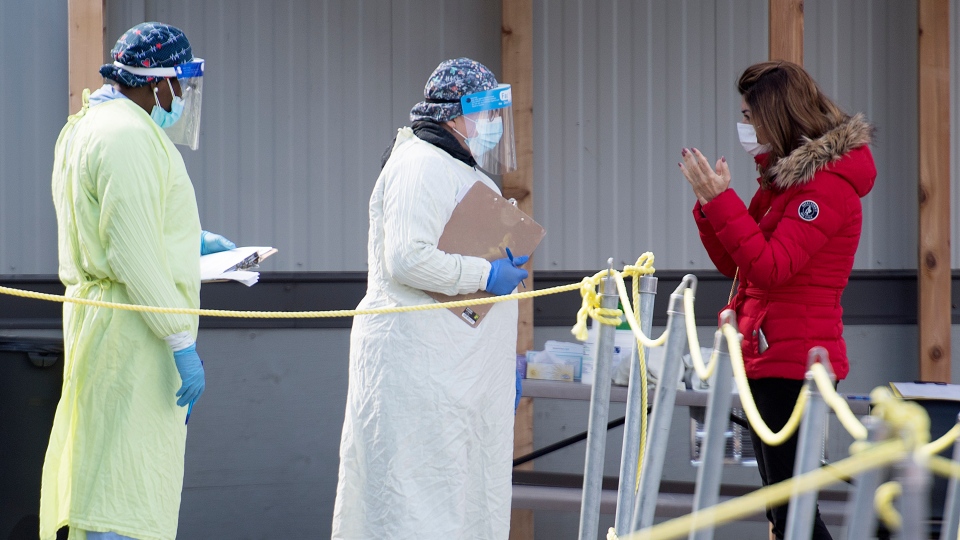
Healthcare workers talk to a woman at a COVID-19 testing clinic
Montreal, Sunday, October 11, 2020, as the COVID-19 pandemic continues
in Canada and around the world.THE CANADIAN PRESS/Graham Hughes