Blog dedicated primarily to randomly selected news items; comments reflecting personal perceptions
Friday, April 15, 2022
Xi Jinping's Triumph in Leadership
"Until Omicron, I actually thought a COVID-zero approach could be plausible. [But] it's just so insidious, it can just spread so quickly."
"I feel it's kind of like a losing battle. You could do it for a week or two ... then it's going to come back again."
"I just don't know how China will be able o avoid what happened in Hong Kong, write large."
"If everyone stays home, the outbreak will get snuffed out. But ... even if Shanghai can snuff out this particular outbreak, there's going to be more introduction of it, because it's circulating everywhere else in the world."
Dr.Jeff Kwong, public-health professor, University of Toronto
"What happens to your pet if you test positive remains an unsettling grey area with no clear solution."
"Horror stories circulate online about pets being left behind and one was recently killed with a shovel by a person in a haz-mat suit."
CNN journalist David Culver, Shanghai
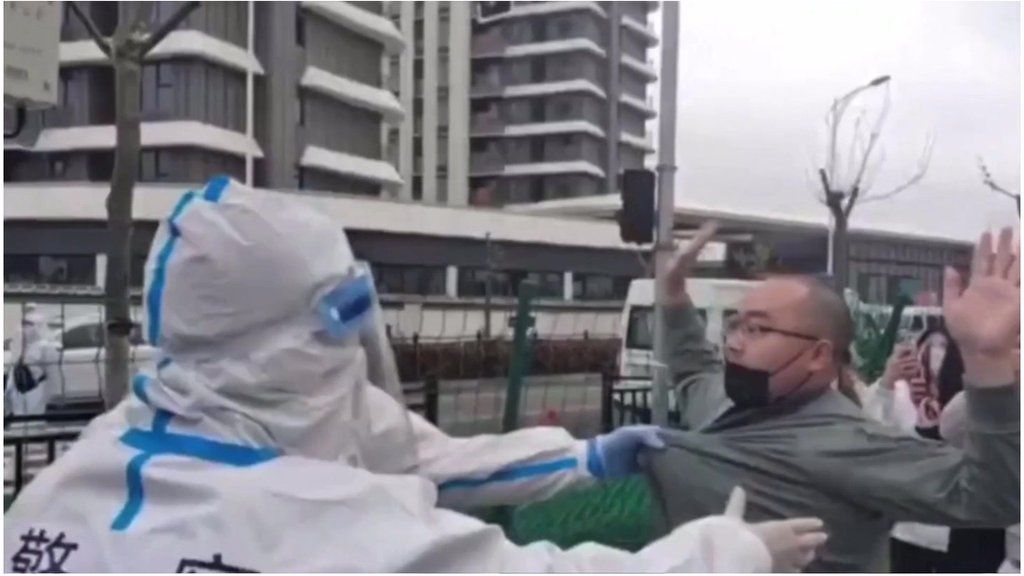
One clip shows a policeman in a hazmat suit removing a protester from the scene BBC
CNN journalist Culver, as a resident of Shanghai, has his own very personal fears aside from his writing about regular morning marches of neighbourhood residents to designated areas where they are tested by health officials wearing haz-mat suits. Should they test positive they are immediately sequestered, not permitted to return home and must go into isolation. If they have pets at home the pets are confiscated and put to death. David Culver has nightmares of testing positive, worried about abandoning his dog, as he would be forced into quarantine.
Shanghai's 25-million residents have been cooped into lockdown for weeks, unable to leave their homes except for COVID testing, and living with food shortages caused by the enforced total lockdown. A lockdown originally meant to last a few days, but that has been ongoing now for weeks with no indication how long it may last, as long as COVID-positive cases continue to present and authorities continue to react with draconian methods of isolation. The situation led to people shouting in desperation from open windows in their apartments and from balconies.
People wearing personal protective equipment
transfer food supplies and necessities for local residents during a
COVID-19 lockdown in Shanghai, April 5, 2022.Photo by AFP via Getty Images
The protests spurred officials to seek a solution to the angry social protests, including media posts in a country not known to tolerate dissent. The solution? Drones, circulating in neighbourhoods with very specific messages: "Please comply with COVID restrictions. Control your soul's thirst for freedom. Do not open your windows and sing", the female voice instructs.
Children separated from their parents when found to be COVID-positive. This is a reflection of China's COVID-zero policy meant to completely eradicate, not merely control SARS-CoV-2. The virus is not responding positively to that goal, however, and the method finds no wide public acceptance. Chinese health authorities who subscribe to the COVID-zero manoeuvres insisting on complete lockdown to effectively beat virus transmission, appear not to have reckoned with the high transmissibility of the Omicron strain.
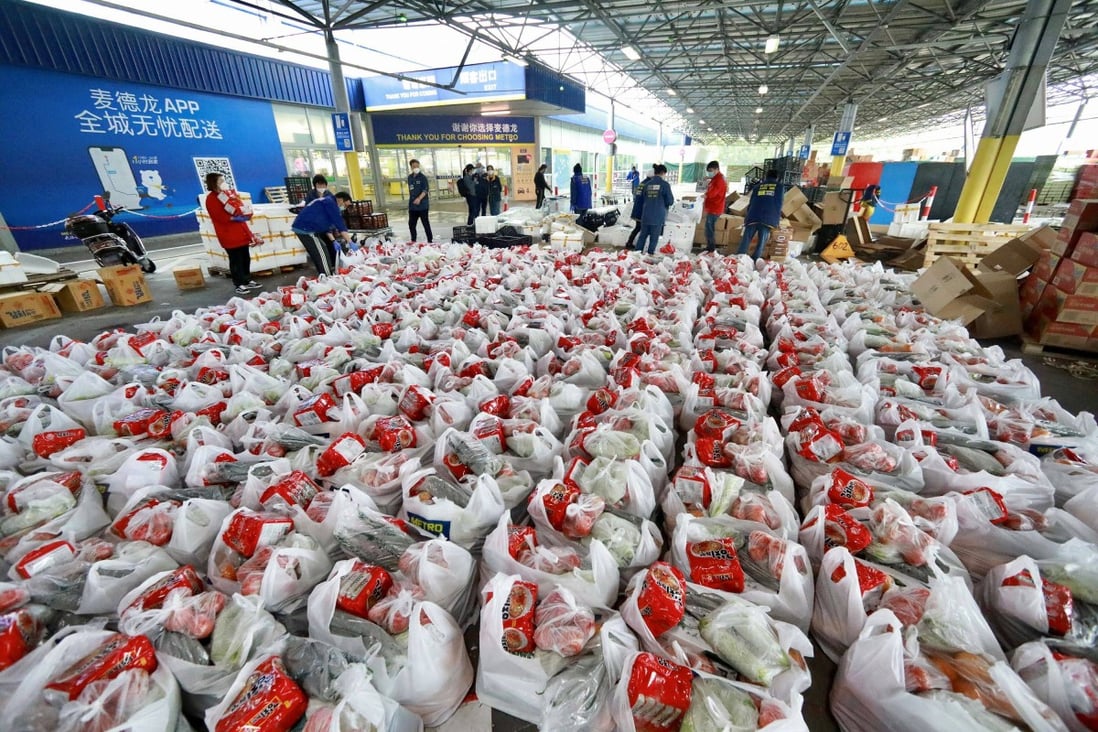
Staff members organize mass food orders from locked down Shanghai residents. Photo: Reuters
"Judging from how this pandemic is being handled by different leaderships and systems ... [we can] clearly see who has done better", China's President Xi Jinping has boasted in the past. And it did realize a good measure of success with pop-up cases here and there and swift responses in fragmented areas, quickly contained. Until Omicron arrived and infections began reaching into the stratosphere, as much as 15,000 daily of late. Beijing's firm orders for Shanghai's total lockdown reflected its wish to avoid the disaster in Hong Kong.
Hong Kong's own COVID-zero achievements were blown to smithereens when three million people were infected and mass deaths occurred. In both areas low vaccination rates among people aged 80 and over and lack of access to mRNA vaccines seem partly to blame. That the most vulnerable age group in the populations have not been vaccinated seems like an an avoidable Achilles heel that should not have gone unaddressed. China's home-grown vaccines have a relatively low efficacy rate; somewhere around 50% and less, compared to the mRNA vaccines.
Locked into their homes the population has been unable to work, attend school, shop, attend medical appointments. The government plan to supply people with food deliveries has overburdened commercial delivery services, the result of which has been that a great many people face starvation, deprived of food access. Clearly, China's approach to stifling the virus that originated in Wuhan, China and went on speedily to infect the global population, has been nothing to celebrate as a success.
Workers
in protective suits disinfect an old residential area under lockdown
amid the COVID-19 pandemic, in Shanghai on April 15.ALY SONG/Reuters
Amid the COVID-19 pandemic, psychologists are worried about the mental
health toll of rising cases and tightened restrictions during the
winter ahead. (Evan Mitsui/CBC)
"When we saw that everything we were doing was having an effect
and the numbers were dropping, that empowered us. It made us feel like
we're beating this thing, And that is great
until the numbers start to go up and we start hearing that more
restrictions are going to be in place and ... we might start to feel
like everything we did didn't matter. It came back anyway."
"It requires a much quicker step towards getting somebody that
really knows what they're doing to help. So if we're
heading into winter with less sunshine, less ability to get social
interaction, less opportunity for aerobic activity, less job security
for some ... I worry we might see depression rates increase."
"It does feel like we're heading into a long, dark winter."
"[Physical signs of depression include very low levels of energy.
Anxiety, meanwhile, can cause elevations in heart rate, breathing and
sweating as it] basically makes our muscles ready to fight or flee. But
we don't know how to fight, and we can't flee. So
we're left with this feeling that's becoming chronic, it's engaged all
the time."
"Mental health is not something somebody else struggles with anymore — it's something we're all struggling with now, The critical point to remember is that it certainly will get better. It's a matter of persevering through the dark days and coming out to a better spring and a better summer next year."
Steve Joordens, psychology professor, University of Toronto
The news, the news. Not very inspiring at the best of times and these
are not the best of times. On the one hand we have the almost-imminent
appearance of a vaccine that it is hoped will obliterate the presence of
the horrible novel coronavirus that has afflicted the global community
for almost a year. The world economy has suffered, but above all, there
is now one-and-a-half million dead whose family members will never come
to terms with their loss.
But there appears to be another type of
affliction that people suffer under, apart from the physical distress,
apart from the disabling physical effects of the SARS-CoV-2 virus that
so mysteriously entered the pantheon of deadly diseases preying on the
animal kingdom, and that has relentlessly stalked the world in such a
sinister manner.
People have been doubly victimized, their organs
succumbing to the dire destructive effects of the virus on the
respiratory system and other vital organs, and aside from and together
with that there is the psychological affect. People already suffering
mental insecurity, and those newly introduced to the intensity of fear
and loneliness are experiencing a greater loss of equilibrium;
debilitating mental illness.
A new poll just released by the
Mental Health Commission of Canada and the Canadian Centre on Substance
Abuse has revealed that respondents who claim to be in "strong mental
health" has realized a fall in numbers by 23 percent over the time the
global pandemic was set loose on humanity. In 2019, 67 percent of
Canadians felt themselves to be in a condition of strong mental health,
and that number has now declined to 44 percent. Over half of Canadians
now think of themselves as being at a perilous level of mental health.
A
pedestrian walks past a mental health advertisement during the COVID-19
pandemic. Canada invests just 7.2 per cent of $219 billion in total
health spending on mental health.Photo by Peter J. Thompson/National Post
Suicide help lines have been beleaguered by a wholesale increase in
calls of desperation, vastly outstretching their ability to effectively
cope with a mental health crisis that has afflicted youth in particular
with one in five seen to be acquiring or worsening a mental health
disorder, according to the Canadian Institute for Health Information.
Emergency department visits and hospitalizations for mental health
disorders among young people rose in the last decade by 60 percent even
as hospitalizations for other issues fell by 26 percent. And the numbers
are rising, thanks to COVID.
In effect, this disaster that
the public has been warned about for years has been realized at a time
when no one appeared to take the warning seriously, that a global
pandemic was due to appear, and would have to be dealt with. Governments
ignored the warning, health authorities took heed but did little to
prepare, since it takes financing to do so and public health is financed
by the public through taxation, a dirty word when it is suggested that
more taxes need to be forthcoming to handle an immense problem that
might or might not appear in the near-to-distant future.
Well, it
appeared in the near-enough future and that future is now, and we are
living through the disaster that just about everyone found too difficult
to assimilate into their unreceptive minds as being something that had
to be prepared for. That lack of preparation has resulted in horrendous
consequences. On the other hand, it's difficult to imagine how matters
could have turned out differently. There are simply so many issues of
vital importance that have to be seen to and dealt with, even absent the
appearance of a global pandemic.
Things have certainly changed for youth everywhere, from toddlers at day care to elementary-school children, through to high school and university. How comfortable and 'child friendly' would it seem to a child looking around and seeing everyone wearing masks? Conformity may make it appear non-threatening, but it is also, undeniably, off-putting not to be able to see peoples' faces, their smiles the kind of facial language that we learn to read so effortlessly from birth to adulthood. Now denied the young.
Close physical contact another denial, when this is precisely what the human psyche thrives on. And to explain to a child the necessity of distancing is to introduce to that child the concept of an evil, unseen threat waiting to pounce. Which may be true but would be of no comfort to a child being informed that life has its dangers. Teens have seen their casual world of pairing up, joining groups, sport activities suddenly disappear in the interests of health safety. Strictures of caution are introducing them to a solitary existence.
University students, masked and distancing are as exposed to the feeling of suspicion of the 'other' as a potential vector of a disease that may merely inconvenience them, or that may, under certain physical conditions of receptivity when their particular immune system goes amok may alternately result in internal organ disruptions that can be pretty serious, and in rare circumstances lead to life-long impairment, and possibly an early death.
Not very reassuring to those setting out on what should be a long, 'normal' trajectory toward adulthood and aspirational lifestyles. Now, the new normal is isolation and loneliness, confusion and resentment. And mental illness, newly arrived or lingering in the background and newly exacerbated. And there is this kind of whistling-in-the dark:
"Being alone doesn't have to mean being in isolation, We're going to be finding more creative ways of
[interacting] again — having game night over Zoom, having a movie night
where you're both watching the same movie separately."
"So it's [about]
being cautious, but still continuing to do the same activities that we
normally use to ground us."
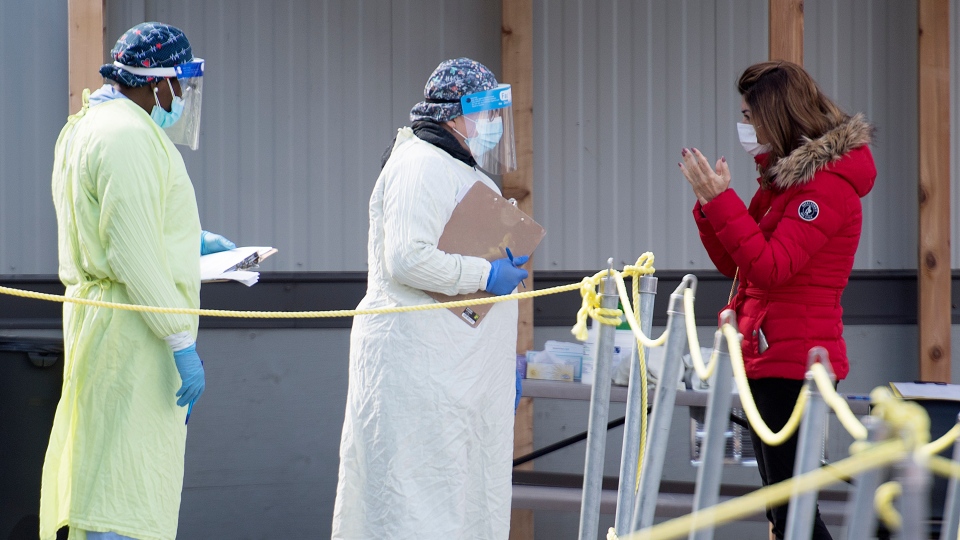
Healthcare workers talk to a woman at a COVID-19 testing clinic
Montreal, Sunday, October 11, 2020, as the COVID-19 pandemic continues
in Canada and around the world.THE CANADIAN PRESS/Graham Hughes
Public Discrimination Against Health-Care Workers in the Era of COVID-19
"I tried to explain that I've had contact but not exposure."
"They were not following the latest guidelines. They were discriminating against me because I'm a health-care worker."
"When people find out I'm a paramedic, they often step back, like, 'Oh, I can't come near you."
Sarah Nuhn, paramedic, Rockland resident
Emily Fullarton, Ottawa Paramedics.Photo: Tony Caldwell/Postmedia
"Why are they not asking the same questions of people who work in grocery stores or restaurants?"
"Our paramedics are so diligent and very highly trained in infection control measures. They've been facing this pandemic since Day 1 and have had full PPE [personal protection equipment] since Day 1. They're probably safer to be around than the person you run into at the grocery store."
"They've [paramedics] been told things like, 'You're carrying COVID and it's going to get caught in the walls' [of rental properties]."
"It's definitely taking a toll. Our peer-support group has been working full-tilt through all the different challenges that come with COVID."
Emily Fullerton, public information officer, Ottawa Paramedic Service
"Early on, health care workers were at an increased risk of getting infected, and then they started wearing personal protective equipment -- gloves, masks, visors -- and then it dropped down to almost zero."
"But in most cases it's really safe to be around a health care worker, unless there's some egregious disregard for personal protective equipment."
"If things continue and we're back into another round of lockdowns, if there are more deaths and the outbreaks continue, I expect this fear would persist, and maybe even intensify unless there were corrective measures such as education campaigns ..."
Steven Taylor, clinical psychologist, professor, University of British Columbia
North Americans discriminate
against health-care workers (Rafferty Baker/CBC)
"They're acting out of discrimination, ignorance and hypocrisy. Their fear is completely unfounded and unfair", pointed out Doris Grinspun, chief executive of the Registered Nurses' Association of Ontario. The RNAO was led to recommend that its 45,000 members not wear scrub or other professional identifying uniforms in public as a result of public behaviour. During the SARS outbreak, she pointed out, when nurses wearing scrubs were refused services at some gas stations, a similar situation prevailed.
Ian Da Silva, director of the Ontario Personal Support Workers Association remarked that roughly ten percent of the association's 43,000 members have also experienced abuse related to public fears over COVID-19 transmission. A stranger accosted one of his members at a gas station, he related, accusing him of bringing COVID to the town, while "Another is a PSW who was working in a COVID-positive home, and every day for three weeks, one of her neighbours would come out of her apartment and yell at her and say, 'I'm lodging a complaint because I do not believe you should be here, because you're dirty and you're spreading your dirt all over us'."
"The strong, good feeling that was there in the community at the beginning of the outbreak deteriorated by the time we got to June. The stigma is hurtful and demoralizing. They're trying to take care of people, and this adds a dimension of alienation they really don't need", pointed out Michael Hurley, president of CUPE's Ontario Council of Hospital Unions -- of the dissipation of the goodwill directed toward health care workers at the initial stages of the epidemic.
Health care workers have been refused appointments with other medical practitioners such as osteopaths, fertility clinics, chiropractors. They're informed that testing and examinations and consultations for personal reasons could be scheduled only if and when the applicants first take two weeks off work to self-isolate at home. The level of misinformation within the general public community is surprisingly echoed by parts of the medical community itself, it would appear. Renting housing accommodation can be another area of contention -- and refusals.
This despite that N95 masks, shields, gloves, goggles and gowns that exceed the recommendations by both the World Health Organization and the province, are meticulously used by health care workers to make certain that even should they come in contact with COVID-19 patients, they are not exposed to the virus, which still does not protect them from being viewed with suspicion. Leading to health-care workers requiring medical appointments or other services for themselves being asked questions such as whether they've come into contact with someone who may have tested COVID-positive, bypassing affirming they had been protected against transmission.
Children of paramedics living in some neighbourhoods are shunned by other children on instruction of their parents. Examples such as real-estate agents insisting that house sellers inform potential buyers that they are paramedics or other health-care personnel. Moving agencies asking paramedic clients to be absent from their home when they arrive to pack up their belongings.
A health-care worker at Vancouver's St. Paul's Hospital. (Ben Nelms/CBC)
A recent University of British Columbia study indicated an alarming number of Canadians fear, avoid and tend to stigmatize health care workers based on their belief that they are contagious. Published in the October issue of the Journal of Anxiety Disorders, the study indicated one-third of Canadians and Americans think health care workers working in hospitals likely have contracted COVID, while one in four believe health care workers should not appear in public and further, should live with restrictions on their freedom of movement. Half of those studied claimed they would not wish to be in close proximity with health care workers who professionally treat COVID-19 patients.
"At times of lockdown during the COVID-19 pandemic, alcohol consumption
can exacerbate health vulnerability, risk-taking behaviours, mental
health issues and violence." "Alcohol consumption is associated with a range of communicable and
noncommunicable diseases and mental health disorders, which can make a
person more vulnerable to COVID-19." "In particular, alcohol compromises the body’s immune system and increases the risk of adverse health outcomes." "[Governments should consider] restricting access [during the COVID-19
pandemic, complemented by] communicating with the public about the
risks [and] maintaining and strengthening alcohol and drug services." World Health Organization, Europe
"People turn to substances to cope with stress and trauma." "These substances offer an immediate source of control. Having a drink or smoking can make you feel better right away." "But long-term, as you get into addiction, then really the substance
itself is driving that cycle of coping and stress rather than the
outside environment itself." Michael Chaiton, associate professor, Dalla Lana School of Public Health
A shopper wears a mask and gloves at the liquor store. Alcohol sales
across Canada increased in March as people stocked up to stay home. (Evan Mitsui/CBC)
Alcohol-related COVID-19 misinformation is not hard to find on various social media platforms. The public was informed by health experts early in the first wave of infections from SARS-CoV-2 that alcohol consumption plays an inimical role in the novel coronavirus, enabling the virus to stake a larger claim on the human body. At first people were just having fun about Corona beer, and then things began taking an uglier turn with the word, as in the name of a young boy in Australia with that given name being bullied.
Alcohol is viewed as a social good, as a relaxant, tempering moods during times of high tension. Self-congratulating videos began appearing on Instagram and other platforms as people were eager to demonstrate how they were handling the new rules around self-segregation, having virtual on-line cocktail hours with friends. And then there were the supposedly reliable heads-up claims that alcohol would kill the virus, leading people to load up their systems with alcohol in the hopes of forestalling infection.
Leading the World Health Organization to issue a six-page instruction on COVID-19 and alcohol consumption in the public interest: "Under no circumstances should you drink any type of alcoholic product as a means of preventing or treatment COVID-19 infection." Irrespective of which Canadians, in a reflection of what is occurring on a global scale, have taken to drinking more and more frequently since the implementation of social distancing.
One quarter of Canadians aged 35 to 54 and one-fifth aged 18 to 34 respond that they have increased their alcohol consumption, even as 10 percent over age 54 report drinking more frequently, according to a Nanos poll commissioned by the Canadian Centre on Substance Use and Addiction. Rita Notarandrea, CEO of the addiction centre, points out the obvious; that stress and anxiety can lead to an increase in substance use.
"Disrupted routine may be accompanied by loneliness and anxiety about the current situation. With the possibility that people are stocking up and there is more alcohol in the home than usual, some might drink more than they typically do", added senior research and policy analyst at CCSA, Catherine Paradis.
Increased alcohol use has been recognized in many areas of the world, leaving some experts concerned that misinformation plays a role in the situation. "Consuming alcohol will not destroy the virus", the WHO urges on the public. It also addresses misconceptions about drinking and stress relief, pointing out that alcohol is known to amplify symptoms of anxiety, depression and other mental disorders.
And underlying the twin concerns of contracting COVID, and seeking relief from the pressures of stress and worry, a new survey shows half of Canadians who participated reporting their mental health situation has been exacerbated as a result of the global pandemic. The Angus Reid Institute set out to illuminate how economic uncertainty and social distancing measures caused by the pandemic affect the psychological balance of Canadians.
When asked to describe their primary emotions in recent weeks, 44 percent of respondents stated they are worried, 41 percent that they're anxious, and 30 percent that they are quite simply bored.
A liquor store lineup is 50 people deep in downtown Toronto as shoppers await their turn, CBC
Awarding Public Gratitude for Health Professionals During the Time of COVID-19
"She was concerned that I would expose her to the COVID virus and
since she was considered a high-risk person, she just couldn't rent the
room to me." "I can absolutely understand her point of view and agree with her concerns. I'm just upset because she chose the day I was supposed to be
moving into her home when I've already made all the arrangements and
paid her all the money. And now I have nowhere to go." "I do understand that they're concerned and I would be, too, but as a human being who serves my public and serves my community
and puts a lot of life into it, I'm really kind of saddened and upset
that I have no place to go and no one to help me." Ottawa nurse Kathrine Slinski
“I called my friend. I didn’t know what to do. I told [the police officers], ‘I am a nurse. I just got home from work. It’s late'." "They just said: ‘We don’t care. Your landlord wants you out, and you have to go now'." "I feel totally humiliated by this experience, and I don’t want to draw
attention to myself. I need to be able to go in to work
to do my job, completely focused on my patients." "I told her selfish people die first. If I get the coronavirus, I will
share it with her. I know that was wrong and that I
shouldn’t have said that. But I was so frustrated and stressed out by
this woman." Toronto nurse Gigi
Gigi, a Toronto nurse who was recently evicted, found support among
local politicians after telling her story “so no one else can lose their
home like I did.” - Steve Russell/Toronto Star
"DEEPLY ANGUISHED" "All precautions are being taken by doctors & staff on #COVID2019 duty to ensure they're not carriers of infection in any way." Health Minister Harsh Vardhan, India "Going to and from work in my scrubs, I often watch people take two steps back away from me." "I think the concern is that any health-care provider is contagious themselves." Chicago nurse "We see how in Italy a nurse leaves her home to go to work and people applaud." "But here we see these sad situations." Fernando Rios Quinones, spokesman, Guadalajara state health department, Mexico
A doctor examining a suspected coronavirus patient
in the isolation ward at Patna Medical College and Hospital, on 14
March, without protective gear. As they prepare to confront a wave of
COVID-19 cases within an already under-funded public health
infrastructure, healthcare workers in various parts of India have raised
concerns about the shortage of supplies such as masks, coveralls,
gloves, among others, that will protect them from contracting the novel
coronavirus.
Santosh Kumar/Hindustan Times/Getty Images
The heroes society salutes at a time of mass terror while a highly infectious, deadly new virus whose properties are still not fully understood but whose toll on people's health and mortality has cut a wide, destructive path through the global community while medical science feverishly works overtime in an effort to find some way to stop it, to control it, a vaccine that will protect populations, have also become the targets of some minority segments of the global population, fearful of being contaminated by health workers they view as carriers, given their proximity to COVID-19 victims. "We are sure you have corona!" shrieked a woman toward a psychiatrist at a government hospital in western India, as Sanjibani Panigrahi finds the neighbourhood in which she lives viewing her as a threat. "We will not allow you in the building", she has been informed. Health-care workers in some cities are applauded for their self-sacrifice, their dedication to their profession, placing themselves in harm's way in exposure to a virulent threat, and in other places the long hours they pit in as they struggle to save people from the coronavirus effects, gains them suspicion and fear as a carrier.
Filipinos are attacking and eschewing frontline medical workers on misguided fears they carry the lethal coronavirus Asia Times
Mexican state authorities are concerned enough about this trend so have arranged special buses for nurses. Hospitals urge nurses in parts of Australia, not to wear their uniforms in public, as a way to avoid attacks. Philippine President Rodrigo Duterte ordered police to protect health workers in the wake of assaults, one of which saw bleach thrown at a hospital employee's face. Doctors and nurses worldwide have contracted COVID in the pursuit of their professional duties aiding those stricken with the virus, only to be themselves cut down by its deadly effects. Health workers worry about their patients' plights and do their utmost to help save them, while concerned at the same time of the universal shortage of personal protection equipment for medical personnel, leaving them even more vulnerable to disease transmission. "I understand people are afraid, but abusing doctors is not OK. We are at risk more than them", stated Ms.Panigrahi. Local police and politicians intervened over the harassment she had suffered and ultimately her neighbours apologized, excusing their behaviour by professing fright over her proximity. In Delhi, a doctors' association wrote to the central government that health workers being evicted by landlords over their work had nowhere to turn to. "Many doctors are now stranded on the roads with all their luggage, nowhere to go, across the country." In Quezon province in the Philippines, a man shot at an ambulance driver to stop it from entering a subdivision where he was concerned the virus would be spread. The ambulance driver from the Peter Paul Medical Center of Candelaria was transporting hospital personnel, not patients. "Moreover, proper cleaning and disinfection of the vehicle is done on a regular basis", explained the hospital.
People protest the construction of a coronavirus testing center in Abidjan, Ivory Coast, on Monday. Legnan Koula, Shutterstock
A nurse in Chicago informed a local television channel she had been punched in the eye while on a public bus by a man who accused her of spreading the virus. Protesters in Abidjan, Ivory Coast attempted to destroy a coronavirus testing centre under construction. Social media aired videos showed people ripping wood planks off the structure while police fired tear gas canisters. "They want to kill us" -- one of the rioters told Reuters -- with a treatment facility close to their homes. Authorities are concerned that such attacks and insults might serve to demoralize health workers. "If we continue to harass them, more of them will quit their jobs, and our health-care system would be in danger", stated Reigner Antiquera, president, Alliance of Young Nurse Leaders and Advocates, in the Philippines.