Ruminations

Blog dedicated primarily to randomly selected news items; comments reflecting personal perceptions

Tuesday, August 15, 2023

Exposure to Green Nature's Benefits

"Our study shows that being near green space caused some biological or molecular changes that can be detected in our blood."
"[Biological age] really depends on what we do daily [including what we eat and how physically active we are]."
Lifang Hou, preventive medicine professor, Feinberg School of Medicine, Northwestern University

"We know the benefits of green space in reducing premature mortality."
"This study explains how this could happen by describing how green spaces can modify how genes are expressed."
David Rojas-Rueda, epidemiology professor, Colorado State University

"This is one of the first studies that really kind of demonstrates how exposure to nature, living in greener areas, may get under our skin and lead to these kinds of fundamental changes to these biomarkers of aging."
"We have this vegetation data, but it tells us very little about what the active ingredients in nature are that influence health. It just tells you the quantity of vegetation in a given area around your home."
"We need to start changing our perspective on green space and really viewing it as an essential piece of infrastructure, just the same as sewer systems and garbage collection."
"This is something that we require as human beings to thrive, to be healthy."
Peter James, environmental epidemiologist, T.H. Chan School of Public Health, Harvard

According to a study published recently in the journal Science Advances, living near heavily green spaces could be a great aid in allowing us to live longer, healthier lives. The study suggests that long-term exposure to greenery where you live can led to adding 2.5 years to your life on average. The result of the paper's conclusions adds to existing knowledge of health benefits gained by living around greenery.

The study sheds increased light on how nature can affect our bodies. Long-term exposure to surrounding green spaces and how that affected biological aging among a group of over 900 people in four U.S. cities formed the basis of the research. The researchers compared age-related biological alterations in the study participants over a 20-year period against data on green spaces near where those participants live in their goal to explore the association between long-term green benefits exposure and aging.

With the use of blood DNA, the researchers were enabled to measure biological age at a molecular level through analyzing small changes in how genes related to the aging process work, explained Dr. Hou. Should an individual's biological age, sped up or slowed down depending on how they live, be seen as older than their chronological age, they could be at higher risk for developing age-related conditions like cancer, cardiovascular disease or Alzheimer's, explained Dr. Hou.
 

The study emphasized that not only is it about what each individual actively engages in for their own health, but as well their neighbourhoods and communities. Satellite imaging was used by the researchers to assess green spaces, applying a widely-accepted measure of quantifying vegetation, explained the study's lead author, Kyeez Kim, a post-doctoral researcher at the Feinberg School of Medicine, at Northwestern University. Major parks were also identified close to participants' homes.

That helped to identify the location and quantity of plant life; the approach however, fails to provide details regarding the type of vegetation -- whether an area is a golf course or a forested nature trail -- or quality of green space. Greater details of the green spaces under study and what people might be engaged in within those landscapes, is critical, according to Karen Seto, director of the Hixon Center for Urban Ecology at the Yale School of the Environment.

"Because we don't know what type of green space it is, I think for cities, they don't know is it sufficient just to plant a bunch of street trees?" Other questions were left unanswered by the study; as for example, why the rate of biological aging appeared different across race, gender and socioeconomic status. Black people, the researchers observed, who had more access to green space realized only an advance of a single year younger in biological age in comparison with the study's average of 2.5 years.

The results of the study even so, are meant to encourage people to think more about their surroundings, when making healthy living decisions, along with observance of a healthy diet, adequate sleep and daily exercise, urged Dr. Hou. And, added Dr. James, the study should also serve as motivation for policymakers to incorporate nature into people's daily lives. More parks and better access to community parks in dense neighbourhoods, for a start.


Labels: , , , , ,

Thursday, September 06, 2018

Seeing Stars

"Look up at the stars and not down at your feet."
"Try to make sense of what you see and wonder about what makes the universe exist."
"Be curious. And however difficult life may seem, there is always something you can do and succeed at."
"It matters that you don't just give up."
Dr. Stephen Hawking, Cambridge University, 2012

Sagely poignant advice from someone whose life was challenged in such an extreme manner that anyone else might simply surrender to the reality of a mind struggling to express itself in a body that nature had abandoned to a long, agonizing downward spiral of failure. A man who overcame obstacles that would have truncated anyone else's expectations for the future. A man determined to use whatever resources he had to the fullest, despite the wholesale disadvantage of a disintegrating body. And who succeeded beyond the wildest imagination of doctors. In the process creating a different type of celebrity awe in the public awareness of the possible transcending the impossible.

At George Mason University in Virginia, 97 students were asked to complete a series of personality questionnaires by researchers Todd Kashdan and Michael Steger. A diary was to be kept and updated for a three-week period. The researchers, analyzing the results, found that respondents scoring high on curiosity found more enjoyment in life and had the impression that their existence was suffused with more meaning than those in comparison who tended to be inward-looking.
FastCompany

A survey of over 1,200 Swiss and American adults found that the qualities linked to high levels of satisfaction in life were love, gratitude, curiosity and perseverance. A finding that Christopher Peterson at University of Michigan along with Dr. Willibald Ruch who led the survey, was found to validate Professor Hawking's advice that determination and a sense of purpose leads to personal well-being. Linked to our personal views on life's values is the way we physically carry ourselves.


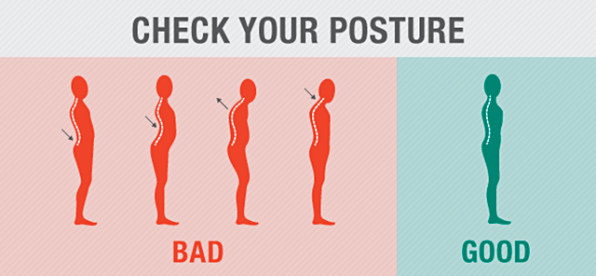
According to a study by John Riskind at Texas A&M and Carolyn Gotay at the University of Calgary, people who slump rather than stand upright surrender more readily when faced with difficult tasks. Slumpers appear to report greater stress than their counterparts in the study whose posture was upright. Volunteers were asked to generate positive or negative thoughts while either slumped or in an upright position by Vietta Wilson at York University in Toronto and Erik Peper at San Francisco State University. Those participating in that study reported finding it to be significantly easier when upright to produce positive thoughts.

At the University of Auckland in New Zealand, Carissa Wilkes and her colleagues recruited 74 individuals suffering from mild-to-moderate depression in a test to determine whether upright posture might alleviate low moods. Asked to either assume their usual position (slumped) or instructed to sit upright, mood and fatigue levels of participants were then assessed, everyone assigned two stress tests; to prepare and deliver a speech.

While delivering their speech, those who stood upright delivered a more relaxed, fulsome speech, and distinguished themselves by scoring higher for positive mood and self-esteem, while reporting feeling less fatigue than their slumped counterparts. Focusing outward rather than inward, considering our environment, working to solve problems as they are presented throughout life, assures that people feel more fulfilled, content with life and purposeful.

Labels: , , ,

Tuesday, May 15, 2018

No Rehearsals for the Stage of Life

"Life expectancy is the number of years on average a person is expected to live based on their age, gender and country. The Global Burden of Disease calculates life expectancy by using a country's mortality rates across age groups."
"Life expectancy may vary for people of different ages because it is calculated as the number of years a person is expected to live given they have already reached a certain age."
"For example, a girl born in 2016 in Mexico is expected to live to age 79, however the life expectancy of a 65-year-old woman in Mexico in 2016 is 84. Her life expectancy is higher because she has already reached 65 and is therefore more likely to live another 20 years."
BBC News, Health Metrics and Evaluation


"Meditation urges you to focus on your breath. It's the same thing with remembering that you're mortal."
"You forget, so you need something strong, someone telling you straight out."
Hansa Bergwall, founder, WeCroak

"I think, 'oh my gosh, I can wash dishes with a smile, I can talk on the phone', knowing all the while that this life is not a dress rehearsal."
"It helps me enjoy the moment."
Karen Rosenberg, 50, Miami

"One should be free to use the rest of one's life as one chooses."
"If one chooses to kill oneself, then that's fair enough. I don't think anyone else should interfere."
David Goodall, 104-year-old Australian scientist
Dr. Goodall, a man with influence in the world of science lived a good life. After his retirement as a senior scientist with three doctorates working for an Australian science agency, he took up work as an honourary research associate in Perth at Edith Cowan University until he reached 102 years of age. The last two years of his life gave him no pleasure, he explained, because of his deteriorating health.

When he was no longer mobile, could no longer perform as an actor, and was unable to continue driving, he decided he had lived long enough. He travelled to Switzerland to take advantage of their laws permitting assisted suicide helped by an assisted-suicide advocacy group, Exit International.

He had fallen, living alone in his apartment and it was two days before he was discovered, in distress. "It was just the beginning of the end", said a friend. "I've lived quite a good life until recently", Dr. Goodall said in an interview. "The last year has been less satisfactory for me because I couldn't do things", he explained, before his voluntary death.

This was a man who had lived well and long. Others are less fortunate. Many seek the unknown formula that would serve to prolong life, and keep them healthy in the process. Some believe that they have discovered that formula, a kind of elixir of long-life. An American nutritionist, Clive McCay in the 1930s after feeding his laboratory rats a low-calorie diet concluded that though they were extremely thin they were active, looked healthy and two of them reached the equivalent of 130 years.

He felt compelled to lend himself to the experiment of emulating the rats' restrained diet, began eating very limited food grown on his own farm, and he too remained fit and trim. Until he had two strokes and lived to only 69. There are others, and quite a few who strive to find that elusive formula. Euell Gibbons thought he had, in his enthusiasm for wild foods that led him to advocate a plant-based diet. His enjoyed his own until he experienced an aortic aneurysm, and died at 64.

Nutritionists of note have been on record as promising great benefits to those who scrupulously maintained the diets they recommended. Nathan Pritikin's gospel was that of low-fat diets and like Dr. Robert Atkins who espoused a direct opposite regimen, both died at 69. Refined foods such as white bread were anathema to Adelle Davis. She lived to age 70 despite taking great care with her diet and encouraging others to do the same. She died of cancer.

It is not the easily led and the ignorant who desperately look for something that will guarantee them longevity. Take, for example, Valter Longo, director of the University of Southern California Longevity Institute, who seems convinced that the multiday fasts he swears by will extend his life. Some scientists in pursuit of anti-aging therapies take the diabetes drug metformin believing it has properties to protect cells from aging.

In the hopes that vitamin B might be a defence against aging, biochemist Charles Brenner drinks milk with high doses of nicotanamide riboside, a type of vitamin B. And then for a completely alternate diversion there is WeCroak, an app designed to alert anyone who downloads it, five times daily to their phone with messages such as: "Don't forget, you're going to die". If you don't care for that one, there are others: "The grave has no sunny corners." Or how about: "Begin again the story of your life."

So do we really need reminders that we're mortal? To help us appreciate the fact that we're not yet dead? To remind us that life is wonderful, even at those times when it doesn't appear to be? Does this mean that we're not capable of our own volition and appreciation of existence to look forward to each day and make the most of it? To immerse ourselves in the wonders of nature? To truly appreciate our relationships with those who mean much to us emotionally?

Does attitude to life and fulsome acknowledgement of how wonderful it is to be alive, to be sensitive to everything surrounding us, to love and to hold, to plan and to experiment, to be ourselves to the fullest of our abilities help at all? Many are convinced that those who value life and live with a positive attitude and expectations win half the battle; their genetic endowment, lifestyle and geographic location complete the other half.

Mind, we cannot escape bad fortune when it comes knocking.

But we can make the most of what we have, and with what we have groom ourselves to enjoy our lives and as we do, help others to do the same. Can't we! No magic required. The power of positive thinking, on the other hand....

Life expectancy calculator promo


Labels: , , ,

Monday, August 14, 2017

Eat Well, Exercise, Sleep Well, Enjoy Life!

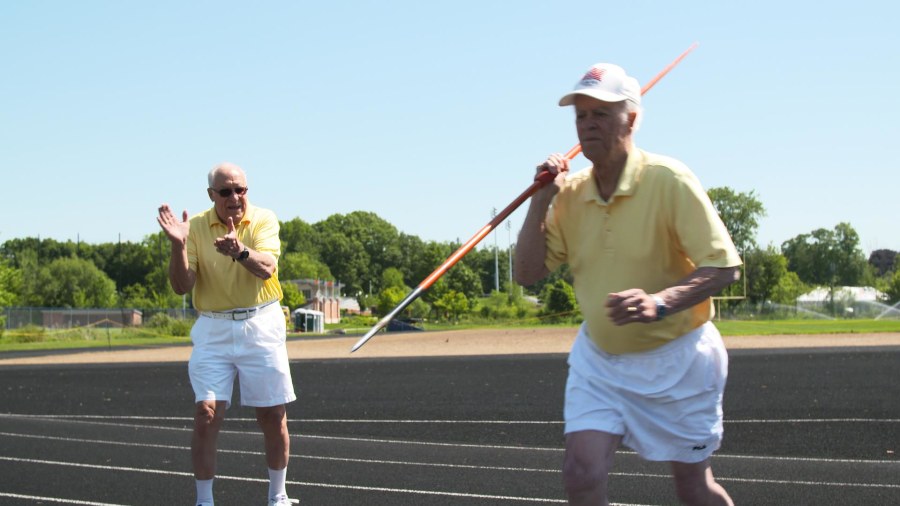
"My secret of life is to wake up every morning with something to do."
"Some people I feel are old because they allow themselves to get old. When people ask me how I'm able to do what I can do, I say I never did quit trying."
Warren Berger, 95, Chattanooga, Tennessee, national high-jump record, 94 - 99 age bracket

"Individuals in favourable cardiovascular health at younger ages not only live a longer life, but live a healthier life and a greater proportion of life free of morbidity."
Chicago-based study

"My research looks at why no one wants to be old. They want to set themselves apart from this negatively viewed age group. They just want to distance themselves from stereotypes; 'I'm not like the stereotype. I'm different'."
"Adults who believe age is just a umber showed better memory performance, but adults who believed aging is set in stone and fixed had a decrease in memory performance and a stronger stress reaction."
Dr. David Weiss, assistant professor, sociomedical sciences, psychology, Columbia Ageing Center, Columbia University, New York

"One of the most unique and novel aspects of this study [published last year in the Journal of Applied Physiology]. is the exceptional participants."
"These are individuals in their 80s and 90s who actively compete in world masters track and field championships. We have seven world champions. These individuals are the crème de la crème of aging."
"Therefore, identifying opportunities to intervene and delay the loss of [nerve and muscle fibres] motor units in old age [through exercise] is of critical importance."
"Exercise is definitely an important contributor to functional performance. Staying active, even later in life, can help reduce muscle loss."
Dr.  Geoffrey A. Power, professor, Department of Human Health and Nutritional Sciences, University of Guelph

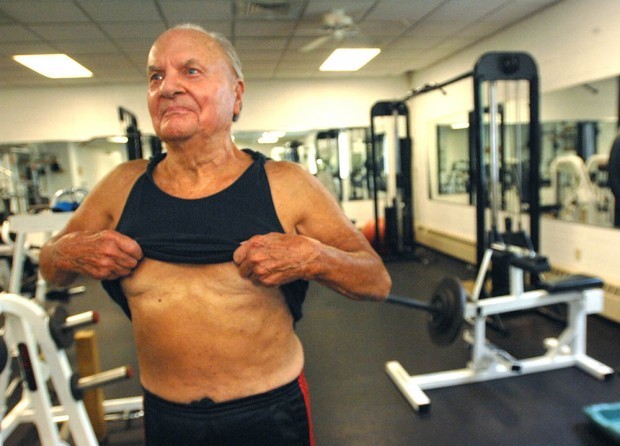
Exercising octogenarians
Glenn Bradd, who will turn 87 later this month, shows his six-pack after working out at the Bloomington-Normal YMCA. (The Pantagraph/Steve Smedley) 
Setting the stage at an early age when most people barely think of themselves into an elderly future is like paying a monthly insurance fee. Anyone who looks ahead to consider what their health might be like, how long they may live and how much quality their lives might hold, should consider how best to be healthy while they're young. The American Heart Association has created a formula, the contents of which will not be new to anyone. The guide of seven issues that all add up to healthful living is simple enough. 
  1. Manage blood pressure because when it stays within a healthy range the strain on heart, arteries and kidneys is reduced.
  2. Control cholesterol because high cholesterol contributes to clogging your arteries with plaque buildup, in turn leading to heart disease and stroke.
  3. Reduce blood pressure since over time high levels of blood sugar may damage heart, kidneys, eyes and nerves.
  4. Get active for, as anyone knows, daily physical activity is an assist in managing blood pressure, blood sugar and stress, increasing quality of life and longevity.
  5. Eat better because following a heart healthy diet improves opportunities for feeling and staying healthy throughout your life.
  6. Lose weight because when you lose extra fat and unnecessary pounds you also reduce the burden on heart, lungs, blood vessels and skeleton.
  7. Stop smoking for the simple and unalterable reason that smokers are at higher risk of developing cardiovascular disease (and lung cancer). 
According to Statistics Canada, one in four Canadians will be over 65 years of age by the year 2031. The Life's Simple 7 guidelines represent the seven lifestyle habits meant to keep your heart healthy and to reduce the risk of other types of chronic illness -- and for the present and the future, the requirement for both short- and long-term medical care and hospital stays.

Heart disease, according to the Heart Research Institute, burdens the Canadian economy to the tune of $20.9-billion annually and with 33,600 lives lost yearly by heart disease, represents Canada's number one killer. A recently published study based in Chicago examined the medical history of 25,804 men and women following them from middle age until age 54 to determine whether longer life came with good health.

The study concluded the risk of ignoring the Simple 7 recommendations in early adulthood and middle age  has its consequences up to 43 years on by earlier onsets of chronic disease on an average of four to five years, compared to people who had recognized the value of living a heart-healthy lifestyle. These same people benefited as well with a life of 3.9 years longer duration than those who paid no attention to two or more of the Simple 7 points.

Ditching a sedentary lifestyle for exercise such as just moving oneself about, going out for walks, swimming, or hiking, bicycling, attending fitness classes, all have a place in a healthy lifestyle, just as a diet emphasizing whole grains, fruits and vegetables, and fewer processed food choices all help to control cholesterol, blood sugar in balance, and keep excess weight gains at bay.
Still from video -- Today

Carl Reiner, 95 year old writer, comedian, director, creator of the 1960s hit sitcom The Dick Van Dyke Show and 91-year-old Mel Brooks enjoy a close relationship based on their show business backgrounds. Reiner's 22nd book -- Too Busy to Die -- recently published, represents one of five books he has had published since turning age 90 and he is planning two additional books.

Advice sex therapist, 89-year-old Ruth Westheimer is busy, out of the house six nights a week visiting with friends and family, and serving on several boards. Her advice? "Do as many things that are enjoyable ... as possible -- participating in activities at a senior centre, going to the theatre and movies and not just sitting home and saying, 'I'm too old to be out there'." And, she says: "I'm very busy. I'm teaching at Columbia. I'm coming out in 2018 with three new books." Beat that.

Labels: , , , , ,

 
()() Follow @rheytah Tweet