Ruminations

Blog dedicated primarily to randomly selected news items; comments reflecting personal perceptions

Tuesday, August 15, 2023

Exposure to Green Nature's Benefits

"Our study shows that being near green space caused some biological or molecular changes that can be detected in our blood."
"[Biological age] really depends on what we do daily [including what we eat and how physically active we are]."
Lifang Hou, preventive medicine professor, Feinberg School of Medicine, Northwestern University

"We know the benefits of green space in reducing premature mortality."
"This study explains how this could happen by describing how green spaces can modify how genes are expressed."
David Rojas-Rueda, epidemiology professor, Colorado State University

"This is one of the first studies that really kind of demonstrates how exposure to nature, living in greener areas, may get under our skin and lead to these kinds of fundamental changes to these biomarkers of aging."
"We have this vegetation data, but it tells us very little about what the active ingredients in nature are that influence health. It just tells you the quantity of vegetation in a given area around your home."
"We need to start changing our perspective on green space and really viewing it as an essential piece of infrastructure, just the same as sewer systems and garbage collection."
"This is something that we require as human beings to thrive, to be healthy."
Peter James, environmental epidemiologist, T.H. Chan School of Public Health, Harvard

According to a study published recently in the journal Science Advances, living near heavily green spaces could be a great aid in allowing us to live longer, healthier lives. The study suggests that long-term exposure to greenery where you live can led to adding 2.5 years to your life on average. The result of the paper's conclusions adds to existing knowledge of health benefits gained by living around greenery.

The study sheds increased light on how nature can affect our bodies. Long-term exposure to surrounding green spaces and how that affected biological aging among a group of over 900 people in four U.S. cities formed the basis of the research. The researchers compared age-related biological alterations in the study participants over a 20-year period against data on green spaces near where those participants live in their goal to explore the association between long-term green benefits exposure and aging.

With the use of blood DNA, the researchers were enabled to measure biological age at a molecular level through analyzing small changes in how genes related to the aging process work, explained Dr. Hou. Should an individual's biological age, sped up or slowed down depending on how they live, be seen as older than their chronological age, they could be at higher risk for developing age-related conditions like cancer, cardiovascular disease or Alzheimer's, explained Dr. Hou.
 

The study emphasized that not only is it about what each individual actively engages in for their own health, but as well their neighbourhoods and communities. Satellite imaging was used by the researchers to assess green spaces, applying a widely-accepted measure of quantifying vegetation, explained the study's lead author, Kyeez Kim, a post-doctoral researcher at the Feinberg School of Medicine, at Northwestern University. Major parks were also identified close to participants' homes.

That helped to identify the location and quantity of plant life; the approach however, fails to provide details regarding the type of vegetation -- whether an area is a golf course or a forested nature trail -- or quality of green space. Greater details of the green spaces under study and what people might be engaged in within those landscapes, is critical, according to Karen Seto, director of the Hixon Center for Urban Ecology at the Yale School of the Environment.

"Because we don't know what type of green space it is, I think for cities, they don't know is it sufficient just to plant a bunch of street trees?" Other questions were left unanswered by the study; as for example, why the rate of biological aging appeared different across race, gender and socioeconomic status. Black people, the researchers observed, who had more access to green space realized only an advance of a single year younger in biological age in comparison with the study's average of 2.5 years.

The results of the study even so, are meant to encourage people to think more about their surroundings, when making healthy living decisions, along with observance of a healthy diet, adequate sleep and daily exercise, urged Dr. Hou. And, added Dr. James, the study should also serve as motivation for policymakers to incorporate nature into people's daily lives. More parks and better access to community parks in dense neighbourhoods, for a start.


Labels: , , , , ,

Saturday, May 22, 2021

The Dread Lyme Disease

"What we see a lot -- both with pain and Lyme disease -- is that when we can't provide a good explanation about what's going on, we act like it's somehow the patient's fault. Like it must be all in their head."
"Imagine if you had these terrible symptoms and they occurred every day and they got in the way of your ability to socialize, to work, to enjoy your family -- and people kept telling you that you were making ti all up. That's a terrible way to live. It's a challenging problem and one that we would like to reverse."
"We're starting from the idea that people's symptoms are real and we want to hear about them. Sometimes in these studies we treat variations and individual differences as 'noise'. We'll say, 'This person doesn't really fit the profile of what we're looking at. Maybe we should study someone else who fits better'. What we're saying with this study is 'We've got you'."
"There's been lots of good research on Lyme disease and we've got some good treatments now, but a lot of people are being left behind. We're hoping to narrow that gap."
Dr.Tim Salomons, professor of psychology, pain research, Queen's University, Kingston, Ontario

"I told my daughter the other day that living and dealing with colon cancer is so much easier than living with Lyme."
"Doctors believe you and they're willing to treat you [with cancer], whereas with Lyme disease it's so painful trying to find a doctor who is actually willing to listen to you and treat you."
"Most doctors are afraid. There's so much backlash against Lyme."
Julie Konzuk, environmental engineer, Brampton, Ontario
How to Keep Kids Safe From Ticks
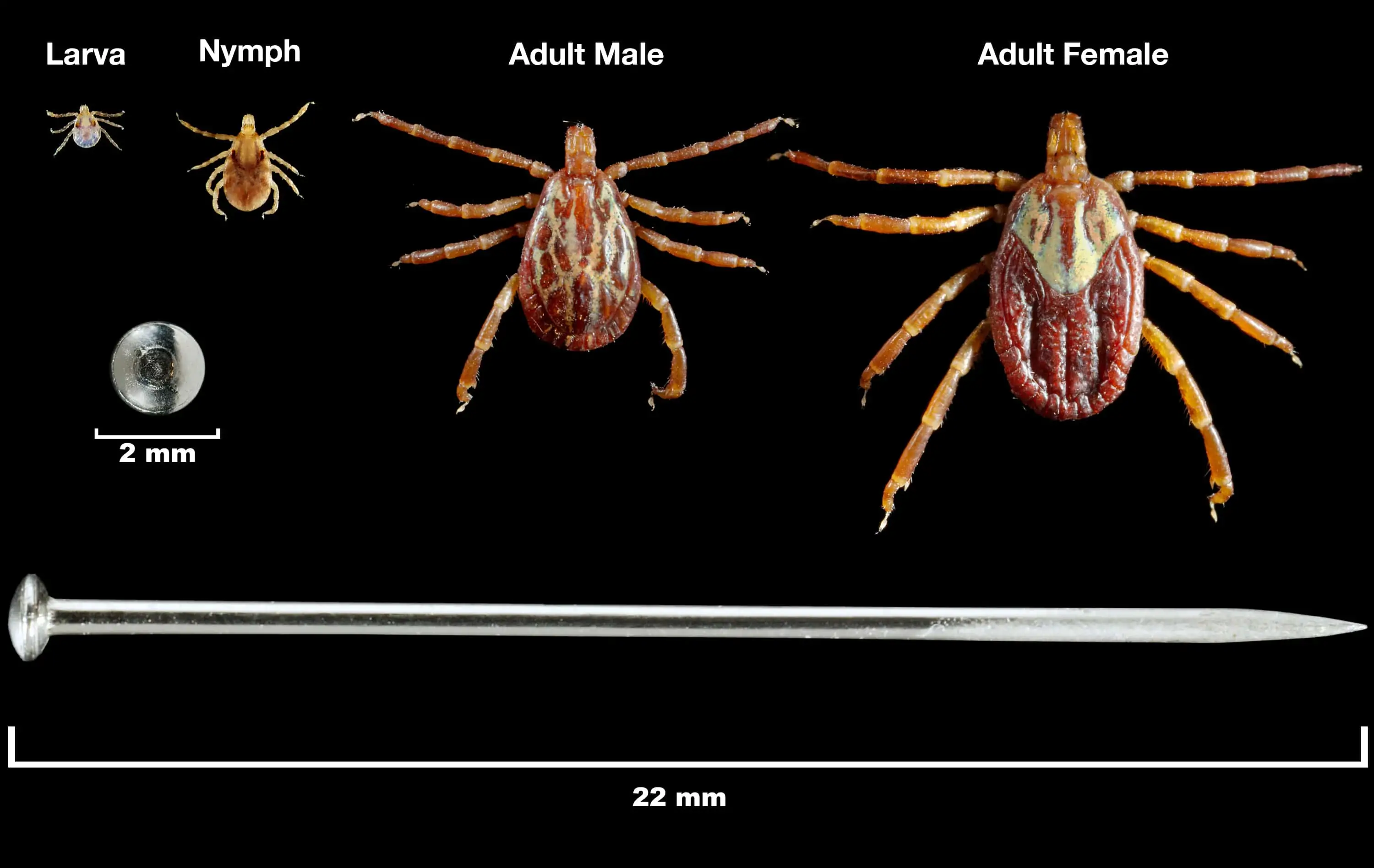
Fourteen years ago while on a job site in Virginia, environmental engineer Julie Konzuk contracted Lyme disease through tick bites. Usually in the spring months deer ticks, also called black-legged ticks, fasten themselves to any exposed flesh when people (or animals) walk through forests or tall grasses. Once a tick latches on it begins to engorge itself with its victim's blood over a period of time, and this can be overlooked by the afflicted person, feeling nothing, oblivious to the presence of the tick. At the point of entry before drawing blood, the tick injects an anesthetic; little wonder people are unaware they're bitten and the tiny tick is drawing blood. And at the same time conferring on its victim a miserable affliction that can entirely change their lives.

In that fourteen years since Ms.Konzuk was diagnosed with Lyme disease, as a result of her exposure to black-legged ticks infected with the bacteria that cause Lyme disease, she has been prescribed countless regimens of antibiotics, and she has tried naturopathic remedies, but the fatigue, headaches and muscle pain always return. Shortly after she was exposed to the tick bites she suffered searing headaches, face and joint pain, severe fatigue sapping her energy and "brain fog", leaving her forgetful of her normal vocabulary. It took a matter of weeks and she lost 10 kilograms of weight.

She underwent round after round of therapeutic antibiotics, resulting in brief temporary respite, but her symptoms always returned. Some doctors refused her treatment, citing the many she had already undergone. Simultaneously she also suffers from Stage 4 colon cancer, the treatment of which she is better able to accept than the frustration and pain of living with Lyme disease. It is precisely her experience, mirroring that of many other people who have contracted Lyme disease that the new research project headed by Dr.Salomons hopes to address.
 
How to Identify Tick Bites | IGeneX Tick Talk
Lyme-bacteria-carrying ticks slowly made their way from the south-eastern United States into Canada over the years. Now, in the Ottawa area the last five years has seen these ticks become well established. There were 22 recorded cases of Lyme disease in 2014; by 2019 that number had risen to 181, and last year the number reached 120. In some areas of the city, of the ticks collected, two-thirds tested positive for the Lyme-causing bacteria. The surveillance has been placed on temporary hold while all attention has been focused on the coronavirus pandemic. Strangely enough symptoms of both COVID-19 and Lyme overlap.

The research team from Queen's University partners with experts in genetics, antibiotic resistance, biochemistry, pain research, and environmental and ecological factors. Their focus is analyzing the collection of experiences people living with Lyme disease relate to them, in hopes they can more fully understand more about the various ways the disease can manifest its presence. "There may be one person whose symptoms perhaps seem atypical, but if you put them all together then maybe there's a bunch of people in the Ottawa area that have similar symptoms. 
 
"And people in Vancouver might have different symptoms. Once we have a lot of data, we can cluster those people together and have a basis for our other studies", explained Dr. Salomons.

Help! I've gotten a tick bite. Now what do I do?

Labels: , , , , , , , , ,

Friday, July 03, 2020

Ravaging Forests

"Our forests are under attack here in Eastern Ontario. We had the forest tent caterpillar. Now we've got the Gypsy moth. And you've got the drought. We're getting  hammered."
"We knew they were here. We just didn't know what numbers there were. It really blew up at this end of the province."
"You can scrape those [egg masses laid by the moths] off the tree and destroy them. You can use soapy water or you can just crush them."
"If people want to take matters into their own hands, that's something you can do, especially if you're a cottage owner. But it's very difficult to do if you have a woodlot."
"Our regional forest health network is watching at what's coming at us from across the border in the States. We're looking at oak wilt. We're looking at hemlock woolly adelgid. The list goes on."
"But right now, it's the Gypsy moth."
Jim McCready, forester, arborist, Eastern Ontario
A full-grown gypsy moth caterpillar, about 6 cm in length, in late June. Joe Shorthouse

Mr. McCready is past president of an agency dedicated to protecting and managing forests of the region of eastern Ontario. He has identified the Gypsy moth hatch this year as being particularly acute for the health of the forest mass, a destructive outbreak in a wide swath across the region. Foresters failed to anticipate that this year would be particularly bad for the presence of the moths in huge, destructive numbers. On top of which is the problems generated for the forests by a years'-long drought situation, leaving trees in an already weakened state, vulnerable to the damage caused by the moths.

My daughter lives on a rural property on White Lake, not far from Arnprior. She's seen such infestations before, but her trees have been impacted by the drought situation where no rain of any significance has fallen year after year, even when more than ample rain falls a little further to the north-east where we live, and where there has been no paucity of rain whatever. Here, in the Ottawa area, rain has been a constant throughout the spring, to the extent where the vegetation growth in our nearby forests have been even more vigorous than usual.

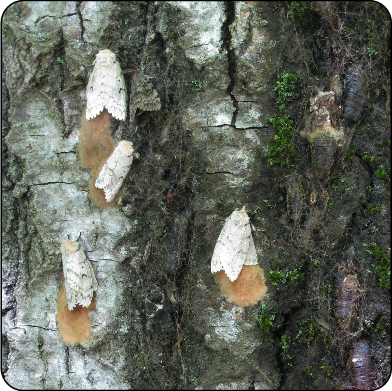
Gypsy moth adults laying eggs
Mature female Gypsy moths laying egg masses

Originating in Europe, the
Gypsy moth is one of many invasive species that have devastated local forests. Several years ago it was the Emerald Ash borer beetle that destroyed ash trees. Those that were cut down years back in an effort to stop the advance of the beetle and to protect woodland hikers from the potential of falling trees, are struggling to re-establish themselves, putting out new growth around the ash stumps in a bid to survive.

In 1859 a silkworm breeding experiment took place in Massachusetts with the Gypsy moths. While the experiment failed to succeed, the gypsy moths themselves succeeded in escaping, becoming a destructive pest in an environment where it has no natural predators. The caterpillars can grow to over six centimetres in length, recognized by bristles and a twin row of blue and red dots on their backs. A square metre of foliage will do an individual caterpillar initial to pupation and hatch, when it becomes a grey-brown moth in late summer.

The caterpillars have been present in Ontario since 1969, with intermittent outbreaks. Creeping up trees to feed in the canopy at night, they creep back down during the day making themselves less visible. Forest tent caterpillars, native to the region, feed early in spring and summer when they present an outbreak, so trees have the opportunity to put out a second covering of foliage. With fewer predators compared to the tent caterpillars, the Gypsy moths wreak far more lasting damage.

The only bright spot in defence against their depredations is a virus called baculovirus that they're susceptible to, that destroys the caterpillars from inside out.They lay buff-coloured egg masses on tree trunks providing an opportunity for the less squeamish to scrape them away and destroy them before hatching.


Labels: , , , ,

Saturday, December 01, 2018

Forest Preservation

"These trees [surviving wildfires] are lifeboats. There are some places in the landscape that seem to avoid fire time and time again."
"[A strategy for preserving refugia evades ecologists as yet]. That requires identifying where they are and why we think they're important."
"[If researchers can agree, an atlas of fire refugia could result]. That would be sort of the Holy Grail."
Meg Krawchuk, Oregon State University
Fire watch
What are fire refugia?: Wildfires are familiar landscape disturbances in forested ecosystems of western Canada and the United States that result in mosaics of fire effects. The concept of burn severity is used to quantify biological, physical, and chemical effects of fire, and can be broadly defined as the degree to which an ecosystem changes as a result of fire. Landscape heterogeneity produced by burning, which can include a range in severity from unburned patches to high severity fire, is important to conserving characteristic biodiversity of fire-adapted ecosystems. As a part of the burn mosaic, areas that experience comparatively low-severity fire or remain unburned are landscape legacies that can provide an essential environment for species sensitive to fire, and support populations that contribute to the reassembly of biotic communities after fire. Fire islands, residuals, remnants, skips, shadows, refuges, refugia, or unburned patches are all terms used to describe areas at the low end of the burn severity spectrum. Here, we use the term fire refugia to describe places that are disturbed less frequently or less severely by wildfire than the surrounding landscape matrix. Refugia can exist at a range of spatial scales, e.g., from an individual plant or small patch of vegetation to broader landscapes. And refugia can occur across a range of temporal scales, persisting only in the short term through a single fire event or in the longer-term through multiple events. The term fire refugia is adapted from the broader concept of refugia as places providing environmental stability and facilitating species persistence as regional biotic and abiotic environments change. An understanding of the processes and patterns of fire refugia formation, maintenance, and ecosystem role across multiple spatial and temporal scales is critical as we (society) strive(s) to meet landscape fire management and ecosystem restoration goals, now and into the future.
Landscape Fire and Conservation Research Group, Oregon State University

wildfires
Firefighters try to stop a wildfire as wind drives embers across Highway 20 near Clearlake Oaks, Calif., on Sunday, July 1, 2018. (AP Photo/Noah Berger)

"We might have a change of wind, it cools down at night, and the fire might not grab that patch of forest."
Arjan Meddens, University of Idaho
Trees and plants manage to survive even while forest fires rage within their range, in small isolated areas that ecologists have named 'refugia'. They are discrete refuges where green still meets the eye despite that they're an oasis in the midst of a grey, ashen, smouldering forest. They are areas where the fire for one reason or another has somehow skipped over, left intact to flourish and to succour whatever wildlife may have found its way within its haven, and will in time spread to bring new life to the burnt-out forest.

Those islands of green grass, shrubs and trees within the larger landscape of barren disaster are fire refugia, vital long-term to forest regeneration. They are where species can shelter. And they become the starting gate for the ecosystem's race to restore itself. Refugia are not yet full understood by botanists and ecologists but those involved in the well-being of forests understand full well that reaching a fuller understanding of how and why they survive can be critical to their ongoing capacity to save forests.

Climate change may threaten both the refugia existence and their valued capacity for restoration of the forest ecology. Fire refugia have been referred to by ecologists over the years as fire shadows, unburned islands, skips, or stringers in recognition of their function. While a forest fire rages desperate animals seek out shelter within refugia. And from their refuge there as the forest gradually regenerates those animals are able to return to refugia for nesting and to seek out food.

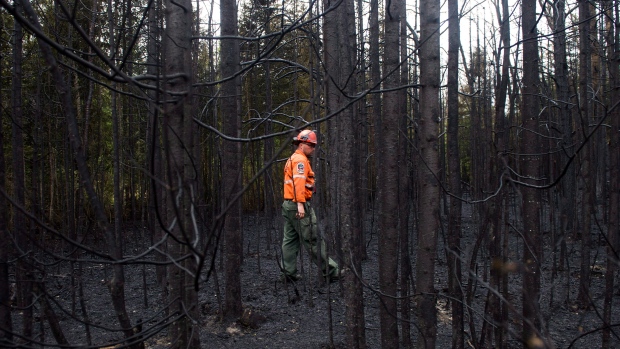
Thunder Bay Fire Ranger John Perry checks out a still a slow burning forest as Fire Rangers battle the blaze to save trailers and homes at the Cache Campground, west of Timmins, Ont., on Sunday, May 27, 2012. (Nathan Denette/The Canadian Press)

The charred landscape eventually welcomes seeds of trees that have survived within a refugium and new plants are slowly produced. Researchers relying on a half-century of satellite data are slowly piecing together those sanctuaries' histories. In the wake of a fire, refugia represent and resemble a glowing green gem in their scattering across blackened landscapes. Because of this phenomena, up to 25 percent of a forest is enabled to survive.

The north sides of mountains favour refugia in the Northern Hemisphere where plants are exposed to less sunlight enabling them to hold more moisture in their trunks and roots, as a consequence. Biodiversity is hugely dependent on these shelters. Patches of grasslands that catch fire yearly may survive one year and burn the following year. Yet these uneven fire refugia are invaluable to their survival as opposed to grasslands that burn in their entirety yearly, threatening the butterflies with extinction.

Invasive species and other like pests threaten refugia, but it is climate change that may in fact pose a greater threat where heat waves and droughts turn plants into fuel for fire. That could result in refugia becoming less frequently capable of surviving fires that become more intense in their nature. So it is critical to know more about refugia so that a strategy to preserve them can be achieved.

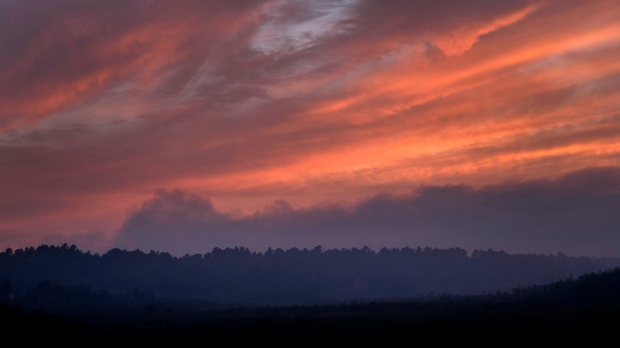
Smoke hangs above the treeline near dusk blocking out the setting sun at forest fires near Killarney, Ontario Tuesday July 31, 2018. (THE CANADIAN PRESS / Fred Thornhill)

Labels: , , , , ,

Tuesday, August 21, 2018

Incendiary Solutions

"[British Columbia has] a landscape that's full of contiguous fuel. There's any number of combinations [contributing to wildfire potential; topography, weather, fuel] there."
"When it's doing those runs [such as a fire vortex], you just back off."
Robert Gray, fire ecologist, Chilliwack, British Columbia

"It doesn't matter how much rain you've had in the spring or winter; once the snow's gone you give me a week of hot, dry, windy weather, I can give you a raging inferno."
"It;s just Mother Nature, cycle of life, and if anything, it may be beneficial to the forest."
Mike Flannigan, professor, fire researcher, University of Alberta

"Really, it is one of our primary firefighting tactics [stalling a fire by removing its flammable fuel]."
"When you see them [firefighters setting a back burn] in action, being used for a burn-off on a wide-scale operation, it's pretty impressive."
Claire Allen, fire information officer
A wildfire burns on a logging road approximately 20 km southwest of Fort St. James, B.C., on Aug. 15, 2018. Darryl Dyck/The Canadian Press
The government of British Columbia declared a state of emergency last week in the face of 500 wildfires threatening the forests of the province, and in some instances, human habitation, necessitating evacuation of thousands of people, and an alert to many thousands of others who might be in harm's way should the wildfire close to their community approach so threateningly close that they must be prepared to evacuate on order.

Over three thousand, five hundred firefighters and support staff are working non-stop to control wildfires. Of that number 731 people are from out-of-province working alongside over a hundred members of the military deployed to assist the firefighters. Most of those fires were spontaneous, caused by lightning strikes, in a highly combustible environment of dry and brittle matter on the forest floor and trees obligingly accelerating the fires as hot winds encourage the spread.

Those fires that burn in remote and isolated areas are not considered a priority, and are left to burn themselves out, that conclusion reliant on the fact that scientists now recognize the ecological and practical benefits that ensue from forest fires. Those forests will in time regenerate; the forests that were at their prime will be renewed with new growth in nature's endless cycle. In another sense a burnt area is a bonus since the next fire season it will represent a fire break that could conceivably bring a fresh wildfire to a halt for lack of fuel.

At the present time there are 550 wildfires burning in British Columbia. Discounting attending to those in remote areas or difficult terrain where water bombers cannot fly and firefighters are unable to approach, those whose proximity to towns are viewed as high risk and are priorities for aggressive shut-down. Smoke from all these fires blankets Western Canada. Forty-eight evacuation alerts have gone out, affecting 15,770 people, while 4,830 people have already received 31 evacuation orders.
Smoke billows over the northern shoreline of Nadina Lake, B.C., captured in a photo by a helicopter pilot who has been working on the fires in the area. (Dylan De La Mare)
On windy days the fires go through immense growth spurts in a forest landscape that can be endless as well as hot and dry in the wildfire season. Atmospheric conditions have the potential to create a fire vortex, where the resulting fierce energy feeds the fire to immense proportions to the extent that no intervention can take place; such fires left to their own devices until the environment changes. Such fires are capable of leaping the area of a football field in fifteen minutes.

The Shovel Lake fire, the largest blaze at the moment taking up some 850 square kilometres, less than ten kilometres from the village of Fraser Lake, was roused to more rapid expansion resulting from windy weather last week. One firefighting tactic in the face of such immense, swift-burning fires is a backburn where a fire is deliberately set in front of the wildfire to burn up the fuel, leaving the large out-of-control fire no flammable material, so it dies.

Fire retardant or water dropped from planes and helicopters represent another tactic. Digging firebreaks by hand or with machinery, trying to use natural breaks like rivers and roads to guide, fight and discourage fire spread represent additional tactics in response to wildfires. Those that pose no threat to towns and human life, well in the interior, are simply left.

The variety of types of fires also predicates their outcomes. One burning in the forest canopy, feeding on the tops of trees is recognized as unstoppable. Another type of fire smouldering in the ground can continue to burn for a lengthy period of time; months, even years.

A helicopter being used to fight a smaller fire nearby flies past a large plume of smoke rising from a wildfire near Fraser Lake, B.C., on Aug. 15. (Darryl Dyck/Canadian Press)

Labels: , , ,

Sunday, November 12, 2017

Iceland's Future Forests

"At the time of human settlement almost 1150 years ago, birch forest and woodland covered 25-40% of Iceland's land area. The relatively tall (to 15 m) birch forests of sheltered valleys graded to birch and willow scrub toward the coast, on exposed sites and in wetland areas and to willow tundra at high elevations."
"As in agrarian societies everywhere, the settlers began by cutting down the forests to create fields and grazing land. Sheep were important as a source of wool from the outset, but by about 1300 they had become a staple source of food for Icelanders as well"

"An important contributor to Iceland's mitigation policy is planting trees."
"It's a big discussion here."
"[Roughly 40 percent of the country is desert] but there's plenty of rainfall -- we call it 'wet desert'."
Gudmundur Halidorsson, Soil Conservation Service of Iceland

"The aim now is that in the next fifty years we might go up to five percent [coverage in forest growth in barren Iceland's environment]."
But at the speed we're at now, it would take 150 years to do that."
Saemundur Thorvaldsson, Iceland government forester
Iceland has a spectacular and most unfortunate lack of trees. It is a northern, volcanic island; a group of islands to be more precise, the largest, main island on which the capital Reykjavik stands. It suffers from severe soil erosion. Unsurprising, given the lack of forests in the country since any kind of vegetation struggles to set down roots and a lasting presence. Raising livestock is impracticable under the circumstances; where and what would they graze? Similarly farming presents its own dilemma with the loose soil swept away by wind of which Iceland has an abundance.

The population of Iceland is about 350,000 people living in a small geography, estimated at 39,000 square miles. A volcanic eruption occurs on average every four years. Quaintly in this most peculiar of environments, which is said to be the last on Earth to have been inhabited by settlers, there is a popular and firm belief in the presence of elves.  The native language spoken is that of ancient Norse. It is outstanding as a whale-watching venue, earning the country tourist dollars for that very purpose. Unsurprisingly for an isolated population, more films are viewed in Iceland than anywhere else in the world.

The country uses geothermal energy and hydro power to solve its energy needs, yet still faces high per capita emissions of greenhouse gases, as a result of transportation and heavy industries such as aluminum smelting. That there is an absence of trees to perform the vital function of absorbing atmospheric carbon dioxide within their trunks, roots and tissues spells a huge dilemma for a country anxious to meet climate change goals through offsetting its industrial emissions..

There are no trees -- at least there is a huge dearth of trees -- because a thousand years ago Viking settlers axed the forests that had once been hosted on 24 percent of the countryside. Not that Iceland hasn't been trying to regenerate forests. "It's definitely a struggle", explained Jon Asgeir Jonsson who has been planting trees in the barren landscapes of his country, with the understanding that the return of forests would go far to improve and stabilize the harsh soils reflecting desertification resulting from deforestation.
mbl.is/Eggert Jóhannesson
At the very least, three million trees have been planted in the recent past in a landscape that doesn't lend itself to nourishing them to swift maturity. An estimated one percent of Iceland was covered in forest at the turn of the 20th Century at a time when the country viewed reforestation as a priority. That pitiable percentage has barely budged, since then. Mr. Jonsson, a forester working for the private Icelandic Forestry Association, plants saplings alongside volunteers from local forestry groups. "We have gained maybe half a percent in the last century", he states gloomily.

Volcanic ash and rock spewed by ongoing eruptions contributes to severe soil erosion. Loose soil and strong winds make for sandstorms further damaging the land. Sandstorms fierce enough to blast the paint off cars. Thick layers of volcanic material leave ash rich in nutrients, but representing fragile soil unable to hold water, which shifts about with the blowing wind. Mr. Thorvaldsson considers the tree species to plant in Iceland is birch, reflecting the original species, 30 percent dominant when the land was settled.

Birch's ability to tolerate poor soil provides shelter for other species as it grows. Sitka spruce, lodgepole pine, black cottonwood -- all originated in Alaska, now growing as well in Iceland as saplings in greenhouses. Trees imported from elsewhere are prohibited by law. These trees grow quicker than birch but even they grow slowly. In comparison southeast Alaska sees its trees reaching three times the height of spruces planted in the 1940s, now reaching 15 meters in height.
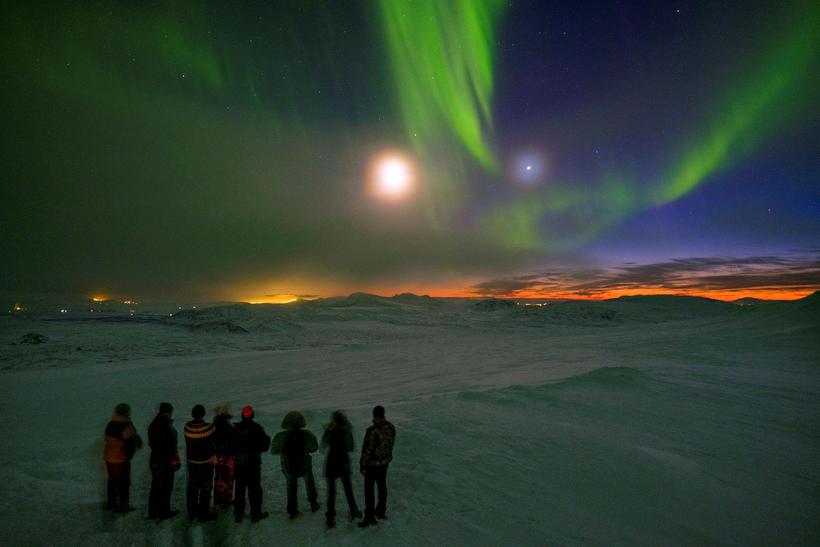
The northern lights are a common source for complaints and ...
Viewing the Northern Lights   --  mbl.is/Golli

Labels: , , ,

Thursday, August 24, 2017

Wildfires: Let Them Burn Backcountry?

"It’s a few extreme fires that cause all our problems, at least from society’s point of view."
"This is where the appropriate response … allows you to concentrate on problem fires and hope to get to them while they’re still small, while allowing Mother Nature to take its course in the back 40."
Dr. Mike Flannigan, professor, University of Alberta

"That fire [a 1976 backwoods wildfire] could have probably been allowed to just burn and it would have put itself out. But in those days, the mantra was: All fire is bad, so we got to suppress it."
And that’s what we did."
"As a society, we have to recognize that if we’re going to manage this problem appropriately, we’re going to have to accept the fact that, at times, we may have to have a little smoke in the air that we may not like. But it’s going to a better outcome than what we’re seeing in the Chilcotin [region of British Columbia] today."
Brian Simpson, retired, former head, B.C. Wildfire Management Branch
"This huge grief that’s come from Fort Mac [ferocious 2016 Fort McMurray, Alberta wildfire] came from less than 10 per cent of the loss of that town and, really, what would we be looking at if we lost half of that?"
"We could have been looking at a staggering loss on the financial side and how we didn’t lose hundreds of people, I don’t know."
"If you look historically at some of the 19th-century fires: fire got into Fredericton [New Brunswick], fire’s gotten into Timmins [Ontario]. We even had one around Halifax [Nova Scotia] just a couple years ago where a few homes were lost. And the big fire in Tennessee late last year just shows we can have big fires in the East."
Glen McGillivray, managing director, Institute for Catastrophic Loss Reduction, Toronto

There is now general agreement among scientists involved in ecological research that suppressing wildfires hasn't worked to the advantage it was meant to reflect through best forestry practise in response to these natural phenomena. The realization that a different kind of forest management is required is not new, it has been considered for quite some time, but old practises thought to be the logical reaction of authorities to fires threatening great swaths of forest and any towns and homes increasingly in their path are difficult to set aside.

However, a new approach involving backcountry fires permitted without human intervention to burn across millions of hectares is beginning to make sense to those tasked with the monumental job of husbanding these natural resources. Wildfires across North America still routinely see a response owing to the tradition of gathering fire-fighting resources to attempt to control them as they burn their way through valuable timberland. Now, the focus is to restrict firefighting activities to those areas where towns are threatened, and to simply allow wildfires where no human habitation is to burn themselves out.

Biologists are now recognizing that plants and animals appear to thrive in blackened, burnt-out forests, that renewal swiftly takes place, and that indeed some species of flora require that scorched-earth situation to enable them to renew and flourish. It is when human lives, and the livestock they maintain are threatened by being in the pathway of an out-of-control wildfire that the alarm bells bring in all the massive equipment and experienced wildfire-fighters to ward off catastrophe and then the lives of firefighters too are at stake.

Public safety where communities have established themselves in close proximity to forests, or communities that have long been in existence in those vulnerable forested areas remain the driving force behind firefighters answering the call to battle wildfires. An estimation of how often forests went through the natural process of burning out before the era of human habitation, hazards estimates of between eight million to 12 million hectares annually. At the present time that burnout is estimated at 1.5 million to two million hectares, with fire suppression action.

Around the 19th century the prevailing view was that forests ideally should be represented as economically valuable standing timber. Industrial scale techniques to battle wildfires gave firefighting agencies the capability of fighting wildfires by the 1930s, maintaining the landscape by suppressing wildfires. Even then a small grouping of environmental scientists felt that this type of response gave little benefit to the natural surroundings. The nature of wildfires has undergone a not-too-subtle change attributed to climate change; they have become more savage, more difficult to suppress and as such more dangerous to those fighting them.

Now, additionally, it is well understood that hundreds of species live, and some prefer to live in forests that have been recently burned, becoming by far the vastly preferred habitat. And with that realization the recognition by many more environmentalists that the health of the forests is maintained when fires thin them out of their climax condition, inviting the resurgence of the forest as saplings regenerate from the dead ash which in fact, enriches the forest soil.

It doesn't take long before trees begin sprouting, butterflies return to flit through shrubs when the density of a forest opens to the wind, sun and air and certain plants find their ideal growing places. The 'dead' forest in the wake of a wildfire becomes full of standing charred tree trunks called 'snags', many up to 24 to 30 meters in height, a sad and sorry sight, but a natural one. Environmentalists have noted that the black-backed woodpecker for one, included in the U.S. Endangered Species Act as threatened thrives under these conditions.

Environmentalists urge governments to help people living in forest-fire-vulnerable communities to think before they build there, or to withhold licenses to build. Alternately, taking steps in fire-prone areas to make homes fire-resistant, as for example, installing metal roofs on homes, enabling people to take partial responsibility for their choices and potential outcomes.

Labels: , , , , , ,

Thursday, March 23, 2017

Battling the Extinction of the Ash Tree

"We're hoping to raise about 10,000 [wasps] for this summer. That will be enough to do five or six more sites across Ontario and Quebec."
"[The Tetrastichus planipennisi wasps represent a] bio-control [program operating in a laboratory, the only] large-scale attempt to manage the emerald ash borer."
"The wasps will eat and kill the larvae and then you get more wasps coming out instead of the emerald ash borer. Over time the wasp population builds up and we hope that they'll help kill a fair number of emerald ash borers out there."
"The spread is a major concern. We're finding that 99 percent of ash trees are killed within five to seven years of emerald ash borer getting into an area and causing extensive mortality."
Krista Ryall, lead researcher, Natural Resources Canada

The emerald ash borer is a beetle originating in Asia. Like all foreign-origined flora and fauna once they are removed from their native environment they thrive because their natural predators are absent from the new environment, and they become a threat to native species. These foreign invaders often arrive along with shipments of goods by sea. Sometimes they are deliberately introduced for one reason or another; seen as a solution to a local problem, but they rarely turn out to solve anything. Instead, they become giant headaches as they run riot in a new environment that they have successfully adapted to.

The beetles were first noticed in 2002 in Michigan, and they have steadily moved on to colonize larger areas, ranging across the United States and Canada. The United States Forest Service in Brighton, Michigan discovered that the Tetrastichus planipennisi wasp was a natural predator for the beetles, imported them from Asia and began raising them and releasing them in forested areas in hopes of saving some of the ash trees that haven't yet been impacted. But the beetle has cut a wide swath in North American forests, destroying native ash trees, leaving forests bare of their presence.

Much has happened with trees native to North America; in the 1950s with the American Chestnut, a giant species of chestnut that dominated forests and was struck with a blight that eventually wiped out those forest giants, taking species of insects out of circulation that depended on the chestnut as well. There was a wide-spread effort to save the Elm trees when Dutch Elm disease struck with catastrophic consequences, and later Spruce Budworm, hitting the forests, destroying indigenous stands of spruce. The die-off of ash is simply the latest phenemenon to strike another valued tree species.

Millions of ash trees have died across Canada and the United States thanks to the deadly march of the emerald ash borer. Natural Resources Canada has been importing the wasps that lay their eggs on the larvae of the borer from its American counterpart federal forest service to release them in stages in Quebec and Ontario. The female wasp finds trees that have been infested with the emerald ash borer larvae and lays fifty to sixty eggs on the larvae so that when the larvae of the wasps appear, they feed on the emerald ash borer larvae.


When the wasps mature they fly out and about and and their natural cycle commences; they breed, they  lay eggs and then they die a month after taking flight, with the cycle repeating itself several rounds throughout the summer months. The assurance is that the wasps, also native to China, will have no deleterious effect on other organisms, according to American research. Windsor, Ontario was the first site where the emerald ash borer was seen in Canada in 2002, and it continued to move on, reaching Toronto by 2007.

The beetle spread relentlessly, reaching western Quebec in 2008, and finally Montreal by 2011. It has even been seen in Thunder Bay, in northern Ontario. Now that Natural Resources Canada has initiated its own wasp breeding program, about 60,000 wasps have been released to target the emerald ash borer, and the hope is that what is left of the ash trees may yet be saved, even while botanists attempt to breed ash trees that will be resistant to the borer.


Labels: , , , , ,

 
()() Follow @rheytah Tweet