Ruminations

Blog dedicated primarily to randomly selected news items; comments reflecting personal perceptions

Friday, April 15, 2022

Xi Jinping's Triumph in Leadership

"Until Omicron, I actually thought a COVID-zero approach could be plausible. [But] it's just so insidious, it can just spread so quickly."
"I feel it's kind of like a losing battle. You could do it for a week or two ... then it's going to come back again."
"I just don't know how China will be able o avoid what happened in Hong Kong, write large."
"If everyone stays home, the outbreak will get snuffed out. But ... even if Shanghai can snuff out this particular outbreak, there's going to be more introduction of it, because it's circulating everywhere else in the world."
Dr.Jeff Kwong, public-health professor, University of Toronto

"What happens to your pet if you test positive remains an unsettling grey area with no clear solution."
"Horror stories circulate online about pets being left behind and one was recently killed with a shovel by a person in a haz-mat suit."
CNN journalist David Culver, Shanghai
Shanghai police remove protester
One clip shows a policeman in a hazmat suit removing a protester from the scene  BBC
 
CNN journalist Culver, as a resident of Shanghai, has his own very personal fears aside from his writing about regular morning marches of neighbourhood residents to designated areas where they are tested by health officials wearing haz-mat suits. Should they test positive they are immediately sequestered, not permitted to return home and must go into isolation. If they have pets at home the pets are confiscated and put to death. David Culver has nightmares of testing positive, worried about abandoning his dog, as he would be forced into quarantine.
 
Shanghai's 25-million residents have been cooped into lockdown for weeks, unable to leave their homes except for COVID testing, and living with food shortages caused by the enforced total lockdown. A lockdown originally meant to last a few days, but that has been ongoing now for weeks with no indication how long it may last, as long as COVID-positive cases continue to present and authorities continue to react with draconian methods of isolation. The situation led to people shouting in desperation from open windows in their apartments and from balconies.
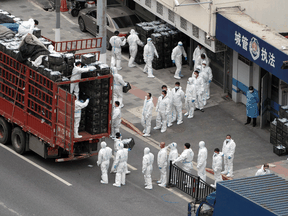
 
People wearing personal protective equipment transfer food supplies and necessities for local residents during a COVID-19 lockdown in Shanghai, April 5, 2022.
People wearing personal protective equipment transfer food supplies and necessities for local residents during a COVID-19 lockdown in Shanghai, April 5, 2022. Photo by AFP via Getty Images
 
The protests spurred officials to seek a solution to the angry social protests, including media posts in a country not known to tolerate dissent. The solution? Drones, circulating in neighbourhoods with very specific messages: "Please comply with COVID restrictions. Control your soul's thirst for freedom. Do not open your windows and sing", the female voice instructs.

Children separated from their parents when found to be COVID-positive. This is a reflection of China's   COVID-zero policy meant to completely eradicate, not merely control SARS-CoV-2. The virus is not responding positively to that goal, however, and the method finds no wide public acceptance. Chinese health authorities who subscribe to the COVID-zero manoeuvres insisting on complete lockdown to effectively beat virus transmission, appear not to have reckoned with the high transmissibility of the Omicron strain.
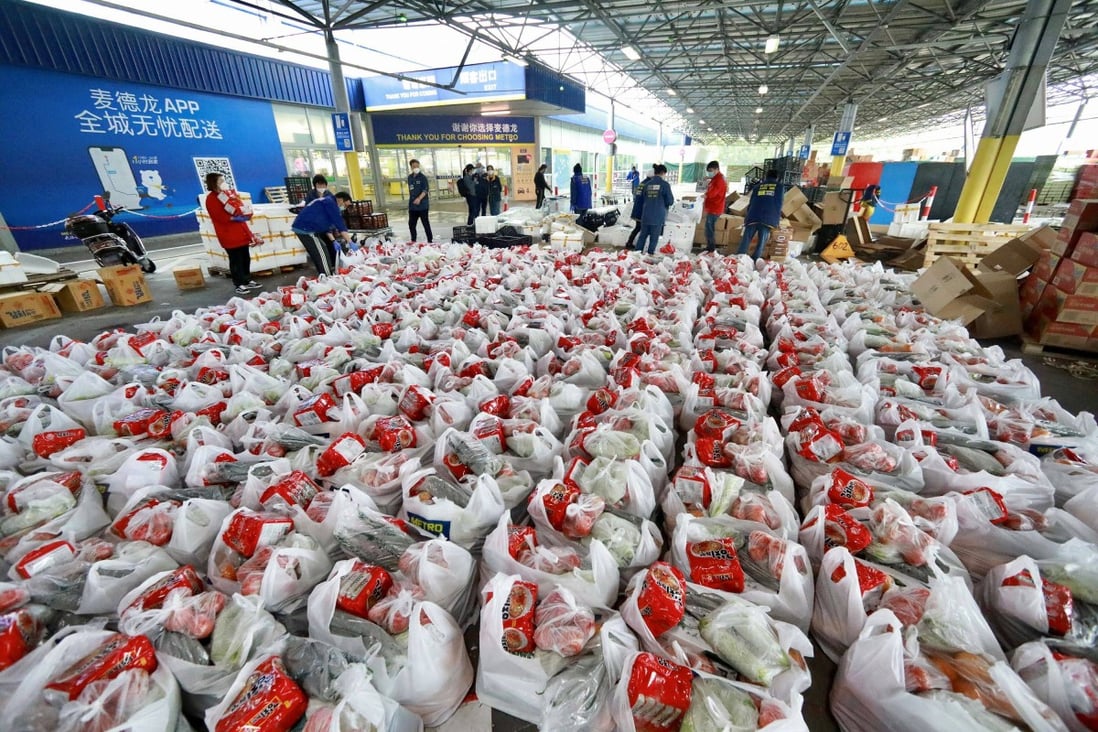
 
Staff members organise mass food orders from locked down Shanghai residents. Photo: Reuters
Staff members organize mass food orders from locked down Shanghai residents. Photo: Reuters

"Judging from how this pandemic is being handled by different leaderships and systems ... [we can] clearly see who has done better", China's President Xi Jinping has boasted in the past. And it did realize a good measure of success with pop-up cases here and there and swift responses in fragmented areas, quickly contained. Until Omicron arrived and infections began reaching into the stratosphere, as much as 15,000 daily of late. Beijing's firm orders for Shanghai's total lockdown reflected its wish to avoid the disaster in Hong Kong.

Hong Kong's own COVID-zero achievements were blown to smithereens when three million people were infected and mass deaths occurred. In both areas low vaccination rates among people aged 80 and over and lack of access to mRNA vaccines seem partly to blame. That the most vulnerable age group in the populations have not been vaccinated seems like an an avoidable Achilles heel that should not have gone unaddressed. China's home-grown vaccines have a relatively low efficacy rate; somewhere around 50% and less, compared to the mRNA vaccines.

Locked into their homes the population has been unable to work, attend school, shop, attend medical appointments. The government plan to supply people with food deliveries has overburdened commercial delivery services, the result of which has been that a great many people face starvation, deprived of food access. Clearly, China's approach to stifling the virus that originated in Wuhan, China and went on speedily to infect the global population, has been nothing to celebrate as a success.

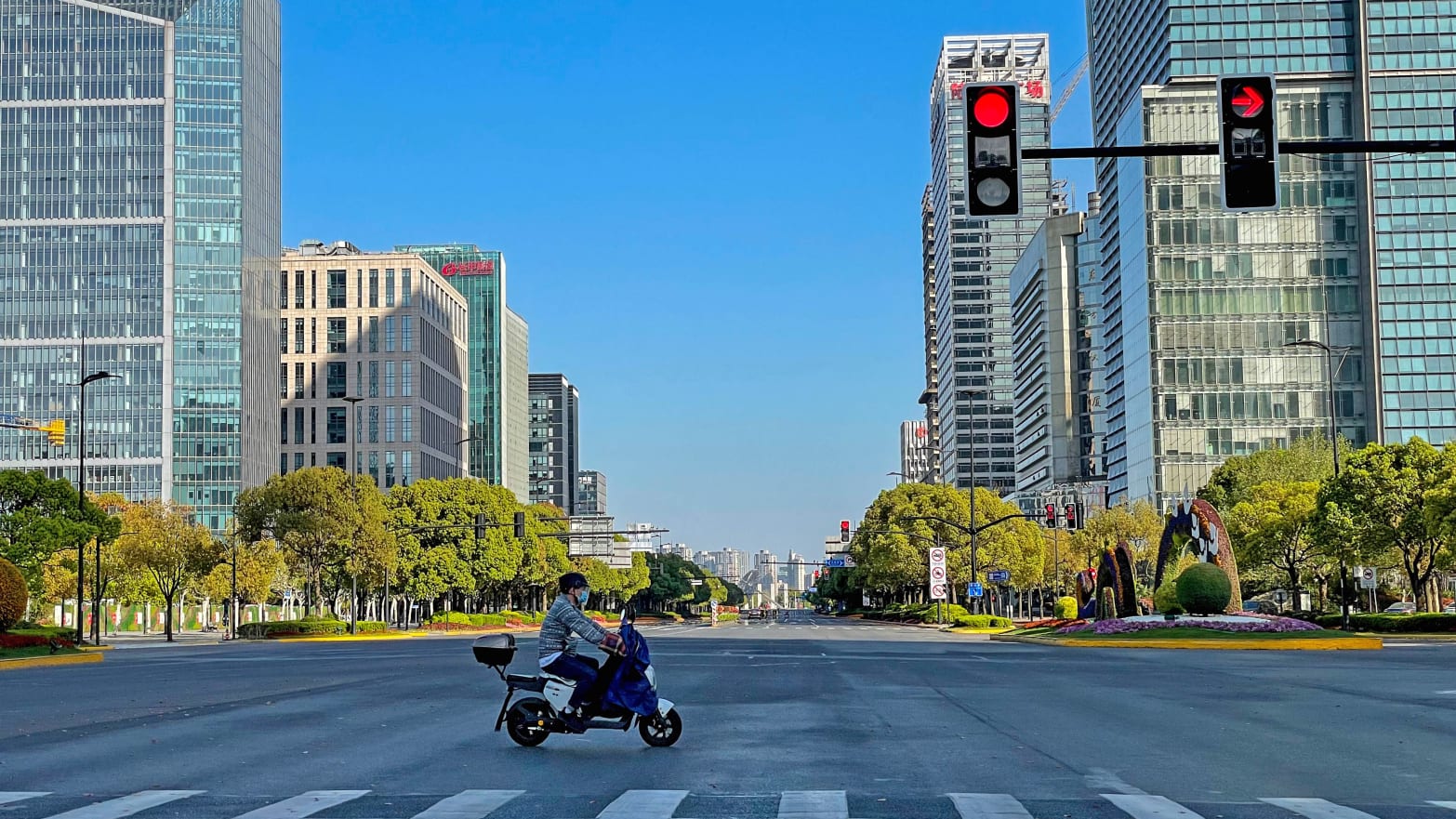
Workers in protective suits disinfect an old residential area under lockdown amid the COVID-19 pandemic, in Shanghai on April 15.  ALY SONG/Reuters

Labels: , , , , , , , ,

Tuesday, April 12, 2022

COVID-Control-Frenzied Chinese Authorities

"Many of us are very anxious. I spoke to friends, and many of them can't sleep at night."
"This concerns our very survival."
Nicole Tsai, Marketing manager, Shanghai 

"When I returned to China [after living in the U.S. for several years], I thought Shanghai was a relatively free city."
"But when I read the news online about children needing to be separated from their parents for quarantine, I find it very hard to understand."
"I'm worried to test positive [for COVID], not so much about the virus itself but about all the trouble that it will bring."
Ngo (surname withheld), IT specialist, mother of 3-year-old
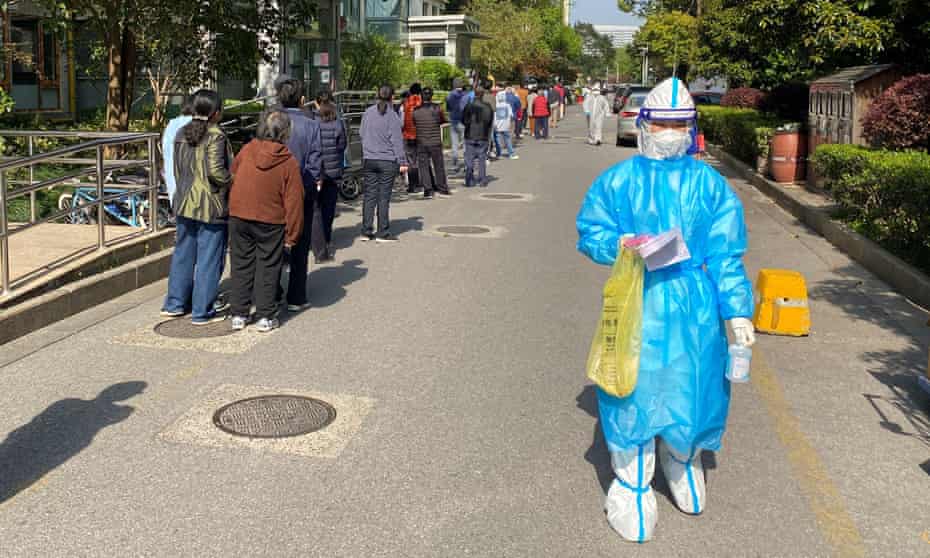
A medical worker in a protective suit walks past people queuing to take a nucleic acid test in a residential area
A medical worker in a protective suit walks past people queuing to take a nucleic acid test in a residential area. Photograph: David Stanway/Reuters
 
Ngo has reason to be fearful, and to want to avoid contracting COVID, living in Shanghai, a city of 25 million people, shut down for weeks in a concerted effort to 'control' the virus. Authorities in Shanghai have taken to separating families from their children if they've been confirmed with COVID. The plight of dog-loving dog owners is much the same.
 
When dog owners are sent into quarantine, testing positive for COVID, their dogs are 'culled'. Last week the city burst into outrage when a video of a corgi bludgeoned to death took place in the city street. Similar starkly unforgiving incidents take place all across China. This at a time when dog owners are unable to walk their dogs for weeks on end, the fear is should they contract COVID it would be a death knell for a beloved pet.
 
The Shanghai government, when it first instituted a citywide lockdown made it clear it would last for four days. No one was permitted to question that time-frame; anyone who spread rumours that this would be a longer lockdown was threatened with punishment. People went out to stock up for food to last them a week. That four days passed and so did a week and another week. It became clear the lockdown would remain, and people ran out of food. 

Apartment dwellers were shown on video screaming out their windows and from balconies in frustration and fear and hunger when a video went into circulation to emphasize the plight of the population. "I'm going to die because of the lockdown, not the infection", one resident of the city posted on China's version of Twitter, Weibo. While the government organized food deliveries through community volunteers, hundreds posted online of their days without food.

Videos appeared of the city residents fighting over bags of produce at food distribution areas set up in residential compounds. Nicole Tsai remarked on spending over four hours every day on delivery apps in the hope of finding a window where food might be available to order for delivery. Entering the third week of lockdown there was an announcement that government would ease restrictions in some areas.
Food scarcity in China   Photograph AFP
 
The new plan by Shanghai officials would be a grouping of residential units into three risk categories to enable "appropriate activity" in neighbourhoods with no positive cases through a two-week stretch. A Shanghai city official explained the city was to be divided into 7,624 areas to remain sealed off, and 2,460 would become subjected to "controls" following a week of no new infections. After two weeks without a positive case, 7,565 "prevention areas" would be opened.

In the "prevention areas" people would be permitted to move throughout their neighbourhoods, practising social distancing. Should new infections arise, the areas would be sealed again. "The zones have been divided into government officials' zone, rich people's zone and poor people's zone" clarified one Weibo user.

A record 25,173 cases were reported Monday bringing the total number to over 200,000 since March 1st. The current outbreak constitutes the largest COVID crisis to arise since the first emergence of the virus in the city of Wuhan where the virus originated, in December of 2019. The most curious statistics is that rise in case numbers aside, there have been no reported deaths, and one serious illness only has surfaced. 

VCG
 
 
The solution, however is more permanent in that if a pet owner tests positive their pet is in line for elimination. Last week the city viewed with outrage a video of a corgi bludgeoned to death on t he streets after the dog's owners had been sent into quarantine at a government-operated centre. Across China, this is the fate of pets whose owners are diagnosed with COVID.

Labels: , , , , ,

Tuesday, March 29, 2022

COVID-19 Returns to Home Base in China

"While the majority of G20 countries are exiting pandemic-related lockdowns, China appears to be stuck with its old tool box of zero tolerance and draconian measures to fight COVID."
"In addition to the strain on business, the population seems less willing to put up with lockdowns, as more and more erratic local policies erode citizens' confidence in their local administrations."
Jon Wuttke, president, European Union 
Chamber of Commerce in China
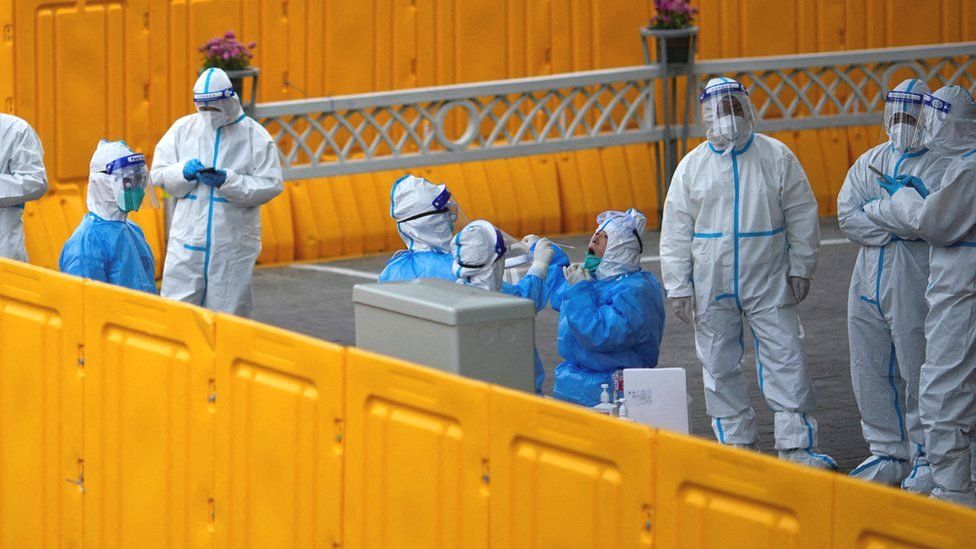
Policemen and staff workers get tested for the coronavirus disease (COVID-19) at a makeshift nucleic acid testing centre inside barriers of an area under lockdown amid the coronavirus disease (COVID-19) pandemic, in Shanghai, China March 24, 2022
Tests take place behind the barriers of a makeshift Covid centre in Shanghai earlier this week  Reuters
 
Shanghai, China's financial engine with its 26-million-srong population has never encountered a need previously for a mass COVID lockdown. Three days ago authorities ruled there would be no shut down of the city in reflection of its huge economic importance to the Chinese economy. Instead the focus was on more targeted solutions, to seal off residential towers and manufacturing plants where outbreaks had been occurring.

Until Wu Fan. one of a panel of expert COVID advisers, informed a city briefing of recent mass testing that discovered 'large scale' infections throughout the entire city. "Containing the large scale outbreak in our city is very important because, once infected people are put under control, we have blocked transmission", he explained.
 
Chinese authorities believe in the efficacy of large-scale responses to even relatively small breakouts of COVID and its variants. Where its zero-COVID policy has fairly well shut off its borders for the past two years from outside 'influences. The introduction of more infectious variants such as Omicron has led some to question the strategy of mass testing, lockdowns and reliance on domestic vaccine development.
 
Now, in lock-step with China's COVID-aversive reactions, the financial hub of Shanghai went into lockdown Monday with the determined purpose of quelching its COVID-19 problem. The sudden decision was announced on Sunday by local authorities; the city was to be divided in half, with mass testing, closure of businesses and confining millions of people to their homes to take place first in one half of the city, then the other, as the first half reopens.
 
CHINA-HEALTH-VIRUS
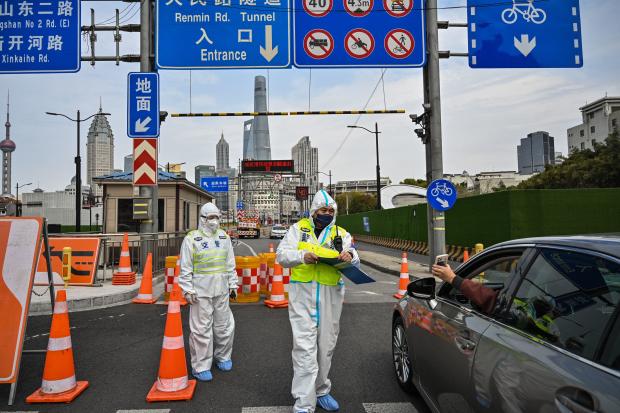
Police control access to a tunnel leading to the locked-down Pudong district of Shanghai, amid efforts to stop the spread of COVID-19 in China's financial capital, March 28, 2022. HECTOR RETAMAL/AFP/Getty

This reaction to the discovery of widespread infections must seem puzzling to the 26 million people in the city, given that the epidemic has been largely asymptomatic. The lockdown and its implications arriving when most nations in the West have moved on to abandoning COVID lockdowns and restrictions  to move toward an acceptance of the virus's existence.
 
Shanghai authorities Monday locked down areas east of the Huangpu River, an area where its financial district and industrial parks are located. The four-day lockdown shifts to the second half of the city in the west then, for another four days. During which time testing is to be conducted on residents barred from leaving their homes.
 
Public transport is suspended and private cars forbidden from the roads. tunnels and bridges linking the two halves of the city have been closed off; roads leading out of Shanhai have been blocked. A negative  COVID test is required for anyone wishing to leave in an emergency. Residents of the city responded to the orders in a panic of stocking up on food and related supplies to the point where supermarket shelves were emptied.
 
CHINA-LIFESTYLE
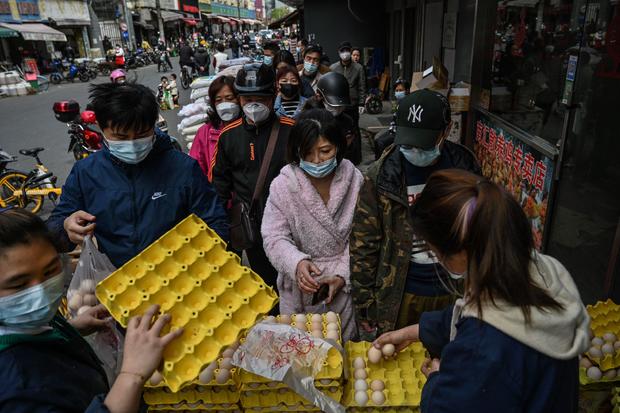
Shanghai residents line up to buy eggs from a vendor next to a market in Yangpu district, in Shanghai, China, as the city is shut down in two staggered phases to limit the spread of COVID-19, March 28, 2022. HECTOR RETAMAL/AFP/Getty
 
Staff of financial institutions were instructed on short notice to return to offices before the lockdown and to expect to sleep over nightly until the lockdown is lifted. Linked foreign businesses have viewed the situation from the outside with concern. In Hong Kong, over a million cases of COVID erupted in the city that had been largely free of the virus in the past two years.
 
The highest number of cases recorded anywhere in the world surfaced in Hong Kong in early March where close to 900 cases per 100,000 residents was tabulated. Deaths of close to 300 daily surged earlier in the month in Hong Kong. Reflective of low vaccination rates among the elderly. China's home-grown vaccines, as it happens, have a low efficacy rate. 
 
Medical staff walk in front of barriers of an area under lockdown in Shanghai on Friday. (Aly Song/Reuters)


Labels: , , ,

 
()() Follow @rheytah Tweet