Blog dedicated primarily to randomly selected news items; comments reflecting personal perceptions
Friday, May 26, 2023
Back by Unpopular Demand : XBB Omicron Subvariant
"The number of infections will be less. The severe cases will be certainly less, and deaths will be less, but that could still be a large number."
"Even when we think this is a milder wave, it could still be quite a substantial health impact on the community."
Ben Cowling, epidemiologist, School of Public Health, University of Hong Kong
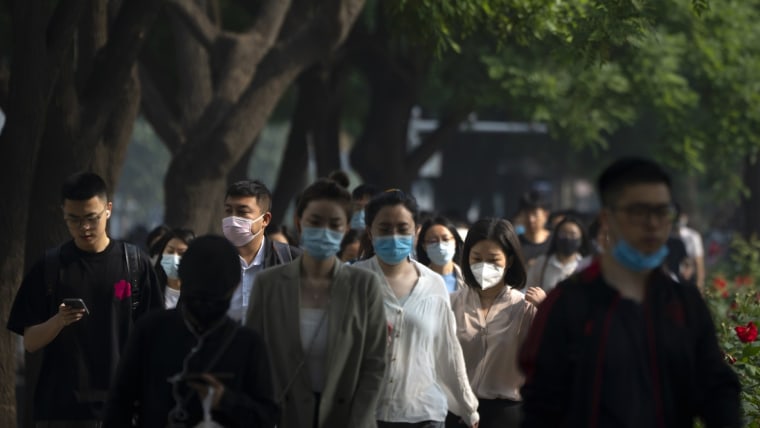
People walk at the tourism site of Qianmen street in Beijing. Photograph:(Reuters)
There is no complacency over the vastly lower presence in our consciousness of COVID. Globally, one country after another has declared SARS-CoV-2 to have been established as a constant presence which in its various presentations following mutations veered toward greater infectiousness, but lower infections of serious qualities. It still has been capable of great health injury, and the lingering effects of Long COVID, bedevil the unfortunate, but there are far fewer hospitalizations and deaths.
The everyday cautions in the first few years of the coronavirus pandemic such as mask-wearing and enhanced hygiene along with distancing have been officially relaxed at the very same time that regional health authorities warn that the threat of viral infection remains and with it health risks, counselling those at greatest risk to continue practicing those everyday cautions.
In China, the state's 'zero-COVID' policies, strictly policed, made for abject misery for the population. A population so vexed at the severe restrictions that rebellion was in the air, influencing Beijing's decision to release itself from that draconian policy. And people adjusted to life's ordinary freedoms again following a huge outbreak of large-scale infections, which in the final analysis came close to herd protection against the virus.
Yet despite the fact that an immense swath of the population was exposed to the virus at some level said to represent fully 85 percent of the population, a new wave of the coronavirus is spreading throughout China with expectations that it will affect up to 65 million people weekly. The new XBB variant of the virus has evolved to overwhelm the built \-up immunity that resulted from the abrupt lifting of the 'zero COVID' mandate of the Chinese Communist Party.
As a result Chinese medical authorities are expediting vaccines, two of which, a Chinese epidemiologist, Zhong Nanshan explained, were designed to overcome the XBB omicron subvariant, have been given initial approval. Speaking at a biotech forum in Guangzhou, Dr. Zhong stated that three to four other vaccines would be approved shortly to address the new outbreak which could become the largest infection wave since the zero-COVID regime was dismantled.
Experts in the United States have not ruled out new variants creating another wave of infections in years to come. An increase in infections has been noted in the U.S. caused by the new variants -- which had no impact on the declaration of the end of the public health emergency on May 11.
Public health experts feel an aggressive vaccine booster program and a ready supply of antivirals at hospitals are required in prevention of another death spike among China's large elderly population despite the acknowledgement that the new wave is expected to be less severe. Most residents in China are continuing life as usual, and the government has made no effort to prevent infections, resembling the severe restrictions of previous years.
"Until Omicron, I actually thought a COVID-zero approach could be plausible. [But] it's just so insidious, it can just spread so quickly."
"I feel it's kind of like a losing battle. You could do it for a week or two ... then it's going to come back again."
"I just don't know how China will be able o avoid what happened in Hong Kong, write large."
"If everyone stays home, the outbreak will get snuffed out. But ... even if Shanghai can snuff out this particular outbreak, there's going to be more introduction of it, because it's circulating everywhere else in the world."
Dr.Jeff Kwong, public-health professor, University of Toronto
"What happens to your pet if you test positive remains an unsettling grey area with no clear solution."
"Horror stories circulate online about pets being left behind and one was recently killed with a shovel by a person in a haz-mat suit."
CNN journalist David Culver, Shanghai
One clip shows a policeman in a hazmat suit removing a protester from the scene BBC
CNN journalist Culver, as a resident of Shanghai, has his own very personal fears aside from his writing about regular morning marches of neighbourhood residents to designated areas where they are tested by health officials wearing haz-mat suits. Should they test positive they are immediately sequestered, not permitted to return home and must go into isolation. If they have pets at home the pets are confiscated and put to death. David Culver has nightmares of testing positive, worried about abandoning his dog, as he would be forced into quarantine.
Shanghai's 25-million residents have been cooped into lockdown for weeks, unable to leave their homes except for COVID testing, and living with food shortages caused by the enforced total lockdown. A lockdown originally meant to last a few days, but that has been ongoing now for weeks with no indication how long it may last, as long as COVID-positive cases continue to present and authorities continue to react with draconian methods of isolation. The situation led to people shouting in desperation from open windows in their apartments and from balconies.
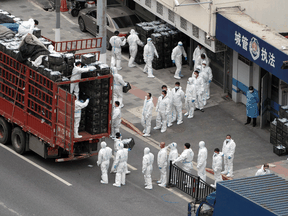
People wearing personal protective equipment
transfer food supplies and necessities for local residents during a
COVID-19 lockdown in Shanghai, April 5, 2022.Photo by AFP via Getty Images
The protests spurred officials to seek a solution to the angry social protests, including media posts in a country not known to tolerate dissent. The solution? Drones, circulating in neighbourhoods with very specific messages: "Please comply with COVID restrictions. Control your soul's thirst for freedom. Do not open your windows and sing", the female voice instructs.
Children separated from their parents when found to be COVID-positive. This is a reflection of China's COVID-zero policy meant to completely eradicate, not merely control SARS-CoV-2. The virus is not responding positively to that goal, however, and the method finds no wide public acceptance. Chinese health authorities who subscribe to the COVID-zero manoeuvres insisting on complete lockdown to effectively beat virus transmission, appear not to have reckoned with the high transmissibility of the Omicron strain.
Staff members organize mass food orders from locked down Shanghai residents. Photo: Reuters
"Judging from how this pandemic is being handled by different leaderships and systems ... [we can] clearly see who has done better", China's President Xi Jinping has boasted in the past. And it did realize a good measure of success with pop-up cases here and there and swift responses in fragmented areas, quickly contained. Until Omicron arrived and infections began reaching into the stratosphere, as much as 15,000 daily of late. Beijing's firm orders for Shanghai's total lockdown reflected its wish to avoid the disaster in Hong Kong.
Hong Kong's own COVID-zero achievements were blown to smithereens when three million people were infected and mass deaths occurred. In both areas low vaccination rates among people aged 80 and over and lack of access to mRNA vaccines seem partly to blame. That the most vulnerable age group in the populations have not been vaccinated seems like an an avoidable Achilles heel that should not have gone unaddressed. China's home-grown vaccines have a relatively low efficacy rate; somewhere around 50% and less, compared to the mRNA vaccines.
Locked into their homes the population has been unable to work, attend school, shop, attend medical appointments. The government plan to supply people with food deliveries has overburdened commercial delivery services, the result of which has been that a great many people face starvation, deprived of food access. Clearly, China's approach to stifling the virus that originated in Wuhan, China and went on speedily to infect the global population, has been nothing to celebrate as a success.
Workers
in protective suits disinfect an old residential area under lockdown
amid the COVID-19 pandemic, in Shanghai on April 15.ALY SONG/Reuters
"[Omicron's reduced severity] will make the goal of living with COVID-19 in the absence of socially and economically disruptive public health interventions substantially easier to achieve at the current time."
Research study, Imperial College London
"Interestingly, how much severity is reduced varies by age, with the greatest reduction in severity seen in 50- to 70-year-olds, and a smaller reduction in younger and older age groups."
"[The latest analysis showing a substantial drop in severity] has undoubtedly made it easier for countries to end pandemic restrictions than might otherwise have been the case."
Neil Ferguson, research author
"[BA.2 is 30 percent more transmissible] and more when you add in lack of restrictions and waning immunity."
"Fortunately, it's not more virulent, and three shots protect well [against hospitalization]."
Eric Topol, founder, director, Scripps Research Translational Institute
"Does this mean Omicron is severe for kids? Not necessarily."
"In young kids, hospitalization doesn't always equal more severe disease, as the threshold for admission is low."
Meaghan Kall, epidemiologist, report author
This was a massive study where over one and a half million COVID infections in England provided "clear evidence", according to its authors, that Omicron is not as deadly as the previous mutated strain that roared through the world community -- Delta. Evidence, according to the British scientists behind the study, that supports the case for COVID restrictions being dropped.
Omicron was seen to have a 59 percent lower risk of hospitalization along with a 69 percent reduction of dying in comparison to those people who were infected with Delta. At the same time the risk among the unvaccinated was significantly higher for hospitalization. The risk of ending up in hospital was 70 percent lower, however, even among the unvaccinated, with the risk of death 80 percent lower, infected with Omicron in comparison to unvaccinated people infected with Delta.
Leading researchers to state with conviction that the Omicron variant is intrinsically less severe than its predecessor. Infection breakthroughs saw vaccines somewhat less effective at keeping people out of hospital in comparison to Delta breakthrough cases. Those who were boosted with a third shot were the most protected from hospitalization and death; at 80 percent less likely to be admitted to hospital or to die from their infection, compared to the unvaccinated
When Omicron was beginning to surge in November, Imperial College researchers felt no evidence existed to credibly prove that Omicron was less deadly than Delta and that its capacity to elude some level of protection from a previous infection or vaccination could mean a "major, imminent threat to public health" was posed by Omicron, based on early and limited data available at the time.
A substantial drop in severity has now reversed that early data according to the latest analysis. Despite which the assurance comes with no guarantee that a future variant will not end up being more virulent. The BA.2 sub-variant of Omicron itself now driving record case counts and deaths in some areas is on the cusp of becoming more dominant. And more must be learned about its virulence potential. It is seen to be 30 percent more transmissible.
An analysis separate to this latest study published in The Lancet, by the U.K. Health Security Agency, found no evidence that people infected with BA.2 are more likely to be hospitalized. Only adults had significantly reduced risk of ending up in hospital with Omicron as compared to Delta cases in The Lancet study. The risk of hospitalization among children under age ten, was similar where both variants were involved.
People with the Omicron variant of SARS-CoV-2 were less likely to be
admitted to hospital or to die, compared to those with the Delta
variant.
Omicron: Greater Infectiousness, More Hospitalizations
"Despite Omicron seeing the highest reported numbers of COVID-19 cases and hospitalizations during the pandemic, disease severity indicators, including length of stay, ICU admission, and death, were lower than during previous pandemic peaks."
U.S. Centers for Disease Control and Prevention
"There is support for both scenarios [that the Omicron variant really is a milder disease than Delta, or that it now encounters those with immunity from vaccination and old infections]."
"The emergence of another major variant of concern is highly probable as the virus has proven it can evolve to escape immunity in the current climate of infection."
Alex Sigal, virologist, South Africa
"It's replicating in places that cause less damage."
Suimit Chanda, infectious disease expert
"[Omicron entered a population] that had considerably more immunity than any previous SARS-CoV-2 variant had encountered."
"There must be a renewed push to vaccinate and boost those not yet protected, because Omicron is not necessarily intrinsically milder."
"[Matters would have been] much, much worse [with Delta]."
William Hanage, epidemiologist, Harvard University
"I think there's genuine good news about both intrinsic severity appearing to be slightly lower and immunity holding decently well against severe disease, far better than it is against infection."
"I just find myself a bit concerned about the oversimplified narrative that 'Omicron is milder', [or even worse], 'Omicron is mild'."
"The nuances matter here, I think."
Roby Bhattacharyya, infectious diseases physician, Harvard University
As much as medical science knows about the SARS-CoV-2 virus causing COVID-19, it doesn't know quite enough. Leaving too many questions and too few answers. But observation and greater understanding are all being acquired, bit by bit as the coronavirus continues its journey in its myriad mutations circulating world-wide, alerting anxious scientists time and again to new and perplexing variants.
Although there was a giant sigh of relief that circled the globe with the initial assurance that this form of the virus is milder, albeit more infectious than the Delta strain, there are still questions about whether, in actual fact, it is. There is the realization that its greater infectiousness means more illnesses leading inevitably to more hospitalizations, ICU treatment and deaths by virtue of sheer numbers of infection. All the more so among the as-yet-unvaccinated.
Compared to other variants, laboratory studies suggest that Omicron invades human cells differently than its predecessors, that once within human cells its presence is restricted for the most part to the upper respiratory tract, leaving it less likely to enter and spread in the lungs to cause more severe disease. Significantly reduced chances of severe disease developing and death for those infected with Omicron have been validated in studies.
Photo by Getty Images
Researchers at Imperial College London were first to report in December that Omicron seemed to be less likely to hospitalize people or to ensure they're kept hospitalized for over a day, in comparison to people infected with the Delta strain. Since then, studies have emerged from South Africa, Southern California and the U.S. Centers for Disease Control and Prevention, finding that those with confirmed Omicron remain substantially less likely to be hospitalized, require oxygen therapy or mechanical ventilation - or die, in comparison with confirmed cases of Delta.
Where the Omicron variant was first identified in South Africa the strain found a population with a substantial degree of immunity. Even so, Omicron excels in slipping around vaccine-produced immunity to cause breakthrough infections;'vaccines' effectiveness against hospitalization largely preserved, diminishing Omicron's impact, as a result of vaccine doses administered.
In comparison to those who have been doubly vaccinated, those who have not had any inoculation bear a five-fold higher risk of being hospitalized. Omicron has been the cause of over 2,400 deaths daily on average in the past week in the United States. Millions globally of new infections have been recorded from Omicron. The greater the number of infections, the more opportunities arise for the virus to mutate.
"Infection is the fuel that evolution has to bring us these new variants. We need to get infection numbers down."
"Those things [uncertainty over how long immunity from vaccination and exposure to Omicron lasts] will all affect how many new infections are happening per day, or per week, after this peak."
Caroline Colijn, epidemiologist, Simon Fraser University, British Columbia
Omicron
is getting "an oversimplified narrative" that is it milder, but "the
nuances matter here," says one infectious diseases doctor.Photo by Cole Burston/Reuters
"We are still catastrophizing COVID. The emotion and fear are so overwhelming."
"We have somehow made when you have a positive result equal disaster in a lot of people's minds."
"It's very difficult to try to break through this."
Dr,Martha Fulford, infectious diseases specialist, chief of medicine, McMaster University Medical Center
"[Canadian doctors see a lot of COVID in emergency departments] And it's all Omicron."
"The cases coming to the emergency room are basically all comers [ranging from mild symptoms, no shortness of breath but worried people who want to be tested -- up to those with seriously] robust [pneumonia]."
"Why that scares me is that it tells me that this virus is as bad a player as any other before it. It can be a milder virus, but it can also be quite severe."
"You don't want to spread panic, but you also don't want to be blase about what can be a very dangerous virus."
"Most people are coming [to emergency] because they feel very unwell. Most are using emergency services appropriately. We want to continue to get the message out there, if you have mild symptoms, you should stay home to decrease the risk of exposure to other people, particularly our emergency room staff. But of course, if you are ever concerned you come right into emergency, and we'll always be here. Not just Humber, but any hospital."
Dr.David Jacobs, radiologist, Humber River Hospital, Toronto
"We aren't seeing as many patients gasping for air. Thankfully the COVID patients aren't as sick. BUT there are SO many of them."
"But for most, COVID seemed to topple a delicate balance of an underlying illness [diabetes, for example where a COVID infection can trigger serious ketoacidosis, potentially fatal]. It's making people really sick in a different way."
Dr.Craig Spencer, emergency doctor, New York City
"We're not seeing a lot of admissions for respiratory failure, we're not seeing a lot of patients being put on high-flow oxygen being intubated."
"What we are seeing is people who are being admitted because they are extremely weak, dizzy, a fall risk. [Respiratory distress and respiratory failure are not encountered as much]; That's not so much an issue thi8s time." "We're not seeing a huge number of COVID pneumonia [patients] and people requiring intensive respiratory support. We're not seeing that very much at all."
Dr. Eric Legome, emergency sites, Mount Sinai Health System, New York City
A number of
scientists have expressed concern that while Omicron appears to be
milder, it is highly transmissible, meaning hospital numbers and deaths
could rise rapidly without intervention. Photograph: Ben Stansall/AFP/Getty Images
New strain, new symptoms, new presentations and a sigh of relief; concerns over yet another mutated COVID virus hammering health systems, exhaled. But wait; there's the signal issue of infectability and sheer, overwhelming numbers of new infections overwhelming health care systems, upsetting the balance of 'less threatening--more infectious' against 'less infectious--more dangerous', and the outcomes level out. The sheer volume of infections mitigate against relief and produce serious cases flooding ICUs and causing deaths. With SARS-CoV-2 you just can't win for losing.
Imagine, if another strain were to appear just when Omicron appears to be cresting. A strain with the qualities of both. Say, Delta picking up about 10 Omicron mutations. Mightn't that result in a far more dangerous strain; the threat of Delta's more serious outcomes allied with far greater infectiousness. Well, it's been named Deltacron and it has surfaced in Cyprus. And given the lightning speed with which Omicron shoved Delta aside as the dominant strain in a matter of weeks, the world has yet to assess how threatening this new strain will be.
One step forward, two steps back has become COVID's overwhelming presence in our lives. As matters now stand, emergency rooms in Canadian hospitals are being overwhelmed by endless numbers of people suspecting they have been infected with COVID, showing symptoms ranging from that of a mild cold to severe COVID pneumonia, surfacing mostly in the unvaccinated and the vulnerable. Front line doctors report arrivals in hospital with minimal symptoms driven by anxiety.
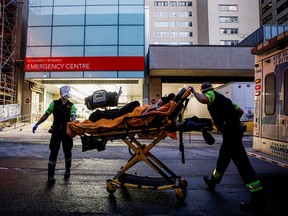
A health-care worker wearing PPE transports a patient in the dialysis
unit at the Humber River Hospital during the COVID-19 pandemic in
Toronto. THE CANADIAN PRESS/Nathan
Denette
The public is confused, with no clear idea how to respond if they've contracted COVID. Explosive growth has been seen in hospitalizations with the advent of the hugely contagious Omicron variant. Ontario has directed its hospitals to put off non-emergency surgeries, to brace for a potential "tsunami" of infections in coming days and weeks, as daily case numbers explode. Still, January 2022 is not a reflection of March 2020, when no vaccines were available.
Doctors and health-care workers in New York City during the first SARS-CoV-2 wave were trailblazers -- where now hospitalizations soared beyond 10,000 this week for the first time in 20 months. Back in March 2020 lung inflammation was the first wave's major issue when people were suffering respiratory failure. As with earlier waves there are some people who present short of breath, requiring supplemental oxygen, but they're now a distinct minority.
According to new research Omicron infects and homes itself in the bronchi, not as deep in the lungs as per Delta. That difference appears to explain its spreadability and less severe outcome.
Bit as with previous strains, it is the unvaccinated that appear to make up a disproportionate number of the sickest patients with COVID. Severe cases of Omicron are little different than those seen in the Delta infection heights and the first wave. The difference now is vaccination status, immune status and age grouping. Again, as with all strains of COVID, it is the elderly who are the most vulnerable, alongside the immuno-compromised.
Among patients presenting in hospital emergencies and hospitalized most are there because of COVID, and a lesser but comparable number are hospitalized as an incidental diagnosis; admitted for example for a broken leg or appendicitis or to deliver a baby and they happen to have COVID, explained Dr.Jacobs."Of those in the ICU their numbers are "Much much lower than we've had with previous waves".
Because COVID is the universal threat, people search for clear guidance "And it's very hard for them to know and access reliable information. They want treatment, they don't know what's available for treatment and there is very little public guidance around this", stated Dr.Andrew Morris, professor of medicine at University of Toronto, an infectious diseases specialist at Sinai Health System in Toronto.
A
drive-thru testing site in Baldwin Park, Calif., on Monday. The Omicron
variant became dominant in the United States last week, according to the Centers for Disease Control and Prevention. Credit...Bing Guan/Reuters
"We hover between three and four patients in the ICU with Omicron. Those who are recovered but still in the ICU are from the Delta wave."
David Jacobs, chair, Ontario Specialists Association, radiologist, Humber River Hospital, Toronto
"Due to the transmissibility of Omicron, the absolute number of hospitalizations and impact on the health-care system is likely to be significant, despite possible reduced severity."
Public Health Ontario
"There is a rise in hospitalization [including ICU] due to the Omicron surge, but this is nowhere near what we would have seen with similar numbers of Delta."
Isaac Bogoch, infectious disease specialist, University of Toronto
People queue up for their COVID-19 PCR test at Women's College Hospital,
as the latest Omicron variant emerges as a threat, in Toronto, Ontario,
Canada December 22, 2021. REUTERS/Cole Burston
A growing slate of epidemiological data indicating Omicron as a variant which is more infectious than its predecessors, but yet far less likely to severely injure much less kill the people it infects, is being reflected in the Canadian experience. Scottish data published prior to Christmas found numbers similar to those in Ontario, relating to shrinking hospitalization rates: "Omicron is associated with a two-third reduction in the risk of COVID-19 hospitalization when compared to Delta", read their report.
This week a study out of South Africa -- known as the initial country to identify Omicron and alert the world community -- discovered only 4.9 percent of COVID-19 cases were ending up in hospital in comparison to a 13.7 percent hospitalization rate experienced during the previous Delta wave.
Initial reports of the Omicron variant painted a picture of uncertainty, of dark fear that the mutated virus's insatiable appetite for infecting greater numbers of people, would result in unprecedented death and destruction. That early results with numbers indicating a milder virus in circulation has seen a great sigh of relief exhaled, tempered with a wait-and-see attitude.
Over the holidays, British Columbia had 100 people admitted to hospital during a period of up to 50,000 new cases being verified. Similar results are being seen in Ontario where a new Public Health Ontario study found Omicron to be 54 percent less likely to result in death or hospitalization than previous COVID variants. "Omicron appears to be the first dominant variant to demonstrate a decline in disease severity", the report read.
Earlier waves saw hospitals so badly hit they were left with little option but to send away up to 100 patients weekly for treatment at outside facilities. Dr.Jacobs, a radiologist at Toronto's Humber River Hospital, reported the Omicron wave was largely defined by COVID-19 patients appearing at the emergency room with coughs and sore throats, minus severe pulmonary complications seen in previous waves.
As an example, he described performing X-rays of just four suspected COVID-related pneumonias, compared to up to 60 during the most recent wave of Delta patients. Severe cases, found Dr. Jacobs, seemed reserved fairly exclusively within the unvaccinated population; an impression supported by province-level data. The rate of unvaccinated Ontarians admitted to intensive care reflecting COVID onset was over 20 times higher than for people with at least two doses of vaccine.
While those impressions are hugely reassuring the ghost at the back of the health community's mind is Omicron's capacity to overwhelm the health-care system where even an exceptionally mild virus, should too many people become infected at once, can send ICUs into crisis. However, thus far the Canadian experience appears to exhibit what epidemiologists refer to as a 'de-coupling'; where in previous waves a rise in confirmed cases seemed a harbinger of deaths and hospitalizations to come, this time cases have been 'decoupling' from those serious indicators, whereby the infections spike hugely without yielding surges of severe illness.
Of 76,992 active cases, 726 were in hospital in Ontario mid-week, last. The last record high for active cases in the province was 42,917 in April, with 2,335 in hospital; half the cases, three times the hospitalization. Quebec, which is experiencing its third-highest number of COVID-19 hospitalizations since the beginning of the pandemic appears as the Canadian epicentre of the Omicron wave; in a rate of new cases at least four times higher than has yet been seen.
It took 2,000 new cases per day in Quebec a year earlier to plunge the province into full-fledged hospitalization crisis with 1,500 beds occupied by COVID-19 patients at its height. Quebec at the present time has just 939 hospital beds occupied by COVID patients despite a daily rate of new cases far higher than 2,000 for the past two weeks where cases stood at a soaring 14,000 per day.
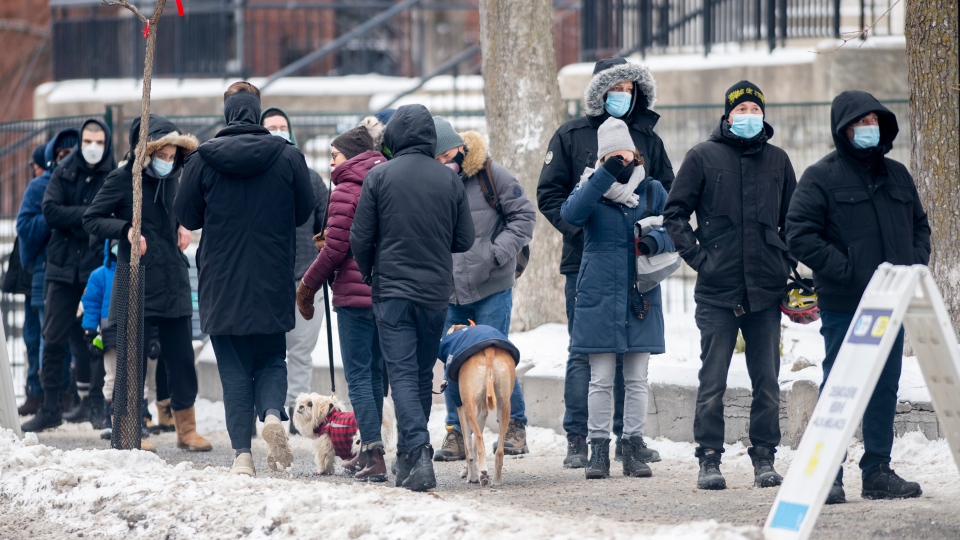
People wait in line at a COVID-19 testing and vaccination site in
Montreal, Wednesday, December 29, 2021, as the COVID-19 pandemic
continues in Canada. THE CANADIAN PRESS/Graham Hughes
"[The rodent studies show that Omicron] could be non-severe in the
right context. [However the results should be taken with a
grain a salt, given that these studies don’t focus on humans.]"
"[There's] some encouraging data at both the epidemiological and now in
the rodent models that suggest Omicron could have the potential to
cause disease less severe than Delta, for example. But it's not the same
thing as saying that it's benign."
Dr. Donald Vinh, infectious disease specialist, McGill University, Montreal
Omicron? Take a Deep Breath and Carry On -- With Boosters
"[Within weeks Omicron will dominate in more countries of the region], pushing already stretched health systems further to the brink."
Hans Kluge, European head, World Health Organization
"It [large public event restrictions following Christmas] will also mean unfortunately that large scale Hogmanay [traditional Scottish New Year events] celebrations, including that planned here in our capital city [Edinburgh], will not proceed."
Nicola Sturgeon, first minister, Scotland
"Even if measures [in response to the Omicron variant] are introduced immediately,
there may not be time to fully ascertain whether they are sufficient
before decisions are needed on further action."
"The
situation could develop quickly over the coming weeks and
decision-makers may need to act while there is still a high level of
uncertainty including considering the potential need for stringent
response measures."
Sage COVID advisory committee, United Kingdom
"The honest truth is that the booster programme,
which I think will work, is not going to work soon enough if there is a
big wave here soon. It takes time to get them into people
and it takes time for them to make an immune response."
"We
need to buy time. If in three weeks it’s died out, then fine, we can
all relax, but right now is the time when you could prevent there being a
big wave. The more people can work from home now the
better, until we are more definite about what’s going to happen."
Adam Finn, professor of paediatrics, University of Bristol, member of the Joint Committee on Vaccination and Immunisation, U.K.
Bipartisan members of the U.S. House and Senate hold a
moment of silence for 800,000 American lives lost to COVID-19 on the
steps of the Capitol in Washington, D.C., on Tuesday. (J. Scott Applewhite/The Associated Press)
Israel is set to become the first country in the world to provide fourth doses of COVID-19 vaccine to people over age 60, in reaction to national concerns over the viral spread of the Omicron variant. A fourth dose was recommended by the country's Health Ministry, the decision welcomed by the government, with Prime Minister Naftali Bennett saying it was "great news that will help us overcome the Omicron wave that is spreading around the world."
"My message is -- don't waste time, go get vaccinated", the Israeli prime minister urged the population. The Soroka Medical Center in Beersheba spoke of a notice that a 60 year-old man had died weeks after being admitted to the coronavirus ward. A patient that suffered from a variety of COVID-unrelated serious illnesses. "His morbidity stemmed mainly from pre-existing sicknesses and not from respiratory inspection arising from the coronavirus", the hospital clarified. Nonetheless, initial news of the death had attributed it to Omicron, while it turned out Delta was the culprit.
Similarly the Texas Department of State Health in the United States also reported at roughly the same time, the first Omicron death to have taken place, in Harris County. A conservative commentator with a huge following had tweeted the man was fully vaccinated and had in fact also received a booster shot.
Evidently not: "The death reported this afternoon was of a man between the ages of
50-60 years old who was unvaccinated and had been infected with COVID-19
previously. The individual was at higher risk of severe complications from
COVID-19 due to his unvaccinated status and his underlying health
conditions", came the corrected update from Harris County Public Health.
Germany, Scotland, Ireland, the Netherlands and South Korea have reimposed partial or full lockdowns along with other modes of social distancing measures recently, among many other countries experiencing a swift incursion of the Omicron variant. Nightclubs and bars have been ordered to close in Portugal, people told to work from home.
In Italy a COVID state of emergency has been extended to March 31, the government ruling that all EU member-country visitors must have a test taken before arrival, requirements reflected for many non-EU countries. In France, tightening controls for travellers from Britain are being contemplated, despite that visitors must show a negative test less than 48 hours old, currently.
People line up for their booster dose outside a COVID-19 vaccination centre in south London on Tuesday. (Hannah McKay/Reuters)