Blog dedicated primarily to randomly selected news items; comments reflecting personal perceptions
Sunday, May 26, 2024
Canada: Full-blown Antisemitism
"As everybody was traumatized, we waited, in shock, for people to condemn. And I was waiting for the Society of Obstetricians and Gynecologists [SOGC] as soon as the stories of rape and sexual violence came out. I was waiting for the women's organizations, and it became very clear the duplicity of women's organizations across the world."
"This silence has shaken me to the core because it reveals something much more sinister than just the age-old fear of a Jew experiencing antisemitism."
"Weeks after October 7 passed, I wrote to the leadership asking why they had been silent and was met with excuses. Eventually, in December, the SOGC released a statement, but this made no mention of Hamas or even the date of October 7. It simply stated, 'In the light of recent and ongoing global events' and mentioned the Red Line initiative. What recent events Committed by who against whom? I asked, but received no response."
Dr. Jon Barrett, obstetrics professor, McMaster University
"It was not surprising that he [Professor Barrett] reacted against the SOGC's double standard in its statement on the brutal attacks on women in Ukraine and Israel."
"When he failed to modify the Society's position, he resigned his membership -- an ethical response."
Dr. Arthur Leader, professor emeritus of obstetrics, University of Ottawa
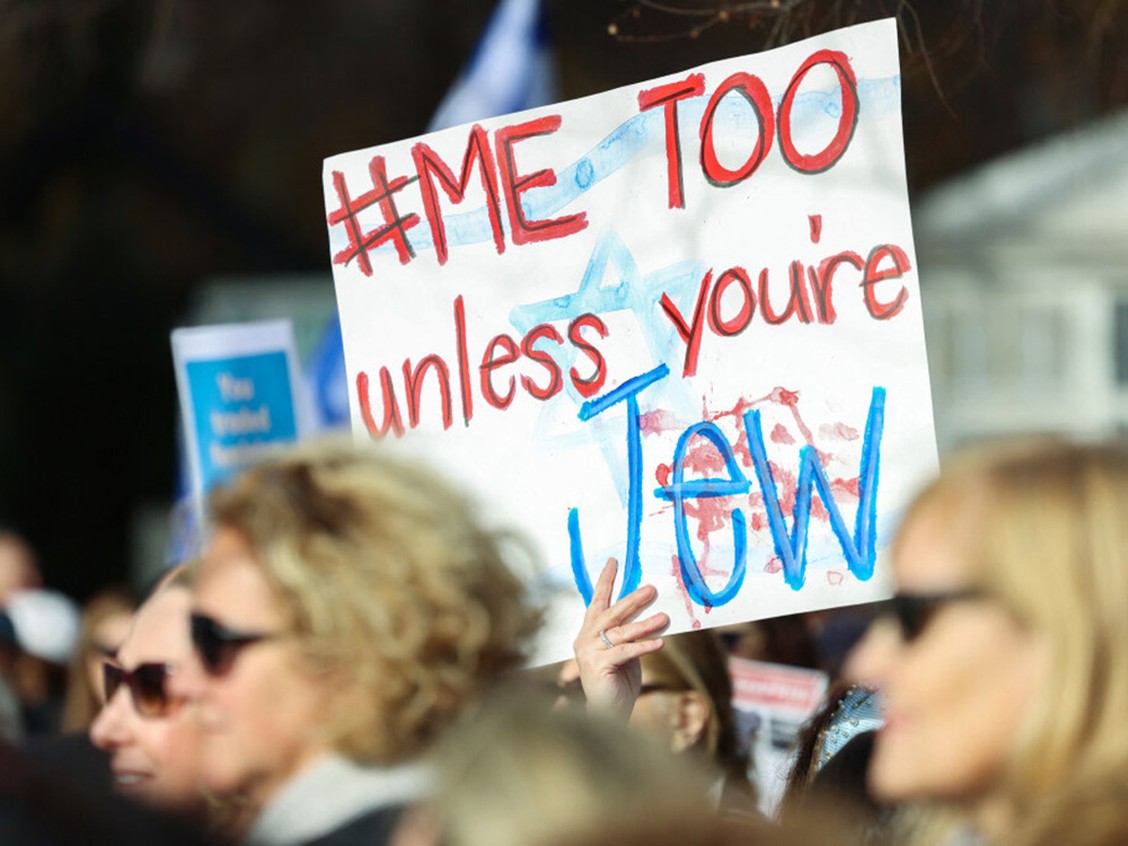
Demonstrators gather during a protest outside of United Nations headquarters in New York City on Dec. 4, 2023. Photo by CHARLY TRIBALLEAU /AFP via Getty Images
Dr. Barrett is an obstetrics professor at McMaster University, rebuked by having been removed from the editorial board of an academic journal in a reaction to his having publicly criticized his professional association for their failure to condemn the mass rapes perpetrated on Israeli girls and women on October 7 by Hamas terrorist operatives who had flooded across the border from Gaza through a separation fence they had destroyed to gain access by the thousands into Israel where as deadly marauders they slaughtered 1,200 Israelis on that fateful day.
Perplexed, alarmed and angry, Dr. Barrett wrote to the leadership of his professional group looking for answers as to why it was the association failed to make a public statement, to comment on the atrocities from their perspective as a special group for whom this should have been a matter of interest and abhorrence. Months transpired and there was no response as though the organization avoided a public statement in their name addressing the sexual violence. Which prompted Dr. Barrett to make a public critique in writing condemning the position his professional association had taken.
He felt personally affected that the leading body for Canadian OBGYNs with its four thousand-plus members to which he had devoted his professional trust sat silent in the face of this event that was well beyond repugnant in its lethal violence against women and girls, and the impact it should have had on a professional body for which such actions should have been horrifying had no obvious wish to condemn it. That his organization had no condemnatory comment in light of the violence Hamas perpetrated on women felt devastatingly both professionally and personally disappointing.
When the association's president Amanda Black applauded through a public letter the reporting of sexual violence that Russian soldiers perpetrated in Ukraine, highlighting the organization's advocating work for women, its silence in the face of the Hamas atrocities committed against women in Israel appalled Dr. Barrett. "The penny dropped, my denial evaporated and it all changed. It was then that I resigned. I fear that, once again, just like in my grandmother's generation, the Jew is being dehumanized to the point where the most heinous of acts are accepted by society. If you cannot name the perpetrators and victims, you are complicit", he wrote in a National Post op-ed.
When that piece saw publication a call came in from the editor-in-chief of the Journal of Obstetrics and Gynecology Canada, the academic publication associated with SOGC. The editor, Togas Tulandi, informed Dr. Barrett that his op-ed resulted in the association leadership's anger who demanded his removal as an associate editor of the journal. Once Dr. Barrett challenged the editor over his potential removal's basis, he received an apology from the editor-in-chief who went on to send a message to the journal's editorial board to the effect that "I regret my error"; Dr. Barrett would not be dismissed.
That series of events led to the Journal board's confusion and ultimate disagreements from within and eventually editor-in-chief Tulandi felt constrained to announce his resignation from the journal's leadership, with two other editorial members of the board joining him. Others expressed empathy, contemplating leaving themselves, but thought deeper of such a move that would impact on their ability to challenge the journal's direction. Dr. Barrett regretted himself resigning, in retrospect.
"I don't think it was the right thing to do, but it was that frustration that I didn't feel I had a voice anyway", he said ruefully. SOGC president Amanda Black followed up with an elucidating statement of a December 2023 piece she had written: "Specifically condemning the use of women as weapons of war -- a tragic and enduring reality for women globally. This was a general statement applicable to all countries where such atrocities were, and continue, to be committed." Again, the specific identifiers of Hamas violations/Israeli women stepped around.
Dr. Barrett remains dissatisfied by the Society of Obstetricians and Gynecologists' approach to the issue. He points out the differences in the SOGC public statement of condemnation and that of the American College of Obstetricians and Gynecologists condemning violence against women in the Middle East: "It is horrifyingly clear that they are being specifically targeted for sexual violence, abuse, and kidnapping". A statement by the Society for Maternal-Fetal Medicine also committed to a more direct approach: "Our Israeli colleagues and your patients."
"In another world, on university campuses, some Jewish students -- coddled by their administrations -- cite their fear of a protest chant as an indicator that a Second Holocaust is imminent. It's not rational, but understandable."
"They are not feigning: the fear is so real it can conjure the Gestapo in the halls of the Ivy Leagues. Then they are guests on television networks, narrating their harrowing life at the academy."
"You almost laugh but it isn't a joke. It's psychosis."
Mohammed El-Kurd
"If Mr. Rosenthal is bent on silencing diverse or dissenting voices, particularly Palestinian voices describing genocidal conditions and western hypocrisy, I'll call that what I believe it is: racist."
"If he's encouraging students to boycott one of the few Canadian Muslim law professors in the country because he doesn't like my opinions or who I retweet, I'll call that what I believe it is: Islamophobia."
Professor Faisal Bhabha, Osgoode Law School
"We disguised our political demands behind religion and multiculturalism, and deliberately labeled any objection to our demands as racism."
"Even worse, we did this to the very generation who had been socialist sympathizers in their youth, people sympathetic to charges of racism, who like Dave Gomer were now in middle-career management posts."
"It is no wonder then that the authorities were unprepared to deal with politicized religion as ideological agitation; they felt racist if they tried to stop us."
"Islamism demanded no less of a root-and-branch overhaul of society. But it was cloaked in religious garb, no one quite knew what to do with it, and people were desperate not to offend."
"There was confusion over whether to define our activism as a cultural identity, an ideology, or a faith. To top it off, Islamism went through a decade of being embraced by both the left and right wings."
"The default liberal position was to embrace the movement as part of multicultural sensitivity: to tell people to stop practicing their faith was imperialism in nineties clothing, a colonial hangover bordering on racism."
"Instead, we were embraced as a new generation of anti-colonial politicized youth."
Maajid Nawaz, Radical: My Journey out of Islamist Extremism
A 'pro-Palestinian' rally Sunday, Nov. 12, 2023. Photo by THE CANADIAN PRESS/Graham Hughes
According to Howard Levitt, lawyer and journalist, class-action lawsuits are pending against three Canadian universities who for years have nurtured a culture of antisemitism that has resulted in a poisoned environment on campus, one that has become intolerable for Jewish students, a situation that has been exacerbated by the horrific events of October 7 and the aftermath, of condemnations emanating from the left, from unions, and from academia, not of the terrorist group Hamas, but of Israel's response to the terrorist rampage of deadly carnage.
The government-sanctioned woke movement had its origins in universities and professors which have for years been indoctrinating their students into the ideology which began in the United States and moved into Canada, although it was at the University of Toronto that it was taken to another level by the instituting of the BDS movement that then moved onward and upward to the United States.
According to Mr. Levitt, the reason that the now-famed professor of psychology and author Jordan Peterson left his tenured position as professor-emeritus at University of Toronto was his realization that any student studying their degrees under his tutelage would be penalized by a studied lack of academic prospects. The atmosphere in most colleges and universities now is corrosively left-woke-progressive and Israel appears to be their iconic demon.
Close to three of every four American-Jewish students has had experience of, or witnessed antisemitism in this academic year, according to a study carried out by the Anti-Defamation League jointly with Hillel International. In addition to which more than one in three non-Jewish students reported having witnessed or experienced an incident of antisemitism in the wake of October 7 (some of whom may have been erroneously targeted as Jews; others likely as a result of having indicated no sympathy with antisemitism).
It appears that an Osgoode Law School professor unapologetically in support of the 'Palestinian' cause, which in the current context cannot be separated from approval of Hamas, was seen to have reposted a number of posts seen on the social media platform X with a clear message of anti-Israel, anti-Zionist, antisemitism pathology. This is a professor of law -- Faisal Bhabha -- who obviously teaches students from all walks of life, ethnicities, religions, cultures, and finds it irresistible to single out Jews for personal antipathy.
He would teach legal ethics, a course in civility as an authority of Canada's rule of law. The question occurs how might students of Jewish background cope with their emotions when this professor guides them through the tenets of the legal profession, and then grades their progress? In response to Professor Bhabha's postings, Jonathan Rosenthal, part-time Osgoode professor, Law Society Bencher and Fellow of the American College of Trial Lawyers took umbrage:
"It is disturbing that as a legal educator you would choose to repost this tweet. Have you no concern for any of your students? Evidently not" he addressed Professor Bhabha back on X. Professor Rosenthal went on to discourage students from taking any courses Professor Bhabha teaches, leading Bhabha to respond with: "You're a first-class bigot", in a classic response of the pot calling the kettle black. Which led Mr. Levitt to intervene, asking him how he felt Jewish students might react to their fear considered "psychotic" and the characterization as a "pampered, pathologically narcissistic 'community'."
A group of York University faculty members,
staff and students say they will participate in a walkout of classes
Tuesday in protest of suspensions of three employees who were charged
for mischief of a Toronto Indigo bookstore. An Indigo bookstore is seen
Wednesday, November 4, 2020 in Laval, Que. THE CANADIAN PRESS/Ryan
Remiorz
This week, York University suspended three members of their staff, one among them a professor, when they were criminally charged with the defacing of a Toronto Indigo bookstore, targeting its Jewish founder, Heather Reisman for her connections with Israel. The three involved had gone out at night geared for mischief, pouring a blood-like substance over posters on the glass frontage of the store, accusing the Indigo CEO of involvement in Israeli 'genocide' of Palestinians.
Another professor at York University, along with a group of professors and students protesting the suspension, issued a statement including "We feel that the administration should be standing up for rights to free expression". Police don't have a habit of charging malefactors with criminal behaviour when they're exercising their rights to 'free expression', a little factoid that may have slipped the attention of these brilliant academics.
All of which leads one to despair over the quality of university graduates that North America is preparing to take their place in society as responsible adults dedicated to uphold the law and the system of justice under a democracy that stresses equality, human rights and freedom from racist discrimination.
"Mr. Bhabha twice asserted that “Zionism is about Jewish supremacy,”
which he linked to white supremacy in the United States. The notion that
Zionism, which merely calls for Jewish statehood in the Jewish homeland
– no different than most other national movements – is a uniquely evil
form of “supremacy,” is a false and dangerous allegation."
"Worse yet, Mr. Bhabha also stated that “Accusing Israel of exaggerating
the Holocaust could be, for some, a plausible argument.” This is a
preposterous canard with no supporting evidence."
"We, the undersigned, demand that Associate Professor Faisal Bhabha no longer teach any “human rights” courses at York University’s Osgoode Hall Law School."
"Any version of human rights that does not include a firm
rejection of antisemitism is ethically and morally bankrupt. Students at
York University and Osgoode Hall Law School deserve better."
B'Nai Brith Canada
York University campus
(photo credit: REUTERS/MARK BLINCH)
"As we all know, Canadian universities are supposed to be bastions of
freedom of thought and critical thinking, where controversial ideas are
explored and debated in a framework of civility."
"The reality today is that Canadian universities undermine academic
freedom because they are dominated by group-think, left-wing academics
who intimidate their conservative colleagues into silence, while
university administrators do nothing."
Editorial, Toronto Sun
"In November 2017,
Lindsay Shepherd, then a twenty-two-year-old graduate teaching
assistant, made international headlines when she was censured for
showing a clip of a public broadcaster’s current-affairs program in a
Wilfrid Laurier University communication studies tutorial, in which
University of Toronto psychology professor and bestselling self-help
author Jordan Peterson expressed his opposition to Bill C-16: the (now
passed) legislation adding gender identity and gender expression as
protected categories in the Canadian Human Rights Act and Criminal Code.
In the clip, Peterson said he would refuse to use gender-neutral
pronouns if requested to do so by a nonbinary student and that any
attempt to compel the use of gender-neutral pronouns amounted to
curtailing free speech. As Shepherd explains ... she 'wanted to make a larger societal point about how something
innocuous, like grammar, can actually be politicized'."
John Semley, The Walrus
"As a professor in the Faculty of Liberal Arts at Wilfrid Laurier
University’s Brantford, Ontario campus for the past 15 years, I’ve
witnessed what happens when liberal professors deem their conservative
students an “enemy to be openly opposed.” My public writing and
presentations in support of conservative ideas often lead like-minded
students to reach out to me."
"Many are Christians, although not all.
Before Covid-19, it was common for me to have students sobbing in my
office. Now I hear their stories via email. Many who write have never
taken one of my courses; some don’t even attend Laurier. But their
stories are always similar."
David Millard Haskell, C2C Journal
A recently-released report -- whose findings were the result of an investigation by Christopher Dummitt, professor of Canadian history, Trent University, and Zachary Patterson, associate professor of geography at Concordia University -- has revealed some very telling statistics. Results not totally unexpected, since for years the prevailing situation at most universities and colleges in North America has been to ignore or condemn university professors and students who hold what is termed 'conservative' views of any dimension. In a prevailing atmosphere of liberal-left and now 'woke' views, conservative voices have been stifled.
In essence the report these academics steeped in the tradition of higher-education learning have published, found more than enough proof that Canadian universities just as those in the U.S. and U.K. have become politically homogeneous, promoting a total lack of diversity in perspectives leading to diminished support for academic freedom and providing a hostile environment for those disagreeing with left-leaning values. All of which has contributed hugely to a miserable situation of self-censorship as a type of self-defence among academics.
Their survey indicated that 88 percent of professors self-identify as 'left-leaning'. That group voted for left-leaning political parties in the most recent federal election, whereas under 39 percent of the general population voted for conservative candidates, which fewer than 9 percent of academics voted for as well. Homogeneous decision-making, according to studies, ultimately lead to poor decisions, reflecting incomplete information when those with diverse viewpoints are silenced by the prevailing majority.
The study demonstrates that 47 percent of right-leaning professors tend to self-censor in avoidance of professional blowback from their peers. The report stated that even with left-leaning faculty, 37 percent tend to self-censor, while fifty percent of right-leaning faculty fear social and professional consequences should it become known among their colleagues that their opinions of political affiliations are conservative. University departments are reported by forty percent of right-leaning faculty as hostile work environments.
A third of professors admit they would support cancelling a colleagues should that colleague's research conflict with contemporary social justice values. For a large proportion of the professoriate, the study points out, academic freedom matters but conditionally; as long as it does not conflict with their political views. Protection for part-time faculty and students are absent under collective agreements. While some professors may be in a protected position from their employers, collegial or online mobs practise discrimination. In recognition of such problems some jurisdictions have enabled laws to protect universities' academic freedom on campuses.
"At a time when political polarization and social media algorithms diminish trust in institutions, Canadian universities need to be part of the solution -- modelling intellectual humility and genuine acceptance of all forms of diversity, especially viewpoint diversity."
Inventing Brain Imbalance In Service of Pharmaceuticals
"You want to know why it took so long for the truth to come out?"
"I am afraid this has something to do with the toxic relationship between industry and academia. [Drug companies encourage MDs to prescribe often, and heavily and have] paid many academic psychiatrists to promote their products."
Dr. Joel Paris, Montreal psychiatrist
"But the main thing that has got people riled up is that we have dared to draw conclusions about anti-depressants."
"It seems the main criticism is that antidepressants work. It doesn't mater how they work. It doesn't matter that the original idea, the original theory for how they work is unproven. They work, and that's all that matters."
"[To me, it matters] Because whether they work or not depends on how we understand what they are doing. We have to consider other possible ways that they may be 'working' ... which include the fact they are drugs that change normal brain chemistry."
"[When the first SSRI, Prozac was launched in the 1980s] the pharmaceutical industry knew it couldn't market them in the same way as [benzos], so, it had to convince people that they had an underlying disease and needed o take the drugs for an underlying disease."
:If you think something is wrong with your brain and a drug is going to put it right, of course you're going to take it."
Dr.Joanna Moncrieff, consultant psychiatrist, professor of critical and social psychiatry, University College, London
Chip Somodevilla/Getty Images; J. Scott Applewhite-Pool/Getty Images; Yulia Reznikov/Getty Images
Dr.Moncieff is the co-founder of the Critical Psychiatry Network and agrees that sedatives like benzodiazepines can be useful short term in a crisis: "But I think that drugs that affect the brain, we should be cautious about". No evidence exists that such drugs reverse an underlying abnormality of the brain, but "they are doing something to the brain. And by doing that they change our normal mental states."
Dr. Moncrieff points out that specific drugs known as SSRIs (selective serotonin reuptake inhibiters that are believed to work by correcting abnormally low serotonin, a neurotransmitter helping to move messages between brain cells thought to play a role in how brains process emotions) represent a drug formulation whose efficacy is taken on trust as a tried-and-true medication for clinical depression, but that in actual fact they are not at all effective.
An international media frenzy broke out with news headlines such as "How were so many duped?" when it became all too evident that the "serotonin theory" of depression, the belief in too little of the brain chemical leading to depression was debunked. The hypothesis weathered well for decades becoming deeply entrenched throughout the psychiatric medical community, a huge assist in promoting a class of antidepressants taken by millions worldwide.
Several months ago a major review concluded there was no support for the hypothesis that depression is caused by lowered serotonin activity or concentrations, for basically, no convincing evidence of a "chemical imbalance" exists. The paper's authors have been ridiculed and attacked, accused of succumbing to urban myths that link antidepressants to mass shootings.
The suggestion and subsequent acceptance that a "chemical imbalance" in the serotonin theory first introduced 60 years ago seemed promising. However, said Dr. Allen Frances, professor emeritus of psychiatry at Duke University, involved in creating the fourth edition of the Diagnostic and Statistical Manual of Mental Disorders in 1994, the association was weak and failed to replicate. "Depressions are so remarkably heterogeneous, there can't possibly be any unitary cause", stated Professor Frances; further study "revealed just how ridiculously complicated is brain structure and function".
For their "umbrella" review published in Nature's Molecular Psychiatry, Dr. Moncrieff and her co-authors reviewed high-level studies in six major areas of research which spanned 56 years, involving tens of thousands of people. The studies involved indirect measures of serotonin activity in the knowledge that no "normal level" of serotonin exists. The investigators reviewed studies indicating indirect measures of serotonin activity; serotonin and its breakdown products in people's blood or cerebral spinal fluid comparing levels between people diagnosed with depression and those not diagnosed with depression, as healthy "controls".
No overall difference in levels of serotonin was found by the researchers between the two groups. Serotonin comes from tryptophan, an amino acid extracted from the diet. Healthy people on diets lacking tryptophan did not become depressed. Looking at studies of genes involved in the brain's serotonin system, researchers again found no consistent difference between depressed and healthy volunteers.
"I think people need to think carefully about why they are taking [SSRIs] and what they think the drug is doing for them."
"If they are taking the drug because they think it's correcting an imbalance in their brain,I would suggest that they could re-evaluate whether they need to take it", said Dr. Moncrieff.
According to Dr. Frances, what is often lost in the controversial conversation over chemical imbalance and depression, is that mild depressions are usually caused by life stressors which do not require medications. "Instead, they improve with time, support, reduced stress and/or psychotherapy", while severe depressions do require medication, rarely responding to anything else.
It is not just for depression that SSRIs are prescribed, but for social anxiety disorder, panic disorder, OCD (obsessive-cmpulsive disorder), phobias and an even longer list of complaints. Like all drugs, these carry side effects which include agitated feelings, low alcohol tolerance and loss of libido and sexual dysfunction.
A recent analysis paints a compelling picture that depression isn't
caused by a chemical imbalance in the brain. But experts say this is
already widely accepted and it's also true that antidepressants can be
extremely beneficial to some patients — even if we don't know exactly
why. (Shutterstock / Chanintorn.v)
"We acknowledge that we are all
living off the taken ancestral lands of Indigenous peoples for thousands
of years. We acknowledge the extraction of brilliance, energy and life
for labor forced upon people of African descent for more than 400 years.
We celebrate the resilience and strength that all Indigenous people and
descendants of Africa have shown in this country and worldwide." "We
carry our ancestors in us, and we are continually called to be better as
we lead this work…. We envision a nation in which…all
physicians are equipped with the consciousness, tools and resources to
confront inequities and dismantle white supremacy, racism, and other
forms of exclusion…."American Medical Association
"[The AMA’s proposed strategic plan] is rooted not in science and
the medical ethics of the Hippocratic Oath but in a host of Marxist
ideologies that devalue the lives of our most vulnerable patients and
seek to undermine the nuclear family which is the single most critical
institution to child well-being."
Dr. Michelle Cretella, executive director, American College of Pediatricians
Gender equity in medicine ... AAMC
It's simply yet another manifestation of the mammoth sway in society of its latest zeitgeist, an 'awakening' of conscience so burdened with guilt that the sins of the fathers have been visited upon their sons, their daughters, their grandsons, their granddaughters, their great-grandsons and great-granddaughters burdening all of society with collective guilt and responsibility for what humanity has embarked upon since time immemorial; taking advantage of others to advance one's own well-being.
The social-cultural miasma of collective guilt handed down through the generations, finding all those who have moved forward in life at the ostensible and frequently real manipulation and oppression of others who themselves have learned to bask in their victimhood, found guilty as charged. If anyone is an art lover, in Canada the National Art Gallery housing priceless art collections to be admired and enjoyed, now is meant to be viewed through the lens of a JEDI&A lens (Justice, Equity, Diversity, Inclusion and Accountability). Do not, under any circumstances, view art henceforth for its own authentic qualities in the search for aesthetic beauty and originality.
AAMC
According to the American Medical Association, doctors must now inform their patients with a preamble, elocuting in the instance of patients of Native American background, that they were historically "dispossessed by the government of their land and culture". As for people living in straitened economic circumstances presenting with illnesses, they too are to be addressed with the explicating admission that "people underpaid and forced into poverty as a result of banking policies, real estate developers gentrifying neighbourhoods, and corporations weakening the power of labour movements among others, have the highest level of coronary artery disease".
In the time-consuming process of earnestly convincing patients that the medical profession is on their side in indignant fury over the rough ride that life has given them thanks to the powerful selfishness of the entitled class and the colour-white tyrants, doctors might very well lose track of their obligation within the medical profession of addressing the patient's symptoms to find a medical diagnosis, in their brain-straining efforts at placing themselves at the service of diversity, inclusion and equity (DIE). In the process helping their patients to do just that.
University campuses give full throttle to 'woke' culture. Academia has embraced its politics, encouraging students and staff alike to take up the cause of underdogs everywhere, castigate the self-perceived vision of innocence, replacing it with communal guilt and cast those entities named as guilty-as-imagined to be beyond the pale, to be exorcised from polite society. The formidable icons of Western heroism, the principals behind the most meaningful measures of civilization's advance are now to be viewed as reprehensible white saviors who sacrificed the lives and cultures and heritage of indigenous peoples for white gain.
Their crimes against society may be centuries old, but the current white-privileged are their spawn and as guilty of oppression and discrimination as their forbears, irrespective of their remedial actions and conscientious acts of present-day consciousness. The woke politicization of science, academia and government has soared in an evolutionary cultural volcanic eruption of caustic blame melting the rock-solid core of democratic civilization as we were fond of knowing it.
In Canada, research scientists working on cutting-edge technological advances will be turned down for government funding research grants should their completed funding applications under assessment reek of insufficient dedication to equity, diversity and inclusion considerations. Consideration of criteria such as qualifications and skills and work ethic and experience are now irrelevant when faced off against minority rights and entitlements to equality treatment in all spheres of influence; qualifications recognized as secondary skills, shields behind which exclusion appallingly skulks.
In Canada recently, a Lakehead University professor was granted $1.2 million for her research studying the efficacy of Indigenous healing in the prevention of cancer. She proposed that the medical, scientific community should focus on matters from a different perspective altogether: "Think of cancer as a symptom of colonialism". Upon which a governing party Member of Parliament -- who before re-assignment to the Indigenous Services ministry was the Minister of Health -- congratulated the Lakehead professor and wrote: "I look forward to hearing and learning from your work and findings".
"We got the idea that a really useful way to look at people's appearance might be to look at something like acne, because, turns out that acne affects people pretty randomly." "And we thought that acne was a good vehicle for investigating this
relationship [the link between physical appearance and education and labor market outcomes] because a lot of people get acne and it happens to everyone
regardless of their socioeconomic status." "We’re hesitant to say that we find iron-clad proof." Erik Nesson, economics professor, Ball State University, Indiana
"[Basically, acne] is associated with reduced participation in sports clubs and increased participation in non-sports clubs, suggesting a possible shift from physical to intellectual pursuits." "Knowledge of long-term benefits associated with having had acne has the potential to reduce teen suicides." "Our findings are consistent with a mechanism where severe acne limits socialization so much as to affect long-term outcomes that may depend both on studying and on sociability." "Skin problems are also associated with increases in cumulative overall high-school GPA [grade point average] and cumulative science high-school GPA, and we find some evidence that skin problems are related to cumulative mathematics and science high-school GPAs." "Skin problems are not consistently related to earnings among the entire sample, but skin problems are positively related to personal earnings for women and white women." U.S. study, adolescent acne outcomes
"Overall, this is an interesting study in that it suggests that what might be considered as a disadvantage when growing up ends up translating into positive outcomes later on in life." "In this regard, the finding contrasts with similar studies which show that other kinds of disadvantages [being short or not beautiful] are typically linked to labour market penalties." Vera Brencic, economics professor, University of Alberta
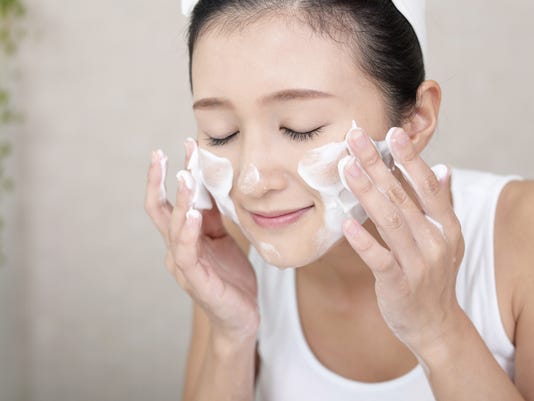
Many
youth need to treat skin conditions such as acne, which can be
exacerbated when pores on the surface of the skin become clogged.(Photo11: liza5450, Getty Images/iStockphoto)
Teens plagued with skin-blemishing acne see no upside in their affliction and would do almost anything to find a miracle 'cure' for their acne. However, two American professors of economics put their heads together, scoured scholarly articles on acne -- and there are plenty of them -- and came to the conclusion that there's an upside for having acne, as long as the sufferer is patient and endures. Their study was published in the Journal of Human Capital in late 2018.
And they found, convincingly enough to write with a high degree of confidence, that having acne in one's adolescent years was correlated with higher grade point averages alongside a higher likelihood of graduating from college and singularly for women, they detected through their study that evidence exists that having acne is associated with higher earning potentials for women.
There is a rational enough reasoning here, that teens with acne were uncomfortable with their appearance and preferred to shelter themselves from public view as much as possible, meaning they were less likely to socialize and likelier to spend that time on their studies. There you have it: problems with skin blemishes point to a more intellectually-flavoured lifestyle and that in turn equates with improved grades, more intensive academic studies and eventually, higher incomes.
Greatist
That's the good news, and there was no way of ignoring the bad news, that acne strongly correlates with adolescent suicide; the detrimental effect of severe acne even while it seems that lighter bouts of occasional acne result in labour market success. If we're weighing quality of life as opposed to cessation of life, there's really no contest, is there?
The paper and its conclusion is considered one piece of a larger puzzle relating to work that explores how physical attractiveness matches with greater success in life outcomes, a well-studied phenomenon where it is recognized that comely people have a tendency to reach for greater success through their aspirational pursuits.
Professor Nesson partnered for this study with Hugo Mialon, both analyzing data collected by the Eunice Kennedy Shriver National Institute of Child Health and Human development where studies were run of adolescent development in waves from 1994-95. Information was available through that research relating to academic performance, perception of physical attractiveness, acne, and adding research that followed over the years, educational attainment and income.
Having acne through the adolescent years correlates with a 3.8 percent increase in chances of obtaining a bachelor's degree.
Grestist
Abstract We use data from the National Longitudinal Study of Adolescent to
Adult Health to investigate the association between having acne in
middle to high school and subsequent educational and labor market
outcomes. We find that having acne is strongly positively associated
with overall grade point average in high school, grades in high-school
English, history, math, and science, and the completion of a college
degree. We also find evidence that acne is associated with higher
personal labor market earnings for women. We further explore a possible
channel through which acne may affect education and earnings. Hugo M. Mialon Emory University - Department of Economics Erik Nesson Ball State University - Department of Economics
"It [cannabis] is not really a big part of my life outside of the science." "There is a need for the science and there is a market and there are people that are growing it and they are going to have to grow it safely and make money -- and they can't just make it all up themselves." "They [University of Guelph] offered a number of plant courses and I took some on a whim and fell in love with it. I'd always been interested in economics and business and I figured I wanted to get into an exciting, fast-growing industry and unfortunately there's not much that qualifies in terms of the plant science." "I was trying to graduate to be done by the time legalization [as of October 17 in Canada] was happening so I kind of had my head on the ground, not looking for work." "But I had a number of companies contact me, some with some very serious interest in having me on to continue to do research with them or to help them improve their production practices." "It's interesting and new and the fact that there is [little] research in the area [meant] I could have free rein of what I wanted to do. Being able to get into the forefront of a scientific topic these days doesn't seem like even an option, it's kind of just built upon the work of others." "Any crop you're producing you have to know how much to fertilize it, how much to irrigate it, what to grow it in. And because there's not academic research on the topic, there's very little guidance for growers and growers are forced to rely on [often[ unreliable information." "We custom=formulated and evaluated several growing substrates -- specifically for cannabis and determined what would work best." "There's a lot of practices that we see with cannabis growers that are interesting and have some kind of logical explanation, but not necessarily one that's founded in plant science." Deron Caplan, alumnus, University of Guelph
Deron Caplan will soon be what is believed to be North America’s first Ph.D in pot production. (Turgut Yeter/CBC)
This enterprising young man who has earned Canada's first doctoral degree in cannabis production focused on the basic horticultural elements of cannabis production ... basically methodology which, during the era of prohibition -- soon to be concluded -- represented trial and error. His doctoral thesis in effect has resulted in an academic body of expertise on vital agricultural methodology relating to optimal fertilizer rates and growing mediums, useful for large licensed producers and at-home growers alike.
Methods of propagation and best practise in stem-cutting techniques also received their due. Although University of Guelph, best known in Canada as an outstanding agricultural institute of higher learning is the first to have produced a specialist in specifically growing marijuana crops McGill University also has three students with doctoral theses in neutral hemp production, none yet having earned their PhD with an emphasis on the medicinal and intoxicating marijuana strains that will become legal in Canada in October.
Other major agricultural schools across Canada have yet to focus on producing programs that will result in doctorates in marijuana production. Now, pot doctor Deron Caplan will find his academic skills in high demand. Though he is the first Canadian to emerge as a PhD in cannabis production he won't be the last as more postgraduate degrees will most certainly emerge, according to Anja Geitmann, dean of agriculture at McGill University in Montreal. "I'm pretty sure it's going to change the research landscape in the sense that researchers now have access or can do research on the plant much easier", she commented. In so doing, scientific knowledge relating to the cannabis plant will expand as universities respond to the legalization of pot. Taking undergraduate classes in environmental sciences at Guelph, Caplan's interest in cannabis science was sparked leading to the serendipitous synchrony of his completed doctorate with the new cannabis law.
Once his undergraduate degree was realized, Caplan was inspired to approach horticulture professor Youbin Zheng who has worked extensively with cannabis, to enquire about the possibility of a master's study of the plant. While awaiting an opening for postgraduate studies in cannabis research, Caplan filled in the time by travelling for eight months to France, Germany, Croatia, the Netherlands, Greece, Japan, Korea, Thailand, Indonesia, Cambodia and Russia.
His travels came to an end when Professor Youbin messaged him that a project was at hand, compelling Caplan to return to Guelph to pursue the research in 2015, which he later combined with his doctoral work in 2016. Professor Zheng acted as thesis adviser which led to the two collaborating on the first research paper in North America to be published in a peer-reviewed journal on indoor cannabis production.
A
worker at Cann Trust's Niagara region greenhouse cultivates marijuana
plants. Cann Trust will be one of a number of licensed marijuana
producers looking to hire graduates from Niagara College's new
commercial cannabis program. (Turgut Yeter/CBC)
"Less than one percent of published biomedical research is both scientifically valid and clinically useful." Dr. Brian Haynes, clinical epidemiology professor, McMaster University
"Much of what biomedical researchers conclude in published studies is misleading, exaggerated, and often flat-out wrong." "There is increasing concern that most current published research
findings are false." "The probability that a research claim is true may
depend on study power and bias, the number of other studies on the same
question, and, importantly, the ratio of true to no relationships among
the relationships probed in each scientific field. In this framework, a
research finding is less likely to be true when the studies conducted in
a field are smaller; when effect sizes are smaller; when there is a
greater number and lesser preselection of tested relationships; where
there is greater flexibility in designs, definitions, outcomes, and
analytical modes; when there is greater financial and other interest and
prejudice; and when more teams are involved in a scientific field in
chase of statistical significance." "Simulations show that for most study
designs and settings, it is more likely for a research claim to be false
than true. Moreover, for many current scientific fields, claimed
research findings may often be simply accurate measures of the
prevailing bias." John Ioannidis, expert on credibility of medical research, Stanford University
Universal Biomedical Research Laboratory
Doesn't the public get all worked up with excited anticipation on reading newspaper accounts of radical new health research that has succeeded in finding that elusive cure for whatever ails the anxious reader. That anxious reader will hope against hope that he will live long enough to take advantage of this breakthrough finding in new techniques, medicines, protocols that will surely benefit his/her condition, knowing that from laboratory finding to animal modelling to human clinical trials a decade may pass before government health bodies give regulatory assent for use.
The trouble is there are so many of these research projects and papers that come out of studies that are published to great acclaim. Whose conclusions have a qualifier such as "may", "might", "can", or "could" possibly have an impact on any given health condition. Despite which the research and its conclusion swiftly gets reported in headline news with added emphasis here and there to garner public interest and sell papers. And though people are at first thrilled at the prospect of a cure around the corner, some researchers in the field may think differently.
A seasoned researcher who would never dream of accelerating output on the basis of a fragile thread in research supposition might ask himself what selective science methods might have been used to conclude that their specific research points to a cure? Was the research contrived with a bias beforehand, a prior determined outcome? Was this a rigorous, double- or triple-blind study, one whose conclusion could be trusted?
Deceptive methods are often used by researchers anxious to publish and receive professional credit for producing yet another influential paper cited by other researchers, to advance their careers. This has become a motivating factor for many in the field of health science seeking to impress those who may then regard them as promising experts in a particular field of study for whom an attractive position in academia may be forthcoming.
Selective study designs make use selectively of data, taking care to use the analyses or reporting of results that most closely match the outcome they have determined to aim toward. The results are heavily biased studies, a common failing in research, but one that experiences little difficulty in finding a place within science publications of good reputation. As an example with health impacts reported out of air-pollution-epidemiology studies, researchers can select outcomes from previous studies that suit their purposes.
Ignoring studies that fail to demonstrate the impacts the researcher is looking for, heavily biases his or her own conclusions, making them worthless. In the same token, scientists who are informed that their study appears to be one based on bias will be affronted, and go into vigorous denial. But it is not the 'evidence' unearthed that reflects the nature of science, but the methods used; flawed methodology results in flawed outcomes. Bias nullifies any evidence that results from such studies.
When a study undergoes triple- or double-blinding, its purpose is specific to the reduction of scientific bias on the part of scientists undertaking the study. Peer reviewers for journals prior to publication, are meant to carefully read the papers to ask probing questions, and recommend changes that clarify issues, and if well done by knowledgeable reviewers, preclude bias, assuring the publishers that the paper they will then publish is scientifically rigorously defensible.
On the other hand, journal publishers and their editors look for novel research that will pique the interest of their readers. If a study fails to demonstrate health impacts, they may be rejected for publication, and when this occurs the bias shown is on the part of the publisher. As for the media, methods are irrelevant, they look for results and the more spectacular they can make those results appear in print by their own use of superlatives and excesses, the more saleable their product is to the public.
This is an issue that doesn't start in the laboratory, but in the classroom. Where professors in academic settings now all too often train their students what they must think, and not how they should think to reach reliable conclusions, muddying science with prevalent social attitudes. Often hopes of procuring more research funding motivates academics to rush their work to publication to impress funding agencies.
Academic education has a purpose, to teach students how to think analytically. Failing that purpose, degrees are mere papers signifying little. Supporting the view of the cynical that the experience of life aligned with plain good old common sense rate as a practical equal to the value of a doctorate.
"Whether this was done out of ignorance or not [an official apology from the university is due] that this piece was approved for display." "As a Muslim community, we feel greatly offended, concerned and disappointed." "This has already provoked Muslims and has caused very upsetting reactions, and several students' responses and behaviour [sic] towards this is extremely alarming and is starting to make some students feel unsafe at OCAD." "This is serious and we do not take it lightly." Muslim Student Association, Ontario College of Art and Design University
The controversial piece.Twitter
"Why does someone need to disrespect a whole religion and the way of life of billions of people?" "...The intent does not change the blatant disrespect to our Islamic faith and the objects, places and symbols we hold dear to our heart." "Picking up customers in my taxi that swear I hate them and want to kill them simply because I am Muslim or having my mother or my sisters followed and abused for wearing the hijab makes me live a certain anxious and protective lifestyle." OCAD student, part-time taxi driver
"We understood she was speaking from within her own cultural practices and experiences." "We didn't feel we could put up the work without any information. We've been working with her [the artist] the last couple of days. We've been in discussion." "So for her, no name and no statement means the work has to come down. [Despite the controversy raging around the work] that doesn't mean we're shutting the dialogue down. The university supports the right to artistic expression." Natalie Majaba Waldburger, show co-curator, OCAD professor
"We respect the Muslim Student Association has their opinions, and this is an important dialogue around this piece." "It's a matter of looking at both sides." Christine Crosbie, OCAD media and communications manager
The Ontario College of Art and Design University in downtown Toronto.Peter J. Thompson/National Post/File
The controversy at the Ontario College of Art and Design University in downtown Toronto emerged as a result of a Muslim art student's statement piece to be hung at the campus for a special show. The piece was untitled and there was no attribution revealing the name of the artist. As for the art piece itself it was a green Islamic prayer mat. Rather different than most such mats in that etched upon the mat was the black outline of a nude woman, recumbent.
It hung among the other exhibits until a complaint was received by the college, which then removed the prayer mat and in its place hung a notice from the curators and show jurors stating: "the intent of the work that was previously hanging in this space" was to be clarified, the decision made to "remove it temporarily ... until a statement from the artist can accompany it."
Reference was made to "the concerns of a number of OCAD University student groups", and concluding with a rather delicate apology should concern have been caused either by the artwork's removal or its inclusion prior to removal in case either "has caused anyone harm." And since the complaint emanated from the ever-watchful eyes of Muslims demanding its immediate removal, and an investigation launched, a bit of panic ensued.
Affront to an Islamophobia-sensitive-prone minority; what a ghastly turn of events!
Yet the controversial piece fit right in with the spirit of the show titled Festival of the Body. The artist originally allowed her name to be attached to the piece, reconsidered, and then had it removed. Lest one wonder why an artist would decide to detach herself from a piece she designed with a purpose for a special event expressing her belief both in her religion and her art, consider the danger she would be placing herself in through connection with a piece of art that enraged her religious peers.
At the same time the university administration is also sensitive to the issue of primary importance in the west known as freedom of speech.
As a fascinating corollary to this incident the school displays a piece of art titled Immersion (Piss Christ), a 1987 photograph by American photographer Andres Serrano. This piece shows a plastic crucifix submerged in a tank of the artist's urine. Christians have denounced, vandalized or threatened harm to the photographer every time the photo has been exhibited over the last three decades.
"We’ve seen the same impulse for self-censorship in the West before …
Given the seriousness of the violence, such self-censorship is
understandable; it’s also a step backward at a time when we need to
reassert the importance of free expression by artists, activists,
journalists and editors alike." Andres Serrano, art photographer
As for the controversial prayer mat which has engendered so much attention, ensuring that the OCAD University special show was a resounding success judged by reaction and presumably attendance, the artist did in the end, give context to her piece, which was re-hung, name still withheld, along with her statement: "If the body was created halal (permissible) when did we make it haram
(forbidden)?"
"Homeopathy is a pseudo-science and this alone should be sufficient to reject the inclusion of such a program at a publicly funded institution." "There are at least twelve international organizations that have evaluated the literature and again and again they find homeopathy does nothing." "This [a respected institute of higher education legitimizing homeopathy] will likely result in patients delaying or even failing to seek effective health care for their ailments." "[Homeopathy’s appeal is based on the] naturalistic fallacy — the idea that if it’s natural, it’s going to be better. And there’s nothing more natural than pure water with no active ingredient." Dr. Chris Giorshev, chair, chronic pain section, Ontario Medical Association
"[The Barrie campus of Georgian College] will provide students with the theoretical, practical and clinical skills necessary to graduate with the competencies required to successfully meet the entry to practice requirements of the regulator body [College of Homeopaths of Ontario]." "Georgian is seeing strong interest in the program." "As an educational institution we welcome critical discussion and debate. It helps ensure the best possible curriculum and learning outcomes for our students." "In an era of patient choice, it is important for the college to provide students with the most diverse education possible, including options for care and different methods." Fay Lim-Lambie, dean of health, wellness and science, Georgian College
"Any talk about solutions having some sort of 'memory' is utter claptrap, and even if such memory would exist why should it have any therapeutic effect?" "The real danger in homeopathy is not toxicology -- there's nothing in there." "The real danger is toxicity to the mind because it can convince people to go down this ridiculous route when there actually might be treatments that can work for whatever condition they have." Joe Schwarcz, director, McGill University Office for Science and Society
Critics say there is no scientific evidence that homeopathic compounds
have any effect at all. Clinically unproven claims by makers of
homeopathic treatments make them targets for class action lawsuits in
the U.S PHOTO :CBC
In 1796 a German physician by the name of Samuel Hahneman based his newly-founded philosophy of homeopathy on the assumption that "like cures like", theorizing that a substance causing symptoms in a healthy person will serve to cure those very same symptoms in someone who is ill. This supposedly works by placing the 'active' agent in water and ultra-diluting it. Devoted to the arcane conception that the more diluted the higher its potency, would seem counter-intuitive at any time, back then or at the present.
Those scorning the very basis of homeopathy point out that the final product is so "ridiculously diluted" it no longer holds a single molecule representing the original substance, when the product is finalized. Yet the theory holds that with each succeeding dilution and shaking of the water molecules the result is that a memory or "imprint" of the original substance is retained in molecular memory. Leading to its efficacy.
Yet the practice which is based on the philosophy that illness is treatable with massively-diluted substances which scientific critics point out is quite simply water mumbo-jumboed into a pretense of a magical potion, as a 'remedy' to illness, is being treated as a legitimate option to conventional medical treatment. Their ire is targeted at Georgian College which has created a three-year course with no science grounding, based solely on "magical thinking" that could result in great injury, lending the field an aura of official credibility.
Studies have concluded there is no reliable evidence through research in humans that homeopathic remedies are superior to placebos (sugar pills) in treatment of illnesses. Dr. Giorshev denounces the situation as unethical, when an academic institution sets out to teach students a program based on scientifically implausible principles. His point is obvious enough; that the gullible public may be led to assume that homeopathy represents a validated type of medicine.
Homeopathy is based on the philosophy
“like cures like,” the theory that a substance that causes symptoms in a
healthy person will cure those symptoms in a sick person.Getty Images
The curriculum presented by the Georgian College is inclusive of a discussion on the 'role' of nosodes -- homeopathic solutions claimed by natural-health practitioners and anti-vaccine advocates to be alternatives to vaccines against measles, mumps, polio and associated childhood diseases. When Ontario regulated the practice of homeopathy three years ago, the government was accused of legitimizing "quackery". It is public tax dollars that support the province's institutes of higher learning.
The National Health and Medical Research Council of Australia decided "there are no health conditions for which there is reliable evidence that homeopathy is effective", following an extensive review in 2015. The Council gave warning that homeopathy should never be used to treat conditions which are "chronic, serious or could become serious". Homeopathy"goes through the motions of health care, and looks a bit like medicine, but actually accomplishes nothing at all", wrote pharmacist Scott Gavura on his Science-Based Medicine blog.
And as far as Chris MacDonald -- who teaches ethics and critical thinking at the Ted Rogers School of Management at Ryerson University in Toronto -- is concerned, it represents bad ethics to spend public money "to supposedly teach people how to do something that we know doesn't work". In the United States, the U.S. Food and Drug Administration announced in December it plans to target homeopathic remedies marketed for diseases like cancer and heart disease, as
well as for infant and children’s products.
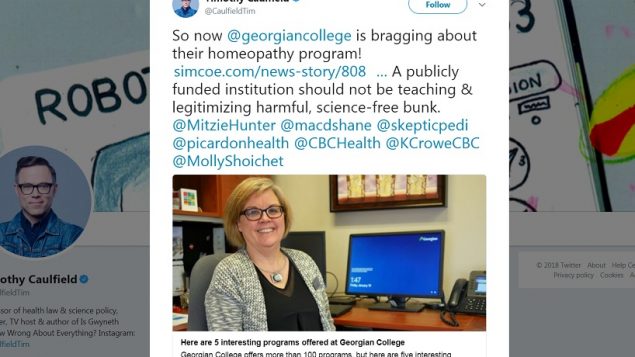
Tim Caulfield , University of Alberta professor of Health Law and Policy
was outraged to hear of a diploma program in homeopathy IMAGEl
Caulfield -twitter