Ruminations

Blog dedicated primarily to randomly selected news items; comments reflecting personal perceptions

Friday, June 06, 2025

Far Reaching Consequences in Air Quality From Canadian Wildfires

https://www.ctvnews.ca/resizer/v2/QVD62FH6MRGUFHHMBHLHHJQI4Y.png?auth=b2a28004f09139fff52987be801292dc377f1790dfbec36664f6778f7241792c&width=1440&height=810
A smoky haze continues to linger over Ottawa on Friday afternoon.  (Westin Camera)
 
"We have these massive fires going on out west in Manitoba, in Saskatchewan, and all this smoke is being lofted high up into the atmosphere and then you have the jet stream, the strong winds higher up in the atmosphere blowing it over to Ontario."
"Even if you’re not smelling it at the ground, you’re probably noticing the sky is a bit of milky colour, kind of a white colour, this is all smoke that’s just been blown over from these massive prairie fires." 
Environment Canada meteorologist Crawford Luke
 
"Things like asthma, cough, headaches — we know that over time [smoke exposure] can increase your risk of things like respiratory infections. It can also increase your risk for long-term disease like lung cancer if you have high exposure."
"Clean air quality is definitely becoming more of an awareness concern because we are experiencing more wildfire seasons that are increasing. They’re longer, they start earlier, they get worse. We’re noticing a lot more air quality alerts."
"Check the air quality and if it’s over five, six, seven, that’s when you need to pay attention. That means air quality could be bad, even if the sky looks clear." 
"This affects the youth, seniors, as well as people with lung disease, heart disease. Anyone with a lowered immune system tends to be considered higher risk. They would be the ones we’d want them to watch the alert a little bit earlier."
Jamie Happy, health promotion coordinator, Alberta Lung
 
"The particle air pollution event is the result of extensive wildfires in central and Western Canada."
"Wind patterns are forecasted to transport plumes of smoke from these fires across much of New England and New Hampshire."
New Hampshire Department of Environmental Services 
https://i.cbc.ca/1.7554388.1749245549!/cantoImage/httpImage/image.jpg_gen/derivatives/original_1180/ottawa-gatineau-weather-wildfires-2025-smoke-downtown-parliament.jpg?im=Resize%3D1180
A skateboarder cruises down Rideau Street in Ottawa on Friday as drifting smoke from wildfires in Western Canada shrouded the city. (Gabrielle Huston/CBC)
 
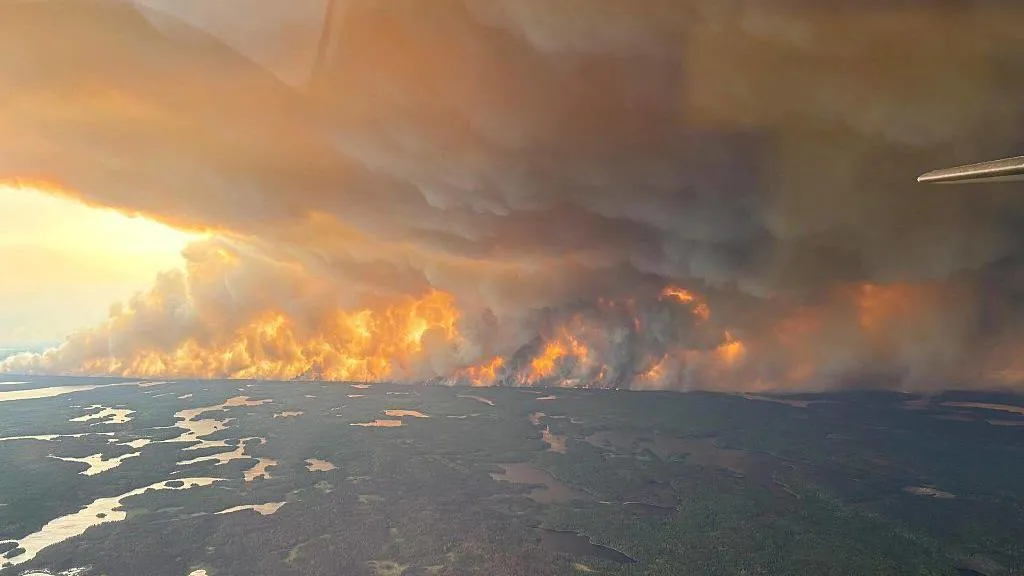
Hundreds of wildfires are burning across Canada, many of them out of control with flames sending plumes of smoke skyward, resulting in unhealthy air wafting off with the prevailing winds, reaching distant places. The more gigantic of the blazes deliver thick smoke spreading southward into the United States and far across the Atlantic Ocean to the United Kingdom. 
 
Fires in British Columbia, Alberta, Saskatchewan, Manitoba, from Western Canada, as well as northern Ontario in central Canada burning out of control. Some of the fires range between 100,000 to 300,000 hectares. Fire season in Canada is earlier than usual this year. And this year more of the fires are considered to be man-made; fewer have resulted from lightning strikes and excessively dry conditions along with warmer temperatures than usual. 
 
These early-appearing wildfires have already consumed vast tracts of land and forest, in comparison to the long-term average with about a normal half year's worth of land at this early stage already scorched.  
 
https://static01.nyt.com/images/2025/06/04/multimedia/31int-canada-wildfires-explainer-hmlz/31int-canada-wildfires-explainer-hmlz-superJumbo.jpg?quality=75&auto=webp
A photo released by the government of the Canadian province of Manitoba shows wildfires burning last week in Flin Flon, Manitoba.   Credit...Government of Manitoba
 
Three provinces have evacuated over 25,000 people altogether, whose habitation is in the line of fire. In Manitoba alone 17,000 of the evacuations have left people stranded away from their homes in fire-vulnerable towns and villages. In Alberta roughly 1,300 people were forced to relocate, as well as some 8,000 people affected by the need to evacuate in Saskatchewan.
 
The largest of two fires in Manitoba scorched 189,834 hectares on the border with Ontario, about 100 km northeast of Winnipeg. On the border with Saskatchewan several fires around Flin Flon are responsible for most of the evacuations there, where this fire season has been recognized as the worst in decades. The fires burn largely in rural forest, threatening communities nearby that remain under evacuation orders, among 20 towns forced from homes in the province. 
 
Smoke that crossed the Atlantic Ocean is blowing over the United Kingdom, contained in a thin, high-altitude layer not expected to seriously affect air quality. "No impacts expected as it remains at height, but could lead to some striking sunsets and sunrises", advised Georgie Myers of the UK's Met Office.  
 
https://static01.nyt.com/images/2025/06/06/multimedia/06int-canada-wildfires-explainer02sub-photo-kzgt/06int-canada-wildfires-explainer02sub-photo-kzgt-superJumbo.jpg?quality=75&auto=webp
Members of the Royal Canadian Air Force help evacuees board an aircraft in Norway House, Manitoba, on June 3.   Credit...David Lipnowski/The Canadian Press, via Associated Press
 
Smoke, carried by the river of air in the sky known as the jet stream, ended up south as far as the coastal Southeast United States where skies turned hazy as far south as northern Florida. The Midwest saw smoke particularly thick with  high temperatures held down several degrees, irrespective of sunshine. Visibility dropped as low as a kilometre or so in North Dakota as smoke drifted groundwise. 
 
Parts of British Columbia to Ontario south of Hudson Bay, saw air quality alerts warn populations. Environment Canada warns residents in harder-hit areas of northern Alberta, Saskatchewan and Manitoba to limit outside time and cancel or reschedule outdoor events. Much of Minnesota, Wisconsin and close locations are under a code orange alert. 
 
The Canadian wildfires have already early in this season burned about half of the average major fire seasons up to 2023 and 2024, translating to over 1.1 million hectares this year so far.  Seasonal wildfire burns saw a yearly average of 2.1 million hectares as opposed the 2023 historic season when 17.3 million hectares were scorched.  
 
https://static01.nyt.com/images/2025/05/31/multimedia/31int-canada-wildfires-explainer03-photo-wzlc/31int-canada-wildfires-explainer03-photo-wzlc-superJumbo.jpg?quality=75&auto=webp
A photo from the Manitoba Royal Canadian Mounted Police shows firefighting efforts in northern Manitoba, in May.   Credit...The Canadian Press, via Associated Press


Labels: , , , , , ,

Friday, May 30, 2025

Manitoba's Raging Wildfires

https://i.cbc.ca/1.7547196.1748638965!/fileImage/httpImage/image.jpg_gen/derivatives/16x9_1180/wildfires-in-manitoba.jpg?im=Resize%3D780
A wildfire burns near Sherridon on May 27. Several out-control blazes have forced the evacuation of thousands of people in northern Manitoba this week. (Government of Manitoba)
"We could see [the fire] very well throughout the night. The night before, the wind was in our favour ... but then we were told that the wind was going to change on Wednesday, and it did."
"We could see [the fire] perfectly. Red [skies] and lots of black smoke."
"Some of the residents, like my kids, live right off the perimeter, which is only one-and-a-half kilometres from the fire."
"[First responders] were going door to door, telling them to get out."
Rob Burroughs, resident of Flin Flon, Manitoba
 
"Pray for Flin Flon, pray for Pimicikamak, pray for Mathias Colomb, pray for Cross Lake, pray for everybody in Manitoba who's out of their homes right now."
"As we head into the weekend, pray for rain. We haven't seen rain in the forecast yet. That could really help — sustained rainfall, in particular."
"But in the absence of that, the past few days have been very challenging, and that may continue."
"We cannot thank other jurisdictions enough, [other provinces and territories — now also being bolstered by 100 more firefighters and 25 logistics managers from the U.S]."
"It really does just underline how serious this situation is." 
Manitoba Premier Wab Kinew
 
"I hear … there's choppers now, that smoke has engulfed the airport." 
"We're getting desperate now. It's getting rougher. We're going to be heading for the lake … shortly if nothing turns out, if nothing puts the flame out."
Chief Gordie Bear, Pukatawagan Cree Nation 
https://i.cbc.ca/1.7547832.1748577329!/fileImage/httpImage/image.jpg_gen/derivatives/16x9_1180/pukatawagan-evacuees.jpg?im=Resize%3D780
Evacuees from Pukatawagan Cree Nation arrive at the Brandon Municipal Airport Thursday night. Thousands of residents were stranded in Pukatawagan, also known as Mathias Colomb, after the nearby fire shut down its airport at around 6:30 p.m. CT, the First Nation's chief said. (Chelsea Kemp/CBC)
 
Cars lined bumper to bumper with Flin Flon residents evacuating to Winnipeg for shelter from the wildfires threatening their homes were in for a long drive. From the highway, the frightening sight of the wildfires accompanied their journey as Winnipeg awaited the thousands of evacuees during Manitoba's province-wide state of emergency.
 
Flin Flon residents were informed they had to leave their homes and go south with their essentials, by Wednesday night. Even before the evacuation orders were disseminated, hospital patients had been sent out of the city where fires have forced 17,000 residents from their homes in remote communities and First Nations. Some 6,000 people were dispatched from Flin Flon alone. 
 
Advance emergency preparations had been made to house evacuees at a Winnipeg arena while others would be housed at larger facilities like recreation centres and soccer fields. According to Manitoba's premier, this is the province's largest exodus of this nature in living memory. The military has been called upon to assist evacuation flights to Winnipeg.  
 
https://ichef.bbci.co.uk/news/1024/cpsprodpb/1dcb/live/8c0bfc20-3dc6-11f0-88f5-8142f8bee856.jpg.webp
A fire is currently closing in on the city boundaries of Flin Flon, a community of some 5,000 people  Government of Manitoba Handout
 
Nearby Creighton, Saskatchewan was involved in the Flin Flon fire on Monday when it crossed the boundary, then exploded in volume as crews struggled to contain it Tuesday. A drone in nearby flight kept water bombers grounded at a critical time in attempting to manage the runaway fire. Upward of 1,200 residents were informed they had to leave the town. Wildfire officials informed Creighton Mayor Bruce Fidler that flames could move in by Thursday, cutting off road access.
 
"We declared a state of emergency and put out a mandatory evacuation so that we can get as many people out of the area as possible, to be safe and before the roads become impassable", explained the Creighton mayor. Wildfires have forced thousands of residents from Manitoba to Alberta from their homes in the heated summer atmosphere prevailing. Advancing wildfires forced evacuation of residents from the town of Lynn Lake northwest of Winnipeg.
 
According to the Wednesday count, 22 active wildfires were ablaze in Manitoba where 102 fires this year have marked the province's growing vulnerability to more extreme weather conditions where the 20-year annual average has been 77. Firefighters from New Brunswick, Alberta, British Columbia and Prince Edward Island were relocated to give assistance in Manitoba. Three First Nations in northern Saskatchewan declared a joint state of emergency where thousands have been forced from their communities amidst escalating wildfires. 
 
https://ichef.bbci.co.uk/news/1024/cpsprodpb/35e8/live/e1b17740-3d99-11f0-bace-e1270fc31f5e.jpg.webp
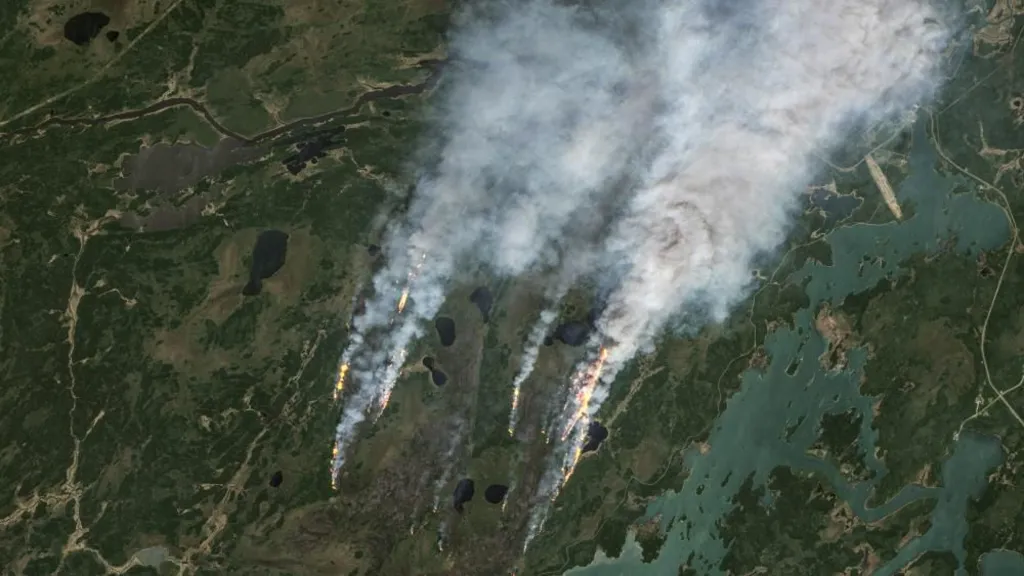
Smoke rises from wildfires in Manitoba, Canada   Copernicus Sentinel-2/Reuters
 
They report that there are "critical shortages" of firefighting resources, personnel and air support, a joint statement by the Lac La Ronge Indian Band, Peter Ballantyne Cree Nation and Montreal Cree Nation and Montreal Lake Cree Nation advised. 1,300 residents of Swan Hills, north-central Alberta, were ordered on Monday to leave ahead of an advancing fire whipped by raging winds.  
 
https://i.cbc.ca/ais/2316649e-d01b-4850-8109-af8f11bb80e2,1748635867283/full/max/0/default.jpg?im=Crop%2Crect%3D%280%2C0%2C1920%2C1080%29%3BResize%3D620
Premier Wab Kinew updates on wildfires.
"Everyone who is working on your behalf is working together, and ... we are making important progress to move Manitobans to safety, to push back the wildfires and to ensure that people will be able to return to their homes and the lives that we're so proud of here in this province."
"I think the most important thing for Manitobans to understand is that we need to be calm. The situation can be very concerning, can be very emotional."
Manitoba Premier Wab Kinew
 
https://dht7q8fif4gks.cloudfront.net/2025-05/2025_05_wildfire_water_LacduBonnetEmergencyManagementFBpage_0.jpg
(Photo Credit: Facebook.com/lacdubonnetemergencymanagement)
 

Labels: , , , , ,

Tuesday, June 27, 2023

21st Century Updated School Sex-Health Curricula


Image
"The material in question — as Minister of Education, frankly as a parent — is completely inappropriate to be in a classroom."
"We want to make sure that material is not going to be a part of the resources that will be provided to students …"
"I want to make sure that the Ministry of Education, also, is undertaking a review of our own information to ensure that it is appropriate — and age-appropriate in particular."
Saskatchewan Education Minister Dustin Duncan 
 
"Sex from A-Z is a set of cards intended for gay, bi and queer young people. This is a fun and accessible resource that facilitates humorous and frank discussion among young people about sexuality and HIV and STI prevention. It can also be used by service providers as a discussion tool in workshops and training sessions."
"[The cards target young people as a] discussion tool [in workshops, with the instruction to] affirm [and be] sex positive [about every one of the sex acts depicted]."
"Do not make fun of any of the topics, including ones you personally enjoy. Affirm choices, theirs and other people’s who might be into the topic."
"A lot of people think that's really hot" [sample phrase on how to react 'properly' to some of the cards]." 
"If you do decide to go condomless, use lots of lube and get tested regularly for HIV and STIS."
Planned Parenthood/CATIE ABC Card instructions
 
Saskatchewan's Minister of Education has taken steps to ban Planned Parenthood from presenting their version of healthy sex education in the province's schools. On June 19 at Lumsden High School, the major secondary school in Lumsden, Saskatchewan, a community of 1,800 residents north of Regina, a Planned Parenthood coordinator delivered a Grade 9 presentation billed as a standard course on sex education. One student -- the students were 14 and 15 years of age -- left the presentation carrying home with him a complimentary deck of cards. 

Image
That deck of cards led to a shock and outrage for their content detailing extreme sex acts some of which carry the potential for danger to anyone's health. The deck: "Sex: From A-Z" has 26 cards each with a sexual term (and cartoon) for every letter of the alphabet. Targeted toward young people as a "discussion" tool. Several cards detail acts of sex revolving around domination and risky sex, including urine and fecal matter: "Yellow and brown showers", describing  urinating and defecating on a sex partner. With instruction to "keep them on the outside of your body".
 
The under-18 targets of the card game, under "raw sex" are informed that although unprotected sex leaves them vulnerable to HIV, it remains a matter of personal preference. Produced and distributed by CATIE (Canadian AIDS Treatment Information Exchange), a Toronto-based non-profit almost entirely funded by government grants, they have a Disney-like flair to them. 

The same type of cards produced some controversy in British Columbia when they were distributed to children by a public health nurse, but this time the cards that CATIE had produced in that instance had focused on "safer snorting", as a guide to drug consumption. 

In the Lumsden instance focusing on sex, following a complaint by a parent, the high school administration sent an email to parents explaining that the cards were not a core component of the presentation, but rather were placed on a table of "secondary resources" accessible by students. "Staff do preview resources, but one of the resources consisted of an A to Z sexual vocabulary which was not in the scope of the Grade 9 Health curriculum", the email conveyed to some incredulous parents.

Samples of A - Z Sex education cards


Labels: , , , , ,

Sunday, October 03, 2021

Addressing the Vaccine-Hesitant

"It's a good vaccine. But it's not an mRNA vaccine, and we have approved it."
"It's not a bad idea, as long as  you have an honest conversation with people about what the risks and benefits are, and one of the risks, of course, is a pretty severe blood-clotting event."
"If it would get more people vaccinated, and people can make an informed decision, I think it would be really wise to have an alternative, if people wanted it."
Dr.Isaac Bogoch, infectious diseases specialist, Toronto

"Your body doesn't have the cellular machinery to reverse from RNA to DNA. It's kind of like speculating you can flap your arms and fly without feathers."
"[All vaccines authorized in Canada are] really, really good. Humans are made of twisted timbers. [Some say the technology is] too new [though researchers worked on it since the 2003 SARS-1 outbreak]."
"There's always an excuse for hesitation that can be built around any technology. I just see this as the latest in that long history."
Dr. Amir Attaran, professor of law and health policy, University of Ottawa
 (Dirk Waem/BELGA/AFP via Getty Images)
A desperate solution is sought to an impasse between health authorities and the millions of Canadians still uncertain, along with hard-core anti-vaxxers who refuse to be inoculated against COVID-19 imperilling plans to vaccinate sufficient numbers of eligible people to produce the hoped-for 'herd-effect' that would neutralize the menace of contagion by SARS-CoV-2 causing COVID. Those in government who rely on the professional advice of medical experts see agreement that the one-shot Johnson & Johnson vaccine might fill part of the vacuum.

In Saskatchewan and Alberta, the two western provinces of Canada with the lowest vaccine uptake rate and the commensurately higher infection rate hope is that in offering the Janssen single-shot those who are hesitant might be convinced to being vaccinated. The J&J vaccine is a viral vector like AstraZeneca. The National Advisory Committee on Immunization had advised in May that Pfizer and Moderna represented preferred vaccines in view of a rare risk of a blood-clotting disorder.

Following that, thousands of AZ appointments were never met, attributed to news reports of its potential side effects. March saw authorization of the Janssen vaccine and months later the government of Canada announced its donation of ten million unused doses to low-income countries in view of plentiful supplies of Pfizer and Moderna with little demand for any other vaccine. Offering the J&J single-shot vaccine is a gamble, with uncertainty over how many people will express interest in "a vaccine but not an mRNA" vaccine.

Johnson&Johnson, however, recently recommended a booster shot, in other words a second dose, to increase antibody levels. Blood-clotting potential in these vaccines is a concern. Thrombosis with thrombocytopenia syndrome causes unusual blood clotting and low platelet levels in blood which increase risk of strokes or heart attacks. U.S. data reveal an estimated one in 300,000 people vaccinated with Janssen's COVID vaccine have the potential to develop TTS in comparison to one in 100,000 with AstraZeneca.

mRNA vaccines on the other hand, are not seen to risk TTS events. Which hasn't stopped misinformation that mRNA vaccines have the potential to modify DNA, permanently altering people's attributes, including causing sterility in women. That Pfizer and Moderna make use of genetically engineered messenger RNA instructing body cells in producing spike protein that SARS-CoV-02 uses to latch onto and invade cells makes people suspicious of its supposed intrusion into other areas of cell integrity.

J&J has been used in the U.S. to vaccinate 15 million Americans, where the largest concerns motivating the unvaccinated to become inoculated against COVID have been, understandably, rising hospitalization rates and death rates, according to the Kaiser Family Foundation. According to Health Canada -- of 15,090 reports of adverse events after vaccination representing 0.029 percent of all doses administered, 4,288 (0.008 percent of all administered doses) were rated to be serious complications.

Some Albertans are demanding access to the Johnson & Johnson vaccine for faster access to full immunity - particularly now the province has adopted an opt-in vaccine passport system. (Christophe Gateau/dpa/The Associated Press)

Labels: , , , , , ,

Wednesday, July 21, 2021

Chronic Wasting Disease

"I would say this question [whether the wasting disease afflicting deer could infect humans] was answered with 'yes'."
"The more we did, the more we could confirm the macaques [laboratory experimental monkeys] were infected."
Hermann Schaetzl, veterinary scientists, University of Calgary

"It's easy to go down a doomsday scenario but I don't think we're there yet."
"I think it's low-risk."
Dr.Keith Lehman, provincial veterinarian, Alberta  
 
"I was shocked when we first learned of the results. It's absolutely confirmative that this happened — you could give macaques a prion disease through oral consumption of contaminated meat."  
"[For] many people with a spinal cord syndrome, it wouldn't even occur to the treating neurologist that this could be a prion disease. It's going to take some education and alertness to even think of the diagnosis." 
"I hear the alarm bells going off."  
"I would have expected a human case to emerge in the U.S. before Canada. But on the weight of evidence, I think it's not only not impossible, it's kind of expected at this point."
Neil Cashman, prion expert, University of British Columbia 
New research on chronic wasting disease has raised new fears about whether the illness could infect humans. (Radio-Canada)

Decades ago the world was horrified when an outbreak of variant Creutzfeldt-Jakob disease saw people dying horrible deaths in the United Kingdom, linked to the consumption of infected internal organs from cattle finding their way into animal feedlots, butchered animals for human consumption then passing on the disease that causes degenerative brain wasting as a result of proteins called prions that were abnormally shaped. Once infected, deterioration was swift and deadly, a horrendous scenario.

Now, a spread of a fatal wildlife disease in Alberta and Saskatchewan is infecting deer across a wide area of the Canadian Prairies. Research about to be published on Chronic Wasting Disease highlights fears over whether the illness could end up crossing the species barrier and infect humans. A recent report from the Canadian Agri-Food Policy Institute advising the federal government on agriculture policy resulted from a study of Professor Schaetzl's research.

The Institute had concluded that the spread of the disease over the past decade is a dire threat to Western Canada's agriculture, wildlife and food security. Quite apart from, but connected to concerns over transmission to humans. "It's continuing to increase in its spread and the speed of its spread", the Institute's strategy officer, Ted Bilyea, stated.

"The southern range [of caribou] is pretty much the northern range for our survey. If [prions] pass through that, then we have a genuine food security problem for our northern people." Dr.Bilyea is referring to hunters, susceptible to contracting the disease in the closeness of their proximity to infected animals, mostly First Nations hunters. "We don't have any buffer zone. It's not a very pleasant idea, but this is not a very pleasant topic."
 
Chronic Wasting Disease is a prion disease which deer, elk and caribou, in both wild and farmed populations in Canada, the U.S., and more recently in South Korea and Scandinavia are susceptible to; highly contagious between hoofed animals. It is spread through saliva, animal carcasses and fecal matter. Soil and vegetation in areas where infected animals have died can be contaminated with it. The pathogen can survive up to a decade in an area. Data indicates potential transmission to cats, pigs, sheep, cows and rodents.
 
It attacks the nervous system of afflicted animals and its presence is always fatal, the morbid illness is excruciating but fairly swiftly concluded in death. Misshapen prions cause the wasting disease, quite similar to Creutzfeldt-Jakob in humans; the prions are able to persist in the environment and to transfer their disease-causing shape to healthy proteins. 
 
An experiment that was conducted on macaque monkeys -- as the closest animal genetically to humans -- in 2006 by German scientists fed macaques with meat from contaminated animals. With the knowledge that the disease can take years to develop the monkeys were not tested until two years ago with the first tests being ambiguous. It soon enough became clear, however, that the monkeys had developed low-level infections.
 
Dr.Schaetzl had been involved in the confirmatory tests, and although his work is in the process of peer-review before publication it was presented in conferences, subsequently widely discussed among experts in the disease. According to Dr.Cashman of the University of British Columbia, a leading prion expert, his opinion is that people could already be suffering from a human form of chronic wasting disease.
 
Deer and elk farmers are required in Saskatchewan and Alberta to test every animal on their farms that dies, including those that are slaughtered, in an effort to ensure that tainted meat is kept out of the food supply. Although theoretically domesticated cattle could be contaminated by wild animals with the disease, no cases of this occurring have yet been recognized.

A portrait of a beautiful male elk during the late autumn season in the backcountry of British Columbia. Mount Assiniboine Provincial Park.

Labels: , , , , ,

Thursday, March 25, 2021

The Humboldt Tragedy and the Immigrant Driver

"Contrary to almost all of the many people I have acted for, [Sidhu's] remorse and empathy for the victims was foremost, and his concern for his personal consequences was secondary."
"As a criminal barrister for 40 years, I can tell you that this type of selflessness is unusual."
"Throughout the proceedings, his instructions were to attempt to minimize the collateral grief to the families that necessarily flowed from the criminal proceedings."
Mark Brayford, Sidhu defence lawyer
Jaskirat Singh Sidhu is taken out of the Kerry Vickar Centre in Melfort following his sentencing on March, 22, 2019 for his role in the Humboldt Broncos bus crash
A young male immigrant from India, starting to make a new life for himself in Canada, hired by a cartage company to drive semi-trailers for which he received inadequate training. A week of instruction sufficed to earn him a legal license to drive a large rig on Canadian highways; in the instance at hand a tractor-trailer with an added pup trailer. He had two weeks' experience driving the rig solo. His attention fully turned to driving when he realized the tarp on the pup trailer was flapping. Distracted, he missed a stop sign at a poorly designed intersection.

That intersection was known locally as a dangerous  spot, to the extent that six people had died there in previous motor vehicle accidents. Jaskirat Sidhu had been on the job for a month when the assignment to drive a delivery with the rig came up. Because of that momentary distraction, the driver who was not using his cellphone, was not on drugs, hadn't used alcohol, was fully aware, drove past the flashing stop sign at the rural Saskatchewan intersection and collided with a bus carrying the junior hockey team from Humboldt, Saskatchewan. 
 
The young hockey players and the team's staff were being taken to a playoff game on April 6, 2018. 
Sixteen members of the junior hockey team and staff died in the collision and 13 were injured, some with life-changing injuries. 
 
At the scene, the shattered truck driver fully cooperated with police investigators. Throughout the investigation to follow, his arrest and trial, he abnegated any opportunity to help his case, even when evidence came to light that the intersection and the stop sign were inadequate to their purpose, the cause of previous deadly accidents; he was driving into the sun; and mature trees were growing beside the highway partially obscuring views, including that of the stop sign.
 
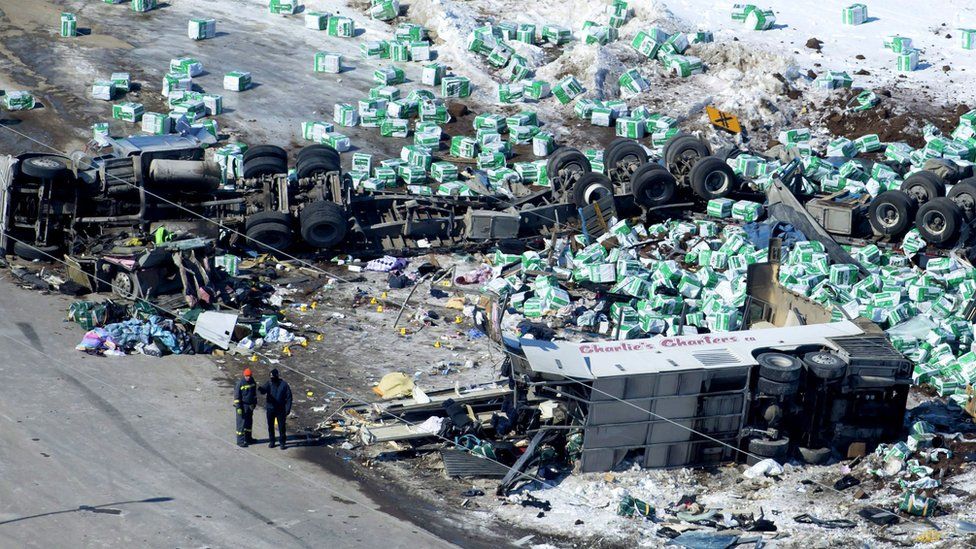
Aerial photograph of wreckage shows lorry's load scattered in the snow, highly damaged bus and overturned trailer
Aerial photographs of the scene showed the scale of the collision with heavy damage to the coach (right) Canadian Press, Rex/Shutterstock

His purpose was to take full responsibility for the outcome of a momentary distraction that had resulted in  a horrific ending. His purpose was to spare the families involved any additional suffering after their dreadful losses. Jaskirat Sidhu has the official status of a landed immigrant. He is not yet a citizen of Canada, although he aspired to citizenship. He was newly married to another immigrant and together they planned to make a life for themselves in Canada.

He was sentenced to eight years in prison, representing the stiffest such penalty for accidents of this kind. Vehicular homicides are not all that uncommon in Canada, mostly caused by people driving under the influence of alcohol, drugs, speeding, talking on their cellphones or instances of sheer carelessness. Jaskirat Sidhu had pleaded guilty to 29 charges of dangerous driving causing death and bodily harm. He made no effort to defend himself. Overwhelmed with remorse he instructed his lawyers to plead guilty on his behalf to all charges brought against him.

The case management team at Prince Albert Penitentiary where he was incarcerated citing his exemplary behaviour while in prison along with his "significant level of remorse and victim empathy", recommended his transfer to a minimum-security facility. That recommendation was turned down by the prison warden. Uppermost in the warden's mind would be the reaction from family members whose children were killed or maimed by the accident that shocked the entire country when news exploded nationally of the Humbold team's dreadful loss.

Under Canadian law, anyone who is not a citizen of Canada, someone with the status of a landed immigrant for example, who is found guilty of a major criminal act can be extradited to their country of origin. Despite the ghost of the tragedy following the young immigrant couple, their hope is to be allowed to remain in Canada, become Canadian citizens, make their lives here, raising a family. An official with the Canada Border Services agency is to decide whether to allow Jaskirat Sidhu to remain in Canada, or to deport him when he becomes eligible for parole this coming November.
"Deportation of Mr. Sidhu back to India only serves to cause more suffering to him, his wife and his family."
"We have exchanged several emails with Mr. Sidhu and his wife, Tanvir, and it is clear to us that Jaskirat is indeed a broken and suffering soul."
"There has been enough suffering for everyone involved in this tragedy. We do not need any more."
Scott and Laurie Thomas, parents of 18-year-old Evan Thomas who died in the crash.
Evan Thomas between his two parents
Evan Thomas between his two parents   Photo: Scott Thomas

"I believe it would be extremely unfortunate to now not allow a man who made a mistake and owned up to it and accepted his consequences the opportunity to continue his life here in Canada."
"I spent every day of the trial watching a man cry and be utterly devastated by the results of a mistake he made ..."
"I believe in second chances. A man who took the harshest sentence for a crime of this nature without appealing or defending himself in an attempt to ease even a small amount of pain for those he hurt is someone I believe deserves a second chance."
Christina Haugan, widow, Broncos' head coach Darcy Haugan who died in the crash

"By contrast [to the Humboldt Broncos' case], a Saskatchewan driver who had previously dodged charges of drunk driving and fleeing the scene of a crash, drove through a stop sign in 1997, killing a 39-year-old woman and injuring her young son before fleeing the scene without rendering assistance."
"He was not charged with leaving the scene, but received a ticket for driving without due care and paid a small fine."
"That driver, Scott Moe, is now premier of Saskatchewan."
Parker Denham, retired Nova Scotia journalist


Labels: , , , , ,

Friday, July 24, 2020

Hutterite Communities : Living COVID Transmission Laboratories

"The question we need to ask is, 'What are a minority of our people doing that brings suffering like this upon the rest of us'?"
"Such situations are a golden opportunity to be a light to the world and show mainstream society that we have many great people among us."
Hutterian Safety Council

"We can answer a lot of questions [in Hutterite colonies] that can't be answered in mainstream communities. [This is] knowledge that couldn't be obtained anywhere else."
"It's a very giving culture. There is a generosity of spirit [here]."
Dr.Mark Loeb, infectious disease professor, McMaster University
***2008 POY REGINA** NEWS -- REGINA, SASK: September 10,2008 -- Members of the Box Elder Hutterite Colony stand on the headers of eight combines just before they start to combine what is left of the 20,000 acres of barley they are harvesting near Tregarva, SK. Don Healy/Leader-Post

Founded in 16th century Switzerland together with Mennonites and Amish, Hutterites represent a branch of the Anabaptist movement of Protestanism. All of these minority breakaway groups were historically persecuted throughout Europe, inspiring them to self-exile when they moved to North America in the late 1800s. There they found freedom in the establishment of limited colonies of 100 souls, living remote from others in the mainstream community. Hutterites have a unique mode of dress and most are involved in farming and in small-scale manufacturing.

A number of Hutterite colonies located in Alberta, Saskatchewan and Manitoba have had outbreaks recently of COVID-19 infections, as well as several deaths resulting from COVID. Where in the general community within which their remote and isolated communities exist the incidents of COVID have receded in numbers, in the Hutterite communities they have proliferated. Speculation is that communal meals and prayer, traditions within the community, may prove to have been a factor in the infection rate.

Which led to the Hutterian Safety Council identifying for censure some of the community members for having visited doctors without divulging they were ill; not observing social distancing; and travelling outside their colony for non-essential purposes. The premier of Saskatchewan spoke of imposing travel restrictions to and from the colonies in an effort to curb the cornavirus spread, at the same time cautioning against stigmatizing the communities.

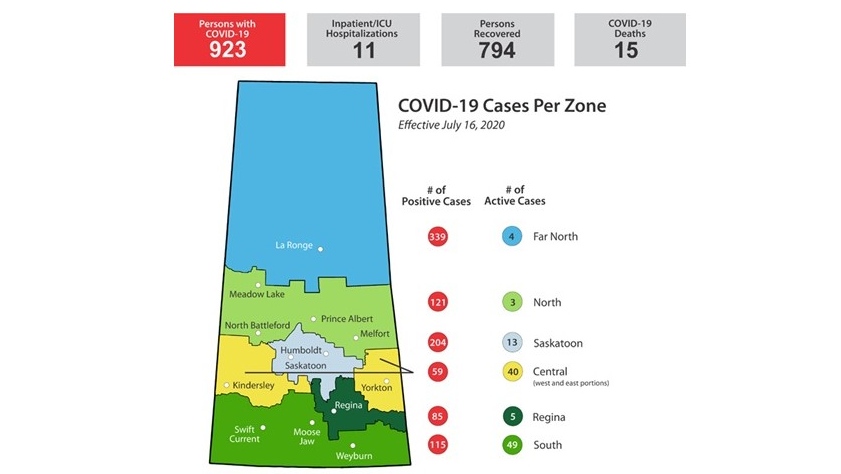
Saskatchewan COVID-19 map for July 16, 2020.
A research project is in the planning stages to view the religious group as a living laboratory, a potential source of vital new information about the coronavirus. McMaster University intends to study the small, self-contained colonies with a view to examining the critical issue of herd immunity related to COVID-19 transmission. Earlier research on flu within the communities could serve as a platform on which to mount this new study.

The Canadian Institutes of Health Research has funded the proposed study with a $1.5-million award. The study now awaits a go-ahead from the University of Alberta which is partnering with McMaster, along with formal consent from the twenty colonies chosen by the team to be part of the study. Dr. Loeb, tagged to lead the study is familiar with the colonies' residents from the flu study, considering them to be "extraordinarily generous" to visiting scientists, in his decades-long association with them.

COVID-19
Laboratory technical assistant, LifeLabs, THE CANADIAN PRESS/Darryl Dyck

The makeup of the communities is unique; small, manageable populations, the colonies are isolated from the outside world, thus becoming the ideal laboratory where the vital issue of herd immunity can be studied to determine how respiratory viruses behave on a community-wide basis. The earlier study dating from 2010 examined the effect immunizing children within the community at ages three to 15, impacted on community members at large.

Communities whose children received flu shots irrespective of whether or not the population was vaccinated, were 60 percent less likely to harbour the virus in comparison to those colonies that received Hepatitis A vaccine, used as a control group. Confirming the herd effect of immunizing children against flu. The study was noted at the time by Dr.Anthony Fauci, director of the U.S.National Institute for Allergy and Infectious Diseases, who praised it as a "really nice study".

As schools prepare to re-open, the research will study the role children play in COVID-19 transmission. "Findings from this cohort study will inform policy-makers about the determinants of community transmission", noted the grant description meant for the attention of the Canadian Institutes of Health Research.

Labels: , , , , , ,

Friday, February 15, 2019

Say After Me: OSS-men!

"I could have got a [license] plate for the front but I really wanted a vanity plate on the back of my truck."
"See, I hate to say it but I'm kinda a sarcastic ass and well, I just wanted to go big!"
"I think they [licensing authorities] are too worried that people are going to have hurt feelings about something that is complete nonsense. Even if it wasn't my last name, who is it going to hurt?"
"It's just a name, and censorship should be out of the window. It upsets me [to be denied the freedom to register his name], but I'm not one of those guys to take offence to it."
Dave Assman, railroad worker, Melville, Saskatchewan

"Even if a word is someone's name and pronounced differently than the offensive version, that's not something that would be apparent to other motorists who will see the plate."
Tyler McMurchy, SGI spokesman
Dave Assman of Melville, Sask. had a giant vanity plate bearing his name painted on the tailgate of his truck after Saskatchewan Government Insurance again refused to issue a legitimate plate with his name on it. SASwp
When addressing Dave Assman directly, person-to-person, you might advisedly pronounce his name properly as "OSS-men" in deference to its correct pronunciation. However, if you just read off his name as it appears, he would be the first to laugh, and then laugh with your embarrassment, certainly not at you. He is rightfully proud of his name; it's his, after all. It's legitimate and it's the name he was born with, so to speak.

Mr. Assman thought it would be neat to have a vanity plate identifying his truck with his name. The Saskatchewan Government Insurance (SGI) thought far less kindly of the request than he anticipated they might; after all, it's his name, and to describe it as a "profanity" is quite the insult. He was denied the option of naming his vanity plate as he wished. He decided to re-apply some time later.

But his most recent application was similarly denied -- on the grounds that his name applied to a license plate was "offensive, suggestive or not in good taste", in accordance with the rules of approving or rejecting vanity plates in the province of Saskatchewan. Once again, Mr. Assman reeled under the suggestion that there was something unpleasant and socially verboten about his given name.

But he was now prepared to take action. To, let us say, circumvent the proscription of having his name as it is properly spelled, not pronounced, grace the license plate of his vehicle. As it is often said of assertive people, he thereupon 'took matters into his own hands'. His truck, his decision, his design and his money involved. As in nyah-nyah!

Now the tailgate of his truck sports an imaginative faux 'license plate' many, many times larger than its actual license plate. He ordered an oversized decal to replicate a plate with his name on it, and it now graces his white Dodge Ram pickup truck. And he is pleased no end that his name is out there for all to behold, identifying his truck with his name and his name with its proud owner.

Saskatchewan's list of prohibited possible vanity plate requests is 85 pages in length. It covers sex, drugs, politics, religion, and undoubtedly any form of profanity. In truth, Saskatchewan's reaction to Mr. Assman's otherwise-reasonable request, is reflected in the 'standards' of public decency upheld by all other licensing agencies in other provinces and without doubt elsewhere in the world.

On another occasion decades ago another resident of Saskatchewan with the very same surname was featured on the late-night talk show hosted by David Letterman. Dick Assman operated a Petro-Canada gas station where his name was emblazoned on a massive sign outside the gas station. When he died in 2016 The New York Times ran an obituary of the otherwise-unremarkable man.


Labels: , ,

Monday, December 01, 2014

Culpable Negligence and Grief

"I could never imagine how or why I would be asked to have to do this. You try to figure out whether you're supposed to gain something or whether you're supposed to change somehow or what you're being tested for ... and I don't have the slightest idea."
"I open it [grief] a little bit every day and I have my little bit of sad time and crying and whatever I need to do. Then I shut that box [containing grief] ... I don't have to throw it open and cope with it all right now."
"I'll carry that box forever."
Anne Arnal, Ravenscrag, Saskatchewan

"It destroyed an entire generation that should be running that farm. ... 
"There's no future there now that they're gone."
Clifford Arnal, Ravenscrag, Saskatchewan
Makeshift memorial to Sean, Lyndon and Blake Arnal in Eastend SK. Photo via Facebook
 
Anne and Clifford Arnal farmed together in southwestern Saskatchewan. It was the very place where Clifford grew up, the family homestead. He spent decades with his brother and father herding cattle and harvesting crops and preparing to take over the farm himself. Now, however, after working hard and experiencing the joys and the disappointments of family life, farming, and raising six children on that farm, Clifford Arnal has moved out of the farm.

He now lives in Estevan, Saskatchewan, a five hour drive east of the tiny community of Ravenscrag, where he works on a construction crew. Where his wife makes the drive occasionally to visit with him. Her husband has no wish to return to the farm. Too many painful memories. And there on the farm that was their family home for so long, none of their children live there any longer.

The oldest of their six children, Chantal Henderson, a nurse in Swift Current, Saskatchewan is 26 and married. Her brother Dylan Arnal now 24, lives in East End, working on a neighbour's farm. Chantal's younger sister Olivia, 18, studies business at the University of Regina. As for the other three children, a younger contingent, they're no longer on the farm either because they've died. What larger heart-breaking calamity could impact a family?

All three of the younger Arnal siblings died in accidents on the farm. First there was 14-year-old Blake, an ambitious boy who involved himself in farm work, school, sports and who aspired to one day attend university to study agriculture. In 2008, on an all-terrain vehicle, intent on tagging a newborn calf, he died instantly from a blow to the chest when the vehicle he was on went over a ridge crashing onto an icy creek.
Blake Arnal and his brother-in-law Corey Henderson on quads preparing to chase cattle are shown in this undated handout photo. Blake is one of three Arnal boys who were killed in farm accidents.
Family Photo / THE CANADIAN PRESS   Blake Arnal and his brother-in-law Corey Henderson on quads preparing to chase cattle are shown in this undated handout photo. Blake is one of three Arnal boys who were killed in farm accidents. 

This past summer in July, the two youngest of the brothers, Sean and Lyndon Arnal, died together in a another tragic accident. They were riding a tractor while towing a bailer, heading for home. The tractor was on a downhill trajectory and crashed, killing the two boys, Sean 16 and Lyndon ten. Statistics on farm deaths are sobering, particularly involving children most of whom are boys killed by tractors and all-terrain vehicles.

The Canadian Agricultural Injury Reporting program produced a study that revealed the occurrence of an average of 104 farm deaths annually, among them thirteen children dying from accidents such as these. Sean, explained his father Clifford, started driving a tractor at age 11. His brother Blake ran a combine by the time he was eight, the same age as Lyndon when he first took the wheel of a semi-trailer
Dirt bike of Arnals
Lyndon, top, and Dylan Arnal ride Lyndon's dirt bike in this June 2014 handout photo. (Handout / Arnal Family)

Anne Arnal explained that even after Blake's death she and her husband never considered restraining their boys from working on the farm. It was their inheritance, and it was meant to be their legacy. As energetic boys she wouldn't think of them being placed in a protective bubble. The alternative would have been to have them playing video games in the basement, and that hardly expressed the people they were meant to be.

In retrospect, Clifford Arnal thinks the tractor's computer failed while Sean was driving it, which forced the machine to go into neutral so that Sean found himself incapable of steering it. No suspicious circumstances were discovered when the RCMP investigated the accident. One of their neighbours on a nearby ranch says his own two boys grew up performing the same farm work as the Arnal children.

Anne Arnal finds herself spending quiet, pensive days alone on the farm. No children, no husband. A lonely place to be. And in a sense, a strange place to find herself in. After all, a married couple dedicated to family and farm, sharing so much over the years, taking joy and pleasure in their children as they matured, but now, in their loss and their inconsolable grief, they don't share whatever their lives can now provide them, in comforting one another.

This is a dreadfully sad story. Three young lives gone in a split second albeit years apart. Compare what the three young boys were given responsibilities for, and then think to the urban style of child-rearing when caution and concern are ever-present, and parents do all they can to protect their vulnerable children from adverse circumstances with the dreaded potential of impacting on their safety and security.

Even for people whose sense of cautionary support of young children is more moderate than the famous "helicopter" parents the very thought of allowing an eight year old, an eleven year old, a fourteen year old child to operate and drive a tractor, a combine, even an all-terrain vehicle would represent an instance of parents neglecting their primary role of safeguarding a child against preventable accidents.

Labels: , ,

Tuesday, July 08, 2014

Calamitous Climate

"It's utterly unprecedented."
"And this one is blowing all the others out of the ballpark."
"Everything we know about hydrology on the prairie appears to be different. We never have saturated spongy soils with flow running off farmers' fields in the midsummer. Never."
John Pomeroy, director, centre for hydrology, University of Saskatchewan
Recovery help on the phones

Floodwaters surround cottages and homes on Crooked Lake during Saskatchewan Premier Brad Wall's aerial tour of flood-ravaged southeast Saskatchewan last Wednesday, July 2. Nearly 90 communities in Saskatchewan and Manitoba have declared emergencies because of flooding and more than 500 people have been forced to leave their homes. Photograph by: Don Healy,  The Leader-Post


Dr. Pomeroy holds a Canada research chair in water resources and climate change. His professional assessment is that three floods -- one currently unfolding in Saskatchewan and Manitoba and an earlier one in southern Alberta taking place a year after high flood waters ripped through Calgary, causing Canada's costliest natural disaster up to then with over $6-billion in damage -- have been caused by storm fronts laden with moisture that moved up from the United States, then "stalled".

That stall was a disaster for the landscape under the stalled storm fronts. Torrential rain came down over large areas for days, seemingly never to end, and in the process saturating soil, funnelling the runoff into streams and rivers, which overflowed inundating fields. In the process washing away roads and flooding entire communities.

The natural ecology of the landscape had been altered over generations of farming by land owners draining natural slews and wetlands. The result was instead of retaining excess moisture falling out of overloaded skies, water ran off fields more quickly than they might otherwise have done. But who might have predicted the extreme weather events that appear over the past decade to surprise everyone whose geography has been impacted?

That increase in stalled summer storms "that just sit there" appears, from what Dr. Pomeroy is able to discern, to be linked to a shift in the jet stream and atmospheric flows. This is a phenomenon that may well be responsible for much of the extreme weather that has been ricocheting around the Globe; the prolonged deep freeze last winter in central North America, Australia's heat waves and the monsoon-like rains that inundated Britain earlier in the year.

This "regime shift" has impacted the Prairies which are far more accustomed to short sporadic summer thunderstorms; generally over from start to finish in a matter of minutes, not incessant rains lasting or days. Historically it has been spring snowmelt, not summer rain that has caused Prairie floods. The past decade has seen a shift to "rain-derived floods."

He and his research team have documented the change through a research program in the Smith Creek Basin in southeast Saskatchewan flowing into the Assiniboine River, which is now causing untold misery with countless homes and farms in Saskatchewan and Manitoba now labouring through a state of emergency with the province calling in the military to aid the province in dealing with the overwhelming flood conditions.

Normally, streams and creeks in east Saskatchewan begin their flow in March, then peak in April and dry up by early May once the snowmelt is completed and that is reflected in records that date back to the 1950s. While Smith Creek is generally "bone dry" by July, last week it hit a never-before-seen high of 24.5 cubic metres of water a second roaring downstream.

Floodwaters invade a farmstead near Gainsborough,SK during Saskatchewan Premier Brad Wall’s aerial tour of flood-ravaged southeast Saskatchewan on July 02, 2014. Nearly 90 communities in Saskatchewan and Manitoba have declared emergencies because of flooding and more than 500 people have been forced to leave their homes
Don Healy/Postmedia News -- Gainsborough, Saskatchewan

Heavy winter snow -- heavier than most winters last year -- had saturated the soil, and then came a heavier-than-usual spring rain season. When the frontal system looming up from the U.S. stalled over southeast Saskatchewan in late June it "pushed it over the top". More than 150 millimetres of rainfall in a few days; that much rain normally falls in dry southeast Saskatchewan in the space of a year.

Dr. Pomeroy speaks unkindly of the stark lack of a national Canadian strategy and program for improved flood prediction and water management. He cites recent cutbacks by the federal government, and the "gutting" of federal hydrology climate and flood management programs leaving the country ill-prepared to predict and cope with the fallout of changing weather patterns.

"Every province is left on its own, with some doing better than others."

Labels: , , ,

 
()() Follow @rheytah Tweet