Ruminations

Blog dedicated primarily to randomly selected news items; comments reflecting personal perceptions

Friday, June 06, 2025

Far Reaching Consequences in Air Quality From Canadian Wildfires

https://www.ctvnews.ca/resizer/v2/QVD62FH6MRGUFHHMBHLHHJQI4Y.png?auth=b2a28004f09139fff52987be801292dc377f1790dfbec36664f6778f7241792c&width=1440&height=810
A smoky haze continues to linger over Ottawa on Friday afternoon.  (Westin Camera)
 
"We have these massive fires going on out west in Manitoba, in Saskatchewan, and all this smoke is being lofted high up into the atmosphere and then you have the jet stream, the strong winds higher up in the atmosphere blowing it over to Ontario."
"Even if you’re not smelling it at the ground, you’re probably noticing the sky is a bit of milky colour, kind of a white colour, this is all smoke that’s just been blown over from these massive prairie fires." 
Environment Canada meteorologist Crawford Luke
 
"Things like asthma, cough, headaches — we know that over time [smoke exposure] can increase your risk of things like respiratory infections. It can also increase your risk for long-term disease like lung cancer if you have high exposure."
"Clean air quality is definitely becoming more of an awareness concern because we are experiencing more wildfire seasons that are increasing. They’re longer, they start earlier, they get worse. We’re noticing a lot more air quality alerts."
"Check the air quality and if it’s over five, six, seven, that’s when you need to pay attention. That means air quality could be bad, even if the sky looks clear." 
"This affects the youth, seniors, as well as people with lung disease, heart disease. Anyone with a lowered immune system tends to be considered higher risk. They would be the ones we’d want them to watch the alert a little bit earlier."
Jamie Happy, health promotion coordinator, Alberta Lung
 
"The particle air pollution event is the result of extensive wildfires in central and Western Canada."
"Wind patterns are forecasted to transport plumes of smoke from these fires across much of New England and New Hampshire."
New Hampshire Department of Environmental Services 
https://i.cbc.ca/1.7554388.1749245549!/cantoImage/httpImage/image.jpg_gen/derivatives/original_1180/ottawa-gatineau-weather-wildfires-2025-smoke-downtown-parliament.jpg?im=Resize%3D1180
A skateboarder cruises down Rideau Street in Ottawa on Friday as drifting smoke from wildfires in Western Canada shrouded the city. (Gabrielle Huston/CBC)
 
Hundreds of wildfires are burning across Canada, many of them out of control with flames sending plumes of smoke skyward, resulting in unhealthy air wafting off with the prevailing winds, reaching distant places. The more gigantic of the blazes deliver thick smoke spreading southward into the United States and far across the Atlantic Ocean to the United Kingdom. 
 
Fires in British Columbia, Alberta, Saskatchewan, Manitoba, from Western Canada, as well as northern Ontario in central Canada burning out of control. Some of the fires range between 100,000 to 300,000 hectares. Fire season in Canada is earlier than usual this year. And this year more of the fires are considered to be man-made; fewer have resulted from lightning strikes and excessively dry conditions along with warmer temperatures than usual. 
 
These early-appearing wildfires have already consumed vast tracts of land and forest, in comparison to the long-term average with about a normal half year's worth of land at this early stage already scorched.  
 
https://static01.nyt.com/images/2025/06/04/multimedia/31int-canada-wildfires-explainer-hmlz/31int-canada-wildfires-explainer-hmlz-superJumbo.jpg?quality=75&auto=webp
A photo released by the government of the Canadian province of Manitoba shows wildfires burning last week in Flin Flon, Manitoba.   Credit...Government of Manitoba
 
Three provinces have evacuated over 25,000 people altogether, whose habitation is in the line of fire. In Manitoba alone 17,000 of the evacuations have left people stranded away from their homes in fire-vulnerable towns and villages. In Alberta roughly 1,300 people were forced to relocate, as well as some 8,000 people affected by the need to evacuate in Saskatchewan.
 
The largest of two fires in Manitoba scorched 189,834 hectares on the border with Ontario, about 100 km northeast of Winnipeg. On the border with Saskatchewan several fires around Flin Flon are responsible for most of the evacuations there, where this fire season has been recognized as the worst in decades. The fires burn largely in rural forest, threatening communities nearby that remain under evacuation orders, among 20 towns forced from homes in the province. 
 
Smoke that crossed the Atlantic Ocean is blowing over the United Kingdom, contained in a thin, high-altitude layer not expected to seriously affect air quality. "No impacts expected as it remains at height, but could lead to some striking sunsets and sunrises", advised Georgie Myers of the UK's Met Office.  
 
https://static01.nyt.com/images/2025/06/06/multimedia/06int-canada-wildfires-explainer02sub-photo-kzgt/06int-canada-wildfires-explainer02sub-photo-kzgt-superJumbo.jpg?quality=75&auto=webp
Members of the Royal Canadian Air Force help evacuees board an aircraft in Norway House, Manitoba, on June 3.   Credit...David Lipnowski/The Canadian Press, via Associated Press
 
Smoke, carried by the river of air in the sky known as the jet stream, ended up south as far as the coastal Southeast United States where skies turned hazy as far south as northern Florida. The Midwest saw smoke particularly thick with  high temperatures held down several degrees, irrespective of sunshine. Visibility dropped as low as a kilometre or so in North Dakota as smoke drifted groundwise. 
 
Parts of British Columbia to Ontario south of Hudson Bay, saw air quality alerts warn populations. Environment Canada warns residents in harder-hit areas of northern Alberta, Saskatchewan and Manitoba to limit outside time and cancel or reschedule outdoor events. Much of Minnesota, Wisconsin and close locations are under a code orange alert. 
 
The Canadian wildfires have already early in this season burned about half of the average major fire seasons up to 2023 and 2024, translating to over 1.1 million hectares this year so far.  Seasonal wildfire burns saw a yearly average of 2.1 million hectares as opposed the 2023 historic season when 17.3 million hectares were scorched.  
 
https://static01.nyt.com/images/2025/05/31/multimedia/31int-canada-wildfires-explainer03-photo-wzlc/31int-canada-wildfires-explainer03-photo-wzlc-superJumbo.jpg?quality=75&auto=webp
A photo from the Manitoba Royal Canadian Mounted Police shows firefighting efforts in northern Manitoba, in May.   Credit...The Canadian Press, via Associated Press


Labels: , , , , , ,

Wednesday, December 04, 2024

Enforcing the Pro-Palestinian Narrative by Terror Tactics

"The PD [professional development] is very much needed. That's the number one concern."
"If it's not safe ... to provide PD on antisemitism, what does that communicate about the safety for Jewish educators, for Jewish students and their allies and quite frankly, for all educators and students." 
Tamara Gottlieb, co-founder, Jewish Educators and Families Association (FEFA)

"Our decision was discouraging to members of the Jewish community, and to our Jewish members."
"The point has been made that it would have been helpful for us to consult with the community prior to making the decision to cancel, and we appreciate this valuable feedback."
"As we said to our members in a recent email, this is difficult work, and we won't always get it right. But we are committed to it, and to ongoing dialogue in our efforts to promote understanding and community within our organization."
Nathan Martindale, president, Manitoba Teachers' Society union
https://smartcdn.gprod.postmedia.digital/nationalpost/wp-content/uploads/2024/11/ws20231104cp05-wp.jpg?quality=90&strip=all&w=1128&h=846&type=webp&sig=9aTisDx9h8i41ynk175Y0Q
Some Manitoba teachers signed up for a professional development course; the subject: "Bearing witness to October 7th", along with fighting antisemitism in the classroom, a talk meant to be delivered by Kelly Hiebert, a history teacher at Westwood Collegiate in Winnipeg, tasked by the provincial government to develop a mandatory Holocaust curriculum for Manitoba students. When the event was cancelled, Jewish teachers felt alarmed by the decision of the Manitoba Teachers' union.

In their concern over the cancellation, the teachers for whom the event was both personal and important, contacted the Jewish Educators and Families Association as well as the provincial government, to intervene on their behalf with the union. "This approved and well thought PD session is needed now more than ever. Cancelling it with so little notice before it was to take place leaves many educators without the resources they need", read a letter signed by JEFA along with a few other organizations.

The Manitoba Education and Early Childhood Learning ministry responded to the letter, stating that the event had been cancelled as a result of unspecified threats. "The decision to cancel the session was made out of an abundance of caution for the safety of the presenters due to online comments related to this event and recent escalations in antisemitic incidents." To which the Manitoba Teachers' Society added that there were "unsettling comments" on social media related to the event.

"Out of an abundance of caution for the safety of the presenters and those in attendance, MTS elected to cancel", explained the  union. This is Canada, where factions hostile to the existence of Israel, extending their alienation to Canadian Jews, their institutions, including their support of Zionism, act out in socially exclusionary ways to harass, threaten and isolate Jews in a country that celebrates its pride in multiculturalism.
 
 One group of antisemites essentially closing down the right of free speech, and threatening violence should an initiative to counter antisemitism dare to proceed.

Statistics Canada data show that Jews were the target throughout 2023 of 70 percent of all religiously motivated hate crimes, a situation that in and of itself, is ample reason of the necessity that such professional development courses for teachers proceed, in this climate of exclusion, isolation and threats aimed directly at the Canadian Jewish population. A climate fostered and derived from a conflict of long duration and historical antecedents in the Middle East.

https://winnipeg.ctvnews.ca/content/dam/ctvnews/en/images/2024/10/6/palestine-rally-oct--5-2024-1-7064173-1728246649063.jpeg
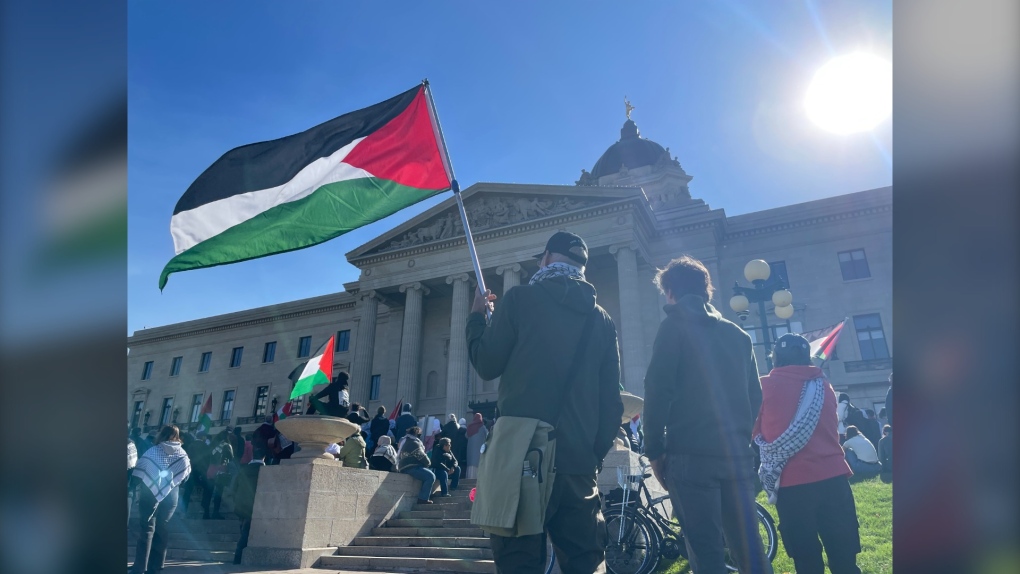
Pro-Palestinian protesters gather in front of the Manitoba Legislative Building   CTV News
"[There had been a 'sharp rise' in antisemitism in the province."
"Threats to places of worship, community centres, and campuses have left many Jewish Manitobans feeling unsafe expressing their identity."
"This past year has been challenging for many, but we stand together, united in rejecting all forms of hate and ensuring that everyone can live freely and without fear."
Manitoba Premier Wab Kinew

Labels: , , , ,

Wednesday, February 15, 2023

Fated

"When  you come from a loving family and something like this comes, it destroys you. He [adoptive father] was my giant."
"How can something like that happen?"
"That really made me really torn. It tears something out of your body. It rips your heart out. This is your family."
“How do you have the wrong baby and give it to the parent? What happened at that time? It’s something I will never be able to explain. Obviously, it was a big, careless mistake.”
“I have met already some of my sisters and brothers. I need to get my identity back. I need to prove who I am.”
“I call him my brother [Beauvais]. Even though we are not brothers, we are brothers in a way.”
Edward Ambrose, 67, Winnipeg, Manitoba
An elderly man holds up two picture frames to the camera.
Edward Ambrose holds up two picture frames. The picture in his left hand is a wedding photo of his 'bonded parents,' as he calls them. The pictures in his right hand are of his biological parents, who he never got to meet. (Gary Solilak/CBC)
 
"[It was a difficult childhood -- living with his siblings in a historically Metis community on the shores of Lake Manitoba -- but] seemed normal to us."
"All of a sudden I realized I'm not Native. That really upset me."
“The hardest time in my life, I think, is when I had to phone my two sisters … and tell them that I was not really their brother,"
“I felt as if something was taken away from me. I guess I fought for the right to be native. Whenever anyone teased me about it, I would fight them when I was a kid, and I was kind of proud to say I was native. And you don’t understand it until it’s taken away from you suddenly."
Richard Beauvais, 67, Sechelt, British Columbia
It's an old story, one that takes people by surprise, angers and upsets them, leaving them feeling that their world has turned inside out and they hardly know how to respond. Some do with dismay and bitterness, disbelief and self-pitying anguish. Some take it in stride, others are traumatized and forever changed. Their verities altered, they are no longer, they feel, who they thought they were. This happened to two men whose both sets of parents lived in Manitoba.

Their mothers gave birth to them at a municipally owned and operated hospital equipped with eight beds and cribs and four bassinets. The Arborg Medical Nursing Unit was located within the area now administered by the Interlake-Eastern Regional Health Authority itself under the control and direction of the Manitoba Department of Health. But in 1956 when the men were born, the provincial health department was not responsible for the hospital.

And it was there that the babies were given into the care of the wrong families. Each set of parents took  home with them babies not their biological own, but a stranger's who just happened to give birth at the same time in the same nursing centre. And it is only now that each of those men discovered that switch that threatens the stability of their lives. One, Edward Ambrose, lives in Winnipeg, the other, Richard Beauvais in Sechelt, British Columbia, their sense of identity suspended.

Born June 28, 1955, neither man suspected they had been switched at birth. They had no reason at all to investigate the time and place they were born and whether their parents actually were their parents. Beauvais was recently given an at-home ancestry kit as a gift. When it was returned he was identified as having Ukrainian and Jewish genetic origins. This man who had been raised Metis, who had always believed himself Indigenous. As a youth he knew racism, and he was also sent to a residential day school.

He puzzled over the genetic results, discussed the situation with some of his relatives, then set it aside as an anomaly, inexplicable and of no real significance. And then Ambrose's sister made use of an at-home ancestry kit. Curiosity drives people to want to know about their distant past. To discover unexpected links. And she did. Her results revealed a brother living in British Columbia and she reached out. It just happened to be Beauvais.

Soon Ambrose's sister and Beauvais discovered that both men had been born the same day in the same small hospital. Ambrose was nonplussed and disbelieving. He and his sister decided on further testing, hoping to ease his mind. The conclusion was that further tests indicated they were not, after all, biological siblings. Had the two men not been switched, their life paths would have been completely different.

Beauvais explained that his father died while comparatively young leaving his mother to struggle to raise three children, himself and two siblings, in Saint Laurent, Manitoba. He recalls the difficulties of an impoverished childhood, scrubbing about in the local dump to find anything edible. He recalls being picked on by others and bullied because he was an Indigenous child. In time he and his siblings were taken into care.

Then came various foster homes until a family adopted him and that family represented his safe haven; their support was invaluable and continues to the present. He moved to British Columbia and became a commercial fisherman. He married and children followed. Pride in his Metis roots was shattered when he learned he was not Metis, leaving in his mind a profound sense of loss. He was loathe to tell his sisters that what they had believed all their lives just was not reality; they were not biologically related. 
 
Ambrose's story is fairly similar. His memories revolve around growing up in a farming community south of Arborg. His mother died in 1953 when he was 9 years of age, followed by his father's death when he was 12. He was placed with various relatives, and finally with a foster family that adopted him. As an adult, he married, became a father and lived his life. Now, he says, he's trying to explore the good that can come from the truth about his parentage.

A man and a woman stand together on a dock at the edge of water, with mountains in the background.
Richard Beauvais, seen here with his wife, Sonja, says it was a shock to learn he was not Métis. (Submitted by Richard Beauvais)

Labels: , , , ,

Friday, July 24, 2020

Hutterite Communities : Living COVID Transmission Laboratories

"The question we need to ask is, 'What are a minority of our people doing that brings suffering like this upon the rest of us'?"
"Such situations are a golden opportunity to be a light to the world and show mainstream society that we have many great people among us."
Hutterian Safety Council

"We can answer a lot of questions [in Hutterite colonies] that can't be answered in mainstream communities. [This is] knowledge that couldn't be obtained anywhere else."
"It's a very giving culture. There is a generosity of spirit [here]."
Dr.Mark Loeb, infectious disease professor, McMaster University
***2008 POY REGINA** NEWS -- REGINA, SASK: September 10,2008 -- Members of the Box Elder Hutterite Colony stand on the headers of eight combines just before they start to combine what is left of the 20,000 acres of barley they are harvesting near Tregarva, SK. Don Healy/Leader-Post

Founded in 16th century Switzerland together with Mennonites and Amish, Hutterites represent a branch of the Anabaptist movement of Protestanism. All of these minority breakaway groups were historically persecuted throughout Europe, inspiring them to self-exile when they moved to North America in the late 1800s. There they found freedom in the establishment of limited colonies of 100 souls, living remote from others in the mainstream community. Hutterites have a unique mode of dress and most are involved in farming and in small-scale manufacturing.

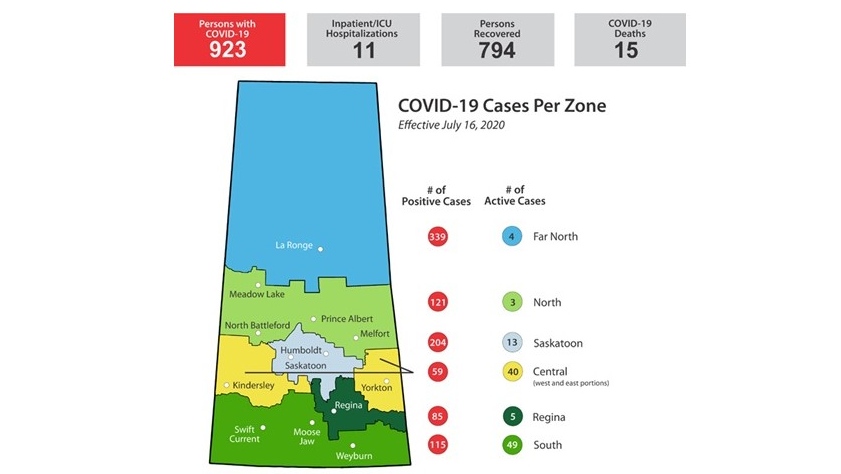
A number of Hutterite colonies located in Alberta, Saskatchewan and Manitoba have had outbreaks recently of COVID-19 infections, as well as several deaths resulting from COVID. Where in the general community within which their remote and isolated communities exist the incidents of COVID have receded in numbers, in the Hutterite communities they have proliferated. Speculation is that communal meals and prayer, traditions within the community, may prove to have been a factor in the infection rate.

Which led to the Hutterian Safety Council identifying for censure some of the community members for having visited doctors without divulging they were ill; not observing social distancing; and travelling outside their colony for non-essential purposes. The premier of Saskatchewan spoke of imposing travel restrictions to and from the colonies in an effort to curb the cornavirus spread, at the same time cautioning against stigmatizing the communities.

Saskatchewan COVID-19 map for July 16, 2020.
A research project is in the planning stages to view the religious group as a living laboratory, a potential source of vital new information about the coronavirus. McMaster University intends to study the small, self-contained colonies with a view to examining the critical issue of herd immunity related to COVID-19 transmission. Earlier research on flu within the communities could serve as a platform on which to mount this new study.

The Canadian Institutes of Health Research has funded the proposed study with a $1.5-million award. The study now awaits a go-ahead from the University of Alberta which is partnering with McMaster, along with formal consent from the twenty colonies chosen by the team to be part of the study. Dr. Loeb, tagged to lead the study is familiar with the colonies' residents from the flu study, considering them to be "extraordinarily generous" to visiting scientists, in his decades-long association with them.

COVID-19
Laboratory technical assistant, LifeLabs, THE CANADIAN PRESS/Darryl Dyck

The makeup of the communities is unique; small, manageable populations, the colonies are isolated from the outside world, thus becoming the ideal laboratory where the vital issue of herd immunity can be studied to determine how respiratory viruses behave on a community-wide basis. The earlier study dating from 2010 examined the effect immunizing children within the community at ages three to 15, impacted on community members at large.

Communities whose children received flu shots irrespective of whether or not the population was vaccinated, were 60 percent less likely to harbour the virus in comparison to those colonies that received Hepatitis A vaccine, used as a control group. Confirming the herd effect of immunizing children against flu. The study was noted at the time by Dr.Anthony Fauci, director of the U.S.National Institute for Allergy and Infectious Diseases, who praised it as a "really nice study".

As schools prepare to re-open, the research will study the role children play in COVID-19 transmission. "Findings from this cohort study will inform policy-makers about the determinants of community transmission", noted the grant description meant for the attention of the Canadian Institutes of Health Research.

Labels: , , , , , ,

Tuesday, July 08, 2014

Calamitous Climate

"It's utterly unprecedented."
"And this one is blowing all the others out of the ballpark."
"Everything we know about hydrology on the prairie appears to be different. We never have saturated spongy soils with flow running off farmers' fields in the midsummer. Never."
John Pomeroy, director, centre for hydrology, University of Saskatchewan
Recovery help on the phones

Floodwaters surround cottages and homes on Crooked Lake during Saskatchewan Premier Brad Wall's aerial tour of flood-ravaged southeast Saskatchewan last Wednesday, July 2. Nearly 90 communities in Saskatchewan and Manitoba have declared emergencies because of flooding and more than 500 people have been forced to leave their homes. Photograph by: Don Healy,  The Leader-Post


Dr. Pomeroy holds a Canada research chair in water resources and climate change. His professional assessment is that three floods -- one currently unfolding in Saskatchewan and Manitoba and an earlier one in southern Alberta taking place a year after high flood waters ripped through Calgary, causing Canada's costliest natural disaster up to then with over $6-billion in damage -- have been caused by storm fronts laden with moisture that moved up from the United States, then "stalled".

That stall was a disaster for the landscape under the stalled storm fronts. Torrential rain came down over large areas for days, seemingly never to end, and in the process saturating soil, funnelling the runoff into streams and rivers, which overflowed inundating fields. In the process washing away roads and flooding entire communities.

The natural ecology of the landscape had been altered over generations of farming by land owners draining natural slews and wetlands. The result was instead of retaining excess moisture falling out of overloaded skies, water ran off fields more quickly than they might otherwise have done. But who might have predicted the extreme weather events that appear over the past decade to surprise everyone whose geography has been impacted?

That increase in stalled summer storms "that just sit there" appears, from what Dr. Pomeroy is able to discern, to be linked to a shift in the jet stream and atmospheric flows. This is a phenomenon that may well be responsible for much of the extreme weather that has been ricocheting around the Globe; the prolonged deep freeze last winter in central North America, Australia's heat waves and the monsoon-like rains that inundated Britain earlier in the year.

This "regime shift" has impacted the Prairies which are far more accustomed to short sporadic summer thunderstorms; generally over from start to finish in a matter of minutes, not incessant rains lasting or days. Historically it has been spring snowmelt, not summer rain that has caused Prairie floods. The past decade has seen a shift to "rain-derived floods."

He and his research team have documented the change through a research program in the Smith Creek Basin in southeast Saskatchewan flowing into the Assiniboine River, which is now causing untold misery with countless homes and farms in Saskatchewan and Manitoba now labouring through a state of emergency with the province calling in the military to aid the province in dealing with the overwhelming flood conditions.

Normally, streams and creeks in east Saskatchewan begin their flow in March, then peak in April and dry up by early May once the snowmelt is completed and that is reflected in records that date back to the 1950s. While Smith Creek is generally "bone dry" by July, last week it hit a never-before-seen high of 24.5 cubic metres of water a second roaring downstream.

Floodwaters invade a farmstead near Gainsborough,SK during Saskatchewan Premier Brad Wall’s aerial tour of flood-ravaged southeast Saskatchewan on July 02, 2014. Nearly 90 communities in Saskatchewan and Manitoba have declared emergencies because of flooding and more than 500 people have been forced to leave their homes
Don Healy/Postmedia News -- Gainsborough, Saskatchewan

Heavy winter snow -- heavier than most winters last year -- had saturated the soil, and then came a heavier-than-usual spring rain season. When the frontal system looming up from the U.S. stalled over southeast Saskatchewan in late June it "pushed it over the top". More than 150 millimetres of rainfall in a few days; that much rain normally falls in dry southeast Saskatchewan in the space of a year.

Dr. Pomeroy speaks unkindly of the stark lack of a national Canadian strategy and program for improved flood prediction and water management. He cites recent cutbacks by the federal government, and the "gutting" of federal hydrology climate and flood management programs leaving the country ill-prepared to predict and cope with the fallout of changing weather patterns.

"Every province is left on its own, with some doing better than others."

Labels: , , ,

 
()() Follow @rheytah Tweet