Ruminations

Blog dedicated primarily to randomly selected news items; comments reflecting personal perceptions

Wednesday, November 20, 2019

Venice, World Heritage Site

"We are used to flooding and we know how to deal with it, but my generation has never seen anything like this."
"When I was a kid, it was normal to have an acqua alta [high tide] of 1.1 metres. But now it's normal to experience 1.3, 1.4 metres."
"Sooner or later people's resilience will run out. About ninety percent of my classmates from school have left because living here is a battle."
Alexandro Guggia, 42, Castello District, Venice

"We have to keep going."
"Many people are abandoning Venice and if these dramatic floods continue, you fear that it will one day turn into some sort of legend, like Atlantis."
Chiara Tonello, Venice
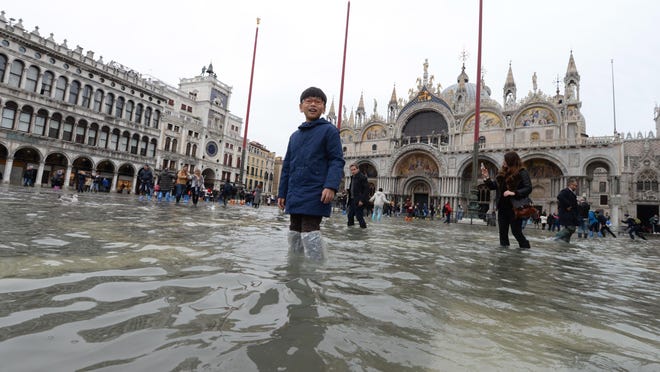
San Marco square remains covered in flood water days after the second highest tide since 1966 on November 15, 2019 in Venice, Italy.
San Marco Square remains covered in flood waters days after the second highest tide since 1966 on November 15, 2019, in Venice, Italy.  Getty Images

The 1.87-metre flood inundating Venice on Wednesday last damaged the Byzantine basilica of St.Mark's, while swamping St.Mark's Square and left a tide's-worth of debris in the narrow alleyways leading off the square in the murky brown sludge that crept its way into shops, hotels and homes. But that wasn't the end of it, there was no relief in sight as two days later flood warning sirens once again gave notice that another high tide arrived to raise the lagoon's level 1.6 metres, leaving the city to cope once again with its new underwater emergency and Venetians had little option but to make their way through the flooded alleyways in rubber boots.

Women wade through water in Venice on Nov. 13, 2019. The high-water mark hit about 74 inches on Nov. 12, meaning more than 85% of the city was flooded.
The high-water mark hit about 74 inches on Nov. 12, over  85% of the city was flooded.
Luca Bruno, AP

Desperate shopkeepers and restaurateurs made use of mobile pumps in an effort to free their establishments from the floodwaters. Venetians are accustomed to living uncertainly in this most beautiful of heritage cities, like none other. Tourism brings millions of people to the city annually and cruise ships value it as a destination, frustrating residents even as their presence generates badly needed income to help pay for potential solutions to flooding issues. Rising sea levels have played havoc with the city, and many of its residents have fled the pressures of stress.

In the 1950s, Venice had a population of 175,000 fortunate residents. By 2000 that population base was reduced to 65,000 and the ongoing trickle of those leaving the city for good has further eroded its population numbers to its current 52,000 inhabitants. As morale of the people living there is eclipsed by ongoing flooding whose inundation levels continue to grow, people increasingly see no future for themselves in Venice. "We've seen a lot more flooding in recent years. It's the frequency that is concerning", Paolo Brandolisio, a maker of wooden oars to equip the 450 gondoliers who ply the canals of Venice, explains.
Water starts rising again in Venice, northern Italy on Nov. 16, 2019. High tidal waters returned to Venice on Saturday, four days after the city experienced its worst flooding in more than 50 years.
Andrea Merola, EPA-EFE

His oar-making workshop has been flooded time and again. In this latest super-flood he was able to rescue his power lathe and electric belt saw last Friday when his workshop was thigh-deep in water. He lost the use of his wood supplies along with other tools that the floodwaters swamped in his shop and they were unsalvageable. Despite the tribulations owing to increased flooding, the regional government of Veneto rejected measures meant to ward off climate change. And then its historic offices located on the Grand Canal were themselves under flood water, shortly afterward.

Tourists take pictures in a flooded St. Mark's Square.
Luca Bruno, AP

Majority right-wing parties had rejected the climate action plan. "It's rather ironic that the council chamber was flooded two minutes after the majority parties rejected our proposals", ventured Andrea Zanoni, a member of the centre-Left Democratic Party, leaving a senior League member to dismiss any criticism reminding critics that the regional government had set aside 965 million euros ($1.4 billion) in the past three years to address air pollution and climate change problems.

"This is Venice's last hope. I think we should be able to manage our own affairs. We should be separate. It's logical. And it's the only way out of our current situation", stressed Matteo Secchi, president of Venessia.com, a campaign group urging Venetians to vote in favour of a referendum on Venice having a dedicated city council, away from the mainland currently administered as Veneto. "A mayor looking after just Venice would have more time to dedicate to the things that really matter to the city", remarked Jane da Mosto, British head of We Are Here Venice think tank.
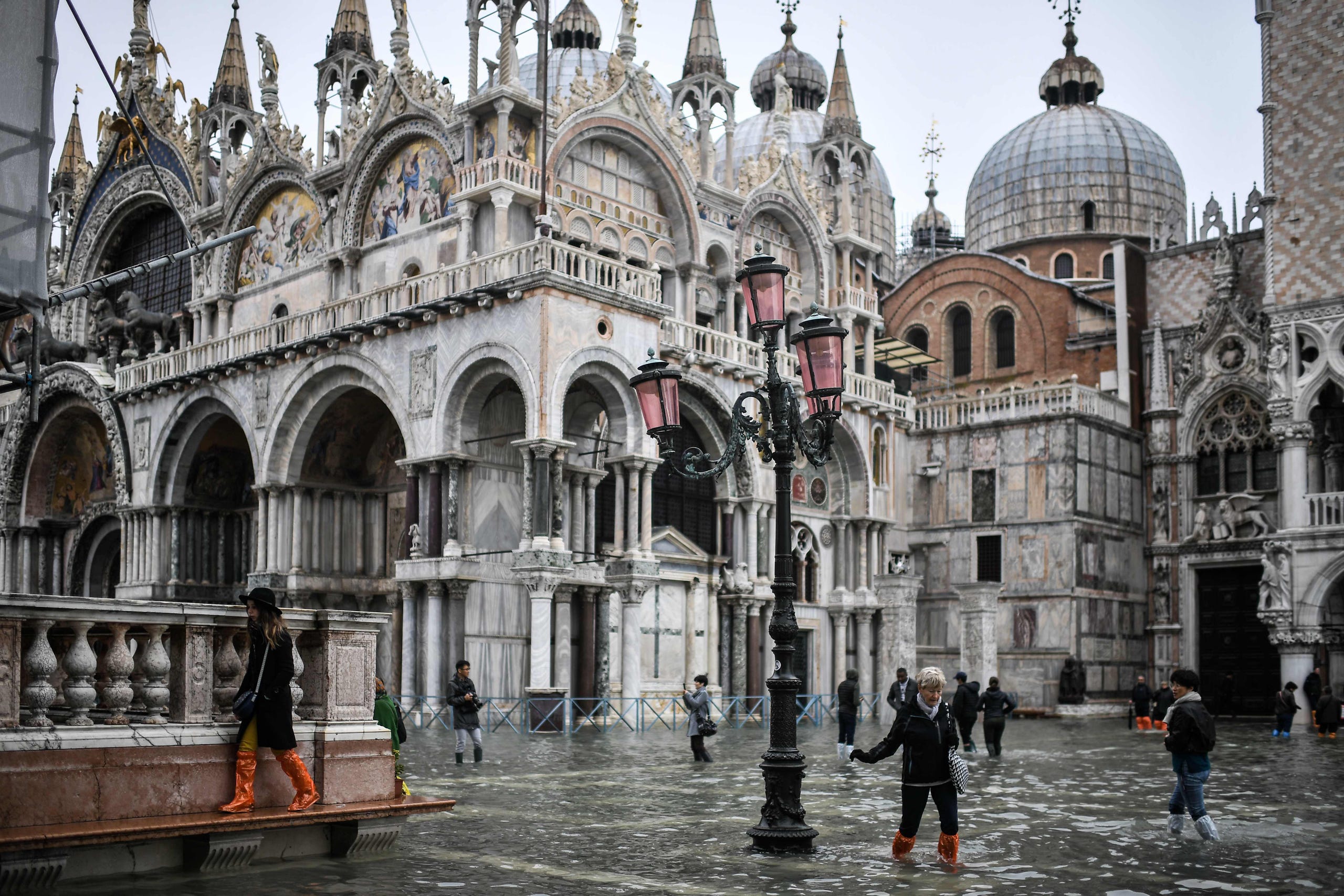
Pedestrians walk across the flooded St. Mark's Square past St. Mark's Basilica.
Marco Bertorello, AFP via Getty Images

Labels: , , , ,

Monday, September 24, 2018

Surviving Natural Disasters

"I guarantee you, I can say this without a doubt, my husband saved my life and my son's life."
"We didn't get water inside the house, but at one point we were completely surrounded."
"I try to be positive, but it's getting harder and harder. I really feel like we're being tested. I'm a God-fearing woman but I'm confused right now."
"I have never heard my husband yell in that manner 'Get down here right now'!"
"A friend of mine was joking when she said, 'I will never live beside you'. This is following us. I said to our builder, I feel like this is my fault."
Nicole Lowden, Ottawa paramedic
Brian and Nicole Lowden’s house was destroyed by a tornado on Thomas Dolan Parkway in Dunrobin, September 23, 2018. Jean Levac / Postmedia News
"This is definitely not a short-term fix here. We're looking at weeks and months [of work to normalize the community struck by a category 3 tornado on Friday]."
"Dunrobin will bounce back and it will be rebuilt and we'll be stronger for it."
"There's a lot of heartache, but it's expressed in hope."
Greg Patacairk, president, Dunrobin Community Association
Last Friday was a really peculiar day weatherwise in Ottawa, Canada's capital city. The area, in the Ottawa Valley, is prone to freakish weather conditions, but this time the conditions were quite extraordinary. A year ago, areas of the city and across into the province next to Ontario, Quebec, there was flooding from incessant heavy spring rain. Built on Leda clay, susceptible to 'melting' when completely suffused with rain, there had been some mudslides, and the Ottawa River dividing the provinces, flooded.

Back then, the Lowden family living in the community of Constance Bay on Bayview Drive, just managed, with the help of sandbags and pumping the water out of their basement, to keep the floodwaters out of the house they had lived in for twenty years. They decided, however, to sell the house and move out of the area. Then, they planned to build a new house elsewhere in the community. Just as their old house sold, their daughter, age 21, was diagnosed with Stage 2 lymphoma. After chemotherapy treatment she is on the road to recovery.
Brian Lowden sits on an overturned boat in his backyard among debris left by the tornado that touched down in Dunrobin on Sept. 21. (Justin Tang/Canadian Press)
They have been living in a rented house in the community of Dunrobin, and disaster followed them to that location when on Friday, after a steaming, humid day of 29C with forceful winds prevailing and weather warnings of violent thunderstorms, one of those thunderstorms struck at 4:30 p.m., sending daggers of lightning from sky to ground. So much, so normal, for the Ottawa area. What was abnormal was the tornado that struck at five in the afternoon of the last day of summer. It swept through the community, ripping up trees, tumbling cars, tearing the roofs off homes and buildings.

The tornado broke hydro poles as though they were matchsticks, a quarter-of-a-million residents were without power and have been for days. And about 60 houses were completely destroyed. The Lowden family's rented house among them. Their adult son, tired after work, had arrived home to collapse on his bed upstairs. Nicole's husband Brian, a volunteer firefighter who had been on duty at a nearby fall fair, came home early in response to the severe weather warning. Nicole was upstairs closing windows against the wind and rain, when she heard her husband shout out from downstairs.

He bounded up the stairs to drag their son Daniel out of bed, and hauled her with them down the stairs to huddle in the kitchen beside the refrigerator in the basement-less house.  "I'm telling you, that's the only part of the house that is untouched", she later said. Daniel went in frantic search of their six-pound blind dog, Lola, as windows were breaking all around them, and lumber was splintering and flying through the air, and the roof flew off the house. They could look outside to see the house next door utterly gone, nothing but the foundation left.

They had no insurance on the house contents and nothing is salvageable. Escorted by firemen and other volunteers on Sunday the evacuated residents of Dunrobin were allowed to return to their homes -- what was left of them -- to look for items and keepsakes. And the Lowden family is looking for alternate rental accommodation, awaiting the completion of their new home whose construction is meant to be complete by next spring.

A firefighter hands Alex Carlson his laptop, which was recovered from the wreckage of his Dunrobin home. A volunteer firefighter for the local fire department, Carlson might have been called to the scene of his own home's destruction had he not been out of the city at the time. (Justin Tang/The Canadian Press)

Labels: , , , ,

Tuesday, May 09, 2017

The Spring Deluge Drowning Canada

Une dame se rend à la rame jusqu'à une maison à Rigaud.   A woman canoeing toward her flooded home in Rigaud, Quebec. Photo : Reuters/Chris Wattie
"We're doing a good job responding to an event on the ground right at the moment."
"What we're not so good at is having the event not happen in the first place."
"It's almost news that people don't want to hear."
Blair Feltmate, head, Intact Centre on Climate Adaptation, University of Waterloo

"We don't seem to learn our lessons. We have built and continue to build on floodplains, for one thing."
"When the flood comes and disaster assistance kicks in, it's the province that's paying them [municipalities]."
"It's not costing them [municipal responses to catastrophic local flooding] anything to do this."
Glenn McGillivray, managing director, Institute for Catastrophic Loss Reduction

"Most jurisdictions in Canada will not provide government assistance if you could have bought insurance instead. In some ways there's more confusion than there was in 2013 [when Alberta and the Toronto area experienced extraordinary flooding events]."
"Most people are not aware that overland flood insurance is available. Therefore, unless they have been directly in a conversation with their [insurance] broker or their agent at the time of renewal over the past year, they likely won't have it."
Craig Stewart, vice-president, Insurance Bureau of Canada
WEA CDA Flooding 20170508
A woman carries her belongings as two members of Quebec provincial police follow close behind, with more of her things in tow. Flooding in Rigaud forced the evacuation of several neighbourhoods in the town west of Montreal. (Graham Hughes/Canadian Press)

Copious, continuous rainfall has caused flooding conditions across Canada, from the Maritimes to the West Coast and Central Canada. Spring flooding of the normal variety related to runoff of melting snow and ice in the transition from winter to spring had already taken place, with some insignificant flooding occurring along lakes and rivers, which had since subsided.

And then came the month of May when April showers traditionally heralds the introduction of early spring flowers. But the sun sequestered itself behind banks of rainclouds for days on end, and subsequent rain that seemed to go on forever -- because it did, --swelled lakes and rivers beyond absorptive capacity.

Quebec was the worst-hit province, with a number of communities under water, people evacuated, and an emergency called, the military requested to enter the picture to give assistance. To help with the sandbagging, and the evacuation of residents from low-lying areas.

And in some areas hillsides comprised of Leda clay and sand simply gave way and slumped, completely destabilizing the area causing house foundations to shift and engineering inspections to declare the houses too compromised for homeowners to remain in them, forcing residents to evacuate.

Canadian Forces personnel wade through the flooded streets, Monday, in Deux-Montagnes, Que. About 1,650 soldiers were expected to be helping in the flood effort by the end of the day Monday.
Canadian Forces personnel wade through the flooded streets, Monday, in Deux-Montagnes, Que. About 1,650 soldiers were expected to be helping in the flood effort by the end of the day Monday.  (Ryan Remiorz / THE CANADIAN PRESS) 

From the St.John River in New Brunswick, the Gaspe Peninsula in Quebec, areas of eastern Ontario where the Gatineau and Ottawa rivers overran their banks and Interior British Columbia where the mighty Fraser did likewise, people have been forced out of their homes. In many instances gas and electricity has been cut off to prevent potential side-effects.

People who opted to remain in their homes, hoping that the peak would be reached without the floodwaters rising above their cellar ceilings into their first floor, managed to get out and about with canoes. Until they were convinced it was time to leave.

Canada once had a federal flood damage reduction program that used flood mapping to discern where and when such devastating floods would take place, and the conditions that led to them. Those flood maps, updated to show where the high-risk areas are, are no longer available, since the program was shuttered in the 1990s.

As for it being resurrected, it is seen by those who evaluate such situations that it would be a "politically toxic" move to restore it. Not because the data provided would not be enormously useful, but because that data would include naming areas most susceptible.

And that in turn would lead to homeowners experiencing the cash value of their property crashing, should they be among those living in an identified high-risk area. Developers would "go apoplectic", mused Blair Feltmate at the University of Waterloo. And, as matters stand now, municipalities don't recognize much of an incentive on the prevention route, to deny building permits to development on known floodplains, as sensible as that would be.

Flooding Deux-Montagnes
Pierre Gagnon surveys the floodwaters around his home in Deux-Montagnes, Que. That city, northwest of Montreal, is one of at least 10 under a state of emergency due to flooding. (Ryan Remiorz/Canadian Press)

Glenn McGillivray of the Institute for Catastrophic Loss Reduction speaks of workable measures that could be undertaken to complement a partial ban on new development in high-flood-risk areas. Such as the building of diversion channels and cisterns capable of holding excess water. Alternately, making available a battery backup for a sump pump when electricity is shut off.

But the real situation at the present time is that Canadians generally have no idea when and how their properties may be at risk. New research recently released demonstrated that a mere six percent of Canadians were knowledgeable enough to be aware that they live in a designated flood risk area.

It was only following the 2013 flood in southern Alberta that insurance companies initiated overland flood insurance, previously not available. It is now, to aware homeowners, but as an add-on to regular insurance, and at a steep price in recognition of the fact that flooding is the number one risk to home values being compromised through acts of nature. Only ten to 15 percent of homeowners have taken the additional assurance that "overland flood insurance" provides.
A flooded area of Gatineau, Quebec, seen from the Ottawa side of the Ottawa River, Monday. A ground and air search will resume Tuesday to try to find the two-year-old who went missing near the Sainte-Anne River in eastern Quebec.
A flooded area of Gatineau, Quebec, seen from the Ottawa side of the Ottawa River, Monday. A ground and air search will resume Tuesday to try to find the two-year-old who went missing near the Sainte-Anne River in eastern Quebec.  (Fred Chartrand / THE CANADIAN PRESS)

Meanwhile, people are frantically coming to grips with the dilemma of losing everything they have worked for their entire lives. Their properties so badly damaged it will require more money than they have to repair them. Even so, their resale value will be decreased enormously. And since so few people have the add-on, expensive flood insurance, it will be up to them, their own responsibility to somehow come up with the funding to restore their homes to livable condition. They will never be able to recover personal possessions that will have been ruined, or simply floated away.

A man, driving a SUV in response to friends' communication that they were in need of rescue, set out to do just that, his girlfriend and her two-year-old daughter in the vehicle with him. The vehicle was swamped, turned over and floated away with all three within. The woman managed to swim to safety, the man and the child have not yet been found, despite an intensive search. This is nature teaching humanity that it can not, ever, be too smug about our place in her landscape.

Canadian forces soldiers lay down sandbags to reinforce the highway in Saint-Andre-d'Argenteuil, Que.
Canadian forces soldiers lay down sandbags to reinforce the highway in Saint-Andre-d'Argenteuil, Que. (Ryan Remiorz/Canadian Press)

Labels: , , , ,

 
()() Follow @rheytah Tweet