Ruminations

Blog dedicated primarily to randomly selected news items; comments reflecting personal perceptions

Tuesday, June 21, 2022

Show and Tell With Pride
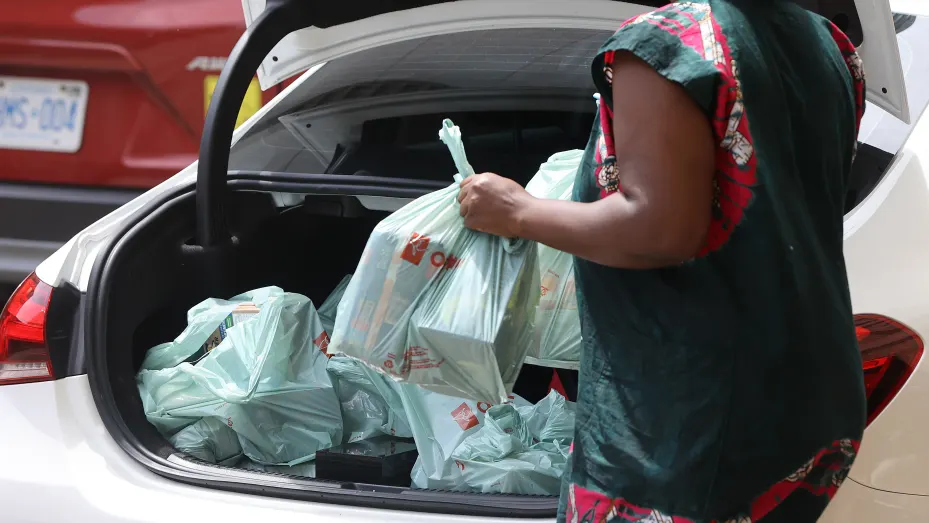
Restaurants and grocery stores worry about a supply of alternative products as the government announces details of its ban on single-use plastics. in Toronto. June 20, 2022.
Steve Russell | Toronto Star | Getty Images
"By the end of the year, you won’t be able to manufacture or import these harmful plastics. After that, businesses will begin offering the sustainable solutions Canadians want, whether that’s paper straws or reusable bags."
"With these new regulations, we’re taking a historic step forward in reducing plastic pollution, and keeping our communities and the places we love clean."
"We have not closed the door to banning certain other single-use plastics.We're starting with these ones because, based on the data we have, these are the most harmful plastic substances. But it may be the case that we decide in the near future to ban some others."
Steven Guilbeault, minister of environment and climate change, Canada
 
"The government needs to shift into high gear by expanding the ban list and cutting overall plastic production."
"Relying on recycling for the other 95% is a denial of the scope of the crisis."
"It's a drop in the bucket. Until the government gets serious about overall reductions of plastic production, we're not going to see the impact we need to see in the environment or in our waste streams."
Sarah King, head, Greenpeace Canada, oceans and plastics campaign
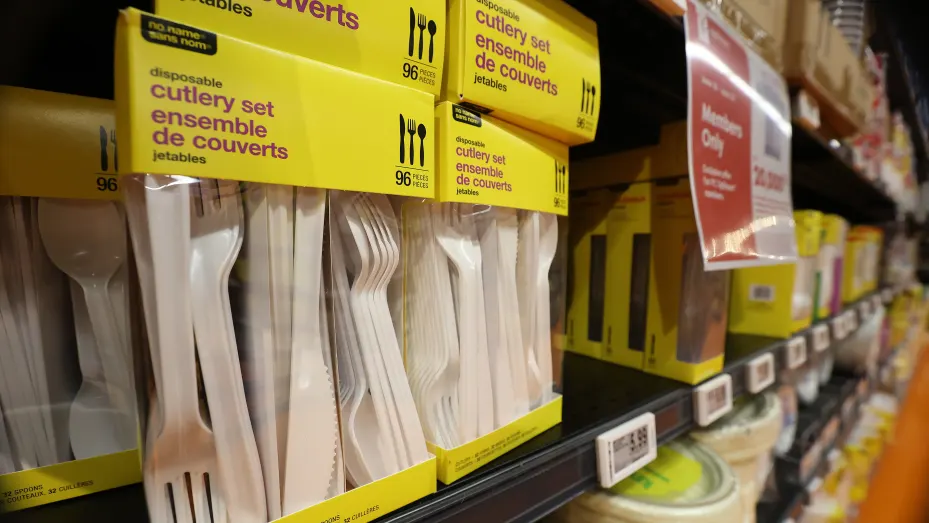
Restaurants and grocery stores worry about a supply of alternative products as the government announces details of its ban on single-use plastics. in Toronto. June 20, 2022.
Steve Russell | Toronto Star | Getty Images

The Liberal government of Justin Trudeau is a virtue-signalling administration like few others. It is also self-congratulatory to the Nth degree, and madly in love with photo opportunities certain to be splashed over the front pages above the fold of every newspaper in Canada. And if the news is of a type that addresses a universal problem, the chances are it will reverberate further than Canada and make it to the news of the day on global media; all the better for a government obsessed with itself and with the efficacy of its patinated veneer. Shiny, green and of-the-moment.

So, there it is, another campaign promise half-fulfilled. No more plastic straws, single-use shopping bags, plastic cutlery, etc. Makers and users of such indispensable, environment-cluttering garbage have until 2024 to figure out either how to get along without them, or plausible replacements. The industry is staggering under the challenge, and outraged that it has been targeted. Too bad the same cannot yet be said of the same industry that now proliferates transparent plastic clamshells full of fresh fruits and vegetables on grocery shelves and those neat little plastic carry-bags of same.

Can't make everyone happy, can we? Some environmental groups speak of the bans as typically cosmetic, leaving the vast majority of plastic waste in Canada yet to be dealt with. Even the government's own science sources indicate the ban will have a negligible effect on, for example, ocean health, the very goal of the ban. The fact is, the real plastic culprits messing up Canada's shorelines and its portion of the world's oceans, are being ignored; at the very least not adequately addressed.

A 2019 study Environment Canada commissioned to examine the state of the Canadian plastics market estimated just one percent of Canadian plastic waste was lost to "leakage"; the meaning of which is that the waste entered the environment as litter. Of 3,268 kilotonnes of plastic waste generated in 2015, 3,239 kilotonnes was "collected"; mostly in landfills, not recycling. The Deloitte study recommended that the leakage could be reduced ten-fold by efforts "to reduce litter"; no mention of plastic bans as a solution.

The proposed federal plastics ban relied on data providing a scientific backgrounder from the Great Canadian Shoreline Cleanup in estimating the effect of plastic on waterways of Canada. In their 2018 report, plastic bags actually ranked sixth, and straws ninth, as items most often recovered from cleanups on shorelines. Among the worst offenders, bottle caps and cigarette butts accounting for 42.1 percent alone of all litter recovered. More recent cleanups featured rising rates of discarded surgical masks. None of these items are mentioned in the ban.

Ocean plastic is undeniably a growing global problem, but one driven almost exclusively by abandoned fishing gear, and poor waste management in the developing world. In Canada, a Ghost Gear Program was initiated in 2019, spending about $8.3 million recovering 739 tonnes of abandoned fishing gear from the oceans, representing close to a third of the estimated 2,500 tonnes of plastic litter Deloitte's report estimated find their way into the environment annually. Not among the six items the new ban targets.

A shopper places her goods into her car outside a supermarket. Canadians will need to find alternatives for plastic straws and grocery bags by the end of the year. (Mark Baker/The Canadian Press)

Labels: , , , ,

Saturday, August 29, 2020

Plastics Waste During COVID

Another Side Effect of COVID-19: The Surge in Plastic Pollution

"I remember going to a coffee shop and them saying, 'We can't fill  your cup'. I think it was mere days later everything was shutting down. But that was the first little tiny step, was reusable coffee cups."                                             "People are still motivated to want to do something [about the environment]."                             "There was really strong support for more regulations and bans on single-use plastics a year ago. When we ran our survey this summer, we saw a lot less support for that, which makes sense based on the idea that it's less of a priority issue right now [in preoccupation with COVID-19 issues]."                                                                                               "The experience of the pandemic has been gendered in a lot of different ways [such as childcare disproportionately affecting women]."                                       "It's hard to imagine how you can move ahead [with things like zero-waste grocery stores] in the same way today in our new environment. But at the same time, the issue of plastic pollution is the same whether or not there's a pandemic. Ocean plastics don't care about our pandemic. The problem hasn't gone anywhere, and we still need to find solutions."                                                                                  Robert Kitz, research associate, Agri-Food Analytics Lab, Dalhousie University, Halifax, Nova Scotia

When COVID-19 struck an unready world, companies such as Bulk Barn and Starbucks halted the use of reusable containers in a reflection of overall concerns relating to contagion and hopes of controlling the coronavirus spread. This issue marked the turning point as the coronavirus transmission was identified as a global pandemic by the World Health Organization, heralding sweeping changes in coming months. Not too gradually cup lids, disposable cutlery, bottled water packs and plastic containers have been proliferating as plastic waste continues to make its presence known.

Dr.Kitz and co-authors of a new study on plastic food packaging looked intensively at how attitudes of consumers have been altered as a result of the COVID-19 pandemic. In their search to identify the changed attitudes, the researchers compared 977 responses collected between July 10 and 14 against results of an earlier survey of 1,014 Canadians dated May12 to 18 of 2019. Consumers actively avoiding plastic packaging has stabilized, remaining the same (58 percent in 2019 as opposed to 66 percent in 2020).

More than half (52 per cent) of Canadians think new regulations on plastics should only be put into place when the COVID-19 pandemic is over, the study found.

In Canada, consumers taking steps to avoid plastic packaging has remained pretty much stable (58 percent in 2019 versus 60 percent in 2020), yet fewer consumers are now concerned in relation to environmental repercussions (91 percent from 87 percent; the larger decrease seen among men), as one-third of respondents admitted purchasing more plastic-wrapped foods, attributed primarily to takeout and home delivery (44 percent) and increased concerns over safety (43 percent). Anxiety over food safety strikes fifty-five percent of Canadians, while 40 percent think of new safety concerns as "very", or "extremely important" in considering whether to purchase plastic-wrapped consumables.

At the outset of the study, researchers imagined that respondents might be less concerned over plastic pollution in the light of grave immediate concerns relating to pandemic contagion. A measurable decrease was recognized, but it was also observed that most Canadians continue to be engaged in the issue of environmental protection. Zero-waste grocery stores where bans on plastic bags and straws, pre-pandemic were proliferating, have come to an abrupt halt.

One-third of Canadians are buying more plastic-wrapped foods during the pandemic, according to a survey conducted by Dalhousie University’s Agri-Food Analytics Lab.
1/3 of Canadians now buy more plastic-wrapped foods Photo: Mario Tama /Getty

The issue of plastic pollution appears to be gaining momentum as the use of single-use plastic is seen to have grown by 250 to 300 percent during the pandemic, and as their use has increased, regulation efforts have faltered in the face of the coronavirus. Plans announced last year by the federal government on a ban of single-use plastic have not yet been carried through and will not likely be, for the foreseeable future of struggling to overcome the threat of the pandemic.

Back in 2019, fully 90 percent of respondents viewed stricter regulations favourably, while 70 percent gave their support to a single-use plastics ban. A drop of 11 and 12 percent respectively was seen in the most recent survey; men in particular reporting a notable drop in agreement. The issue of gender in concerns over environmental ramifications -- pointed out Dr.Kitz -- wasn't present in 2019. Price-consciousness has struck 50 percent of Canadians among the demographic receiving government top-ups to income, under CERB (Canada Emergency Response Benefits).

Leaving 55 percent of people reporting their willingness to pay more for products wrapped in biodegradable food packaging. Food security, as a result of the pandemic disrupting production and supply chains, has arisen as a greater issue in Canada because of the pandemic, with rising food costs; yet another recognizable difference from the year before. New regulations on plastics should be put into place only once the pandemic is over, in the view of over half of Canadians (52 percent). 

“What we found was that people are still concerned about it,” says Robert Kitz about plastic pollution. “People are still motivated to want to do something.” Photo by Mario Tama /Getty Images

Labels: , , , ,

Friday, April 10, 2020

Trashing the Environment

"In an effort to clean up its own backyard, China stopped importing plastic waste in 2017. There's still a long way to go before the flow of plastic into the ocean is stopped, however."
"Bans on drinking straws or grocery bags in Canada won't stop it; economic development and improved waste-management systems in low-income countries will."
"The best way for us to make sure our waste doesn't end up in the ocean is to send it to the landfill rather than trying to sell it on the international recycling market."
"Meanwhile, for those who have lamented our use of plastic packaging over the years, it's understandable, especially since the marketers sometimes make excessive use of the stuff."
"But the coronavirus shows that public hygiene was, and remains, an important priority, and we downplay it at our peril."
Ross McKitrick, professor of economics, University of Guelph, senior fellow, Fraser Institute 
A man collects plastic waste at a garbage dump in Bali  (Getty Images)

On the other hand, burying plastic waste in landfills doesn't solve the problem of ridding it once it has served its purpose. Plastic is derived from petroleum products. As such, gathering waste plastics to destroy it by burning it through a process that would produce energy, just as gas and oil do, would most certainly produce a desired effect; ridding the world of the waste, and transforming it to usable energy. A process that may even now be in the developing stages, and if not, research into a method whereby this can be achieved, should proceed.

Banning the use of plastics for packaging certainly isn't the answer, since for strictly hygienic reasons, plastic services us well. There was a time in the not-too-distant past when not only at outdoor markets once popular in inner-cities, but also in supermarkets to a degree, all manner of food products were simply piled up for people to riffle through and select what they wanted. Meat and meat products were set out on open shelving, uncovered until shoppers selected portions to take home.
A man sits among massive piles of plastic and other waste on a beach in Munbai, India. (Photo by Akira Kodaka)

For the most part, fruits and vegetables continue to be sold in bulk, unpackaged, to be selected by the purchaser, running their hands along items to ascertain freshness. In a time of care being taken to avoid contamination and cross-contamination where the very real fear of contracting a deadly virus like COVID-19 haunts us all, it has become verboten to handle food that others will eventually acquire for themselves. Public hygiene is now uppermost in everyone's mind, hoping to avoid a nasty infectious pathogen.

Wrapping perishable foods in plastic serves a double purpose; keeping it clean, avoidance of being handled by other than the purchaser, and maintaining a degree of freshness. At the same time, it is also true that packaging can be overdone, and this is another matter to be separately discussed, bringing in packagers to agree to reduce packaging as required. Even wrapping commodities other than food can be useful, done to a minimum degree, to avoid picking up germs.

Society is concerned over environmentalists' messages of garbage-filled oceans, and of bits of plastic being found in the most inaccessible and remote places on Earth. We're right to be concerned. But the issue requires a closer examination. It is not from the developed world and the West that waste plastic has been littering the environment, since for the most part, there recycling of waste plastic has become an absolute requirement.
Plastic and other waste clog a river in Cambodia. (Photo by Akira Kodaka)
In reality, single-use plastics, singled out as the source of environmental degradation and contamination is not the real culprit. Merely a minuscule fraction (about three percent) of the world's plastic production ends up annually as ocean waste, very little of that tiny amount emanating from high-income countries with their effective waste-management systems. Over 50 percent of the Great Pacific Garbage Patch is comprised of abandoned fishing nets and fishing gear.

And the simple fact of the matter is, that most plastic waste that enters the ocean from land -- fully 86 percent of it -- arrives through rivers in Asia, about ten percent of it imported plastic waste that was once gathered by China from recyclers in Europe and North America, to be processed for re-use. The type that proved not to be reusable, was discarded. Which answers to Dr.McKitrick's contention that it would be better off buried in stable landfills away from lakes and rivers.

Children collect plastic bottles from the Buriganga river in Dhaka. (Getty Images)
                                                                       

Labels: , , , ,

Friday, June 14, 2019

Single-Use Plastic Exceptions

"It would be hard to overemphasize the importance of plastics in modern society."
"Just think what our world would be like if we didn't have garbage bags. It's not a frivolous use -- it's absolutely necessary for sanitation."
"We were gyrating with hula hoops, going to Tupperware parties [in the 1960s], listening to vinyl records, playing with plastic toys and drinking from plastic cups through plastic straws. And we were paying for it all with plastic."
"[The current backlash against plastic is no all-or-none situation]: It never is in science. You have to evaluate each of these uses on their own merit."
"This business of having a plastic-free world, it's just nonsense."
Dr. Joe Schwarcz, director, Office for Science and Society, McGill University, Montreal
A surgeon holds a syringe prior to administering chemotherapy on June 7, 2019, at the Georges-Francois Leclerc centre in Dijon, central-eastern France.   ROMAIN LAFABREGUE/AFP/Getty Images
"Climate change is now a lot more real for more people than ever. To most, it falls under the umbrella of 'environmental harm', so it all gets lumped together."
"The problem is, being aware that something needs to be done about the environment, and actually doing something about the environment is a big leap. They have all the worry of climate change, and none of the control."
"That it might be negligible overall [to give up plastic straws and feel virtuous about it] is not really the issue, it's the feeling of making a difference, of being able to affect outcomes -- that is the main thing."
"[Politically, straws are easy targets], something that could be removed without much upheaval, for maximum political gain."
"The disposable plastic furor isn't bad, per se [but some objects will always require durable, flexible, sterile material for proper function]. Syringes, IV stuff. Could you make plastic alternatives that have similar properties but are more biodegradable? Maybe."
Dean Burnett, neuroscientist, author, Cardiff, Wales
Disposable plastic items in the health sector aren’t a major concern, experts say. Tim Boyle/Getty Images

A study conducted a few years back by researchers at Magee-Womens Hospital in Pittsburgh found that on average, a single abdominal hysterectomy was responsible for generating 9.2 kilograms of waste. Half of that waste was disposable gloves, thin film packaging, wrappers, hard plastic trays and other plastics. The idea of the study was to weigh the environmental impact involved in the second most common major surgery for women in the U.S. and Canada; a hysterectomy.

The team studied 62 surgeries where researchers immediately on the completion of each of the surgeries entered the operating theatre to carefully collect, sort, label and weigh the solid waste and recycling. When politicians announce that it is time for single-use plastics to be regulated against in view of the vast amount of plastics circulating as waste in our environment, in the world's oceans, they have a point; we do package consumer items much, much too much.

On the other hand, there are exceptions; nothing is ever as simple as it seems at first glance. Syringes, IV tubing, saline bags, plastic-wrapped drugs, catheters -- all are objects made of plastic without which modern hospitals would find it difficult to operate, ensuring adequate sterile conditions to contain bacterial contamination. Some  hospitals, cognizant of the ultra abundance of waste plastics have undertaken steps to make operating rooms and other patient care areas less wasteful.

According to an article published in the Canadian Medical Association Journal, up to 85 percent of hospital garbage is non-hazardous solid waste. Plastic packaging is a typical source of waste plastic where many surgical products are double-wrapped. Blue sterile wrap is used to cover surgical instruments, but it can be recycled into curbside blue boxes. Hospitals in Quebec sort plastics, to send them to recyclers.

Hospitals began their shift to plastic, single-use sterilized products a decade ago, transitioning from sterilizing reusable products in a bid for absolute sterility, and to ensure that pathogenic bacteria not be transferred from one patient to another through re-used instruments, when sterilization processes failed. "The shift has been done and, while it's not impossible, it's difficult to undo", stated Jerome Ribesse, director general of Synergie Sante Environnement and a member of the board of the Canadian Coalition for Green Health Care.

According to Vito Buonsante, plastics program manager at Environmental Defence (what a name to match with an enterprise!) disposable plastic items emanating from the health sector do not constitute a major concern. It is the unnecessary use of plastics for the production of cutlery, plates and take-out containers that would usefully be tackled first. Straws are symbolic for environmentalists, yet they account for little in terms of weight in total plastic waste.

Think in terms of plastics of merit and long-term use. Say, for example, flat-screen TVs, computers, water pipes. Indispensable to our modern way of life.
Operating room.
Operating room. - 123RF Stock Photo


Labels: , , , , ,

 
()() Follow @rheytah Tweet