Ruminations

Blog dedicated primarily to randomly selected news items; comments reflecting personal perceptions

Tuesday, May 27, 2025

Dredging the Ocean Floor and Capturing all that Swims

https://i.cbc.ca/1.7541038.1747930000!/fileImage/httpImage/image.jpg_gen/derivatives/16x9_1180/bottom-trawler-ocean-documentary.jpg?im=Resize%3D780
A bottom trawler scours the ocean floor. In his new documentary, Ocean with David Attenborough, the famed broadcaster looks at the vast but fragile underwater world. (Silverback Films and Open Planet Studios)

"Over three-quarters of a trawler's catch may be thrown away. It's hard to imagine a more wasteful way to catch fish."
"[The seas are] the last great wilderness ... our final frontier."
"No one alive today has known the abundance of a truly wild ocean. We have drained the life from our ocean[s]."
"Now we are almost out of time."
David Attenborough, Ocean documentary 

"[The documentary has failed to incorporate anything] about aggregate dredging; about subsea cables; about seabed mining [or about wind turbines and the damage they do to the seabed."
"Bottom trawling is a relatively small, but important part of [the industry] in the U.K. today."
National Federation of Fishermen's Organization
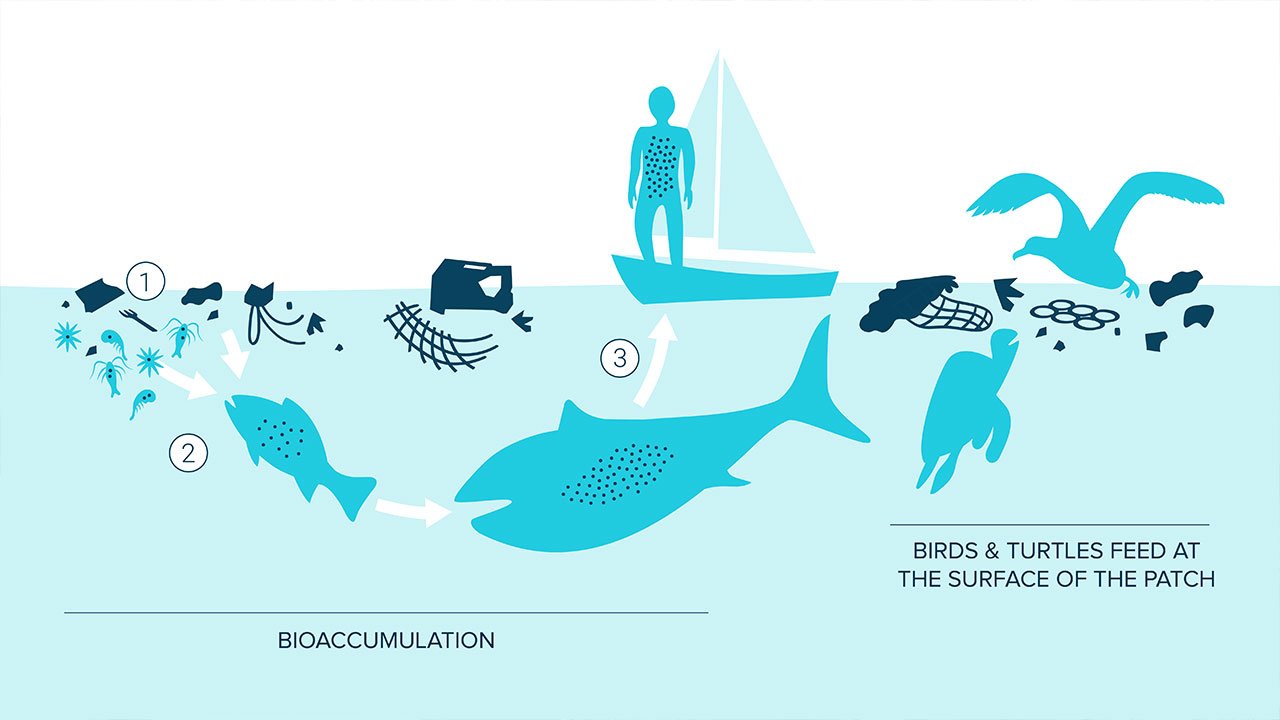
https://assets.theoceancleanup.com/app/uploads/2019/05/TOC_GPGP_bioaccumulation_1280.jpg
Not only does plastic pollution in the Great Pacific Garbage Patch pose risks for the safety and health of marine animals, but there are health and economic implications for humans as well. The Ocean Cleanup

Conservationist, 99-year-old David Attenborough grows apoplectic at footage of net dredging the ocean floor by commercial trawlers. He has produced another -- the latest -- documentary, Ocean, now being featured in some theatres on May24, with a wider audience beginning June 7 when it is set to be streamed on National Geographic, Disney+ and Hulu. Mr. Attenborough's passionate appeal against environmental degradation has inevitably turned more political in its nature.
 
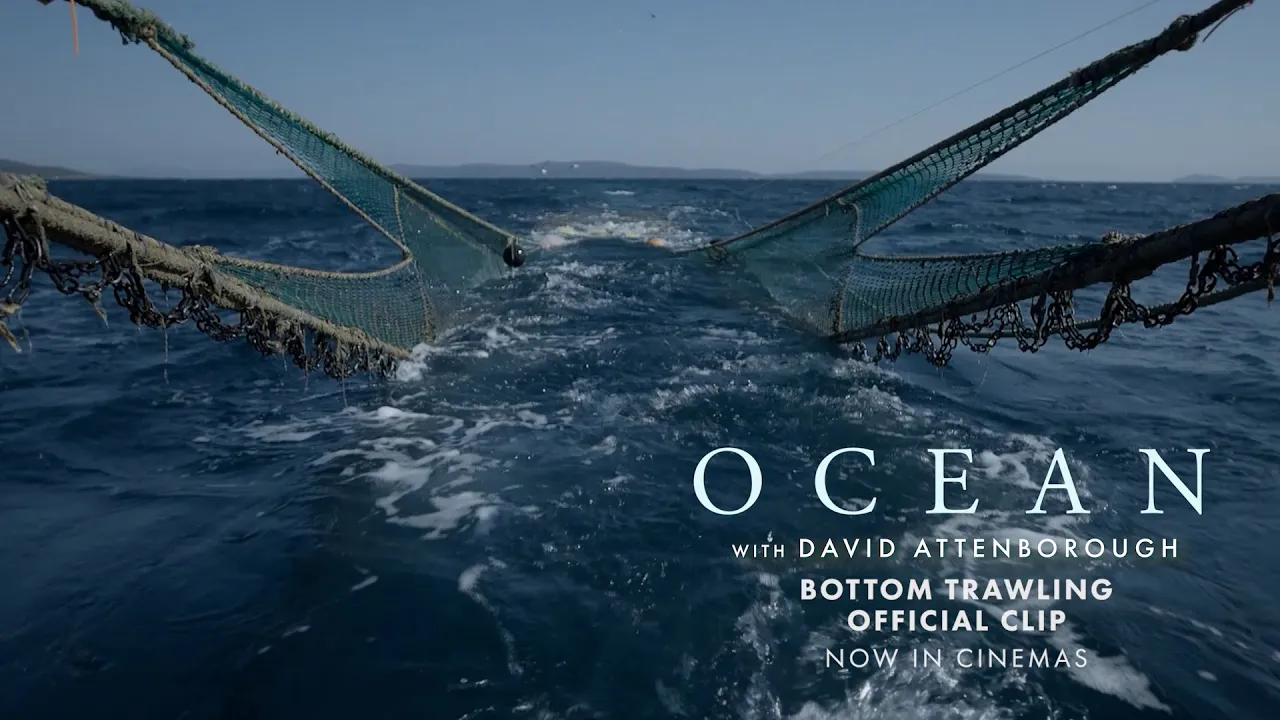
He rages against the fishing industry, specifically its trawling technique impacting the sea bottom. Fishing boats drag iron nets along the sea floor, in bottom trawling. Every animal in the path of the iron nets is caught, while the seabed itself becomes damaged as a result of the net-dragging. The Ocean documentary producers managed to obtain footage of an unprecedented nature that eluded Greenpeace itself. Attaching a camera to a commercial trawler's net resulted in a sharp focus on what transpires at the ocean bottom with that kind of trawling.
 
https://i.ytimg.com/vi_webp/eLxmUbQESAU/maxresdefault.webp
The beast that opens its maw to swallow everything is a bottom trawler, grinding the sea floor indiscriminately for fish.

According to one of the directors of Ocean, some of the most affecting images -- "terrible shots of all these spider crabs being crunched up because the dredge has these teeth" -- failed to make an appearance in the final version of the documentary, because it didn't make it past the cutting floor, with the realization that the plight of the creatures would be too "upsetting" for most viewers, at the release of the documentary.
 
https://assets.theoceancleanup.com/app/uploads/2019/04/toc-gpgp-1point8trillion.gif
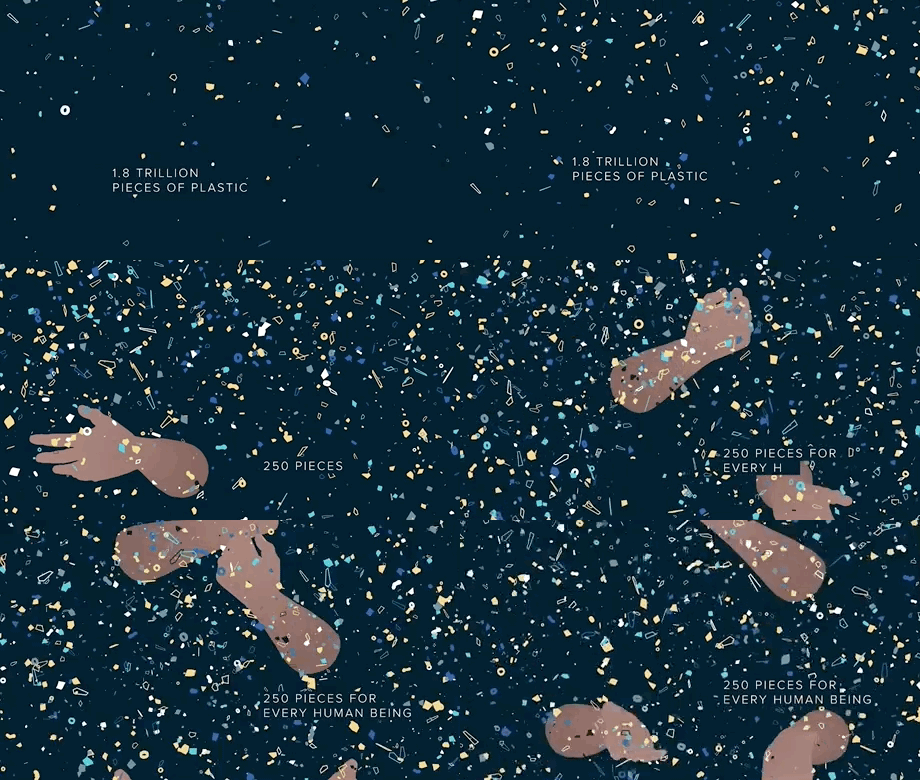
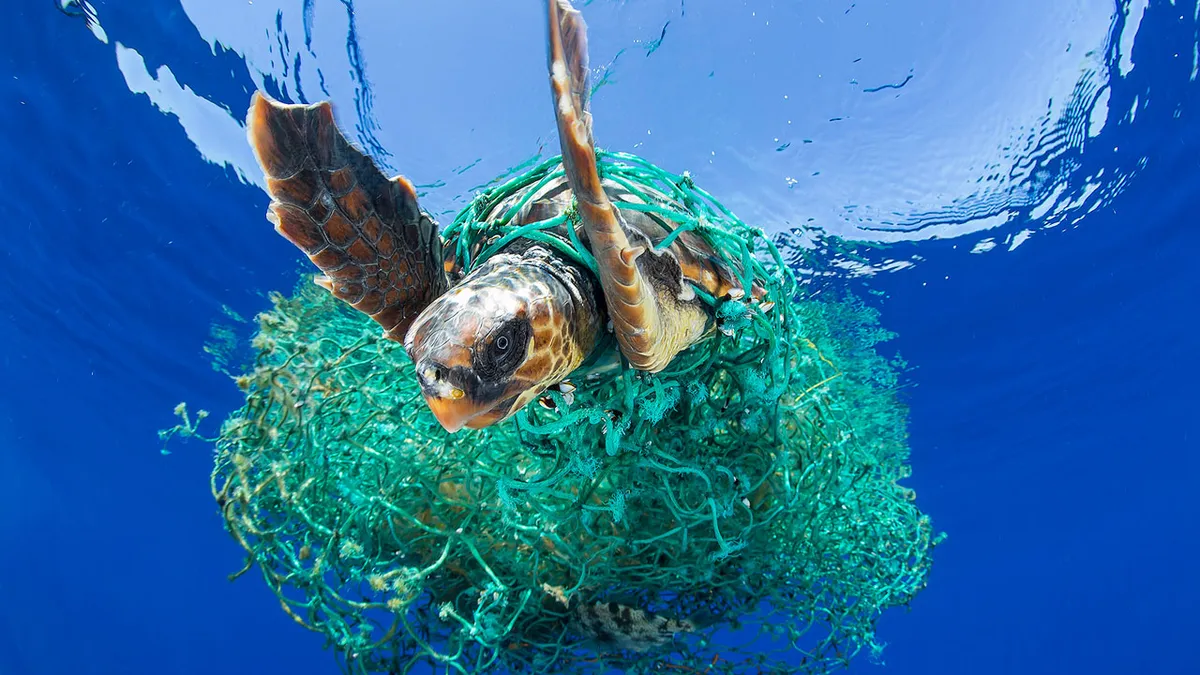
Sustainable fishing practices merit no complaints from the documentary. According to You-Gov., David Attenborough is the most popular individual in the United Kingdom, resulting from his revelatory documentation of fishing industry practices inimical to the environment and to the creatures sharing the ocean as a home. Fishing nets and allied fishing gear account for much of the accumulated ocean plastic; between 75 and 86 percent of the  plastic waste that accumulates in the Great Pacific Garbage Patch.
 
Conservation organizations and campaigners urge a ban on all dredging in marine protected areas, covering less than half of Britain's waters. Of Britain's marine protected areas, bottom trawling is banned in only five percent. The pushback from the U.K. fishing industry argues that the Ocean documentary is "indiscriminate" in its charges of  environmental degradation.
 
What the documentary sets out to accomplish is for promises made by countries to protect 30 percent of the oceans, to be actualized rather than remaining a promissory note acknowledging their responsibilities yet failing to act upon them.  
 
https://assets.theoceancleanup.com/scaled/1200x/app/uploads/2019/05/TOC_Entangled_Turtle_by_Francis_Perez1.jpg.webp


Labels: , , ,

Tuesday, August 29, 2023

Flawed Solutions to Single-Use Plastics

"[Even in situations where straws produced from plant material are not part of growing litter, their most likely destination would routinely be a landfill. There, the paper straws' life cycle will be spent] releasing PFAS [per-and polyfluoroalkyl substances] further into the environment." 
Belgian study

"Straws made from plant-based materials ... are often advertised as being more sustainable and eco-friendly than those made from plastic."
"However, the presence of PFAS in these straws means that's not necessarily true."
Thimo Groffen, environmental scientist, Belgium
A woman drinking through a paper straw.
Canada is in the midst of an all-out drive to prohibit the distribution of single-use plastics, meaning paper straws now usually replace the plastic variety. Photo by Getty Images
 
There are some countries, Canada among them, that intend to, or have produced legislation for the mandatory adoption of paper straws in a well-publicized and self-congratulatory announcement that single-use plastic will no longer be tolerated for use in their jurisdictions given their wasteful carbon footprint and propensity to end up bobbing in a sea amongst floating islands of plastic detritus, posing a threat to aquatic wildlife and adding to the garbage heaps humanity is responsible for on land and ocean.
 
A just-published study in the journal Food Additives and Contaminants was the result of studying over 20 different brands of plant-based straws, only to discover in their makeup high levels of toxic chemicals. "These 'eco-friendly' plant-based straws are not necessarily a more sustainable alternative to plastic straws", a research team based at University of Antwerp in Belgium concluded.

The straws that were  selected for examination by the researchers were not only made of paper, but other materials as well, including plastic, glass and steel. They were found, on close examination to be largely laden with per-and polyfluoroalkyl substances commonly recognized as 'forever chemicals'. Not only would this mean the straws are not biodegradable, but they would as well act as vectors for chemicals considered hazardous to human and environmental health.

In December of 2022, Canada in its drive to prohibit distribution of single-use plastics singled out plastic straws as one of the most visible ban targets and Environment Canada regulations made it illegal to manufacture or import plastic straws, cutlery and single-use shopping checkout bags. By year's end, the sale of such products will become prohibited. A costly venture overall; with the average Canadian scheduled to pay roughly $50 in the higher cost of acquiring plastic alternatives.

The University of Antwerp research team performed chemical analyses on 39 types of straws commonly sourced from supermarkets in Belgium as well as from fast food outlets: 20 paper, five glass, five bamboo, five stainless steel, and four plastic. The stainless-steel straws alone were found completely PFAS-free, the only type that could be recycled. Even glass straws contained measurable amounts of forever chemicals.

The chemicals' widespread use is attributed to the fact their addition in the manufacturing process produces water-repellent products. It transpires that in its zeal and zest to outlaw the most obvious single-use plastic products, Canada neglected to inspect the environmental effects or potential unintended consequences of replacing single-use plastics with acceptable alternative products.

<p>Researchers have looked at whether paper drinking straws are as good for the environment as they are hailed to be</p>

Researchers have looked at whether paper drinking straws are as good for the environment as they are thought to be   (PA Archive)

Labels: , , , ,

Tuesday, June 21, 2022

Show and Tell With Pride

Restaurants and grocery stores worry about a supply of alternative products as the government announces details of its ban on single-use plastics. in Toronto. June 20, 2022.
Steve Russell | Toronto Star | Getty Images
"By the end of the year, you won’t be able to manufacture or import these harmful plastics. After that, businesses will begin offering the sustainable solutions Canadians want, whether that’s paper straws or reusable bags."
"With these new regulations, we’re taking a historic step forward in reducing plastic pollution, and keeping our communities and the places we love clean."
"We have not closed the door to banning certain other single-use plastics.We're starting with these ones because, based on the data we have, these are the most harmful plastic substances. But it may be the case that we decide in the near future to ban some others."
Steven Guilbeault, minister of environment and climate change, Canada
 
"The government needs to shift into high gear by expanding the ban list and cutting overall plastic production."
"Relying on recycling for the other 95% is a denial of the scope of the crisis."
"It's a drop in the bucket. Until the government gets serious about overall reductions of plastic production, we're not going to see the impact we need to see in the environment or in our waste streams."
Sarah King, head, Greenpeace Canada, oceans and plastics campaign
Restaurants and grocery stores worry about a supply of alternative products as the government announces details of its ban on single-use plastics. in Toronto. June 20, 2022.
Steve Russell | Toronto Star | Getty Images

The Liberal government of Justin Trudeau is a virtue-signalling administration like few others. It is also self-congratulatory to the Nth degree, and madly in love with photo opportunities certain to be splashed over the front pages above the fold of every newspaper in Canada. And if the news is of a type that addresses a universal problem, the chances are it will reverberate further than Canada and make it to the news of the day on global media; all the better for a government obsessed with itself and with the efficacy of its patinated veneer. Shiny, green and of-the-moment.

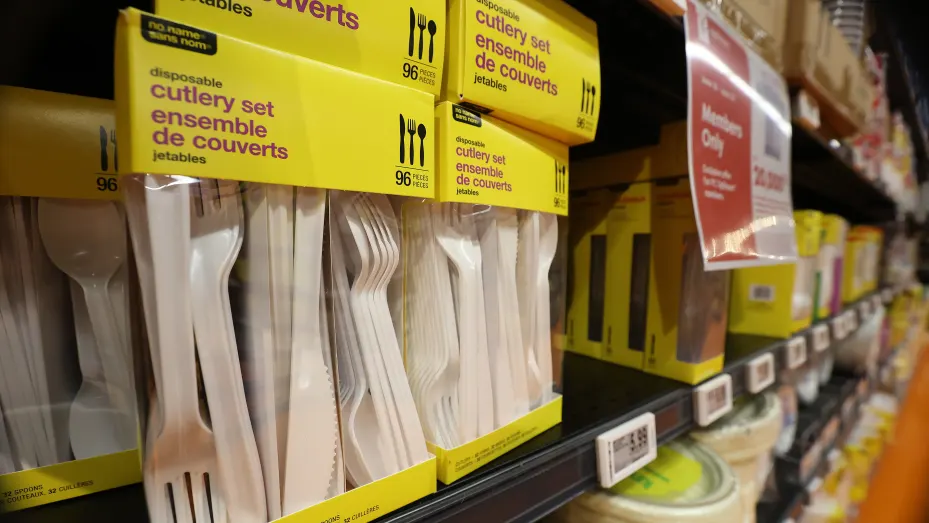
So, there it is, another campaign promise half-fulfilled. No more plastic straws, single-use shopping bags, plastic cutlery, etc. Makers and users of such indispensable, environment-cluttering garbage have until 2024 to figure out either how to get along without them, or plausible replacements. The industry is staggering under the challenge, and outraged that it has been targeted. Too bad the same cannot yet be said of the same industry that now proliferates transparent plastic clamshells full of fresh fruits and vegetables on grocery shelves and those neat little plastic carry-bags of same.

Can't make everyone happy, can we? Some environmental groups speak of the bans as typically cosmetic, leaving the vast majority of plastic waste in Canada yet to be dealt with. Even the government's own science sources indicate the ban will have a negligible effect on, for example, ocean health, the very goal of the ban. The fact is, the real plastic culprits messing up Canada's shorelines and its portion of the world's oceans, are being ignored; at the very least not adequately addressed.

A 2019 study Environment Canada commissioned to examine the state of the Canadian plastics market estimated just one percent of Canadian plastic waste was lost to "leakage"; the meaning of which is that the waste entered the environment as litter. Of 3,268 kilotonnes of plastic waste generated in 2015, 3,239 kilotonnes was "collected"; mostly in landfills, not recycling. The Deloitte study recommended that the leakage could be reduced ten-fold by efforts "to reduce litter"; no mention of plastic bans as a solution.

The proposed federal plastics ban relied on data providing a scientific backgrounder from the Great Canadian Shoreline Cleanup in estimating the effect of plastic on waterways of Canada. In their 2018 report, plastic bags actually ranked sixth, and straws ninth, as items most often recovered from cleanups on shorelines. Among the worst offenders, bottle caps and cigarette butts accounting for 42.1 percent alone of all litter recovered. More recent cleanups featured rising rates of discarded surgical masks. None of these items are mentioned in the ban.

Ocean plastic is undeniably a growing global problem, but one driven almost exclusively by abandoned fishing gear, and poor waste management in the developing world. In Canada, a Ghost Gear Program was initiated in 2019, spending about $8.3 million recovering 739 tonnes of abandoned fishing gear from the oceans, representing close to a third of the estimated 2,500 tonnes of plastic litter Deloitte's report estimated find their way into the environment annually. Not among the six items the new ban targets.

A shopper places her goods into her car outside a supermarket. Canadians will need to find alternatives for plastic straws and grocery bags by the end of the year. (Mark Baker/The Canadian Press)

Labels: , , , ,

Thursday, March 31, 2022

Landscape-Altering Climate Change

"[The landslide was not the largest ever in Canada, but it was] very, very enormous."
"Imagine a landslide with a mass equal to all of the automobiles in Canada travelling with a velocity of about 140 kilometres an hour when it runs into a large lake."  
"This drained most of the lake water, which then travelled down [a 10-km]-long channel causing widespread channel erosion and loss of salmon habitat,"
"It took about 30 seconds from when the rock started to detach on the slope for that mass of rock to enter the lake and, that produced a huge displacement wave. And everything was removed, all the trees and the soil, and so that was pretty spectacular." 
Marten Geertsema, adjunct professor, University of Northern British Columbia
 
"What we don't know is whether the final straw that broke the camel's back, for lack of a better phrase, was a rainstorm or unusually wet conditions during 2020."
"The ability to have perhaps half of the lake volume drained within ten minutes or less, I mean, it was tremendously powerful and disruptive."
"It feels very small [as a human], studying things with such power."
Professor Brian Menounos, Canada Research Chair in glacier change, University of Northern British Columbia
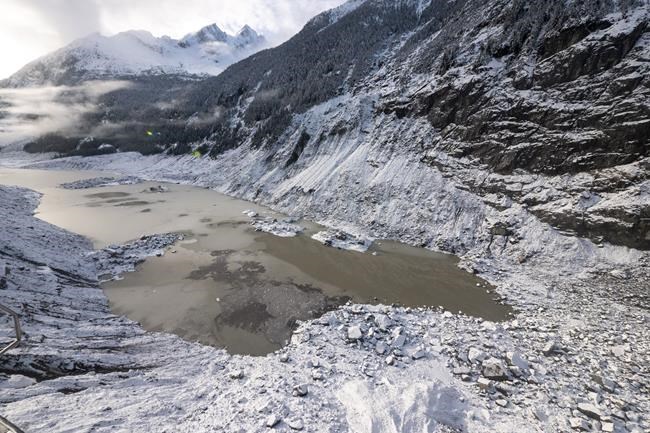
Brian Menounos, a professor of geography at the University of Northern British Columbia, surveys a debris field caused by a landslide and outburst flood off the coast of B.C. (Briar Stewart/CBC News)

A massive landslide presumed to have been caused by a retreating glacier located in a remote valley in British Columbia, caused a 100-metre-tall tsunami to occur, wiping out kilometres of salmon habitat. The earth tremors caused by the landslide was powerful enough to be detected by sensitive scientific equipment located as distant as Australia, according to a study published in Geophysical Research Letters.
 
An immense load of 18 million cubic metres of rock was sent cascading down a mountainside on November 28, 2020, as a result of the landslide uprooting trees and displacing soil, on its way to slamming into Elliot Creek. In Germany, Japan and Australia, earthquake sensors detected the landslide, the study points out, emphasizing its powerful effect. 

Salmon spawning habitat was destroyed over 8.5 kilometres of the creek runway, sending a plume of mud and organic matter over 60 kilometres into Bute Inlet located around 150 kilometres from Vancouver. At Columbia University in New York, a professor simultaneously measured a magnitude-5 earthquake in the area.

Dr.Geertsema described most of the lake water being drained and forced down a 10-kilometre-long channel when the massive slide fell, causing widespread erosion and loss of salmon habitat. Roughly four million cubic metres of material was removed from the creek within a stunning ten minutes. An event that would naturally have consumed thousands of years, should the stream have continued its normal flow.
 
The landslide scoured the Elliot Creek bed, creating this canyon, after an initial outflow into a glacial lake triggered an outburst flood. (Bastian Fleury/49 North Helicopters)
 
 Members of the Homalco First Nation who brought their intimate knowledge of Elliot Creek's salmon habitat, contributed to the research. Landslides, while not uncommon, are known to have carved the landscape of continents for millennia creating or diverting water bodies and rivers.

According to Professor Menounos, several factors would have occurred for the slope's instability and the landslide to have eventuated. Deglaciation, however, is being pinpointed as an accelerating cause of landslides. Scientists now have the required research methodology and accumulated data to map topography under glaciers, allowing them to estimate such events, inclusive of new lake formations.

20220330160344-308822733f60450fea4d91f790554ae39e477a4fd93093228d286c895ffe4762
Study: A retreating glacier in a remote British Columbia valley caused a massive landslide that crested a 100-metre-tall tsunami, wiped out kilometres of salmon habitat and was detected as far away as Australia. ElliotlakeToday

Labels: , , , , ,

Tuesday, September 28, 2021

Public Urination Issues Threatening to Impact Environment

"Illicit drug contamination from public urination happens at every music festival."
"The level of release is unknown, but festivals undoubtedly are an annual source of illicit drug release."
"Unfortunately, Glastonbury Festival’s close proximity to a river results in any drugs released by festival attendees having little time to degrade in the soil before entering the fragile freshwater ecosystem."
Dan Aberg, School of Natural Sciences, Bangor University, Wales, U.K.
 
"[The levels of illegal drugs were] high enough to be classed as environmentally damaging. [However, levels] decline pretty quickly after Glastonbury has finished."
"This has highlighted the fact that stopping public urination is so important. Not just for the traditional pollutants, which we've kind of known about, but for these these types of pollutants, which we're only now really just becoming aware of -- pharmaceutical waste, illicit drug waste -- these are important."
"We need to start highlighting the dangers of these drugs to the public and to festival goers and saying, 'look, another reason why you should not be peeing on the ground, go and use the loos, go and use the facilities."
"Our main concern is the environmental impact. This study identifies that drugs are being released at levels high enough to disrupt the lifecycle of the European eel."
 Christian Dunn, professor in wetland science, Bangor University
Glastonbury Festival
Public urination at Glastonbury Festival leaves traces of cocaine and MDMA in river, posing threat to rare eels. Pictured, Glastonbury Festival goers at Worthy Farm, Pilton. (Ian Gavan/Getty Images)
 
Published in the journal Environmental Research last week, a study out of Bangor University Wales, led by Professor Christian Dunn, has revealed the presence of dangerous levels of illicit drugs running through rivers, after Britain's Glastonbury Festival is over, representing a threat to local eels. Due to cocaine levels in the river the sexual maturity of the European eel population downstream is in danger of being delayed.

Narcotics are released into the waterways from festival-goers spurning the use of the public lavatories placed at the festivals to be used, whereas among those in attendance many find it more convenient to urinate on the ground, and do so in sufficient numbers that the effluent reaches streams and rivers, polluting them, negatively impacting wildlife and aquatic vegetation.

Outdoor urination has resulted in levels of MDMA quadrupling during the week following the festival, according to findings in the study dating from the 2019 festival. Cocaine concentrations rise to levels affecting the life cycle of European eels, which happen to be a protected species of aquatic wildlife. The threats posed by the influx of drugs into the waterways also impact zebrafish embryos and mussels, along with fern spores.

The area where the festival takes place is close to the Whitelake river, making it all the more vital that people attending the festival make use of the official lavatories. A partial solution suggested by the study researchers might be to construct reed beds to treat wastewater prior to it entering the river at Glastonbury, a method of intervention that might be useful at other festival sites with similar problems.

The best solution, however, is to educate people, and advise them of the potential damage their carelessness creates. Dangerously high levels of antibiotic pollution with the potential to create bacterial resistance has been found as well through previous studies of waterways.

glastonbury mdma cocaine public urination peeing drugs dangerous whitelake river somerset
Glastonbury Festival, photo by Mariel Wood

Labels: , , , , ,

Saturday, August 08, 2020

Arctic Environmental Degredation

"Entire cities are that size. These are big pieces of ice."                                     "This was the largest remaining intact ice shelf, and it's disintegrated, basically." "The very small ones, we're losing them dramatically."                                              Luke Copland, glaciologist University of Ottawa 

"We saw them going, like someone with terminal cancer. It was only a matter of time."                                                                                                                 "When I was there in the 1980s I knew every square inch of those ice caps. You have the memories. It's like your first girlfriend."                                                       "I knew them as friends too, you know, and now they're gone.... It's like losing an old friend."                                                                                                            "We're in control of the climate now. Basically, we've taken on the reins.... So unless we as a people and as a society get a handle on this ... there's no way these things are ever going to come back."                                                               Mark Serreze, director, National Snow and Ice Data Center, Boulder, Colorado 

"[Recently, scientists uncovered a channel on the Milne ice sheet that was home to] a truly unique ecosystem of bottom-dwelling animals — scallops, sea anemones and so forth."                                                                                                       "[The discovery was] phenomenal, [but is now threatened.]"                                      "Our team was on the cusp of further documenting this unique environment, which may well have disappeared as a result of this collapse."                                                  Derek Mueller, Associate Professor of Geography and Environmental Studies, Carleton University

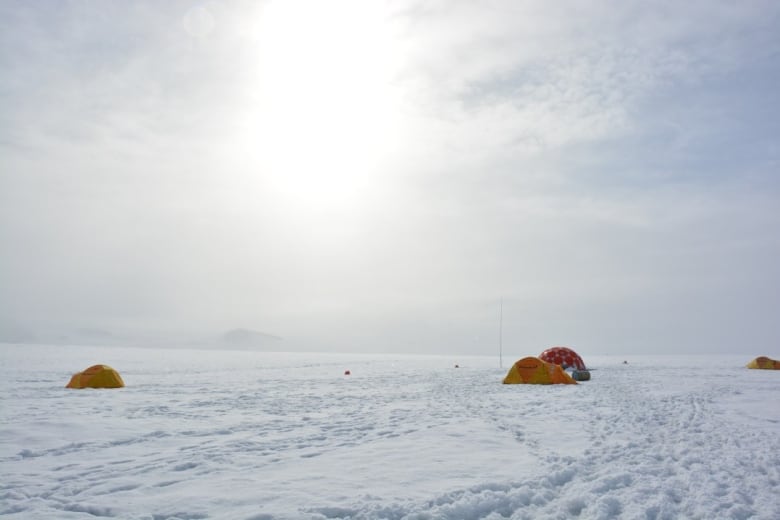
A Milne ice shelf research camp as seen in 2018. (Jeremie Bonneau)

The Milne Ice Shelf, at the very fringe of Ellesmere Island, the last fully intact ice shelf in the Canadian Arctic has collapsed. In so doing, more than 40 percent of its area has been lost in two days as the month of July closed. Located in Nunavut, a sparsely populated territory in Canada's Arctic, the loss has shocked, but not surprised the scientists that have followed its gradual decline in lock step with environmental change.

"Above normal air temperatures, offshore winds and open water in front of the ice shelf are all part of the recipe for ice shelf breakup", noted the announcement of the loss by the Canadian Ice Service. To imagine the size of the loss a comparison can be made with the island of Manhattan in New York which covers about 60 square kilometres. The shelf's collapse caused its area to shrink by approximately 80 square kilometres.

For the last thirty years, the Arctic has been warming at a rate twice that of the rate elsewhere on the globe. A process known as Arctic amplification is at play. The current year in particular has seen intense temperatures in the polar region causing the polar sea ice to shrink to its lowest extent for July in 40 years. An environmental warming that has brought record heat and wildfires to Siberian Russia as well.

This year in the Canadian Arctic summer has been 5 degrees Celsius above the average for the last thirty years, a situation that has threatened smaller ice caps which have the potential to melt quickly -- related to a lesser bulk than larger glaciers to resist the warming and remain colder longer. When a glacier vanishes bedrock becomes exposed, heating up and accelerating the melting process.

The last intact ice shelf in the Canadian Arctic has collapsed. The Milne ice shelf, which is situated in the Tuvaijuittuq marine protected area, is now adrift. (Adrienne White)

Another unique feature of the Arctic has been lost; the northern hemisphere's last known epishelf lake, caused by the ice shelf collapse. An epishelf lake represents a geographic feature on Ellesmere Island where a body of freshwater is dammed by the ice shelf and floats above ocean water. With the collapse of the ice shelf, a research camp complete with water-flow-through-the-ice-shelf-measuring instruments was lost. "It's lucky we were not on the ice shelf when this happened", remarked Derek Mueller.

In 2017, Mark Serreze of the National Snow and Ice Data Center in Boulder, produced and published a study along with other NSIDC researchers which predicted that within five years the ice caps which were believed to have formed several centuries ago, were likely to disappear. Last month NASA satellite shots revealed a complete lack of snow and ice in the region.

Two researchers walking along the Milne Ice Shelf. (Jeremie Bonneau)

Dr.Serreze reminisced over his first trip to the Arctic as a graduate student when he studied the caps. The caps had appeared to him back then like immovable parts of the geography. Another two ice caps on Ellesmere Island; Murray and Simmons, are also diminishing, and within a ten-year span, are destined to disappear as well, Dr.Serreze said with regret.

"It's very smooth undulating hills on this ice shelf ... and you're riding a snowmobile, so it's kind of like a very smooth slow going roller coaster over the hills and valleys on the ice shelf. These ice shelves are not going to regenerate anytime soon. So, these are ecosystems that are lost basically for good now", noted Andrew Hamilton, a research fellow at the University of Alberta.


Labels: , , ,

Friday, April 10, 2020

Trashing the Environment

"In an effort to clean up its own backyard, China stopped importing plastic waste in 2017. There's still a long way to go before the flow of plastic into the ocean is stopped, however."
"Bans on drinking straws or grocery bags in Canada won't stop it; economic development and improved waste-management systems in low-income countries will."
"The best way for us to make sure our waste doesn't end up in the ocean is to send it to the landfill rather than trying to sell it on the international recycling market."
"Meanwhile, for those who have lamented our use of plastic packaging over the years, it's understandable, especially since the marketers sometimes make excessive use of the stuff."
"But the coronavirus shows that public hygiene was, and remains, an important priority, and we downplay it at our peril."
Ross McKitrick, professor of economics, University of Guelph, senior fellow, Fraser Institute 
A man collects plastic waste at a garbage dump in Bali  (Getty Images)

On the other hand, burying plastic waste in landfills doesn't solve the problem of ridding it once it has served its purpose. Plastic is derived from petroleum products. As such, gathering waste plastics to destroy it by burning it through a process that would produce energy, just as gas and oil do, would most certainly produce a desired effect; ridding the world of the waste, and transforming it to usable energy. A process that may even now be in the developing stages, and if not, research into a method whereby this can be achieved, should proceed.

Banning the use of plastics for packaging certainly isn't the answer, since for strictly hygienic reasons, plastic services us well. There was a time in the not-too-distant past when not only at outdoor markets once popular in inner-cities, but also in supermarkets to a degree, all manner of food products were simply piled up for people to riffle through and select what they wanted. Meat and meat products were set out on open shelving, uncovered until shoppers selected portions to take home.
A man sits among massive piles of plastic and other waste on a beach in Munbai, India. (Photo by Akira Kodaka)

For the most part, fruits and vegetables continue to be sold in bulk, unpackaged, to be selected by the purchaser, running their hands along items to ascertain freshness. In a time of care being taken to avoid contamination and cross-contamination where the very real fear of contracting a deadly virus like COVID-19 haunts us all, it has become verboten to handle food that others will eventually acquire for themselves. Public hygiene is now uppermost in everyone's mind, hoping to avoid a nasty infectious pathogen.

Wrapping perishable foods in plastic serves a double purpose; keeping it clean, avoidance of being handled by other than the purchaser, and maintaining a degree of freshness. At the same time, it is also true that packaging can be overdone, and this is another matter to be separately discussed, bringing in packagers to agree to reduce packaging as required. Even wrapping commodities other than food can be useful, done to a minimum degree, to avoid picking up germs.

Society is concerned over environmentalists' messages of garbage-filled oceans, and of bits of plastic being found in the most inaccessible and remote places on Earth. We're right to be concerned. But the issue requires a closer examination. It is not from the developed world and the West that waste plastic has been littering the environment, since for the most part, there recycling of waste plastic has become an absolute requirement.
Plastic and other waste clog a river in Cambodia. (Photo by Akira Kodaka)
In reality, single-use plastics, singled out as the source of environmental degradation and contamination is not the real culprit. Merely a minuscule fraction (about three percent) of the world's plastic production ends up annually as ocean waste, very little of that tiny amount emanating from high-income countries with their effective waste-management systems. Over 50 percent of the Great Pacific Garbage Patch is comprised of abandoned fishing nets and fishing gear.

And the simple fact of the matter is, that most plastic waste that enters the ocean from land -- fully 86 percent of it -- arrives through rivers in Asia, about ten percent of it imported plastic waste that was once gathered by China from recyclers in Europe and North America, to be processed for re-use. The type that proved not to be reusable, was discarded. Which answers to Dr.McKitrick's contention that it would be better off buried in stable landfills away from lakes and rivers.

Children collect plastic bottles from the Buriganga river in Dhaka. (Getty Images)
                                                                       

Labels: , , , ,

 
()() Follow @rheytah Tweet