Ruminations

Blog dedicated primarily to randomly selected news items; comments reflecting personal perceptions

Sunday, May 14, 2017

A Revision Whose Time Has Time

"There is an altruistic element to it, but I've honestly in my career never met someone who is willing to do that for free for a stranger."
"But there may be a sizeable number willing to do it if at least they're compensated for wages and some of their time."
Dr. Jeff Roberts, president, Canadian Fertility and Andrology Society

"It sounds like the [society] would like to open the door to a sort of fee-for-service system, where money is promised and people line up to sell their eggs or sperm or gestational capacity."
"People who find themselves in difficult financial circumstances will do this ... for the purpose of defraying their debt or paying for university tuition."
Juliet Guichon, professor, University of Calgary

"The fact they're being paid under the table makes them feel guilty, makes them feel part of something clandestine and hidden."
"They may not feel free to claim their rights and receive the health care they may need."
Vardit Ravitsky, professor, University of Montreal
An employee at a clinic prepares a sample of sperm and an egg for the process of fertilization under the microscope on May 25, 2016 in Barcelona.
An employee at a clinic prepares a sample of sperm and an egg for the process of fertilization under the microscope on May 25, 2016 in Barcelona. LUIS GENE/AFP/Getty Images

Canada enacted a law in 2004 allowing surrogates and donors of eggs and sperm reimbursement for expenses related to their cooperation with people anxious for parenthood acting as surrogates or egg or sperm donors. It is, however, illegal for anyone to directly charge for these services; they must be voluntarily given without recompense. A Royal Commission had studied the complex issues involved and extensive debate in Parliament concluded that Canadians remained opposed to the "commodification" of human sperm, eggs and wombs.

Now, the Canadian Fertility and Andrology Society is interested in spurring the federal government to overtime that ban of compensating people for their contribution to the parenthood of others. Their contention is that at the time the law was passed, this was an emerging technology, one that people were uncertain of, and insisted on precautionary measures  being put in place. Since that time, women in Canada have gone to great lengths inconveniencing themselves by charitably carrying someone else's baby to term.

These women can legitimately claim expenses related to their voluntary pregnancies, but they may not receive payment for that service. But although it remains a criminal act to pay a fee for the acquisition of eggs or sperm, fertility brokers and others in the system beak the rules with a measure of impunity. That being the case, since it is illegal, donors and surrogates have no real self-interested incentive to become involved -- other than those rare individuals who charitably offer themselves regardless.

Many Canadians who are anxious to become parents, but cannot themselves through natural means acknowledge the indefinite wait that is imposed upon them by the criminalization of the means. And many visit other countries to hasten the process where it is not illegal to acquire sperm and eggs, and to rent out a womb, as it were. Sherry Levitan, a member of the society's board suggests that maximum allowable payments could be set by the government, reasonable rates that are not outrageous.

She points out the unfairness of Canadians' disadvantage "in terms of managing their own fertility care". One bio0ethicist who has studied the situation extensively and is viewed as an expert is in support of permitting payments to be made; but her perspective is that it should be done in a manner that is seen to be fair to the donors, the surrogates and the children that result; not particularly for the purpose of benefiting the parents per se.

As Professor Ravitsky points out, the criminal ban has led those transactions to take place within the atmosphere of a grey market. She points out how unfair it is that women are expected to provide eggs or to become surrogates out of a sense of charity for others, while lawyers and brokers and owners of clinics profit from the situation. The Assisted Human Reproduction Act which makes it a crime to buy the services of surrogates or donors remains in effect for the time being, administered by Health Canada.

In agitating for change, the Canadian Fertility and Andrology Society, while standing to gain if it does proceed, has failed to address one additional issue. And that is, quite simply, when pregnancies ensue the universal health care system in the country picks up the medical costs. At the present time there are Canadian women offering, at no charge to foreign prospective parents, to lend themselves to the enterprise of surrogacy. Those foreign parents-to-be get quite a bargain. They pay the surrogate mother only her expenses related to the pregnancy in recognition that this is the law in Canada.

The surrogate mother uses the universal health care system to look after all the medical requirements involved. And this is a medical cost that the Canadian taxpayer picks up. There should be a provision distinctly addressing this situation; that should foreign parents-to-be use the services of a Canadian surrogate, they should be financially liable for the health services given that surrogate during the course of her pregnancy, and the baby's delivery.

Labels: , , ,

Sunday, December 18, 2016

Single-by-Design Parenthood

"I work with a number of single intended fathers each year. There is an increase in single dads in my practice."
"I think it is men who want to be dads who just haven't found their life partner and aren't willing to wait any longer to be a parent."
Sara Cohen, fertility lawyer, Toronto

"I have many single men contact me about surrogacy."
"The majority is gay and of the heterosexual ones, their reasons for pursuing surrogacy are usually because they couldn't find the right partner."
Sally Rhoads-Henrich, Surrogacy in Canada Online
When my next-door neighbour discovered she couldn’t have children, I offered to carry them for her!:

torontolife.com

The message boards of online surrogacy support groups give ample evidence of an obvious interest that is growing from a source hitherto barely suspected; single men wanting to be parents without altering their singlehood state. This growing phenomenon has not gone unnoticed by surrogates themselves as well as agency owners and fertility lawyers. Men across Canada, it seems, as well as those around the world, are thinking about and deciding to pursue single fatherhood through surrogacy.

Easier said than done. It is a time-consuming, costly process, and one fraught with many disappointments along the way before success finally comes the way of many of these would-be fathers. Many experience failed embryo transfers on more than one occasions, as well as egg donors who change their minds, not to mention surrogates who also may experience a change of mind. The cultural, universal social contract where children are born to heterosexual couples in a marriage bond is changing.
"This is the time [age 31] I had set in my life to start a family. I'm not waiting around for some guy in a relationship, waste a few years, get older and then be an old man trying to raise a newborn. I have older parents. I never really got to know my grandparents and I really would like my kids to get to know their grandparents."
"You have to sell yourself [in the business of trying to land a surrogate]. You're competing with other intended parents. What makes me the better candidate than the next person? I thought I'd be a bottom-feeder. The last one to get picked is a single male, I thought. People would think, 'How is he going to raise a child? On top of that, he's a homosexual'."
"I told them one day [his parents], hey, what do you think if I had a kid? They were like, 'What do you mean? How? Do you have a girlfriend? My mom and dad said: 'Some lady would give you her baby?' They didn't grasp the concept of it right away. But they want to be grandparents really badly so they were super happy. Now, they're even more excited than I am. Every day, they say: 'How's the surrogate? Where are we'?"
"I want to see how the first year-and-a-half goes with baby. If I'm doing fine, I want to have another baby. That will definitely impact my lifestyle more. This is already half a family. It will give the child someone else to relate to."
Harman Tattla, gay 31-year-old registered nurse, Vancouver
This  young man looked for help on a Canadian surrogacy website service, searching for some woman who might agree to carry his child. He carefully rehearsed how he would couch his pitch to appeal to a prospective surrogate, to describe how important it was for him to be a parent, that his extended family supported his dream, and he would lavish love and attention on this child who would be his alone. And lo and behold, a 26-yer-old single mother from Barrie, Ontario, responded.

She is now carrying this young man's baby, five months into the pregnancy. "We just clicked. I ha a son. And I thought, 'Why should a man not have the same ability?", she explained, while withholding her name from publication. Now the two, the surrogate mother and the prospective father, maintain a daily contact with one another. When the young woman agreed to carry Mr. Tattla's baby for him, she was single. Since then she has established an intimate relationship with a young man, who appears not to be the least bothered by the enterprise she has engaged herself in.

The cost to this prospective father was fairly substantial for him to gain his aspirational status as a father. The egg alone had a price tag of $9,000 attached to it. The services of a surrogate has no price attached; it is unlawful to charge for surrogacy services in Canada, but any expenses she incurs as a result of the pregnancy can be returned to her legally.

It was a Toronto woman whom he had never met whose egg it was that he acquired and that made the pregnancy possible. The woman did make available to him her family history, what her distinguishing features are, and a sketch of her personality. "Sometimes, I think I'm nuts, but you have to grab life by the horns. Life isn't meant to be boring. And I'm trying to meet my life goals. It's a bucket-list thing for me to be a father".

A bucket-list thing?

Labels: , ,

Monday, July 18, 2016

Canada's Bargain Surrogacies

"The attachment is different. It's like when a friend is pregnant and you're excited for them, except in this case I'm the pregnant one ... I've actually forgotten I was pregnant in a way from time to time."
"I think it's because I'm not excited for myself, I'm excited for them so if I'm not thinking of them at that moment, I forget."
"I've had a few 'oh yeah' moments."
Chantelle McCallum, Victoria B.C. single mother

"When I gathered up the courage to tell my husband ... he was on board right away. He went through three years of not being able to have children, too [with in vitro fertilization]."
It wasn't just a thing to do with me, it had to do with him [as well]."
"It was a horrifying experience month after month not being able to do something all these other people are doing so easily [natural conception]. This is one of the reasons why I wanted to be a surrogate. No woman should have to go through that."
Paula Capa, Toronto, Ontario, mother of twins
Caryn and David Crabb, from Australia, began the process of surrogacy in Australia to no avail, as surrogates are hard to find there. Paula Capa, from Kitchener, Ont., will be their surrogate.
Caryn and David Crabb, from Australia, began the process of surrogacy in Australia to no avail, as surrogates are hard to find there. Paula Capa, from Kitchener, Ont., will be their surrogate. thestar.com
"I separate emotions differently. Because I know this isn't my child, I'm not rubbing my belly 24/7 like I was with my own. I definitely don't look at the child as if it's mine. I look at it as if I'm babysitting the child for nine months. If I eliminate those feelings I don't get attached."
"Knowing it's not mine, I've already created that safeguard."
"Yes, a surrogate does put her body and health on the line for complete strangers. But it shouldn't be like a cattle call."
"I get the joy of seeing someone else's happiness. ... Acts of kindness do come back in some manner."
"Sure, material things make us happy. But emotions -- joys and happiness --they can't be bought. And if you don't get to experience those feelings, why do we live?"
Trudy Lalone, surrogate from Peterborough, Ontario

It is illegal in Canada to be paid for agreeing to be clinically impregnated with sperm and eggs of people you have contracted with to carry a baby on their behalf from conception to birth. There are certain expenses like medication, food and transportation considered to be part of the pregnancy which can be billed to the client, but no payment for profit may be forthcoming. In contrast, in the United States, it is legal to charge for surrogacy, with the going rate in the tens of thousands.

Yet despite that Canadian women of child-bearing age are not legally able to charge for renting out their body for a nine-month period, most often to complete strangers, and often enough to strangers from foreign countries, it seems there is a growing roster of hundreds of women willing to become part of this unusual service industry. For couples unable to conceive living abroad, it's like winning the lottery when a Canadian woman agrees to carry and allow her body to nurture their baby.

Expenses involved in the process, for one thing, are kept to an absolute minimum. There is no charge that the surrogate Canadian mother may extract from clients. And when same-sex couples are involved there is also no fuss. Moreover, all medical-hospital expenses are fully covered by Canada's universal health care. The surrogate is, after all, Canadian and as such is fully entitled to the same care as any other Canadian. And the baby, born on Canadian soil, is automatically 'Canadian'.

There have been unfortunate, unforeseen occasions when a baby has been born with congenital defects, complications of birth or simply that the foetus hasn't developed normally and the result is misfortune. When that has happened it hasn't been unusual for the contracting would-be parents to walk away from the situation, despite a contract having been signed between the surrogate and the 'parents'. Leaving the surrogate to pick up the pieces, having given birth to an imperfect baby, the fears of any prospective parents realized.

Chantelle McCallum has two young children of her own, aged 6 and 4 Their mother has explained to them that she will be carrying a child that will not be related to them, and after the child's birth it will disappear from all their lives. "I explained that the doctor was putting a baby seed in my tummy so I could grow it for my friends", explained the 27-year-old, pregnant for a same-sex couple from Barcelona, Spain. "They were both like, 'OK, cool'. Their only question was why does everyone want to have babies?"

Children so young and so perspicacious. Why indeed does everyone want to have babies? Particularly since there are more than enough children of all ages yearning for a home because their own parents for whatever reason have been unable to give them the love and emotional and practical support they need to become fully-functioning adults, a credit to any society? Simply not as appealing, perhaps, lacking the allure of fresh little humans we call babies. Is it not altruistic in part to adopt a child needing a home?

Chantelle McCallum's children spend alternate weeks with their father. Her mother, the children's grandmother, helps her with her two small children during this time of pregnancy while she continues to work full-time hours as a community support worker in Victoria. Paula Cappa has been involved in a number of surrogacies; she carried twin girls for a Toronto couple when her own twin boys were only two.

And Trudy Lalone is temporarily living with her parents with her four young children. She works night shifts to enable her to look after her children, taking them to school, picking them up, preparing their dinner, then leaving them with her mother. "Compared to my previous surrogacy, I find more of a bond in this one, more of a friendship", said Lalone who, a year after her twins were born pursued her first surrogacy, one where her husband accompanied her to medical appointments and was in the delivery room to see someone else's child born to his wife.

She is carrying a child for a same-sex couple from Florida. "Because I'm constantly on the go with how much I do in my life, I don't notice being tired", she said. As for her children: "They didn't look at the child like it was their siblings [previous surrogacy]. It was the baby that mommy carried for someone else. Kids are so carefree. It doesn't cause grief to them the way it would with an adult." Hers is no longer an intact family, she and her husband have separated.
Paul, right, an emergency room doctor, and his partner Steve, a consultant, are Americans who sought out a Canadian surrogate — and found Trudy LaLone, from Peterborough.
Paul, right, an emergency room doctor, and his partner Steve, a consultant, are Americans who sought out a Canadian surrogate — and found Trudy LaLone, from Peterborough.  (Chris So)

Labels: , , ,

Sunday, July 12, 2015

Altriuism on Steroids

"They offered me December 24 ad I said that would be the coolest Secret Santa gig ever. I think the symbolism is pretty cool."
"Most people's reaction is 'Oh my god, you are amazing.' No, I don't see myself as being all that amazing. Yes, it is amazing for the recipient. But I am not amazing. It’s absolutely incredible to know that something that is actually an extra for me is working in somebody and letting them regain their life."
"I’ve had the comment 'But you could die'. Yeah, and I could be crossing the street and get hit by a bus. I don’t believe you can live your life waiting to die. If something happens on the operating table, let them harvest everything they can."
Annemieke Vanneste, Ottawa, Ontario

Peter J. Thompson/National Post
Peter J. Thompson/National Post    Annemieke Vanneste, left, laughs with sister Caroline Vanneste and 
Dr. Michael Robinette as she prepares to head into her anonymous kidney donation operation at Toronto 
General Hospital.
"I met a lot of people who had benefitted from transplant. I felt that I had this advantage and thought I should share some of my health somehow."
Caroline Vanneste

"We can only do surgery on people who are sane and by definition giving a kidney to a stranger is an act of insanity. I didn't think it was the right thing to do and people challenged me."
Dr. David Landsberg, kidney transplant program, St.Paul's Hospital, Vancouver

"There are people in this world who do an awful lot for other people and want very little for themselves. Those people exist. Our job is to do a good evaluation process, to make sure it is as safe as possible and they are fully apprised if the risks and benefits, and we do that in spades."
"For years we have treated these people like they are nuts. They are not."
Linda Wright, director of bioethics, University Health Network, Toronto

But they certainly are not representative of the attitude of the general population for whom the very prospect of submitting to a surgical procedure that is not personally needed to save one's own life, and to do it for a purpose that in the end will save someone else's life, knowing that undergoing surgery can also threaten one's life, and certainly would require a long recovery period; all of which knowledge is more than sufficient to make the prospect out of the question for most people.

On the other hand, it's somewhat different when you have the experience of someone you love suffering poor health that continues to deteriorate to the point where they will die without the saving grace of a transplant. And for most transplants that take place, it is required that people in the general population agree that if their organs could help others after their death they will agree to surrender them for surgical transplant.

Other than the difficulty of persuading enough people to sign such a consent form and keep it on their person readily available, and to discuss their decision with their closest family members, there remains a paucity of those who will commit, leading to a severe shortage of cadaver organ transplant opportunities. Into which vacuum step some quite extraordinary people. People who may have convinced themselves because they have witnessed the need.

Take, for example, Annemieke Vanneste and her sister Caroline. Caroline is married to Dr. Aubrey Goldstein, president of the Canadian Transplant Association. Annemieke witnessed her brother-in-law, Dr. Goldstein, become healthy following his liver transplant; that brought home to her what a precious gift an organ can be in saving a life. "It was incredible. I had already signed my donor card years before this, but that was when it really hit home how important this was", she said.

Her sister Caroline also donated a kidney, to a friend last year. The first living anonymous donor kidney transplant took place in Vancouver in 2004. Since then it has become not entirely uncommon for family members to step forward and offer parts of their own body viscera to help a loved family member deny the invitation of the Angel of Death to accompany him to the netherworld, for a person not yet prepared to abandon life.

Dr. Landsberg, the chairman of Canadian Blood Services' Living Donor Advisory Committee, authored a paper positing that anonymous donors are surely either "lunatics or saints", admitting at the time he needed to be convinced. He discovered that most anonymous donors were well balanced psychologically, simply altruistic in character.

And in that category Annemieke Vannese certainly stands out. She works with disabled children, and also works with developmentally disabled adults. She is a frequent blood donor, and volunteers on a regular basis for various needs. She visits the dementia wing of an Ottawa nursing home every second Sunday with her rescue dog. She is a committed kind soul.
Sisters Caroline and Annemieke Vanneste are both living organ donors:  Caroline, left, gave her kidney to a friend and Annemieke gave hers to a stranger.
Sisters Caroline and Annemieke Vanneste are both living organ donors: Caroline, left, gave her kidney to a friend and Annemieke gave hers to a stranger. Darren Brown / Ottawa Citizen

Donor screening and obtaining informed consent is vital. Advances in medical technology assist in balancing risk faced by donors undergoing surgery. For such surgery performed on a healthy patient could be viewed as a violation of the Hippocratic oath's pledge to 'do no harm'. "In general, you will find there is an enormous amount of work done to make sure the donation is as safe as possible for the donor", Dr. Katherine Tinckham, medical adviser on transplantation for Canadian Blood Services states.

Liver donation can be risky, particularly if an adult is to be the recipient, since a larger portion of the donor liver is required to be removed than for a child. It has more risks than a kidney donation. The risk of death for living liver donors is placed in one study at one in 500. The risk of death for living kidney donors on the other hand is about one in 3,200, according to a study published in 2010 in the Journal of the American Medical Association. Five living liver donors have died in the U.S.

There have been no deaths among almost 700 donors since the program began over a decade ago at Toronto General Hospital, part of University Health Networks, home of the largest living liver transplant program in North America. About 40 percent of donors experience complications, from pain to infection, pneumonia and other symptoms post-surgery. "It is worth noting that the risk of death is higher after live donation than the risk of death after routine bypass surgery", cautions the hospital to prospective liver donors.

Donation of a liver results in a much longer surgery, requiring greater recovery time. Livers grow back to full size in months leaving donors to go on with their normal lives. Kidney donations on the other hand, not as risky, can be accomplished laparoscopically or with a micro-incision. "Living donors are amazing, they offer an incredible gift, but it is a gift that should never required", comments Ronnie Gavsie, president and CEO of Ontario's Trillium Gift of Life Network overseeing cadaver organ donations.


Linda Wright, director of bioethics, University Health Network, Toronto

Labels: , , , , ,

Wednesday, August 27, 2014

Making Babies

"There was a lot of excitement, and many people were jealous."
"If I weren't this old, maybe I would have done it myself [offered herself as a surrogate birth mother]."
"This is a poor village. We make money by day and it's gone by evening."
Thongchan Inchan, 50, Pak Ok shopkeeper, Thailand

"This is a symbol of moral erosion. It's a symbol that people are concerned above all with money."
Kaysorn Vongmanee, Pak Ok public health department head

"There's nothing wrong with surrogacy -- you are helping people who can't have a baby."
"I understand the feeling of a mother who really, really wants a child."
Pakson Thongda, 42, Pak Ok resident
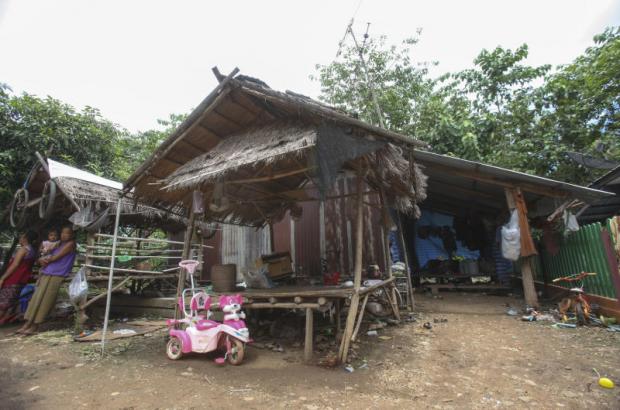
This house of a 26-year-old woman in Phetchabun's Ban Huai Chan Moo 14 that accommodates 10 members unveils part of her motive to become a surrogate mother for money. (Photo by Pattarapong Chatpattarasill)

Pakson Thongda understands, in fact, the marketplace commodity of a young, healthy Thai woman wanting to make a windfall for herself by offering her strong body to carry a child to term for those wealthy enough and certainly willing to hire her so that they may have a child of their own, when their own bodies fail the test of fertility brought to closure. Her daughter sold eggs twice to a fertility clinic, and through this process earned $1,000 for each occasion.

This represents a lot of money for people living in this remote Thai village of about 12,000 people located a six-hour drive from the capital, Bangkok. According to local officials, around two dozen women out of the entire community have taken to contracting out as paid surrogate mothers. For at least a decade this kind of commercial enterprise has been available to people with the means to engage.

Thailand is one of a few countries where commercial surrogacy is legal and represents only one of two in Asia. It has become a prime destination for couples in the near geography coming from countries where this kind of commercial enterprise is banned. When the opportunity to contract as a surrogate mother first came to this village, neighbours took note of conspicuous home renovations and a new car.

As most residents of Pak Ok live in wooden houses, alongside tamarind groves and rice paddies, this incident gained great notice, and of course, envy. The womb rental business has great appeal for young women in this country where free enterprise of a sometimes sordid nature takes place, related to sex-tourism with those whose age would land the pedophiles and child-abusers in jail in their own countries.

The two issues are hardly to be compared, needless to say. One is a disgustingly horrendous practise, the other a practical means by which childless couples are able to attain parenthood with the assistance of someone glad to be paid to offer the service. The estimation is of several hundred surrogate births taking place in Thailand annually, not all that huge in terms of numbers, but huge in terms of opportunity and happiness for those engaged in the trade.


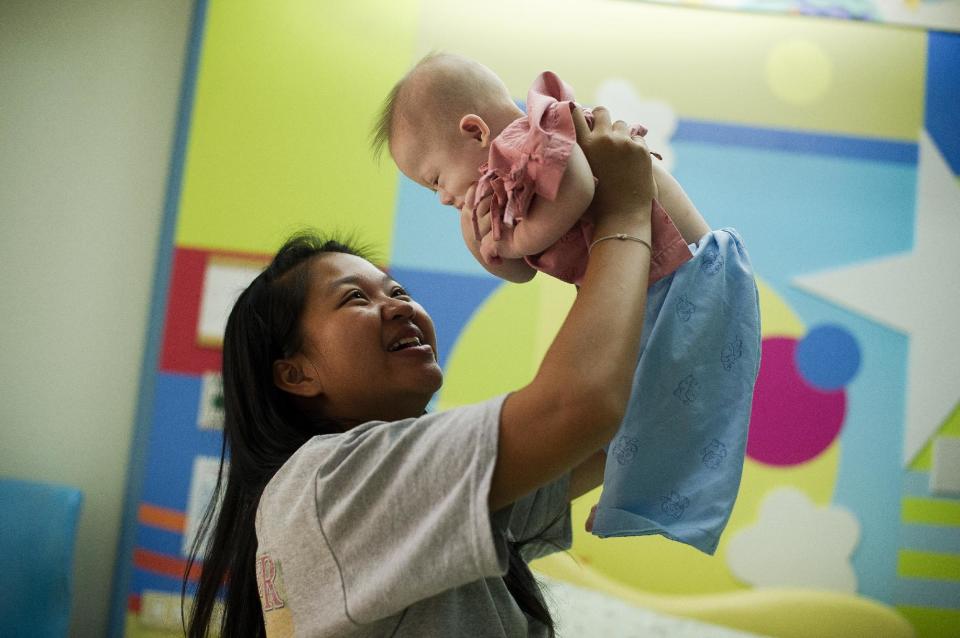
Thai surrogate mother Pattaramon Chanbua with her baby Gammy, born with Down Syndrome, at the Samitivej hospital in Sriracha district, in Thailand's Chonburi province on August 4, 2014 (AFP Photo/Nicolas Asfouri

Unless, like the couple from Australia who contracted through an agency with a young Thai mother to carry their egg-and-sperm to term, but chose to take with them the tiny girl, and leave behind her male twin who had Down Syndrome. Leaving the child with its surrogate mother who loves the baby and cares for it. After all, said the father David Farnell, as he disowned his own biological child, "I don't think any parent wants a son with a disability".

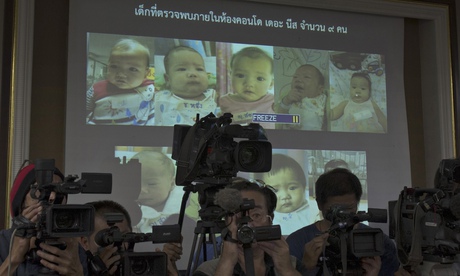
Surrogacy clinics in Bangkok recently were raided by police who revealed that a 24-year-old Japanese man had fathered a dozen babies through surrogates whose births were weeks or months apart. This is rather embarrassing to Thailand which winces as it is at its reputation for casual prostitution with males and females of all ages. The man insisted he was not interested in selling the babies on the Asian black market, but in an entirely legal way wanted to 'have a large family'.

Thai police display pictures of the surrogate babies
Thai police display pictures of the surrogate babies during a press conference at the police headquarters in Chonburi, Thailand. Photograph: Sakchai Lalit/AP

Surrogates, according to Thai officials, earn about $10,000 at the conclusion of a successful pregnancy, and greater amounts for twins. They also receive a monthly allowance of around $450 and live rent-ree in Bangkok, where women are given instructions to carry out their pregnancies. Commissioning parents are usually from Japan and other wealthy Asian nations, according to Mr. Vongmanee.

The village of Pak Ok has lately been the subject of the news media in Thailand, which saw throngs of reporters descend to write their stories with personal interviews relating to another national scandal. Villagers in Pak Ok are furious at the witch hunt by authorities, interfering with a legal practise undertaken by impoverished young women, eager to earn a living, however they can.

Labels: , ,

 
()() Follow @rheytah Tweet