Ruminations

Blog dedicated primarily to randomly selected news items; comments reflecting personal perceptions

Saturday, October 10, 2020

Interpreting COVID Caseload In Canada

"I think minimizing right now is a real mistake. People are not wanting to believe that this is a thing, because I think they don't want to return to the state we were living in earlier in the year. That's a dangerous path to take."
"The threshold for what we consider high on percent-positivity probably should be considered different now than it was in the spring."
Dr.Lynora Saxinger, University of Alberta

"We are still screening asymptomatic people, but these are people we have a reason to believe were exposed, and that seems to capture most of the cases."
"So we have to always be reacting to what is coming and not necessarily what's happening today."
Dr.Craig Jenne, infectious diseases researcher, University of Calgary

"There's been a definite increase in the number of people who are infected. It isn't just because they're testing more."
"That's kind of the tip of the iceberg [hospitalizations creeping into triple digits]. It ... tells you there's way more community transmission than you might expect."
Dr.Ameeta Singh, infectious diseases specialist, Royal Alexandra Hospital / University of Alberta
 
"[There is a host of] very clear, accelerating trends [in places like Toronto, Peel and Ottawa. Ontario is now imposing stricter measures in those regions to clamp down on the situation, as a record 939 new cases were recorded Friday]."
"The curve continues to increase in terms of its steepness."
"[The province is seeing] a dramatic growth in the percent of tests that are positive."
"In worst-case scenarios, it crosses other thresholds that lead to the reduction of access to hospital care."
"It's there in that older population [the increased positivity rate] where the consequences for health and the consequences for the health system are most severe."  
Dr. Adalsteinn Brown, adviser to Ontario government
 
"There's not a perfect, single metric that's going to give you a perfect sense of what's happening in terms of transmission."
"We certainly shouldn't be looking at the reported case numbers alone. They've become very difficult to interpret."
"The challenge with all of these is you can't really look at them in isolation. But I think the signal we're seeing right now in terms of increases in hospitalizations and people being admitted to ICUs really are indicators that cases are increasing in the community."
"So basically, [it means] you're at a point where you are going to be struggling to understand and identify where people are getting infected." 
Ashleigh Tuite, epidemiologist, University of Toronto's Dalla Lana School of Public Health
Ontario instituted measures like shutting down indoor dining in some areas of the province Friday in an effort to curb the spread of COVID-19. (Evan Mitsui/CBC)

A recent surge in COVID-19 cases surpassing a spike that occurred last spring, warns infectious disease specialists, must not be given short shrift as representing a mere byproduct of increased testing. Data publicly posted in Alberta, British Columbia, Ontario and Quebec over the week ending April 21 for that specific single week, and another ending October 6 meant to obtain a sense of just how the two case surges compare was compiled by the Canadian Press. The results do not inspire confidence.

In Alberta daily cases are now two percent higher in the most recent period in comparison to the week in April, while Ontario's were 13 percent higher, Quebec's 14 percent higher and cases in British Columbia were more than tripled the mid-to-low, double-digit numbers experienced in that province in April. As an early leader in increased testing Alberta took close to four times as many swabs during the week of October than in the April week, while B.C.'s daily testing grew eightfold, Ontario and Quebec performed roughly 4.5 times as many weekly swabs in the fall week as compared to the spring.

The positivity rate representing the percentage of tests coming back positive, in all four provinces dropped markedly between spring and fall surges. Quebec averaged some 6,300 daily tests and 930 new cases in April with a positivity rate during that period of about 15 percent. More recently in October as Quebec coped with five consecutive days of new cases in quadruple digits, its positivity rate sat at about four percent.

In Ontario, dealing with a large backlog of swabs awaiting analyzing, the province posted an official daily positivity rate of two percent for October 7, reduced from the roughly six percent range it had posted in mid-April. The positivity rate in Alberta dropped to one percent from close to five percent, and B.C.'s fell to 1.3 percent from four percent. Yet experts indicate that the lower positivity rates are no cause for comfort. They point out that early testing was largely limited to people with specific symptoms and those who came into close contact with them.

Test now tend to service a much broader portion of the population, many with mild symptoms or asymptomatic cases. Testing among people with no suspected exposure or symptoms in Alberta over the summer unearthed very few new cases, pointed out infectious diseases researcher Dr. Crag Jenne, at the University of Calgary. Testing has since been tightened to those at higher risk, or with upcoming travel, by the province. Yet, pointed out Dr.Jenne, today's results reflect viral transmission of ten to 14 days earlier.

Trends in hospitalization are seen as a lagging indicator eyed with concern by experts. For example, in Ontario, hospitalization began creeping into the triple digits roughly two weeks earlier. The percentage of people testing positive grows in a "very sharp way", according to Dr.Brown, against the backdrop of "relatively strong" testing numbers. According to provincial data released Friday, some regions in Ontario are far above the three percent positivity rate, recognized as an international benchmark reflecting a serious problem.

People wait in long lineups for a COVID-19 test at a drive-thru testing centre in Toronto on Sept. 28. The province has since moved to an appointment-only testing model, though a testing backlog remains. (Evan Mitsui/CBC)

Labels: , , , , , , ,

Saturday, July 04, 2020

Waiting on Time To Tell

Sweden's state epidemiologist Anders Tegnell
Anders Tegnell, Public Health Agency Sweden. (Pontus Lundahl/TT FILE via AP)
"I'm looking forward to a more serious evaluation of our work than has been made so far. There is no way of knowing how this ends."
"Maybe [a stricter lockdown would have been preferential], I don't know. But you have to consider whether there are other tools that work just as well."
"In the same way that all drugs have side effects, measures against a pandemic also have negative effects. At an authority like ours [in Sweden], which works with a broad spectrum of public-health issues, it is natural to take these aspects into account [the avoidable cost of lockdowns]."
Anders Tegnell, Swedish State epidemiologist
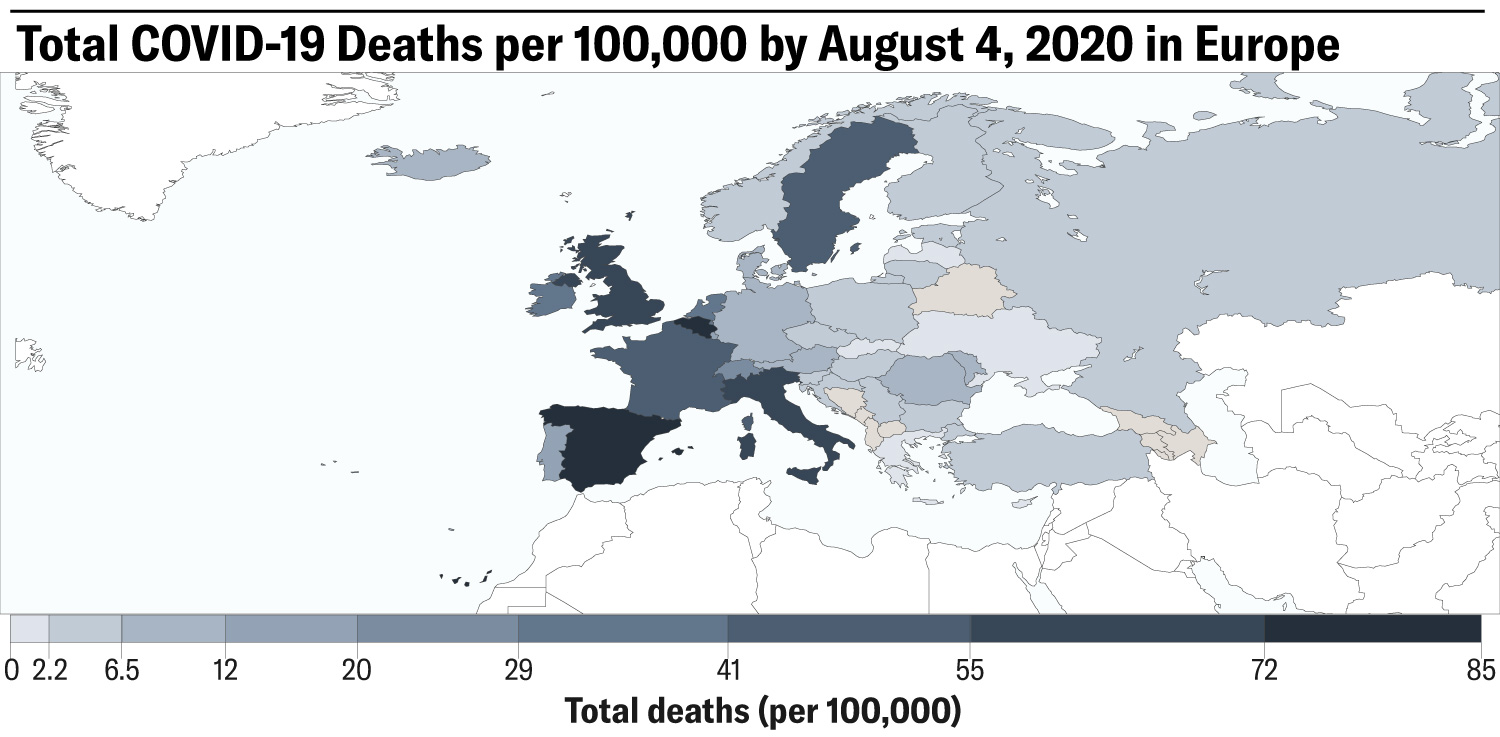
Figure shows the Total COVID-19 deaths per 100,000 by August 4, 2020 in Europe

"Sweden's policy is unusual in that it took a much less stringent approach to preventing transmission, but interestingly it implemented those measures at a very early stage in the pandemic, before large amounts of community spread had occurred."
"Sweden's approach may be sustainable in ways other countries have not proven to be. It should be noted that lockdowns are a response to an imminent surge into health care, with the goal of stopping as many transmission chains as quickly as possible."
"The full accounting will only be possible after the pandemic."
"[In Sweden, it is] bluntly not clear how the vulnerable are expected to be protected. Once you get a very large outbreak in one age group, it becomes more difficult to protect others."
"Sweden's approach has been widely misrepresented as doing nothing. It's not. Given a starting point in which it has been decided an outbreak is inevitable, the question becomes how to mitigate it and preserve health care, and the earlier on in the outbreak you take action to slow transmission, the less intense that action needs to be -- initially."
"Sweden's strategy, in that sense, has been smarter than those countries that encouraged transmission until shutdowns became necessary. However, it has come at a great cost in terms of mortality in vulnerable groups ... It also needs to be flexible and responsive; if a surge is building, you need to be able to detect it and know what you will do to avert it."
"As for the overall outcome. Time will tell."
William Hanage, associate professor of epidemiology, Harvard School of Public Health, Boston
The photo shows a chalk sign in front of a bar that reads, "We're Open."
Sign outside a pub in Stockholm, Sweden.  REUTERS/Colm Fulton
Several weeks ago -- shaken by the number of deaths overall suffered in Sweden resulting from the SARS-CoV-2 virus leading to COVID-2, Sweden's state epidemiologist whose decision not to lock down the country, but to rely on the good sense of the Swedish population to take recognized self-distancing steps, persuaded the government to go counter to the measures undertaken by its neighbours and most of the rest of the world, of locking down their economies -- declared himself semi-remorseful, uncertain that he had reached the right decision.

Those lockdowns brought absolute havoc to societies whose health system was unprepared and who feared the breakdown of their medical-hospital personnel ability to cope with a flood of serious respiratory syndrome cases requiring emergency treatment. That decision led to  mass unemployment as business activity was frozen and economies went into a deep dive. And while people perished from the dire effects of the disease, those countries were able to control the situation, balancing lives saved against a ruined economy.

Sweden has now been excluded for the time being from the European Union's recently declared safe-travel lists, a penalty exercised resulting from his decision to advise his government against a lockdown in Sweden. Which brought that country the distinction of having one of the world's highest mortality rates for COVID-19. Dr.Tegnell appears now to have reversed himself on his statement of uncertainty, expressing a new opinion that he likely did, after all, make the right decision for Sweden.

The photo shows a health worker in blue protective gear opening a sterile package.
 Skane University Hospital, Lund, Sweden. TT News Agency Johan Nilsson via REUTERS

He has convinced himself that all other nations reached a self-destructive decision in deciding for lockdown. The world, he now argues, has passed only the first of many stages of dealing with COVID-19; there is certain to emerge further, ongoing outbreaks, perhaps with mutating strains more highly infectious than the original. By maintaining normal life rhythms, choosing to believe that people are capable of behaving rationally and self-protectively, with concerns for the welfare of their communities, he is convinced Sweden embarked on the correct course of action.

He also feels vindicated that the WHO, which had originally been critical of the Swedish decision,  naming Sweden on a list of 11 European countries where "accelerated transmission has led to very significant resurgence that, if left unchecked, will push health system to the brink", has now decided to proclaim that contagion rates in Sweden are "stable", linking the high case numbers to a testing increase.

The photo shows a large number of people sitting close together in an outdoor eating area.

"There are several very positive trends in Sweden, notably, a continued decrease in new cases presenting with severe disease, a gradual decrease in patients admitted into intensive care since April, and continued decreasing numbers of new COVID-19 deaths."
"Sweden has involved the community in the response, and has been able to keep transmission to levels that can be managed by the Swedish health system."
World Health Organization

There was a high cost associated with the Swedish approach, however. Its death toll per 100,000 population represents five times that of neighbouring Denmark. The Danes imposed a strict lockdown in mid-March that has since been wound back, following the virus being brought under control. In Sweden, nursing homes saw a death rate that has been brutal, and at least one criminal investigation has resulted from that misfortune.

Now, Dr. Tegnell has backtracked his earlier mea culpa, declaring himself uncertain whether in hindsight he would have chosen to impose a stricter lockdown. Strict lockdowns, he feels, may have the effect of seeming to contain the virus temporarily, but the virus would return and that wouldn't have been prevented. Lockdown has its absolute deficits, and he lists among them, domestic abuse, loneliness and mass  unemployment.

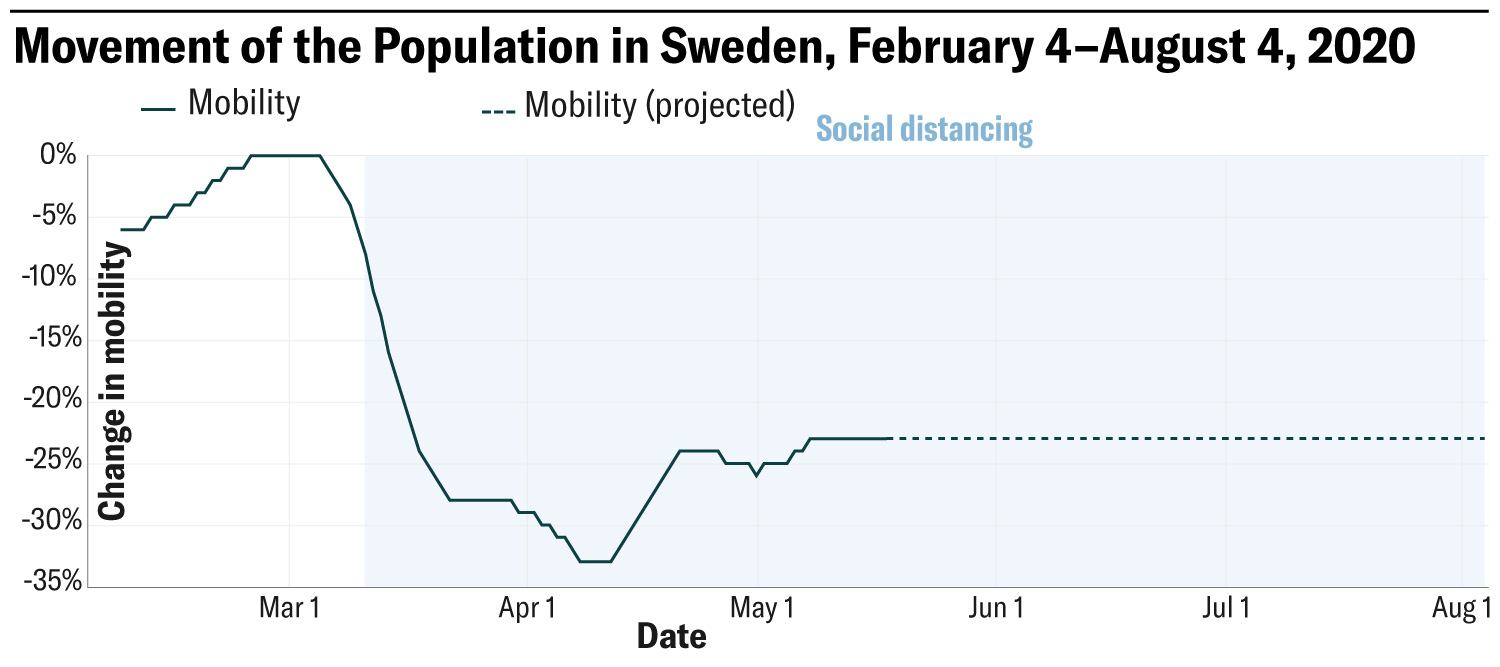
Figure shows the Movement of the population in Sweden, February 4 – August 4, 2020
In response to government guidelines on social distancing, Sweden's mobility dropped 33 percent in April—not as dramatic as neighboring countries. View latest: https://covid19.healthdata.org/sweden. IHME

Labels: , , , ,

 
()() Follow @rheytah Tweet