Ruminations

Blog dedicated primarily to randomly selected news items; comments reflecting personal perceptions

Tuesday, August 18, 2026

Traditional U.S. Alliances: Now You See Them ... Soon You Won't

https://i.cbc.ca/ais/0ffb4f1b-4b4b-40f5-8bf7-9bbeda17b5e1,1786978031134/full/max/0/default.jpg?im=Crop%2Crect%3D%280%2C0%2C1280%2C720%29%3BResize%3D620
"Based on my very good relationship with Kim Jong Un, of North Korea, I am not happy with the fact that the United States has, long ago, agreed to participate in Joint Military Exercises with South Korea."
"These exercises are not only costly, with much of these costs paid for by the United States of America [as usual], but send a signal that is totally inappropriate and hostile, to a Country that, as long as Donald J. Trump has been President, has been unthreatening and respectful."
U.S. President Donald J. Trump 
https://i.cbc.ca/ais/51379c34-b663-490b-a8e8-1a9107d4e979,1780960900974/full/max/0/default.jpg?im=Crop%2Crect%3D%280%2C0%2C1920%2C1080%29%3BResize%3D620
Chinese President Xi Jinping made a rare visit to North Korea to meet with Kim Jong Un, where the two moved closer to improving economic ties despite North Korea strengthening its relationship with Russia. Still from video, CBC News
 
Mr. Trump's great good friend saw to it that Pyongyang test-fired a ballistic missile recently over the Sea of Japan, warning it was prepared to respond to the annual joint military exercises shared by the United States and South Korea as practise runs in preparation for a potentially possible attack by North Korea on the South. All of the region has been made nervously expectant by the obvious militancy of Kim Jong Un, leading North Korea on a military and nuclear arms trajectory that traditional U.S. allies like South Korea, the Philippines, Japan and others view as threatening, along with that of Beijing, North Korea's 'big brother'.
 
There is also no secret about an alliance between Russia, North Korea, China and Iran. Much less the fact that Russia's war on Ukraine has been aided by the presence of North Korean troops. All four of those countries are anything but friends of the Democratic West. And while the U.S. military views Russia, North Korea and China as volatile military enemies, and is at war, directed by their president, with Iran, this tangled version of friends and allies versus military belligerents and adversaries of all that the West values is as puzzling as it is nonsensical.
 
https://static.dw.com/image/76947268_1004.webp
A museum in North Korea honors soldiers who have fought for Russia
 
 The U.S. president wrote on his Truth Social site that he had ordered the Pentagon to scale back "inappropriate and hostile" military drills with South Korea, mere hours prior to the drills taking place. The exercises, according to South Korean officials, proceeded as planned. South Korea officials, in fact, expressed the hope that the personal relationship Mr. Trump speaks of with the South's political nemesis could yield a resumption of talks, and with that, some forward movement in reconciliation between the two Koreas.
 
While U.S. allies in East Asia cringe over displays of weapons' technical capabilities forever moving forward and displayed with militant pride by Pyongyang, along with the hermit nation's growing alignment with Vladimir Putin's territorially aggressive agenda, not to mention North Korea's historical mentorship by China, the annual drills offered a notional reassurance of having the support of the United States should the situation of military threats continue to accelerate.
 
"I recently asked the President of South Korea if they would like to join us in the Denuclearization of the Islamic Republic of Iran, and they said, 'No thanks!'." That disinclination to become embroiled in a conflict outside their own internal interest zone appears to have sealed and delivered a verdict that Mr. Trump has applied elsewhere, when allies have failed to join America's spontaneous military decisions with no outreach before conflict has been launched with the heads of governments later expected to lend themselves to the American enterprise of war.
 
https://i.cbc.ca/ais/6594b015-63b5-4318-bea6-c35b82f09f38,1786930439450/full/max/0/default.jpg?im=Crop%2Crect%3D%280%2C0%2C7796%2C5197%29%3BResize%3D796
U.S. army soldiers are seen during joint military exercises with South Korea in Yeoncheon, South Korea, in March 2025. (Ahn Young-joon/The Associated Press)
 
The normal 11-day Ulchi Freedom Shield exercises, designed to prepare the region for a potential war with North Korea, proceeded, though to "substantially reduced" impetus. That, reflecting the fact that when Mr. Trump decided he no longer wished the United States under his rule to continue with the drills, it was too late to cancel them, but Defence Secretary Pete Hegseth was ordered to reduce them.
 
Seoul's presidential office assured the press that it remained in "close coordination" over the exercises with Washington, expressing the "hopes that the friendly relationship between the leaders of the United States and North Korea will lead to meaningful dialogue". That's called diplomacy. Or looking on the bright side of things as expressed by Monty Python, in a skit somewhat resembling his tongue-in-cheek, sardonic episodes of portraying human lunacy.
 
There are some 28,500 American troops stationed in South Korea as a show of support for the country's defences since the 1950-53 armistice that ended the Korean War. Tellingly, American commitments to security in East Asia now appear fairly wobbly given U.S. President Trump's repeated criticism of what was once universally thought of as rock-solid alliances.
 
https://media-cldnry.s-nbcnews.com/image/upload/t_fit-1000w,f_auto,q_auto:best/rockcms/2026-08/260818-US-South-Korea-military-drills-vsb-2115-87fdac.jpg
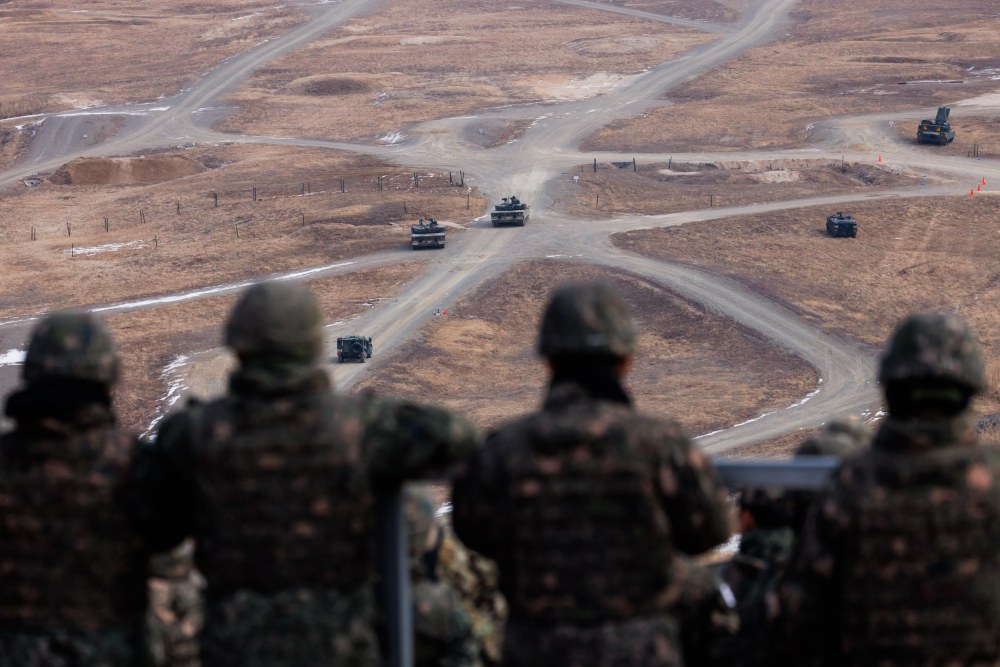
South Korean soldiers watching a joint live-fire exercise with the U.S. Army in Pocheon, South Korea, last year.   SeongJoon Cho / Bloomberg via Getty Images file
 

Labels: , , , , , ,

Monday, December 01, 2025

South Korea: ChatGPT becomes Exam CheatGPT

https://wimg.heraldcorp.com/news/cms/2025/11/10/news-p.v1.20251110.6e3a017e887345c09c0f3d0f2d975242_P1.jpg
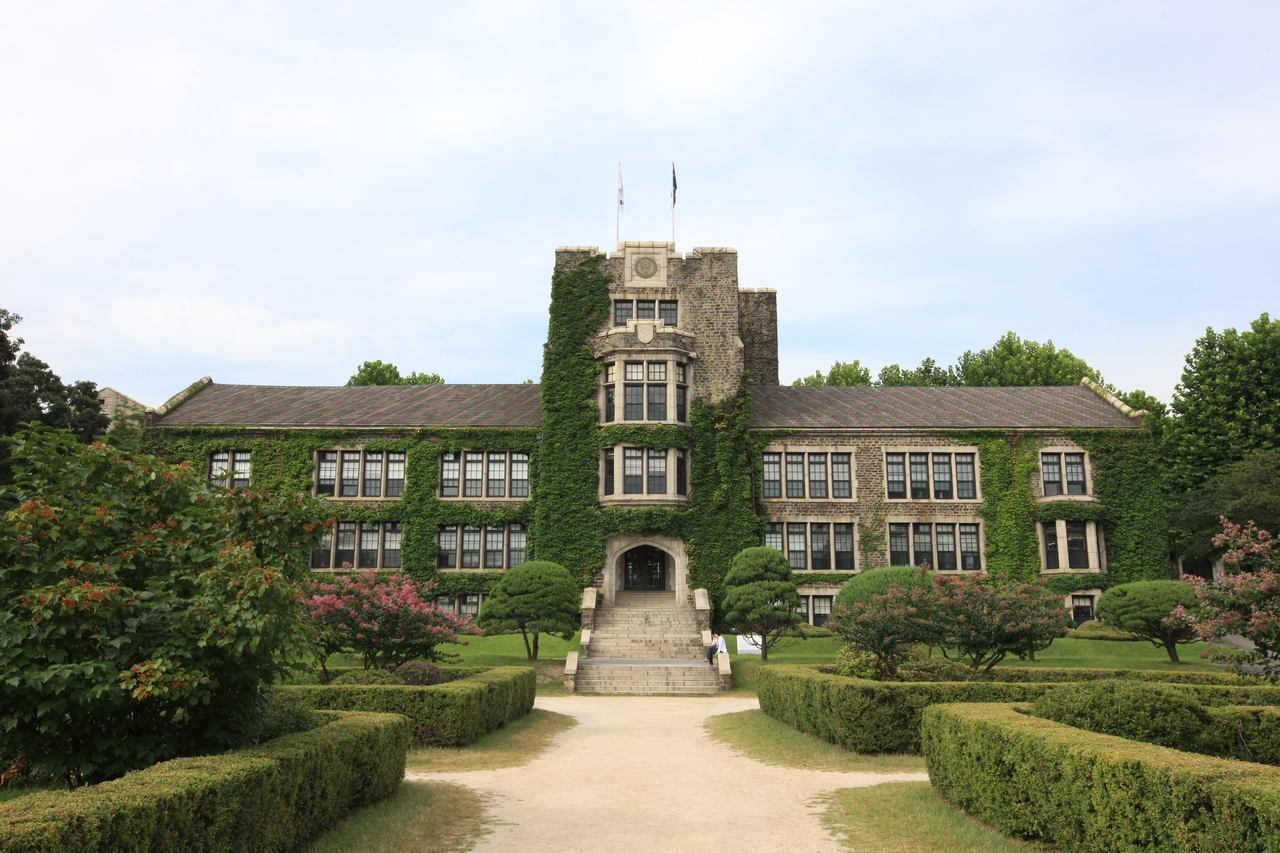
Yonsei University in Seodaemun-gu, western Seoul (Korea Tourism Organization via Getty Images Bank)

"A.I. is a tool for retaining and organizing information so we can no longer evaluate college students on those skills."
"[Students should be tested on their creativity which A.I. cannot replicate]." 
"The current method of  education is already out of date." 
Park Joo-Ho, professor of education, Hanyang University, Seoul, South Korea 
 
"It's inevitable that A.I. will affect our education."
"[To find research papers and aid in translating between English and Korean, I used ChatGPT] but if students break a pact with their professors to refrain from using it, [then it is a matter of trust and a bigger issue."
Ju Yuntae, Yonsei University student 
https://koreajoongangdaily.joins.com/data/photo/2025/11/28/358a42bb-6f43-43a9-b84f-bedaaec8953c.jpg
University students are seen in a lecture hall at a university in Busan on Sept. 1. [YONHAP]
 
 In South Korea, mid-term university exams have been completed and with that a sudden scandal has been revealed with the nation's most prestigious institutes of higher learning, those elite universities referred to  by the acronym SKY identifying the elite institutes of higher education in the Korean hyper-competitive world of education. The discovery that dozens of students have indulged in the use of textbooks, computer programs, even ChatGPT during online midterm examinations. The irony here is that the  course involved was itself on ChatGPT.
 
This revelation occurred when a professor at Yonsei University in Seoul  discovered the clandestine cheating taking place. When the story hit the news, two other top-tier schools in South Korea -- Seoul National University and Korea University found similar mass cheating had been discovered with students using A.I. on recent tests. Typically such incidents are found in 'lesser-reputed' universities. The discovery that underhanded student actions on tests at the elite universities sent the nation's academic reputation into a headspin.
 
In South Korea (as in Japan) the highly competitive arena of successful students leaving high school to  enroll in university with grades in the stratosphere ensuring their acceptance at these Ivy League schools represents frenetic studies toward such academic achievements and future upward social mobility. South Korea can boast one of the highest proportions of college graduates among developed countries where most students ply themselves to achieve the marks required to qualify for entrance at SKY* schools. 
 
To qualify for entrance acceptance at one of these top-tier schools, a high score on an eight-hour college entrance exam to test knowledge of Korean, mathematics, English and other subjects must be achieved. Over half of the nation's million high school seniors sit for the exam taking place on November 13. On that traditional day, flights are grounded, construction halted and there are enforced traffic restrictions to keep ambient sound to a minimum to enable students to concentrate on their exam performance.
 
https://koreajoongangdaily.joins.com/data/photo/2025/11/28/5881e990-18da-417d-8b6f-344f6f4ba8b9.jpg
High school students are seen during the College Scholastic Ability Test (CSAT), also known as Suneung, at a school in Suwon, Gyeonggi on Nov. 13. [JOINT PRESS CORPS]
 
Over 90 percent of college students in South Korea with generative A.I. experience acknowledge their use of such tools on school assignments, according to a 2024 survey by the Korea Research Institute for Vocational Education and Training.  
"Some professors don't like us using A.I. "
"Some encourage it because it helps solve problems quickly."
"[However], there isn't really a way you can stop students from using it."
Lee T.H., graduate student of computer engineering, Seoul National University 
 
*SKY schools = Seoul National University, Korea University, Yonsei University 

Labels: , , , ,

Sunday, July 11, 2021

When Success Turns to Desperate Need

"We cannot live with this variant. No place on Earth has unless they have their vaccination rates much, much higher than what we  have."
"Otherwise, it subjects the population to thousands and thousands of deaths."
Gladys Berejiklian, premier, New South Wales
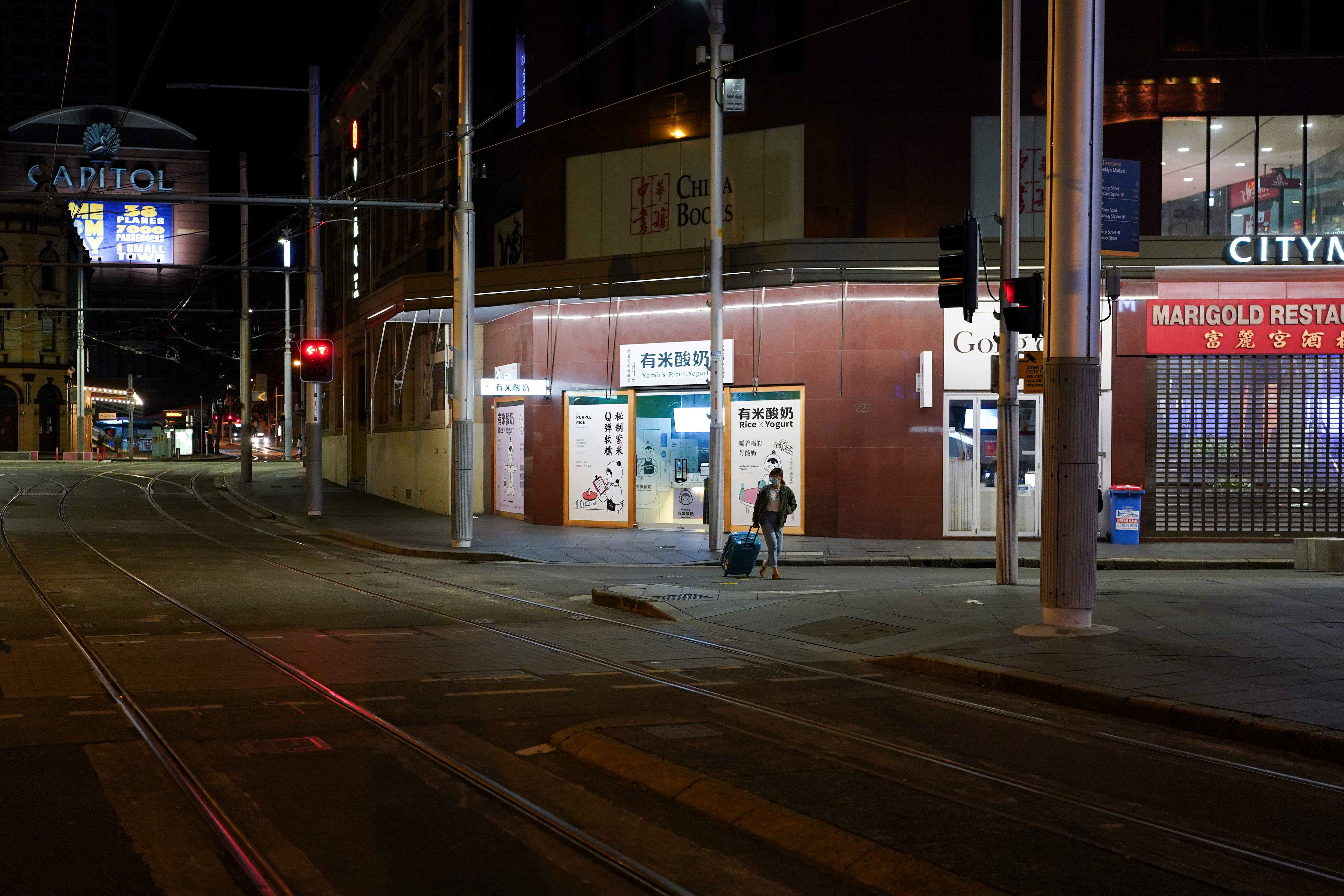
A lone woman wearing a protective face mask pulls a suitcase through the city centre during a lockdown to curb the spread of a coronavirus disease (COVID-19) outbreak in Sydney, Australia, July 6, 2021.  REUTERS/Loren Elliott
A lone woman wearing a protective face mask pulls a suitcase through the city centre during a lockdown to curb the spread of a coronavirus disease (COVID-19) outbreak in Sydney, Australia, July 6, 2021. REUTERS/Loren Elliott
 
Celebrated internationally for their swift reactions that worked to suppress the global pandemic last year, the death toll in Australia and South Korea was comparatively low in comparison to the United Kingdom and the United States. One critical oversight: their vaccination rollouts have now placed them in a position of public vulnerability to COVID-19 outbreaks. And this, at a time when the Delta variant has been wreaking havoc world-wide.

On Friday, South Korea brought out its highest level of restrictions across Seoul and the surrounding area of virus-related restrictions, leaving half of the country's 52 million population affected. "We are facing the biggest crisis with our containment efforts with the daily new cases hitting a record every day", Prime Minister Kim Bookyun explained as he announced the new lockdown measures, including gatherings of over two people after 6 p.m. banned, and shutting school operations down.

The worst was yet to come for South Korea, warned head of the Korea Disease Control and Prevention Agency, even as the vaccine drive was strengthening. Gen.Paul LaCamera, leading 28,500 American troops stationed in South Korea, reintroduced tougher controls on military personnel movements. "While we have achieved a more than 80 percent vaccination rate, we are witnessing small clusters of the virus spread within select locations", he said.

In Japan, Prime Minister Yoshihide Suga was forced to declare a state of emergency in Tokyo with the additional statement that the Olympics will now be held for the most part in the absence of spectators. Across the Asia-Pacific governments have been forced to swiftly impose tougher lockdowns in the face of the highly contagious COVID-19 Delta variant's sudden resurgence, one that is straining health systems and creating anxiety among their public, with vaccination drives interrupted by delays and shortages.

Among the worst hit of the countries in the region, Indonesia's 270 million people are in the throes of its deadliest outbreak since the introduction of the pandemic; its medical system struggling to cope with record numbers of cases, and with a daily death toll that has doubled in the past week to over 2,000. Authorities warn the number of new infections may surge up to 70,00 after surpassing 34,000 in mid-week.
 
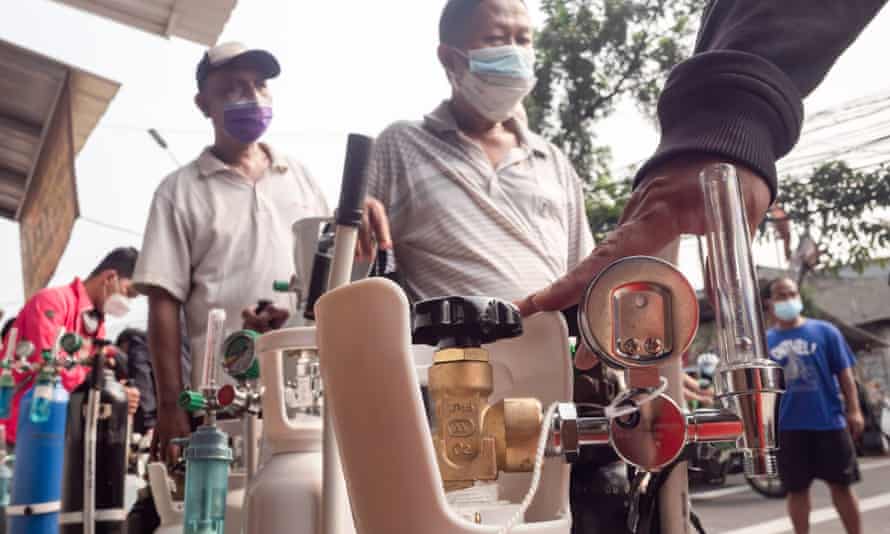
People wait in line to refill their oxygen tanks at a filling station in Jakarta
People wait in line to refill their oxygen tanks at a filling station in Jakarta. Indonesia is facing an oxygen crisis amid a surge in Covid-19 cases. Photograph: Wisnu Agung Prasetyo/SOPA Imag/Rex/Shutterstock
 
Hospitals are reaching capacity and turning patients away, with the government attempting to import oxygen tanks from neighbouring countries, their own supplies exhausted. Indonesia has been reliant on the Chinese Sinovac vaccines, but its rate of vaccination has been tardy, in the midst of supply shortages, apart  from its less-than-optimal efficacy rate, made all the more severe by the Delta strain.
 
Authorities in Australia warn thousands of people could die, taking into consideration the Sydney outbreak with its Delta variant link, should it not be brought under control. The city of 5 million has failed to quell active case clusters despite a two-week lockdown, requiring a tightened activation of restrictions in a desperate bid to block any further spread and to control the level of infection.

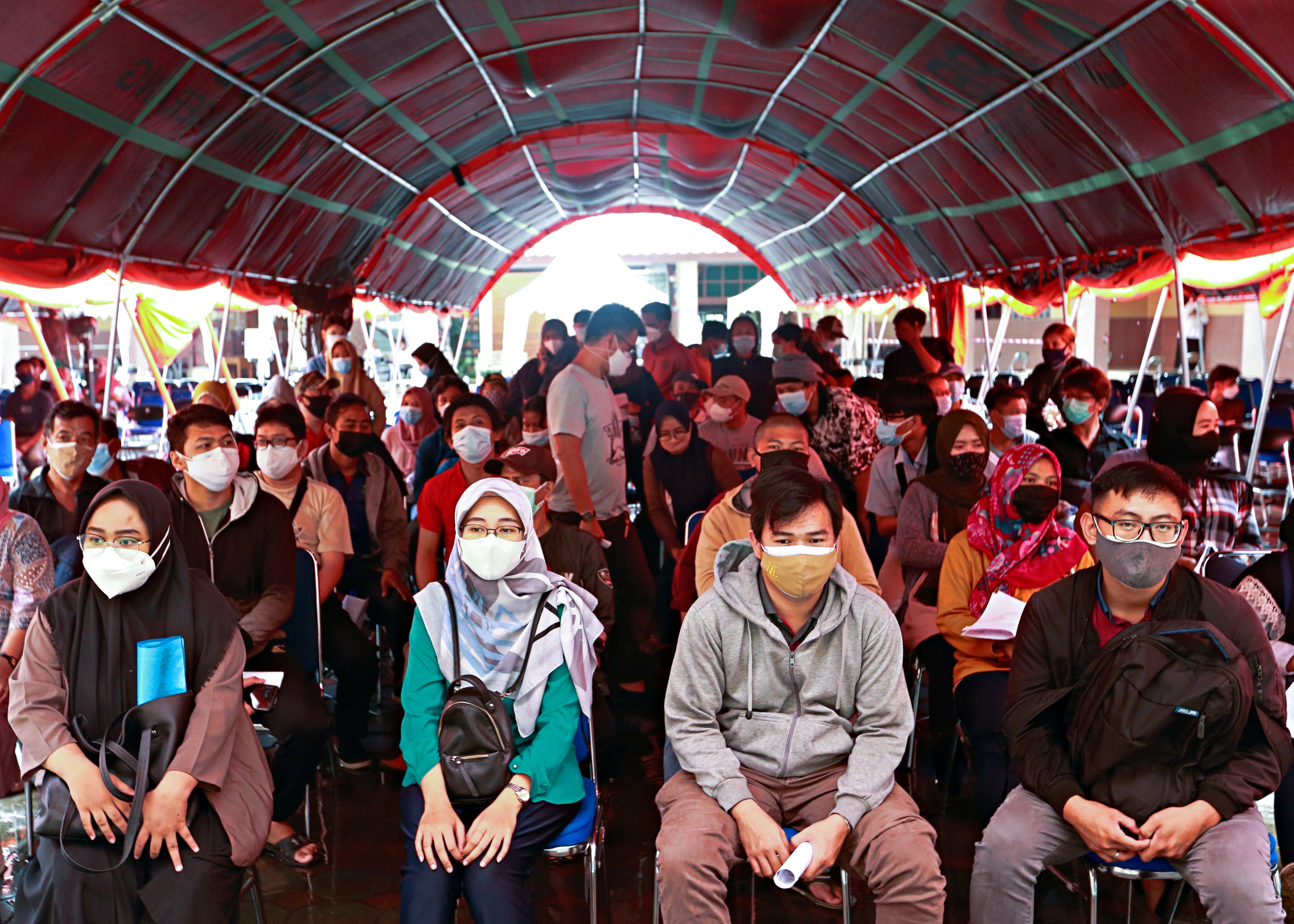
People wearing protective face masks sit before receiving a dose of the coronavirus disease (COVID-19) vaccine during the mass vaccination program at the Tangerang City Government Center, in Tangerang on the outskirts of Jakarta, Indonesia, June 30, 2021. REUTERS/Ajeng Dinar Ulfiana/File Photo
Mass Vaccination clinic, Seoul, South Korea -- Reuters

Labels: , , , , ,

Tuesday, April 29, 2014

The Grieving

"The Catholic undertaker volunteers were wiping the fingers and toes of the kids, ever so gently and carefully, as if they were bathing a baby."
"In the end, the kids became pretty again. I'm glad they met adults that they could be thankful to before leaving this world."
Jung Hye-shin, South Korean psychiatrist, Jindo, South Korea
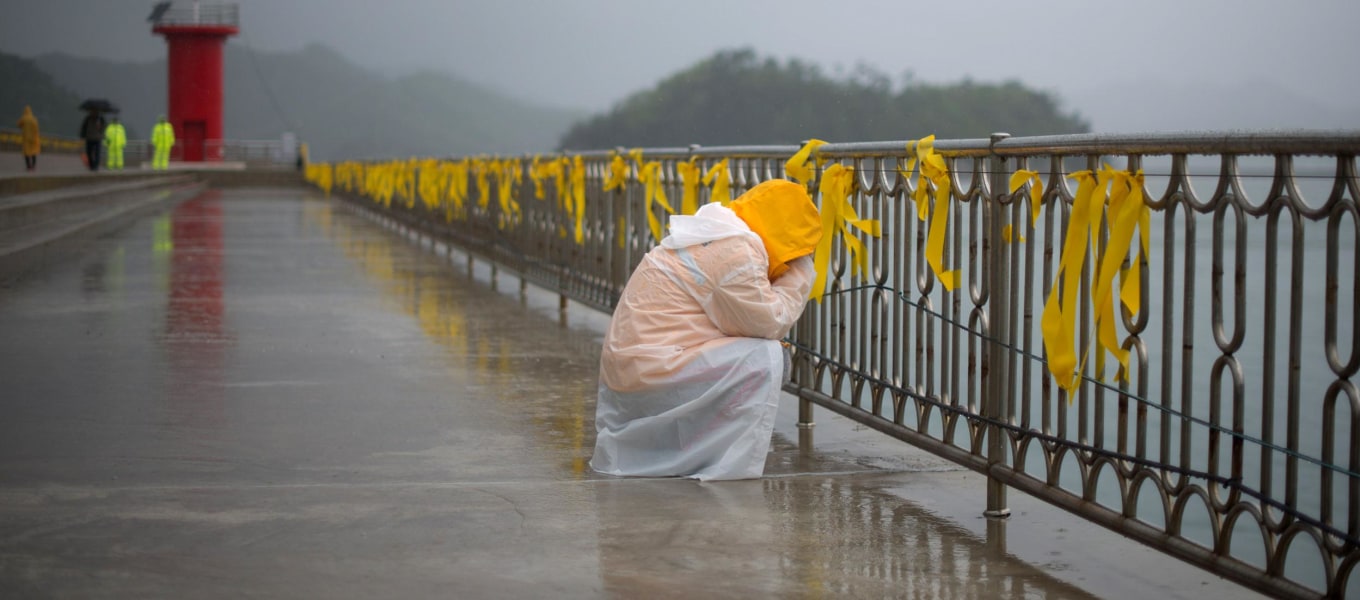
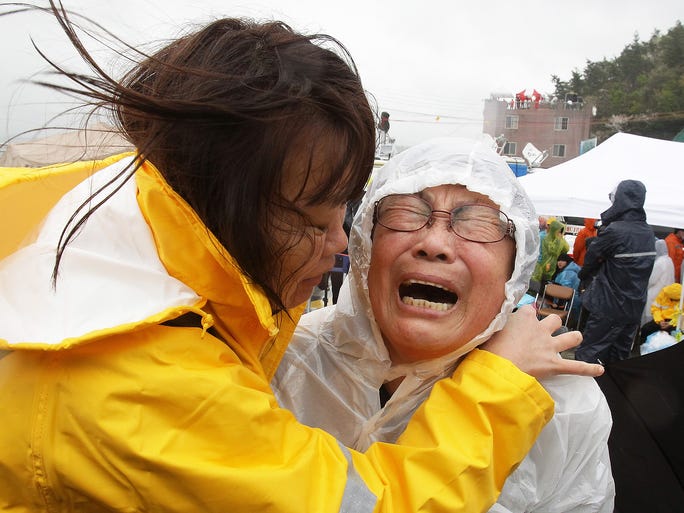
Image: A relative weeps before yellow ribbons at Jindo harbor

They sit and they wait. They wail forlornly through the prevailing quiet shattering the solitude and peace of those quietly anguishing in their own grief, and then silence again prevails. There are no conversations, for there is nothing to say. If there were something to look forward to, something to give them the joy however, brief of hope, some animation might enter their haunted, hollow eyes, but there is nothing and so they say nothing.

They are drained, emotionally emptied of any anticipation of the future. For some, the future has died. For others the future will be a dim, dark void. For others, the future will represent coping as best they can. Time heals all wounds, we are informed, and perhaps it does, since time also brings the peace of not knowing, in death that will visit all living organisms. It was just that their time was too short, they were only, after all, still in their formative years.

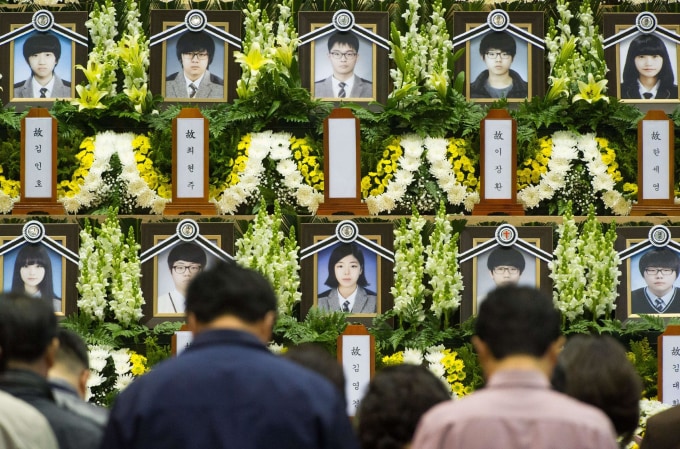
Image: People attend a memorial for the victims of the sunken South Korean ferry Sewol KIM DOO-HO / AFP - Getty Images  People attend a memorial for the victims of the sunken South Korean ferry Sewol at the Ansan Olympic memorial hall on Thursday. 
 
It is an astounding toll anywhere, for any group of people to come to terms with the reality that through a catastrophic set of circumstances, three hundred teens from the same town, same high school, embarked on a holiday trip, would meet such a fate. And it is not just their grieving parents, siblings and extended families who are mourning inconsolably; it seems that the consciousness of the nation has been wounded.

What else accounts for the fact that over 16,200 people have arrived in Jindo, on their own or representing close to 730 organizations. And that 690,000 aid items representing food, bottled water, blankets and clothing have arrived in Jindo since the sinking of the Sewol ferry with most of the teenagers on board, trying desperately to save themselves, sending messages of love to their parents in their last farewells.

People in their hundreds, some from aid groups, from private companies, from churches and other civil social groups pack roads where white tents sit near Paengmok port and a gym on the island, offering soup, kimchee, rice, hamburgers, taxi services, cellphone battery charging, laundry services, medicine, energy drinks, psychiatric help and little thoughtful necessities like underwear, socks, cotton swabs, toothbrushes.

No one is charged for anything, these are goods and services representing the soul of the nation, a compassion that is as wide and as deep as the ocean that holds the remains of their loved ones. The grieving families are too numb to do anything for themselves; their apathy and sorrow have sapped them completely. And so, the volunteers are there, not so much speaking, but proffering whatever is needed; comforting, mourning also.

Huge pots of hot kimchee soup are prepared, blankets distributed, along with towels and toiletries. Trash is collected, the grounds swept. Cab drivers from Ansan, where the high school students had come from, provide free-of-charge drives to wherever anyone might wish to go. "It's time to help those who are mourning. Giving up several days of work is nothing", said driver Ahn Dae-soo.

The owner of a Japanese restaurant arrived in Jindo from Daejeon to cook traditional beef soup for the mourners. He also serves other volunteers and journalists. Lim Jang-young, 58, closed his restaurant to arrive in Jindo; unable to focus on his business interests while thinking about the victims and their families, he finds some measure of relief being there, doing what he can to help, hoping that what he offers will provide some salve for wounded souls.

A Buddhist monk approaches a weeping mother sitting on the edge of windblown dock. He wipes away the tears from her face as she gives full vent to her grief and her hopeless longing for her missing son. The monk, Bul Il, leads her away from the edge of the dock, and chants Buddhist scriptures, sounding a wooden gong in a prayer for her son's return.

"They are really suffering", he said. He had come from the port city of Busan to help the families still awaiting word that their missing children have been retrieved from the sunken vessel. "It's painful for me to watch their misery", he said. Volunteers are warned that they must be aware at all times of the potential for provoking a backlash from the mourners. They must not smile, nor engage in small talk, attempt to take photos.


Young people who come to volunteer are dissuaded from presenting themselves for their presence will evoke more pain as their very youth reminds the deprived parents of what they have lost. Volunteers who appear youthful are awarded tasks that will keep them behind scenes.

One volunteer who had driven from the southern city of Suncheon to clean toilets and shower rooms at a gym where the families sleep said: "It's totally different from when I watched this on TV. I've become really solemn. I can't really express how I'm feeling."

Labels: , ,

Sunday, April 27, 2014

Abandonment by the 'Nicest Person'

"For those who are using our Incheon-to-Jeju ferry, I can tell you that the next time you return, it will be a safe and pleasant [experience]. If you follow the instructions of our crew members, it will be safer than any other means of transportation."
Captain Lee Joon-seok, 2010 interview statement to media 

"He was generous, a really nice guy. He was probably the nicest person on the ship."
"The captain is very old. But he should have made sure that the crew could escape before he escaped."
Oh Yong-seok, South Korean ferry Sewol helmsman

Mr. Oh very much appreciated the kind personal touches in his relations with the Sewol's captain, always asking how his wife and children were. And always prepared to give personal and professional advice. "Although we had no conversation about personal stuff, he was a nice guy" another helmsman on the Sewol Park Kyung-nam agreed, in speaking of the captain.

Both men, Park and Oh, were on the bridge with the captain as the ship sank, each of them thinking it might either be the captain's age or the fact that he had accidentally crashed into a bridge door, possibly injuring himself, that caused him to leave the ship so peremptorily, before any responsible ship's captain would, making for extenuating circumstances.

Captain Lee, along with at least ten of his crew are under arrest on suspicion of negligence and what seems obvious enough, that they abandoned people in need. The captain denied abandoning ship, insisting evacuation was delayed because of legitimate safety concerns. Those concerns, and the delayed action arising from them most unfortunately, led to the deaths of almost three hundred teens.

The sunken Sewol was a 7,000-ton ship, with a passenger capacity of 921. The owner, Chonghaejin Marine Co. Ltd., had three captains on their payroll, including Captain Lee, each taking control of Sewol ten days a month as another captain went on vacation, according to an official at Incheon Regional Maritime Affairs & Port Administration.

Captain Lee, according to a Chonghaejin official, had the longest sailing career of the three. He had sailed the route between Incheon and Jeju from 2006 to the present. "Pain in the left rib and in the back, but that was it", said Jang Ki-joon, director of the orthopedic department at Jindo Hankook University where Captain Lee was treated post-rescue.

In an earlier 2004 interview with Jeju Today during which time Captain Lee was captain of another Incheon-to-Jeju ferry, he spoke of a fright he had experienced working on ocean freighters before becoming a ferry captain. "The first ship I sailed on was a hardwood ship that flipped over in waters near Okinawa, Japan. The Japanese Self-Defence Forces saved me with their helicopters. If I hadn't been saved then, I wouldn't be here today", he reminisced.

That was more than enough of a brush with death to cause him to reconsider life on the high seas. "When I got caught in a storm at sea, I told myself I would never get on a ship again. But the human mind is cunning. After getting over one crisis, I would forget about such thoughts, and I've been sailing on ships until this day", he stated in that 2004 interview. Captain Lee, then was no stranger to a near-death experience at sea.

At the back of his mind there surely always lurked a certain type of caution and concern. He was fortunate, rescued by Japanese Self Defence Forces. A helicopter rescue was mounted and he lived to see another day, in fact many other days. In contrast, divers in South Korea are experiencing a dread search for bodies in wretched circumstances. Their trauma will be lifelong and far more awful than Captain Lee's.

Watch this video

They must grope their way cautiously through the corridors and cabins of the sunken vessel, for visibility is hugely compromised both by the dark water, the interior of the vessel and copious sediment that obscure light from flashlights. Darkness is almost total inside the ferry flipped upside down on the sea floor. Sightlessly, the divers must grope with sensitive hands on outstretched arms into the void in their search for bodies.

The water is freezing, it is a hostile, dark environment where bodies suddenly appear, floating in the murky water, buoyed by life-jackets, bloated by decomposition. Yet peering closely at the faces of what were once young, vibrant human beings one sees etched fear and shock. The divers must also be cognizant of compromises to their own security in their dives, that their lifeline, a 100-metre compressed hose could be snagged or slit as they venture deeper through the wreck.

Watch this video

"They can see the people's expressions at the instant" of sinking. "From the bodies' expressions, you can see they were facing danger and death", said Hwang Dae-sik, supervisor of a team of 30 divers for the Marine Rescue and Salvage Association. "Just imagine a room that is flipped. Everything is floating around, and it's hard to know exactly where they are."

"I got around by fumbling in the darkness to try to find things with my hands", one civilian diver, Cha Soon-cheol said. He spent five days searching underwater. He was exhausted from swimming against the current. They are the heroes of this monumentally sad tragedy. The villains are yet to be fully revealed.

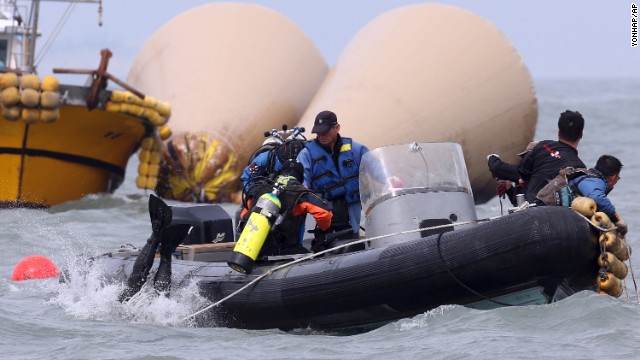
Divers jump into the water on April 21 to search for passengers near the buoys which mark the site of the sunken ferry. Divers jump into the water on April 21 to search for passengers near the buoys which mark the site of the sunken ferry. Chonghaejin Marine Co. Ltd. no longer takes calls from the media. An official with the company refused to respond to questions from reporters posed to him from the company's Incheon office on Tuesday. Little wonder they have become mute. At last report it was revealed that the Sewol was carrying an estimated 3,608 tons of cargo; three times what an inspector stated it could carry with safety.

Labels: ,

Thursday, April 24, 2014

Coping With the Aftermath

"We are trained for hostile environments, but it's hard to be brave when we meet bodies in dark water."
Hwang Dae-sik, South Korean diver

"Close your eyes. That's what I saw."
Choi Jin-ho, South Korean diver

"The hull is upside down. It is pitch black, and everything is floating around in the water. Finding people is almost by touch, almost impossible."
Chris Ware, professor, Greenwich Maritime Institute, London

"The lounge is one big open space, so once in it we got our search done straight away. But in the case of the cabins, we will have to break down the walls in between because they are all compartments."
"Even if there is only one survivor, our government will do its best to rescue that person."
Koh Myung-seok, South Korean emergency task force spokesman

"We don't want the bodies to decay further, so we want them to pull out the bodies as quickly as they can."
"It inflicts a new wound for the parents to see the bodies decomposed."
Pyun Yong-gi, father of missing 17-year-old

  South Korean rescue members carry the bodies of victims recovered from the 'Sewol' ferry to ambulances at a harbour in Jindo
Here South Korean rescue members carry the bodies of victims to waiting ambulances at Jindo harbour    Picture: Jung Yeon-Je/AFP/Getty Images
 
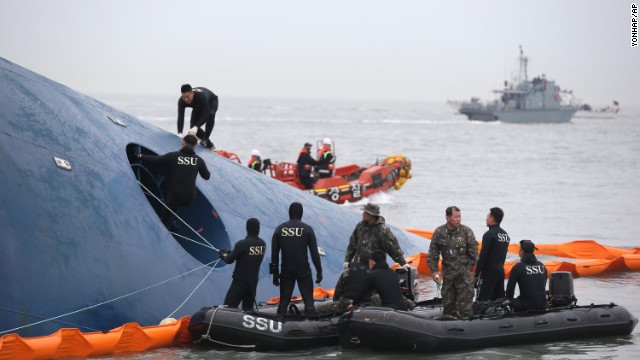
During the drive to recover bodies from the Sewol ferry the dive teams must plunge into the swirling, dark waters of the Yellow Sea, up to 500 divers at a time. Some are directly attached to oxygen and communications lines and have the capability of an hour's submersion. Others wear oxygen tanks allowing them ten to twenty minutes to search before they must return to the top.

On Wednesday most of the 160 bodies that were recovered, it was revealed, had fingers fractured as a result of the hopeless effort expended in attempting to climb walls and floors in the submerged, overturned ferry, at an impossible slope to enable that task to succeed. Leaving to the imagination the desperate fear and agony suffered by the teens as they realized they were doomed.

Divers now search for the remaining estimated 150 as yet unaccounted for whose families are waiting to identify their loved ones. Search officials have informed them that divers must break down the walls leading to cabins in an effort to retrieve all the victims. Only when that is accomplished and there is certainty that all have been accounted for will demolition and salvage operations emerge.
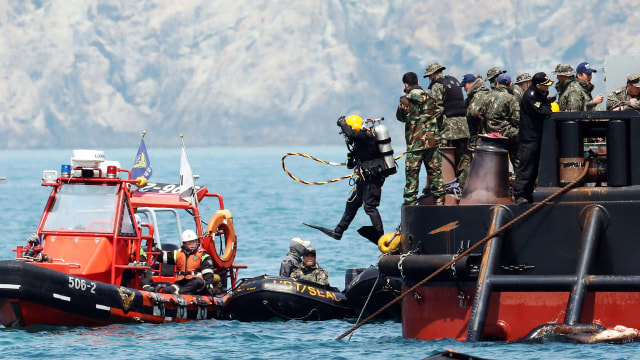
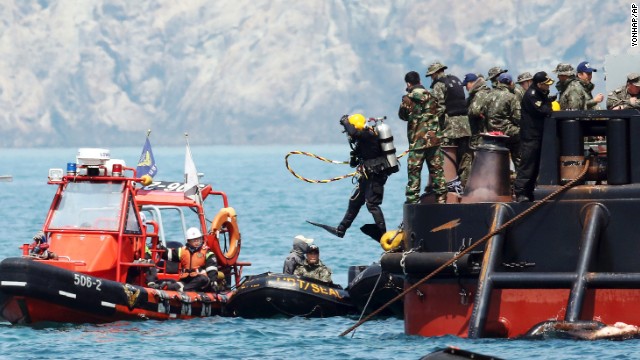
Coast Guard divers prepare to jump into the water during a search and rescue operation for missing people at the ferry
South Korean Coast Guard divers prepare to jump into the waterPicture: Yonhap/EPA

It is a sensitive issue; when the cranes will be brought in and the cutting up and raising of the submerged vessel will take place. Government officials have cautioned that this work would eliminate any existing air pockets that might yet be sustaining the lives of possible survivors. This admission of faint hope is embraced by some of the parents and denied by others.

Some parents hold out no hope whatever that anyone will be found alive; their concern now is centred on bringing all the bodies out before decomposition is in an advanced stage, a situation that will further devastate the already traumatized relatives of the dead teens. Over three-quarters of the 323 students aboard the ferry are dead or missing.

Professor Kim Woo-Sook of Mokpo National Maritime University who taught the third mate, Park Han-gyeol who was steering the ferry before it sank spoke to Ms. Park at the detention facility where she is being held. She informed her former professor that she ordered a helmsman to conduct a five-degree turn as would normally be done but the steering gear turned too far and the helmsman was not able to turn it back.
Family members are shown footage of divers searching the wreckage
Family members are shown footage of divers searching the wreckage      Picture: Ed Jones/AFP/Getty Images

While the cause of the disaster is not yet clear investigators, taking into account wind, ocean currents, freight, modifications made to the ship and the sharp turn it made before it began listing, Professor Kim feels that if the freight had been loaded tightly enough on the ship it would not have capsized even if the steering gear was defective. He in fact, suspects a technical problem occurred with the steering gear.

Senior prosecutor Ahn Sang-don stated that an analysis of photos and video before the sinking occurred showed the captain and other crew members who have all been placed under arrest made no move to rescue passengers. And that crew members at the steering room and engine room fled the sinking ship before seeing to the welfare of the passengers whom the captain had instructed to remain in their cabins.

Maritime experts are in agreement that had the captain ordered passengers to the deck, without instructing them to abandon ship, they would have benefited from a greater chance of survival.

Labels: ,

Tuesday, April 22, 2014

 Causing a Disturbance

"[Sorry] for causing a disturbance."
"At the time, the current was very strong, the temperature of the ocean water was cold, and I thought that if people left the ferry without (proper) judgement, if they were not wearing a life-jacket, and even if they were, they would drift away and face many other difficulties."
Lee Joon-seok, captain, Sewol ferry, South Korea
Coast guard members search for passengers near a South Korean ferry that capsized on its way to Jeju island from Incheon, at sea some 20 kilometers off the island of Byungpoong in Jindo on April 17, 2014. (ED JONES/AFP/Getty Images)

"What the captain and part of the crew did is unfathomable from the viewpoint of common sense. Unforgivable, murderous behaviour."
"[Instead of following a maritime traffic controller's instructions to] make the passengers escape [the captain and some crew] told the passengers to stay put while they themselves became the first to escape. Legally and ethically, this is an unimaginable act."
President Park Geun-hye, South Korea

"At first, I was just very sad, but now it's like an endless wait. It's been too long already ... The parents' only wish right now is to find the bodies before they are badly decomposed."
Woo Dong-suk, missing student family member
The bodies of the recovered students are indeed in the initial state of decomposition. Even so, parents refuse to believe that their children are dead, gone from them forever. For the time being, bodies are receiving visual identification. That is, after they've been taken to Jindo island and rescuers notify families, where they wait endlessly at the port or at a gymnasium serving as a shelter.

If identifying items are not discovered on the body, notes are taken on clothing, on specific physical marks, and additional notes are taken on the condition of the body. Those details are given to the waiting families in lieu of definite recovered ID. Once at the dock, bodies are taken into a white tent where they are again inspected and a coroner tidies the bodies for viewing, mostly by wiping oil and dirt away, straightening limbs.

One distraught father, seeing his 15-year-old son's recovered body shouted "Don't touch my son! He's still alive!", then turning to the boy he begged "Stop sleeping! Why are you sleeping so much? Daddy will save you!" Whereupon the man began applying CPR, and blowing into his son's mouth in a desperate effort to resuscitate the boy; soon understanding he would not, could not, nothing would work: "...I could only smell a rotting stench".

The captain explained he was had been waiting with caution before issuing an evacuation order because of the strong current, the cold water and his concern that the passengers could drift off before help arrived. Maritime experts experts roundly disagree, saying passengers could have been ordered to the deck, and there might have experienced a greater opportunity for survival where they could be reached, as they could not be, below deck.

The third mate, Park Han-Kyul, who was steering in the absence of the captain on the bridge, had no prior experience of the area and she informed investigators just why she had made that sharp turn, which, it is speculated, caused the ferry to tilt, though her explanation has not been divulged publicly yet. Fifty-nine bodies were recovered, leaving about 240 people still missing and the death toll will rise of a certainty.

Thirty minutes after the tilt began, a crew member asked a marine traffic controller whether passengers would be rescued if they abandoned ship. A radio transcript recorded that conversation between the crew member and an unidentified official at Jindo Vessel Traffic Services Centre on Wednesday, 29 minutes after the ferry had reported encountering problems:
Marine Traffic Centre: "Even if it's impossible to broadcast, please go out and let the passengers wear life jackets and put on more clothing."
Sewol crewman: "If this ferry evacuates passengers, will you be able to rescue them?"
MTC: "At least make them wear life rings and make them escape!"
SC: "If this ferry evacuates passengers, will they be rescued right away?"
MTC: "Don't let them go bare -- at least make them wear life rings and make them escape! The rescue of human lives from the Sewol ferry ... the captain should make his own decision and evacuate them. We don't know the situation very well. The captain should make the final decision and decide whether you're going to evacuate passengers or not."
SC: "I'm not talking about that. I asked, if they evacuate now, can they be rescued right away?"
The traffic official assured at that point that patrol boats would arrive in ten minutes. Another ship was nearby and had informed controllers it meant to rescue anyone who was overboard. The ferry had 476 people aboard when it sank, the majority of them students from a South Korean high school. Over 170 people survived the Sewol sinking. Over the weekend divers were finally able to find a way to the interior of the sunken vessel and began discovering bodies.

The South Korean government has not exactly covered itself in glory in its response to the dreadful sinking of the ferry. Common sense appears to be in short supply. When a high ranking official in the Ministry of Security and Public Administration, chief of the Regional Development Policy Bureau thought it a good idea to take a photograph of the situation room in Jindo where briefings to relatives take place, he earned the fury of the grieving families.

A relative of missing passengers from a sinking South Korea ferry waits in a makeshift tent along a dockside in Jindo, April 17, 2014. (ED JONES/AFP/Getty Images)

When Song Young-chur resigned in disgrace, a spokesman for the government affirmed his resignation was accepted "as a warning to others, as he has raised public resentment by trying to take commemorative photos without understanding the feeling of the families of the victims and lost persons." On site was over 200 rescue boats, 35 aircraft, 13 fishing boats and 641 personnel representing the South Korean coast guard and navy.

Relatives wait for missing passengers of a sunken ferry at Jindo gymnasium on April 17, 2014 in Jindo-gun, South Korea. (Chung Sung-Jun/Getty Images)

But this is no rescue mission. It is a recovery exercise, to bring the anguish of closure to hundreds of bereaved parents whose children perished because they trusted authority. The public is expending their anger in a fury of condemnation against the captain and the crew of the ferry, some of whom, principally the captain, have been placed under arrest and will stand trial for various offences against the maritime code of ethics.

But there were, among the 29 crew members at least seven who are missing or dead. A few of the others who survived to give witness to the catastrophe had remained on or near the ship helping passengers. Some of those crew members handed their own lifejackets to passengers. And one who refused to leave while shepherding students off the ship was later found among the dead.

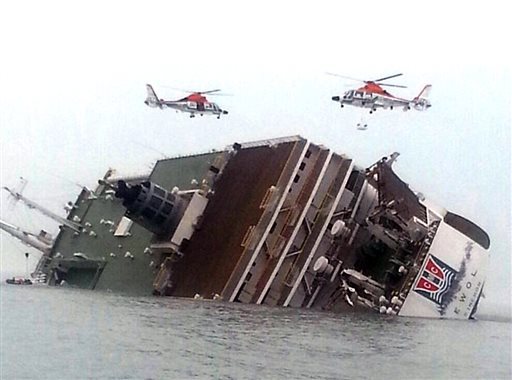
Rescue helicopters fly over a sinking South Korean passenger ferry that was carrying more than 450 passengers, mostly high school students, Wednesday, April 16, 2014, off South Korea's southern coast. Hundreds of people are missing despite a frantic, hours-long rescue by dozens of ships and helicopters.

Others made strenuous efforts from rescue boats to break windows on the ferry's cabins and pull people to safety. Their morality and heroic efforts in a demonstration of decency and responsibility remains on the back burner as the public's fury over the inexplicable loss of life of so many young people wraps the nation in a black fug of mourning.

Labels: , , , ,


Volunteers find scenes of hope, despair at S. Korea ferry site

Volunteers from across Korea are assisting relatives of missing passengers on the capsized Sewol ferry. Many are asking why high-tech Korea couldn't respond more quickly to the disaster.

By Donald Kirk, Correspondent / April 22, 2014

Relatives of passengers aboard the sunken ferry Sewol wait for news on their missing loved ones at a gymnasium in Jindo, south of Seoul, South Korea, Monday, April 21, 2014. Volunteers from across Korea have come to Jindo to provide assistance.    Lee Jin-man/AP 

Jindo, South Korea
Hundreds of bereaved parents, relatives, and friends mingle with volunteers here in a display of agony and heartbreak, shame and disbelief, over the sinking of a ferry on a holiday cruise packed with high school students on a school excursion.

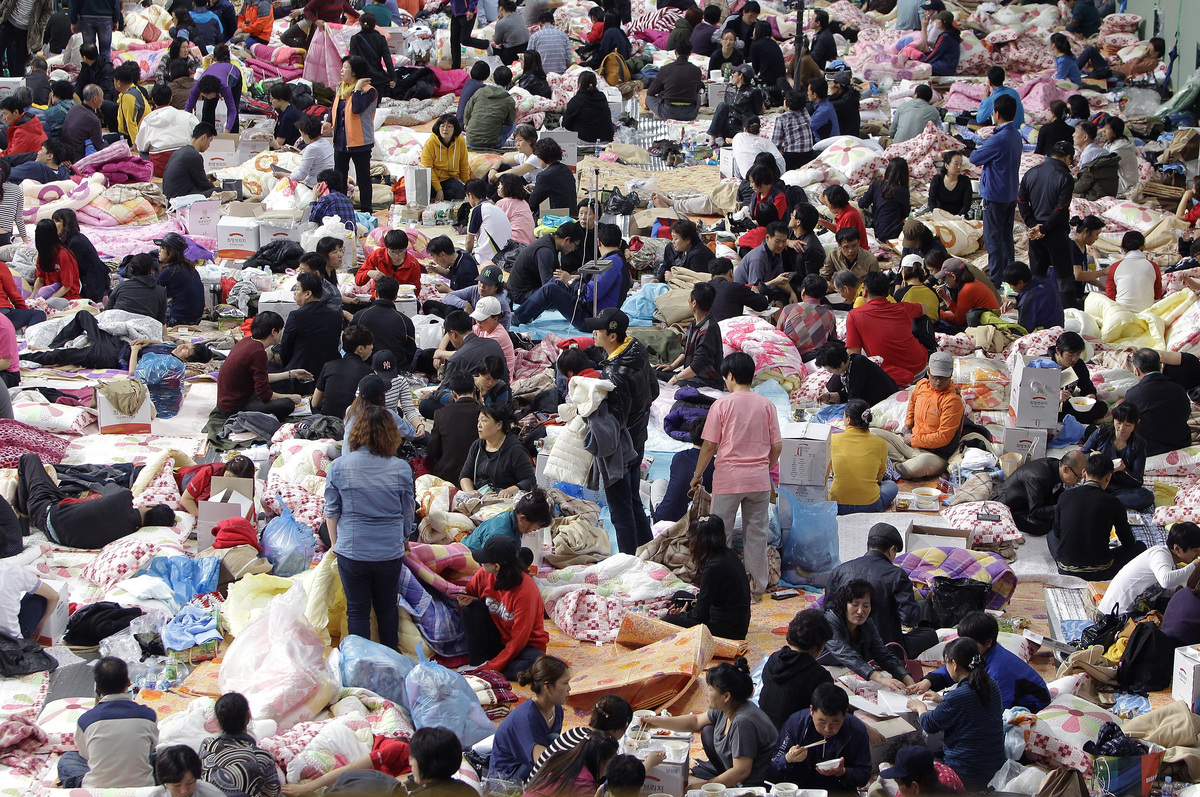
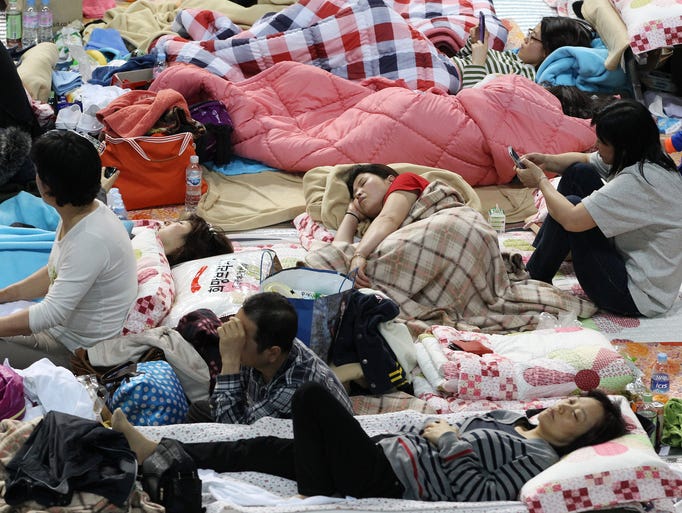
An atmosphere of stoicism and quiet calm pervades the floor of the spacious gymnasium in this pleasant seaside community as fathers and mothers, brothers and sisters, talk in low strained murmurs, lying on mats, wrapped in blankets, a week after the ferry, the Sewol, sank 12 miles south amid rocky islets visible to the horizon.

The ship was on a routine overnight voyage from the west coast port of Incheon to the resort island of Jeju when it took a sharp turn and capsized, taking down all but 174 of the 476 passengers and crew on board.

As investigators look for why and how the ship went down, volunteers have come from across Korea to hand out food and drink, fresh clothing, and toiletries. One volunteer tries to explain why the tragedy has resonated so deeply, from empathy for those suffering to outrage over the national humiliation of the disaster.

“When this happened, I realized I was neglecting my country,” says Youn Ji-na, a young woman who came from Seoul, 200 miles to the north. “This tragedy is the result of people not thinking about the country, about other people.”

In the gymnasium, sudden cries from a relative, the inconsolable weeping of a mother, frantic dashes to the tent where an official posts the latest count of recovered bodies interrupt the mood of quiet acceptance.

Through all such conversations runs the question of how such a tragedy could occur in a high-tech society where super-fast trains run all over the country, huge factories turn out the latest in modern gadgetry – electronics, motor vehicles, and industrial products sold worldwide – and "pali, pali" for quickly, quickly, is a common expression.

The authorities have arrested nine of the crew members, including the captain, three mates, three navigators, and the chief engineer, for abandoning the ship, but many believe the tragedy goes far deeper into the character of a nation periodically afflicted by disasters costing hundreds of lives.

Memories turn to the shoot down by a Soviet fighter jet of Korean Flight 007 as it veered off course over the Kamchatka peninsula in 1983, of the subway arson that killed nearly 200 people in the city of Daegu in 2003, of the collapse of a department store in Seoul in 1995 that killed 500.

Like many others, however, Ms. Youn tries not to view the tragedy quite so coldly, so analytically. “It’s not about national pride,” she says, struggling to convey how she feels. “Humanity and children come first. Every single one of us in Korea are deeply sorry, and we are totally responsible for this disaster. We put the kids in this situation. Every Korean is aching so much.”

A gulf exists, however, between the bereaved and those who wait with deceptive calm for news that will only deepen their sadness. Parents complain quietly that no one is listening – and then, gathering on the road between the gymnasium and the docks, engage in futile protest against the government that they hold responsible for the inadequate initial rescue and now for the prolonged recovery.

“At this point we have to rescue survivors,” says Ryu Duk-chu, whose young cousin is among those "still unaccounted for," and who is representing the relatives in talks with the coast guard and other officials. “

Mr. Ryu says authorities “are listening, but the outcome is not happening.” Until the divers have gone through the entire ship, up and down stairwells, through corridors, into cabins and storerooms, he says, “I have hope.”

Down by the docks, ambulances stand by, ready to take bodies to hospitals and mortuaries, while families of those whose bodies are already recovered prepare for funerals. Most of the funerals are in the Seoul suburb of Ansan, where 325 students on the ship were attending high school. Among the tents lining the dock, the letters “DNA” are painted in blue across the entrance to one of them. A coast guard team stands by waiting to swab the tongues of parents so they can match their DNA to bodies. More than 200 family members have volunteered DNA samples there and in a small room inside the gymnasium, also marked with a blue DNA sign.

Some parents, though, flinch at submitting their DNA and turn away. Nobody can force them. “It is too sensitive, too delicate,” a young coast guard sailor explains. “They don’t want to believe they will never see their children again. They wait to see if anyone is alive.”

Labels: , , ,

Friday, April 18, 2014

Breaking Fragile Hearts

"There are 160 divers from the special forces, but the current is so strong that they are being swept away when they enter the water."
"The teams are tapping on the outside of the ship with hammers to listen for any survivors inside. When they can go in, only two divers at a time can fit because the corridors are so narrow."
"There is an air pocket in the front of the boat. If anyone made it there, they may have survived. But for anyone in the rest of the boat, the hopes are low."
Kim Dohyun, Korean Special Forces liaison

"The parents are very upset about the captain of the coast guard who ordered the civilian divers to leave. There is no clear chain of command, the navy, the special forces, the coast guard and the local police all have different commanders and do not talk to each other."
Jin Kwangyung, father of missing Yoonhwee
Parents whose children were aboard the Sewol ferry and are now missing rest on the floor at a gymnasium in Jindo, South Korea on April 18, 2014. The captain of the doomed ferry delayed evacuation for half an hour after a South Korean transportation official ordered preparations to abandon ship, raising more questions about whether quick action could have saved lives.
Photo, Ahn Young-joon -- Parents rest on floor of gymnasium in Jindo, South Korea, 18 April 2014
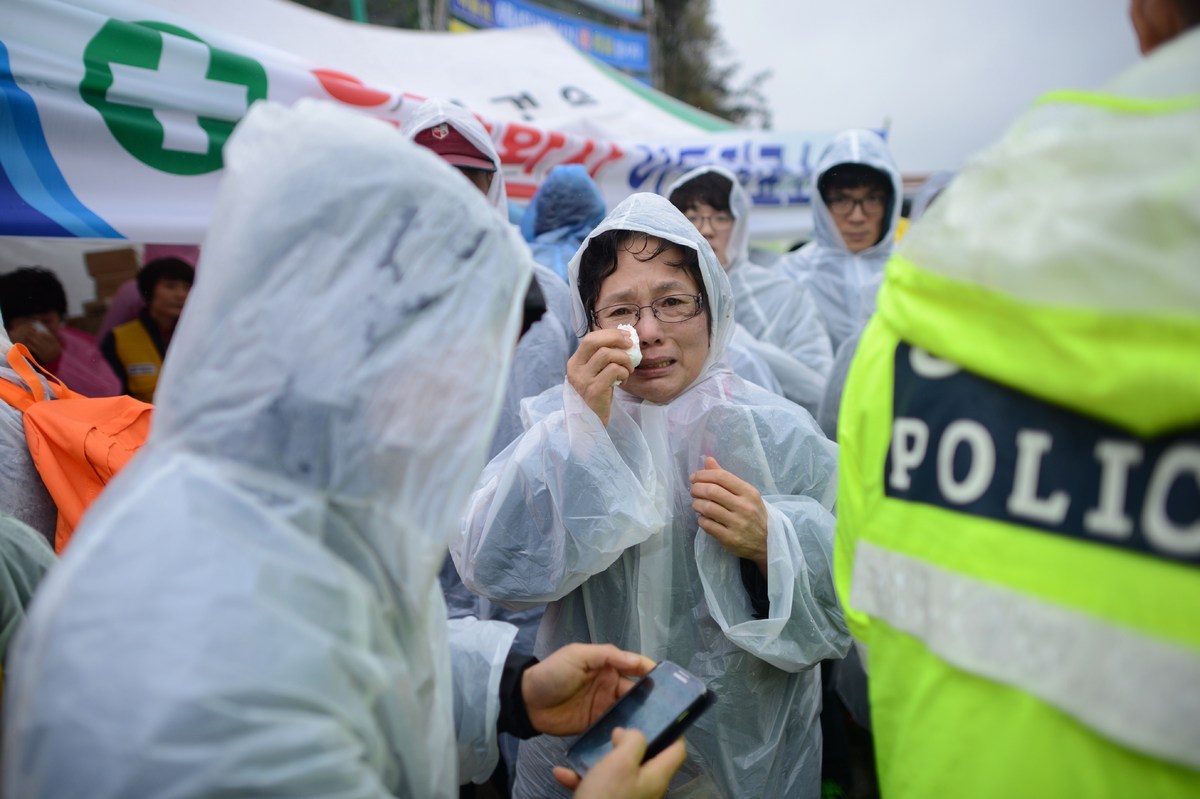
Wrapped in light raincoats against the wind and the rain, parents stood in agonized vigil on the jetty. Their teenage children -- 250 of them and most certainly no longer alive trapped inside the 6,200-tonne Korean ferry Sewol -- rested underwater, twenty kilometres from the jetty. They had been en route to a four-day field trip on the holiday island of Jeju. So festive and yet ordinary an event, suddenly turned into a viciously dreadful catastrophe.

The captain of the vessel had turned over control of the steering to a third officer with scant training. And Captain Lee Joon-seok was being asked why it was that he had been among the first on board the sinking ship to evacuate, while knowing full well the desperate state of affairs, and that hundreds of passengers, high school teens in his care, were desperately helpless below. Abandonment of responsibility, for which a shamed apology could do nothing to salve the festering wound of loss.

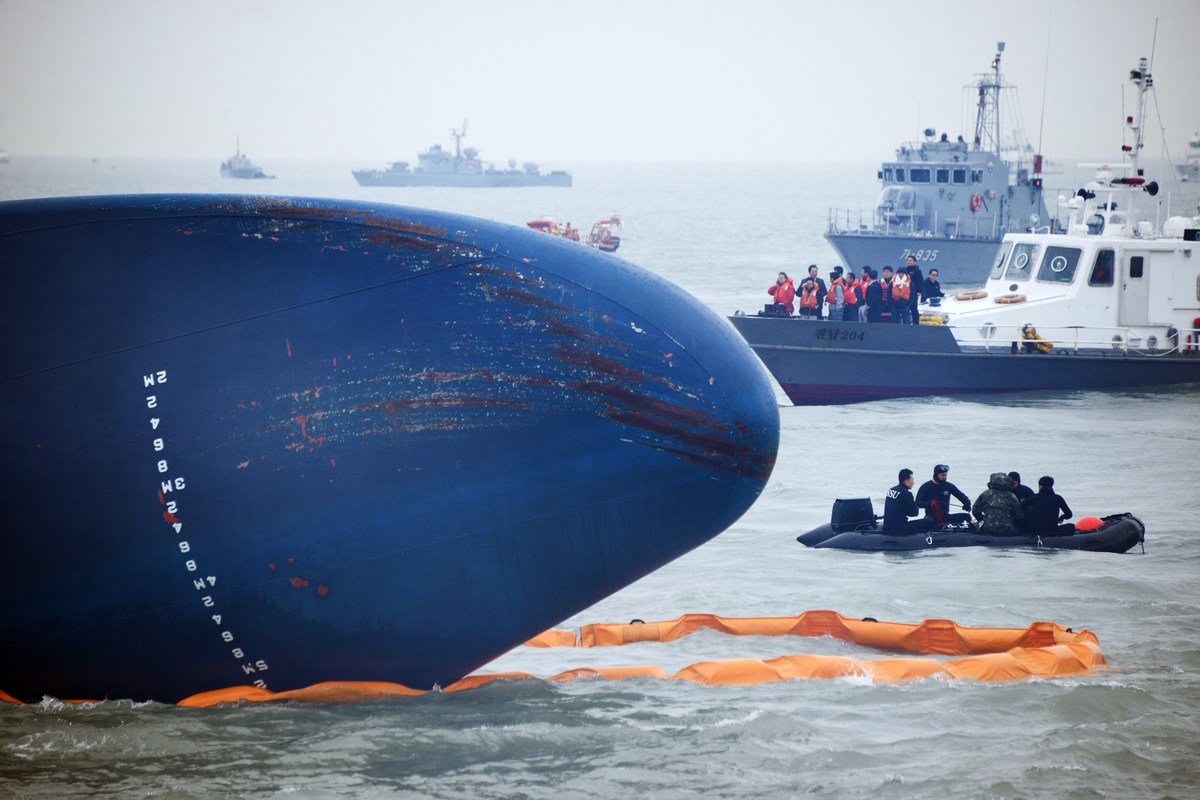
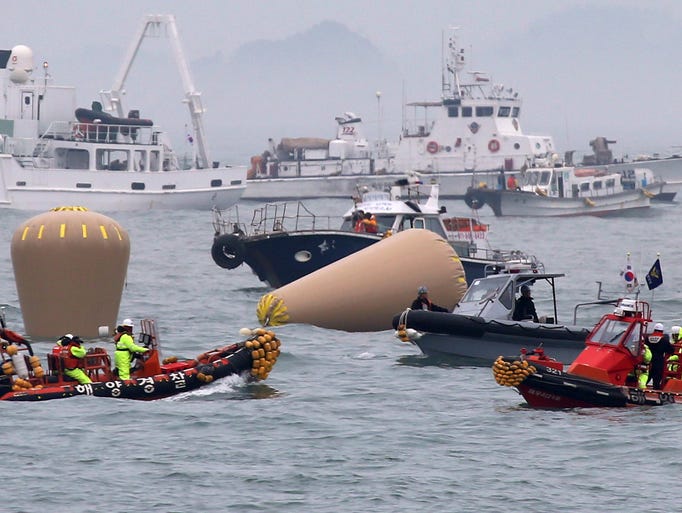
South Korean Navy officials work on buoys to mark the sunken passenger ferry Sewol in the water off the southern coast near Jindo, South Korea.
South Korean Navy officials work on buoys to mark the sunken passenger ferry Sewol in the water off the southern coast near Jindo, South Korea.  (Photo: AP)
Navy divers are attempting to do what they can under truly vicious sea conditions leaving them scant visibility. They have been unable to enter the submerged ferry's hull. So dreadful were the weather conditions and the swelling seawaters the divers were forced to abandon their efforts by early afternoon. Officials who would not allow their names to be used commented that the chance of finding any passengers alive would be "close to zero".

"We have received at least 20 text messages from children on the boat who are still alive", wailed one mother on the jetty. Spoken communication with the children still on board was not possible due to weak mobile-phone conditions, but text messages were getting through initially; messages like "Mom, I'm sending you this now because I'm afraid I might not be able to say it later. I love you." Or, "Dad, don't worry. I'm wearing a life vest and am with other girls. We're inside the ship, still in the hallway."

Tell these parents that there is no longer any hope their cherished children will be found alive? Some of the waiting parents had to be held back by the crowd, to stop them from attacking coast guard officials on the jetty. "Children are dying! They sent messages! What do you mean bad weather has stopped you!", shouted a father.

The ship, explained Kim the special forces liaison, had been "outside its authorized route", and may have struck a rock, gashing the prow. Rescued passengers had recalled a loud bang. Investigators felt the ship had turned sharply left before tilting representing perhaps the captain attempting to steer back on course. A suggestion was made that the load of 160 vehicles and over a thousand tonnes of cargo may have shifted, improperly secured, causing the ship to "tilt out of control", when it turned.
A relative of a missing passenger weeps as she waits at the port on Jindo Island.
A relative of a missing passenger weeps as she waits at the port on Jindo Island.  (Photo: Chung Sung-Jun, Getty Images)
"There are few people on the ship, can't see a thing, it's totally dark. So there are few men and women, women are screaming and we are not dead yet, so please send along this message." 
Student to parent text message.

Labels: , ,

South Korea seeks arrest of Sewol ferry captain

BBC News online -- 18 April 2014
Rescue teams have entered the cargo deck on the sunken vessel
Prosecutors in South Korea have asked a court to issue an arrest warrant for the captain of the ferry that sank on Wednesday, officials say.

It was earlier revealed that a junior officer - and not the captain - was at the helm of the ferry when it capsized.

Efforts to find the 268 people still missing have been hampered by low visibility and strong currents.
Twenty-eight people are now known to have died in the disaster, with 179 people rescued.

Coast guard officials said on Friday two divers managed to enter the cargo bay of the vessel, but could not identify or rescue anyone due to items obstructing the way.

The vessel - named Sewol - had been travelling from Incheon, in the north-west, to the southern resort island of Jeju. It capsized and sank within a period of two hours, officials said.

Some 350 of those on board were students from Danwon High School in Ansan, a suburb of Seoul, who were on an outing when the ferry sank.

Investigations are focusing on the sharp turn the vessel took before it started listing and whether an evacuation order by the captain could have saved lives.

Graphic showing location of sunken ferry and timeline of events
South Korean navy personnel try to install buoys to mark the sunken passenger ship Sewol in the water off the southern coast near Jindo on 18 April 2014. Rescue teams install buoys to mark the position of the sunken ferry after the keel of the ship - visible until Friday - disappeared under the surface
A family member of a missing passenger from the South Korean ferry "Sewol" reaches out to sea as she cries at a port in Jindo on 18 April 2014. Relatives await news of their loved ones on the shore of nearby Jindo island
 
Some experts believe such a tight turn could have dislodged heavy cargo and destabilised the vessel, while others suggest it could have been caused by a collision with a rock.

In addition to the captain, arrest warrants are also being sought for two other crew members, reports say.

"The joint investigation team of police and prosecutors asked for warrants to arrest three crew, including the captain," a coast guard official in Makpo told AFP.

Captain Lee Joon-seok, who has already been quizzed by police, was shown on television on Thursday apologising to the victims and their relatives.

"I am really sorry and deeply ashamed. I don't know what to say," he said.

Maritime accidents in South Korea

  • 1970: Sinking of passenger vessel Namyoung leaves 323 dead
  • 1993: Sinking of passenger vessel Seohae Ferry leaves 292 dead
  • 2007: Sinking of freighter Eastern Bright leaving 14 sailors missing
  • 2009: Sinking of cargo ship Orchid Pia after a collision leaves 16 sailors missing
Source: Yonhap news agency
Details of the charges have not yet been made public.

The vice principal of Danwon High School, who was rescued from the ferry, was found dead on nearby Jindo island on Friday.

Kang Min-Kyu, 52, had been missing since Thursday and was discovered hanging from a tree near the gym on Jindo island - where many of the relatives of missing passengers have been staying.

Amid a major search and rescue operation, officials say air has been injected into the ship to help any people trapped inside - though officials have said that survivors are unlikely - and to help refloat the vessel.

Three salvage cranes have reached the site, which officials say may be used to raise the ship or move it to another area with weaker currents.
But challenging conditions have hampered the search for a third consecutive day.

"Visibility is almost non-existent. You can hardly see your hand in front of your face," one diver told AFP news agency after returning from a trip.

South Korean rescue members prepare to search for missing passengers of a capsized ferry at sea off Jindo on 18 April 2014. Divers are beating back strong currents and poor visibility to try to gain access to the sunken vessel
A family member of missing passengers (C) watches the site of the accident, as police officers stand guard at a port in Jindo on 18 April 2014. As the hours pass, hopes of finding any survivors are fading
Messages left by fellow students are stuck to the classroom windows of students missing in the South Korean ferry disaster at Danwon High School in Ansan on 18 April 2014. Students of Danwon High School leave messages for those missing in the ferry disaster
 
State prosecutor Park Jae-Eok earlier told journalists that the third officer was in command of steering the ship when the accident took place.

"Though surviving crews have different testimonies about the situation, we've been investigating the captain as he was suspected to leave the steering room for an unknown reason," Mr Park added.
But former ferry Captain Malcolm Shakesby told the BBC this was not uncommon.

"Depending on whether or not it was in pilotage waters, then yes, the master would be expected to be on the bridge, but if it wasn't in pilotage waters it's a common practice for one of the officers to be doing navigation," he said.

Survivors have accused the crew of instructing them to remain where they were rather than evacuate the ship.

Messages and phone calls from those inside painted a picture of people trapped in crowded corridors, unable to escape the severely-listing ferry.

Their relatives, who have endured a long wait for news, released a statement on Friday calling for more urgent action.

"Our children would be shouting for help in the freezing water... Please help us save our children," a representative of the families said.

bbc graphic

Labels: ,

Thursday, April 17, 2014

S Korea ferry: Bad weather hampers search for survivors

BBC News online -- 17 April 2014
Rescue teams are frantically trying to find any survivors, as Lucy Williamson reports
Bad weather, murky water and strong currents are hampering the search for survivors of the South Korean ferry disaster.

Emergency services are still searching for more than 270 people missing after a ship carrying 475 people sank.

Officials say 179 people have been rescued. Most of the passengers were pupils at the same high school.

South Korea's president visited the wreck and urged rescuers to "hurry".
Park Geun-hye said that time was running out and that every minute and every second was critical.
Rescuers near hull of boat Military divers who attempted to search the ship were reportedly swept out to sea
Family members of passengers missing on the overturned South Korean ferry Relatives of the missing are enduring an agonising wait for information
Graphic showing location of sunken ferry and timeline of events
Twenty-five people are confirmed to have died, with dozens more injured.
South Korea's Yonhap news agency reported earlier that one Russian and two Chinese were among the missing.
The small port of Paeng-Mok in Jindo is the centre of the rescue efforts. It is where the coast guard is launching boats that are heading to the submerged ferry more than 20m away.
The port is also where many relatives of the missing are waiting for news about their loved ones.
When I arrived the police had surrounded a man wearing only trunks and swimming goggles. He was deranged with grief and appeared prepared to do anything to find his child.
The police were trying to prevent him from jumping into the sea and launching a futile one-man rescue operation.
The government and various aid agencies have set up dozens of stalls to provide a modicum of shelter and comfort for the relatives. There is a first-aid station; a food stall stacked with pot noodles; a shelter were you can charge your phones and computers.
In the background, there is a constant hum of generators powering up a bank of satellite trunks. All the South Korean channels are broadcasting round the clock coverage. The eyes of the nation are on this search and rescue operation.
At one stage, dozens of relatives surrounded a coastguard official who was giving an update on the rescue operation. During a heated exchange, some of the family members demanded to know why more flares and floodlights had not been used to light up the night sky.
Other relatives, wrapped in blankets, sit on plastic chairs waiting for news.
But grief is never far from the surface. Standing beside one tent, I heard a woman inside sobbing uncontrollably.
Military divers have been fighting high winds and waves to try to access the vessel but were not able to get into any of the cabins, the Chief of the West Regional Headquarters of the South Korean Coastguard, Kim Soo-hyun, said.

At a press conference on Thursday, Mr Kim said reports that the ferry went off its course were being investigated.

It is not yet clear what caused the ship to list at a severe angle and flip over, leaving only a small part of its hull visible above water, but some experts have suggested the ship may have hit an underwater obstacle.

Passengers' relatives are also questioning the role of the captain, who is being quizzed by police.
Capt Lee Joon-seok was shown apologising on television. "I am really sorry and deeply ashamed. I don't know what to say," he said.

It comes amid reports he was one of the first to escape the doomed ship.

Naval and coastguard vessels have been using floodlights and flares as darkness falls to maintain a search now involving more than 500 divers, 171 vessels and 29 aircraft.

But distraught relatives gathered in a gymnasium on nearby Jindo island insisted more should be done, and vented their grief and frustration to anyone who would listen.

"Get my child out of that ship! Dead or alive," one distraught father repeatedly shouted to rescue and local government officials.

The vessel - named Sewol - was travelling from Incheon port, in the north-west, to the southern resort island of Jeju.

Yonhap said the dead included four 17-year-old students and a 25-year-old teacher as well as a 22-year-old female crew member. Identities of the other victims were not immediately known.

The latest figures say 475 people were on board. Figures issued by the government have changed several times, prompting criticism.
Aerial footage shows frantic efforts to rescue passengers as the ship sank

Search efforts have been concentrated on the ship, which sank in about 30m (100ft) of water.
"We carried out underwater searches five times from midnight until early in the morning, but strong currents and the murky water pose tremendous obstacles," said Kang Byung-kyu, Minister for Security and Public Administration.

Meanwhile, the coastguard chief, Mr Kim, denied reports that three divers had been swept away and had to be rescued themselves.

Privately, some officials admit it is unlikely the remaining passengers will be found alive.
"Honestly, I think the chances of finding anyone alive are close to zero," one coastguard official told an AFP journalist on a rescue boat.

The US Navy has sent an amphibious assault ship, the USS Bonhomme Richard, to assist with the search.

Cranes are expected to reach the scene on Friday.
bbc graphic
The wreck, lit up by a helicopter's spotlight at night Teams used spotlights and flares to light up the scene at night-time
South Korea's President Park Geun-Hye (left, on stage) addresses a hall full of relatives of missing passengers in Jindo South Korea's president (left, on stage) spoke to relatives of missing passengers, assembled in Jindo port

The ferry sent a distress call at around 09:00 local time (00:00 GMT) on Wednesday, about 20km (12 miles) off the island of Byungpoong. It sank within two hours, reports said.

About 325 of the passengers on board the ship were students from Danwon high school in Ansan, near the capital, Seoul, who were heading on a field trip to Jeju island with about 15 teachers.
Survivors say they heard a loud thud, before the boat began to shake and tilt.

Some of the passengers managed to jump into the ocean, wearing life jackets, and swim to nearby rescue boats and commercial vessels.

But several survivors have said that they were told by crew members not to move.
"We must have waited 30 to 40 minutes after the crew told us to stay put," one unnamed rescued student was quoted as saying by AFP news agency.

"Then everything tilted over and everyone started screaming and scrambling to get out," he said.
Koo Bon-hee, 36, told the Associated Press that the rescue was not "done well". "If people had jumped into the water... they could have been rescued. But we were told not to go out."

Students hold signs with messages of hope for the return of their missing friends who were on the Sewol ferry, which sank in the sea off Jindo, at Danwon High School in Ansan on 17 April 2014 Students hold messages of hope for their missing classmates at Danwon High School
Arial view of the site of the ferry sinking Military and civilian ships, as well as planes and helicopters have been searching for survivors

Some of those trapped managed to send text messages to their relatives.
"Dad, don't worry. I'm wearing a life vest and am with other girls. We're inside the ship, still in the hallway," one girl told her father, AFP news agency reported.

Major maritime accidents in South Korea

  • 1970: Sinking of passenger vessel Namyoung leaves 323 dead
  • 1993: Sinking of passenger vessel Seohae Ferry leaves 292 dead
  • 2007: Sinking of freighter Eastern Bright leaving 14 sailors missing
  • 2009: Sinking of cargo ship Orchid Pia after a collision leaves 16 sailors missing
Source: Yonhap
But in a subsequent message she said she could not get out. "The ship is too tilted. The hallway is crowded with so many people."

However, the authorities have cautioned that they do not think that recent text messages purporting to come from the ship, are in fact from people inside.

Kim Young-boong, an official from the company which owns the ferry, has apologised.

Japan's prime minister offered "heartfelt sympathy" to the victims and their families, and his government offered help with the search - a rare moment of detente between the feuding neighbours.
Shinzo Abe, whose strident nationalism has raised tensions between the two countries, said his thoughts were with those caught up in the tragedy.

In a news conference on Thursday, US President Barack Obama expressed his "deepest condolences" to the victims' families and said his country's commitment to South Korea was "unwavering in good times and in bad".

Correspondents say this could turn out to be South Korea's biggest maritime disaster for more than 20 years.

Labels: ,

 
()() Follow @rheytah Tweet