Blog dedicated primarily to randomly selected news items; comments reflecting personal perceptions
Saturday, November 20, 2021
Yet Again : Agreeing to Disagree Disagreeably
"His [accountant first widely thought the first COVID-19 patient reported his first symptoms December 16] symptom onset came after multiple cases in workers at Huanan Market, making a female seafood vendor there the earliest known case, with illness onset 11 December."
"It becomes almost impossible to explain that pattern if that epidemic didn't start there."
Mchael Worobey, head, ecology and evolutionary biology, University of Arizona
"It [Woorobey's conclusion] is based on fragmentary information and to a large degree hearsay."
"In general, there is no way of verifying much of what he describes, and then concludes."
David Reiman, professor of microbiology, Stanford University
"I don't feel like anything can be concluded with high or even really modest confidence about the exact origin of SARS-CoV-2 in Wuhan, simply because the underlying data are so limited."
Jesse Bloom, computational biologist, Fred Hutchinson Cancer Research Center, Seattle, Washington
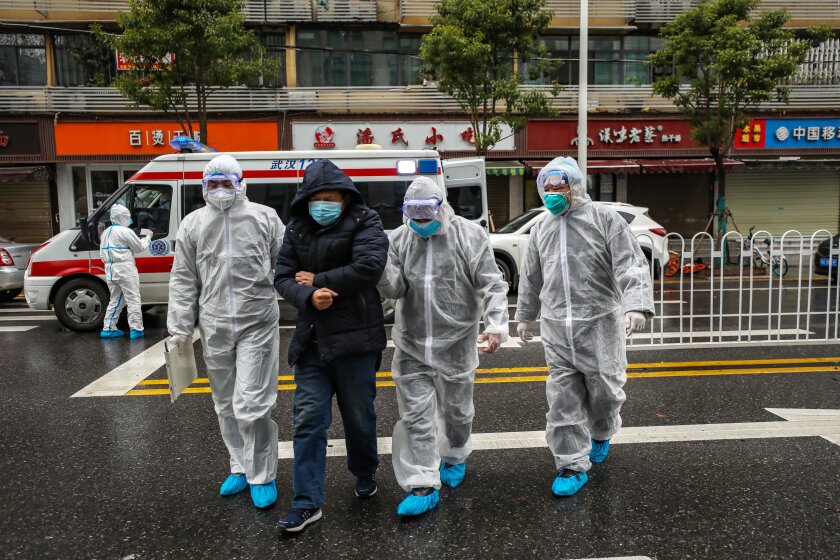
Medical staff help a patient walk into the hospital in Wuhan, China, in January 2020 as the pandemic was beginning. (Barcroft Media via Getty Images)
Another study, this one published in the journal Science reflecting investigative work by Michael Worobey, head of ecology and evolutionary biology at the University of Arizona, concludes that by indications newly unearthed, the SARS-CoV-2 virus causing COVID-19 is unlikely to have been the result of a laboratory escapee, as many in the field of virology insist, implicating the Wuhan Institute of Virology.
This conclusion based on a new revelation that it was not an accountant with no link to the Wuhan markiet, but a market vendor who was the first COVID case.
Based on the mistaken belief that the accountant who was said to have reported his first symptoms appeared in actuality several days later than was initially believed, Dr. Worobey believes that most early symptomatic cases had links to the city's live-animal food market. He pointed at the western section as the locale of transmission where raccoon dogs were caged, believing the new timeline to be indicative of evidence of a live-animal market origin, where a zoonotic transfer took place from animal to human.
The origin of the SARS-CoV-2 virus has vexed medical science since the first cases appeared and in short order the virulent pathogen flew across geographic borders to infect the entire globe with utterly disastrous, and ongoing lethal effect, overturning the world social, political and economic order. Its origins' mystery and the manner in which China attempted to suppress news of its presence instead of instantly alerting the World Health Organization which would have led to a global warning, has caused cold-war-like tensions across continents.
A closely monitored and impacted joint study by China and the World Health Organization pretty well ruled out the prevailing suspicions that the COVID-19 origins lay in a laboratory located not far from the Wuhan market. The study, studiously managed by China, summed up a collaborative position on the origins as basically unknown, but unlikely to have originated from a lab escapee, to more likely having been transferred naturally via the wildlife trade to humans.
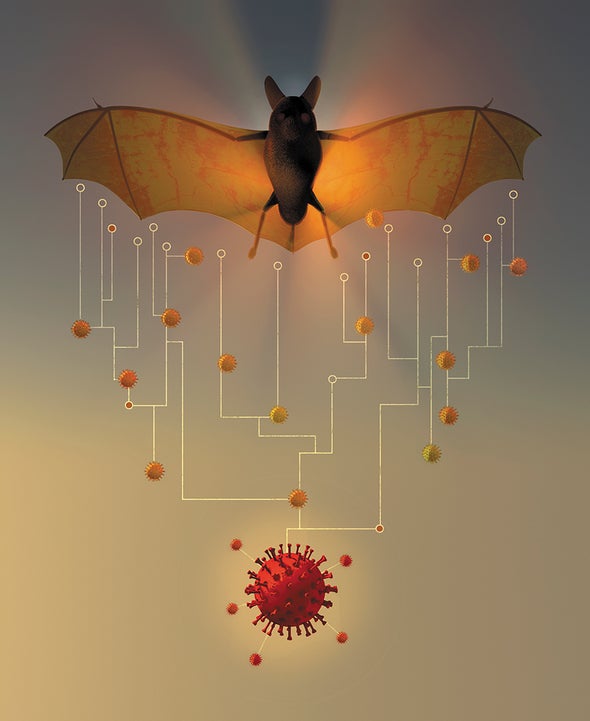
Researchers at the Wuhan Institute of Virology conduct experiments on corona viruses circulating commonly within bat colonies located in central and southern China. A focus had been concentrated on the laboratory as the locus of the virus which at some point escaped the confines of the high-security laboratory, where experts in the field are convinced an accidental leak from a research lab to be the most likely source of infection.
The article by Dr. Worobey and the conclusion drawn was received with skepticism from scientists who believe the quality of the data out of China on early coronavirus infections to be too incomplete to support any conclusion. The mystery of the origins of the dread virus that has robbed the world population of well over five million lives -- while crushing the global economy and changing the world as we know it, likely forever in the general agreement that the virus, now established, will remain a health threat to be dealt with on an ongoing basis -- continues.
"A lab employee infected in the field while collecting samples in a bat cave -- such a scenario belongs both as a lab-leak hypothesis and as our first hypothesis of direct infection from bat to human. We've seen that hypothesis as a likely hypothesis."
"In the beginning, they didn't want anything about the lab [in the report], because it was impossible, so there was no need to waste time on that. We insisted on including it, because it was part of the whole issue about where the virus originated."
"It probably means there's a human error behind such an event, and they're not very happy to admit that. The whole system focuses a lot on being infallible, and everything must be perfect. Somebody could also wish to hide something. Who knows?"
"The politics was always in the room with us on the other side of the table."
Dr.Peter Ben Ebarek, head, World Health Organization Wuhan Virus Investigation
Peter Ben Embarek (center) and Marion Koopmans (right) say
farewell to their Chinese counterpart Liang Wannian (left) after 9
February press conference to discuss the findings of a joint
investigation into the pandemic’s origins. AP Photo/Ng Han Guan
The original hypothesis brought to the investigative table by the members comprising the investigating team representing the World Health Organization was the likelihood of a Chinese scientist in the field becoming infected with a coronavirus directly from a bat while collecting bat samples. A supposition based on the likelihood of such an event occurring since it was a rational explanation; a zoonotic disease suddenly appearing for the first time, emerging out of such an encounter had been documented before, in other cases.
However, as Dr. Ben Embarek explained, this was an educated hypothesis that the Chinese with whom his team engaged as a proviso of their being permitted to conduct an investigation in China into the origins of the SARS-CoV-2 virus causing COVID-19 which was first identified and linked to a live market in Wuhan, a city of teeming millions which also incidentally hosted two virus-investigative laboratories, one of which was highly restricted.
Danish television channel TV2 released a documentary this week evolving out of an interview with Dr. Ben Embarek who spoke of the "likely hypothesis" a lab employee at the Wuhan Institute of Virology might have been infected while working in the field. The Chinese researchers that had partnered with the WHO team in their investigation were not prepared to discuss such a scenario, insisting no possible link existed of the origins of the pandemic and a Wuhan research laboratory.
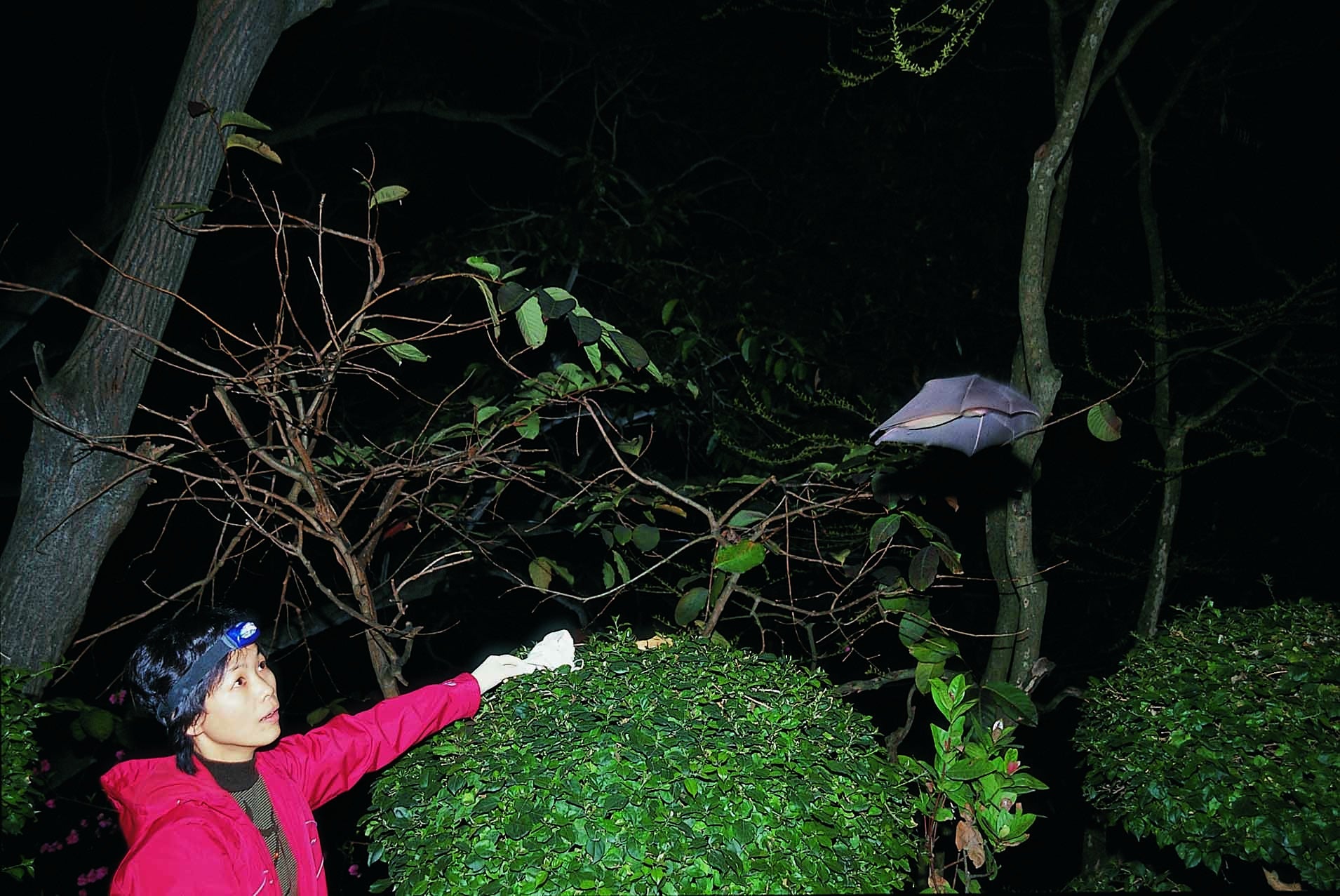
A BAT CAVE in China's Guangxi province in 2004, Shi Zhengli releases a
fruit bat after taking a blood sample. Credit: Shuyi Zhang
The WHO-China team's follow-up report at the conclusion of the joint investigation claimed it to have been "very unlikely" the virus might accidentally have been leaked from the Wuhan Institute of Virology or any other facility in the city where the infections first emerged. No further investigation into the issue would be recommended by the joint research team. Whether to even include the lab-leak theory remained a thorn to the very end of the WHO team's stay in China.
By the time the mission concluded, Dr. Ben Embarek explained to Danish reporters that the Chinese counterparts of the investigative team finally came around to agreeing that a discussion might be in order "on the condition we didn't recommend any specific studies to further that hypothesis". As for the wording relating to the lab-leak theory of "extremely unlikely", Dr. Ben Embarek responded: "It was the category we chose to put it in at the end, yes"; at the same time it might have been categorized as possible, but simply unlikely.
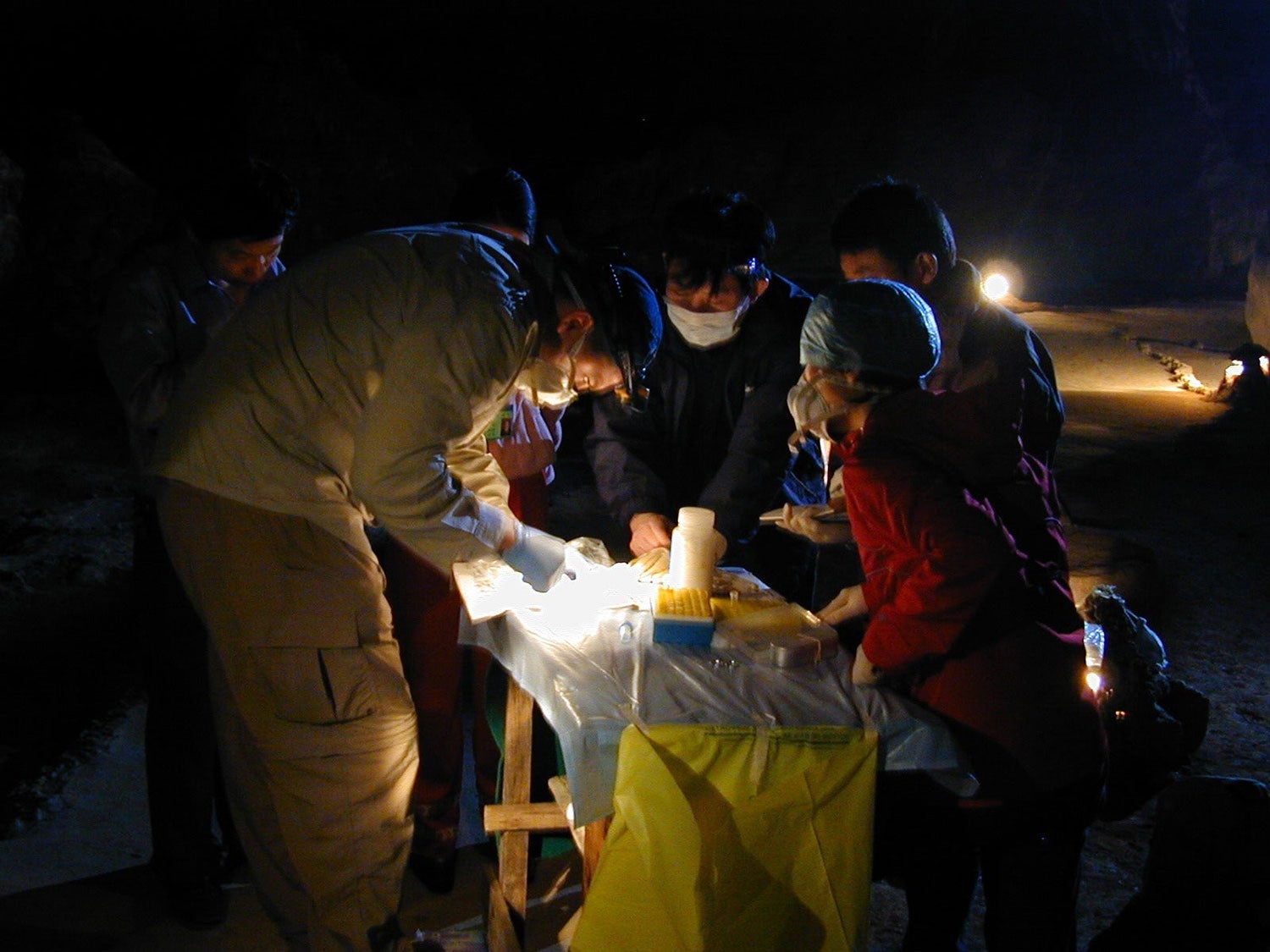
A group of researchers prepare bat blood samples that they will screen for viruses and other pathogens. Credit: Shuyi Zhang
The head of the WHO team also suggested that "human error" might have been involved, but given the Chinese political system disallowing authorities to admit such a possibility, it had to be discarded. Dr. Ben Embarek collaborated with the documentary filmmakers by filming his China trip on his cellphone for an inside view of a closely-kept trip. As the leader of the team of international scientists whose mission to China was to work with local officials in the investigation of the pandemic origins, he obviously feels an obligation to the world community to disclose any and all possible links to the origins of the pandemic.
A pandemic, after all, that still roils the world; one which up to the present caused over 200 million confirmed infections and at the very least 4.3 million deaths globally. The WHO team members alluded to the immense pressure brought to bear on them throughout the duration of the trip, with up to 60 Chinese colleagues working with the scientists but also collaborating with Chinese public health figures.
And while WHO chief Tedros Adhanom Ghebreyesus has declared that a deeper, more thorough investigation should proceed to clear up the remaining mysteries over the pandemic's source, Chinese officials declared it to be "impossible" to welcome a further China-focused probe. They will not expose themselves to anything they cannot control the outcome of.
Credit: Richard Borge
"It’s now clear that during the second half of December [2019] there was
wide circulation of the virus in Wuhan. The contribution of the market
at that time was not so important anymore because the virus was also
circulating elsewhere in the city. That, to me, is a big finding. That
was not the picture we had before. The cases outside the market were
showing differences in terms of [virus] sequence diversity. Whether that
indicates multiple introductions to the city or a single introduction a
little bit earlier, followed by spread in different parts of the city,
is still unclear. But it all points towards an introduction in the human
population in that area in the period October to early December
2019—most probably late November, not so long before the earliest cases
were found. But the route of introduction remains a mystery."
Dr. Peter Ben Embarek, head, WHO investigation into the genesis of the COVID-19 pandemic, February 2021 interview
"[A Phase Two probe would require] audits of relevant laboratories and research institutions operating in the area of the initial human cases identified in December 2019."
"Finding the origins of this virus is a scientific exercise that must be kept free from politics. For that to happen, we expect China to support this next phase of the scientific process by sharing all relevant data in a spirit of transparency."
"We ask China to be transparent and open and to co-operate."
"We owe it to the millions who suffered and the millions who died, to know what happened."
"[It was] premature to discount the lab theory [As the first WHO probe concluded it to be unlikely.] As you know, I was a
lab technician myself, an immunologist, and have worked in the lab. And
lab accidents happen. It’s common."
"[A new WHO International Scientific Advisory Group for Origins of Novel
Pathogens (SAGO)]will play a vital role in the next phase of studies
into the origins of SARS-CoV-2, as well as the origins of future new
pathogens."
"[There is a need for more] studies of animal markets in and around Wuhan,
including continuing studies on animals sold at the Huanan wholesale
market."
WHO Director-General Tedros Adhanom Ghebreyesus
World Health Organization Director-General Tedros Adhanom
Ghebreyesus wants China to allow a biosecurity audit of some of its
virology labs. Jean-Christophe Bott/Keystone vía AP
"It’s a sign that the WHO might be able to do [a] more credible or balanced investigation."
"Right now, the lack of clarity is in China’s interest."
Alina Chan, a gene therapy researcher at the Broad Institute
"I’m worried about delays and of course it’s a bit strange. We’re losing valuable time."
"[While it's] logical [to push for lab audits the demand right now
could backfire.] It’s not going to be popular with China, so I’m a
little bit worried that that will shut the doors to the rest of the
studies that we feel are needed."
Marion Koopmans, virologist, veterinarian, Erasmus University
Medical Center
Customers select seafood at a wet market in Dandong, Liaoning province, China Philip Wen/Reuters
In the early stages of the pandemic WHO Director-General Adhonom Ghebreyesus faced scathing criticism over a number of judgemental lapses; the decision to take Beijing's word for its claim that it took awhile to recognize the appearance of a new virus and its harsh impact, the acceptance of Beijing's assurance it was not communicable, and the lapse of time before the 'Wuhan virus' was declared a pandemic, thus failing to alert the world community in a timely enough manner to a fast-moving viral juggernaut that was soon to upend normalcy everywhere.
Since then, the WHO head appears to have made a reversal. He is not viewed more latterly as being quite as comfortable with China and its assurances as he was back then. And he is under great pressure from some countries -- Australia certainly comes to mind, in its strenuous insistence from the beginning that an investigation into the origins of the SARS-CoV-2 virus was badly needed, if for no other very good reason that would inform scientists of its origins, trajectory and how better the world might respond in future to new such viruses as they appear.
The real pressure, however, comes from the WHO's greatest financial supporter, the United States. Former President Donald Trump had little use for the institution and threatened to halt its funding, and his successor Joe Biden has continued to apply pressure on the World Health Organization for a far more in-depth investigation into the origins of COVID-19, which has taken such a dreadful world toll on the lives of millions of people who succumbed to its lethal complications, much less those living with a wide spectrum of COVID-induced symptoms.
It should have come as no surprise to anyone -- much less Beijing -- that another proposal for a second phase of studies into the origins of the coronavirus would be recommended by the World Health Organization. Suggesting audits of laboratories and markets in Wuhan, requiring greater cooperation and transparency in the process from China. The plan was presented to member states hard on the heels of a declaration that investigations were being held up by the lack of raw data reflecting the initial period of COVID-19's spread in China.
A commitment to Phase Two would encompass studies of humans, wildlife and animal markets in the city of Wuhan and certainly inclusive of the Huanan wholesale animal market where the virus was first thought to have emanated. China which has always been resistant to any deep scrutiny of the virus linked to Wuhan, has no obvious wish to be cooperative in a new study which promises to delve deeper than the previous one did, where researchers submitted to official Chinese scrutiny and oversight and the resulting paucity of requested data and documentation, much less exposure to critical sites for review.
In view of the fact that some scientists have raised their doubts over China's explanations, including its suggestion that the virus emanated from outside China; one theory that U.S. military brought it with them, another that it was imported into China with frozen food; and that the United States is adamantly pushing for a deeper investigation, the WHO has little option but to proceed. The U.S. along with many scientists demand a further investigation, and with particular attention into the Wuhan Institute of Virology which at the time of the virus emergence had been conducting research into virus vectors, bats.
Beijing maintains that the theory the virus could be connected to the Wuhan laboratory is beyond remote -- "absurd", repeatedly claiming that "politicizing" the issue would only serve to hamper any investigation. Any decision on continuing the probe "should be reached by all members through consultation", responded Chinese Foreign Ministry spokesman Zhao Lijian. As in, perhaps, China, as a member of the UN Security Council having the capability of scuppering international investigations of any kind by veto.
A Chinese produce market.
Felix Wong/South China Morning Post/Getty
"[I wish Tedros
had owned up to past WHO] missteps. I don’t think he can simply just
take the next step and not worry about what’s happened so far."
"I’m very suspicious about dismissing the initial task force and now
allowing individuals and governments to nominate themselves, which will
result in a partisan, selective process and not lead to the best
composition."
"They’re not a truly independent body [World Health Organization]. They are the
product of a very political world, and what makes their problem 100
times worse is that they don’t have the resources to operate
independently."
David Relman, microbiome researcher, Stanford University
"The Chinese side noted the draft plan made by Tedros and the secretariat and the Chinese side is looking into it."
"Origin-tracing is a scientific matter. All parties should respect the opinion of the scientists and should refrain from politicizing origin-tracing."
Chinese Foreign Ministry spokesman Zhao Lijian
The Wuhan
Institute of Virology has carried out research on coronaviruses for
years because these pathogens are endemic to the region where it's
located.Credit: Kyodo News via Getty
"My understanding is in fact there is no limit in accessing information we might need for the team."
"We will see. We are not in China yet."
Hung Nguyen, Vietnamese biologist
"What we would like to do with the international team and counterparts in China is to go back in the Wuhan environment, re-interview in-depth the initial cases, try to find other cases that were not detected at that time and try to see if we can push back the history of the first cases."
Peter Ben Embarek, WHO expert on animal diseases crossing species barrier
"We are looking for the answers here that may save us in future
— not culprits and not people to blame."
"[The WHO is willing to
go] anywhere and everywhere."
World Health Organization top emergency expert,
Mike Ryan
"At this stage what I think we need is a very open mind when
trying to step back into the events that led eventually to this
pandemic."
Marion Koopmans, virologist, Erasmus University Medical Center, Netherlands
A worker in protective coverings directs members of the World Health
Organization team on their arrival at the airport in Wuhan, in central
China's Hubei province, on Thursday. (Ng Han Guan/The Associated Press)
An earlier attempt by WHO experts who set out to investigate the origins, extent and the host country's initial realization they were dealing with a novel coronavirus and the information they shared with the World Health Organization, resulted in a disappointing setback when members of the team were denied authorization by China to enter the country to fulfill the function they were dispatched by the world health body to accomplish. At the time WHO chief Tetros Adhanom Ghebreyesus had voiced his disappointment and China responded that there had been a 'misunderstanding'.
That misunderstanding appears now to have been settled and the WHO team of expert investigators set off once again -- comprised of global scientists, experts in their field -- to investigate the novel coronavirus origins, planning to spend a month in the city of Wuhan. Just having arrived now, their first two weeks will be spent in quarantine. Before their arrival, Hung Nguyen, speaking via video-call from Singapore said the ten-member team did not expect to encounter any restrictions to their movements nor access to vital investigation sites.
They were preparing at that point to fly from Singapore to Wuhan. The end result of their investigation would presumably put to rest the skepticism voiced by the governments of the United States and Australia, to mention several of the more prominent voices demanding answers of Beijing. China has been accused of screening the extent of the initial outbreak leading to calls for a transparent investigation led by the WHO in the wake of criticisms of the terms by which experts in China conducted their research during the SARS-CoV-2 virus's initial entrance.
The group arrived late in the morning from Singapore and was expected to head into two weeks of quarantine. (Thomas Peter/Reuters)
Dr.Hung explained in a media interview that the WHO team had conducted regular virtual meetings for discussions with their Chinese virus-expert counterparts, taking place over the months before the team embarked on their trip to China. Once their period of quarantine had lapsed, the team planned to spend the following two weeks in interviews with people from research institutes, hospitals and from the seafood market in Wuhan where the pathogen was believed to have first emerged and began its spread, eventually appearing everywhere across the globe.
Dr.Hung's expertise is in the field of food safety risks arising from wet markets, whose existence is common throughout Asia and parts of Africa. He is himself based in Kenya, and he was chosen to take part in the investigative mission taking advantage of his training and experience. China has pushed back against international criticism as the crucible of yet another malignant virus that managed to leap the species gap between animals and humans; bats and pangolins considered to be vectors. Pangolins happen to be the most trafficked wild-animal species found in wet markets.
China has its own narrative of the novel coronavirus origins; that it was brought to China, not that it originated in China. Its state media has been expressing and promulgating a home-grown narrative of the virus being present in imported frozen food packaging from abroad. That it was present in 2019 in Europe. China being made a scapegoat for something it was not at all responsible for. And China has produced scientific papers featuring those claims.
Before the WHO delegation of experts left for China they underwent COVID-19 tests in their countries of origin and then again in Singapore, all negative, which cleared them all for travel. On arrival in China additional, more complex tests were taken that showed two members of the delegation had bloodstream antibodies to COVID, and they were denied entry.
Nucleic acid tests were negative but two of the
members had coronavirus antibodies. "They are being retested for both IgM and IgG antibodies", explained the WHO. "Relevant epidemic prevention
and control requirements and regulations will be strictly enforced", noted Chinese foreign ministry spokesman Zhao Lijian at a briefing
update Thursday responding to a question about the two team members.
People wearing face masks walk in a street market in Wuhan,
Hubei province, the epicentre of China's novel coronavirus disease, in
April 2020. The WHO team, which landed Thursday, will spend two weeks
interviewing people from research institutes, hospitals and the Wuhan
seafood market market where the new pathogen is believed to have
emerged. (Aly Song/Reuters)
"Where an epidemic is first detected does not necessarily reflect where it started."
"Research conducted in China and elsewhere since the COVID-19 pandemic began has shown that a range of animals -- including wild and farmed species -- are susceptible to infection, but when and where SARS-CoV-2 spilled over to humans, and from which animal, remains unknown."
World Health Organization report
"Asymptomatic people are probably especially important because from the studies that have been done so far people who have been asymptomatically infected, their antibody levels are lower and they may not be high enough to confer protection [without receiving an inoculating shot]."
"It's very misleading to discuss the overall case fatality rate because there is so much variability between populations and age groups."
"It tends to be the case that viruses that cause really, really high death rates are not well adapted to spread in humans."
Dr.Matthew Miller, associate professor, infectious diseases and immunology, McMaster University, Hamilton
"We should pause to remark that COVID-19 is extraordinarily successful epidemiologically, precisely because it is not extremely lethal."
"[Ebola, by contrast] is a rather stupid virus: It kills its host -- and itself == too quickly to spread far enough to reshape other species' life-ways to cater to its needs."
Dr.Samuel Paul Veissiere, Psychology Today, cognitive scientist, assistant professor of psychiatry, McGill University
There are no longer any reported cases of COVID in the city of 11 million inhabitants, Wuhan, China, where the novel coronavirus first emerged. There, life is resuming a normal pace. While globally the rest of the world struggles with seemingly vain attempts to control the contagion that has taken so many lives worldwide. Globally countries and their cities have experienced several 'waves' of the viral contagion, necessitating lockdowns, while their economies have been shattered, their people demoralized and fearful.
There remains two days left in the memorably cursed year of 2020, and when the midnight hour of 31 December arrives ushering in the next year, there will have been 1.8 million deaths worldwide, caused by SARS-CoV-2, and growing day by day. When the initial reports began circulating of a mysterious new respiratory illness, a puzzling, killing pneumonia appearing in hospitals in Wuhan, experts in the field sat up and took notice. China denied there was anything unusual happening, China informed the WHO there was no evidence of person-to-person transmission.
Then China closed ingress and egress to Wuhan, effectively locking the city of almost 12 million souls into itself, to contain a disease with frightening potential. Those experts looked on with growing trepidation. The coronavirus had no intention of being locked into Wuhan with its population and soon news coming out of Italy shocked the world as a warning of what was soon to appear on their own unready shores. New York quickly learned what Italy was going through and before long the virus swept the United States.
Chinese President Xi Jinping in Wuhan March 2020
Xie Huanchi Xinhua / eyevine / Redux
"As Washington falters, Beijing is moving quickly and adeptly to take
advantage of the opening created by U.S. mistakes, filling the vacuum to
position itself as the global leader in pandemic response. It is
working to tout its own system, provide material assistance to other
countries, and even organize other governments."
"The sheer chutzpah of
China’s move is hard to overstate. After all, it was Beijing’s own
missteps—especially its efforts at first to cover up the severity and
spread of the outbreak—that helped create the very crisis now afflicting
much of the world. Yet Beijing understands that if it is seen as
leading, and Washington is seen as unable or unwilling to do so, this
perception could fundamentally alter the United States’ position in
global politics and the contest for leadership in the twenty-first
century."
Kurt M. Campbell and Rush Doshi
Irrespective of the numbers of people whom COVID-19 has affected it is still not as lethal as an infectious disease as we commonly think it to be, given the horrendous number of victims it has taken. If it is any comfort to anyone at all, SARS-1 was far more deadly, with its one-in-three chance of killing those it infected. Even so, it failed to kill as many people as COVID has for the simple reason that the more lethal a virus is, it succeeds in killing their hosts and with it the virus itself, the opportunity to spread denied it as a result of its very virulent deadliness.
COVID is different and it has behaved differently, its strategy is far more successful in that it kills fewer and infects greater numbers. Numbers so great that the kill-rate far outdistances that of the more deadly viruses that have gone before it. COVID thrives in those it infects and because it is less deadly it is more contagiously opportunistic, adept at transmission in a way that SARS-1 failed to be. Given the numbers it infects it demonstrates that though less deadly it has become more lethal simply through strength of numbers.
The most common symptoms of infection; shortness of breath, loss of taste and smell, cough, fever and tiredness is a giveaway of the virus's presence. Those failing to show any symptoms are still capable of infecting others, even as asymptomatic carriers' impact on infection spread is still an unknown. Roughly one in five people with COVID have no symptoms, representing around 20 percent of all cases. "But researchers are divided about whether asymptomatic infections are acting as a 'silent driver' of the pandemic'", according to a study in the Nature Journal.
And according to the WHO, "The virus can spread from an infected person's mouth or nose in small liquid particles when they cough, sneeze, speak, sing or breathe heavily. These liquid particles are different sizes, ranging from larger 'respiratory droplets' to smaller 'aerosols'." No longer does science believe that surface contamination is the threat it was made out to be at the beginning of the pandemic; transmission is primarily through respiratory droplets and aerosols.
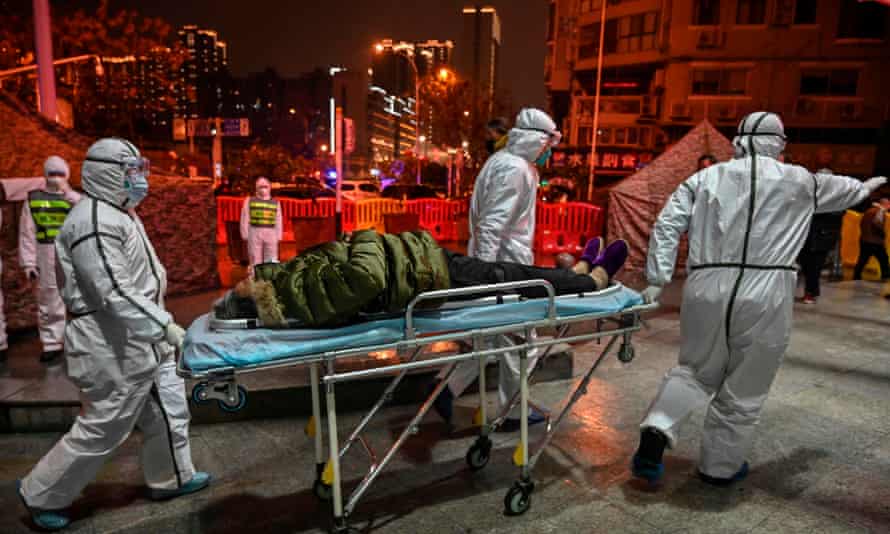
A man with what was then a mystery illness is brought into a Wuhan hospital in January this year.Photograph: Héctor Retamal/AFP/Getty Image
A study in ScienceMag illustrates that viruses in droplets "can be sprayed like tiny cannonballs onto nearby individuals", with virus-laden aerosols capable of remaining in the air for hours. COVID is able to remain active on a surface for several hours, even days, yet unless that surface is touched, and hands then reach out for eyes, mouth or nose, there is no threat as long as awareness and simple hygiene methods are followed; the use of antibacterials or rigorous handwashing.
There is relief on the horizon. Vaccines which are rolling out and beginning to be distributed since gaining official permission to proceed. Inoculations are taking place targeting the most vulnerable within society with plans to expedite vaccines for distribution and vaccinating entire populations. That may take as long globally as the length of time the world has been coping with trying to contain the outbreaks. Which is good reason to understand that populations must continue to distance themselves physically, wear masks, observe good hygiene and avoid crowded indoor spaces.
In the interim, other treatments of COVID are being explored. As long as the danger of contracting COVID continues, alternate treatments fill a necessary gap, and may in fact continue to have applications useful to ward off the effects of COVID. Among them convalescent plasma which consists of using blood from people who have recovered from illness to aid others by using their protective antibodies as a new COVID-19 therapeutic protocol.
Canada has instituted a convalescent plasma trial with a need to recruit new blood donors to study whether the proposed therapy actually works as it is meant to do theoretically. Therapeutics such as this are yet to come to market, but what is available is a few drugs that help overcome the most severe cases of COVID: Dexamethasone, a steroid acting as an anti-inflammatory, proven effective on the most ill patients, and remdesivir, an antiviral which is able to prevent the virus from replicating in a person sick with severe infection.
Lastly, there is 'proning', considered effective in hospitals by reducing the high demand for ventilators with the process of turning a sick individual from their back to their stomach for improved oxygenation.
As far as the World Health Organization is concerned, COVID-19 should be considered a test run. A serious virus that has managed to upturn the world as we know it, but not as lethal as a viral pestilence can conceivably become. The WHO has warned and continues to warn of a severely deadly strain of virus that may eventually arrive. That the discoveries made by science in coping with and trying to fully comprehend the SARS-CoV-2 virus causing COVID may better prepare us for the Big One.
"This is coming at the virus from a different way. It's almost boosting the patient's own immune system by giving them additional antibodies [through administering convalescent plasma]. Like a foot soldier to essentially fight off the infection."
"We're 100 percent reliant on people who have had the infection and have recovered to become blood donors."
Dr.Donald Arnold, associate professor of medicine, director, McMaster Centre for Transfusion Research
"Far from admitting its own culpability in trying to cover up the initial spread of COVID-19, China is busy fostering conspiracy theories about the origins of the virus [that it began outside China] and attack Western leaders for blaming the pandemic on a deliberate effort by China to destabilize Western economies." David J.Bercuson, fellow, Canadian Global Affairs Institute, director emeritus, Centre for Military, Security and Strategic Studies, University of Calgary
Masks are seen on a production line manufacturing masks at a factory in Shanghai, China on Jan. 31, 2020. Aly Song / REUTERS
China became a beacon of low-wage, efficient production, scalped-cost goods, attractive to American, Canadian and European production with an eagle-eye set on profit through outsourcing to China's vast factories. That manufacturing in the West sidled off to China, leaving millions of people who once had their living wage guaranteed by strong union demands, looking for other means of employment failed to register, even when products leaving China for points west were found to be substandard, dangerously adulterated and a threat to human health, it left little impression on the quest to lower production cost and raise the bottom line.
The world became hugely dependent on Chinese production lines for an immense spread of medicines, for the supply of medical equipment the world is now finding itself in perilously low supply of. In the face of a pathogen that emerged from a 'wet' wild animal market in Hubei Province and inevitably spread outward from China when millions of Chinese, focused on traditional travel for Chinese New Year streamed out of Wuhan -- the city that became the epicentre of the epidemic because Beijing failed to take action -- the world also became indebted to China to provide it with the equipment it had trusted China to produce.
China had become the major producer of ventilators and respirators at the very time when the novel coronavirus had begun surfacing in Wuhan last December. Half of the medical masks dispersed around the world in normal times, before the advent of SARS-CoV02, are produced in China. The United States became reliant on China for 97 percent of its antibiotics by 2018, according to Yanzhong Huang, senior fellow, global health, at the U.S. Council on Foreign Relations.
At the same time China had captured between 70 and 95 percent of the American market for vitamin C, ibuprofen, hydro-cortisone and acetaminophen, according to U.S. Commerce Department records. The United States sourced its surgical gowns and blood oxygen level measuring equipment through Chinese factories, along with magnetic resonance imaging (MRI) scanners. And then, Chinese officials authorized Wuhan's lockdown along with other cities in Hubei, leading Beijing to enforce official bans on export of medical equipment. From U.S.-owned manufacturers stationed in China.
The European Commission closed down the export of personal protective equipment (PPE) supplies so that the European Union and over 50 countries banned outright or imposed strict restrictions on the export of a range of medical equipment and PPEs, inclusive of masks, visors, hazmat suits and gloves. Canada, along with Australia, Brunei, Chile, Myanmar, New Zealand and Singapore signed a commitment to "maintaining open and connected supply chains", to oppose "trade restrictive measures on essential goods, especially medical supplies".
That, when the Canadian company Medicom was producing three million medical masks daily at its Shanghai factory, but was prohibited from exporting its masks out of China, to Canada. And nor was Canada only hit in this 'nationalization' of a foreign company's production; the very same situation impacted on American companies whose production facilities were located in China; American they might be, but shipping their products back to the United States at a time of desperate need was out of the question.
Suddenly and swiftly, companies whose exports out of China were forbidden, saw a light bulb explode in the realization that they owed it to their country of origin to return to producing badly needed goods right at home. Canada, like the United States, is facing a dramatically critical shortage of medical equipment, and in Canada, Medicom is among the firms enlisted to begin producing to make up a dangerous shortfall, poised now to open its first permanent factory in Canada, to help supply the country with the millions of masks and thousands of ventilators in short supply
Ottawa had sent along 16,000 tonnes of gear in February to aid China in its struggle to control their zoonotic outbreak; 1,101 masks, 50,118 face shields, 36,426 medical coveralls, 200,000 pairs of gloves and more; representing a tiny fraction of what China would require to quell the virus. Last month, a New York Times investigator discovered China had imported 56 million respirators and masks in just the first week of the Wuhan shutdown. Affiliates of the United Front Works Department, China's overseas propaganda and influence-peddling arm of the Chinese Communist Party are suspected to have been engaged in forwarding that critical bulk cargo.
The USNS Comfort passes the Statue of Liberty
as it enters New York Harbor during the outbreak of the coronavirus
disease (COVID-19) in New York City, U.S., March 30, 2020. The United
States, like other western countries, is scrambling for medical
supplies.ANDREW KELLY /
REUTERS
Out of the goodness of their hearts, now that China has more or less subdued the galloping infection rate internally, Beijing has been busy ingratiating itself as a benefactor to countries all over the world, themselves now attempting to cope with the firestorm of infection rates they're experiencing. The Bank of China donated 30,000 masks and PPEs to Canada, and has forwarded supplies in a gesture of humanitarian forgiveness to the United States, briefly overlooking President Trump's insistence on naming the coronavirus the 'Wuhan virus'.
A fierce bidding war for desperately-needed medical supplies is breaking out all over the world, with hard-hit nations hoping to acquire sufficient supplies to enable their medical community to cope with the expected surge of hospital admissions due to the respiratory illness afflicting communities. The U.S. Federal Emergency Management Agency is alert to the dire state of U.S. medical supplies and the instructions that FEMA has been given is to lock down any and all supply it can locate, anywhere in the world.
Last Sunday's planeload of medical equipment landing at JFK airport, New York where America's premier city is struggling to cope with its current status as number one hotspot for viral infections, came courtesy of China, the country that is now busy burnishing its credentials as the saviour of the world, despite its purported conspiracy theory of having had the virus deliberately planted through a biological war bid, by the very country it is now attempting so nobly, to aid.
FDNY
Emergency Medical Technicians (EMT) secure a patient that was
identified to have coronavirus disease (COVID-19) into an ambulance
while wearing protective gear, as the outbreak of coronavirus disease
(COVID-19) continues, in New York City, New York, U.S., March 24, 2020.
REUTERS/Stefan Jeremiah/File Photo