Ruminations

Blog dedicated primarily to randomly selected news items; comments reflecting personal perceptions

Sunday, October 19, 2014

World Health Organization Ebola Response

"Time will come for investigation. Right now we have to focus on the response."
"When we scaled up, the beginning of the outbreak was very comparable to what we had seen elsewhere in Africa. And then, by June, it became something different."
"We indicated that this outbreak was different. I'm afraid we probably didn't say it loud enough for the world to understand what we were saying and for all the international community to be mobilised."
Isabelle Nuttall, head of global response and alert, World Health Organization, Geneva
A medical worker dons protective gear before entering an Ebola treatment centre in Freetown, Sierra Leone - 16 October 2014  The World Health Organization is ramping up efforts to stop Ebola from spreading elsewhere in Africa
"I was not fully informed of the evolution of the outbreak. We responded, but our response may not have matched the scale of the outbreak and the complexity of the outbreak."
WHO director general, Margaret Chan

"We are putting in place the foundations of a very powerful response"
"I am absolutely certain that when we look at the history, that this effort that has been put in place will have been shown to have had an impact, though I will accept that we probably won't see a reduction in the outbreak curve until the end of the year." 
David Nabarro, United Nations Ebola Coordinator

Since April, Doctors Without Borders has been on the ground treating the ill suffering from the dread effects of Ebola, from the outset. They've long had familiarity with such outbreaks and the requirement to respond swiftly and put them to an end. They were alarmed by the spread of the most recent outbreak and the weak response to what looked to them to be becoming a real problem. And they began to warn that the global response to the Ebola outbreak was inadequate.

"Leaders are failing to come to grips with this transnational threat", MSF international president Joanne Liu cautioned at a UN briefing. "We are in uncharted waters." The trouble was the warning really was falling on deaf ears. The World Health Organization simply wasn't responding in a manner adequate to the perceived danger. Margaret Chan claimed to have been "very unhappy" in late June when she realized the scope of the health crisis outlined in a memo describing her local team's deficiencies.

Now the blame is being placed on poor communication, a lack of leadership and underfunding. All of which conspired to permit the disease to spiral out of control thanks to the World Health Organization's initial weak response to the Ebola outbreak. The WHO director general took personal command at that point in June to initiate moves to replace the heads of offices in Guinea, Liberia and Sierra Leone, and at the same time upgrade the emergency to the top level.
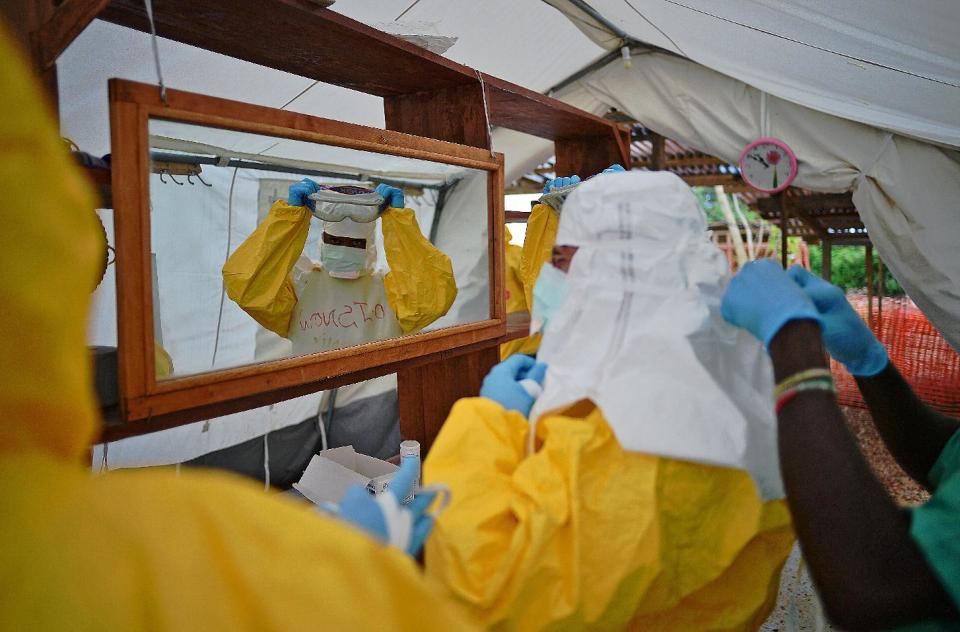

Doctors Without Borders medical workers put on protective clothing at an Ebola treatment facility in Kailahun, Sierra Leone, on August 15, 2014 (AFP Photo/Carl de Souza)

Since that time the situation has only become exacerbated, the spread of the virus even more alarming, and particularly so with the swath it was cutting in the already-short-handed numbers of local health practitioners. Nurses and doctors were contracting Ebola from the overload of patients they were caring for, and dying. All of this occurring though there was no lack of warning. In April Doctors Without Borders warned the outbreak was "unprecedented". Even while the WHO felt the contagion was under control.

Toward the end of June, WHO's top Ebola expert, Pierre Formenty, finally produced a presentation to a steering committee of the Global Outbreak Alert & Response Network, with charts indicating that the outbreak in Sierra Leone, Liberia and Guinea were swamping the capacity to respond. New infections were doubling every 24 days. By August, the tally had eclipsed the case total reported in the previous 24 Ebola outbreaks all combined. Nine thousand cases are now expected to emerge as of this week.

According to an October 8 report in the Lancet medical journal, the WHO's response capacity was weakened and eroded in the wake of budget cuts. And a  report in the British Medical Journal added that donors' contributions declined to 25% of the WHO's revenue in 2010 - 2011 from 80 percent in 1978 -1979. But the larger problem appears to be bureaucratic complacency and an unwillingness to listen to the experts in the field.

Labels: , , , , , ,

Wednesday, September 03, 2014

Alien Invasion

Species alien to the environment to which they migrate, whether by design or by accident, usually have no natural enemies and if and when the species that have migrated, whether animal or vegetable, have not been a part of the ecology, but find the environment congenial to their prolonged presence, they prosper by settling into the new ecology finding a niche for themselves with a food source that will prolong their lives, and then they set about reproducing. And if they also happen to be particularly resourceful and thuggish by nature they are capable of pushing out native species, sometimes by aggressively growing or feeding on things that native species have always relied upon.
img_4482_jaycallaghan
Whether it's kudzu, introduced from Japan, or dog-strangling vine from eastern Europe or Purple Loosestrife that overwhelm other growing things by growing up, around and over them, or the zebra mussels that have proven an aquatic pest, or the predatory oriental fish capable of spreading their nasty presence by brief overland travel from lake to lake, they're a menace. The insect or mould species that have invaded, threatening indigenous tree species like Dutch Elm disease or the Emerald Ash Borer, ensure that nature's plan is upset by an invading species of some kind when inadvertence, carelessness, or someone's decision to illegally bring a plant or a reptile from one continent to another, threatens the local environment.

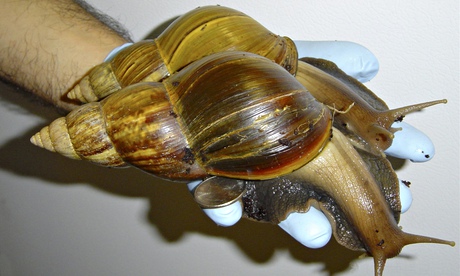
The giant African snail has a reputation for damaging buildings, destroying crops, and even potentially causing meningitis in humans. Like the Asian Carp invasion, people value them for the table, as part of their cultural cuisine, and have brought them to North America where some of the fish have been loosed into local lakes, proliferated, and caused a giant headache because of the reality of their voracious appetites and threat to local species' survival.

The threat they pose to the Great Lakes is immeasurable, should they ever succeed in populating those vulnerable waters. The Florida Everglades have been invaded by alien snake species, among them the Burmese python that is capable of growing to huge dimensions, and posing a threat to all other animals in the environment, let alone human beings. 02022013-1

 02022013-4


So when the U.S. Department of Agriculture discovered the presence of giant African land snails, a species that some people fancy keeping as pets, and many others view as food for the table, they were alerted to the need to destroy those animals in an attempt to halt their colonization of wherever they happen to be placed in the environment, through careless indifference to the damage they are capable of creating. The USDA seized over 200 snails from a Long Island, N.Y. individual who identified a Georgia seller as his source. From the Georgie entrepreneur they took another thousand snails.

Their swift capture wherever they appear is a necessity since they're capable of tremendous multiplication, producing 1,200 or more offspring each year. These are large snails, which grow larger than fist-size, with no natural predators. In Florida, Agriculture officials have been trying to eradicate them for three years. In Miami, they have been discovered eating plaster and stucco on houses and eating their way through plants in residential gardens.

In Florida alone, the Department of Agriculture has discovered in 26 areas 141,000 snails to be destroyed. Should they succeed in gaining entry to rich agricultural areas, the creatures which eat 500 types of plants inclusive of row crops and citrus, would be enabled to ruin entire crops. Arriving accidentally in cargo or on peoples' luggage, some are collected by hobbyists, and they're used in some African religious ceremonies, or cosmetic processes, as well as being considered an edible delicacy.

Giant African Land Snail
Giant African snails like these damage homes and crops and can cause meningitis, authorities say. Photograph: Scott Burton/AP

Creepily, according to the U.S. federal Centers for Disease Control and Prevention, the Giant African land snail can also carry a parasitic worm that can lead to meningitis. It remains legal to import frozen giant African snails to the U.S. and some European countries permit entry to live snails. An entomologist at the USDA specializing in snail and other species' identification intercepted in international commerce has his own safety warning: "Don't play with snails when you are on vacation."

For that matter, giant Asian carp, or Burmese pythons, as well.


Labels: , , , ,

Wednesday, January 08, 2014

Big freeze shatters North America temperature records

BBC News online -- 8 January 2014
BBC's Mark Mardell: "After a few minutes outside it's really painful to breathe"
Weather records have tumbled across North America, with freezing temperatures even in the southern US.

The most extreme arctic blasts, blamed on a weather pattern known as the polar vortex, were said to have affected nearly 190 million people.

In Kentucky, an escaped prisoner turned himself in to get out of the cold.

Some parts of the Midwest hit -26C (-14F), as low as the Antarctic coast in winter, and much colder than the inside of a domestic freezer.

Temperature records were shattered in states across the US, including Alabama, Georgia, Tennessee, Arkansas, Michigan, Maryland, Ohio, Pennsylvania and New York.

It was -17C (1F) in the small town of Hell, Michigan, prompting online jokes that the weather was so bad even hell had frozen over.

The unprecedented freeze comes after a year of extreme weather episodes across the globe

But it was Embarrass, Minnesota, that experienced the lowest temperature in the nation on Tuesday: -37C (-35F).

That was colder than readings recently recorded on the Red Planet by the Mars Rover.

A video of a meteorologist tossing a pot of boiling water into the air in Wisconsin, to demonstrate how it immediately turns to snow, quickly went viral on the internet and was widely imitated.

A woman in Sioux Falls, South Dakota, was taken to hospital with severe burns after she slipped on ice while attempting the trick, spilling boiling water on herself, the Argus Leader newspaper reported.

 
Weather map showing how the polar vortex is bringing freezing weather to the US
A man works to remove snow on the sidewalk in Muskegon Heights, Michigan A man works to remove snow on the sidewalk in Muskegon Heights, Michigan
The frozen mist from Niagara Falls coats the landscape around Prospect Point at Niagara Falls State Park A frozen mist from Niagara Falls coats the landscape at Niagara Falls State Park
Ice forms on the shore of the East River due to unusually low temperatures caused by a Polar Vortex in New York Ice forms on the shore of the East River due to unusually low temperatures in New York
 
The extreme weather resulted in the usual travel chaos - nearly 2,700 US flights were cancelled on Tuesday.

More than 500 rail passengers on their way to Chicago were marooned overnight into Tuesday morning in northern Illinois on three Amtrak passenger trains after drifting snow and ice covered the tracks.

What can you wear to help cope with extreme cold weather?

The big freeze was even testing the resolve of Canadians, no strangers to cold weather.

Temperatures in parts of Ontario fell to -30C (-22F), causing flights in and out of Pearson International Airport to be halted for several hours on Tuesday morning.

Roads in the cities of Toronto and Ottawa were coated in dangerous black ice.

Freezing temperatures were recorded even in usually mild southern states.
In northern Florida temperatures briefly dropped below freezing.

Atlanta, Georgia, was 25 degrees below average for this time of year.
"I didn't think the South got this cold," Marty Williams, a homeless man in the city, told the Associated Press news agency.

"That was the main reason for me to come down from up North, from the cold, to get away from all that stuff."

People in the Midwest are still digging out from two massive snow storms recently which dumped more than 2ft (61cm) of snow.

A reprieve is expected soon, however, with forecasters predicting temperatures above freezing for much of the US in the coming days.
A tug boat navigates the frozen Mississippi River in St. Louis, Missouri A tug boat navigates the frozen Mississippi River in St Louis, Missouri
A sculpture near a walking path is covered in snow in Carmel, Indiana, north of Indianapolis A sculpture near a walking path is covered in snow in Carmel, Indiana, north of Indianapolis
A man walks down a snow covered street in Hamburg, New York on 7 January 2014 A man braves the freezing temperatures in Hamburg, New York state
A man warms himself near a fire in Indianapolis, Indiana, on 7 January 2014 A man warms himself before a fire in Indianapolis, Indiana

Labels: , ,

Saturday, December 07, 2013

Storm sweeps Hemsby, England houses into the sea: ‘We watched our kitchen get ripped apart’

| | Last Updated: 06/12/13 3:11 PM ET
More from Associated Press
Stephen Pond/Getty Images
Stephen Pond/Getty ImagesThe scene where properties have fallen into the sea due to the cliff 
collapsing on December 6, 2013 in Hemsby, England
 
LONDON — Hundreds of people in Britain mopped up flooded homes on Friday after a powerful storm that scoured northern Europe with hurricane-force gusts kicked up the biggest tidal surge in 60 years, swamping stretches of shoreline.

The rising seas prompted evacuations along the eastern English coast, with 1,400 properties flooded and at least a half-dozen communities at great risk of exceptionally high tides and large waves.
In the town of Hemsby in eastern England, several houses fell into the sea as waves eroded cliffs. It was the biggest tidal surge in Norfolk in 60 years, according to the BBC.

A local council spokesperson told the BBC that three houses fell off a cliff and four were “seriously undermined.”

“I heard a crash and the whole back part of the floor caved in. Everything went down,” Ray Mooney told the BBC. 

“This is my only asset,” he said. “That’s it, I haven’t got anything else.”
“I had just done the house up to sell but now I have nothing. I’m homeless.”
Stephen Pond / Getty Images
Stephen Pond / Getty ImagesOfficers secure the scene on the beach
 
Steve Connelly told the BBC he and his wife Jackie rescued their kittens before their house was lost.
“Suddenly we heard a shout ‘it’s going, it’s going’ and we watched our kitchen get ripped apart. The whole house collapsed before our eyes.

“We’re devastated at what we’ve lost but at least me, Jackie and the kittens are safe.”

Environment Secretary Owen Paterson said there would be “exceptionally high tides” on Friday and Saturday, though they were not expected to reach Thursday’s levels, when water swamped seaside promenades and flooded homes.

In London, the Thames Barrier — a series of huge metal plates that can be raised across the entire river— closed for a second time in as many days to protect the city from the surge.

Stephen Pond/Getty Images
 
Britain’s Environment Agency said that sea levels late Thursday in some areas exceeded those in a 1953 flood in which hundreds died. But flood defences and evacuation warnings meant that only two people were killed in storm-related accidents.

Stephen Pond/Getty Images
Stephen Pond/Getty ImagesA local council spokesperson told the BBC that three houses fell off a cliff 
and four were 'seriously undermined'
 
Accidents linked to the storm that roared across Europe Thursday have killed at least eight people, from Britain to Sweden, Denmark and Poland.

Traffic ground to a halt on icy highways and train service was cancelled in large parts of Sweden. Tens of thousands of people lost electricity. Strong winds knocked down the city of Vaxjo’s Christmas tree.

Scores of flights were cancelled at airports in Sweden, Denmark, Norway, Germany and Poland. More than 1,000 people spent the night at Copenhagen airport where 200 flights were cancelled Thursday and about 70 on Friday.

Stephen Pond/Getty Images
Stephen Pond/Getty ImagesThis house left its living room behind
 
Strong winds threatened a collection of Viking ships recovered from the bottom of a Danish fjord in the 1960s and put on exhibition. Museum workers boarded up the expansive windows of the Viking Ship Museum in Roskilde 40 kilometres west of Copenhagen amid fears water from the fjord would rise and shatter the glass.

Police in Denmark ordered the evacuation of people in the towns of Frederikssund and Frederiksvaerk, 40 kilometres northeast of Copenhagen, because of imminent flooding. The towns lie on the Roskilde fjord, which has seen water levels rise noticeably.

Hamburg airport, where almost all flights were cancelled late Thursday, was open for business on Friday but cautioned that there would be cancellations because of wind and snow. Trains northward from Hamburg to Denmark and some other destinations were cancelled.

Stephen Pond/Getty Images
 
Tidal floods that hit Hamburg in the early morning were akin to those that drenched the city in 1962, causing the worst flooding in living memory. But higher and better coastal defences along the North Sea these days meant the impact of this week’s storm on the city was negligible, with no reports of major damage or loss of life.

A further tidal surge is expected to hit Hamburg Friday evening.

Soccer club Werder Bremen, whose game Saturday against German champion Bayern Munich had been in doubt, announced on Twitter Friday morning that flood water hadn’t topped a levee near its stadium and the match would go ahead.

Meanwhile, wind farms in Germany reaped benefits from the storm.
According to European Energy Exchange AG, an energy trading platform, production of wind energy in Germany surged in recent days.

Stephen Pond/Getty Images
 
At 1 p.m. local time the country’s vast network of on- and offshore wind turbines produced 25,205.8 MW of electricity — the equivalent of 25 nuclear plants and almost 35 per cent of the country’s total energy output that hour.

With files from National Post staff
Stephen Pond/Getty Images
Stephen Pond/Getty ImagesFirefighters secure a building where properties have fallen into the sea
Stephen Pond / Getty Images
Stephen Pond / Getty ImagesA man surveys the damage
Stephen Pond/Getty Images
Stephen Pond/Getty ImagesIt was the biggest tidal surge in Norfolk in 60 years, according to the BBC.

Stephen Pond/Getty Images
Stephen Pond/Getty ImagesEnvironment Secretary Owen Paterson said there would be 
“exceptionally high tides” on Friday and Saturday, though they were not expected to reach 
Thursday’s levels

Labels: , , , ,

Sunday, October 06, 2013

Busy Protesting

"It is very easy for a small group of people to show up at a town council meeting and the councillors aren't scientists, they don't know, they just know they've got a whole bunch of angry constituents."
Iain Martel, co-chairman, Committee for the Advancement of Scientific Skepticism

"Smaller communities have little if any scientific staff, beyond the local officer of health, and therefore cannot defer to the consensus on these issues. ...more easily swayed by the subtle yet specious arguments offered by organized groups of anti-science protesters."
Michael Kruse, Bad Science Watch


"Just because we are local government does not mean that we can't read scientific reports and make decisions based on science. [No] dollars or perks are surreptitiously slipped into our back pockets; we do not have former members of Monsanto's board on our committees."
Moralea Milne, councillor, Metchosis, B.C.
File photo of burning a corn field (© Philip Quirk/Getty Images)

Hungary won't tolerate GMO seeds, burns 1,000 acres of corn -- Getty Images

The esteemed magazine Science had gathered a panel of food researchers to draft an editorial admonishing GE alarmists for creating a panic among people of potential hazards that are in the offing as a result of growing and eating genetically modified food crops, when "no evidence of actual hazards", is actually in existence. The World Health Organization and the American Association for the Advancement of Science all agree that GE foods have a clean bill of health.

But that doesn't stop people with an agenda, a passion that displays itself in renouncing the use of GE foods. Their claims that genetically engineered canola, soy, and corn, as laboratory-designed food, should be rejected out of hand are deeply held and projected. And last month all of British Columbia's municipalities voted to outlaw GE food from their jurisdictions, following the hysterical dictates of the population they serve who take the admonitions they hear seriously indeed.

No one, it seems, really stopped to think this through. But GE foods are verbotten in B.C. That being so, expect all supermarket shelves to look pretty sparse in future. Since up to 70% of all processed foods contain some elements of GE-grown agricultural crops. Towns, villages and cities across Canada have passed laws outlawing certain scientifically proven 'goods' because of misinformation, ignorance and mass psychosis; fear of the unknown.

That includes water fluoridation bans, anti-Wi-Fi resolutions, GE-free zones. If nothing else, people feel justified and satisfied, happy with the results their insistent demands have borne. Fears of fluoridated water have never left the public consciousness, despite that municipal water fluoridation has proven its safety and efficacy, the results pleasing the dentists who examine children's teeth.

File photo of the level of fluoride being tested in a sample of water at WUC Albert Weeks plant on Wyandotte Street East. (Windsor Star files)
Nick Brancaccio / Postmedia News -- Water operator tests level of fluoride in water sample in Windsor, Ontario

In Windsor, the city council decided to respond to the demands of their public. Choosing to ignore the almost unanimous condemnation from health and dental experts, including their own medical officer of health. The anti-fluoridation crowd rule. The city's director of water production shut off the city's fluoride and made this statement: "If you haven't been brushing, it's probably a good time to start."
Mike Graston's Colour Cartoon For Wednesday, January 30, 2013
Mike Graston’s Colour Cartoon - The Windsor Star

"It's so much easier to make the noisemakers go away by voting in favour of the moratorium. They put on the show in public, but behind closed doors, they know it's not their jurisdiction", said James Smith, a spokesman with StopSmartMeters.ca. A group that received wide support for a symbolic smart meter moratorium. The activist websites like the Coalition to Stop "Smart" Meters claim they are deleterious to human health.

Calgary too, chose the route of doing away with municipal water fluoridation. And dentists have started reporting, just as they forewarned, a sudden spike in the presentation of children with cavities, larger, painful tooth decay appearing in patients as young as 11 months. "I predicted we'd see a big increase 12 months from the time the city took it out", said pediatric dentist Dr. Leonard Smith. "We are busier."

Labels: , , , , ,

Tuesday, June 18, 2013

Being Accountable

Protesters are engulfed in tear gas and sprayed by water canons at the entrance of the Divan Hotel in Istanbul, Turkey, Saturday, June 15, 2013 after being chased out of Gezi park. Protesters set up barricades and plumes of tear gas rose in Istanbul's streets into the early hours Sunday after Turkish riot police firing tear gas and water cannons cleared out the occupation of a park at the center of the strongest challenge to Prime Minister Recep Tayyip Erdogan's 10-year tenure.(AP Photo/Vadim Ghirda)

"We know very well the ones that sheltered in their hotels -- those who co-operated with terror. Will they not be held accountable? If we do not hold them accountable, then the nation will hold us accountable."
Turkish Prime Minister Recep Tayyip Erdogan
Doctors and nurses who made the unfortunate decision to use their medical skills to compassionately treat injured protesters have been amply rewarded by their government. They were detailed by security forces. This has been made public through the account of the legal offices of the Istanbul Chamber of Doctors.

And it is not only doctors, but lawyers too have been held by authorities, for they have come out in their numbers in support of the protesters. How dare they!?

And, as far as Prime Minister Erdogan is concerned, the owners of luxury hotels who exercised the abysmal judgement of providing refuge to protesters anxious to evade justice at the hands of riot police raiding their protest sites with water cannons, tear gas and rubber bullets, are also and most obviously, linked to terrorism.

What else could conceivably explain their willingness to aid the terrorists posing as innocent Turkish protesters?

All the malcontents of Turkish society -- for no society however well adjusted and perfectly governed, is free of its social and political malcontents -- have come out to express their disaffection with the most effective government they have ever had the good fortune to be ruled by. According to the Istanbul Bar Association about 400 people were arrested on Sunday alone. Among them journalists.

One foreign photographer busy documenting the Saturday night clashes described how a white-helmeted police officer had torn off his gas mask, to ensure he would be completely engulfed in the cloud of tear gas, and while he was in a perilous state as a result, the officer forced him to clear his memory card of all photographs he had taken.

No doubt a matter of great elation to the police officer, at his clever circumstantial use of authority.

Riot police forewarned protesters that their rally was unlawful. If they did not immediately disperse, authorities would take action. Thousands of demonstrators in Ankara waved union flags, jumped and whistled, facing off about 50 metres from riot police. The demonstrations led by two major labour unions was comprised of middle-aged men who banged drums, and chanting women clasping hands, seated on the ground.

The deputy prime minster Bulent Arine, warned that if matters continued as they had over the past several weeks, the military might be called in. Troops could be mobilized, a state of emergency declared, if the police operations were unsuccessful in clearing out the protests. Local governors, he said, "can benefit from Turkey's military forces" under the law.

Prime Minister Erdogan, so disgusted with his Syrian neighbour's military crackdown on rebellion, appears to be taking his cue from the very source he has so vigorously disparaged.

But perish the thought that he could be considered an Islamist dictator.

His reaction to the peaceful activists shines an unwelcome spotlight on Turkey's version of democracy. Turkey's interior minister warned on Monday that anyone joining 'unlawful' demonstrations would "bear the legal consequences."

Labels: , , , ,

Being Accountable

Protesters are engulfed in tear gas and sprayed by water canons at the entrance of the Divan Hotel in Istanbul, Turkey, Saturday, June 15, 2013 after being chased out of Gezi park. Protesters set up barricades and plumes of tear gas rose in Istanbul's streets into the early hours Sunday after Turkish riot police firing tear gas and water cannons cleared out the occupation of a park at the center of the strongest challenge to Prime Minister Recep Tayyip Erdogan's 10-year tenure.(AP Photo/Vadim Ghirda)

"We know very well the ones that sheltered in their hotels -- those who co-operated with terror. Will they not be held accountable? If we do not hold them accountable, then the nation will hold us accountable."
Turkish Prime Minister Recep Tayyip Erdogan
Doctors and nurses who made the unfortunate decision to use their medical skills to compassionately treat injured protesters have been amply rewarded by their government. They were detailed by security forces. This has been made public through the account of the legal offices of the Istanbul Chamber of Doctors.

And it is not only doctors, but lawyers too have been held by authorities, for they have come out in their numbers in support of the protesters. How dare they!?

And, as far as Prime Minister Erdogan is concerned, the owners of luxury hotels who exercised the abysmal judgement of providing refuge to protesters anxious to evade justice at the hands of riot police raiding their protest sites with water cannons, tear gas and rubber bullets, are also and most obviously, linked to terrorism.

What else could conceivably explain their willingness to aid the terrorists posing as innocent Turkish protesters?

All the malcontents of Turkish society -- for no society however well adjusted and perfectly governed, is free of its social and political malcontents -- have come out to express their disaffection with the most effective government they have ever had the good fortune to be ruled by. According to the Istanbul Bar Association about 400 people were arrested on Sunday alone. Among them journalists.

One foreign photographer busy documenting the Saturday night clashes described how a white-helmeted police officer had torn off his gas mask, to ensure he would be completely engulfed in the cloud of tear gas, and while he was in a perilous state as a result, the officer forced him to clear his memory card of all photographs he had taken.

No doubt a matter of great elation to the police officer, at his clever circumstantial use of authority.

Riot police forewarned protesters that their rally was unlawful. If they did not immediately disperse, authorities would take action. Thousands of demonstrators in Ankara waved union flags, jumped and whistled, facing off about 50 metres from riot police. The demonstrations led by two major labour unions was comprised of middle-aged men who banged drums, and chanting women clasping hands, seated on the ground.

The deputy prime minster Bulent Arine, warned that if matters continued as they had over the past several weeks, the military might be called in. Troops could be mobilized, a state of emergency declared, if the police operations were unsuccessful in clearing out the protests. Local governors, he said, "can benefit from Turkey's military forces" under the law.

Prime Minister Erdogan, so disgusted with his Syrian neighbour's military crackdown on rebellion, appears to be taking his cue from the very source he has so vigorously disparaged.

But perish the thought that he could be considered an Islamist dictator.

His reaction to the peaceful activists shines an unwelcome spotlight on Turkey's version of democracy. Turkey's interior minister warned on Monday that anyone joining 'unlawful' demonstrations would "bear the legal consequences."

Labels: , , , ,

 
()() Follow @rheytah Tweet